


Jacob gathers all twelve sons before him. The father who once fled from home now speaks about a future he will not live to see. He remembers violated trust, cruel anger, repentance, and the son preserved through betrayal. His words reach beyond the family toward Israel’s tribes and, in Judah’s blessing, toward the king awaited by the nations. Genesis 49 teaches us to receive a blessing that tells the truth and to look for its fullness in Christ.
The preceding chapter placed Joseph’s sons within Israel’s inheritance. Here Jacob addresses the twelve sons themselves. The sayings differ in length because their histories and callings differ; Judah and Joseph receive the fullest treatment. The closing burial charge keeps the family facing God’s promise while they remain in Egypt. Brenton’s “Ruben,” “Symeon,” “Juda,” and other name forms correspond to the familiar Reuben, Simeon, and Judah used in the explanation.
Gather to hear the future (Genesis 49:1-2)
1 And Jacob called his sons, and said to them, Assemble yourselves, that I may tell you what shall happen to you in the last days. 2 Gather yourselves together, and hear me, sons of Jacob; hear Israel, hear your father.
Jacob calls the sons to assemble and then to listen. Their shared father binds them together, but hearing him will require more than family pride. The words ahead include judgments they might prefer to forget. A household can preserve its history honestly only when it makes room for both gratitude and repentance.
“The last days” opens a prophetic horizon. Jacob speaks of what will unfold for the tribes, while Judah’s promise reaches toward the Messiah. The phrase does not turn every saying into a timetable for the world’s end. It places this dying man’s voice within a history governed by God. Jacob can relinquish the future because it belongs to the Lord who called him.
Reuben, Simeon, and Levi: strength brought under judgment (Genesis 49:3-7)
3 Ruben, thou art my first-born, thou my strength, and the first of my children, hard to be endured, hard and self-willed. 4 Thou wast insolent like water, burst not forth with violence, for thou wentest up to the bed of thy father; then thou defiledst the couch, whereupon thou wentest up. 5 Symeon and Levi, brethren, accomplished the injustice of their cutting off. 6 Let not my soul come into their counsel, and let not mine inward parts contend in their conspiracy, for in their wrath they slew men, and in their passion they houghed a bull. 7 Cursed be their wrath, for it was wilful, and their anger, for it was cruel: I will divide them in Jacob, and scatter them in Israel.
Reuben’s firstborn strength has become “hard and self-willed.” Brenton’s “insolent like water” describes force overflowing its bounds, and the following command forbids violent bursting forth. Jacob names the particular wrong: Reuben violated his father’s bed in Genesis 35:22. The Hebrew-based NKJV reads “Unstable as water,” while Brenton’s “insolent like water” directs attention to self-willed strength breaking its proper bounds. Authority entrusted by birth becomes destructive when desire treats another person’s dignity as an obstacle.
Simeon and Levi’s conspiracy recalls the slaughter at Shechem in Genesis 34. Jacob refuses to join their counsel. He curses their wrath because it is willful and cruel, while verse 28 will still count them among the blessed sons. The distinction matters: sin is condemned without making the sinner’s ancestry a permanent sentence of worthlessness. Defending a wounded family member cannot sanctify collective vengeance. Jacob’s own failures do not make the cruelty of his sons righteous.
Later Scripture gives these judgments different histories. Simeon’s inheritance lies within Judah’s allotment (Joshua 19:1-9). Levi’s scattering becomes the setting for service throughout Israel. Deuteronomy 33:8-11 speaks of Levites guarding the covenant, teaching God’s law, and offering incense. Exodus 32:26-29 and Numbers 25:10-13 connect their priestly history with demanding judgments and zeal for God. These later texts do not retract the condemnation of Shechem or authorize Christians to enact private religious violence. They show that God can give a judged history a new vocation. The same energy that once served wrath must now come under His command.
Truthful correction therefore opens a way forward. Repentance cannot undo what happened, but it can change what our strength serves. A sharp mind, a forceful voice, or family influence may protect the vulnerable when it ceases defending its own importance.
Judah: the king awaited by the nations (Genesis 49:8-12)
8 Juda, thy brethren have praised thee, and thy hands shall be on the back of thine enemies; thy father’s sons shall do thee reverence. 9 Juda is a lion’s whelp: from the tender plant, my son, thou art gone up, having couched thou liest as a lion, and as a whelp; who shall stir him up? 10 A ruler shall not fail from Juda, nor a prince from his loins, until there come the things stored up for him; and he is the expectation of nations. 11 Binding his foal to the vine, and the foal of his ass to the branch of it, he shall wash his robe in wine, and his garment in the blood of the grape. 12 His eyes shall be more cheering than wine, and his teeth whiter than milk.
Judah’s brothers will praise him, and the father’s sons will honor him. The man who proposed selling Joseph later acknowledged his wrong toward Tamar and offered himself in Benjamin’s place. His prominence follows a history of exposed sin and changed conduct. God’s promise works through repentance rather than through an invented account of Judah’s blamelessness.
The lion at rest carries royal strength: “who shall stir him up?” Numbers 24:9 repeats the image in Balaam’s blessing. Christian fulfillment brings an unexpected form of victory. Revelation 5:5 announces the Lion of Judah; verse 6 shows a Lamb standing as though slain. The royal conqueror is the crucified and risen Lord. His triumph discloses what worldly strength cannot accomplish: death overcome through His self-offering.
Language insight: “the things stored up for him”
Brenton names “a ruler” and “a prince,” then says, “until there come the things stored up for him; and he is the expectation of nations.” Readers of the NKJV encounter “scepter,” “lawgiver,” and “Until Shiloh comes.”1 These are different translation forms of a difficult prophecy, not interchangeable words to insert into the displayed verse. Brenton directs attention to promised things coming to fulfillment and to a person in whom the nations hope. Christian interpretation recognizes that person as Christ, who arose from Judah (Hebrews 7:14), and hears the fulfillment of the blessing promised to Abraham’s descendants for all nations.
The foal and vine also belong first to a picture of royal abundance: the vine is plentiful enough to tether an animal to it, and wine flows with the richness of washing water. That abundance becomes a prophetic sign in the Gospel. Zechariah 9:9 announces the meek king riding on a young foal. Matthew 21:2-7 and John 12:14-15 show Jesus entering Jerusalem on the donkey’s colt. The king of Judah approaches His Passion in humility. He gathers people to Himself without imitating the power of those who will condemn Him.
Gems from the Fathers 💎: the colt and the cleansing robe
St. Justin Martyr reads the colt as a prophecy of the Lord’s entry into Jerusalem. In Dialogue with Trypho 53 he joins Jacob’s saying to Zechariah 9:9 and also sees the Gentiles receiving Christ’s teaching in the untrained colt brought under His yoke. The nations’ expectation becomes discipleship: people once far from God’s covenant learn to obey the king who comes to them.2
Justin then reads the washed robe as the people cleansed by Christ’s blood. In chapter 54 he explains: “For the Holy Spirit called those who receive remission of sins through Him, His garments; amongst whom He is always present in power, but will be manifestly present at His second coming.”3 His First Apology 32 likewise connects the robe to the Passion and to believers cleansed by the Lord’s blood. This is the Church gathered into Christ’s saving life, awaiting the return of the One already present among His people.
St. Irenaeus treats the whole blessing in Against Heresies IV.10.2 as a witness to the same Lord. After asking about the ruler, vine, colt, garments, eyes, and wine, he concludes that readers “shall find that there was none other announced than our Lord, Christ Jesus.”4 His point is the unity of God’s revelation: the Creator who spoke through Moses is the Word who redeems us. The king promised by Genesis is not a stranger arriving to overthrow Israel’s God.
The vine leads us also to Christ’s teaching in John 15:1-5: fruit comes from abiding in Him. The robe and blood imagery finds a further biblical echo in Revelation 19:13, where the victorious Word wears a blood-dipped robe. Isaiah 63:1-3 pictures the divine Warrior’s garments reddened in the winepress of judgment; Revelation’s victorious Word gathers judgment and royal triumph into His appearance. In Justin’s direct reading of Genesis, the saving emphasis is clear: the king cleanses His people through His Passion. At the Eucharist we receive the life of this crucified and risen Lord, whose royal abundance is given for communion with Him.
The Church’s Voice in Worship ⛪
The Coptic Church reads Genesis 49:1-28 at Matins on Lazarus Saturday, together with Isaiah 40:9-31, Zephaniah 3:14-20, and Zechariah 9:9-15.5 The colt joins Jacob’s blessing to Zechariah’s meek king on the threshold of Palm Sunday. After the raising of Lazarus, the Church turns toward the Lord who enters Jerusalem and freely approaches His Passion. Judah’s royal promise is heard as expectation fulfilled in a king whose strength gives life. The robe washed in the blood of the grape prepares the heart to behold His saving self-offering.
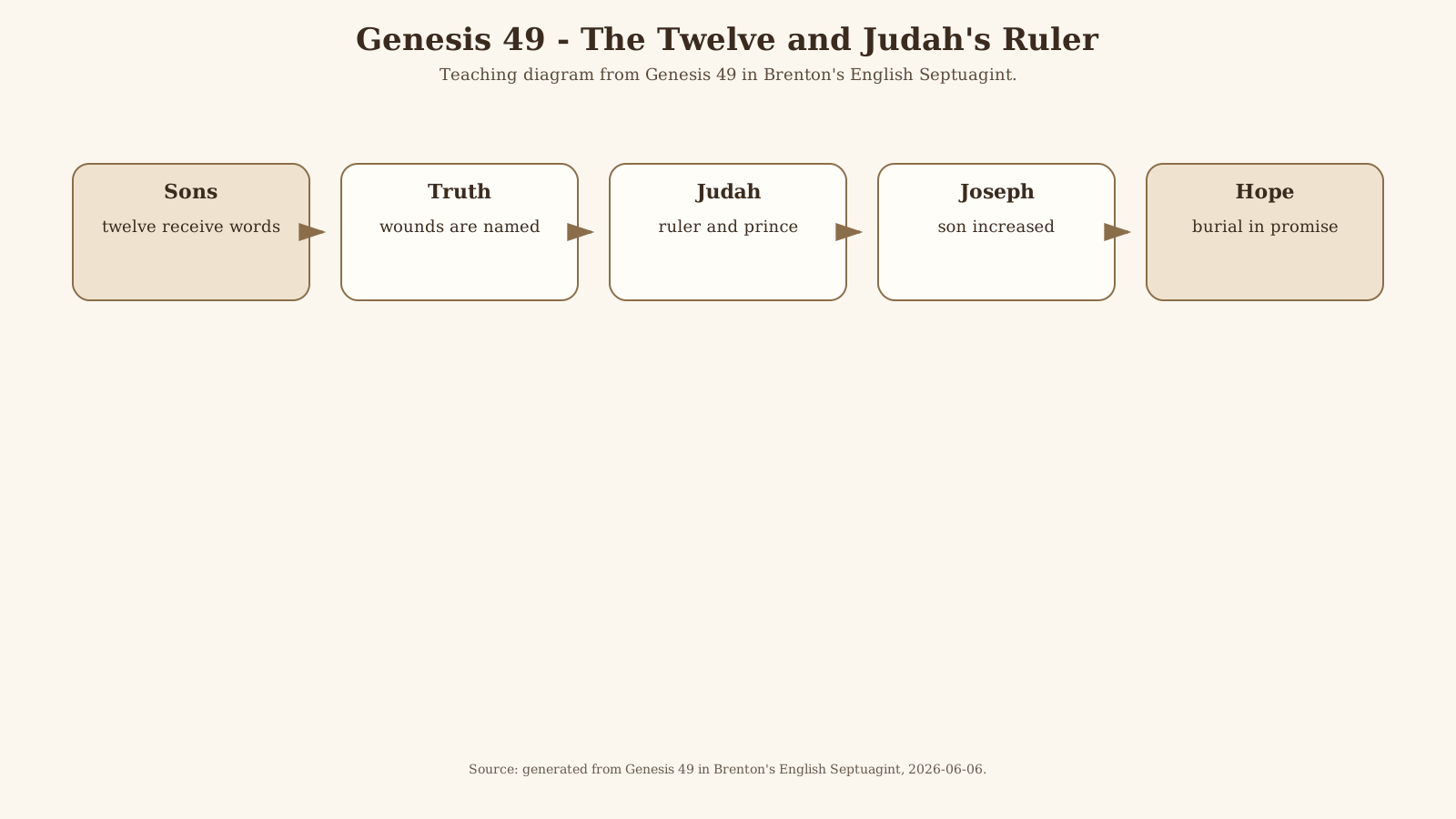 Genesis 49 narrative schematic based on Brenton’s English Septuagint.
Zebulun and Issachar: coast, rest, and work (Genesis 49:13-15)
13 Zabulon shall dwell on the coast, and he shall be by a haven of ships, and shall extend to Sidon. 14 Issachar has desired that which is good; resting between the inheritances. 15 And having seen the resting place that it was good, and the land that it was fertile, he subjected his shoulder to labour, and became a husbandman.
Zebulun’s saying faces the sea, ships, and Sidon. It gives this son a horizon wider than the family’s immediate life in Egypt. Travel and exchange form part of Israel’s future alongside cultivation and defense. The verse evokes a maritime calling; it should not be forced into an exact surveyed map of later tribal boundaries.
Issachar receives a different blessing. In Brenton he has desired what is good, sees fertile land, and gives his shoulder to labor as a husbandman, a cultivator of the soil. The NKJV’s strong donkey and band of slaves belong to its Hebrew-based wording. Brenton’s account holds rest and labor together: good land is enjoyed through willing work. Rest need not mean refusing responsibility, and labor need not mean despising the goodness one has received. A household or parish is often sustained by people whose service is as quiet and necessary as tending a field.
Zebulun’s later Christian significance appears with Naphtali in Matthew 4:13-16. Jesus dwells in Capernaum in their regions, and Matthew cites Isaiah’s promise of light dawning upon those in darkness. The coastal and northern horizon becomes a place where Christ is heard. His presence gives these shorter tribal sayings a future beyond their economic images. God’s saving light reaches people away from the political center, in the places where they work and live.
Dan: judgment, danger, and waiting for salvation (Genesis 49:16-18)
16 Dan shall judge his people, as one tribe too in Israel. 17 And let Dan be a serpent in the way, besetting the path, biting the heel of the horse (and the rider shall fall backward), 18 waiting for the salvation of the Lord.
Dan is affirmed as a tribe within Israel and given a judging role. The serpent then depicts a weaker combatant overturning a mounted rider by striking at the heel. The image is dangerous, yet the saying begins with a vocation, not an exclusion from God’s people. Samson, of Dan, will begin to deliver Israel from the Philistines (Judges 13:2-5). The tribe’s later history also includes the graven image established in Judges 18:30-31. Both deliverance and corrupted worship belong to its biblical history.
Brenton ends the saying “waiting for the salvation of the Lord.” The NKJV makes this a first-person prayer: “I have waited for your salvation, O LORD!” The prayer-like turn directs hope beyond tribal skill. An enemy unhorsed is not the whole of salvation. The Lord must deliver His people and heal their worship. Simeon waiting for Israel’s consolation and then beholding God’s salvation in the infant Christ gives this waiting its Gospel fullness (Luke 2:25-30).
Gems from the Fathers 💎: a warning governed by patience
St. Irenaeus, in Against Heresies V.30.2, connects Dan with the coming Antichrist and the tribe’s absence from Revelation 7’s list. His stated biblical basis there is Jeremiah 8:16, not a direct exposition of Jacob’s serpent. This is a particular patristic interpretation, not proof that Dan’s descendants are evil or that the tribe’s whole vocation is Antichrist. Irenaeus immediately counsels patience instead of speculative identification: “It is therefore more certain, and less hazardous, to await the fulfilment of the prophecy, than to be making surmises”.6 Received together, his warning and restraint call us to resist deceptive worship without treating prophecy as a game of naming enemies.
Gad, Asher, and Naphtali: endurance and gifts shared (Genesis 49:19-21)
19 Gad, a plundering troop shall plunder him; but he shall plunder him, pursuing him closely. 20 Aser, his bread shall be fat; and he shall yield dainties to princes. 21 Nephthalim is a spreading stem, bestowing beauty on its fruit.
Gad is attacked by a plundering troop and answers in close pursuit. His saying gives conflict a place within the blessing without pretending that being blessed means never being attacked. It also resists a passive picture of Gad as only a victim. The image belongs to tribal warfare; Christian endurance takes its measure from fidelity to Christ rather than from a mandate to retaliate against those who wound us.
Asher’s rich bread and royal delicacies give nourishment a place beside defense. The family’s future requires food as surely as courage. Abundance is a gift meant to feed others. In the life of the Church, generosity is tested by whether the hungry can actually eat, not by the prosperity of the giver. Asher’s saying helps restore dignity to the work of providing a meal, growing food, and receiving another person at the table.
Naphtali is a “spreading stem” bestowing beauty on its fruit. The NKJV’s deer let loose and beautiful words are a different image. Here growth becomes visible through what the stem bears. Beauty is given outward, not hoarded in the root. With Zebulun, Naphtali will be named in Matthew’s account of Christ’s Galilean ministry. The light that dawns there will bear fruit in disciples and in the proclamation of the Gospel. The blessing is therefore worth hearing in its own form: a life rooted in God’s gift becomes fruitful for those around it.
These three short sayings add something the longer royal blessing cannot replace. Endurance, nourishment, and fruitfulness belong within one people. Communion does not require each person to imitate another person’s gift. It asks that each gift serve the household gathered around its true king.
Joseph: increase under the hand of Jacob’s God (Genesis 49:22-26)
22 Joseph is a son increased; my dearly loved son is increased; my youngest son, turn to me. 23 Against whom men taking evil counsel reproached him, and the archers pressed hard upon him. 24 But their bow and arrows were mightily consumed, and the sinews of their arms were slackened by the hand of the mighty one of Jacob; thence is he that strengthened Israel from the God of thy father; 25 and my God helped thee, and he blessed thee with the blessing of heaven from above, and the blessing of the earth possessing all things, because of the blessing of the breasts and of the womb, 26 the blessings of thy father and thy mother—it has prevailed above the blessing of the lasting mountains, and beyond the blessings of the everlasting hills; they shall be upon the head of Joseph, and upon the head of the brothers of whom he took the lead.
Jacob turns to the dearly loved son who was taken from him and restored. The blessing remembers hostile counsel and archers pressing hard, then attributes deliverance to “the mighty one of Jacob.” Brenton’s verse 24 says that the attackers’ bow and arrows were consumed and their strength slackened. It is their opposition that fails under God’s hand. The NKJV instead speaks of Joseph’s bow remaining strong and names the Shepherd and Stone of Israel. Those images should not be imported as though printed in this passage.7
The repeated increase in verse 22 also differs from the NKJV’s fruitful bough by a well. Brenton speaks directly of the son and his growth. Verse 26 closes with Joseph and the brothers of whom he took the lead. The wording returns the reader to the family he preserved. His exaltation has meaning because life is sustained through him, a theme the final chapter will state explicitly.
Heaven, earth, breasts, womb, lasting mountains, and everlasting hills gather the blessing across creation and generations. Jacob prays for life that is bodily and fruitful. The sons are more than figures in a royal genealogy; they need rain, land, nourishment, and descendants. Deuteronomy 33:13-17 later develops Joseph’s blessing through sky, dew, produce, ancient mountains, Ephraim, and Manasseh. The adoption in Genesis 48 is thus followed by a blessing that will unfold through Joseph’s sons.
Joseph’s affliction cannot be turned into a rule that suffering always brings wealth or visible success. The text gives thanks for this particular deliverance. Its spiritual strength lies in the God who helped him when hostile counsel seemed to determine his life. Because the blessing is received, Joseph’s power can become provision rather than self-glorification. Christ fulfills the saving pattern at a depth Joseph could only foreshadow: the rejected One gives life to the people who need His mercy.
Benjamin and the twelve: the fierce one can feed (Genesis 49:27-28)
27 Benjamin, as a ravening wolf, shall eat still in the morning, and at evening he gives food. 28 All these are the twelve sons of Jacob; and their father spoke these words to them, and he blessed them; he blessed each of them according to his blessing.
Benjamin’s wolf is fierce, but Brenton’s final clause turns toward giving food in the evening. The chapter then gathers every son under the father’s blessing. Some have heard rebuke and others lavish promise, yet none is silently erased from the twelve. Jacob speaks to each “according to his blessing.” Unity preserves particular histories; it does not require pretending the histories were the same.
An early Christian reading: from persecutor to apostle
Tertullian, an early Christian writer, reads Benjamin’s morning and evening in Against Marcion V.1 as the change in St. Paul’s life. Paul names himself a Benjaminite in Philippians 3:5. Acts 8:3 shows him devastating the Church before his conversion; afterward he feeds Christ’s people through apostolic teaching. Tertullian explains the evening nourishment as Paul’s educating “the fold of Christ, as the teacher of the Gentiles.”8 He makes the connection while arguing that the apostle belongs to the same Creator whose Scriptures announced Christ. This is an early Christian typological reading, not a denial of the saying’s tribal setting.
The interpretation gives repentance a concrete shape. Grace does more than stop the wolf’s attack: the former persecutor becomes a servant who feeds. For us, a converted tongue must learn to teach, encourage, and tell the truth where it once wounded. Changed conduct gives the evening a character different from the morning.
Gathered to his people, facing the promise (Genesis 49:29-33)
29 And he said to them, I am added to my people; ye shall bury me with my fathers in the cave, which is in the field of Ephron the Chettite, 30 in the double cave which is opposite Mambre, in the land of Chanaan, the cave which Abraam bought of Ephron the Chettite, for a possession of a sepulchre. 31 There they buried Abraam and Sarrha his wife; there they buried Isaac, and Rebecca his wife; there they buried Lea; 32 in the portion of the field, and of the cave that was in it, purchased of the sons of Chet. 33 And Jacob ceased giving charges to his sons; and having lifted up his feet on the bed, he died, and was gathered to his people.
The blessings end, but Jacob still has a charge for his sons. He names the cave, field, purchase, and family already buried there. The detail prevents covenant memory from becoming a vague feeling. Abraham acquired a burial possession in Canaan, and Jacob asks to be laid within that remembered promise. He dies in Egypt while directing his sons toward the land God pledged.
Leah is named alongside Abraham and Sarah, Isaac and Rebekah. The wife whose longing to be loved marked the earlier household is remembered within the ancestral burial place; Judah and Levi came through her. Rachel’s roadside grave remains part of Jacob’s grief in Genesis 48:7. Their different burial places do not rank the women’s worth. This final remembrance gives Leah a place in the family’s story that rivalry never adequately described.
Jacob draws his feet onto the bed and is gathered to his people. His voice falls silent before his words have reached their fulfillment. The next chapter will show the sons carrying out his charge, Joseph consoling them, and another oath directing the family toward God’s future visitation. Faith leaves more than possessions to those who remain. It leaves a promise to remember and obedience to carry forward.
The Coptic Matins reading on the closing Friday of Great Lent begins with this death in verse 33 and continues through Genesis 50.9 Jacob’s final moment is thus heard with the mourning, mercy, and hope that follow it. The faithful approach Holy Week carrying a promise stronger than the grave.
Spiritual Fruit 🍇
Let correction name the action rather than condemn your existence. Reuben’s wrong and the brothers’ cruel anger are spoken plainly, while all twelve remain within the blessing. In confession, name the desire, act, or habit that damaged another person. Receive correction without turning it into “I can never change.” Ask Christ to give your strength a new service, and make restitution where it is possible and owed.
Bring zeal under Christ’s kingship. Simeon and Levi expose the danger of anger that claims to defend honor. Before sending the sharp message or gathering allies against someone, stop and consider who may be harmed. Seek truthful protection for the vulnerable through appropriate help. Pray for the humility to defend a person without making revenge your hidden reward.
Receive the king who comes on a colt. Judah’s lion finds His victory in the slain Lamb. When recognition or control becomes the measure of your service, place yourself before the crucified Lord. Offer one useful act that carries no demand for praise. Communion with His life teaches a strength capable of self-giving rather than domination.
Give your particular gift to the common table. Gad, Asher, and Naphtali have different sayings. Do the work actually entrusted to you: endure faithfully, bring food to someone who needs it, or tend a responsibility until good fruit appears. Resist comparison with the person whose gift is more visible. The people of God need nourishment and quiet growth as well as conspicuous leadership.
Let the evening feed where the morning wounded. Benjamin’s Christian reception in Paul gives hope for a changed life. If your words have injured a household or parish, begin with a clear apology and changed speech. Learn to speak for another person’s good without demanding that trust return immediately. Christ can make former sources of harm servants of life.
Lord Jesus Christ, expectation of the nations, gather our divided hearts under Your rule. Cleanse what is cruel, correct what is self-willed, and make our gifts fruitful for Your people. Teach us to await Your salvation and to leave those who come after us a truthful memory of Your mercy. Amen.
Teaching Notes
Gather to hear the future (Genesis 49:1-2)
- Ask: What does Jacob ask of his sons before he tells them their future?
- Watch for: “The last days” does not make every tribal saying an end-times chronology.
Reuben, Simeon, and Levi: strength brought under judgment (Genesis 49:3-7)
- Ask: How do the named sins differ from a judgment that a person has no future?
- Watch for: Brenton says “insolent,” not “unstable”; Levi’s later service does not sanctify the violence at Shechem.
Judah: the king awaited by the nations (Genesis 49:8-12)
- Ask: How do the colt and the cleansing robe show the character of Judah’s fulfilled kingship?
- Watch for: Keep Brenton’s ruler, prince, and stored-up things distinct from the NKJV’s scepter and Shiloh. Justin’s typology is deeper than a word-for-word Gospel quotation.
Zebulun and Issachar: coast, rest, and work (Genesis 49:13-15)
- Ask: How can rest in good land and willingness to work belong together?
- Watch for: Brenton’s husbandman is not the NKJV’s band of slaves; Zebulun’s saying is not an exact boundary map.
Dan: judgment, danger, and waiting for salvation (Genesis 49:16-18)
- Ask: What does waiting for the Lord add to the image of overthrowing a rider?
- Watch for: Irenaeus bases his Antichrist interpretation here on Jeremiah; it is not a verdict against an ancestry or permission to name contemporary enemies.
Gad, Asher, and Naphtali: endurance and gifts shared (Genesis 49:19-21)
- Ask: Which needs of one people are met by these three different gifts?
- Watch for: The warfare image does not authorize personal retaliation, and Naphtali’s plant must not quietly become a deer.
Joseph: increase under the hand of Jacob’s God (Genesis 49:22-26)
- Ask: Whose weapons lose their power in Brenton’s account, and who gives the help?
- Watch for: The NKJV’s Shepherd, Stone, and fruitful bough do not appear in this displayed wording; blessing is not a guarantee of prosperity after suffering.
Benjamin and the twelve: the fierce one can feed (Genesis 49:27-28)
- Ask: How does Paul’s conversion make the morning and evening contrast spiritually concrete?
- Watch for: Name Tertullian as an early Christian writer rather than presenting his entire teaching as the Church’s authority.
Gathered to his people, facing the promise (Genesis 49:29-33)
- Ask: What can Jacob leave his sons when fulfillment lies beyond his lifetime?
- Watch for: Leah and Rachel’s burial places do not measure their human or spiritual worth.
Sources
Embedded Scripture is from Brenton’s English Septuagint (LXX). New Testament quotations are from NKJV.
Genesis 34-35, 38, 44, 48-50; Joshua 19:1-9; Exodus 32:26-29; Numbers 24:9 and 25:10-13; Deuteronomy 33:8-17, for the sons’ histories and later tribal blessings. Brenton Genesis 49 🔗; NKJV comparison 🔗.
Matthew 4:13-16 and 21:2-7; John 12:14-15 and 15:1-5; Luke 2:25-30; Hebrews 7:14; Acts 8:3; Philippians 3:5; Revelation 5:5-6, 7:4-8, and 19:13. These passages supply the Gospel and apostolic connections developed above.
St. Justin Martyr, First Apology 32 and Dialogue with Trypho 52-54; St. Irenaeus, Against Heresies IV.10.2 and V.30.2; Tertullian, Against Marcion V.1. Exact citations follow in the footnotes.
Coptic Matins prophecies, Lazarus Saturday 🔗 and the closing Friday of Great Lent 🔗. The service readings use Hebrew-based English wording; this guide preserves Brenton’s chapter text.
The schematic summarizes the chapter’s sequence. It is a narrative aid, not an icon or reconstruction of tribal boundaries.
Footnotes
-
Brenton, Genesis 49:10 🔗, compared with NKJV Genesis 49:10 🔗. The interpretation follows the displayed Brenton text. ↩
-
St. Justin Martyr, Dialogue with Trypho 53 🔗, translation by Marcus Dods and George Reith, Ante-Nicene Fathers, vol. 1 (1885). The argument belongs to Justin, not to Trypho. Justin’s citation has its own wording. ↩
-
St. Justin Martyr, Dialogue with Trypho 54 🔗; compare First Apology 32 🔗, Dods–Reith translation, Ante-Nicene Fathers, vol. 1 (1885). His account of Christ’s blood concerns the virginal conception, not denial of the humanity received from the Virgin. ↩
-
St. Irenaeus, Against Heresies IV.10.2 🔗, Roberts–Rambaut translation, Ante-Nicene Fathers, vol. 1 (1885), revised for New Advent. Irenaeus identifies the whole blessing with Christ; the more specific interpretation of the robe as cleansed believers is Justin’s. ↩
-
Coptic Matins prophecies for Lazarus Saturday, Genesis 49:1-28 with Isaiah 40:9-31, Zephaniah 3:14-20, and Zechariah 9:9-15; 4 April 2026 reading 🔗. ↩
-
St. Irenaeus, Against Heresies V.30.2-3 🔗, Roberts–Rambaut translation, Ante-Nicene Fathers, vol. 1 (1885). Section 2 names Dan; the quoted counsel of restraint comes from section 3. ↩
-
Brenton Genesis 49:22-26 🔗, compared with NKJV Genesis 49:22-26 🔗. Brenton’s line about the “youngest son” is preserved without substituting the Hebrew-based well and branches. ↩
-
Tertullian, Against Marcion V.1 🔗, translated by Peter Holmes, Ante-Nicene Fathers, vol. 3 (1885). The argument connects Paul’s conversion to the Creator’s Scripture, against Marcion’s separation of the Gospel from that God. ↩
-
Coptic Katameros for Holy Lent, Friday of the seventh week, Matins, Genesis 49:33 and 50:1-26; 3 April 2026 reading 🔗. ↩