


This narration is from a previous version of the study and may include a combined recording of multiple chapters.
Genesis 10-11 shows the nations spreading under God’s providence after the flood, yet using shared strength for proud self-exaltation at Babel. God confuses speech and scatters the builders, an act that is both judgment and mercy because it restrains concentrated rebellion and restores mankind to the wider earth. The genealogy then narrows from the many peoples to Sem, Tharrha, and Abram. God is already preparing the blessing that will reach the nations through one chosen line.
Why this passage matters
These chapters ask us to read a list of names and a failed building project together. Genesis 10 gives the breadth of humanity; Genesis 11 exposes a false way of holding humanity together. Then Scripture places before us a family whose future seems closed. The answer to Babel will begin neither with a taller tower nor with a stronger dynasty, but with God’s call and promise.
Pentecost answers Babel not by erasing languages, but by making God’s wonderful works heard among many tongues (Acts 2:1-12). The contrast is not between a holy single culture and sinful cultural difference. It is between a common purpose turned inward upon its own glory and communion received from the Holy Spirit. Genesis 10-11 therefore teaches providence, judgment, mercy, and the patient preparation of salvation history for Christ.
| Movement | What the text brings into view | What to notice |
|---|---|---|
| Genesis 10:1-32 | Many peoples, lands, and tongues within Noe’s family | Election will not mean that God forgets the other nations. |
| Genesis 10:8-12 | Nebrod’s kingdom begins with Babylon; Assur builds the cities named next | Read the agents carefully rather than giving every city to one ruler. |
| Genesis 11:1-4 | One speech serves a project of self-made security and a self-made name | Shared ability does not settle the goodness of its purpose. |
| Genesis 11:5-9 | The Lord interrupts the project; its remembered name is Confusion | God restrains pride without abandoning the human family. |
| Genesis 11:10-32 | The narrative narrows to Abram and Sara, with bereavement, barrenness, and a journey unfinished | The coming promise will be God’s gift, not this household’s achievement. |
The nations at a glance
The diagram follows the breadth of the nations, using the names in the Brenton Septuagint text printed below. The movement toward Abram is not from universal concern to tribal isolation. It is toward a chosen family through whom all the tribes of the earth will be blessed (Genesis 12:3).
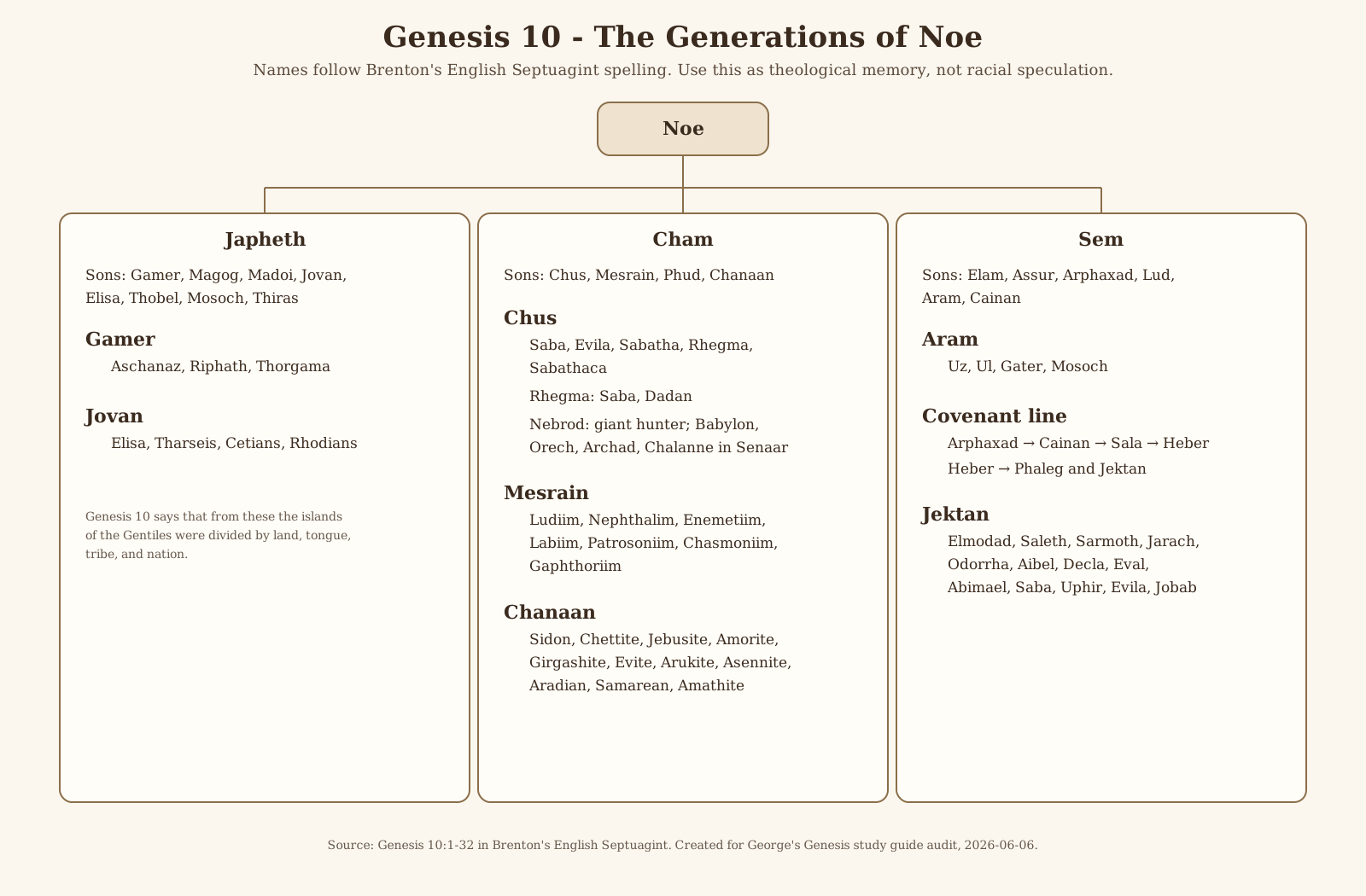 Source: created for this guide from Genesis 10:1-32 in Brenton’s English Septuagint, 2026-06-06.
Historical and Scriptural Context
Genesis 10 stands in the wake of the flood covenant. Humanity has been preserved, blessed, and sent outward (Genesis 9:1, 7). Its names are therefore more than stray data. The chapter repeatedly orders people by kinship, tongue, country, and nation (Genesis 10:5, 20, 31-32). We are looking at a human family spread across the earth, not at a scale of human worth.
Genesis 11:1-9 returns to the shared speech from which this scattering arose. It explains a dispersal already described in the table rather than requiring us to imagine that the languages of chapter 10 suddenly became one again. St. Augustine reads this movement as a return to an earlier point in the story, not as a contradiction.1 After Babel, the genealogy of Sem narrows the narrative toward Tharrha, Abram, Sara, and Lot. The universal field of nations is not forgotten. It is being prepared for a covenantal answer.
This study follows the names and verse divisions of its embedded Brenton text. Cainan appears between Arphaxad and Sala in Genesis 10:24 and Genesis 11:12-13. Luke 3:35-36 also includes Cainan between Arphaxad and Shelah, reading the genealogy backward through the generations. That is a concrete point of contact between this Septuagint genealogy and Luke, not permission to flatten every textual difference.
The table of nations is theology of history (Genesis 10:1-32)
1 Now these are the generations of the sons of Noe, Sem, Cham, Japheth; and sons were born to them after the flood.
2 The sons of Japheth, Gamer, and Magog, and Madoi, and Jovan, and Elisa, and Thobel, and Mosoch, and Thiras. 3 And the sons of Gamer, Aschanaz, and Riphath, and Thorgama. 4 And the sons of Jovan, Elisa, and Tharseis, Cetians, Rhodians. 5 From these were the islands of the Gentiles divided in their land, each according to his tongue, in their tribes and in their nations.
6 And the sons of Cham, Chus, and Mesrain, Phud, and Chanaan. 7 And the sons of Chus, Saba, and Evila, and Sabatha, and Rhegma, and Sabathaca. And the sons of Rhegma, Saba, and Dadan. 8 And Chus begot Nebrod: he began to be a giant upon the earth. 9 He was a giant hunter before the Lord God; therefore they say, As Nebrod the giant hunter before the Lord. 10 And the beginning of his kingdom was Babylon, and Orech, and Archad, and Chalanne, in the land of Senaar. 11 Out of that land came Assur, and built Ninevi, and the city Rhooboth, and Chalach, 12 and Dase between Ninevi and Chalach: this is the great city. 13 And Mesrain begot the Ludiim, and the Nephthalim, and the Enemetiim, and the Labiim, 14 and the Patrosoniim, and the Chasmoniim (whence came forth Phylistiim) and the Gaphthoriim. 15 And Chanaan begot Sidon his first-born, and the Chettite, 16 and the Jebusite, and the Amorite, and the Girgashite, 17 and the Evite, and the Arukite, and the Asennite, 18 and the Aradian, and the Samarean, and the Amathite; and after this the tribes of the Chananites were dispersed. 19 And the boundaries of the Chananites were from Sidon till one comes to Gerara and Gaza, till one comes to Sodom and Gomorrha, Adama and Seboim, as far as Dasa. 20 These were the sons of Cham in their tribes according to their tongues, in their countries, and in their nations.
21 And to Sem himself also were children born, the father of all the sons of Heber, the brother of Japheth the elder. 22 Sons of Sem, Elam, and Assur, and Arphaxad, and Lud, and Aram, and Cainan. 23 And sons of Aram, Uz, and Ul, and Gater, and Mosoch. 24 And Arphaxad begot Cainan, and Cainan begot Sala. And Sala begot Heber. 25 And to Heber were born two sons, the name of the one, Phaleg, because in his days the earth was divided, and the name of his brother Jektan. 26 And Jektan begot Elmodad, and Saleth, and Sarmoth, and Jarach, 27 and Odorrha, and Aibel, and Decla, 28 and Eval, and Abimael, and Saba, 29 and Uphir, and Evila, and Jobab, all these were the sons of Jektan. 30 And their dwelling was from Masse, till one comes to Saphera, a mountain of the east. 31 These were the sons of Sem in their tribes, according to their tongues, in their countries, and in their nations. 32 These are the tribes of the sons of Noe, according to their generations, according to their nations: of them were the islands of the Gentiles scattered over the earth after the flood.
Genesis 10 tells us that God has not lost the nations. Before Abram is called, the peoples are already named. The chapter roots later biblical history in one post-flood human family and teaches that plurality of lands, clans, and tongues unfolds under divine oversight.
Notice the repeated endings: Japheth’s descendants are described by land, tongue, tribe, and nation in verse 5; the same kinds of distinction recur for Cham in verse 20 and Sem in verse 31. No branch is outside the chapter’s attention. Their stories are joined to the same preserved family. The genealogy gives no warrant for assigning spiritual value to modern races or for treating descent as a measure of human dignity.
The list itself slows at particular names. Nebrod receives a kingdom and cities; Phaleg receives an explanation of his name through the division of the earth in his days (verse 25). We need not turn that brief notice into a theory of continental movement or an exact date for Babel. The chapter is preparing us to notice both the reach of human power and the fact of human division.
This is why the table matters spiritually. Scripture does not begin with election by ignoring the rest of mankind. It shows that the Lord of covenant is already Lord of all peoples. The later calling of Abram will narrow the line of promise, but not the scope of God’s concern. Revelation 7:9-10 lets the Christian reader look ahead: a multitude from all nations, tribes, peoples, and tongues stands before the Lamb. The many names of Genesis are not the debris left behind by salvation. The nations are the field toward which God’s blessing will reach.
Nebrod and the beginnings of Babylon (Genesis 10:8-12)
8 And Chus begot Nebrod: he began to be a giant upon the earth. 9 He was a giant hunter before the Lord God; therefore they say, As Nebrod the giant hunter before the Lord. 10 And the beginning of his kingdom was Babylon, and Orech, and Archad, and Chalanne, in the land of Senaar. 11 Out of that land came Assur, and built Ninevi, and the city Rhooboth, and Chalach, 12 and Dase between Ninevi and Chalach: this is the great city.
The notice about Nebrod is brief but strategic. Brenton calls him a giant and a giant hunter; the beginning of his kingdom is Babylon in Senaar. In the next chapter the builders settle in that same land (Genesis 11:2). This shared setting connects the rise of a kingdom with the story of a city determined to make its own name.
Read verse 11 with equal care: in this translation, Assur comes out of that land and builds Ninevi and the cities named with it. The sentence does not say that Nebrod built Ninevi. Nor does Genesis 11 name Nebrod as the tower’s architect or tell us the builders’ individual biographies. The narrative gives us enough to follow its moral movement without supplying a legend for every gap.
The phrase “before the Lord God” in verse 9 should not be silently changed into “against the Lord God.” St. Augustine develops an interpretation of Nebrod as opposing God, but that is his reading, not Brenton’s printed wording.2 Here the firm textual facts are the hunter’s renown, the beginning of his kingdom, and Babylon’s place in it. A person’s capacity to gather power and leave a memorable name is not yet evidence of holiness. That question becomes explicit when the builders themselves speak.
Babel is proud unity without obedience (Genesis 11:1-4)
1 And all the earth was one lip, and there was one language to all. 2 And it came to pass as they moved from the east, they found a plain in the land of Senaar, and they dwelt there. 3 And a man said to his neighbour, Come, let us make bricks and bake them with fire. And the brick was to them for stone, and their mortar was bitumen. 4 And they said, Come, let us build to ourselves a city and tower, whose top shall be to heaven, and let us make to ourselves a name, before we are scattered abroad upon the face of all the earth.
The first conversation is neighborly and practical: one man speaks to another about making bricks. The text explains how brick serves for stone and bitumen for mortar. Neither the material nor the cooperation is condemned. The decisive disclosure comes when the purpose is spoken: “let us build to ourselves” and “let us make to ourselves a name” (verse 4). Their shared skill is being enlisted to secure their own permanence before they are scattered.
That final clause matters. They are not merely delighted with what they can build. Their imagined future is threatened by dispersion, and the city is their answer. Against God’s blessing of an earth filled with human life (Genesis 9:1, 7), they seek a center that will hold them together on their own terms. Babel is therefore a counterfeit communion. Fallen man still wants unity, but he wants to make it safe from dependence upon God.
The contrast with Abram will be exact enough to hear. Here people intend to make themselves a name. In Genesis 12:2 the Lord promises to magnify Abram’s name, and in Genesis 12:3 the blessing opens outward to all the tribes of the earth. The problem is not that a human being has a name or receives honor. It is the attempt to make a name into a refuge that we control. What Babel tries to seize, Abram will be called to receive, and what he receives is meant to bless others.
In parish service, the same question can hide beneath worthy work. A building, a program, or a team may serve our neighbor; it may also become the thing that must succeed so that we can feel important. The passage does not command us to abandon skill. It asks whose glory our skill is serving, and whether we can obey God when obedience loosens our grip on the project.
Gems from the Fathers 💎: Communion is not self-glory
St. John Chrysostom, preaching on love in First Corinthians, sees human interdependence and even cities as ways of drawing people together. He then recalls Babel as concord abused for sin. His point protects us from condemning common work itself: “Here then is why He founded cities also, and brought all into one place.”3 The gift is fellowship; the corruption is the purpose to which fellowship is put.
St. Augustine’s account of the two cities offers a complementary spiritual test. He distinguishes a community ruled by self-love to the contempt of God from one ruled by love of God. “The former, in a word, glories in itself, the latter in the Lord.”4 This is a thematic lens, not a claim that every earthly city is Babel. People may work closely together while using one another as witnesses to their own greatness. True communion releases us from needing to be the center.
Confusion is judgment and mercy (Genesis 11:5-9)
5 And the Lord came down to see the city and the tower, which the sons of men built. 6 And the Lord said, Behold, there is one race, and one lip of all, and they have begun to do this, and now nothing shall fail from them of all that they may have undertaken to do. 7 Come, and having gone down let us there confound their tongue, that they may not understand each the voice of his neighbour. 8 And the Lord scattered them thence over the face of all the earth, and they left off building the city and the tower. 9 On this account its name was called Confusion, because there the Lord confounded the languages of all the earth, and thence the Lord scattered them upon the face of all the earth.
The line “the Lord came down” carries holy irony. Men imagine a tower reaching heaven, yet their greatness remains small before God. The wording does not mean that He has been ignorant of their work or must travel to inspect it. As St. Augustine explains, God’s seeing does not add new knowledge to Him; His intervention brings the character of the city to light.5
Verse 6 recognizes the force of their common purpose. It is not a declaration that creatures have become omnipotent or that God is frightened of engineering. The next verses show how readily the undertaking can be stopped. The danger lies in a shared purpose that no longer encounters restraint.
Listen also to the answering invitation. The builders twice say “Come” (Genesis 11:3-4); now God says “Come” (Genesis 11:7). They organize their neighbors’ voices around their own project; God confounds their tongue so that a man can no longer understand his neighbor’s voice. The very capacity that made their collective plan possible becomes the point at which it breaks. They sought to avoid scattering; scattering is precisely what follows.
The name tells the same truth. They planned a name for themselves, but the name the story leaves us is Confusion. Brenton makes the meaning visible in verse 9, where the place’s naming is linked to the Lord’s confounding of languages. Their monument does not secure the memory they intended.
The confusion of tongues is real judgment. The work stops and the people are scattered. Yet it is also mercy: God interrupts a united rebellion rather than leaving its power unchecked. This does not make every broken plan a private message of punishment, and it does not make every language or culture a curse. The text narrates the rupture of mutual understanding; the Christian hope is not that every people must surrender its own voice. God restrains the builders without abandoning the human family.
Gems from the Fathers 💎: The Spirit restores understanding
St. Gregory Nazianzus explicitly compares Babel and Pentecost. He praises the interruption of a common wicked intention, then praises still more the Spirit’s gathering: “For being poured from One Spirit upon many men, it brings them again into harmony.”6 He immediately speaks of diverse gifts. The unity he commends is not sameness imposed by a stronger human will, but harmony received from the one Spirit.
St. Cyril of Jerusalem makes the direction of the heart decisive: “For in that confusion of tongues there was division of purpose, because their thought was at enmity with God; but here minds were restored and united, because the object of interest was godly. The means of falling were the means of recovery.”7 The tongue that had become an instrument of estrangement can become an instrument of communion.
Acts 2:6-11 gives this contrast concrete form: the hearers recognize God’s wonderful works in their own languages. Pentecost does not require everyone to become culturally identical before hearing the Gospel. For a Coptic Orthodox parish, this makes room both for gratitude for an inherited language of prayer and for patient care that children, newcomers, and neighbors understand what is being proclaimed. Translation, explanation, and attentive listening can be acts of love. We do not honor the Spirit by making another person’s incomprehension a badge of our belonging.
From scattered peoples to the line of Abram (Genesis 11:10-32)
10 And these are the generations of Sem: and Sem was a hundred years old when he begot Arphaxad, the second year after the flood. 11 And Sem lived, after he had begotten Arphaxad, five hundred years, and begot sons and daughters, and died. 12 And Arphaxad lived a hundred and thirty-five years, and begot Cainan. 13 And Arphaxad lived after he had begotten Cainan, four hundred years, and begot sons and daughters, and died. And Cainan lived a hundred and thirty years and begot Sala; and Cainan lived after he had begotten Sala, three hundred and thirty years, and begot sons and daughters, and died. 14 And Sala lived an hundred and thirty years, and begot Heber. 15 And Sala lived after he had begotten Heber, three hundred and thirty years, and begot sons and daughters, and died. 16 And Heber lived an hundred and thirty-four years, and begot Phaleg. 17 And Heber lived after he had begotten Phaleg two hundred and seventy years, and begot sons and daughters, and died. 18 And Phaleg lived an hundred and thirty years, and begot Ragau. 19 And Phaleg lived after he had begotten Ragau, two hundred and nine years, and begot sons and daughters, and died. 20 And Ragau lived an hundred thirty and two years, and begot Seruch. 21 And Ragau lived after he had begotten Seruch, two hundred and seven years, and begot sons and daughters, and died. 22 And Seruch lived a hundred and thirty years, and begot Nachor. 23 And Seruch lived after he had begotten Nachor, two hundred years, and begot sons and daughters, and died. 24 And Nachor lived a hundred and seventy-nine years, and begot Tharrha. 25 And Nachor lived after he had begotten Tharrha, an hundred and twenty-five years, and begot sons and daughters, and he died. 26 And Tharrha lived seventy years, and begot Abram, and Nachor, and Arrhan.
27 And these are the generations of Tharrha. Tharrha begot Abram and Nachor, and Arrhan; and Arrhan begot Lot. 28 And Arrhan died in the presence of Tharrha his father, in the land in which he was born, in the country of the Chaldees. 29 And Abram and Nachor took to themselves wives, the name of the wife of Abram was Sara, and the name of the wife of Nachor, Malcha, daughter of Arrhan, and he was the father of Malcha, the father of Jescha. 30 And Sara was barren, and did not bear children. 31 And Tharrha took Abram his son, and Lot the son of Arrhan, the son of his son, and Sara his daughter-in-law, the wife of Abram his son, and led them forth out of the land of the Chaldees, to go into the land of Chanaan, and they came as far as Charrhan, and he dwelt there. 32 And all the days of Tharrha in the land of Charrhan were two hundred and five years, and Tharrha died in Charrhan.
After Babel, Genesis turns from the city to the genealogy of Sem. The repeated pattern of begetting, further years, sons and daughters, and death restores the quieter scale of generations. The failed tower is not the end of human history. Life continues, and the narrative moves steadily toward Tharrha’s household.
These ages must be read as they stand. The ages at begetting do not steadily decrease, and life spans are not shorter in every successive generation: Cainan and Sala have the same life span, as do Phaleg and Ragau. What the repeated deaths establish is mortality, not an unbroken numerical staircase. The genealogy also carries forward Cainan between Arphaxad and Sala, whose own begetting and later years are printed within Brenton’s verse 13. His presence belongs to the words of this edition, not to an extra verse that we should invent.
Then the regular pattern breaks into the grief of a particular home. Arrhan dies while his father Tharrha is still alive (verse 28). Lot is not merely another name; he is the son of the man whose death has just been reported. Sara’s barrenness is then stated with painful directness: “And Sara was barren, and did not bear children” (verse 30). After so many generations, this household cannot simply presume that another generation will follow.
The text does not blame Sara, diagnose her faith, or treat her as less worthy. Nor does this story authorize a promise that every faithful person will conceive. The coming promise will disclose God’s freedom and fidelity, not a technique for compelling a desired outcome. For readers who bear infertility, childlessness, or bereavement, Scripture has not passed over their kind of sorrow on the way to its great events. The family through whom blessing will come already knows loss and a future it cannot manufacture.
The chapter ends with a journey begun but not completed. Tharrha takes Abram, Lot, and Sara out of the Chaldees toward Chanaan; they reach Charrhan and dwell there. Tharrha dies there. Genesis 11:31 does not yet report arrival in the promised destination, and it names Tharrha as the one leading this departure. The Lord’s command to Abram opens the next chapter (Genesis 12:1-3). We should let the narrative bring us to that threshold without making every earlier movement the same event.
This is where the two chapters meet. The builders try to secure a future by concentrating their strength; Abram’s household has neither a completed journey nor an assured heir. Yet God’s promise will not be proportioned to that household’s visible resources. The particular family is chosen for the sake of universal blessing. Christians reading toward Christ see the wideness of that purpose in the multitude before the Lamb (Revelation 7:9-10). God’s answer to the nations is not to forget their names, but to bring blessing where pride could not bring communion.
Spiritual Fruit 🍇
Babel warns that unity without humility can become rebellion. Begin with one shared undertaking in which you have a stake: a parish service, a household plan, a professional project. Notice what happens when someone else receives credit or suggests a change. Do you listen for what will serve the work and the people, or do you hear a threat to your own name? Bring that concrete reaction to prayer and confession. Then do one useful thing without arranging to be noticed.
The neighbor’s voice is another place to begin. At Babel, neighbors first understand one another but bend that gift toward self-exaltation; in the judgment, they can no longer understand. At Pentecost, the Spirit gives understanding for the praise of God. Before the next disagreement, ask the other person to explain what you have not understood. In the Church, make the effort to explain a prayer or reading rather than shaming someone for needing help. These small acts do not reproduce Pentecost’s miracle, but they resist the pride that makes another person useful only when he echoes us.
Genesis 10 also gives comfort: the nations are not forgotten, even before Abram is called. Pray for a people you usually encounter only as a headline or a political category. Their names belong to human beings, not to the scenery of your own story.
Finally, remain beside Sara long enough to hear what the genealogy has said. A future may be hidden from you without your suffering being a verdict upon your faith. Bring to Christ the loss or longing you cannot repair. Ask for companionship, receive appropriate pastoral and medical care, and refuse the cruel bargain that says you must obtain a visible result to prove that God loves you. The chapter ends in Charrhan, not in fulfillment. Yet it stands at the threshold of God’s promise. We may entrust what is unfinished to Him without pretending that it no longer hurts.
Teaching Notes
The table of nations is theology of history (Genesis 10:1-32)
- Ask: Why does Scripture name nations before Abram appears? What do the repeated endings in verses 5, 20, and 31 help us see?
- Emphasize: The line of promise will narrow, but the horizon of blessing remains wide.
- Watch for: Do not treat genealogies as filler or turn this table into a ranking of modern races.
- Connect: Revelation 7:9-10 shows the nations before the Lamb, not erased into an anonymous crowd.
- Show: Use the table-of-nations visual to trace Japheth, Cham, and Sem without asking the class to memorize every name.
Nebrod and the beginnings of Babylon (Genesis 10:8-12)
- Ask: What does the passage actually tell us about Nebrod, and which actions does it give to Assur?
- Emphasize: Babylon and Senaar prepare the setting of the next chapter; power and renown do not establish holiness.
- Watch for: Brenton says “before the Lord God.” Do not replace that with an interpretive rendering or identify Nebrod as the tower’s named architect.
- Connect: Compare the shared land of Senaar in Genesis 10:10 and Genesis 11:2.
- Show: Locate Nebrod and Babylon in the table, then read verse 11 aloud so that Assur is not lost.
Babel is proud unity without obedience (Genesis 11:1-4)
- Ask: Where does the builders’ practical conversation reveal its spiritual purpose?
- Emphasize: Neither brickmaking nor cooperation is the sin. The phrases about building for themselves and making a name disclose the project’s direction.
- Watch for: Do not teach that cities, engineering, planning, or common language are inherently sinful.
- Connect: Compare Genesis 11:4 with Genesis 12:2-3: a name seized for security versus a name magnified by God for blessing.
- Show: Return to the movement table and notice the change from many named peoples to a group intent upon its own name.
Confusion is judgment and mercy (Genesis 11:5-9)
- Ask: How do God’s “Come” and the remembered name Confusion answer the builders’ own words?
- Emphasize: God is not threatened by height or skill; He restrains a shared purpose turned against Him.
- Watch for: Do not call cultural difference inherently evil or diagnose every interrupted plan as divine punishment.
- Connect: Read Acts 2:6-11 with Gregory Nazianzus and Cyril of Jerusalem: harmony in the Spirit does not require cultural sameness.
- Show: Trace the words “neighbour,” “name,” and “scattered” through Genesis 11:3-9.
From scattered peoples to the line of Abram (Genesis 11:10-32)
- Ask: What changes when the genealogical pattern reaches Arrhan’s death, Sara’s barrenness, and the unfinished journey?
- Emphasize: God prepares universal blessing through a household that cannot guarantee its own future.
- Watch for: Do not claim a decrease at every generation, omit Cainan, blame Sara, or promise pregnancy as a reward for faith.
- Connect: Genesis 12:1-3 opens the next movement, with God’s command and promise rather than this family’s self-sufficiency.
- Show: Trace the printed genealogy from Sem to Tharrha, then distinguish his three sons from Arrhan’s son Lot (Genesis 11:26-27).
Sources
Embedded Scripture is from Brenton’s English Septuagint (LXX). Its spellings and verse divisions are retained. New Testament cross-references are read in the NKJV.
Genesis 9:1, 7; Genesis 10-11; Genesis 12:1-3. Brenton’s English Septuagint, public-domain edition.
St. John Chrysostom, Homilies on First Corinthians, Homily XXXIV, §7, on interdependence, cities, and concord abused at Babel.3
St. Augustine, The City of God, XIV.28 and XVI.3-5, on the two loves, the generations, Babel, and God’s descent.4125
St. Gregory Nazianzus, Oration 41: On Pentecost, §16, on interrupted wickedness and harmony in the Spirit.6
St. Cyril of Jerusalem, Catechetical Lecture XVII, §17, on Babel and Pentecost.7
The accompanying Table of Nations schematic was created for this guide from Brenton’s Genesis 10:1-32. It is a visual aid, not an independent textual witness.
Footnotes
-
St. Augustine, The City of God, XVI.3-4, direct text. ↩ ↩2
-
St. Augustine, The City of God, XVI.4, direct text. His interpretation of Nebrod as acting against God is distinguished here from Brenton’s wording. ↩ ↩2
-
St. John Chrysostom, Homilies on First Corinthians, Homily XXXIV, §7, NPNF1, vol. 12, direct text. ↩ ↩2
-
St. Augustine, The City of God, XIV.28, direct text. ↩ ↩2
-
St. Augustine, The City of God, XVI.5, direct text. ↩ ↩2
-
St. Gregory Nazianzus, Oration 41: On Pentecost, §16, NPNF2, vol. 7, direct text. ↩ ↩2
-
St. Cyril of Jerusalem, Catechetical Lecture XVII, §17, NPNF2, vol. 7, direct text. ↩ ↩2