


A note for readers: This account includes a deceptive marriage and servant women given to bear children for others. Those carrying similar wounds deserve compassionate care, practical protection, and trustworthy pastoral support.
Jacob leaves Bethel with God’s promise of presence and reaches a well where his mother’s family becomes more than a remembered name. Rachel arrives with her father’s sheep; Jacob waters them and weeps. Soon seven years will seem like a few days because he loves her. Yet the house that welcomes him will also deceive him, and the children of Israel will be born amid the longing of women whose deepest wounds cannot be measured by the size of their families. Through these chapters, God’s attention remains personal: He sees Leah, hears her, remembers Rachel, and hears her too. His promise is taking flesh in a household that still needs healing.
A promised presence at an ordinary well (Genesis 29:1-8)
1 And Jacob started and went to the land of the east to Laban, the son of Bathuel the Syrian, and the brother of Rebecca, mother of Jacob and Esau. 2 And he looks, and behold! a well in the plain; and there were there three flocks of sheep resting at it, for out of that well they watered the flocks, but there was a great stone at the mouth of the well. 3 And there were all the flocks gathered, and they used to roll away the stone from the mouth of the well, and water the flocks, and set the stone again in its place on the mouth of the well. 4 And Jacob said to them, Brethren, whence are ye? and they said, We are of Charrhan. 5 And he said to them, Know ye Laban, the son of Nachor? and they said, We do know him. 6 And he said to them, Is he well? And they said, He is well. And behold Rachel his daughter came with the sheep. 7 And Jacob said, It is yet high day, it is not yet time that the flocks be gathered together; water ye the flocks, and depart and feed them. 8 And they said, We shall not be able, until all the shepherds be gathered together, and they shall roll away the stone from the mouth of the well, then we will water the flocks.
At Bethel the Lord promised to keep Jacob wherever he went. Here the first evidence of arrival is wonderfully ordinary: shepherds who know Laban and can tell him that Laban is well. Jacob asks one question after another until the unknown country becomes a place where he has kin. The promise of God accompanies him into conversation, work, and human welcome. We often wait for assurance to arrive in a form more dramatic than the help actually set before us.
The well recalls Genesis 24, where Abraham’s servant met Rebekah while seeking a wife for Isaac. Both accounts bring a traveler from Abraham’s household to water, relatives, and a future bride. Their differences matter too. In chapter 24 the servant prays and watches Rebekah’s generous service; here Jacob questions the shepherds and will himself water Rachel’s sheep. The repeated setting binds the generations together without making their stories identical.
The great stone and the custom of gathering the flocks establish the work waiting to be done. Jacob thinks there is still time to water and feed the sheep; the shepherds explain their shared arrangement. This is a working well before it becomes a place of family reunion. The God who spoke in the night is also present in a day’s labor.
Rachel arrives, and kinship becomes service (Genesis 29:9-14)
9 While he was yet speaking to them, behold, Rachel the daughter of Laban came with her father’s sheep, for she fed the sheep of her father. 10 And it came to pass when Jacob saw Rachel the daughter of Laban, his mother’s brother, and the sheep of Laban, his mother’s brother, that Jacob came and rolled away the stone from the mouth of the well, and watered the sheep of Laban, his mother’s brother. 11 And Jacob kissed Rachel, and cried with a loud voice and wept. 12 And he told Rachel that he was the near relative of her father, and the son of Rebecca; and she ran and reported to her father according to these words. 13 And it came to pass when Laban heard the name of Jacob, his sister’s son, he ran to meet him, and embraced and kissed him, and brought him into his house; and he told Laban all these sayings. 14 And Laban said to him, Thou art of my bones and of my flesh; and he was with him a full month.
Rachel enters as a shepherd, caring for her father’s sheep. Before the narrative compares the sisters’ appearance, it shows her doing useful work. Jacob’s response joins strength, affection, and tears: he removes the stone, waters the flock, kisses Rachel, and identifies himself. Joy makes him active. He gives practical help before he has a place in Laban’s house.
Verse 10 repeats “his mother’s brother” three times. Rachel, the flock, and Laban are all connected to the mother Jacob has left behind. That insistence on kinship helps us hear the weight of his weeping. He has reached the household to which his parents sent him, and strangers have become family. Laban’s embrace and his declaration, “Thou art of my bones and of my flesh,” extend this welcome. The month that follows gives Jacob an initial place to belong.
This well also belongs to a larger biblical pattern that finds a fresh fullness in John 4:5-14. Beside Jacob’s well in Samaria, Christ speaks with a woman and offers water becoming a spring of eternal life. The locations and encounters are distinct, but the comparison helps us recognize the greater gift: Jacob waters a flock at his arrival; Christ gives life that satisfies the soul. Human welcome is precious, and the welcome of the Savior reaches further than even the family we long to find.
Love makes years seem like days (Genesis 29:15-20)
15 And Laban said to Jacob, Surely thou shalt not serve me for nothing, because thou art my brother; tell me what thy reward is to be. 16 Now Laban had two daughters, the name of the elder was Lea, and the name of the younger, Rachel. 17 And the eyes of Lea were weak. But Rachel was beautiful in appearance, and exceedingly fair in countenance. 18 And Jacob loved Rachel, and said, I will serve thee seven years for thy younger daughter Rachel. 19 And Laban said to him, It is better that I should give her to thee, than that I should give her to another man; dwell with me. 20 And Jacob served for Rachel seven years, and they were before him as a few days, by reason of his loving her.
Laban moves from hospitality to wages. His question acknowledges that kinship should not mean unpaid labor, and Jacob offers seven years of service for Rachel. The contrast between the elder and younger daughters prepares the coming conflict. Brenton calls Leah’s eyes “weak”; the verse then praises Rachel’s beauty. The narrator gives a contrast in description, while Jacob’s love explains his choice. Leah’s worth will emerge through far more than this comparison.
The seven years remain seven years. Love changes how Jacob bears their length: they seem “a few days.” His affection takes the form of sustained work rather than a moment’s declaration. There is something beautiful here for married people, servants, and anyone keeping a difficult promise. Love can make an ordinary repeated task bearable because another person has become its purpose. The test of such love is what it gives when the first excitement has passed.
Gems from the Fathers 💎: The labor of love
St. John Chrysostom uses Jacob’s service while preaching on love in 1 Corinthians 13. He notices the hardship of labor among one’s own relatives and explains Jacob’s endurance through his affection: “And the cause was his love, which made the time, though long, appear short.”1 The insight deepens the verse’s account of costly love. In Ephesians 5:25-27, the measure given to Christian husbands is Christ, who loved the Church and gave Himself for her. The Church is sanctified through the Bridegroom’s self-giving. Love grows holy as it seeks the beloved’s good and makes service truthful.
The wedding morning reveals deception (Genesis 29:21-30)
21 And Jacob said to Laban, Give me my wife, for my days are fulfilled, that I may go in to her. 22 And Laban gathered together all the men of the place, and made a marriage-feast. 23 And it was even, and he took his daughter Lea, and brought her in to Jacob, and Jacob went in to her. 24 And Laban gave to his daughter Lea, Zelpha his handmaid, as a handmaid for her. 25 And it was morning, and behold it was Lea; and Jacob said to Laban, What is this that thou hast done to me? did I not serve thee for Rachel? and wherefore hast thou deceived me? 26 And Laban answered, It is not done thus in our country, to give the younger before the elder. 27 Fulfil then her sevens, and I will give to thee her also in return for thy labour, which thou labourest with me, yet seven other years. 28 And Jacob did so, and fulfilled her sevens; and Laban gave him his daughter Rachel to wife. 29 And Laban gave to his daughter his handmaid Balla, for a handmaid to her. 30 And he went in to Rachel; and he loved Rachel more than Lea; and he served him seven other years.
Jacob asks for the wife for whom he has completed his service. Laban gathers the community for a feast, but the decisive act comes in the evening: he brings Leah to Jacob. Morning exposes the substitution. Jacob’s questions name the breach plainly: he served for Rachel and has been deceived. Public celebration and family custom have failed to make the arrangement truthful.
Laban’s defense repeats the elder-younger distinction that has already troubled Jacob’s own family. In Genesis 27 Jacob presented himself as the elder son; here Laban appeals to the elder daughter’s precedence to explain why Jacob has received Leah. The resemblance lets Jacob stand on the receiving side of concealed identity. Scripture makes the irony sharp without announcing that God commanded Laban’s act as a punishment. Laban is answerable for the deception he chose.
Leah and Rachel’s consent to these arrangements is not reported. Leah’s presence does not tell us that she devised or willingly joined the trick. The father’s action determines the sisters’ circumstances, and two women are drawn into a marriage marked from its beginning by unequal affection. When Scripture enters this wounded home, Christian teaching must remain attentive to all the people whose voices are missing.
Language insight: “her sevens”
In verses 27-28 the Septuagint’s τὰ ἕβδομα (ta hebdoma) refers here to the wedding week; the further labor is separately specified as “seven other years.” Jacob completes Leah’s wedding week, receives Rachel, and then serves the additional seven years. Verse 30 confirms that order.2 The brief interval between the marriages intensifies the household’s pain: the sisters must live beside each other as wives of the same man, one loved more than the other.
The Lord sees Leah, and thanksgiving finds a voice (Genesis 29:31-35)
31 And when the Lord God saw that Lea was hated, he opened her womb; but Rachel was barren. 32 And Lea conceived and bore a son to Jacob; and she called his name, Ruben; saying, Because the Lord has looked on my humiliation, and has given me a son, now then my husband will love me. 33 And she conceived again, and bore a second son to Jacob; and she said, Because the Lord has heard that I am hated, he has given to me this one also; and she called his name, Simeon. 34 And she conceived yet again, and bore a son, and said, In the present time my husband will be with me, for I have born him three sons; therefore she called his name, Levi. 35 And having conceived yet again, she bore a son, and said, Now yet again this time will I give thanks to the Lord; therefore she called his name, Juda; and ceased bearing.
The Lord sees what the household’s preference has wounded. Verse 30 says Jacob loved Rachel more; verse 31 calls Leah “hated.” Read together, the words reveal the sorrow of being less loved. The comparison is a lived humiliation, and Leah herself later says she is hated. God’s seeing meets a real person in that sorrow. Rachel’s barrenness stands beside Leah’s fruitfulness in the narrative, but the narrator does not call it punishment for being loved.
Leah’s own speeches give the children’s names their significance. With Ruben, she confesses that the Lord has looked upon her humiliation and hopes Jacob will love her. With Simeon, she says God has heard. With Levi, she longs for her husband to be with her. Then, with Juda, her speech turns toward thanksgiving. These are distinct responses within one wounded heart: hope for affection, relief at being heard, desire for companionship, and praise. Thanksgiving has opened a door even while the old longing remains; in 30:20 she will still hope to be chosen.
Judah’s birth also opens a direct path toward Christ. Matthew 1:2-3 places Judah and his brothers within Jesus’ genealogy, and Hebrews 7:14 says that our Lord arose from Judah. The neglected mother’s son belongs to the royal line through which the Son of God will come according to the flesh. Her cry is heard within a history whose fullness she cannot yet see.
Gems from the Fathers 💎: Names that remember goodness
Preaching on Christ’s naming of Peter in John 1, St. John Chrysostom recalls Leah’s naming of her children. Such names, he says, can preserve the memory of God’s goodness: “in order that men may have the appellation to remind them of the goodness of God.”3 He links the God who gave the ancient covenant with Christ who names His disciple. Leah’s family history thus teaches us to remember mercy deliberately. A sorrowful life can hold memories of divine goodness without first becoming free of every sorrow.
Rachel cries out, and Balla bears children (Genesis 30:1-8)
1 And Rachel having perceived that she bore Jacob no children, was jealous of her sister; and said to Jacob, Give me children; and if not, I shall die. 2 And Jacob was angry with Rachel, and said to her, Am I in the place of God, who has deprived thee of the fruit of the womb? 3 And Rachel said to Jacob, Behold my handmaid Balla, go in to her, and she shall bear upon my knees, and I also shall have children by her. 4 And she gave him Balla her maid, for a wife to him; and Jacob went in to her. 5 And Balla, Rachel’s maid, conceived, and bore Jacob a son. 6 And Rachel said, God has given judgment for me, and hearkened to my voice, and has given me a son; therefore she called his name, Dan. 7 And Balla, Rachel’s maid, conceived yet again, and bore a second son to Jacob. 8 And Rachel said, God has helped me, and I contended with my sister and prevailed; and she called his name, Nephthalim.
Rachel has Jacob’s greater affection and still suffers intensely. Her sister’s births turn her own waiting into jealousy, and she addresses Jacob as though he could supply the missing gift: “Give me children.” His anger gives her no tenderness. His question rightly recognizes that he cannot occupy God’s place; the narrator will later name God as the One who opens Rachel’s womb. Yet a true word spoken in anger becomes a wall instead of a comfort. Jacob names the Giver without carrying Rachel’s grief to Him. Those supporting a person in grief need both truthful limits and compassionate speech.
Rachel then gives Balla to Jacob. The phrase “bear upon my knees” presents Rachel’s intention to receive children through her maid. Balla is the woman who conceives and bears. Her thoughts and consent are unrecorded, and that silence calls for careful attention to her dignity. A child is a person to receive and cherish, and the woman who bears that child remains a person whose good matters. No family desire authorizes reproductive coercion.
Rachel names Dan as a sign that God has judged for her and heard her voice. With Nephthalim, her speech becomes openly competitive: “God has helped me, and I contended with my sister and prevailed.” Rachel places her relief within a struggle against Leah. A gift that could awaken gratitude is also being used to announce victory. Prayer begins to heal this divided desire when we bring the grief itself to God and ask Him to teach us how to receive another person’s joy without losing our own place before Him.
Leah answers through Zelpha (Genesis 30:9-13)
9 And Lea saw that she ceased from bearing, and she took Zelpha her maid, and gave her to Jacob for a wife; and he went in to her. 10 And Zelpha the maid of Lea conceived, and bore Jacob a son. 11 And Lea said, It is happily: and she called his name, Gad. 12 And Zelpha the maid of Lea conceived yet again, and bore Jacob a second son. 13 And Lea said, I am blessed, for the women will pronounce me blessed; and she called his name, Aser.
Leah sees that she has stopped bearing and gives Zelpha to Jacob. The sequence follows Rachel’s action closely: another maid is given, another woman conceives, and the principal wife speaks over the births. Even the wife who has already borne four sons remains vulnerable to comparison. An earlier gift can be forgotten as soon as someone else seems to have gained ground.
Leah speaks first of happiness and then of being called blessed by other women. Brenton’s “It is happily” accompanies Gad; “I am blessed” accompanies Aser. Her words let us hear the social dimension of the sisters’ distress. They want a place in the household and honor in the eyes of others. Joy is real, yet the desire to be recognized can draw a person back into rivalry long after thanksgiving has begun.
Zelpha’s sons are Gad and Aser. Naming them restores the narrative’s personal scale: these births bring children with their own futures, not points added to a contest. The family of Israel will remember their names as well as those of Leah’s and Rachel’s children. When the Church gathers rich and poor, honored and overlooked, she is called to receive each person in the dignity bestowed by Christ. Galatians 3:28 makes that equality explicit: slave and free are one in Him.
Mandrakes are traded, but God hears Leah (Genesis 30:14-21)
14 And Ruben went in the day of barley-harvest, and found apples of mandrakes in the field, and brought them to his mother Lea; and Rachel said to Lea her sister, Give me of thy son’s mandrakes. 15 And Lea said, Is it not enough for thee that thou hast taken my husband, wilt thou also take my son’s mandrakes? And Rachel said, Not so: let him lie with thee to-night for thy son’s mandrakes. 16 And Jacob came in out of the field at even; and Lea went forth to meet him, and said, Thou shalt come in to me this day, for I have hired thee for my son’s mandrakes; and he lay with her that night. 17 And God hearkened to Lea, and she conceived, and bore Jacob a fifth son. 18 And Lea said, God has given me my reward, because I gave my maid to my husband; and she called his name Issachar, which is, Reward. 19 And Lea conceived again, and bore Jacob a sixth son. 20 And Lea said, God has given me a good gift in this time; my husband will choose me, for I have born him six sons: and she called his name, Zabulon. 21 And after this she bore a daughter; and she called her name, Dina.
Ruben brings his mother mandrakes found during the barley harvest, and Rachel asks for them. The plants enter an exchange in which Leah speaks of a husband taken from her and Rachel offers a night with Jacob. Leah’s words on his return carry the language of hiring. The earlier story of a man serving years for a bride has become a scene in which access to the husband is bargained over. Even within one home, companionship has become scarce enough to negotiate.
The decisive sentence follows: “And God hearkened to Lea.” Rachel receives the mandrakes, while Leah conceives. Later God will hear Rachel too. The account directs attention to God’s hearing through a scene of bargaining; it offers no botanical treatment or promise of pregnancy. For a person waiting for a child, the strongest comfort here is the personal nearness of the Lord who hears prayer. Medical care, honest lament, and support can coexist with that prayer.
Leah calls Issachar “Reward” and interprets his birth as God’s reward because she gave her maid to Jacob. The verse carefully lets us hear Leah saying this. Her explanation carries her struggle to make sense of the household’s arrangements; the narrator’s own preceding word is that God heard her. Receiving a good gift should make us grateful and humble, especially when our account of why it came is incomplete.
At Zabulon’s birth, Leah still hopes Jacob will choose her. Six sons have not secured the affection she longs for. The contrast exposes how heavily a child can be burdened when expected to mend an adult relationship. Then Dina is named without a naming speech. Genesis will return to her in chapter 34; here she enters the story simply as Leah’s daughter, a person to remember alongside her brothers.
God remembers Rachel, and Joseph is named (Genesis 30:22-24)
22 And God remembered Rachel, and God hearkened to her, and he opened her womb. 23 And she conceived, and bore Jacob a son; and Rachel said, God has taken away my reproach. 24 And she called his name Joseph, saying, Let God add to me another son.
Three divine actions precede Joseph’s birth: God remembers Rachel, hears her, and opens her womb. “Remembered” describes His attentive action toward her. She has never disappeared from His knowledge. The narrator speaks of God’s hearing both sisters, drawing them together before Him after the rivalry that has set them against each other. Their prayers reach the same merciful Lord.
Rachel’s first words say that God has taken away her reproach. She has lived under a shame attached to childlessness, and this birth brings relief from it. The Church can rejoice with her while also helping those who continue to wait live free of that shame. Their dignity comes from being persons loved by God, and their place in the Church is secure before any change in their circumstances.
Her next words look ahead: “Let God add to me another son.” The passage places two responses side by side, removal of reproach and desire for an addition. Joseph is both an answered grief and a name through which Rachel asks again. Gratitude can remain open to further longing when longing is entrusted to God in prayer.
Joseph’s later preservation of the family will give this birth a significance far beyond Rachel’s present relief. God’s care for one grieving woman prepares help for many others. The reader can hold that larger purpose gently: Rachel receives a son, not an explanation of every sorrow still to come.
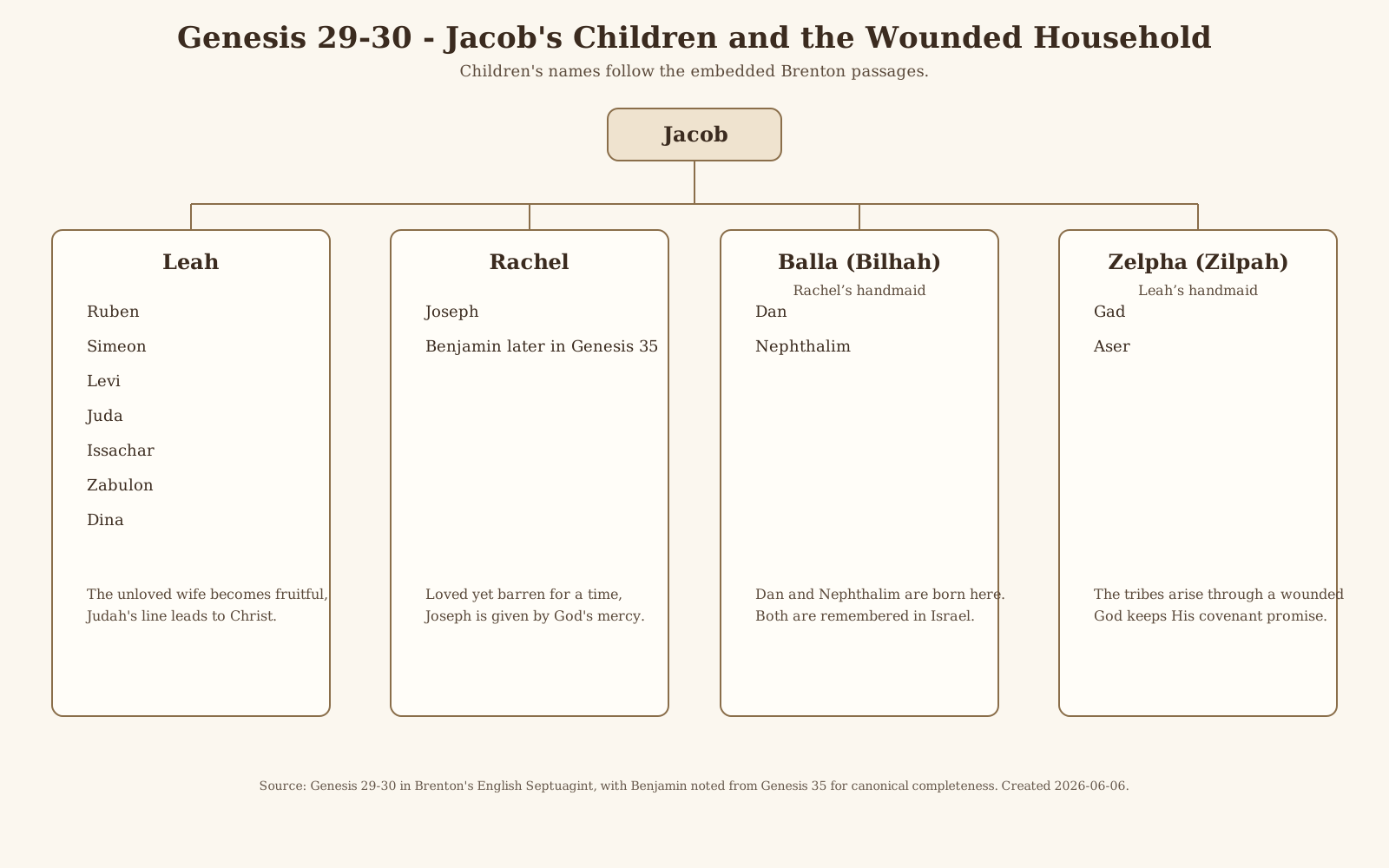 Source: study schematic from Brenton’s Genesis 29-30; Benjamin added from Genesis 35.
Jacob seeks a household of his own (Genesis 30:25-36)
25 And it came to pass when Rachel had born Joseph, Jacob said to Laban, Send me away, that I may go to my place and to my land. 26 Restore my wives and my children, for whom I have served thee, that I may depart, for thou knowest the service wherewith I have served thee. 27 And Laban said to him, If I have found grace in thy sight, I would augur well, for the Lord has blessed me at thy coming in. 28 Appoint me thy wages, and I will give them. 29 And Jacob said, Thou knowest in what things I have served thee, and how many cattle of thine are with me. 30 For it was little thou hadst before my time, and it is increased to a multitude, and the Lord God has blessed thee since my coming; now then, when shall I set up also my own house? 31 And Laban said to him, What shall I give thee? and Jacob said to him, Thou shalt not give me anything; if thou wilt do this thing for me, I will again tend thy flocks and keep them. 32 Let all thy sheep pass by to-day, and separate thence every grey sheep among the rams, and every one that is speckled and spotted among the goats—this shall be my reward. 33 And my righteousness shall answer for me on the morrow, for it is my reward before thee: whatever shall not be spotted and speckled among the goats, and grey among the rams, shall be stolen with me. 34 And Laban said to him, Let it be according to thy word. 35 And he separated in that day the spotted and speckled he-goats, and all the spotted and speckled she-goats, and all that was grey among the rams, and every one that was white among them, and he gave them into the hand of his sons. 36 And he set a distance of a three days’ journey between them and Jacob. And Jacob tended the cattle of Laban that were left behind.
Joseph’s birth becomes the occasion for Jacob to ask to return to his land. He names the wives and children for whom he has served and appeals to Laban’s knowledge of his labor. The question is no longer only what Jacob will receive as wages. It is when he will be able to establish his own household. Service to a relative has extended into dependence, and Jacob seeks a future in which he can provide for those entrusted to him.
Laban wants him to remain. He recognizes blessing at Jacob’s coming, but turns that recognition toward another wage negotiation. Jacob agrees to keep the flocks under terms that should make his share visible: grey animals among the rams and speckled or spotted goats. His “righteousness” will answer for him because the animals themselves will distinguish his wages from Laban’s property. He seeks a test open to inspection rather than a claim whose truth depends only on his word.
Laban agrees, then separates the designated animals, gives them to his sons, and puts three days’ journey between their flocks and Jacob. Jacob is left tending the remaining stock. The distance limits access to the separated animals and makes the agreement’s practical circumstances difficult. The kinship that began with an embrace has become a relationship requiring wages, visible boundaries, and separate herds.
Language insight: “I would augur well”
The Septuagint’s οἰωνισάμην (oiōnisamēn) belongs to the language of taking omens; Brenton preserves that coloring in Laban’s phrase “I would augur well.”4 Laban’s recognition of the Lord’s blessing is spoken through his own religious habits. It remains Laban’s speech, while the coming chapter will give Jacob’s fuller account of God’s care. The text teaches discernment: speaking of blessing and treating the person through whom it came justly are different matters.
The flocks increase, and the family still needs healing (Genesis 30:37-43)
37 And Jacob took to himself green rods of storax tree and walnut and plane-tree; and Jacob peeled in them white stripes; and as he drew off the green, the white stripe which he had made appeared alternate on the rods. 38 And he laid the rods which he had peeled, in the hollows of the watering-troughs, that whensoever the cattle should come to drink, as they should have come to drink before the rods, the cattle might conceive at the rods. 39 So the cattle conceived at the rods, and the cattle brought forth young speckled, and streaked and spotted with ash-coloured spots. 40 And Jacob separated the lambs, and set before the sheep a speckled ram, and every variegated one among the lambs, and he separated flocks for himself alone, and did not mingle them with the sheep of Laban. 41 And it came to pass in the time wherein the cattle became pregnant, conceiving in the belly, Jacob put the rods before the cattle in the troughs, that they might conceive by the rods. 42 But he did not put them in indiscriminately whenever the cattle happened to bring forth, but the unmarked ones were Laban’s, and the marked ones Jacob’s. 43 And the man became very rich, and he had many cattle, and oxen, and servants, and maid-servants, and camels, and asses.
Jacob prepares rods of storax, walnut, and plane-tree, peels stripes in them, and sets them at the watering troughs where the animals conceive. He also separates lambs and keeps his own flocks apart. The description follows his selective practices closely, then ends with marked animals belonging to Jacob and unmarked ones to Laban. Verse 42 stresses that Jacob did not use the rods indiscriminately and that the flocks were divided by their markings.
The narrative reports Jacob’s actions and the resulting increase. Its further explanation arrives in Genesis 31:9-13, where Jacob recounts a dream and the divine word, “for I have seen all things that Laban does to thee.” The God of Bethel has seen his labor under Laban. Thus the reader is carried beyond the rods to the Lord who protects the promised household. We can work attentively and seek fair provision while leaving our future in His hands.
Jacob becomes very rich, with cattle, servants, and transport. He has the resources for a return, but possessions have not reconciled Laban, healed the sisters’ rivalry, or resolved the fear waiting in his relationship with Esau. God’s promise has supplied a future in which deeper obedience will still be required. The next chapter will turn increase into departure.
Gems from the Fathers 💎: A people acquired through the Cross
St. Justin Martyr reads Jacob’s service and household as figures of Christ’s work for His people. He draws together the children of free women and servants as equal in dignity, then sees the varied flocks as an image of the many peoples Christ gathers: “Christ served, even to the slavery of the cross, for the various and many-formed races of mankind, acquiring them by the blood and mystery of the cross.”5 A type is an earlier biblical person or event whose pattern comes to fuller meaning in Christ. Here the fulfillment is the Savior’s costly service and the gathering of diverse people into His Church. The fruit of His labor is a people brought into communion by His blood. In that household, the overlooked are received with honor, and those who possess power learn to serve.
Spiritual Fruit 🍇
Receive God’s attention before trying to earn another person’s love. Leah’s naming speeches show how deeply she wants Jacob to choose her. Some of us bring the same longing into marriage, family, or parish service: one more achievement, one more sacrifice, and perhaps we will finally be welcomed. The Lord sees Leah before she can resolve that longing. Begin prayer by telling Him plainly where you feel overlooked, and receive your place in Christ without making another person’s approval its condition. Then do one faithful act that does not need an audience. Where a relationship is harmful, seek wise support and practical protection; the God who sees the wound also cares for the wounded person.
Give grief words that do not make a rival. Rachel’s pain is real, and so is the jealousy through which she addresses it. Comparison can make every blessing received by someone else feel like something taken from us. In confession, name both the sorrow and the resentment without confusing them. Bring the sorrow to God as petition; resist feeding the resentment through repeated comparisons or hostile speech. If another person’s good news is difficult to bear, begin with a short prayer for that person and a simple, truthful word of kindness. Christ can enlarge a heart that presently feels too crowded by grief to rejoice.
Practice love through truthful service. Jacob’s seven years become few days because he loves Rachel; Laban’s later dealings reveal how easily service can be exploited. Christian love takes its measure from the Bridegroom who gives Himself for the Church. Examine one recurring duty at home or work. Do it for the good of the person it serves, with less complaint and a more attentive heart. If you direct other people’s labor, review wages, expectations, and promises honestly. A religious word about blessing should lead you to honor the people through whom help has come, especially those with little power to insist upon fairness.
Let thanksgiving remain possible within unfinished healing. At Juda’s birth Leah gives thanks, though later she still longs to be chosen. Gratitude need not wait until every sorrow has ended. Before evening prayer, remember one particular mercy from the day and name it before God as concretely as Leah names her sons. This practice trains memory to hold goodness alongside grief. In the Divine Liturgy, bring both to Christ: the gift for which you give thanks and the wound that still needs His care. The Son who comes through Judah gives Himself to us, making thanksgiving a life of communion rather than a demand to appear cheerful.
Hold people more dearly than the outcomes you seek. Balla and Zelpha bear children whose voices and futures exceed the sisters’ rivalry. Jacob gains flocks while the household remains divided. These contrasts reach into ordinary decisions: children can be made to carry our ambitions, employees our insecurity, and possessions our hope of finally being safe. Choose one relationship in which you have begun treating a person as the means to a result. Listen to that person’s need, restore a freedom you have crowded, or keep a promise you have delayed. Christ gathers His household through self-giving, and communion with Him makes room for others to be loved as persons.
At the well, Jacob’s hands turn welcome into water for the sheep. In the divided home, the Lord hears words that longing has made difficult to speak. Remain for a moment before Him with the person or grief you have been comparing, controlling, or carrying alone. Lord Jesus Christ, Bridegroom of the Church, see us in our sorrow, cleanse our love, and teach us to receive one another with the mercy by which You have received us.
Teaching Notes
A promised presence at an ordinary well (Genesis 29:1-8)
- Ask: How does the ordinary conversation at the well continue the promise Jacob received at Bethel?
- Watch for: Keep the parallel with Genesis 24 specific: the traveler, well, relatives, and marriage; avoid treating every detail as a coded prophecy.
Rachel arrives, and kinship becomes service (Genesis 29:9-14)
- Ask: What does the threefold reference to Jacob’s mother’s brother add to the watering of the flock and his tears?
- Watch for: The text gives Jacob’s action and tears, not Rachel’s private romantic response; preserve her visible work and agency without inventing her thoughts.
Love makes years seem like days (Genesis 29:15-20)
- Ask: When does love change the way we bear repeated work, and how does Christ’s self-giving deepen that love?
- Watch for: Voluntary loving service differs from being coerced or exploited; endurance must not be used to silence someone seeking safety or fair treatment.
The wedding morning reveals deception (Genesis 29:21-30)
- Ask: How does Laban’s elder-younger argument echo Jacob’s earlier history, and who bears the cost of this deception?
- Watch for: Explain the wedding week before the additional seven years; do not place Rachel’s marriage after fourteen years or assume Leah’s collusion.
The Lord sees Leah, and thanksgiving finds a voice (Genesis 29:31-35)
- Ask: What changes between Leah’s speech at Ruben’s birth and her thanksgiving at Juda’s birth, and what remains unresolved?
- Watch for: God’s attention is not a promise that every grieving or infertile person will receive a child; affirm personal dignity and avoid declaring Leah completely healed.
Rachel cries out, and Balla bears children (Genesis 30:1-8)
- Ask: How does Rachel’s language at the two births show both relief and the continuing rivalry?
- Watch for: Distinguish Rachel’s anguish from her jealous response, and Jacob’s true word about God’s gift from its unkind delivery; never shame infertility or treat Balla as a mere instrument.
Leah answers through Zelpha (Genesis 30:9-13)
- Ask: Why can Leah return to comparison even after the thanksgiving expressed at Juda’s birth?
- Watch for: Keep Zelpha visible as a mother and person; Leah’s being called blessed here is not automatically a prophecy about the Virgin Mary.
Mandrakes are traded, but God hears Leah (Genesis 30:14-21)
- Ask: What is the significance of Rachel receiving the mandrakes while the narrator says God heard Leah?
- Watch for: Leah’s interpretation of reward does not authorize giving another woman for reproduction; neither plants, sufficient prayer, nor increased fertility guarantees healing of a marriage.
God remembers Rachel, and Joseph is named (Genesis 30:22-24)
- Ask: How do Rachel’s two naming speeches hold thanksgiving and continuing petition together?
- Watch for: Divine remembrance is attentive action, not recovery from forgetfulness; Joseph’s birth must not be made a guarantee for every person waiting for a child.
- Show: Trace the four mothers and the children named in these chapters; identify Benjamin as belonging to Genesis 35.
Jacob seeks a household of his own (Genesis 30:25-36)
- Ask: How does Jacob’s question about his own house change the meaning of the wage negotiation?
- Watch for: Keep Brenton’s grey rams and marked goats distinct from other translations; Laban’s omen-language supplies no Christian approval of divination.
The flocks increase, and the family still needs healing (Genesis 30:37-43)
- Ask: Why does the ending’s wealth prepare the return without completing the family’s healing?
- Watch for: Read the rods as a reported practice, not modern genetics or a prosperity ritual; Justin’s positive providential typology differs from a modern ethical assessment of the household.
Sources
Embedded Scripture is from Brenton’s English Septuagint (LXX). New Testament connections were read in NKJV.
Genesis 29-30; Genesis 24 for the well and bride pattern; Genesis 27-28 for the deception and promise; Genesis 31:9-13 for the interpretation of the flocks; Genesis 35:16-18 for Benjamin. Brenton’s English Septuagint. 🔗 🔗
Septuagint Greek, Genesis 29:27-30 and 30:27, for the wedding week and Laban’s omen-language. 🔗 🔗
Matthew 1:2-3; Hebrews 7:14; John 4:5-14; Ephesians 5:25-27; Galatians 3:28. The Judah connection is explicit descent; the wells are a literary comparison; the Church and household connections concern Christ’s self-giving and the dignity of those united in Him.
St. John Chrysostom, Homilies on First Corinthians, XXXIII, §2, on Jacob’s service as an illustration of love; Oxford translation revised by Talbot W. Chambers, NPNF First Series, vol. 12. 🔗
St. John Chrysostom, Homilies on John, XIX, §2, on biblical names, Leah, and Christ’s naming of Peter; Oxford translation by G. T. Stupart, edited with additional notes by Philip Schaff, NPNF First Series, vol. 14. 🔗
St. Justin Martyr, Dialogue with Trypho, 134; translated by Marcus Dods and George Reith, ANF, vol. 1. Justin treats Jacob’s marriages as providential mysteries and reads Leah and Rachel through covenant typology. This guide uses his account of Christ’s service and equal dignity without reproducing his anti-Jewish polemic or presenting his reading as a modern condemnation of every patriarchal arrangement. 🔗
Coptic lectionary evidence: no occurrence of Genesis 29-30 was identified in the ordinary readings, reverse references, Holy Pascha and Bright Saturday evidence, or special-service reading tables consulted for this study. This is a bounded finding, not a claim that these chapters have no place anywhere in Coptic worship.
Visual: a study schematic of Jacob’s children, following the spellings in the embedded Brenton passages; Benjamin is included from Genesis 35.
Footnotes
-
St. John Chrysostom, Homilies on First Corinthians, XXXIII, §2, NPNF First Series, vol. 12, Oxford translation revised by Talbot W. Chambers. 🔗 ↩
-
Septuagint, Genesis 29:27-30. The wedding-week expression and “seven other years” are distinct; the sequence in verses 28-30 fixes the order. 🔗 ↩
-
St. John Chrysostom, Homilies on John, XIX, §2, NPNF First Series, vol. 14, Oxford translation by G. T. Stupart, edited with additional notes by Philip Schaff; quoted from the New Advent presentation. 🔗 ↩
-
Septuagint, Genesis 30:27, οἰωνισάμην; Brenton’s “I would augur well” preserves the language of omens in Laban’s speech. 🔗 ↩
-
St. Justin Martyr, Dialogue with Trypho, 134, ANF, vol. 1, translated by Marcus Dods and George Reith. 🔗 ↩