


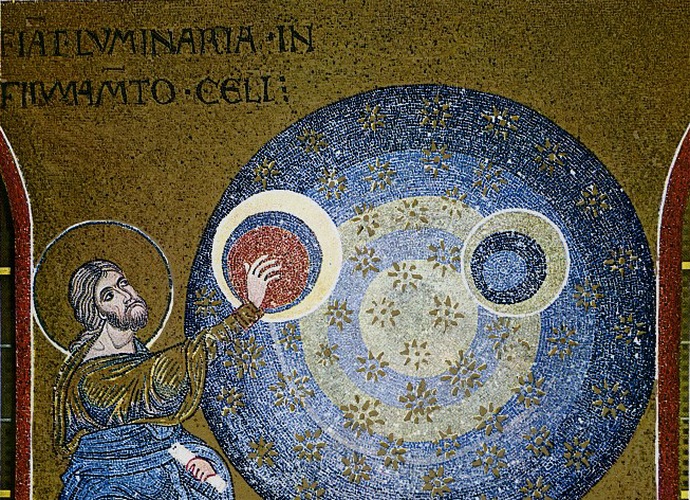
Source: Monreale Cathedral mosaic, Creation of the Sun and Moon, Wikimedia Commons, public domain, https://commons.wikimedia.org/wiki/File:Mosaici_Monreale,_creazione_del_Sole_e_della_Luna.png
Genesis is the Bible’s book of beginnings, but it is not merely a record of first events. It tells us who God is, who the human person is, why the world is both beautiful and broken, and how the history of salvation begins. The book opens with God speaking light into being and closes with Joseph awaiting burial in Egypt. That movement from creation to coffin gives the whole Bible its first great tension: the world is made good, humanity falls from communion, yet God does not abandon His purpose.
Without Genesis, the rest of Scripture loses its first vocabulary. Creation, image, blessing, commandment, temptation, fall, altar, sacrifice, covenant, seed, land, pilgrimage, exile, reconciliation, providence, and burial hope all appear here in foundational form. Exodus, the Psalms, the Prophets, the Gospels, the Pauline epistles, and Revelation all return to Genesis because Genesis names both the original beauty of God’s world and the original rupture that makes redemption necessary.
Genesis speaks about God through households, births, famines, journeys, rivalries, graves, and reconciliations. When Abraham must wait for a child or Joseph must face the brothers who sold him, faith is tested in years and relationships rather than in an abstract argument. The reader should ask both what God promises and how a particular person receives, resists, or distorts that promise.
The Fathers read Genesis this way. St Basil the Great lingers over the goodness and order of creation. St Irenaeus reads Adam in the light of Christ and sees the early chapters as the beginning of the healing fulfilled in the Incarnation. St Athanasius helps us understand the fall as corruption and mortality as well as guilt. St Ephrem the Syrian contemplates Paradise with wonder and grief. St John Chrysostom keeps household realism, obedience, failure, and divine patience in view. St Ambrose shows Abraham and Joseph as living schools of faith and hope. St Gregory of Nyssa helps readers see the patriarchal journey as instruction in purification, desire, and movement toward God.
Their own words give the overview its weight. Athanasius anchors creation in the Word: “out of nothing, and without its having any previous existence, God made the universe to exist through His word.”1 Irenaeus frames Abraham as the father of a faith that already looks toward the Gentiles and the Kingdom: “this man was not only the prophet of faith, but also the father of those who from among the Gentiles believe in Jesus Christ, because his faith and ours are one and the same: for he believed in things future, as if they were already accomplished, because of the promise of God.”2 Chrysostom gives the Joseph cycle its providential grammar in a way that prepares the whole reader for Genesis 37-50: “Such are God’s ways of ordering: the very things by which we are hurt, by these same are we benefited,” and he adds of Joseph that “when he was in honor, then was he in danger; when he was in dishonor, then was he in safety.”3
Genesis matters, then, because it is not a pre-Christian leftover. It is the first movement of the Christian mystery. The Church reads it as the opening revelation of the God who creates, judges, preserves, promises, and prepares the world for Christ.
How the Church reads Genesis
The Orthodox Church receives Genesis as true, inspired, ecclesial Scripture. It is not a disposable set of children’s stories, not a modern scientific handbook, and not a myth emptied of historical seriousness. It is the Church’s opening witness to God, the world, the human vocation, the tragedy of the fall, and the patient beginnings of covenant history.
That means Genesis should be read with several steady principles in mind:
- Read Genesis with Christ at the center. The Word through whom all things were made is the same Lord who becomes flesh for our salvation. Adam is clarified by Christ the New Adam. The tree is answered by the Cross. Paradise opens toward the Kingdom. The ark, Melchizedek, Isaac on Moriah, Jacob’s ladder, Joseph’s exaltation, and Judah’s royal line all prepare the Christian mind for Christ.
- Read Genesis with the Fathers. The patristic tradition does not flatten the text. It widens it. St Basil teaches us to see creation as ordered praise. St Irenaeus teaches us to read beginnings in the light of recapitulation. St Athanasius keeps corruption and restoration before our eyes. St Ephrem preserves the symbolic richness of Eden without dissolving it into fantasy. St John Chrysostom reminds us that the patriarchs are real people trained by grace inside real households. St Ambrose keeps Abraham and Joseph pastorally near. St Gregory of Nyssa helps readers recognize pilgrimage, purification, and ascent as abiding patterns of the spiritual life.
- Read history and theology together. Genesis reveals God through real events, genealogies, places, promises, births, famines, journeys, and burials. The theology is not floating above the narrative. It is carried inside the narrative. Even where interpreters discuss figurative, symbolic, or typological depth, the Church does not treat Genesis as a decorative fiction detached from salvation history.
- Distinguish literary form from modern reduction. Genesis includes exalted creation prose, genealogies, ancestral narrative, blessing oracles, and tightly shaped episodes. Orthodox readers need not flatten every passage into one modern category in order to take it seriously.
- Distinguish what Scripture records from what it approves. Genesis tells the truth about deception, favoritism, lust, violence, vengeance, household fracture, and the long consequences of sin. The honesty of the narrative is not the same as moral endorsement. The patriarchal stories are often spiritually luminous and morally painful at the same time.
- Read Genesis sacramentally and liturgically. Water, oil, bread, wine, blessing, marriage, sacrifice, exile, homecoming, burial, and remembered promise all begin to gather shape here and later flower in the worship and life of the Church. The book should therefore be read not only for information but also for formation.
- Hear Genesis in the Church’s worship. The Coptic Holy Pascha readings bring creation (Genesis 1:1-2:3) and the garden and fall (Genesis 2:15-3:24) into Holy Week. The Church places the beginning of human life beside the Cross, where Christ comes to heal what Adam could not. Other passages also enter Holy Week; the individual guides identify their precise readings.
In this way the Church reads Genesis neither with crude literalism nor with vague spiritualization. Orthodox reading is capable of historical seriousness, theological depth, moral clarity, and Christ-centered contemplation at the same time.
Visual overview: the theological arc of Genesis
This overview diagram gives readers a visual map of the whole book’s theological movement: creation, image, fall, promise, covenant, and providence. It is intentionally simple so it can function as a first-page orientation for the Genesis project.
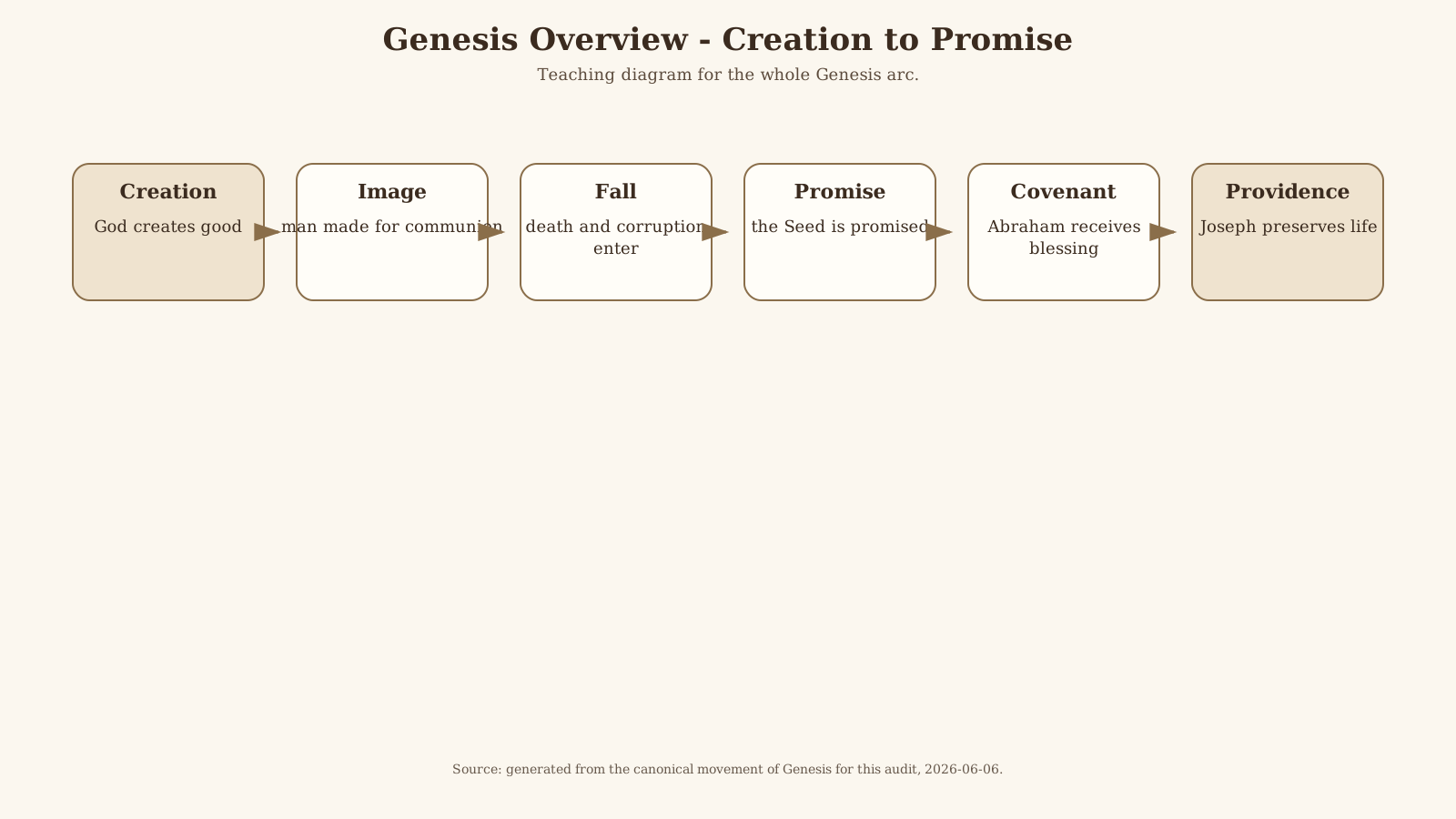 Source: created for this guide from the canonical movement of Genesis, 2026-06-06.
Major movements of the book
Genesis is best read in four major phases. The transitions matter because they show how the story narrows from the whole human race to one chosen family, yet still for the sake of the whole world.
1. Genesis 1-11: creation, fall, flood, and Babel
The first movement gives the universal story of the human race. God creates all things good. Humanity is made in His image and given a priestly and kingly vocation within creation. The fall introduces shame, alienation, toil, and death. Cain and Abel show how damaged worship becomes damaged brotherhood. The flood reveals judgment joined to mercy, while Babel shows that human unity becomes rebellion when it seeks greatness without obedience. This opening section explains why salvation history is necessary at all.
2. Genesis 12-25: Abraham and the covenant promise
With Abraham the story narrows, but it narrows for the sake of the world. One man and one household are chosen so that all the families of the earth may be blessed. This section is filled with altars, journeys, fear, faith, hospitality, intercession, covenant signs, delayed fulfillment, and sacrificial testing. The promise becomes more specific, but never smaller. Election in Genesis is missionary in scope from the beginning.
3. Genesis 26-36: Isaac, Jacob, and the household of promise
The covenant continues through a family that is anything but tidy. Wells are contested, brothers struggle, parents show favoritism, marriages carry grief, and Jacob must be broken before he is renamed Israel. Genesis is pastorally honest here. The chosen line is not chosen because it is morally neat. God remains faithful while slowly correcting, wounding, humbling, and preserving His servants. This section is especially important for teachers because it shows that divine faithfulness does not erase the consequences of sin overnight.
4. Genesis 37-50: Joseph, providence, exile, and hope
The final movement centers on Joseph, one of Scripture’s clearest portraits of providence working through suffering. He is loved, envied, stripped, sold, humiliated, falsely accused, forgotten, raised up, and finally made a source of life for the very brothers who wronged him. This section also moves the family into Egypt. Genesis therefore ends with preservation, forgiveness, and promise, but not yet with homecoming. The story closes in exile, with burial hope and remembered promises, preparing the need for Exodus.
Together these four movements give Genesis its distinctive shape: good creation, catastrophic fall, covenantal election, and providential preservation. The end is hopeful, but unfinished.
Major Orthodox themes in Genesis
- Creation: Genesis begins with the one God who freely creates a good world. Creation is not a prison, not the result of cosmic rivalry, and not an illusion to escape. This gives the Church a deeply sacramental posture toward matter, body, time, work, and worship.
- The image of God: Humanity is given a dignity that is received, not invented. To be human is to be called into communion, holiness, thanksgiving, stewardship, and responsible dominion. Orthodox anthropology cannot be understood apart from Genesis.
- The fall: Sin is presented not as a trivial mistake but as distrust, disobedience, rupture, corruption, shame, and death. Genesis teaches why the human heart and the human world need healing, not merely instruction.
- Promise: Judgment is never the last word. Even after expulsion, Genesis begins to speak of seed, blessing, and future victory. Hope appears early and continues stubbornly through every crisis.
- Covenant: God binds Himself to His promise and forms a people through whom the blessing of the nations will come. Covenant in Genesis is both gift and calling. It is rooted in divine initiative, yet it trains human obedience.
- Sacrifice and worship: Altars and offerings appear early and remain central. Sacrifice in Genesis teaches thanksgiving, obedience, substitution, dedication, and the costliness of communion with God. The book also shows that worship and moral life cannot finally be torn apart.
- Blessing: Blessing is one of the book’s strongest threads. It is spoken over creation, sought in households, fought over by brothers, transmitted across generations, and finally directed toward the nations. Blessing in Genesis is never mere sentiment. It is covenantal speech bound up with inheritance and vocation.
- Providence: Genesis insists that God works through delays, reversals, famines, barrenness, exile, and injustice without becoming the author of evil. Providence is patient, hidden, and often recognized only afterward. Joseph’s final testimony becomes a lens for much of the book.
- Pilgrimage and exile: Adam is driven from Eden, Abraham lives as a sojourner, Jacob wanders, and Joseph’s household descends to Egypt. The patriarchs are repeatedly taught to live without final earthly possession, which makes Genesis a school of pilgrimage for the Church.
- Family, inheritance, and transmission: Genesis never treats salvation history as abstract. It moves through marriages, births, deaths, rivalries, reconciliations, adoptions, and blessings. The household is one of the main theaters where grace and sin both show themselves.
- Burial hope and continuity: Graves, bones, and burial places matter in Genesis because the promises of God are carried even into death. The patriarchs die in faith, not in despair. Burial in the land becomes an act of remembered covenant hope.
- Typology fulfilled in Christ: Genesis is not exhausted by moral lessons. Adam’s disobedience is answered by Christ’s obedience; Joseph’s rejection and later saving of his brothers can teach us to see the beloved Son who saves those who rejected Him. Noah, Melchizedek, Isaac, Jacob’s ladder, and Judah’s line likewise invite reading with the wider canon. A likeness needs textual and ecclesial warrant; not every detail is a secret prediction.
These themes interlock. Creation explains the goodness of the world. The image explains human dignity. The fall explains corruption. Promise and covenant keep hope alive. Sacrifice and blessing shape worship. Providence governs the long middle of history. Pilgrimage, exile, and burial hope teach the reader to trust God beyond death.
How to use these notes for teaching and study
- Begin with the whole arc. Do not teach Genesis as disconnected stories. Keep creation, fall, promise, covenant, sacrifice, blessing, providence, pilgrimage, and exile/homecoming joined together.
- Read the passage itself first. Let the biblical text govern the discussion before turning to summaries, applications, or typology.
- Let the Old and New Testaments illuminate one another. Genesis should be read with the Gospels and the apostolic writings open, but without forcing superficial symbolism onto every detail.
- Use the Fathers as guides, not as decorative footnotes. Their interpretations help guard against moralism on one side and speculative vagueness on the other.
- Teach difficult passages with sobriety. Genesis contains family pain, sexual sin, deceit, vengeance, trauma, and death. The notes should help readers face these texts truthfully, not soften them into sentimental lessons.
- Pay attention to worship. Altars, sacrifice, blessing, calling on the name of the Lord, vows, and burial acts of faith are never side issues in Genesis.
- Move patiently. Genesis often narrates decades in a few paragraphs. The notes work best when used slowly enough for reflection, discussion, and prayer.
- Keep the pastoral level in view. Some groups need doctrinal orientation first; others need moral clarity, historical grounding, or help with typology. These notes work best when the teacher actively gauges the room.
- Return to the passage. Let the next chapter’s actual words test the themes introduced here, especially where a familiar typology or moral lesson might outrun the narrative.
A helpful teaching rhythm is simple: read the passage, identify its movement, name the central theological thread, notice the Christological horizon, and end with discussion or prayer. Used this way, the notes serve both classroom structure and personal study.
Study guide plan
| Movement | Chapters | Guide | Main emphasis |
|---|---|---|---|
| Prologue | Introduction | Genesis - General Introduction | Why Genesis governs the whole biblical story and how to read it in the Church. |
| Primeval history | 1 | genesis-1-creation-and-the-image-of-god | Creation by the Word, the goodness of the world, and humanity’s image-bearing vocation. |
| Primeval history | 2 | genesis-2-eden-marriage-and-the-breath-of-life | Eden, commandment, priestly humanity, marriage, and the breath of life. |
| Primeval history | 3 | genesis-3-the-fall-and-the-first-promise | The serpent, the fall, shame, exile, and the first promise of victory. |
| Primeval history | 4 | genesis-4-cain-abel-and-the-wound-of-worship | Worship, jealousy, murder, and the spread of sin through wounded brotherhood. |
| Primeval history | 5 | genesis-5-adam-s-generations-and-the-hope-of-enoch | Mortality after the fall and the hopeful interruption of one who walks with God. |
| Primeval history | 6-8 | genesis-6-8-noah-the-ark-flood-and-new-beginning | Judgment, mercy, the ark, the flood, and a new beginning after devastation. |
| Primeval history | 9 | genesis-9-covenant-with-noah-and-the-bow-in-the-clouds | Covenant mercy, the sanctity of life, and creation preserved under divine patience. |
| Primeval history | 10-11 | genesis-10-11-nations-babel-and-the-call-prepared | The nations, Babel, and the preparation for Abram’s calling. |
| Abraham and promise | 12 | genesis-12-abram-called-and-the-promise-to-all-nations | The call of Abram and the missionary shape of election. |
| Abraham and promise | 13-14 | genesis-13-14-separation-lot-war-and-melchizedek | Separation from Lot, rescue, and Melchizedek’s priestly blessing. |
| Abraham and promise | 15 | genesis-15-covenant-faith-and-the-smoking-furnace | Faith, covenant, and God’s solemn self-binding promise. |
| Abraham and promise | 16 | genesis-16-hagar-ishmael-and-the-god-who-sees | Hagar, Ishmael, the Angel of the Lord, and the God who sees and hears the afflicted. |
| Abraham and promise | 17 | genesis-17-circumcision-covenant-and-the-eighth-day | Abraham and Sarah renamed, Isaac promised, and circumcision given as bodily covenant sign. |
| Abraham and promise | 18 | genesis-18-the-lord-visits-abraham-and-intercession-for-sodom | Hospitality, promise, visitation, and bold intercession. |
| Abraham and promise | 19 | genesis-19-sodom-judgment-rescue-and-tragic-aftermath | Judgment, rescue, hesitation, and the tragic wounds that remain after escape. |
| Abraham and promise | 20-21 | genesis-20-21-abimelech-isaac-born-and-hagar-comforted | Protection of the promise, Isaac’s birth, and God’s care for the afflicted. |
| Abraham and promise | 22 | genesis-22-the-binding-of-isaac | Sacrifice, obedience, substitution, and one of Genesis’s clearest Christological peaks. |
| Abraham and promise | 23-24 | genesis-23-24-sarah-s-burial-and-isaac-s-bride | Burial hope, covenant continuity, and providential guidance in forming the bride. |
| Abraham and promise | 25-26 | genesis-25-26-generations-esau-jacob-and-isaac-s-sojourning | Transition, conflict, famine, wells, and the steady continuation of promise. |
| Jacob and the household of promise | 27 | genesis-27-jacob-esau-and-the-stolen-blessing | Deception, grief, and the painful struggle over blessing. |
| Jacob and the household of promise | 28 | genesis-28-jacob-s-ladder-and-bethel | Bethel, ascent, divine nearness, and the ladder fulfilled in Christ. |
| Jacob and the household of promise | 29-30 | genesis-29-30-jacob-leah-rachel-and-the-children-of-israel | Family rivalry, suffering, and the growth of Israel through imperfect households. |
| Jacob and the household of promise | 31 | genesis-31-jacob-leaves-laban | Departure from manipulation, divine protection, and a dangerous transition. |
| Jacob and the household of promise | 32 | genesis-32-jacob-wrestles-and-becomes-israel | Fear, prayer, wrestling, wounding, blessing, and a new name. |
| Jacob and the household of promise | 33 | Genesis 33 - Reconciliation with Esau | Reconciliation, offered blessing, and worship before the unfinished return. |
| Jacob and the household of promise | 34 | Genesis 34 - The Defilement at Shechem | Dinah, false peace, vengeance, and the duty to protect without spreading harm. |
| Jacob and the household of promise | 35 | Genesis 35 - Return to Bethel and Rachel’s Death | Purification, renewed promise, grief, and accountable belonging. |
| Jacob and the household of promise | 36 | Genesis 36 - Esau’s Line and the Kings of Edom | Edom’s families, kings, brotherhood, and the hope of the nations. |
| Joseph and providence | 37 | genesis-37-joseph-betrayed-by-his-brothers | The beloved son rejected, stripped, sold, and sent toward hidden providence. |
| Joseph and providence | 38 | genesis-38-judah-tamar-and-hidden-righteousness | Tamar, exposed hypocrisy, and the preservation of the messianic line. |
| Joseph and providence | 39 | genesis-39-the-lord-with-joseph-in-the-house-and-the-prison | Joseph refuses sexual wrongdoing, suffers a false accusation, and receives the Lord’s mercy in prison, showing fidelity that cannot be measured by outward freedom or reputation. |
| Joseph and providence | 40 | genesis-40-remember-me-in-the-place-of-confinement | Joseph attends to two troubled prisoners, attributes interpretation to God, asks for mercy, and is forgotten by the restored cupbearer, opening a Christian meditation on truthful service and Christ’s unfailing remembrance. |
| Joseph and providence | 41 | genesis-41-joseph-raised-up-to-give-bread-to-the-nations | God brings Joseph from forgotten confinement into public responsibility, where humble interpretation becomes prudent provision and the hungry nations come to Egypt for bread. |
| Joseph and providence | 42-43 | genesis-42-43-the-remembered-cry-and-judahs-pledge | The brothers remember Joseph’s unanswered pleading, Judah accepts responsibility for Benjamin, and a frightened household begins to receive undeserved kindness. |
| Joseph and providence | 44 | genesis-44-judah-stands-in-benjamins-place | Judah answers a threatened brother’s loss with costly responsibility, revealing repentance in the offer to remain a servant in Benjamin’s place. |
| Joseph and providence | 45 | genesis-45-i-am-joseph-god-sent-me-for-life | Joseph makes himself known to the brothers who sold him, names God’s life-preserving purpose, and turns mercy into nearness, nourishment, and a road home. |
| Joseph and providence | 46-47 | genesis-46-47-israel-goes-down-to-egypt | Preservation in Egypt and the beginning of the next great tension in salvation history. |
| Joseph and providence | 48 | genesis-48-jacob-blesses-ephraim-and-manasseh | Crossed hands, grace over mere birth order, and inheritance within Israel. |
| Joseph and providence | 49 | genesis-49-jacob-blesses-the-twelve-tribes | Final blessings, Judah’s prominence, and messianic expectation. |
| Joseph and providence | 50 | genesis-50-joseph-forgives-and-genesis-ends-in-hope | Burial, forgiveness, providence, and hope carried forward into Exodus. |
Spiritual Fruit 🍇
- Receive the world as gift. Genesis trains the heart to begin with thanksgiving. Creation is neither meaningless nor self-made. It is spoken into being by God and therefore worthy of reverent stewardship.
- Learn the truth about the human condition. Genesis keeps readers from sentimental optimism and from despair. Human beings are glorious because they bear God’s image, and grievously wounded because sin distorts that image. Both truths must be held together.
- Expect God to work patiently. Much of Genesis is slow. Promises ripen across years, sometimes decades. Reading the book well forms endurance in believers who are waiting on God in unresolved situations.
- Practice repentance without self-deception. Adam blames, Cain refuses to guard his brother, and Joseph’s brothers conceal what they have done. Name one place where self-protection has replaced truth, and bring it to confession or repair.
- Strengthen hope in providence. Joseph can finally name both the evil his brothers intended and the good God brought from it (Genesis 50:20). Do not call harm good. Ask for grace to resist it truthfully and trust that it cannot exhaust God’s power to bring life.
- Recover a pilgrim identity. The patriarchs live by promise more than possession. Genesis therefore loosens the grip of worldly finality and teaches the Church to live as strangers who are still being led by God.
- Read all of Scripture more deeply. Once Genesis is read carefully, the rest of the Bible becomes more intelligible. The Cross, resurrection, covenant, priesthood, kingdom, and new creation all gain depth when their first scriptural roots are remembered.
Teaching Notes
Suggested pacing for an overview session: 10 minutes on why Genesis matters, 15 minutes on how the Church reads Genesis, 15 minutes on the book’s major movements, 10 minutes on Orthodox themes, and 10 minutes on practical use and discussion.
Threads to repeat often: creation, image, fall, promise, covenant, blessing, sacrifice, providence, pilgrimage, and burial hope.
Pastoral warning: Genesis includes grievous family sin, sexual disorder, violence, and deception. Teachers should neither sensationalize these texts nor evade them. Name the sin plainly and keep the focus on what God reveals through and against it.
Interpretive warning: do not force a type of Christ into every minor detail. Orthodox typology is rich, but it is not arbitrary. Use the Fathers and the wider canon to guide emphasis.
Lectionary caution: if teaching within a Coptic parish setting, only assert exact local lectionary placements where the specific note has already verified them. This introduction intentionally stays general on calendar placement.
Practical use: this note works best as a first session handout, a teacher’s briefing document, or a reference page revisited at the start of each major Genesis movement.
Visual: use the Genesis overview arc as a first-page orientation only. It should frame the book, not replace chapter-by-chapter reading.
Glossary
- Creation: God’s free bringing of all things into being from nothing, with the world declared good.
- Image of God: the bestowed human dignity and vocation to communion, holiness, stewardship, and participation in God’s life.
- Fall: humanity’s first disobedience and the resulting rupture, corruption, shame, and death that mark the human condition.
- Promise: God’s spoken commitment to preserve, bless, and bring salvation through the line He chooses.
- Covenant: God’s binding relationship with His people, marked in Genesis by divine initiative, signs, promises, and obligations.
- Seed: a recurring Genesis term that can refer to offspring, covenant line, and the unfolding hope later fulfilled in Christ.
- Blessing: covenantal speech of fruitfulness, favor, inheritance, and vocation under God’s hand.
- Patriarchs: the ancestral fathers of Israel in Genesis, especially Abraham, Isaac, Jacob, and Joseph within the wider household story.
- Providence: God’s wise and sovereign governance of history without becoming the author of evil.
- Pilgrimage: the life of sojourning in faith, where God’s people move by promise and obedience rather than by settled possession.
- Typology: the reading of earlier persons, events, or institutions as real anticipatory patterns fulfilled more fully in Christ and the Church.
- Recapitulation: the patristic theme, especially associated with St Irenaeus, that Christ sums up and heals humanity’s broken history.
Sources
The items below are source anchors and companion tools for this study set. They are not all used in the same way. Primary sources govern the reading; academic and pastoral works help illuminate it.
Primary sources
- Scripture: Genesis in Brenton’s English Septuagint. Public-domain Brenton edition: https://archive.org/details/septuagintversio00bren
- John 1:1-18; Romans 5:12-21; 1 Corinthians 15:21-49; Galatians 3; Hebrews 11; Revelation 21-22.
- St Basil the Great, Hexaemeron.
- St Irenaeus, Against Heresies.: https://www.newadvent.org/fathers/0103.htm
- St Athanasius, On the Incarnation.
- St Ephrem the Syrian, Commentary on Genesis.: https://archive.org/details/selectedprosewor0000ephr
- St John Chrysostom, Homilies on Genesis.
- St Ambrose, On Abraham and On Joseph.
- St Gregory of Nyssa, On the Making of Man, with Life of Moses as a theological companion for pilgrimage and ascent.
Secondary academic sources
- Gordon J. Wenham, Genesis 1-15 and Genesis 16-50.
- Victor P. Hamilton, The Book of Genesis.
- Kenneth A. Mathews, Genesis 1-11:26 and Genesis 11:27-50:26.
- Claus Westermann, Genesis.
- John H. Walton and other Ancient Near Eastern background studies, used carefully for context rather than as Orthodox theological authorities.
Coptic Orthodox / pastoral sources
- The Orthodox Study Bible, notes and cross-references on Genesis.
- Fr Tadros Yacoub Malaty on Genesis.
- Pope Shenouda III on repentance, obedience, humility, and God’s patient training of His people.
- Fr Bishoy Kamel on sacrifice, Eucharistic life, joyful endurance, and mission.
Public web sources cited
- CCEL, New Advent, and Internet Archive for the cited primary texts and scans.
Visual sources
Local generated overview asset:
assets/genesis-overview-arc.svg, created from the canonical movement of Genesis.assets/genesis-overview-arc.svg: schematic created for this guide from the cited Genesis passage in Brenton’s English Septuagint; no external visual-source URL exists.
Footnotes
-
St. Athanasius, On the Incarnation, chapter 3, https://www.ccel.org/ccel/schaff/npnf204.vii.ii.iii.html. ↩
-
St. Irenaeus, Against Heresies IV.21.1, https://www.ccel.org/ccel/schaff/anf01.ix.vi.xxii.html. ↩
-
St. John Chrysostom, Homily XLIX on Acts, https://www.ccel.org/ccel/schaff/npnf111.vi.xlix.html#vi.xlix-p16. ↩