


The man who was forgotten in prison is brought out because a king cannot understand his dreams. His release takes one verse of shaving and new clothing; the years behind it took far longer. Genesis 41 begins after two full years and then opens a future no court interpreter can supply: years of abundance must become food for years of famine. The authority given to Joseph will be tested by whether people live.
The chapter completes the outward reversal begun in the preceding two chapters. Joseph was entrusted with a house, then with prisoners; now he is entrusted with Egypt. In each place he serves with what God gives him. Public honor makes that service larger rather than making the hungry less important. His family has not yet been reconciled, however, and the names of his sons will leave that unfinished history audible.
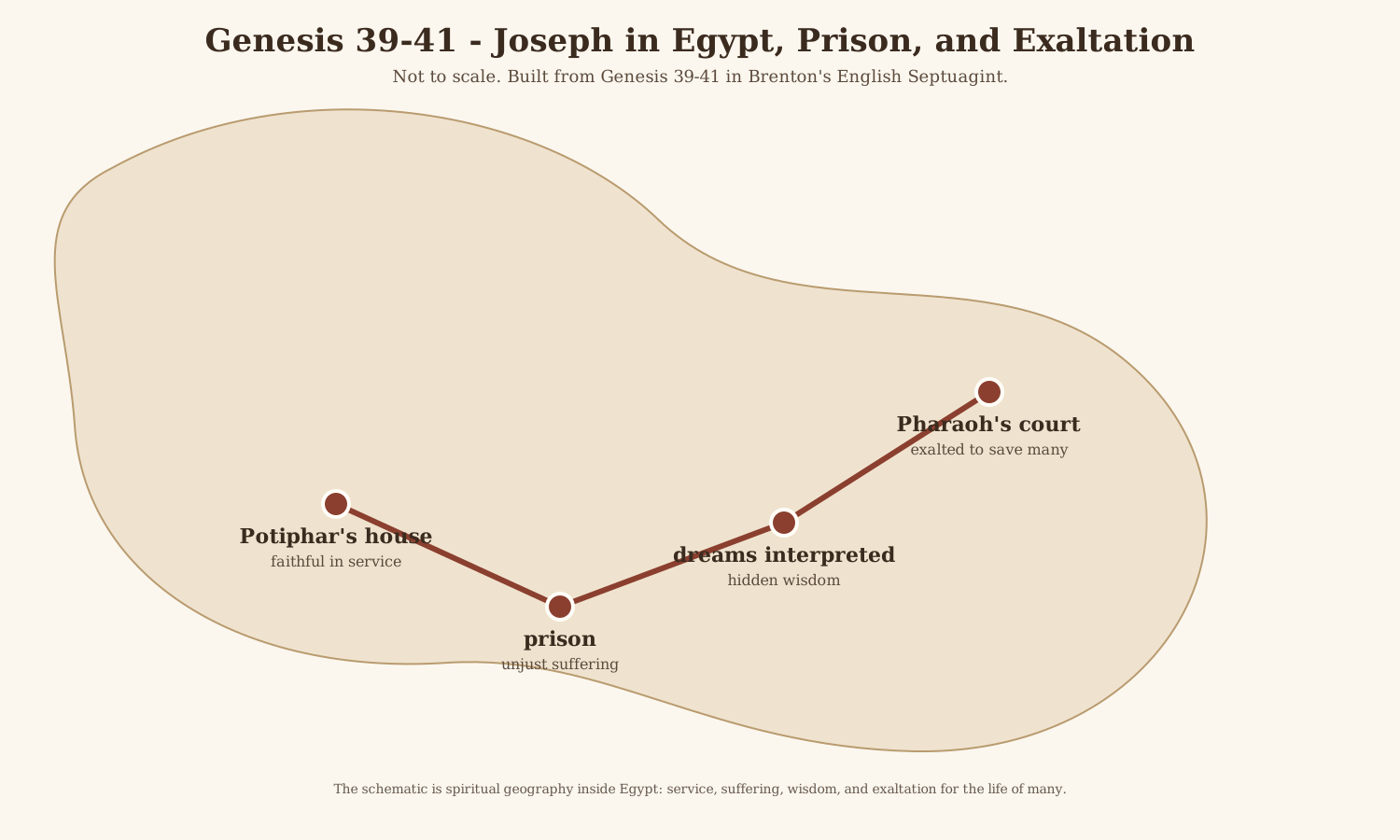 Narrative schematic drawn from Genesis 39-41 in Brenton’s English Septuagint; not to scale.
A king’s trouble recalls a forgotten prisoner (Genesis 41:1-13)
1 And it came to pass after two full years that Pharao had a dream. He thought he stood upon the bank of the river. 2 And lo, there came up as it were out of the river seven cows, fair in appearance, and choice of flesh, and they fed on the sedge. 3 And other seven cows came up after these out of the river, ill-favoured and lean-fleshed, and fed by the other cows on the bank of the river. 4 And the seven ill-favoured and lean cows devoured the seven well-favoured and choice-fleshed cows; and Pharao awoke. 5 And he dreamed again. And, behold, seven ears came up on one stalk, choice and good. 6 And, behold, seven ears thin and blasted with the wind, grew up after them. 7 And the seven thin ears and blasted with the wind devoured the seven choice and full ears; and Pharao awoke, and it was a dream. 8 And it was morning, and his soul was troubled; and he sent and called all the interpreters of Egypt, and all her wise men; and Pharao related to them his dream, and there was no one to interpret it to Pharao. 9 And the chief cupbearer spoke to Pharao, saying, I this day remember my fault: 10 Pharao was angry with his servants, and put us in prison in the house of the captain of the guard, both me and the chief baker. 11 And we had a dream both in one night, I and he; we saw, each according to his dream. 12 And there was there with us a young man, a Hebrew servant of the captain of the guard; and we related to him our dreams, and he interpreted them to us. 13 And it came to pass, as he interpreted them to us, so also it happened, both that I was restored to my office, and that he was hanged.
The dreams begin beside the river, with cattle and grain, the food-bearing world on which Egypt depends. In each dream the thin consumes the plentiful. Pharaoh awakens disturbed and gathers the interpreters and wise men, but none can explain what he has seen. The royal household has access to learned advisers and still reaches a limit.
That failure draws a forgotten act of service into view. The cupbearer says he remembers his fault and tells Pharaoh about the Hebrew servant who interpreted his and the baker’s dreams in custody. He supplies the essential evidence: each outcome happened as Joseph had said. The story that appeared to end in neglect is now spoken before the king.
Two full years separate the cupbearer’s release from this conversation. The narrative does not describe Joseph’s thoughts during them. We can honor the Lord’s care without inventing his mood or telling another sufferer how long their own waiting must last. What becomes visible here is that the prison’s hidden service has a reach beyond what either prisoner could arrange.
The repeated dream of a king and the failure of his wise men prepare a comparison with Daniel 2. In that later account a Jewish captive likewise stands before royal power after the court’s resources fail. In both stories, wisdom will be received from the God who knows what the king cannot command into being. The prison and the exile become places from which God sends help, rather than proof that He has abandoned His servants.
An answer of safety comes through God (Genesis 41:14-24)
14 And Pharao having sent, called Joseph; and they brought him out from the prison, and shaved him, and changed his dress, and he came to Pharao. 15 And Pharao said to Joseph, I have seen a vision, and there is no one to interpret it; but I have heard say concerning thee that thou didst hear dreams and interpret them. 16 And Joseph answered Pharao and said, Without God an answer of safety shall not be given to Pharao. 17 And Pharao spoke to Joseph, saying, In my dream methought I stood by the bank of the river; 18 and there came up as it were out of the river, seven cows well-favoured and choice-fleshed, and they fed on the sedge. 19 And behold seven other cows came up after them out of the river, evil and ill-favoured and lean-fleshed, such that I never saw worse in all the land of Egypt. 20 And the seven ill-favoured and thin cows ate up the seven first good and choice cows. 21 And they went into their bellies; and it was not perceptible that they had gone into their bellies, and their appearance was ill-favoured, as also at the beginning; and after I awoke I slept, 22 and saw again in my sleep, and as it were seven ears came up on one stem, full and good. 23 And other seven ears, thin and blasted with the wind, sprang up close to them. 24 And the seven thin and blasted ears devoured the seven fine and full ears: so I spoke to the interpreters, and there was no one to explain it to me.
Joseph is brought from the prison, shaved, and given a change of dress. He is prepared to appear before Pharaoh, but those changes do not become the source of his wisdom. When the king praises his ability to interpret, Joseph answers with God. Brenton’s wording is striking: “Without God an answer of safety shall not be given to Pharao.” Safety is at stake, not merely the satisfaction of a royal curiosity.
Pharaoh recounts the dreams at length, adding that the lean cattle looked no better even after swallowing the fat ones. The coming scarcity will be so severe that earlier plenty becomes imperceptible. Joseph allows him to finish. Wisdom listens closely enough to answer the actual account instead of merely displaying a ready insight.
Daniel 2:27-30 offers a close parallel. Daniel says the secret is beyond the court’s interpreters and that a God in heaven reveals mysteries. He then denies that the mystery was revealed to him because of any wisdom in him beyond all others living. The glory goes to God; the benefit reaches the king. Such humility makes gifted service possible without turning the servant into an object of worship.
Language insight: “an answer of safety”
The NKJV, following the Hebrew-based form, has Joseph first disclaim the power as his own and then say that God will give Pharaoh an answer of peace. Brenton instead expresses the necessity of God for an answer that brings safety.1 Both direct the king beyond the captive’s personal ability, but the sentence printed here should be heard in its own force: Egypt’s safety cannot come from Joseph apart from God. The following proposal will show what an answer concerned with life requires.
Gems from the Fathers 💎: The gift without self-exaltation
St. John Chrysostom, reflecting on Daniel in Homily XXVI on Hebrews, section 8, praises precisely this refusal to claim divine honor: “For that he also was humble, and referred [the] glory to God no less than they, is evident from many places.”2 He compares Daniel’s humility with that of the apostles and then quotes Daniel’s denial of exceptional personal wisdom. This is a witness from the parallel story, not direct commentary on Joseph’s sentence. It helps us see how honor can be received for service while its spiritual source remains confessed. Joseph’s first word before power is an act of that freedom.
Revelation becomes provision (Genesis 41:25-36)
25 And Joseph said to Pharao, The dream of Pharao is one; whatever God does, he has shewn to Pharao. 26 The seven good cows are seven years, and the seven good ears are seven years; the dream of Pharao is one. 27 And the seven thin kine that came up after them are seven years; and the seven thin and blasted ears are seven years; there shall be seven years of famine. 28 And as for the word which I have told Pharao, whatsoever God intends to do, he has shewn to Pharao: 29 behold, for seven years there is coming great plenty in all the land of Egypt. 30 But there shall come seven years of famine after these, and they shall forget the plenty that shall be in all Egypt, and the famine shall consume the land. 31 And the plenty shall not be known in the land by reason of the famine that shall be after this, for it shall be very grievous. 32 And concerning the repetition of the dream to Pharao twice, it is because the saying which is from God shall be true, and God will hasten to accomplish it. 33 Now then, look out a wise and prudent man, and set him over the land of Egypt. 34 And let Pharao make and appoint local governors over the land; and let them take up a fifth part of all the produce of the land of Egypt for the seven years of the plenty. 35 And let them gather all the food of these seven good years that are coming, and let the corn be gathered under the hand of Pharao; let food be kept in the cities. 36 And the stored food shall be for the land against the seven years of famine, which shall be in the land of Egypt; and the land shall not be utterly destroyed by the famine.
Joseph unites the two dreams as one divine disclosure. Seven plentiful years will be followed by seven years of severe famine. Their repetition establishes the message and its approaching fulfillment. What looked like two separate images becomes one demand upon the king’s present responsibility.
The interpretation does not end with prediction. Joseph recommends a wise and prudent administrator, governors, a fifth of the plentiful harvest, and food stored in the cities. The grain belongs near the people who will need it. Prudence gives the revelation a public form: resources gathered now will preserve the land later. Trust in God’s disclosure calls forth planning rather than replacing it.
This is a particular policy within Pharaoh’s kingdom, not a universal divine tax rate. Its stated aim is that the land not be utterly destroyed. The later famine administration will require its own moral examination; here the text gives the purpose by which stewardship must be judged. Knowledge that impresses a ruler but never reaches the hungry has not completed this task.
There is a searching application for any household or parish with an interval of plenty. Some of what is available now should protect people whose need is already foreseeable. The habit of saving can serve love when it prepares for dependents, illness, age, or shared distress. Hoarding secures the possessor against the neighbor; Joseph’s plan looks toward opening the stores when hunger comes. Its wisdom is measured at that future opening.
A robe, a name, and a responsibility (Genesis 41:37-49)
37 And the word was pleasing in the sight of Pharao, and in the sight of all his servants. 38 And Pharao said to all his servants, Shall we find such a man as this, who has the Spirit of God in him? 39 And Pharao said to Joseph, Since God has shewed thee all these things, there is not a wiser or more prudent man than thou. 40 Thou shalt be over my house, and all my people shall be obedient to thy word; only in the throne will I excel thee. 41 And Pharao said to Joseph, Behold, I set thee this day over all the land of Egypt. 42 And Pharao took his ring off his hand, and put it on the hand of Joseph, and put on him a robe of fine linen, and put a necklace of gold about his neck. 43 And he mounted him on the second of his chariots, and a herald made proclamation before him; and he set him over all the land of Egypt. 44 And Pharao said to Joseph, I am Pharao; without thee no one shall lift up his hand on all the land of Egypt. 45 And Pharao called the name of Joseph, Psonthomphanech; and he gave him Aseneth, the daughter of Petephres, priest of Heliopolis, to wife. 46 And Joseph was thirty years old when he stood before Pharao, king of Egypt. And Joseph went out from the presence of Pharao, and went through all the land of Egypt. 47 And the land produced, in the seven years of plenty, whole handfuls of corn. 48 And he gathered all the food of the seven years, in which was the plenty in the land of Egypt; and he laid up the food in the cities; the food of the fields of a city round about it he laid up in it. 49 And Joseph gathered very much corn as the sand of the sea, until it could not be numbered, for there was no number of it.
Pharaoh recognizes the Spirit of God in Joseph and calls him wiser and more prudent than any alternative. The foreign servant is given authority over the royal house and the people, with only the throne reserved to Pharaoh. Ring, linen robe, gold necklace, chariot, and herald make the appointment publicly recognizable. They announce delegated responsibility, not Joseph’s independence from every higher authority.
Daniel 5:11-14 offers another royal acknowledgment of divine Spirit and exceptional understanding in a captive. Joseph and Daniel have not become wise because foreign kings approve them. Rather, rulers find themselves needing a gift whose source lies beyond their courts. The recognition should not be inflated into a complete Trinitarian confession by Pharaoh. It does reveal that the Lord’s work can be recognized outside Israel.
The clothing answers two earlier scenes: his brothers stripped off his tunic, and the master’s wife retained his garment as false evidence. Now the king gives him fine linen. That reversal matters because the authority is entrusted for life, not for the satisfaction of humiliating those who humiliated him. His first recorded work after the appointment is to travel through the land and gather food.
Joseph is thirty at his appointment. David is thirty when he begins to reign (2 Samuel 5:4, LXX 2 Kingdoms 5:4), and Luke 3:23 says Jesus is “about thirty years of age” when He begins His ministry. These are real scriptural correspondences, not an explanation of why every servant must receive office at that age. Joseph’s own public beginning sends him through Egypt. His authority becomes legible in patient work long before the famine reveals its full necessity.
Language insight: the “herald”, “Psonthomphanech”, and “Heliopolis”
Brenton reports a herald’s proclamation without quoting its words; the NKJV prints “Bow the knee!” The two forms describe the public announcement of Joseph’s new authority, but the cry must not be inserted into Brenton’s Scripture block. The name “Psonthomphanech” is the Septuagint form where the NKJV has “Zaphnath-Paaneah.” The NKJV’s note offers a probable Egyptian meaning, “God Speaks and He Lives”; it is a proposal, not an etymology established by the narrative.3 The name marks Joseph’s new public place within Egypt while the account continues to call him Joseph.
“Heliopolis” means “City of the Sun,” the Greek name corresponding to “On” in the NKJV. Aseneth, commonly spelled Asenath, is the daughter of its priest; this Petephres is Poti-Pherah in the NKJV and should not be casually identified with Joseph’s earlier master merely because Brenton gives both men the same name. Their offices distinguish them: Pharaoh’s captain of the guard in Genesis 39:1 and the priest of Heliopolis here. The marriage gives Joseph an Egyptian household. Scripture does not tell us Aseneth’s conversion or invite us to supply a later story as though it were part of this verse.
Fruitfulness with an unfinished family history (Genesis 41:50-52)
50 And to Joseph were born two sons, before the seven years of famine came, which Aseneth, the daughter of Petephres, priest of Heliopolis, bore to him. 51 And Joseph called the name of the first-born, Manasse; for God, said he, has made me forget all my toils, and all my father’s house. 52 And he called the name of the second, Ephraim; for God, said he, has increased me in the land of my humiliation.
The sons are born before the famine. Joseph names the first Manasse, Manasseh in the NKJV, from God’s making him forget his toils and his father’s house. Ephraim receives the explanation that God has increased him in the land of his humiliation. The names contain thanksgiving, yet Egypt is still called a place of humiliation even after its king has honored him. A high office cannot rewrite how he arrived.
“All my father’s house” introduces a tension that easy accounts of Joseph’s success can miss. His father has mourned him, and the narrative has reported no message sent home during Joseph’s rise or the years of gathering grain. It does not explain that silence, so we should not invent either a noble strategy or a malicious intention. The name describes relief from a painful past while leaving the bonds to that past unresolved.
Forgetting the weight of toil is not the same as reconciling a household. The famine will bring his brothers before him, and the next chapters will show how much memory remains. Ephraim’s fruitfulness and Manasseh’s forgetting are therefore thanksgiving within an unfinished story. God has given Joseph real good without requiring every wound to have been healed already.
The names help a Christian distinguish recovery from erasure. New work, marriage, children, or a settled home may be mercies after suffering. Receive them gratefully without making the right to rejoice depend on a completed family reconciliation. Nor should those mercies become a reason to deny responsibilities that can be undertaken safely and truthfully. Joseph’s story has reached abundance; it has not yet reached the embrace.
The hungry nations come for bread (Genesis 41:53-57)
53 And the seven years of plenty passed away, which were in the land of Egypt. 54 And the seven years of famine began to come, as Joseph said; and there was a famine in all the land; but in all the land of Egypt there was bread. 55 And all the land of Egypt was hungry; and the people cried to Pharao for bread. And Pharao said to all the Egyptians, Go to Joseph, and do whatsoever he shall tell you. 56 And the famine was on the face of all the earth; and Joseph opened all the granaries, and sold to all the Egyptians. 57 And all countries came to Egypt to buy of Joseph, for the famine prevailed in all the earth.
The plenty ends, and the famine arrives as foretold. There is famine in the land, but bread in Egypt. When the people cry out, Pharaoh directs them to Joseph, and Joseph opens the granaries. He sells the stored food; the text does not describe a free distribution. Peoples beyond Egypt also come to buy. The administrator’s task now reaches the nations.
Christ surpasses Joseph as the giver of life. Joseph opens stores of grain; Jesus declares in John 6:35 that He is the Bread of Life. The incarnate Word gives Himself for the world’s life, rather than merely administering a created provision. Christians come to Him in faith and receive His life-giving Body and Blood in the Eucharist. Hunger in Genesis prepares us to hear that gift with bodily seriousness, while ordinary bread and care for the hungry remain real duties.
Egypt here shelters hungry peoples through a Hebrew servant and his Egyptian household. Isaiah 19:19-25 later opens a still wider horizon of Egypt knowing the Lord, worshiping Him, and sharing blessing with Assyria and Israel. Matthew 2:13-15 recounts the Holy Family’s refuge in Egypt and applies Hosea 11:1 to the Son called out of Egypt. Matthew’s “My Son” differs from Brenton’s Septuagint form in Hosea, “his children”; the Gospel applies Israel’s history to the incarnate Son.4 For Coptic Christians, this land is more than the background of a foreign success: it is a place reached by God’s saving care and by the incarnate Lord Himself. Neither its priesthood nor its empire saves Joseph. God’s mercy makes a servant fruitful there and prepares us to behold the One who brings life to every nation.
Language insight: “do whatsoever he shall tell you”
Pharaoh’s direction resembles the Mother of God’s words to the servants at Cana. In John 2:5 she directs them to do whatever Jesus says. The Greek sentences share the pattern of whatever he says to you, do it, including the imperative ποιήσατε (poiēsate), “do.”5 The wording offers a fitting biblical echo: need is answered by coming to the appointed giver and heeding his word. A verbal resemblance supports that contemplation; it does not by itself prove that John is deliberately citing this verse.
Gems from the Fathers 💎: Life beyond a season of grain
St. Cyril of Alexandria, explaining John 6:48-51 in Commentary on John, Book IV, chapter 2, distinguishes manna’s temporal nourishment from the life received in Christ. He describes those who ate manna as “gaining thereby life for a season,” while communion with the Son makes His people “superior to the very bonds of death.”6 Cyril is commenting on the Gospel and manna, not supplying a direct exposition of Joseph’s granaries. His distinction gives the comparison its Christian fullness: material nourishment sustains the body for a time; the flesh of the Word is life-giving because it is His own. He acknowledges that those who partake still taste bodily death. The gift is not a guarantee against present sickness or mortality; resurrection is its horizon.
The Church’s Voice in Worship ⛪
The Lord’s Prayer in the Agpeya asks, “Give us this day our daily bread”.7 The prayer makes the hunger of Genesis part of our daily dependence on the Father: bread is received, even when prudent hands have stored it. Its word “us” also widens our concern beyond our own table. We ask for the food our neighbors need as well as our own, and the stores entrusted to us must be ready to open when another household hungers. This daily prayer belongs beside our approach to Christ, the Bread of Life, who gives Himself and teaches His people to serve.
Spiritual Fruit 🍇
Give the gift back to its Giver. Joseph’s answer before Pharaoh begins with God. When ability wins recognition, practice a truthful acknowledgment of grace and of those who have helped you. Then return attention to the need your skill can meet. Gratitude keeps a useful gift from becoming a throne in the heart.
Turn an interval of plenty toward someone else’s future. Joseph’s stores answer a famine that has not yet arrived. Review one area of household or parish stewardship with that question in view: who depends on this provision when circumstances become harder? Make a modest, actual provision rather than indulging either anxious hoarding or careless spending. Savings and generosity can serve the same love when both protect people.
Receive the robe as a task. New authority gives Joseph more work and more people to serve. If you have responsibility over employees, children, parish funds, or a ministry, ask what happens to the vulnerable when your decisions are made. Listen to the people affected, and keep records and promises that allow your care to be tested. A title is not evidence that those entrusted to you are being nourished.
Give thanks without pretending the whole story is healed. Joseph names both fruitfulness and humiliation. You may thank God for a new beginning while still needing care for an old wound. Bring both to Him. Do not demand a painless memory from yourself or a premature reunion from someone else. The grace that gives present good can also sustain truthful, patient attention to what remains unfinished.
Come to the Bread of Life, then open your hand. Prepare for the Eucharist with repentance, prayer, and a desire to receive Christ rather than merely to complete an obligation. The Lord’s Body and Blood give communion with Him, not social distinction over those who cannot yet approach. Let that communion bear visible mercy afterward: share food, support a person in need, or help the parish make its care dependable. The people who cried for bread should not disappear from Christian memory when we begin speaking of heavenly food.
Lord Jesus Christ, true Bread of Life, receive the hunger I bring to You. Teach me to use abundance before want exposes my selfishness. Keep me humble when entrusted with responsibility and grateful when a new beginning comes. Feed Your people with Your own life, and make our hands ready to serve those who hunger.
Teaching Notes
A king’s trouble recalls a forgotten prisoner (Genesis 41:1-13)
- Ask: What makes the cupbearer’s report credible to Pharaoh, and what does its delay cost Joseph?
- Watch for: The narrator does not supply Joseph’s thoughts during the two years or a timetable for other sufferers.
An answer of safety comes through God (Genesis 41:14-24)
- Ask: How does an answer concerned with safety change the purpose of interpreting the dreams?
- Watch for: Keep Brenton’s God-dependent formulation distinct from the NKJV’s first-person disclaimer.
Revelation becomes provision (Genesis 41:25-36)
- Ask: Why does Joseph’s interpretation require a practical response?
- Watch for: The fifth is a particular famine measure, not a universal divine tax rate or approval of every later policy.
A robe, a name, and a responsibility (Genesis 41:37-49)
- Ask: What do the signs of office require Joseph to do for people beyond the palace?
- Watch for: Explain differing names without merging the two Egyptian officials or treating Pharaoh’s words as a developed Trinitarian confession.
Fruitfulness with an unfinished family history (Genesis 41:50-52)
- Ask: How can the names express real thanksgiving while leaving the family story unresolved?
- Watch for: The text reports no message home but gives no motive for the silence; do not invent one.
The hungry nations come for bread (Genesis 41:53-57)
- Ask: What is the difference between Joseph’s grain and the life Christ gives?
- Watch for: Eucharistic life neither replaces feeding the hungry nor promises freedom from present mortality.
Sources
Embedded Scripture is from Brenton’s English Septuagint (LXX). New Testament quotations are from NKJV.
Brenton, Genesis 39-41; Daniel 2:27-30 and 5:11-14; 2 Samuel 5:4 (LXX 2 Kingdoms 5:4); Isaiah 19:19-25; Hosea 11:1 🔗. New Testament: Luke 3:23; John 2:5 and 6:35, 51; Matthew 2:13-15.
NKJV, Genesis 41, for comparison of verse 16, the herald’s cry, and names 🔗. The name’s Egyptian meaning is identified there as probable.
St. John Chrysostom, Homilies on Hebrews XXVI.8, on Daniel’s humility; St. Cyril of Alexandria, Commentary on John IV.2, on John 6:48-51.
Narrative schematic drawn from Genesis 39-41, retained above as an aid to the sequence of house, confinement, dreams, and public responsibility.
Footnotes
-
St. John Chrysostom, Homily XXVI on Hebrews, section 8 🔗. Nicene and Post-Nicene Fathers, first series, vol. 14. ↩
-
NKJV Genesis 41:43-45 and its note on “Zaphnath-Paaneah” 🔗; Swete, Greek Genesis 41:45, “Ἡλίου πόλεως,” City of the Sun 🔗. ↩
-
Swete, Greek Genesis 41:55 🔗; Nestle 1904, John 2:5 🔗. The shared imperative “ποιήσατε” means “do.” ↩
-
St. Cyril of Alexandria, Commentary on John, Book IV, chapter 2, John 6:48-51, pp. 406-409 🔗. Translation by P. E. Pusey, vol. 1 (1874). The chapter heading is “That the Holy Body of Christ is Lifegiving”; the Gospel distinction between temporary nourishment and incorruption governs the use here. ↩
-
Agpeya, First Hour, “Introduction to Every Hour,” Lord’s Prayer 🔗. The quotation follows the Agpeya translation. ↩