


Content note: This chapter includes sexual wrongdoing, a neglected widow, and a threat of execution.
Judah can recognize his own possessions before he can admit his own sin. When Tamar sends back the ring, bracelet, and staff he left with her, the man who ordered her death has to say, “Thamar is cleared rather than I.” Genesis 38 interrupts Joseph’s story to expose another part of the same family’s need for mercy: a widow kept waiting, a promise withheld, and a father protecting his reputation while condemning someone else. The chapter ends with the birth of the twins whose names will be remembered in Christ’s genealogy. Grace enters this history through truth, without excusing the wrong that truth reveals.
Judah goes down (Genesis 38:1-5)
1 And it came to pass at that time that Judas went down from his brethren, and came as far as to a certain man of Odollam, whose name was Iras. 2 And Judas saw there the daughter of a Chananitish man, whose name was Sava; and he took her, and went in to her. 3 And she conceived and bore a son, and called his name, Er. 4 And she conceived and bore a son again; and called his name, Aunan. 5 And she again bore a son; and called his name, Selom: and she was in Chasbi when she bore them.
Genesis places Judah’s departure between Joseph’s sale in chapter 37 and his life in Egypt in chapter 39. “Judas went down” here is answered by Joseph being “brought down” to Egypt in 39:1. One brother departs and establishes his household; the other is carried away under constraint. The contrast will become moral as well as geographical: Judah turns aside toward a supposed prostitute in this chapter, while Joseph refuses Potiphar’s wife and flees in 39:7-12.
Brenton’s “Judas” is Judah; Iras is Hirah, Odollam is Adullam, and Aunan and Selom are Onan and Shelah. These forms can obscure familiar connections when a reader compares translations. The chapter names Judah’s marriage and three sons without yet describing the father’s whole spiritual condition. His wife’s Canaanite origin supplies the setting; it cannot support contempt for a people. His conduct, his sons’ conduct, and his broken promise will reveal the household’s disorder.
Judah is Jacob’s fourth son. Genesis 49:3-12 judges Reuben’s violation of his father’s bed and Simeon and Levi’s violent anger before speaking of rule through Judah. First Chronicles 5:1-2 distinguishes Joseph’s inherited birthright from the ruling line through Judah. These gifts should not be collapsed into one transfer. The chapter before us also strips Judah of any claim to automatic moral superiority. God’s promise is larger than the man’s present character, and his character must change.
Er, Aunan, and the refusal of brotherly duty (Genesis 38:6-11)
6 And Judas took a wife for Er his first-born, whose name was Thamar. 7 And Er, the first-born of Judas, was wicked before the Lord; and God killed him. 8 And Judas said to Aunan, Go in to thy brother’s wife, and marry her as her brother-in-law, and raise up seed to thy brother. 9 And Aunan, knowing that the seed should not be his—it came to pass when he went in to his brother’s wife, that he spilled it upon the ground, so that he should not give seed to his brother’s wife. 10 And his doing this appeared evil before God; and he slew him also. 11 And Judas said to Thamar, his daughter-in-law, Sit thou a widow in the house of thy father-in-law, until Selom my son be grown; for he said, Lest he also die as his brethren; and Thamar departed, and sat in the house of her father.
The narrator calls Er wicked before the Lord, but does not identify his offence. Aunan’s offence is described: he knows the offspring would count as his brother’s, and deliberately prevents that outcome. The concern is the dead brother’s family continuity and the widow’s place within it. Deuteronomy 25:5-10 will later regulate the duty of a surviving brother in such a case, including a public procedure when he refuses. Genesis records this family obligation before that law is given.
Aunan accepts sexual relations with Tamar while defeating the responsibility those relations are meant to fulfill. The explicit motive, “so that he should not give seed to his brother’s wife,” belongs at the center of the reading. The scene does not describe Tamar’s consent or establish a specific act of coercion. Nor does it authorize compulsory sexual access to a widow. Questions about marital life need pastoral discernment rather than a ruling drawn from this verse alone. God sees the vulnerable person whose future another treats as expendable.
Judah then postpones Tamar’s marriage to Selom because he fears another son’s death. His concern for his own son leaves her waiting under a promise he will fail to fulfill. Brenton’s English prints “father-in-law” in Judah’s instruction and “father” in the narrator’s following clause. Swete’s Greek has “your father” in the instruction, corresponding to “her father” in the account of her departure.1 The English difference should not be used to suggest Tamar disobeyed or left a place Judah had provided for her. She returns to her father’s house holding a promise that Judah will not fulfill. The later narrative explains the decisive injustice: Selom grows, and Judah still withholds him. Tamar’s waiting has become a way of excluding her.
Tamar’s disguise and Judah’s pledge (Genesis 38:12-19)
12 And the days were fulfilled, and Sava the wife of Judas died; and Judas, being comforted, went to them that sheared his sheep, himself and Iras his shepherd the Odollamite, to Thamna. 13 And it was told Thamar his daughter-in-law, saying, Behold, thy father-in-law goeth up to Thamna, to shear his sheep. 14 And having taken off the garments of her widowhood from her, she put on a veil, and ornamented her face, and sat by the gates of Ænan, which is in the way to Thamna, for she saw that Selom was grown; but he gave her not to him for a wife. 15 And when Judas saw her, he thought her to be a harlot; for she covered her face, and he knew her not. 16 And he went out of his way to her, and said to her, Let me come in to thee; for he knew not that she was his daughter-in-law; and she said, What wilt thou give me if thou shouldest come in to me? 17 And he said, I will send thee a kid of the goats from my flock; and she said, Well, if thou wilt give me an earnest, until thou send it. 18 And he said, What is the earnest that I shall give thee? and she said, Thy ring, and thy bracelet, and the staff in thy hand; and he gave them to her, and went in to her, and she conceived by him. 19 And she arose and departed, and took her veil from off her, and put on the garments of her widowhood.
Tamar sees that Selom has grown and that Judah has failed to give her to him. Her change of clothes therefore takes place within an already broken promise. She removes the garments that mark her widowhood, veils herself, and positions herself on Judah’s way to the sheep-shearing. The text gives her reason without turning her course of action into a general prescription for obtaining justice.
Judah thinks he sees a prostitute and turns aside to her. Joseph, in the next chapter, will leave his garment in another person’s hand in order to escape sexual sin. Tamar changes garments to confront Judah’s neglect; Judah gives away identifying possessions to satisfy his desire; Joseph loses a garment through fidelity to God. The repeated clothing scenes show garments used to conceal, to expose, and to escape sin.
The pledged ring, bracelet, and staff become concrete witnesses against Judah. Brenton’s “earnest” means security left until the promised kid arrives. In the Greek of Genesis 38:17-18, the noun is “ἀρραβών,” arrabōn, a pledge. Paul uses the same noun for God’s gift of the Spirit as a pledge in 2 Corinthians 1:22. The ordinary meaning helps us understand Paul’s assurance: God gives a present gift that guarantees His promise. This is a vocabulary connection, rather than an allegory that makes Judah’s bargain holy.2
The promised goat continues the family pattern of Genesis 27:9-16 and 37:31. In those scenes, goats and garments helped to conceal identity or fate; here the pledge retained while a goat is sent will reveal identity. The instruments of concealment cannot keep the truth buried forever.
Hypocrisy exposed and responsibility confessed (Genesis 38:20-26)
20 And Judas sent the kid of the goats by the hand of his shepherd the Odollamite, to receive the pledge from the woman; and he found her not. 21 And he asked the men of the place, Where is the harlot who was in Ænan by the way-side? and they said, There was no harlot here. 22 And he returned to Judas, and said, I have not found her; and the men of the place say, There is no harlot here. 23 And Judas said, Let her have them, but let us not be ridiculed; I sent this kid, but thou hast not found her. 24 And it came to pass after three months, that it was told Judas, saying, Thamar thy daughter-in-law has grievously played the harlot, and behold she is with child by whoredom; and Judas said, Bring her out, and let her be burnt. 25 And as they were bringing her, she sent to her father-in-law, saying, I am with child by the man whose these things are; and she said, See whose is this ring and bracelet and staff. 26 And Judas knew them, and said, Thamar is cleared rather than I, forasmuch as I gave her not to Selom my son: and he knew her not again.
Judah’s first concern when the woman cannot be found is ridicule. He is willing to leave his belongings with her to protect his reputation. Three months later, the report of Tamar’s pregnancy produces an immediate demand that she be burned. He grants himself privacy and grants her a public sentence. Authority becomes deadly when a man exempts himself from the judgment he imposes on another.
Tamar sends the tokens while she is being brought out. The demand to identify them answers the brothers’ demand that Jacob identify Joseph’s coat in Genesis 37:32-33. Both scenes use “ἐπίγνωθι,” “recognize,” followed by “ἐπέγνω,” “he recognized.” Here recognition breaks the deception instead of completing it. Judah has to face evidence bearing his own identity.3
“Thamar is cleared rather than I” is the wording displayed in Brenton. The NKJV’s “She has been more righteous than I” expresses the comparison familiar to many readers. The Greek “δεδικαίωται,” dedikaiōtai, is a form of the verb for justifying or vindicating. Tamar is vindicated against Judah’s accusation, and Judah names the reason: he failed to give her to his son. Her claim has been upheld in this dispute. This does not amount to a declaration that every action in the chapter is beyond moral judgment.4
The final clause matters: “he knew her not again.” Scripture joins confession to a changed course of sexual conduct. This is a narrated sign of repentance, not evidence that every consequence was repaired or every relationship restored. In Genesis 44:18-34, Judah will offer himself in Benjamin’s place, carrying the responsibility he evades here. The man who helped sell one brother will eventually plead to bear another brother’s captivity.
Judah’s confession must never be used to require a harmed person to trust a dangerous person immediately. Truth should lead to accountability, amendment, and protection. Readers living under threats or sexual exploitation may seek help from a trusted priest and qualified professionals; immediate safety does not need to wait for another person’s repentance.
Phares and Zara: the preserved line (Genesis 38:27-30)
27 And it came to pass when she was in labour, that she also had twins in her womb. 28 And it came to pass as she was bringing forth, one thrust forth his hand, and the midwife having taken hold of it, bound upon his hand a scarlet thread, saying, This one shall come out first. 29 And when he drew back his hand, then immediately came forth his brother; and she said, Why has the barrier been cut through because of thee? and she called his name, Phares. 30 And after this came forth his brother, on whose hand was the scarlet thread; and she called his name, Zara.
Zara, usually Zerah, first puts out his hand; the midwife marks it with a scarlet thread. Phares, usually Perez, is born first when the hand is withdrawn. The midwife’s words about a breached barrier explain the significance of his name within the scene. Birth order again unsettles an expectation, and Ruth 4:12 later invokes the household of Perez whom Tamar bore to Judah. Ruth 4:18-22 traces the line from Perez to David. Matthew 1:3 then names both twins while following the ancestry through Perez.
Matthew includes four women before Mary: Tamar, Rahab, Ruth, and Bathsheba, designated as the woman who had been Uriah’s wife. Their histories differ; they should never be reduced to a list of sexual scandals. Mary is the fifth woman named or identified in the genealogy and stands at the birth of Jesus Christ. Rahab’s scarlet cord in Joshua 2:18 gives another biblical scene where a scarlet sign is associated with deliverance. The two scenes offer a biblical parallel, while the thread and cord serve different narrative functions.
Gems from the Fathers 💎: The Savior enters our family history
St. John Chrysostom directly discusses Tamar and the twins in Homily 3 on Matthew, §§3-4. He asks why the Evangelist recalls unlawful intercourse in Christ’s ancestry, and answers through the Incarnation: the Lord comes to remove human shame and sin. “Yea, it was for this cause He came, not to escape our disgraces, but to bear them away.”5 Christ’s condescension reveals His mercy, while the history He enters reveals our need for Him. A reader burdened by a family’s past can hear this without assuming another person’s guilt as his own.
Gems from the Fathers 💎: The scarlet sign and the one saving purpose
St. Irenaeus reads the twins in Against Heresies IV.25.1-3 as a figure of faith before the Law, the intervening period of circumcision and Law, and that faith’s fulfillment among the nations in Christ. Zara’s hand appearing first and his birth after Phares serve that sequence. His interpretation concerns the order of God’s saving work; it does not replace the genealogical fact that Christ’s line passes through Perez. Irenaeus links the scarlet token with “the passion of the Just One, which was prefigured from the beginning in Abel, and described by the prophets, but perfected in the last times in the Son of God.”6 His chapter insists on one God gathering the faithful of both covenants. The image serves that unity, and must not be used to cultivate contempt for Jewish people. Chrysostom also reports a related interpretation of the two peoples in Homily 3, §4.
The ruling promise of Genesis 49:8-12 now reaches beyond Judah’s household. Hebrews 7:14 identifies our Lord’s descent from Judah, and Revelation 5:5 names the victorious Lion of Judah. The family’s exposed sin cannot stop God’s purpose; neither can ancestry deliver a person from the need to repent. The promise reaches its fulfillment in the sinless Savior who bears the world’s sin.
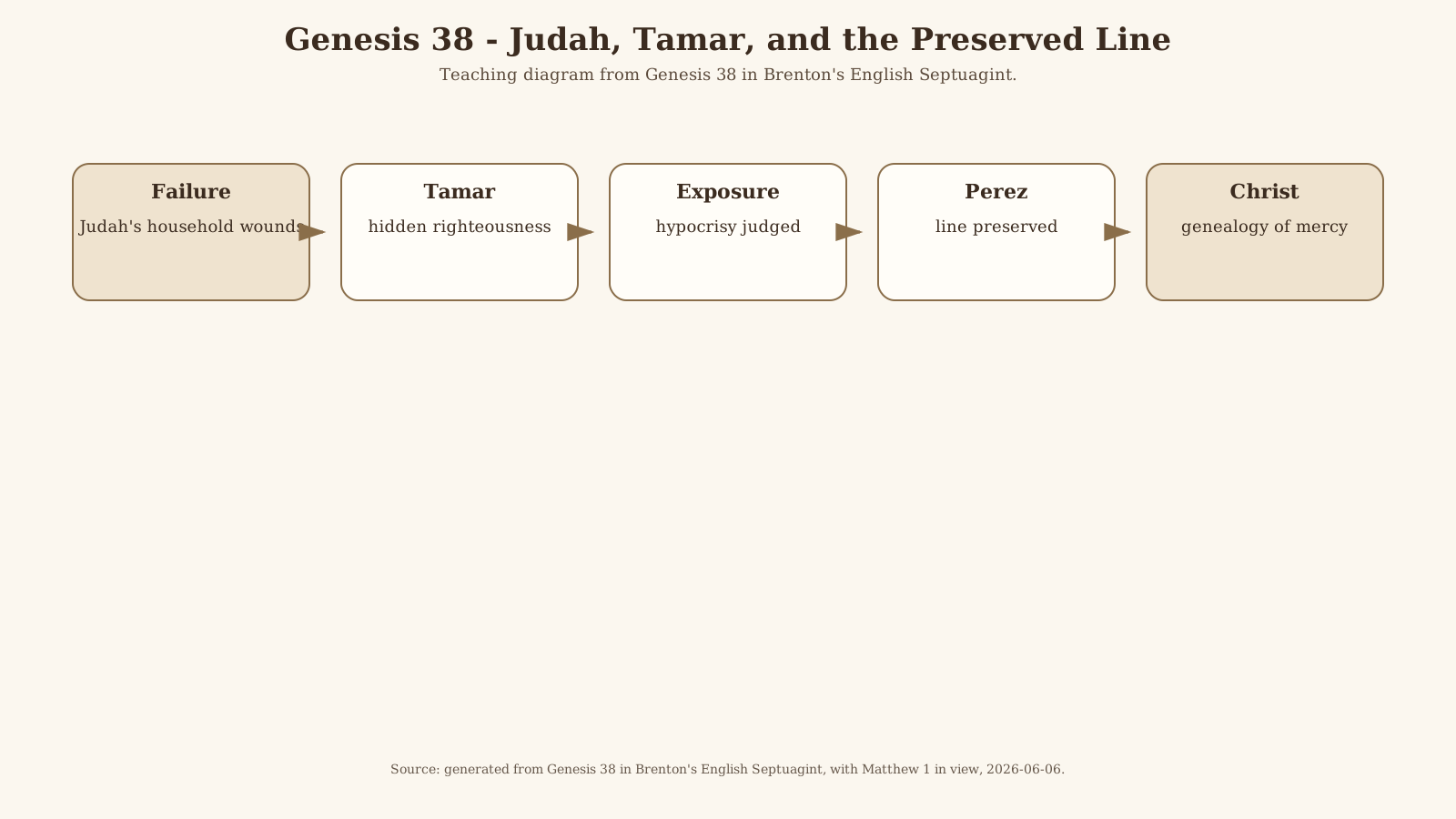 Source: narrative diagram based on Genesis 38 and its genealogical fulfillment in Matthew 1; a schematic, not an icon.
The Church’s Voice in Worship ⛪
At Vespers of the Nativity Paramoun, the preparation for the feast, the Coptic Church reads Matthew 1:1-17.7 Tamar and the twins are heard within the genealogy that ends in Jesus Christ. Before the celebration of His birth, the Church names the generations into which He comes. We prepare by receiving the truth of His mercy and bringing our own hidden failures into confession. The appointed Gospel is Matthew’s genealogy; this connection does not imply an appointment of Genesis 38 itself.
Glossary
- Judas / Judah; Thamar / Tamar: Brenton’s forms for Jacob’s fourth son and his daughter-in-law.
- Aunan / Onan; Selom / Shelah: Judah’s sons, one who defeats his brotherly duty and one whom Judah withholds from Tamar.
- Levirate duty: the responsibility of a surviving brother to raise offspring for a deceased brother; later regulated in Deuteronomy 25:5-10.
- Earnest / pledge: security for a promised payment. Judah’s ring, bracelet, and staff identify him when Tamar presents them.
- Phares / Perez: the twin born first, associated with the breached barrier in the midwife’s words and the line leading to David.
- Zara / Zerah: the twin whose hand appears first and is marked by the scarlet thread, though he is born second.
- Paramoun: a period of preparation before the Nativity or Theophany feast, with its appointed readings and fasting.
Spiritual Fruit 🍇
- Give confession a concrete object. Judah names the promise he broke. In confession, bring a specific act, the person harmed, and the responsibility evaded, rather than hiding behind a general admission of imperfection.
- Repair neglected duties. Tamar waits while Judah moves on. Identify a promise on which someone vulnerable still depends, and either fulfill it or honestly arrange another safe and just provision. No person should be held in uncertainty to protect your convenience.
- Measure repentance by amendment. Judah ceases relations with Tamar. Let confession change a practice that kept the harm alive, while accepting accountability and allowing wounded people time and safety.
- Receive Christ without inherited shame. Matthew names Tamar among the Lord’s ancestors. A family’s sins do not make a child unworthy of Christ’s love. Bring the actual history before Him, seek help where harm continues, and begin the obedience that is yours to offer.
Lord Jesus Christ, born from the line that Scripture refuses to flatter, deliver me from the desire to appear innocent. Give me courage to recognize my own sin, protect those entrusted to my care, and receive Your mercy with a changed life.
Teaching Notes
Keep discussion non-graphic. People harmed by sexual wrongdoing or threats may be present; no personal disclosure is needed.
Judah goes down (Genesis 38:1-5)
- Ask: Why does Judah’s story stand between Joseph’s sale and his refusal of Potiphar’s wife?
- Watch for: Separate Judah’s personal wrongdoing from contempt for his wife’s Canaanite people, and distinguish kingship from Joseph’s birthright.
Er, Aunan, and the refusal of brotherly duty (Genesis 38:6-11)
- Ask: What does Aunan knowingly withhold, and how does Judah prolong Tamar’s exclusion?
- Watch for: The passage supplies Aunan’s motive, not Tamar’s consent. It warrants neither coercive sex nor permission to disregard a widow’s needs.
Tamar’s disguise and Judah’s pledge (Genesis 38:12-19)
- Ask: How do the identifying tokens change the significance of Judah’s promised payment?
- Watch for: The pledge vocabulary helps explain Paul’s assurance, without blessing Judah’s bargain or proposing Tamar’s disguise as a normal remedy.
Hypocrisy exposed and responsibility confessed (Genesis 38:20-26)
- Ask: What responsibility does Judah confess in “Thamar is cleared rather than I,” and what conduct changes afterward?
- Watch for: Tamar’s vindication concerns Judah’s withheld promise, not approval of every act. His amendment is a sign of repentance, not proof that trust must be immediately restored; avoid graphic discussion and victim-blaming.
Phares and Zara: the preserved line (Genesis 38:27-30)
- Ask: How do Perez’s genealogical place and Zara’s role in Irenaeus’ typology answer different questions?
- Watch for: Matthew has four women before Mary, five altogether. Identify Bathsheba by Matthew’s relational designation and avoid making all five stories alike.
Sources
Embedded Scripture is from Brenton’s English Septuagint (LXX).
Lancelot C. L. Brenton, The Septuagint Version of the Old Testament, Genesis 38; biblical connections include Genesis 27:9-16; 37:31-33; 39:1-12; 44:18-34; 49:3-12; Deuteronomy 25:5-10; Joshua 2:18; Ruth 4:12, 18-22; and 1 Chronicles 5:1-2. 🔗
New Testament connections: Matthew 1:1-17; 2 Corinthians 1:22; Hebrews 7:14; Revelation 5:5.
St. John Chrysostom, Homily 3 on Matthew, §§3-4, on Tamar, the Incarnation, ancestry, and the twins, NPNF, first series, vol. 10. 🔗
St. Irenaeus, Against Heresies IV.25.1-3, on faith, the two covenants, and Tamar’s twins, ANF, vol. 1. The sequence is stated explicitly in §1; §2 in this English edition prints “circumcision” at a point where §1 describes faith before circumcision. The interpretation above follows the chapter’s stated sequence, without silently altering the quotation. 🔗
Greek wording: Swete’s Septuagint, Genesis 37:32-33 and 38:17-18, 25-26; New Testament Greek, 2 Corinthians 1:22. Comparative English wording for Genesis 38:26. 🔗 🔗 🔗 🔗
CopticChurch.net, Nativity Paramoun readings, Vespers Gospel Matthew 1:1-17. The dated example is January 6, 2026; the civil date and number of Paramoun days vary with the calendar. 🔗
Footnotes
-
Swete’s Septuagint, Genesis 38:11, has “ἐν τῷ οἴκῳ τοῦ πατρός σου” in Judah’s instruction and “ἐν τῷ οἴκῳ τοῦ πατρὸς αὐτῆς” in the narrative. These refer to Tamar’s father, despite Brenton’s “father-in-law” in the first clause. 🔗 Greek text. ↩
-
Genesis 38:17-18, Swete’s Septuagint, “ἀρραβῶνα”; 2 Corinthians 1:22, the same noun in Paul’s description of the Spirit’s gift. 🔗 🔗 ↩
-
Genesis 37:32-33 and 38:25-26, Swete’s Septuagint, repeated recognition wording. 🔗 🔗 ↩
-
Genesis 38:26, Brenton; Swete’s Greek “Δεδικαίωται Θαμὰρ ἢ ἐγώ”; NKJV comparative rendering. 🔗 🔗 ↩
-
St. John Chrysostom, Homily 3 on Matthew §3, translated by George Prevost, revised by M. B. Riddle, NPNF, first series, vol. 10. 🔗 ↩
-
St. Irenaeus, Against Heresies IV.25.2, translated by Alexander Roberts and William Rambaut, ANF, vol. 1. 🔗 ↩
-
CopticChurch.net, Christmas Paramoune, Vespers, Matthew 1:1-17; January 6, 2026 example. 🔗 ↩