


This narration is from a previous version of the study and may include a combined recording of multiple chapters.
Joshua 1-2 begins the book with two linked movements: the public commissioning of Joshua and the hidden faith of Rahab. The first chapter is about courage governed by the law of God. The second is about a woman from Jericho who recognizes the Lord’s power before many in Israel have yet seen the conquest begin. Together the chapters teach that God’s work moves through both strong obedience and surprising mercy.
These chapters also establish two themes that will govern the whole book. First, Israel’s inheritance depends on the Lord’s presence and not on military self-confidence. Second, the Lord’s judgment on Canaan does not cancel His freedom to save the one who turns to Him in faith. Rahab therefore stands at the beginning of Joshua as a sign that promise and mercy travel together.
Historical and Scriptural Context
The events take place just before the crossing of the Jordan. Moses has died, Joshua has assumed leadership, and Israel is encamped east of the river. Jericho is the first major fortified city facing them in the land. The mission of the spies does not repeat the unbelieving spy episode of Numbers 13. This time the story does not end in paralysis. It ends in confidence, because the issue is not whether the land is difficult, but whether the Lord is faithful.
Joshua 1 is saturated with Deuteronomic language. The command to meditate on the law day and night shows that conquest cannot be separated from covenant. Joshua 2 introduces Rahab, later remembered in Hebrews 11:31 and James 2:25. The New Testament therefore receives her not as a footnote, but as a real witness of faith joined to courageous action.
The two chapters put leadership and outsider faith beside one another. Joshua must receive the word he will speak; Rahab receives news of God’s works and entrusts her household to His mercy. Neither public office nor an honorable past can substitute for that response.
Geographical Significance ⛰️
- Shittim / Sattin is Israel’s final camp east of the Jordan and the launching point for the spies.
- The Jordan stands between promise heard and promise entered.
- Jericho is a strategic oasis city in the lower Jordan valley, heavily associated with access into the central hill country.
- Rahab’s house and window provide shelter and escape. NKJV 2:15 locates the house on the city wall; Brenton’s 2:15 does not include that location.
- The hill country where the spies hide anticipates the terrain of later campaigns and shows that the land is known to the Lord before it is possessed by Israel.
The Characters 👥
- Joshua: courageous because he is under command, not because he is naturally fearless.
- The Lord: the true source of courage, wisdom, and victory.
- The officers, Rubenites, Gadites, and half tribe of Manasse: examples of ordered cooperation and covenant solidarity.
- Rahab: a Gentile woman of Jericho whose faith, hospitality, and boldness place her in the line of salvation.
- The two spies: agents of discernment and witnesses to Rahab’s confession.
- The king of Jericho: emblem of a city already frightened and spiritually exposed.
Light from the Word 🕯️
Scripture readings below retain Brenton’s Septuagint wording while headings follow NKJV numbering. The NKJV follows the Masoretic Hebrew tradition, represented by the medieval Leningrad Codex; Brenton’s Greek edition draws chiefly on fourth-century Codex Vaticanus. These are edition-level descriptions, not a claim that every Greek manuscript agrees at every verse. Leonard Greenspoon explains both the diversity of the Greek witnesses and the debated roles of translation and Hebrew source differences in NETS, pp. 174-175; the date and place of Joshua’s Greek translation remain uncertain.1
Joshua 1:1-9 - Be strong and courageous under the law of God
Text and translation note. In 1:7-8 Brenton ends the commands with wisdom, while the NKJV speaks of prospering and having good success. The wisdom wording belongs to Brenton’s Greek tradition; the NKJV renders the Masoretic Hebrew, where sakal can express prudent conduct as well as success, as Brown-Driver-Briggs explains under שׂכל, Hiphil.2 A translation choice is therefore a plausible explanation, rather than evidence of a different promise, although NETS does not provide a verse-specific account of the origin. Brenton also retains prosperity in verse 8, so wisdom must not be opposed to every kind of success. The emphasis puts Joshua’s understanding under the law, not under a guarantee of worldly achievement.
1 And it came to pass after the death of Moses, that the Lord spoke to Joshua the son of Naue, the minister of Moses, saying, 2 Moses my servant is dead; now then arise, go over Jordan, thou and all this people, into the land, which I give them. 3 Every spot on which ye shall tread I will give it you, as I said to Moses. 4 The wilderness and Antilibanus, as far as the great river, the river Euphrates, and as far as the extremity of the sea; your coasts shall be from the setting of the sun. 5 Not a man shall stand against you all the days of thy life; and as I was with Moses, so will I also be with thee, and I will not fail thee, or neglect thee. 6 Be strong and quit thyself like a man, for thou shalt divide the land to this people, which I sware to give to your fathers. 7 Be strong, therefore, and quit thyself like a man, to observe and do as Moses my servant commanded thee; and thou shalt not turn therefrom to the right hand or to the left, that thou mayest be wise in whatsoever thou mayest do. 8 And the book of this law shall not depart out of thy mouth, and thou shalt meditate in it day and night, that thou mayest know how to do all the things that are written in it; then shalt thou prosper, and make thy ways prosperous, and then shalt thou be wise. 9 Lo! I have commanded thee; be strong and courageous, be not cowardly nor fearful, for the Lord thy God is with thee in all places whither thou goest.
Literal sense. Joshua inherits a mission, not a private dream. He must cross the Jordan, lead the people, divide the land, and remain inside the commandment already given through Moses. The charge repeats Moses’ commission in Deuteronomy 31:7-8, 23. Psalm 1:2 gives the same day-and-night rhythm of meditation; Hebrews 13:5 extends the assurance of God’s faithful presence to Christian life, and Matthew 28:20 places the Church’s mission under Christ’s abiding presence. Ephesians 6:10 locates our strength in the Lord.
LXX insight. The Greek emphasis on becoming wise places courage under understanding. Joshua must know how to obey before he knows how to lead. Meditation is therefore preparation for action, not escape from it.
Christological and typological reading. The greater Joshua, Jesus Christ, brings His people into what the law promised but could not itself bestow: victory over death and entrance into the Father’s house.
Joshua 1:10-18 - The people answer with readiness and solidarity
10 And Joshua commanded the scribes of the people, saying, 11 Go into the midst of the camp of the people, and command the people, saying, Prepare provisions; for yet three days and ye shall go over this Jordan, entering in to take possession of the land, which the Lord God of your fathers gives to you.
12 And to Ruben, and to Gad, and to the half tribe of Manasse, Joshua said, 13 Remember the word which Moses the servant of the Lord commanded you, saying, The Lord your God has caused you to rest, and has given you this land. 14 Let your wives and your children and your cattle dwell in the land, which he has given you; and ye shall go over well armed before your brethren, every one of you who is strong; and ye shall fight on their side; 15 until the Lord your God shall have given your brethren rest, as also to you, and they also shall have inherited the land, which the Lord your God gives them; then ye shall depart each one to his inheritance, which Moses gave you beyond Jordan eastward. 16 And they answered Joshua and said, We will do all things which thou commandest us, and we will go to every place whither thou shalt send us. 17 Whereinsoever we hearkened to Moses we will hearken to thee; only let the Lord our God be with thee, as he was with Moses. 18 And whosoever shall disobey thee, and whosoever shall not hearken to thy words as thou shalt command him, let him die; but be thou strong and courageous.
Literal sense. Joshua acts immediately. The people do not answer with delay. The eastern tribes are reminded that their earlier rest does not excuse them from fighting for their brothers.
Textual observation. Preparing provisions in 1:11 is a literal detail common to the two traditions. It anticipates the end of manna in 5:12: the people prepare food while still receiving the land as God’s gift. Rest already received creates responsibility for brothers still awaiting it.
Christological and typological reading. No tribe may say, “I have already received enough.” In the Church, those given stability must still bear one another’s burdens until all enter their rest.
Joshua 2:1-7 - Rahab hides the spies in a doomed city
1 And Joshua the son of Naue sent out of Sattin two young men to spy the land, saying, Go up and view the land and Jericho: and the two young men went and entered into Jericho; and they entered into the house of a harlot, whose name was Raab, and lodged there.
2 And it was reported to the king of Jericho, saying, Men of the sons of Israel have come in hither to spy the land. 3 And the king of Jericho sent and spoke to Raab, saying, Bring out the men that entered into thine house this night; for they are come to spy out the land. 4 And the woman took the two men and hid them; and she spoke to the messengers, saying, The men came in to me, 5 but when the gate was shut in the evening, the men went out; I know not whither they are gone: follow after them, if ye may overtake them. 6 But she had brought them up upon the house, and hid them in the flax-stalks that were spread by her on the house. 7 And the men followed after them in the way to Jordan to the fords; and the gate was shut.
Literal sense. Rahab receives the spies, hides them, and misdirects the king’s men. The narrative forces the reader to see that faith is already being born inside Jericho before Jericho falls. St Augustine, Against Lying 32, distinguishes the mercy shown to God’s people from the falsehood used to protect them: God rewarded their benevolence, not deceit.3 Honoring Rahab’s courage does not turn lying into a rule for Christian conduct.
Textual observation. The roof, flax-stalks, shut gate, and Jordan fords give the escape its practical shape. Rahab’s allegiance changes before her address does. Nothing in this unit’s Brenton wording places her house on the wall.
Christological and typological reading. Rahab’s first conversion is a transfer of loyalty. She belongs to Jericho by address, but she has already entrusted herself to Israel’s God. So too the Church receives people who have lived under other powers and are brought into a new household.
Joshua 2:8-14 - Rahab confesses the Lord as God in heaven and earth
Text and translation note. Brenton’s 2:9 omits the NKJV’s final statement that all the land’s inhabitants are fainthearted, and 2:12-13 omits Rahab’s request for a “true token”; the spies supply the sign in 2:18. At 2:14 Brenton gives the final plea for mercy to Rahab herself, whereas the NKJV gives the assurance to the spies. These contrasts distinguish Brenton’s Greek text from the Masoretic wording behind the NKJV, without establishing the reading of every manuscript. Holmes, pp. 20-21, discusses accidental loss or Hebrew expansion at 2:9, an anticipatory expansion at 2:12, and possible confusion of Hebrew letters or word forms at 2:14.4 His alternatives are older scholarly proposals, not a demonstrated history or modern consensus. The Greek preserves Rahab’s active appeal for mercy, while both traditions preserve the oath and the household’s rescue.
8 And it came to pass when the men who pursued after them were gone forth, and before the spies had lain down to sleep, that she came up to them on the top of the house; 9 and she said to them, I know that the Lord has given you the land; for the fear of you has fallen upon us. 10 For we have heard that the Lord God dried up the Red Sea before you, when ye came out of the land of Egypt, and all that he did to the two kings of the Amorites, who were beyond Jordan, to Seon and Og, whom ye utterly destroyed. 11 And when we heard it we were amazed in our heart, and there was no longer any spirit in any of us because of you, for the Lord your God is God in heaven above, and on the earth beneath. 12 And now swear to me by the Lord God; since I deal mercifully with you, so do ye also deal mercifully with the house of my father: 13 and save alive the house of my father, my mother, and my brethren, and all my house, and all that they have, and ye shall rescue my soul from death.
14 And the men said to her, Our life for yours even to death: and she said, When the Lord shall have delivered the city to you, ye shall deal mercifully and truly with me.
Literal sense. Rahab interprets history better than Jericho’s king. She has heard the exodus tradition, believed it, and concluded that the Lord has already given the land.
Textual observation. Rahab’s confession in 2:11 echoes Deuteronomy 4:39: the Lord rules heaven and earth. She confesses Israel’s creed from inside a Canaanite city. Her report of fear answers Exodus 15:15-16, and her knowledge of Sihon and Og recalls Numbers 21:21-35.
Christological and typological reading. Rahab stands close to the Gospel logic of hearing, believing, and entering salvation. Her plea for household rescue also anticipates the Church’s prayer that grace gather whole families into life.
Joshua 2:15-24 - The scarlet cord and the sign of salvation
Text and translation note. Brenton’s 2:15 says that Rahab let the spies down by the window; the NKJV’s Masoretic-based text adds that her house stood on the city wall. Holmes, p. 21, treats the wall explanation as a Hebrew gloss, an explanatory addition, but this remains his hypothesis rather than a proven copying sequence.4 The wider Greek manuscript distribution is not established by Brenton’s wording alone. The difference affects our description of the escape, not the faith or mercy of the story: the window is explicit in both, while the wall location must be attributed to the Hebrew account.
15 And she let them down by the window; 16 and she said to them, Depart into the hill-country, lest the pursuers meet you, and ye shall be hidden there three days until your pursuers return from after you, and afterwards ye shall depart on your way.
17 And the men said to her, We are clear of this thy oath. 18 Behold, we shall enter into a part of the city, and thou shalt set a sign; thou shalt bind this scarlet cord in the window, by which thou hast let us down, and thou shalt bring in to thyself, into thy house, thy father, and thy mother, and thy brethren, and all the family of thy father. 19 And it shall come to pass that whosoever shall go outside the door of thy house, his guilt shall be upon him, and we shall be quit of this thine oath; and we will be responsible for all that shall be found with thee in thy house. 20 But if any one should injure us, or betray these our matters, we shall be quit of this thine oath. 21 And she said to them, Let it be according to your word; and she sent them out, and they departed. 22 And they came to the hill-country, and remained there three days; and the pursuers searched all the roads, and found them not.
23 And the two young men returned, and came down out of the mountain; and they went over to Joshua the son of Naue, and told him all things that had happened to them. 24 And they said to Joshua, The Lord has delivered all the land into our power, and all the inhabitants of that land tremble because of us.
Literal sense. The spies establish a concrete sign of protection. Rahab must bind the scarlet cord, gather her household, and remain within the marked house. The spies return not with anxiety but with confidence. St Justin Martyr, Dialogue with Trypho 111, reads the scarlet thread as a sign of Christ’s blood saving sinners from all nations.5 This is Christian typology, not an explanation of the spies’ conscious intention. Rahab’s apostolic reception is explicit in Matthew 1:5, Hebrews 11:31, and James 2:25.
Textual observation. The sign is public, visible, and attached to obedience. Salvation is not automatic. Rahab’s household must remain within the appointed refuge.
Christological and typological reading. The scarlet cord naturally directs the Christian mind toward the saving blood of Christ. Not every red object in Scripture is automatically typology, but here the tradition’s instinct is sound: rescue comes under a marked sign, for those gathered into one house, through a mercy they did not deserve.
The Church’s Voice in Worship 📖
No verse-addressed reading of Joshua 1-2 is appointed in the current lectionary index. Coptic Reader’s Great Thursday Lakkan does contain an adapted, unversified “Joshua from 1, 3” text about the crossing, not a continuous reading of these chapters.6
At the Consecration of a Church, Part 4, the Catholic Epistle is James 2:14-26. Read alongside Rahab, its treatment of faith made visible in action gives her hospitality a place within the Church’s hearing of Scripture. At Matins on Tuesday of the first week of the Holy Fifty Days, the Gospel is Matthew 28:16-20; Christ’s abiding presence answers the promise that steadies Joshua.6
In the First Hour of the Agpeya, Psalm 1 begins the proper psalm set after the introductory penitential psalm. The Midnight Praise sings Exodus 15 as its First Hoos. The published St Antony Monastery translation sings, “All the inhabitants of Canaan will melt away,” followed by “fear and dread will fall on them.”7 Read alongside Joshua 2:9-11, that song helps us hear Rahab receiving the news of the Exodus as a summons to faith.
Gems from the Fathers 💎
St John Chrysostom, Homilies on Hebrews 27.1, preaching on Hebrews 11:28-31, notices how much the apostle can gather into a few words: Passover, the Red Sea, Jericho, and Rahab all become one catechesis in faith. He says the Spirit “does not comprehend a few ideas in a multitude of words, but includes great and manifold thought in brevity of expressions.”8 That is a helpful way to read Rahab. Her story is not a curiosity at the edge of Joshua. It is a compact witness: she hears, believes, receives the spies, marks the house, and is remembered among the faithful.
St Clement of Rome, 1 Clement 12, joins hospitality and faith to the scarlet sign. He explains that “redemption should flow through the blood of the Lord to all them that believe and hope in God.”9 The cord does not purchase mercy. It marks the household that trusts the promised rescue, which Clement reads in the light of Christ’s saving blood.
Iconography and Visual Teaching 🖼️
Rahab is visually powerful, but she must not be treated as spectacle. The artwork depicts the scarlet sign through which a household awaits deliverance. Matthew 1:5 remembers Rahab within the genealogy of Christ.
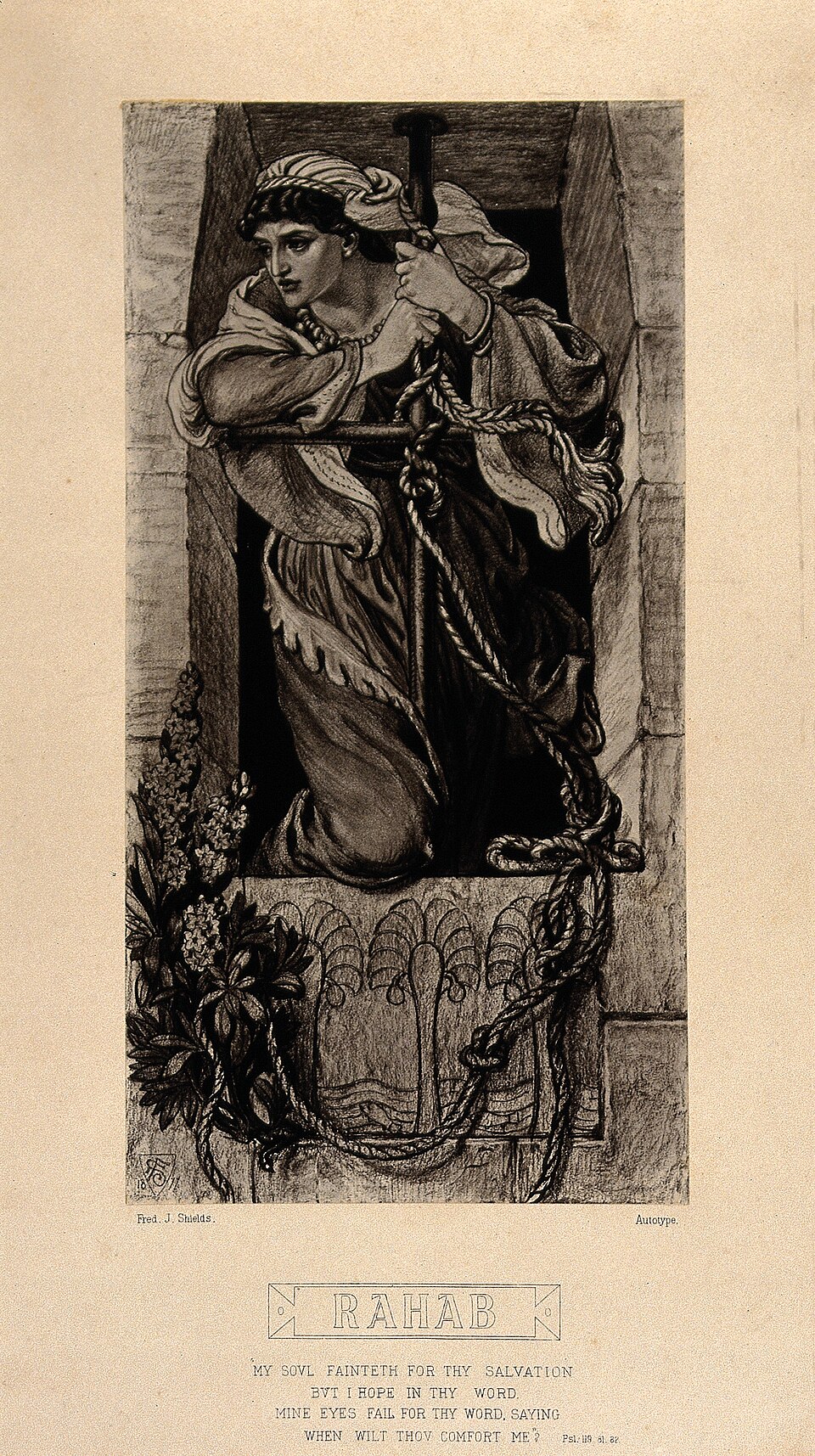 Source: 🔗 Wikimedia Commons / Wellcome Collection, Frederic Shields, CC BY 4.0. Western biblical artwork, not an Orthodox icon.
Spiritual Fruit 🍇
-
Courage begins with hearing God, not psyching yourself up. Joshua is told to be strong and courageous because the Lord is with him. Christian courage is not personality, volume, or natural confidence. It is obedience rooted in the presence of God. When you face a hard conversation, a family burden, a ministry decision, or a season of uncertainty, the first question is not “Am I brave enough?” but “Have I listened, prayed, and stood where God asked me to stand?”
-
Meditation on the word is a form of leadership. Joshua is commanded to keep the law in his mouth and heart. That is not only private piety; it is how he will lead without becoming self-willed. A father, mother, servant, teacher, or ministry leader who does not let Scripture judge him will eventually lead from anxiety, ego, or reaction. Put one verse where it can interrupt you during the day. Let it correct your tone before it corrects someone else.
-
Rahab teaches that faith can begin in a compromised house and still become saving faith. She is not presented as respectable first and faithful second. She hears, fears God, acts, and asks for mercy. This matters pastorally. Do not assume someone is too entangled, too late, too morally complicated, or too far outside the visible people of God to respond to grace. The scarlet cord hangs over a house with a past, and mercy enters there.
-
Judgment and mercy meet at the window. Rahab does not deny that Jericho is under judgment, but she clings to the sign of deliverance. The Christian life is the same: confession does not pretend sin is harmless; it brings sin under the blood of Christ. A practical application is simple and difficult: name the truth without self-excuse, then cling to mercy without despair.
-
Household faithfulness matters. Rahab pleads not only for herself but for her family. Joshua later says, “As for me and my house” (Joshua 24:15). Scripture does not let faith become isolated individual spirituality. Pray by name for your household. Bring your family under the scarlet cord by repentance, example, blessing, apology, forgiveness, and concrete habits of worship.
Summary Table
| Text | Literal focus | Christological and spiritual reading |
|---|---|---|
| Joshua 1:1-9 | Joshua commissioned to lead and obey | Christ the greater Joshua leads His people into inheritance |
| Joshua 1:10-18 | Tribes prepare and stand together | The Church bears one another until all enter rest |
| Joshua 2:1-7 | Rahab receives and hides the spies | Grace reaches the outsider and changes allegiance |
| Joshua 2:8-14 | Rahab confesses the Lord’s universal rule | Faith comes by hearing and asks for household mercy |
| Joshua 2:15-24 | Scarlet cord marks the house of refuge | Salvation under the blood of Christ within the gathered household |
Closing Meditation
These opening chapters tell us that the conquest of the land begins with inward realities: courage under God’s word, obedience without delay, and faith born in an unexpected heart. Rahab sees more clearly than Jericho’s king because she has learned to interpret history through the Lord’s mighty acts. That remains the Church’s task. The Christian does not read the world merely by fear, numbers, or power. He reads it by what God has already done.
Teaching Notes
Whole-study teaching helps:
- The ordination connection is thematic, grounded in Numbers 27:18-23 and Deuteronomy 34:9, not a Joshua appointment in the ordination rite.
- Treat Rahab’s window and scarlet cord as biblical images without claiming a universal standalone Orthodox icon tradition.
- If the group is nervous about conquest themes, acknowledge that immediately and show that Rahab’s story already displays mercy inside judgment.
- Spend time on Joshua 1:8. The first military instruction is really a spiritual instruction about meditation and obedience.
- Handle Rahab’s past without sensationalism. The text magnifies grace, not scandal.
- When discussing the scarlet cord, connect it to Passover and Christ, but say clearly that typology serves repentance and faith, not cleverness.
- Encourage the group to see Rahab as a model for catechumens and seekers who come to faith by hearing before they fully understand everything.
Joshua 1:1-9 - Be strong and courageous under the law of God
Ask: What would change in your next difficult decision if Scripture governed your courage?
Emphasize: Joshua’s strength is tethered to the law and to God’s presence.
Watch for: motivational language detached from repentance, obedience, and holy fear.
Joshua 1:10-18 - The people answer with readiness and solidarity
- Ask: Whose burden remains yours even though your own situation has become easier?
- Emphasize: covenant solidarity.
- Watch for: treating land allotments as tribal selfishness or reading the chapter individualistically.
Joshua 2:1-7 - Rahab hides the spies in a doomed city
- Ask: How can we honor Rahab’s protective mercy without making falsehood a virtue?
- Emphasize: Rahab’s faith and action, not scandalized curiosity about her past.
- Watch for: using her lie as a simple moral model or flattening her into a mere symbol.
Joshua 2:8-14 - Rahab confesses the Lord as God in heaven and earth
- Ask: Why does Rahab confess the Lord’s rule while her king responds only with fear?
- Emphasize: Rahab’s confession is one of the book’s earliest great theological statements.
- Watch for: presenting her only as useful to Israel’s mission rather than as a real believer.
Joshua 2:15-24 - The scarlet cord and the sign of salvation
- Show: Show Rahab’s scarlet-cord artwork when discussing faith that acts before full deliverance is visible. Name clearly that the artwork is not an Orthodox icon.
- Ask: What concrete act makes your trust in mercy visible to your household?
- Emphasize: the cord is not magic. It is a covenant sign joined to faith.
- Watch for: forcing typology in a cheap way or reducing the house to private religion instead of ecclesial refuge.
Glossary
- Joshua son of Naue: Moses’ successor; his name points typologically toward Jesus.
- Meditate on the law: sustained, prayerful, obedient attention to God’s word.
- Jericho: first major fortified city facing Israel west of the Jordan.
- Rahab: woman of Jericho remembered in Hebrews, James, and Matthew.
- Scarlet cord: visible sign of the covenant oath protecting Rahab’s house.
- Household salvation: a recurring biblical theme where God gathers families under His mercy.
Sources
Embedded Scripture is from Brenton’s English Septuagint (LXX).
Scripture: The Holy Bible, Brenton Septuagint, the chapters displayed above; NKJV for comparisons and New Testament references.
Leonard J. Greenspoon, NETS “Iesous,” pp. 174-176 and the corresponding chapter readings.
S. Holmes, Joshua: The Hebrew and Greek Texts (1914), the chapter-and-verse notes specified above.
St Augustine, Against Lying 32.
St Clement of Rome, 1 Clement 12; St Justin Martyr, Dialogue 111; St John Chrysostom, Homilies on Hebrews 27.
Coptic Reader placements cited above; Agpeya, First Hour; St Antony Monastery, First Hoos.
Footnotes
-
Leonard J. Greenspoon, “Iesous: To the Reader,” A New English Translation of the Septuagint, pp. 174-176, official edition. ↩
-
Brown-Driver-Briggs, שׂכל, Hiphil, lexical entry. ↩
-
St Augustine, Against Lying 32, translated H. Browne, NPNF, First Series, vol. 3, section 32. ↩
-
S. Holmes, Joshua: The Hebrew and Greek Texts (Cambridge, 1914), chapter and verse notes cited in the text, public-domain edition. His proposed reconstructions are historical scholarly hypotheses, not established manuscript histories. ↩ ↩2
-
St Justin Martyr, Dialogue with Trypho 111, translated Marcus Dods and George Reith, ANF, vol. 1, chapters 109-124. ↩
-
Coptic Reader, Great Thursday, Lakkan; Special > Consecrations > Church > Part 4; Tuesday of the first week of the Holy Fifty Days, Matins Gospel (Matthew 28:16-20). ↩ ↩2
-
The English Translation of St Antony Monastery, First Hoos, published hymn text. ↩
-
St John Chrysostom, Homilies on Hebrews 27.1-3, NPNF, First Series, vol. 14, Homily 27. ↩
-
St Clement of Rome, First Epistle to the Corinthians 12, public-domain English text mirrored at New Advent, chapter 12. ↩