


This narration is from a previous version of the study and may include a combined recording of multiple chapters.
The Lord who binds Israel to its oath also hears His servant’s prayer. A southern coalition rises because Gibeon has made peace with Israel, Joshua marches all night from Gilgal, the Lord throws the enemy into confusion, hailstones fall from heaven, and Joshua prays for the sun and moon to stand still. The chapter then turns to the five kings in the cave, their defeat, and the rapid southern campaign that follows.
The chapter’s judgment is terrible: kings are executed and populations destroyed. Genesis 15:16 places this judgment after long divine patience; Leviticus 18:24-28 describes the land’s defilement, and Deuteronomy 9:4-5 denies that Israel’s righteousness earns its possession. Rahab and Gibeon show that the story also contains a door of mercy (Joshua 2:9-14; 6:22-25; 9:26-27). The Christian receives these wars through Ephesians 6:12, directed against spiritual evil, never against a modern people, ethnic group, or conflict. Such a reading must neither conceal the deaths nor turn them into an appetite for violence.
Historical and Scriptural Context
The Scripture below is Brenton’s Septuagint, with headings following NKJV chapter and verse numbering. The NKJV translates the Masoretic Hebrew tradition, represented by the medieval Aleppo and Leningrad codices; Brenton’s Greek base is primarily the fourth-century Codex Vaticanus. Leonard Greenspoon’s NETS introduction distinguishes that witness from the wider Greek tradition and warns that both differing Hebrew sources and the translator’s interpretive activity may explain variations. Specific origins are less certain than the readings themselves. The Greek tradition is not uniform, and the variants discussed here should not be assigned to the Dead Sea Scrolls without evidence from the relevant surviving passage.1
Joshua 10 is a direct consequence of Joshua 9. Because Israel swore peace to Gibeon, Joshua is now obliged to defend it. The covenant made rashly still binds. In that sense, chapter 10 is the cost of chapter 9.
The chapter also intensifies the book’s central claim that the Lord fights for Israel. Jericho fell by liturgical obedience, Ai by chastened strategy after Achan’s sin, and now the southern coalition collapses under divine intervention. The text highlights both human action and divine action, but it never lets readers confuse the order. Joshua marches, but the Lord throws the enemy into panic. Israel strikes, but the hailstones kill more than the sword. Joshua speaks, but the miracle belongs to the Creator who rules sun, moon, storm, and history.
Geographical Significance ⛰️
- Gibeon / Gabaon is the immediate flashpoint, a major city whose alliance with Israel destabilizes the south.
- Gilgal / Galgala remains Joshua’s base, making the night ascent to Gibeon a demanding military and geographical movement.
- The ascent and descent near Beth-horon / Oronin form the battlefield corridor where panic, pursuit, and hailstones unfold.
- The valley of Aijalon / Ælon appears in Joshua’s prayer, tying the miracle to visible landmarks.
- Makkedah, Libnah, Lachish, Odollam (NKJV Eglon), Hebron, and Debir trace the southern sweep of the campaign.
- The Negeb, lowland, and slopes in the closing summary show the breadth of the conquest’s southern theater.
The Characters 👥
- The Lord: divine warrior, judge, and ruler of creation.
- Joshua: covenant leader whose obligation to Gibeon becomes the occasion for a larger victory.
- The Gibeonites: recent covenant partners who now call on Israel for rescue.
- Adoni-bezec in Brenton / Adoni-Zedek in the NKJV: king of Jerusalem and ringleader of the southern coalition.
- The five kings, called Jebusites in Brenton 10:5 and Amorites in the NKJV: visible concentration of southern resistance.
- The men of war of Israel: instruments of judgment under divine command.
- Sun, moon, hail, and storm: not deities, but creatures under the Lord’s sovereign rule.
Light from the Word 🕯️
Joshua 10:1-14 - Gibeon rescued, hail from heaven, and the sun standing still
Before the reading: names and peoples. Brenton calls Jerusalem’s king “Adoni-bezec,” where the Masoretic Hebrew and NKJV name Adoni-Zedek; Greenspoon identifies this as a genuine difference of proper name in NETS’s discussion of the two traditions.2 Brenton also has Odollam (Adullam) where the NKJV has Eglon, both among the five kings and later in the campaign, and calls the coalition Jebusites where the NKJV has Amorites. These are the readings of the adopted English witnesses, not permission to place every Greek manuscript on one side. Greenspoon explains why names can involve translation and transmission, but the sources considered here do not settle the origin of these particular substitutions. The geography and character names below follow Brenton, with NKJV equivalents supplied so readers can recognize the same episode.
Before the reading: God’s vengeance and the shorter narrative. At 10:13 Brenton has “until God executed vengeance on their enemies,” while the NKJV says “Till the people had revenge upon their enemies.” Brenton also lacks the Book of Jasher citation; Holmes reports its absence in both his B and A Greek witnesses and proposes that it entered the Hebrew text after the Greek translation.3 Holmes favors the divine subject and suggests a confusion involving a written divine-name abbreviation, but that remains an older reconstruction, not an observed scribal event. The NKJV’s return to Gilgal at 10:15 is also absent from Brenton, as is the parallel return at 10:43; Holmes argues for Hebrew expansion, against an explanation that the Greek simply suppressed a chronological difficulty. These differences sharpen the Greek emphasis on God’s action and explain why the next reading starts at verse 16, while both traditions affirm that the Lord fought for Israel.
1 And when Adoni-bezec king of Jerusalem heard that Joshua had taken Gai, and had destroyed it, as he did to Jericho and its king, even so they did to Gai and its king, and that the inhabitants of Gabaon had gone over to Joshua and Israel; 2 then they were greatly terrified by them, for the king knew that Gabaon was a great city, as one of the chief cities, and all its men were mighty. 3 So Adoni-bezec king of Jerusalem sent to Elam king of Hebron, and to Phidon king of Jerimuth, and to Jephtha king of Lachis, and to Dabin king of Odollam, saying, 4 Come up hither to me, and help me, and let us take Gabaon; for the Gabaonites have gone over to Joshua and to the children of Israel. 5 And the five kings of the Jebusites went up, the king of Jerusalem, and the king of Chebron, and the king of Jerimuth, and the king of Lachis, and the king of Odollam, they and all their people; and encamped around Gabaon, and besieged it.
6 And the inhabitants of Gabaon sent to Joshua into the camp to Galgala, saying, Slack not thy hands from thy servants: come up quickly to us, and help us, and rescue us; for all the kings of the Amorites who dwell in the hill country are gathered together against us. 7 And Joshua went up from Galgala, he and all the people of war with him, every one mighty in strength.
8 And the Lord said to Joshua, Fear them not, for I have delivered them into thy hands; there shall not one of them be left before you.
9 And when Joshua came suddenly upon them, he had advanced all the night out of Galgala. 10 And the Lord struck them with terror before the children of Israel; and the Lord destroyed them with a great slaughter at Gabaon; and they pursued them by the way of the going up of Oronin, and they smote them to Azeca and to Makeda. 11 And when they fled from the face of the children of Israel at the descent of Oronin, then the Lord cast upon them hailstones from heaven to Azeca; and they were more that died by the hailstones, than those whom the children of Israel slew with the sword in the battle.
12 Then Joshua spoke to the Lord, in the day in which the Lord delivered the Amorite into the power of Israel, when he destroyed them in Gabaon, and they were destroyed from before the children of Israel: and Joshua said, Let the sun stand over against Gabaon, and the moon over against the valley of Ælon. 13 And the sun and the moon stood still, until God executed vengeance on their enemies; and the sun stood still in the midst of heaven; it did not proceed to set till the end of one day. 14 And there was not such a day either before or after, so that God should hearken to a man, because the Lord fought on the side of Israel. Literal sense. The oath to Gibeon draws Israel into immediate war. Joshua marches hard, but the battle’s decisive turns are God’s: fear falls on the enemy, hailstones descend, and the extraordinary long day is granted. The text means to present a real intervention of the Creator in aid of His people.
LXX insight. “Until God executed vengeance” makes the actor in this line explicit. Joshua’s prayer is heard, but Joshua does not become the master of heaven. Sirach 46:1-6 remembers both the sun and the hailstones, while Habakkuk 3:11 and Isaiah 28:21 recall the Lord’s dominion at this battle. The miracle’s center is the Lord who fights and hears, not a technique by which His servant controls creation.
Christological and typological reading. The true Joshua is Jesus, in whom the light does not fail. Without denying the historical miracle, the Church hears in this passage a sign that all creation serves the economy of salvation. The Lord of sun and moon can extend the day of deliverance, and in Christ He has done more: He has brought the light of the world into the battle against death itself.
Joshua 10:16-27 - The five kings are brought out, humbled, and judged
16 And these five kings fled, and hid themselves in a cave that is in Makeda. 17 And it was told Joshua, saying, The five kings have been found hid in the cave that is in Makeda. 18 And Joshua said, Roll stones to the mouth of the cave, and set men to watch over them. 19 But do not ye stand, but pursue after your enemies, and attack the rear of them, and do not suffer them to enter into their cities; for the Lord our God has delivered them into our hands. 20 And it came to pass when Joshua and all Israel ceased destroying them utterly with a very great slaughter, that they that escaped took refuge in the strong cities.
21 And all the people returned safe to Joshua to Makeda; and no one of the children of Israel murmured with his tongue.
22 And Joshua said, Open the cave, and bring out these five kings out of the cave. 23 And they brought out the five kings out of the cave, the king of Jerusalem, and the king of Chebron, and the king of Jerimuth, and the king of Lachis, and the king of Odollam. 24 And when they brought them out to Joshua, then Joshua called together all Israel, and the chiefs of the army that went with him, saying to them, Come forward and set your feet on their necks; and they came and set their feet on their necks. 25 And Joshua said to them, Do not fear them, neither be cowardly; be courageous and strong, for thus the Lord will do to all your enemies, against whom ye fight. 26 And Joshua slew them, and hanged them on five trees; and they hung upon the trees until the evening. 27 And it came to pass toward the setting of the sun, Joshua commanded, and they took them down from the trees, and cast them into the cave into which they had fled for refuge, and rolled stones to the cave, which remain till this day. Literal sense. The coalition is not merely scattered. Its rulers are exposed, publicly humbled, and executed as part of the old-covenant judgment falling on the land’s resistance. The gesture of feet on necks is symbolic domination, meant to strengthen Israel’s courage.
Literal-sense observation. Joshua now gives others the courage he first received: his command in 10:25 recalls the Lord’s charge in 1:6-9. The captains’ feet on the kings’ necks enact the defeat of hostile rule; Psalm 110:1 (LXX 109:1) and 1 Corinthians 15:25-26 open a Christian typology toward Christ’s enemies under His feet, with death the final enemy. The removal of the bodies at sunset follows Deuteronomy 21:22-23, as in Joshua 8:29. The stones closing the cave become another severe memorial in a book where stones remember both judgment and grace.
Christological and typological reading. The image of enemies beneath the feet naturally recalls the biblical theme of hostile powers subdued under God’s Anointed. Read in Christ, the scene points toward the defeat of the powers of sin and death. Still, the Church must say plainly that her warfare is now spiritual and ascetical, not a license for violence in Christ’s name.
Joshua 10:28-39 - The southern cities fall in sequence
28 And they took Makeda on that day, and slew the inhabitants with the edge of the sword, and they utterly destroyed every living thing that was in it; and there was none left in it that was preserved and had escaped; and they did to the king of Makeda, as they did to the king of Jericho.
29 And Joshua and all Israel with him departed out of Makeda to Lebna, and besieged Lebna. 30 And the Lord delivered it into the hands of Israel: and they took it, and its king, and slew the inhabitants with the edge of the sword, and every thing breathing in it; and there was not left in it any that survived and escaped; and they did to its king, as they did to the king of Jericho.
31 And Joshua and all Israel with him departed from Lebna to Lachis, and he encamped about it, and besieged it. 32 And the Lord delivered Lachis into the hands of Israel; and they took it on the second day, and they put the inhabitants to death with the edge of the sword, and utterly destroyed it, as they had done to Lebna. 33 Then Elam the king of Gazer went up to help Lachis; and Joshua smote him and his people with the edge of the sword, until there was not left to him one that was preserved and escaped.
34 And Joshua and all Israel with him departed from Lachis to Odollam, and he besieged it and took it. 35 And the Lord delivered it into the hand of Israel; and he took it on that day, and slew the inhabitants with the edge of the sword, and slew every thing breathing in it, as they did to Lachis.
36 And Joshua and all Israel with him departed to Chebron, and encamped about it. 37 And he smote it with the edge of the sword, and all the living creatures that were in it; there was no one preserved: they destroyed it and all things in it, as they did to Odollam.
38 And Joshua and all Israel returned to Dabir; and they encamped about it; 39 and they took it, and its king, and its villages: and he smote it with the edge of the sword, and they destroyed it, and every thing breathing in it; and they did not leave in it any one that was preserved: as they did to Chebron and her king, so they did to Dabir and her king. Literal sense. The chapter becomes intentionally repetitive. City after city falls under the same formula of conquest and destruction. The repetition is not careless. It marks the thoroughness of the southern collapse.
Literal-sense observation. The repeated phrases, especially “the Lord delivered,” keep the campaign from being heard as a tale of mere military brilliance. Yet the repeated language of total destruction also forces the reader to confront the severity of the judgment.
Christological and typological reading. Under Christ, the warfare changes its field. The Church does not conquer territories with the sword. She does learn, however, that compromise with dominant sins leaves the inheritance half-possessed. In ascetical terms, some cities of the old self must fall one after another if the heart is to become a dwelling for God.
Spiritual witness. St John Cassian, Conferences 5.16-24, receives the nations as figures of the vices, and explains in 5.23 that patience must take the heart’s territory from anger and humility from pride.4 This is spiritual interpretation, not a replacement for the literal record of deaths. For the Christian, the point of unrelenting struggle is that charity should live where cruelty once ruled. It can never justify violence against the neighbor whom Christ commands us to love.
Joshua 10:40-42 - The southern victory is summarized under one cause
Before the reading: the chapter ending. The NKJV continues at 10:43 with Joshua and Israel returning to the camp at Gilgal; Brenton ends at 10:42. This corresponds to the shorter Greek narrative also seen at 10:15, not to a missing verse in the reading below. Holmes discusses the two returns together and favors expansion of the Hebrew account, while recording a competing explanation that the Greek translator removed the first to avoid a chronological difficulty.3 Neither reconstruction can be proved merely from the different endings. The chapter’s conclusion is shared in substance: Brenton’s “once for all” and the NKJV’s “at one time” both give the Lord’s fighting as the cause of the southern victory.
40 And Joshua smote all the land of the hill country, and Nageb and the plain country, and Asedoth, and her kings, they did not leave of them one that was saved: and they utterly destroyed every thing that had the breath of life, as the Lord God of Israel commanded, 41 from Cades Barne to Gaza, all Gosom, as far as Gabaon. 42 And Joshua smote, once for all, all their kings, and their land, because the Lord God of Israel fought on the side of Israel. Literal sense. The narrator steps back from individual battles to give the theological summary. The campaign’s breadth is considerable, but its explanation is singular: the Lord fought for Israel.
Literal-sense observation. “Once for all” concerns this campaign, not the end of every struggle in the book. Joshua 13:1 will still name much land unpossessed. Thanksgiving can confess a real victory without pretending that obedience is now finished.
Christological and typological reading. All true victory in the spiritual life is finally the Lord’s. The believer labors, repents, fasts, prays, and struggles, but it is Christ who fights on behalf of His people. That keeps asceticism from becoming self-salvation.
The Church’s Voice in Worship 📖
Joshua 10 has no appointed reading of its own verses in the current verse-addressed Coptic lectionary. Its direct calendar remembrance is the Synaxarium on Paona 26, which commemorates the sun standing still through the prayers of Joshua son of Nun.5 This is a commemoration of the event, not an appointment of the chapter as a reading.
At the Theophany Lakkan, Habakkuk 3:2-19 is read among the prophecies. Its verse 11 recalls the standing sun and moon, so it is an echo of Joshua through Habakkuk, not a Joshua reading at Theophany. Isaiah 28:16-29 is read at the Eleventh Hour of Wednesday of Holy Pascha; verse 21 names the valley of Gibeon.6 Read alongside Joshua, these placements let the Lord’s rule over creation be heard within the Church’s confession of His saving work.
The Ninth Hour of the Agpeya prays Psalm 110 (LXX 109), with enemies beneath the Lord’s feet.7 This becomes a Christian reading of the humbled kings in the light of 1 Corinthians 15:25-26: Christ’s final conquest is the destruction of death.
Gems from the Fathers 💎
St John Chrysostom uses Joshua’s long day to show the spiritual weight of a righteous person before God. He says, “Consider of how great value is the righteous man. Joshua the son of Nun said, ‘Let the sun stand still at Gibeon, the moon at the valley of Elom’ (Josh. x. 12), and it was so.” He immediately guards the point from spectacle by saying Joshua “besought his Friend, and the servants yielded”8. The miracle therefore does not make Joshua a magician. It shows creation serving the Lord, and the Lord hearing His servant.
Iconography and Visual Teaching 🖼️
John Martin’s painting is Western biblical artwork, not an Orthodox icon. Its vast sky and small human figures can help the reader see the difference between Joshua’s prayer and the Creator’s authority. The miracle belongs to the rescue of Gibeon and the costly keeping of Israel’s oath, not to detached fascination with celestial power.
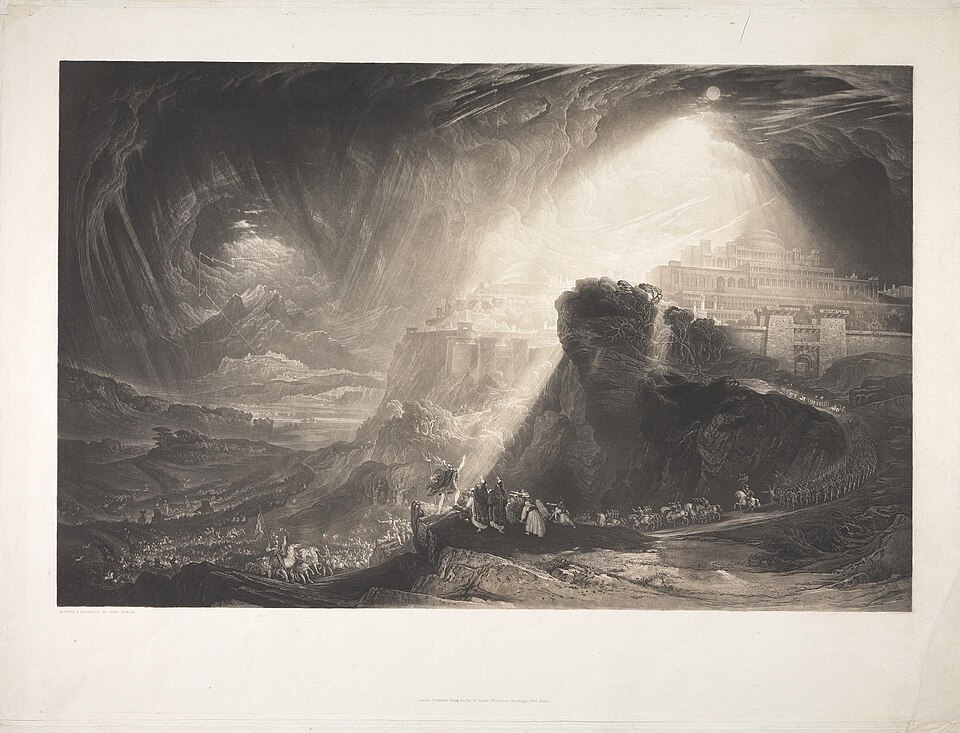 Source: 🔗 Wikimedia Commons / Yale Center for British Art, John Martin, CC0 / public-domain dedication. Western biblical artwork, not an Orthodox icon.
Spiritual Fruit 🍇
-
Covenant faithfulness may require costly rescue. Israel goes to defend Gibeon, even though the covenant began through deception. This matters. Faithfulness is not only keeping promises when the other party is admirable. In families, churches, friendships, and ministry, love often means honoring responsibilities after the emotional simplicity has disappeared. The question becomes: what does righteousness require now, not what would I have chosen if the beginning had been cleaner?
-
The long day teaches that time itself belongs to God. The miracle must be handled humbly, without pretending we can explain every physical detail. But spiritually its meaning is clear: creation serves the Lord’s saving purpose. For the anxious heart, this is medicine. We often live as if time is our enemy, as if deadlines, aging, delays, and pressure rule us absolutely. Joshua 10 says that time is a creature, not a god. Pray and work faithfully, but do not worship the clock.
-
Judgment texts must produce trembling, not appetite for violence. This chapter is hard. It speaks of kings defeated and cities judged. The Christian must not sanitize it, and must not imitate it literally under the New Covenant. Its enduring spiritual force is ascetical: the enemies that must be shown no treaty are the passions that destroy communion with God. Lust, cruelty, greed, pride, and despair should not be negotiated with as honored citizens of the soul.
-
Do not hide the defeated kings in the cave forever. The five kings are trapped before they are brought out and judged. Spiritually, many sins are first contained before they are healed: old anger, secret fear, buried shame, or patterns we do not yet know how to face. But containment is not final freedom. Confession, counsel, prayer, and repentance bring the hidden rulers into the light where Christ can judge and heal what has ruled us.
-
Victory must remain obedience, not triumphalism. Joshua’s victories are narrated under divine command, not personal glory. The same is true in spiritual warfare. When God grants progress, a quieter temper, a cleaner mind, a reconciled relationship, a stronger prayer rule, receive it with gratitude and fear. Pride after victory rebuilds the enemy inside the gates.
Summary Table
| Text | Historical focus | Spiritual and Christological meaning |
|---|---|---|
| Joshua 10:1-14 | Gibeon rescued; hailstones and the long day | The Creator fights for His people; all creation serves salvation |
| Joshua 10:16-27 | Five kings exposed and judged | Hostile powers are placed underfoot in spiritual warfare |
| Joshua 10:28-39 | Sequential fall of southern cities | Entrenched passions must not be left unconquered |
| Joshua 10:40-42 | The campaign summarized | Victory belongs to the Lord, not to human boasting |
Closing Meditation
Joshua 10 stands in holy severity. It shows the Lord answering Joshua, defending Gibeon because of covenant, and acting with kingly freedom over storm and sky. It also confronts us with judgment that cannot be sentimentalized. The Christian answer is not denial. It is transfiguration. We receive the chapter as part of the old covenant’s grave history, and in the light of Christ we learn how fiercely sin must be opposed, how fully victory belongs to God, and how every created power remains under His command.
Teaching Notes
Whole-study teaching helps:
- Be explicit that the Church does not use Joshua 10 to justify religious violence.
- Explain the connection to Joshua 9. Israel is defending an oath-bound covenant partner.
- If the group stumbles at the sun standing still, resist the temptation either to mock the miracle or to turn it into novelty. The chapter’s real point is divine sovereignty.
- Use Cassian, Conferences 5.16-24, to distinguish spiritual interpretation from the literal account, and connect the heart’s conquered territory to concrete virtues.
Joshua 10:1-14 - Gibeon rescued, hail from heaven, and the sun standing still
Ask: How does Israel’s obligation to Gibeon keep the long-day miracle from becoming a story about spectacle alone?
Emphasize: the miracle reveals divine sovereignty, not human technique.
Watch for: both embarrassed reductionism and sensational speculation.
Show: Show John Martin’s artwork with caution, keep the miracle connected to covenant rescue and the Lord’s rule over creation.
Joshua 10:16-27 - The five kings are brought out, humbled, and judged
- Ask: What changes when courage received from God is passed on to others, and what Christian enemies belong under Christ’s feet?
- Emphasize: old-covenant judgment is received by Christians as a figure of victory over passions and demonic powers.
- Watch for: any triumphalist use of the text against living human opponents.
Joshua 10:28-39 - The southern cities fall in sequence
- Ask: Where must patience or humility replace an entrenched habit rather than simply restrain it?
- Emphasize: the Church reads these victories morally and ascetically, not politically.
- Watch for: skipping the severity of the text or domesticating it into something sentimental.
Joshua 10:40-42 - The southern victory is summarized under one cause
- Ask: How can you thank God for a real victory while admitting the obedience that still lies ahead?
- Emphasize: the closing summary interprets the chapter for us.
- Watch for: retelling the campaign as if Joshua were the ultimate source of success.
Glossary
- Gibeon / Gabaon: covenant city whose alliance triggers the southern coalition.
- Adoni-bezec / Adoni-zedek: king of Jerusalem in Brenton’s form of the text.
- Beth-horon / Oronin: ascent-descent battlefield corridor west of Gibeon.
- Aijalon / Ælon: valley named in Joshua’s prayer regarding the moon.
- Makkedah: cave site where the five kings are found and judged.
- Spiritual warfare: the Church’s ascetical struggle against passions, demons, and sin under Christ’s victory.
Sources
Embedded Scripture is from Brenton’s English Septuagint (LXX).
- Scripture: Brenton Septuagint, Joshua 10; NKJV comparison and the cross-references cited in the study, including Sirach 46:1-6 in Brenton.
- Greenspoon, NETS, introduction pp. 174–176 and Joshua 10, pp. 182–183.
- Holmes, Joshua, introduction p. 4 and pp. 50–53.
- St John Chrysostom, Homilies on Hebrews 27, exact paragraph linked above.
- St John Cassian, Conferences 5.16-24, spiritual rather than literal application of conquest.
- Coptic Synaxarium, Paona 26; Coptic Reader, Theophany Lakkan and Wednesday Holy Pascha Eleventh Hour; Agpeya, Ninth Hour.
Footnotes
-
Leonard J. Greenspoon, NETS, “Iesous: To the Reader,” pp. 174–176, especially p. 175 on differing Hebrew sources and interpretive translation; official text. ↩
-
Greenspoon, NETS, pp. 174–176 on names and transmission; Joshua 10:1-5 and 10:23, pp. 182–183; official text. ↩
-
Holmes, Joshua, introduction p. 4 and pp. 50–53, notes on 10:13, 10:15, and 10:43; book scan. These are historical hypotheses, not a claim of present scholarly consensus. ↩ ↩2
-
St John Cassian, Conferences 5.16-24, Abba Serapion, especially 5.23-24; Edgar C. S. Gibson translation, NPNF2 11; direct text. ↩
-
Coptic Synaxarium, Paona 26, commemoration of the sign of the sun standing still through Joshua’s prayers. ↩
-
Coptic Reader, Special > Lakkan > Theophany, Habakkuk 3:2-19; Holy Pascha > Wednesday Day > Eleventh Hour, Isaiah 28:16-29. ↩
-
Agpeya, Ninth Hour, Psalm 110 (LXX 109); Ninth Hour. ↩
-
St John Chrysostom, Homilies on Hebrews, Homily 27, NPNF1 14, paragraph beginning “Consider of how great value”; exact paragraph. ↩