


This narration is from a previous version of the study and may include a combined recording of multiple chapters.
Joshua 3-4 is the book’s great threshold scene. Israel does not simply march into the land. The Lord Himself opens the way through the Jordan as the priests bear the ark before the people. The crossing is both miracle and catechesis. God shows that He is with Joshua as He was with Moses, and He teaches Israel that entry into inheritance is governed by holiness, presence, and remembrance.
These chapters are indispensable for Christian reading because the Jordan naturally becomes a baptismal image. The people pass through waters held back by the Lord, the ark goes first, the nation enters on dry ground, and memorial stones are raised so that future generations will ask what God has done. The Church has long read these features not as empty allegory but as genuine types of baptismal passage, ecclesial memory, and life under the mighty hand of God.
Historical and Scriptural Context
Israel has left Shittim and moved to the riverbank. The exodus generation crossed the Red Sea at the beginning of the wilderness journey. Their children now cross the Jordan at the beginning of inheritance. Joshua 3 explicitly links the event to Moses so that the people may know Joshua’s authority is divinely confirmed. Joshua 4 then insists that miracle must become memory, and memory must become teaching.
Theologically, the ark is central. This is not a story of natural bravery. The Lord’s presence leads, the priests stand in the river, and the people follow at a holy distance. The crossing prepares Israel to receive the land as a gift rather than a possession wrested from God. Orthodox baptismal tradition receives the Jordan even more directly, especially in light of the Lord’s own baptism in the Jordan and the sanctification of the waters.
Geographical Significance ⛰️
- The Jordan River is the decisive boundary between the wilderness east and the inheritance west.
- Harvest season flood stage magnifies the miracle. The crossing happens when the river is not easily fordable.
- Jericho opposite the crossing point makes clear that Israel is entering enemy territory under God’s leadership.
- Gilgal / Galgala becomes the landing place of memory once the crossing is complete.
- The riverbed itself becomes a site of standing, priestly witness, and buried remembrance through the stones set in Jordan.
The Characters 👥
- The Lord: the living God who is among His people and acts before them.
- Joshua: publicly magnified by God through the crossing.
- The priests and Levites: bear the ark and physically stand in the place of passage.
- The ark of the covenant: sign of divine presence, authority, and holy order.
- The twelve chosen men: representatives of all Israel carrying the memory into the future.
- The people: called to sanctify themselves, keep distance, cross in trust, and teach their children.
Light from the Word 🕯️
Scripture readings below retain Brenton’s Septuagint wording while headings follow NKJV numbering. The NKJV follows the Masoretic Hebrew tradition, represented by the medieval Leningrad Codex; Brenton’s Greek edition draws chiefly on fourth-century Codex Vaticanus. These are edition-level descriptions, not a claim that every Greek manuscript agrees at every verse. Leonard Greenspoon explains both the diversity of the Greek witnesses and the debated roles of translation and Hebrew source differences in NETS, pp. 174-175; the date and place of Joshua’s Greek translation remain uncertain.1
Joshua 3:1-6 - Sanctify yourselves, for the Lord will do wonders
1 And Joshua rose up early in the morning, and departed from Sattin; and they came as far as Jordan, and lodged there before they crossed over. 2 And it came to pass after three days, that the scribes went through the camp; 3 and they charged the people, saying, When ye shall see the ark of the covenant of the Lord our God, and our priests and the Levites bearing it, ye shall depart from your places, and ye shall go after it. 4 But let there be a distance between you and it; ye shall stand as much as two thousand cubits from it. Do not draw nigh to it, that ye may know the way which ye are to go; for ye have not gone the way before.
5 And Joshua said to the people, Sanctify yourselves against to-morrow, for to-morrow the Lord will do wonders among you. 6 And Joshua said to the priests, Take up the ark of the covenant of the Lord, and go before the people: and the priests took up the ark of the covenant of the Lord, and went before the people.
Literal sense. Israel is prepared by order, distance, and sanctification. The ark leads because the people do not know the way. Holiness is not ornamental. It is the necessary posture before divine wonder.
Textual observation. The phrase, “ye have not gone the way before,” gives the passage lasting force. New obedience requires following God’s presence rather than relying on old experience.
Christological and typological reading. In the Church, baptism is not merely symbolic washing. It is entry into a way we have not gone before, under Christ’s leading, with reverence and consecration.
Joshua 3:7-17 - The living God opens the Jordan
Text and translation note. Brenton’s 3:16 places the distant heap of water as far as Kariathiarim; the Masoretic text behind the NKJV names Adam beside Zaretan. NETS, p. 178, also prints Kariathiarim in its Rahlfs-based Greek translation, though that does not establish unanimity among Greek witnesses. Holmes, p. 23, proposes Hebrew letter confusion and redivision, followed by expansion into the familiar name Kiriath-jearim; he also reports the shorter Kariathim in manuscripts 54 and 75.2 This is an older reconstruction, not a settled modern explanation, and neither a deliberate geographical relocation nor Qumran support has been established. Kiriath-jearim later houses the ark in 1 Samuel 7:1-2, but that biblical connection does not prove the variant’s origin. The shared point is that the Lord halts the river far upstream while the people cross opposite Jericho.
7 And the Lord said to Joshua, This day do I begin to exalt thee before all the children of Israel, that they may know that as I was with Moses, so will I also be with thee. 8 And now charge the priests that bear the ark of the covenant, saying, As soon as ye shall enter on a part of the water of Jordan, then ye shall stand in Jordan.
9 And Joshua said to the children of Israel, Come hither, and hearken to the word of the Lord our God. 10 Hereby ye shall know that the living God is among you, and will utterly destroy from before our face the Chananite, and the Chettite and Pherezite, and the Evite, and the Amorite, and the Gergesite, and the Jebusite. 11 Behold, the ark of the covenant of the Lord of all the earth passes over Jordan. 12 Choose for yourselves twelve men of the sons of Israel, one of each tribe. 13 And it shall come to pass, when the feet of the priests that bear the ark of the covenant of the Lord of the whole earth rest in the water of Jordan, the water of Jordan below shall fail, and the water coming down from above shall stop.
14 And the people removed from their tents to cross over Jordan, and the priests bore the ark of the covenant of the Lord before the people. 15 And when the priests that bore the ark of the covenant of the Lord entered upon Jordan, and the feet of the priests that bore the ark of the covenant of the Lord were dipped in part of the water of Jordan; (now Jordan overflowed all its banks about the time of wheat harvest:) 16 then the waters that came down from above stopped; there stood one solid heap very far off, as far as the region of Kariathiarim, and the lower part came down to the sea of Araba, the salt sea, till it completely failed; and the people stood opposite Jericho. 17 And the priests that bore the ark of the covenant of the Lord stood on dry land in the midst of Jordan; and all the children of Israel went through on dry land, until all the people had completely gone over Jordan.
Literal sense. The priests must step into the water before the miracle becomes visible. The crossing authenticates Joshua’s leadership and shows that the living God is truly among Israel.
Textual observation. The repeated titles, “the Lord of all the earth” and “the living God,” oppose every local notion of deity. The Jordan does not divide because of ritual technique. It divides because the Creator rules the waters.
Christological and typological reading. Christ enters the Jordan not because He needs cleansing, but to sanctify the waters. Joshua 3 therefore points forward: what Israel experienced as national passage, the Church receives sacramentally in baptism.
Joshua 4:1-9 - Stones carried out of the river as a memorial sign
Text and translation note. At 4:9 Brenton says Joshua set “other twelve stones” in the Jordan; the NKJV says simply “twelve stones.” The former represents Brenton’s Greek tradition, while the latter translates the Masoretic Hebrew. Holmes, p. 27, calls “other” a harmonizing clarification, while leaving open whether it came from the translator or a later hand.2 His explanation fits the word’s function but does not prove its stage of origin. The Greek makes two sets explicit, so the memorial in camp and the stones remaining in the river should not be collapsed into one set.
1 And when the people had completely passed over Jordan, the Lord spoke to Joshua, saying, 2 Take men from the people, one of each tribe, 3 and charge them; and ye shall take out of the midst of Jordan twelve fit stones, and having carried them across together with yourselves, place them in your camp, where ye shall encamp for the night.
4 And Joshua having called twelve men of distinction among the children of Israel, one of each tribe, 5 said to them, Advance before me in the presence of the Lord into the midst of Jordan, and each having taken up a stone from thence, let him carry it on his shoulders, according to the number of the twelve tribes of Israel: 6 that these may be to you continually for an appointed sign, that when thy son asks thee in future, saying, What are these stones to us? 7 then thou mayest explain to thy son, saying, The river Jordan was dried up from before the ark of the covenant of the Lord of the whole earth, when it passed it: and these stones shall be for a memorial for you for the children of Israel for ever.
8 And the children of Israel did so, as the Lord commanded Joshua; and they took up twelve stones out of the midst of Jordan, (as the Lord commanded Joshua, when the children of Israel had completely passed over,) and carried these stones with them into the camp, and laid them down there. 9 And Joshua set also other twelve stones in Jordan itself, in the place that was under the feet of the priests that bore the ark of the covenant of the Lord; and there they are to this day.
Literal sense. The miracle must be made teachable. The twelve stones in camp and the stones set in Jordan together preserve memory in visible form.
Textual observation. The child’s question makes the memorial a form of catechesis. Exodus 12:26-27 and Deuteronomy 6:20-25 likewise place the explanation of God’s works in a household’s speech. The stones give parents something concrete to point to while telling the truth about grace.
Christological and typological reading. The stones do not replace the event. They witness to it. In Christian life, sacramental and liturgical memory similarly makes mighty acts present to the faithful without repeating them as mere past history.
Joshua 4:10-24 - The crossing is remembered for Israel and the nations
Text and translation note. At 4:24 Brenton calls Israel to “worship the Lord our God in every work,” while the NKJV has “fear the LORD your God forever.” Brenton’s Greek tradition and the Masoretic wording behind the NKJV therefore give the conclusion different emphases. Holmes, p. 28, proposed an illegible Hebrew exemplar behind “in every work”; the proposal is conjectural, and the specific cause remains uncertain.2 We need not choose a reconstructed origin to hear the Greek’s call to carry remembrance into action. Both readings join the nations’ knowledge of God’s mighty hand to Israel’s lasting reverence.
10 And the priests that bore the ark of the covenant stood in Jordan, until Joshua had finished all that the Lord commanded him to report to the people; and the people hasted and passed over. 11 And it came to pass when all the people had passed over, that the ark of the covenant of the Lord passed over, and the stones before them. 12 And the sons of Ruben, and the sons of Gad, and the half tribe of Manasse passed over armed before the children of Israel, as Moses commanded them. 13 Forty thousand armed for battle went over before the Lord to war, to the city of Jericho. 14 In that day the Lord magnified Joshua before all the people of Israel; and they feared him, as they did Moses, as long as he lived.
15 And the Lord spoke to Joshua, saying, 16 Charge the priests that bear the ark of the covenant of the testimony of the Lord, to go up out of Jordan. 17 And Joshua charged the priests, saying, Go up out of Jordan. 18 And it came to pass when the priests who bore the ark of the covenant of the Lord were gone up out of Jordan, and set their feet upon the land, that the water of Jordan returned impetuously to its place, and went as before over all its banks.
19 And the people went up out of Jordan on the tenth day of the first month; and the children of Israel encamped in Galgala in the region eastward from Jericho. 20 And Joshua set these twelve stones which he took out of Jordan, in Galgala, 21 saying, When your sons ask you, saying, What are these stones? 22 Tell your sons, that Israel went over this Jordan on dry land, 23 when the Lord our God had dried up the water of Jordan from before them, until they had passed over; as the Lord our God did to the Red Sea, which the Lord our God dried up from before us, until we passed over. 24 That all the nations of the earth might know, that the power of the Lord is mighty, and that ye might worship the Lord our God in every work.
Literal sense. The chapter closes by linking Jordan to the Red Sea and linking Israel’s memory to the knowledge of the nations. The crossing is both inheritance theology and missionary testimony. The tenth day of the first month in 4:19 is also the day the Passover lamb is selected in Exodus 12:3; the feast follows on the fourteenth in Joshua 5:10. Passage and remembrance thus lead toward renewed worship, rather than ending at the far bank.
LXX insight. Brenton ends with a call “that ye might worship the Lord our God in every work.” That broadens the effect of memory. Remembrance is meant to shape conduct and reverence.
Christological and typological reading. Baptism is not only private cleansing. It incorporates the believer into a people whose life should make God’s power known in the world. Jordan leads to witness.
The Church’s Voice in Worship 📖
At the Consecration of a Church, Part 2, Coptic Reader appoints Joshua 3:7-4:9, not both chapters in full.3 It follows Numbers 4:1-16 and 4:17-33, on carrying the holy things. Later in the rite come 2 Samuel 6:1-20, 1 Chronicles 15:2-16:43 and 28:2-29:22, 2 Chronicles 3:1-6:11, and 1 Kings 8:22-61; Part 3 continues with 2 Chronicles 7:1-6 and 7:7-18. The sequence moves from the ark and its bearers toward the dedication of God’s house.
The same consecration’s Liturgy of the Word includes 1 Peter 2:1-10, and Part 4 includes Acts 7:44-56. Our reading of that placement is that the Lord who led His people through water also gathers living stones into a spiritual house (1 Peter 2:4-5). Service waits in the place of passage until others can enter; remembrance becomes instruction.
At the Theophany Lakkan, Psalm 114:3,5 (LXX 113:3,5) precedes Matthew 3:1-17.3 It recalls the Jordan turning back. This is a psalm appointment, not a Joshua reading at Theophany. The baptismal connection is typology, supported by Matthew 3:13-17 and Paul’s reading of passage through water in 1 Corinthians 10:1-2.
Gems from the Fathers 💎
St Cyril of Jerusalem directly treats Joshua in Catechetical Lecture 10.11. He writes, “And Jesus the son of Nave was in many things a type of Him.”4 Cyril compares Joshua’s beginning at the Jordan with Christ’s preaching after baptism, and twelve men with the twelve apostles. His reading keeps the type subordinate to its fulfillment: the ancient passage makes us attentive to Christ, who gives the life into which baptism brings us.
Iconography and Visual Teaching 🖼️
The Jordan crossing is one of Joshua’s clearest visual moments. Tissot’s painting depicts the ark-led crossing. The biblical scene joins passage through the waters to the Lord’s presence and to stones that train a people not to forget grace.
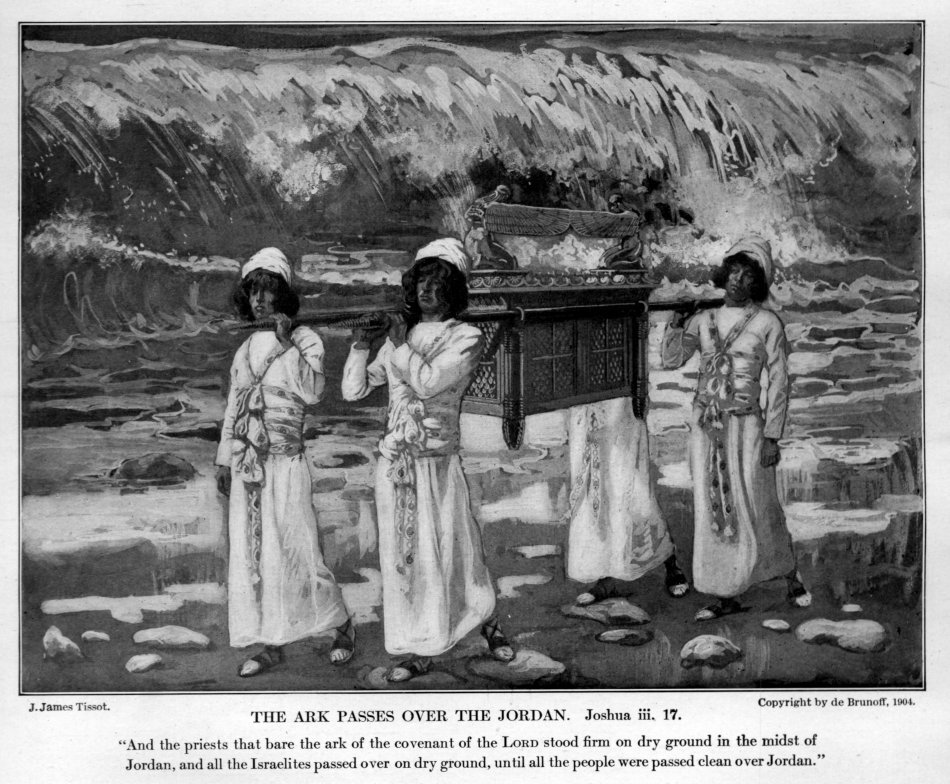 Source: 🔗 Wikimedia Commons, James Tissot, public domain. Western biblical artwork, not an Orthodox icon.
Spiritual Fruit 🍇
-
Do not rush the crossing before sanctification. Israel is told to prepare because the Lord will act among them. The Christian life also has crossings that require preparation: confession before communion, reconciliation before service, prayer before decisions, fasting before feasting. Grace is not magic dropped onto an inattentive heart. Preparation does not earn the miracle; it makes the soul awake enough to receive it.
-
Follow the ark, not your panic. The people cross because the ark goes before them. In moments of transition, the heart often wants to run ahead, control outcomes, or demand certainty. Joshua teaches a different order: worship first, presence first, obedience first. When you do not know the path, stay near the Church’s ark, the sacramental life, the Scriptures, the counsel of the wise, and the commandments that are already clear.
-
Make memory visible. The stones are not decoration. They are a mercy for future forgetfulness. A family needs memorial stones: stories repeated at dinner, icons in the home, feast-day traditions, written testimonies of answered prayer, graves visited with hope, and old wounds remembered as places where God carried us. Children often learn faith through remembered concrete things before they understand abstract theology.
-
Let baptism remain active in you. The Jordan crossing points toward baptism, but baptism is not meant to become a certificate in the past. Each act of repentance is a return to the water. Each renunciation of bitterness, impurity, pride, or despair is another step away from Egypt and toward inheritance. Ask plainly: what old shore am I still emotionally living on?
-
Teach the next generation before they ask badly. Joshua says the stones will provoke children to ask, “What are these stones?” If we do not give our children holy memory, the world will give them another story. The application is not to lecture constantly, but to build a home where faith has visible signs and honest answers.
Summary Table
| Text | Historical focus | Ecclesial and spiritual meaning |
|---|---|---|
| Joshua 3:1-6 | Sanctification before crossing | Preparation of heart before sacramental and vocational passage |
| Joshua 3:7-17 | Jordan halted before the ark | Baptismal type and divine presence leading the people |
| Joshua 4:1-9 | Stones taken from the river | Embodied memory and catechetical signs |
| Joshua 4:10-24 | Miracle remembered for Israel and the nations | Worship, testimony, and life shaped by God’s mighty works |
Closing Meditation
The Jordan crossing teaches that no one enters inheritance casually. The Lord goes first. The priests stand where the people cannot stand by themselves. The waters yield only to divine presence. Then, once the crossing is complete, Israel is told not merely to celebrate but to remember and teach. That pattern remains Christian. We are brought through water, gathered into a people, and charged to live as those who know what God has done.
Teaching Notes
Whole-study teaching helps:
- Read these chapters slowly. They are not filler between two battles. They are one of the book’s deepest theological centers.
- Emphasize the ark. Without the Lord’s presence the crossing does not happen.
- Make the baptismal connection explicit, but do not let it become vague symbolism. The historical event matters.
- Use the memorial stones to talk about Orthodox remembrance, church feasts, and teaching children.
- If time is short, linger on Joshua 3:5 and Joshua 4:6-7.
Joshua 3:1-6 - Sanctify yourselves, for the Lord will do wonders
Ask: What preparation is needed before the next responsibility you want to undertake?
Emphasize: divine presence goes before human action.
Watch for: reducing sanctification to a vague feeling or the ark to a decorative object.
Show: Show Tissot’s Jordan crossing image as a teaching artwork, then return the discussion to the ark, the waters, and memorial obedience.
Joshua 3:7-17 - The living God opens the Jordan
- Ask: What does the priests’ standing in the water teach about serving while the result is still unseen?
- Emphasize: miracle confirms God’s presence and Joshua’s mission.
- Watch for: treating typology as denial of the historical miracle.
Joshua 4:1-9 - Stones carried out of the river as a memorial sign
- Ask: What story of God’s mercy could you tell a child when a visible sign prompts a question?
- Emphasize: remembrance is an act of obedience.
- Watch for: treating memorial stones as mere archaeology or as magical relics.
Joshua 4:10-24 - The crossing is remembered for Israel and the nations
- Ask: Which ordinary work should become an act of worship because you remember God’s help?
- Emphasize: holy memory is outward-facing and pedagogical.
- Watch for: making the crossing only an inward devotional image without covenant and communal implications.
Glossary
- Jordan: the river crossed by Israel into the land and later sanctified by Christ’s baptism.
- Ark of the covenant: visible sign of God’s covenant presence.
- Sanctify yourselves: prepare by consecration, purity, and reverent obedience.
- Galgala / Gilgal: first camp west of the Jordan, marked by memorial and renewal.
- Anamnesis: living remembrance before God, useful for understanding memorial language.
- Type: a real historical event that foreshadows Christ and the life of the Church.
Sources
Embedded Scripture is from Brenton’s English Septuagint (LXX).
Scripture: The Holy Bible, Brenton Septuagint, the chapters displayed above; NKJV for comparisons and New Testament references.
Leonard J. Greenspoon, NETS “Iesous,” pp. 174-176 and the corresponding chapter readings.
S. Holmes, Joshua: The Hebrew and Greek Texts (1914), the chapter-and-verse notes specified above.
St Cyril of Jerusalem, Catechetical Lecture 10.11.
Coptic Reader, Church Consecration and Theophany Lakkan, placements specified above.
Footnotes
-
Leonard J. Greenspoon, “Iesous: To the Reader,” A New English Translation of the Septuagint, pp. 174-176, official edition. ↩
-
S. Holmes, Joshua: The Hebrew and Greek Texts (Cambridge, 1914), chapter and verse notes cited in the text, public-domain edition. His proposed reconstructions are historical scholarly hypotheses, not established manuscript histories. ↩ ↩2 ↩3
-
Coptic Reader, Special > Consecrations > Church, Part 2, Part 3, Part 4, and Liturgy of the Word; Special > Lakkan > Theophany, Psalm before the Gospel. ↩ ↩2
-
St Cyril of Jerusalem, Catechetical Lecture 10.11, translated Edwin Hamilton Gifford, NPNF, Second Series, vol. 7, Lecture 10. ↩