


Judges opens with real victories and a growing list of unfinished obediences. The tribes receive the land, but strength sometimes turns a forbidden arrangement into a profitable one. Chapter 2 then names the deeper loss: the works of the Lord cease to govern the people’s memory and worship. These chapters search the agreements we still protect after receiving mercy, while showing that God hears the groaning of those who have returned to bondage.
Historical and Scriptural Context
Chapters 1 and 2 belong together because the first describes incomplete possession and the second gives its theological interpretation. Judges 2:6-10 looks back to Joshua’s generation after the opening campaign; the backward glance explains the difference between an inherited gift and a living remembrance. The next study will follow the pattern into the stories of Othniel, Ehud, and Shamgar.
The Lord’s promise and Israel’s responsibility remain together. Victory in one city does not establish lasting possession of every place, and a shared ancestry does not keep a people faithful by itself. These chapters are best read beside Joshua’s warnings and 1 Corinthians 10:1-13: Israel’s history gives the Church both a warning against self-confidence and a promise of God’s help under testing.
Geographical Significance ⛰️
- Bezek is the early battlefield in Judah’s campaign and the site of Adoni-bezek’s downfall.
- Jerusalem appears already contested. It is struck in one verse, yet the Jebusite presence remains in another. The city is not yet the secure center it will later become.
- Hebron / Chebron and Debir / Cariathsepher connect this opening with Caleb’s earlier inheritance traditions.
- The south, hill country, and plain matter because Judges highlights that some terrain is taken more readily than others. The changing terrain makes incomplete possession visible.
- Bethel / Bæthel, formerly Luz, becomes an important site in the central hill country and shows the strategy of the house of Joseph.
- Gilgal / Galgal is crucial in memory. It recalls the memorial stones, circumcision, and first Passover in the land under Joshua. The angel’s movement from Gilgal to Bochim is therefore spiritually charged.
- Bochim, “Weepings,” is not merely a map point but a theological place-name. Israel names its tears, but the book will show that sorrow alone does not heal apostasy.
The Characters 👥
- The Lord: giver of the land, covenant Lord, judge, and merciful deliverer.
- Judah (Judas in Brenton): first tribe sent up, receiving real victories but not complete possession.
- Simeon (Symeon): Judah’s brother in cooperative warfare.
- Adoni-bezek: defeated Canaanite ruler whose own confession acknowledges divine recompense.
- Caleb (Chaleb): continuing model of faith-filled inheritance.
- Othniel (Gothoniel): faithful kinsman of Caleb who will later become the first judge.
- Achsah (Ascha): a striking figure of bold petition, asking for blessing and springs in a dry land.
- The Kenites: attached to Israel through Moses’ wider household, showing that covenant history includes outsiders joined to God’s people.
- The house of Joseph: tactically successful at Bethel, yet not a complete answer to the wider problem.
- The angel of the Lord: bearer of divine rebuke who speaks with God’s own authority.
- Joshua and the elders after him: living witnesses to the mighty works of God.
- The later generation: covenant heirs by history, but not by living memory or obedience.
- Baalim and Astartes: false gods of the surrounding nations, representing spiritual infidelity and divided worship.
Iconography and Visual Teaching 🖼️
The map locates the tribes and the places where possession remained incomplete. Its geographical information supports the account without resolving every historical question.
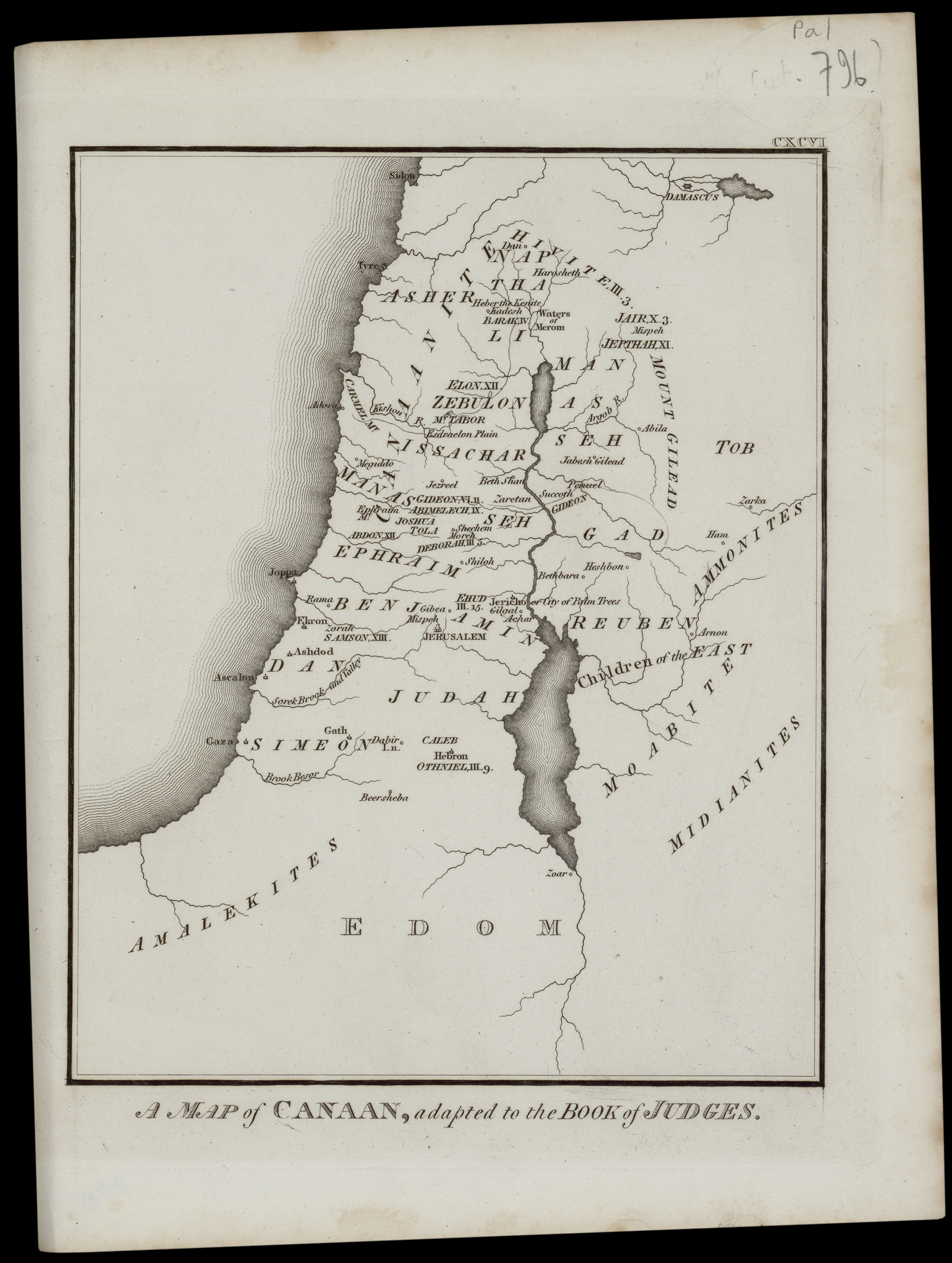 Source: A map of Canaan, adapted to the book of Judges 🔗, Public domain, Eran Laor Cartographic Collection / National Library of Israel via Wikimedia Commons.
Light from the Word 🕯️
The Scripture is followed in its natural units below.
Judah goes first, and Adoni-bezek confesses recompense (Judges 1:1-7)
1 And it came to pass after the death of Joshua, that the children of Israel enquired of the Lord, saying, Who shall go up for us first against the Chananites, to fight against them? 2 And the Lord said, Judas shall go up: behold, I have delivered the land into his hand. 3 And Judas said to his brother Symeon, Come up with me into my lot, and let us array ourselves against the Chananites, and I also will go with thee into thy lot: and Symeon went with him. 4 And Judas went up; and the Lord delivered the Chananite and the Pherezite into their hands, and they smote them in Bezek to the number of ten thousand men. 5 And they overtook Adonibezek in Bezek, and fought against him; and they smote the Chananite and the Pherezite. 6 And Adonibezek fled, and they pursued after him, and took him, and cut off his thumbs and his great toes. 7 And Adonibezek said, Seventy kings, having their thumbs and their great toes cut off, gathered their food under my table: as I therefore have done, so God has recompensed me: and they brought him to Jerusalem, and he died there.
Israel begins by asking the Lord who should go first. Judah receives the promise of the land and invites Simeon to share the labor. The gift of God makes obedience possible; it does not remove the need for cooperation. This opening will return with a terrible difference in Judges 20:18: Judah again goes first, but now against Benjamin. The people who begin by facing enemies together will end by fighting one another.
Adoni-bezek interprets his defeat through his own history of cruelty: seventy kings had been reduced to gathering food beneath his table. His confession of recompense can be read beside Wisdom 11:16, where punishment exposes the means of sin, and Matthew 7:2, where one’s measure returns upon oneself. Power has not made him exempt from the moral world he imposed on others. Yet recognizing that correspondence does not authorize the mutilation of another person. The Church receives this severe narrative as a warning against cruelty and self-exemption, never as permission for revenge.
Language insight: “after the death of Joshua”
The Greek calls Joshua Ἰησοῦς, Iēsous, the same name rendered Jesus in the New Testament. Judges 1:1 therefore speaks of the death of Iēsous, while referring historically to Joshua son of Nun. The shared name opens a Christian comparison, but it does not turn Joshua into Christ or make every detail an encoded prophecy. Hebrews 4:8 supplies firmer ground: Joshua’s entrance into the land did not exhaust God’s promised rest. The inheritance toward which Christ leads His people reaches beyond the territory these tribes are about to fight for.1
Ascetical application
The opening question belongs in the Christian’s struggle against sin: what does obedience require before I act? Prayer interrupts the impulse to turn zeal into self-authorization. In Ephesians 6:10-18 the battle is directed against spiritual evil, not flesh and blood. The person who wrongs us remains someone whom Christ commands us to love; the cruelty that tempts our own heart is the enemy to resist.
Early victories, household faithfulness, and the first limits (Judges 1:8-21)
8 And the children of Judas fought against Jerusalem, and took it, and smote it with the edge of the sword, and they burnt the city with fire. 9 And afterwards the children of Judas went down to fight with the Chananite dwelling in the hill country, and the south, and the plain country. 10 And Judas went to the Chananite who dwelt in Chebron; and Chebron came out against him; [and the name of Chebron before was Cariatharbocsepher:] and they smote Sessi, and Achiman, and Tholmi, children of Enac. 11 And they went up thence to the inhabitants of Dabir; but the name of Dabir was before Cariathsepher, the city of Letters.
12 And Chaleb said, Whosoever shall smite the city of Letters, and shall first take it, I will give to him Ascha my daughter to wife. 13 And Gothoniel the younger son of Kenez the brother of Chaleb took it; and Chaleb gave him his daughter Ascha to wife. 14 And it came to pass as she went in, that Gothoniel urged her to ask a field of her father; and she murmured and cried from off her ass, Thou hast sent me forth into a south land: and Chaleb said to her, What is thy request? 15 And Ascha said to him, Give me, I pray thee, a blessing, for thou hast sent me forth into a south land, and thou shalt give me the ransom of water: and Chaleb gave her according to her heart the ransom of the upper springs and the ransom of the low springs.
16 And the children of Jothor the Kenite the father-in-law of Moses went up from the city of palm-trees with the children of Judas, to the wilderness that is in the south of Juda, which is at the descent of Arad, and they dwelt with the people.
17 And Judas went with Symeon his brother, and smote the Chananite that inhabited Sepheth, and they utterly destroyed them; and they called the name of the city Anathema. 18 But Judas did not inherit Gaza nor her coasts, nor Ascalon nor her coasts, nor Accaron nor her coasts, nor Azotus nor the lands around it. 19 And the Lord was with Judas, and he inherited the mountain; for they were not able to destroy the inhabitants of the valley, for Rechab prevented them. 20 And they gave Chebron to Chaleb, as Moses said; and thence he inherited the three cities of the children of Enac.
21 But the children of Benjamin did not take the inheritance of the Jebusite who dwelt in Jerusalem; and the Jebusite dwelt with the children of Benjamin in Jerusalem until this day.
The chapter places victories and unfinished possession beside one another. Jerusalem is attacked in verse 8, but Jebusites still dwell with Benjamin in verse 21. Taking a city in battle is not the same as holding it securely. Caleb’s household offers a different kind of continuity: Othniel takes Debir, and Achsah asks for the water without which an inheritance in the south cannot sustain life.
Achsah’s petition is bold, but Brenton also says that she “murmured and cried.” Both features must remain in view. Her need is real, her manner is not idealized, and Caleb gives according to her heart. The passage is more human than an effortless portrait of perfect prayer. It gives us a daughter who names what is lacking and a father who answers generously. For a soul ashamed of its own dryness, the comfort is that a request can still be brought honestly before God.
The Kenites in verse 16 carry the memory of Moses’ household into Israel’s life. They will matter again when Judges 4:11,17 identifies Jael through Heber the Kenite. The story’s human boundaries are more complex than a simple division between ancestry inside and outside Israel. Its sharpest concern is worship and allegiance.
Language insight: “the ransom of water” and “Rechab”
In Judges 1:15 the Greek has λύτρωσιν ὕδατος, “redemption of water.” The noun λύτρωσις, lytrōsis, also appears in Luke 1:68 for God’s redemption of His people and in Hebrews 9:12 for eternal redemption. Here it belongs to the gift of springs; the Greek wording does not prove that Achsah consciously asked for baptism. It nevertheless gives a Christian reader a meaningful connection between water, the gift that sustains life, and redemption. The comparison points toward the grace Christ gives, without replacing the actual daughter’s material need with an allegory.2
Verse 19 requires a different kind of care. “Rechab” preserves the Hebrew chariot word in an unusual Greek form. The Hebrew text explains the obstacle as iron chariots, which Brenton also notes in his translation’s footnote; the quoted Greek does not itself say “iron.” Joshua 17:16-18 describes a similar valley problem, and Judges 4:3 will name Sisera’s nine hundred iron chariots. The sentence should not be turned into a story about a commander named Rechab, nor into proof that God’s power failed.3
Ascetical application
Achsah asks for what will make the gift livable. We can possess correct beliefs, a place in a parish, and the memory of baptism while neglecting the prayer through which that life is nourished. Her request gives language to a sober petition: Lord, let what You have given take root in me. At the same time, the unfinished victories prevent us from treating strength in one part of life as evidence that the whole heart is healed.
Bethel is taken, but the old city lives on elsewhere (Judges 1:22-26)
22 And the sons of Joseph, they also went up to Bæthel; and the Lord was with them. 23 And they encamped and surveyed Bæthel: and the name of the city before was Luza.
24 And the spies looked, and behold, a man went out of the city, and they took him; and they said to him, Shew us the way into the city, and we will deal mercifully with thee. 25 And he shewed them the way into the city; and they smote the city with the edge of the sword; but they let go the man and his family. 26 And the man went into the land of Chettin, and built there a city, and called the name of it Luza; this is its name until this day.
The house of Joseph takes Bethel through the help of a man whose family is spared. The episode resembles the sparing of Rahab, but it ends differently. Rahab and her household are brought into Israel’s life; this man goes elsewhere and builds another Luz. The account does not disclose his motives or tell us whether he came to faith. Its ending does show that the old city-name continues beyond the apparent completion of the conquest.
The contrast asks us to distinguish a change of circumstances from a change of allegiance. Rahab’s confession in Joshua 2 belongs to her rescue. Here the text records assistance, mercy, and relocation, without recording that confession. We should preserve the narrative difference while refusing to invent the spared man’s inward life.
Genesis 28:19 explains the name: Jacob called the place Bethel, “house of God,” though it had been Luz. The place had become associated with God’s presence through Jacob’s vision, not through military success. In John 1:51 the angels ascend and descend upon the Son of Man. The Christian connection runs through that vision: Christ Himself is the meeting of heaven and earth. Capturing a holy place cannot substitute for dwelling in obedience to the living God.
Ascetical application
A habit can move without being healed. A person may leave one setting of vanity, resentment, or covetousness only to give the same desire a more respectable object. This is an application, not a judgment on the man who rebuilt Luz. The practical question is whether repentance has changed what we love, or merely where we seek it.
The tribes settle for coexistence and tribute (Judges 1:27-36)
27 And Manasse did not drive out the inhabitants of Bæthsan, which is a city of Scythians, nor her towns, nor her suburbs; nor Thanac, nor her towns; nor the inhabitants of Dor, nor her towns; nor the inhabitant of Balac, nor her suburbs, nor her towns; nor the inhabitants of Magedo, nor her suburbs, nor her towns; nor the inhabitants of Jeblaam, nor her suburbs, nor her towns; and the Chananite began to dwell in this land. 28 And it came to pass when Israel was strong, that he made the Chananite tributary, but did not utterly drive them out. 29 And Ephraim did not drive out the Chananite that dwelt in Gazer; and the Chananite dwelt in the midst of him in Gazer, and became tributary. 30 And Zabulon did not drive out the inhabitants of Kedron, nor the inhabitants of Domana: and the Chananite dwelt in the midst of them, and became tributary to them. 31 And Aser did not drive out the inhabitants of Accho, and that people became tributary to him, nor the inhabitants of Dor, nor the inhabitants of Sidon, nor the inhabitants of Dalaph, nor Aschazi, nor Chebda, nor Nai, nor Ereo. 32 And Aser dwelt in the midst of the Chananite who inhabited the land, for he could not drive him out. 33 And Nephthali did not drive out the inhabitants of Bæthsamys, nor the inhabitants of Bæthanach; and Nephthali dwelt in the midst of the Chananite who inhabited the land: but the inhabitants of Bethsamys and of Bætheneth became tributary to them.
34 And the Amorite drove out the children of Dan into the mountain, for they did not suffer them to come down into the valley. 35 And the Amorite began to dwell in the mountain of shells, in which are bears, and foxes, in Myrsinon, and in Thalabin; and the hand of the house of Joseph was heavy upon the Amorite, and he became tributary to them. 36 And the border of the Amorite was from the going up of Acrabin, from the rock and upwards.
The repeated failures become heavier as the list proceeds. Manasseh does not drive out the inhabitants; Ephraim and Zebulun leave them in their midst; Asher and Naphtali dwell among the Canaanites; Dan is pressed back into the hills. The grammar gradually shifts from Israel possessing the land to Israel living inside arrangements it has not overcome.
Verse 28 prevents the explanation from resting entirely on military weakness. When Israel becomes strong, the Canaanites are made tributary but are not driven out. What was once an obstacle becomes useful. Judges 2 will interpret the religious danger of that decision: forbidden agreements leave rival worship in place. The gain can make the disobedience harder to recognize, because the arrangement appears to be working.
The Christian must not turn this text into ethnic hostility. These are the particular commands and conflicts of Israel’s ancient history. Our neighbors of another people or religion are persons to love. The spiritual application concerns the passions, the disordered habits that enslave our own heart, and is governed by Christ’s commandment of love.
Gems from the Fathers 💎: Removing the fault and planting the virtue
St. John Cassian, in Conferences 5.16-19, reads the nations of Deuteronomy 7 as figures of spiritual faults. This is a related biblical passage, not a verse-by-verse commentary on Judges 1. His reading helps us understand why making a destructive desire useful is not the same as becoming free of it. In 5.23 he also gives the positive side of the struggle: patience takes the place of anger, chastity of fornication, and humility of pride. He writes, “For virtues cannot possibly live side by side with faults.”4 His image calls us to refuse a settled agreement with the fault; it does not require us to deny the mixture of struggle and genuine growth in someone who is still repenting. The aim is a heart inhabited by virtue, rather than an emptied life with nothing to love.
A resentment retained because it protects our pride is a modern form of that profitable arrangement. Renunciation must make room for a different practice: speaking truth without contempt, praying for the person, making restitution where needed. Christ’s healing concerns the desire itself, not simply the public management of its consequences.
The angel of the Lord rebukes Israel at Bochim (Judges 2:1-5)
1 And an angel of the Lord went up from Galgal to the place of weeping, and to Bæthel, and to the house of Israel, and said to them, Thus says the Lord, I brought you up out of Egypt, and I brought you into the land which I sware to your fathers; and I said, I will never break my covenant that I have made with you. 2 And ye shall make no covenant with them that dwell in this land, neither shall ye worship their gods; but ye shall destroy their graven images, ye shall pull down their altars: but ye hearkened not to my voice, for ye did these things. 3 And I said, I will not drive them out from before you, but they shall be for a distress to you, and their gods shall be to you for an offence. 4 And it came to pass when the angel of the Lord spoke these words to all the children of Israel, that the people lifted up their voice, and wept. 5 And they named the name of that place Weepings; and they sacrificed there to the Lord.
The rebuke begins with God’s faithfulness: He brought Israel out of Egypt, gave the promised land, and pledged not to break His covenant. Only then does He name their disobedience. Repentance is possible because the Lord has not ceased to be the One who delivered them. His commandments are the shape of life within His gift.
Gilgal recalls the twelve stones set up so that children would ask what God had done at the Jordan (Joshua 4:20-24), circumcision, and the first Passover in the land (Joshua 5:2-10). Those concrete acts of remembrance are more precise than calling it simply a covenant-renewal site. The angel comes from that place of remembered deliverance to the place of weeping. A few verses later, a generation will arise that does not know the Lord’s works. The contrast makes the failed handing-on of memory especially painful; it does not imply that the angel’s journey caused the failure.
Joshua 23:12-13 had already warned that the remaining nations could become traps and that the Lord would cease driving them out. Judges 2:3 brings that warning into the present. The gods Israel has spared become an “offence,” a stumbling-block or snare. False worship alters the way the people live; it cannot remain an innocent ornament at the edge of their obedience.
The people weep and offer sacrifice. These responses matter, but the command still stands: destroy the images and pull down the altars. The narrative does not report that work being completed here, and the following history exposes the continuing disobedience. Bochim warns against confusing emotional release with a changed allegiance. Holy compunction, sorrow that turns us toward God, needs to become truthful confession and amendment. Tears are precious; the altar we continue to protect is the unfinished matter.
The messenger and the Lord’s voice
The angel conveys the Lord’s first-person rebuke. Fr. Tadros Y. Malaty, in his commentary on Judges 2, section “The Angel of the Lord in Buchim,” regards this as probably an appearance of the divine Word. That is a modern Coptic interpretation, not an established consensus attached to this verse. The text securely presents God’s saving authority and faithful rebuke; Christian reflection can receive both in the light of Christ without claiming that the identity of every angelic appearance has been settled.5
The pastoral force remains clear whichever identification is followed. The Lord addresses the false agreement we have learned to call harmless, while reminding us that He is faithful. A rebuke that leads to healing should not be converted into humiliation of another person.
A faithful generation dies, and memory collapses (Judges 2:6-10)
6 And Joshua dismissed the people, and they went every man to his inheritance, to inherit the land. 7 And the people served the Lord all the days of Joshua, and all the days of the elders that lived many days with Joshua, as many as knew all the great work of the Lord, what things he had wrought in Israel.
8 And Joshua the son of Naue, the servant of the Lord, died, a hundred and ten years old. 9 And they buried him in the border of his inheritance, in Thamnathares, in mount Ephraim, on the north of the mountain of Gaas. 10 And all that generation were laid to their fathers: and another generation rose up after them, who knew not the Lord, nor yet the work which he wrought in Israel.
The narrative looks back to Joshua’s generation. Those who knew the Lord’s great work served Him; after their death, another generation arose that did not know Him or His works. This is more than forgetting a name. The gift of land survives while grateful, obedient remembrance fails. Sacred history can remain available and yet cease to govern the way a community lives.
The verse does not distribute blame between particular parents and children. It does expose a failure of transmission as well as reception. The household and the whole people have to ask whether God’s works are being handed on as living truth. A child learns something about the God we confess from the way adults forgive, pray, speak about suffering, and use authority. Instructions contradicted by daily conduct can teach forgetfulness even while repeating the right words.
Language insight: “all the days of Joshua”
The Greek of verse 7 says “all the days of Iēsous,” and verse 8 names Iēsous son of Naue, Joshua son of Nun. The Greek name is the same as Jesus. Read with Hebrews 4:8, this helps the Church distinguish the genuine gift received through Joshua from the fuller rest promised in Christ. The historical Joshua dies; Christ’s risen life sustains His people’s communion with Him. The connection concerns fulfillment, not a denial of Joshua’s actual death or a claim that the Greek name alone proves the interpretation.1
The Church’s Voice in Worship ⛪
The Church answers forgetfulness by making remembrance part of common prayer. In the Coptic Liturgy of St. Basil, the anamnesis, the remembrance of Christ’s saving work, joins His Passion, Resurrection, Ascension, and awaited coming to thanksgiving before the Father. We are gathered around what the Lord has done, rather than around the spiritual intensity of one leader. That worship must enter the home through Scripture, the feasts, and practiced mercy; otherwise children may know the service’s words without learning the life those words proclaim.6
The cycle of apostasy, oppression, groaning, mercy, and relapse (Judges 2:11-19)
11 And the children of Israel wrought evil before the Lord, and served Baalim. 12 And they forsook the Lord God of their fathers, who brought them out of the land of Egypt, and walked after other gods, of the gods of the nations round about them; and they worshipped them. 13 And they provoked the Lord, and forsook him, and served Baal and the Astartes.
14 And the Lord was very angry with Israel; and he gave them into the hands of the spoilers, and they spoiled them; and he sold them into the hands of their enemies round about, and they could not any longer resist their enemies, 15 among whomsoever they went; and the hand of the Lord was against them for evil, as the Lord spoke, and as the Lord sware to them; and he greatly afflicted them.
16 And the Lord raised up judges, and the Lord saved them out of the hands of them that spoiled them: and yet they hearkened not to the judges, 17 for they went a whoring after other gods, and worshipped them; and they turned quickly out of the way in which their fathers walked to hearken to the words of the Lord; they did not so. 18 And because the Lord raised them up judges, so the Lord was with the judge, and saved them out of the hand of their enemies all the days of the judge; for the Lord was moved at their groaning by reason of them that besieged them and afflicted them. 19 And it came to pass when the judge died, that they went back, and again corrupted themselves worse than their fathers to go after other gods to serve them and to worship them: they abandoned not their devices nor their stubborn ways.
The descent begins with leaving the Lord who brought Israel out of Egypt. The text names rival gods and rival worship before it names the oppressors. Israel’s political captivity grows from a divided allegiance. To be “sold” into enemy hands reverses the direction of the Exodus: a people brought out of servitude returns to it. This is the narrative’s theological image, not a claim that every captive person is responsible for being oppressed.
The Lord nevertheless hears their groaning. Exodus 2:23-24 had joined Israel’s groaning to God’s hearing and remembrance of His covenant. Judges repeats that shape within the land. The Lord raises judges and remains with them, while the people often refuse the correction that accompanies their rescue. The most searching phrase is “worse than their fathers.” Mercy is followed by a relapse into desires that have not been surrendered.
Psalm 106:34-46 (LXX Ps 105:34-46) offers a wider scriptural reflection on this pattern: mingling with the nations, learning their works, becoming ensnared by idols, receiving repeated deliverance, and being heard in distress. Nehemiah 9:27-28 names the return to evil after rest with similar clarity. These passages keep both human responsibility and God’s compassion in view. Sin has real power to enslave; the cry of the afflicted still reaches Him.
Ascetical application
A recurring fall often survives inside the excuse we keep after confessing the act. Relief comes, but the desire for approval, pleasure, or revenge retains its defended place. The text calls us to bring that protected desire into the light. Confession joins the acknowledgment of sin to Christ’s forgiveness and a renewed practice of obedience; healing requires our continuing cooperation with grace.
The judges provide real rescue during their lives. Christ’s Resurrection opens a deeper deliverance from sin and death, received in the Church through faith, repentance, and life in the Holy Spirit. This does not make Christians incapable of relapse. It gives a stronger hope and a living source of healing when they return.
Do not use this account to explain another person’s illness, poverty, bereavement, or abuse as punishment for a particular sin. The passage interprets this history of idolatry; it does not authorize us to uncover supposed guilt behind every instance of suffering.
The remaining nations become a test (Judges 2:20-23)
20 And the Lord was very angry with Israel, and said, Forasmuch as this nation has forsaken my covenant which I commanded their fathers, and has not hearkened to my voice, 21 therefore I will not any more cast out a man of the nations from before their face, which Joshua the son of Naue left in the land. And the Lord left them, 22 to prove Israel with them, whether they would keep the way of the Lord, to walk in it, as their fathers kept it, or no. 23 So the Lord will leave these nations, so as not to cast them out suddenly; and he delivered them not into the hand of Joshua.
The closing verses give two reasons the nations remain: Israel has broken the covenant, and the Lord will test whether the people keep His way. Judges 3:1-4 will add a third: a generation must learn warfare. Punishment, testing, and instruction stand beside one another. The presence of resistance is not described by a single explanation.
Testing makes obedience visible in action. God does not need to acquire information He lacks. The question is whether Israel will walk in the way its fathers were commanded to keep. The repeated difficulty exposes both a weak will and the need for help.
Two other passages widen the perspective without replacing Judges’ own reasons. Exodus 23:29-30 describes gradual removal so that the land does not become desolate; Wisdom 12:3-10 describes judgment by degrees with room for repentance. Delay can therefore have several purposes in Scripture. We should not flatten them into a formula for explaining every unresolved conflict in our lives.
Ascetical application
A temptation that returns can uncover how much we still rely on favorable circumstances rather than a practiced turning toward God. The response is watchfulness with hope. St. Paul follows the warnings from Israel’s history with God’s faithfulness and provision for endurance in 1 Corinthians 10:13. The text does not end with a command to trust our own strength. It turns us toward the help by which we can resist.
Testing never excuses another person’s abuse or obliges anyone to remain in danger. Nor is God the author of an enticement to sin. Christ teaches us to ask for deliverance from evil and to seek the help needed for a faithful response.
Spiritual Fruit 🍇
Bring Bochim’s tears into a definite amendment. After a painful recognition of sin, name the altar that still stands: a protected resentment, an exploitative habit, or the need to appear right. Bring that defended agreement, as well as the act, to your father of confession, the priest who guides your repentance. A fitting metanoia, a bow or prostration expressing repentance, can accompany the prayer of return according to your health and prayer rule. Its meaning is obedience from the heart, not payment for forgiveness.
Ask for the springs needed to live from the gift. Achsah gives a dry soul language for honest need. Before one Hour of the Agpeya, the Coptic prayer book of the Hours, tell God where prayer has become absent or mechanical. Keep the Hour simply and attentively. Ask for the grace to receive what He has given instead of demanding a particular feeling or an immediate material answer.
Hand on one work of God in the home. The stones at Gilgal were meant to awaken a child’s question. At the next feast, explain one saving event before explaining the day’s customs. Join it to shared prayer and a concrete act of mercy. An adult’s apology after harsh speech may teach God’s way more truthfully than another instruction delivered without humility.
Replace the fault with its contrary virtue. Cassian’s reading gives repentance a positive task. Where anger has occupied the heart, practice a patient reply; where vanity seeks notice, do one needed service quietly. Ask Christ for the help needed to endure the next temptation, remembering 1 Corinthians 10:13 rather than treating recurrence as proof that return is hopeless.
At Bochim the people hear the voice of the God who brought them out of Egypt. We too can receive correction from the One who has already shown mercy. The beginning of healing is to stop defending the agreement He has named. His faithfulness gives us somewhere to return.
Teaching Notes
- Begin by holding deliverance and failure together. Scripture honors the judges’ faith, while Judges exposes the divided allegiance that repeatedly follows God’s mercy. These chapters ask whether the inheritance received is becoming a life of obedience.
- Read the repeated phrase did not drive out slowly. Let the repetition do its work.
- Spend time on the contrast between Achsah asking for springs and the tribes settling for compromise.
- Explain clearly that the remaining nations are a religious and covenantal danger in the text, not a charter for ethnic hostility in Christian reading.
- When warfare questions arise, state plainly that the Church’s warfare is now ascetical and spiritual. If needed, note the Orthodox sobriety about bloodshed reflected in sources such as Saint Basil’s Canon 13.
- Emphasize that Judges 2:10 is one of Scripture’s strongest warnings about failed catechesis.
- Do not sentimentalize Bochim. Tears matter, but the book proves they were not enough.
- A helpful class question is: What do we keep as “tributary” in our life rather than truly uprooting?
- Another helpful question is: What practices in the Church keep a generation from “not knowing the Lord”?
Judah goes first, and Adoni-bezek confesses recompense (Judges 1:1-7)
- Ask: Adoni-bezek recognizes in his suffering what he inflicted on others. How can that recognition change the way we use power at home or in service?
- Watch for: His confession of recompense does not authorize mutilation or personal revenge. Read the scene with Matthew 7:2, not as a Christian method of punishment.
Early victories, household faithfulness, and the first limits (Judges 1:8-21)
- Ask: What does Achsah’s request for springs reveal about the difference between receiving a gift in name and receiving what is needed to live from it?
- Watch for: Keep Brenton’s difficult wording about her complaint visible. Do not make the verse a promise that every material request will be granted, or treat the valley resistance as proof of God’s weakness.
Bethel is taken, but the old city lives on elsewhere (Judges 1:22-26)
- Ask: What does the rebuilding of Luz leave unresolved when we compare this man with Rahab?
- Watch for: The text records his relocation, not his motives or a confession of faith. The contrast with Rahab is suggestive; it cannot prove his inward condition.
The tribes settle for coexistence and tribute (Judges 1:27-36)
- Ask: Why is making a forbidden arrangement profitable sometimes more dangerous than admitting an obvious defeat?
- Watch for: The Christian application concerns idolatry and the passions, never ethnic exclusion, hostility toward neighbors, or a demand to expel people.
The angel of the Lord rebukes Israel at Bochim (Judges 2:1-5)
- Ask: Israel weeps and offers sacrifice. What change does the rebuke require that tears alone cannot accomplish?
- Watch for: Compunction can be real even before repentance is complete. Do not mock tears or equate a quiet temperament with a harder heart.
A faithful generation dies, and memory collapses (Judges 2:6-10)
- Ask: What would a child learn about God’s works from the way our household actually prays, celebrates, and forgives?
- Watch for: Do not blame young people alone. The verse exposes failed transmission and reception, while giving no license to judge a particular family’s faith from a child’s choices.
The cycle of apostasy, oppression, groaning, mercy, and relapse (Judges 2:11-19)
- Ask: Why does the Lord’s compassion toward the groaning people make their relapse more sorrowful rather than less serious?
- Watch for: Do not diagnose another person’s illness, poverty, abuse, or bereavement as punishment for a hidden sin. The passage interprets this history; it is not a universal formula for suffering.
The remaining nations become a test (Judges 2:20-23)
- Ask: How can a recurring temptation reveal the difference between a intention to obey and a settled practice of obedience?
- Watch for: Testing is not God enticing a person to evil. Avoid fatalism and never tell someone to remain in danger or abuse as a spiritual exercise.
Glossary
- Apostasy: turning away from the true God into false worship and covenant infidelity.
- Baalim: plural form referring to Baal-type deities worshipped by surrounding peoples.
- Astartes: fertility and cultic goddesses associated with pagan worship in the region.
- Bochim / Weepings: place-name given after Israel wept at the angelic rebuke.
- Galgal / Gilgal: site of memorial stones, circumcision, and the first Passover in the land under Joshua.
- Judge: in Judges, a deliverer or leader raised by God, not merely a courtroom official.
- Kenites: a related group attached to Israel through Moses’ extended household.
- Tributary: made subject to forced labor or tribute rather than fully expelled.
- City of Letters: Brenton’s rendering for the older name of Debir / Kiriath-sepher.
- Angel of the Lord: a title used in key Old Testament manifestations of divine presence and speech.
Translation and Source Notes
Embedded Scripture is from Brenton’s English Septuagint (LXX).
The explanations use familiar English names beside Brenton’s forms: Judah/Judas, Othniel/Gothoniel, Achsah/Ascha, Gilgal/Galgal, and Bethel/Bæthel. Brenton generally follows the Vaticanus-based tradition represented by Greek Judges B. The A/B traditions are explained in the book introduction; relevant differences are discussed beside their verses.
The Greek name shared by Joshua and Jesus, the wording about Achsah’s request, and the difficult form “Rechab” remain distinct from the spiritual applications they support. Psalm references give the familiar Hebrew-based number followed by the LXX number where different. The liturgical remembrance described under Judges 2:6-10 is a verified Coptic prayer practice, not a claim that Judges 1-2 is an appointed reading in that service.
Sources
Greek Judges A/B in the CCAT/Rahlfs text conversion, chapters 1-2. 🔗 🔗 🔗
NETS, Judges introduction and A/B translation, especially printed pp. 195-205; general introduction on Brenton’s textual basis. 🔗 🔗
St. John Cassian, Conferences 5.16-19,23, on the nations in Deuteronomy 7 and the replacement of faults by virtues. 🔗
Fr. Tadros Y. Malaty, A Patristic Commentary: The Book of Judges, translated by Dr. George Botros, chapter 2, “The Angel of the Lord in Buchim.” A modern Coptic Orthodox interpretation. 🔗
Coptic Liturgy of St. Basil, the remembrance after the institution narrative. 🔗
Footnotes
-
Judges 1:14-15, Greek B 🔗; NETS Judges introduction on “redemption of water” 🔗; Luke 1:68 🔗; Hebrews 9:12 🔗. ↩
-
Judges 1:19, Greek B 🔗, Hebrew 🔗, and Brenton’s translation and footnote 🔗. ↩
-
St. John Cassian, Conferences 5.16-19,23, trans. C. S. Gibson, NPNF second series, vol. 11. 🔗 The quotation is from 5.23. ↩
-
Fr. Tadros Y. Malaty, A Patristic Commentary: The Book of Judges, chapter 2, section 1, “The Angel of the Lord in Buchim.” 🔗 ↩
-
Coptic Liturgy of St. Basil, “Therefore, as we also commemorate,” after the institution narrative. 🔗 ↩