


Micah wants to know that the Lord will do him good. He returns stolen silver, establishes a shrine, and obtains a Levite as his priest. The Lord’s name is spoken at every stage, yet the household’s worship contradicts the Lord’s commandments. When Dan carries away both image and priest, Micah discovers how little security he has bought. His cry, “my graven image which I made,” exposes the whole arrangement: the worshiper has made the thing on which he now depends.
Judges 17-18 follows Samson’s death, but it leaves the pattern of judge, deliverance, and rest behind. Israel itself becomes the source of danger. The same tribe whose enemies once confined it now destroys a quiet city; a religious household supplies the shrine around which its new life will be organized. The question is no longer simply who will rescue Israel from its enemies. Who will rescue Israel from the worship it has chosen for itself?
Historical and Scriptural Context
The concluding narratives of Judges are arranged to expose the nation’s inward disorder, not to provide a securely dated sequel to Samson. Jonathan’s genealogy in 18:30 and Phinehas’ presence in 20:28 point toward older priestly families; they make an early setting plausible. They do not establish a precise generation after Joshua. The refrain of 17:6 recalls the failure described in 2:10, when a generation arose that did not know the Lord or His deeds. These stories show the consequences of that forgetfulness without supplying a complete chronology.
The commandments remain the measure of the events. Exodus 20:4-6 forbids making and serving idols. Deuteronomy 12 directs Israel toward the place the Lord chooses, rather than a sanctuary established on private authority. Numbers 3:10 assigns priestly service to Aaron and his sons. Micah supplies religious objects and personnel while disregarding the obedience that gives those things their proper place. An ephod can be a priestly garment in lawful worship; here it belongs to an unauthorized shrine. Teraphim, Brenton’s “theraphin,” are household cult objects. Their presence makes the household’s mixture of religious practices concrete.
Dan’s difficulty has a history. Joshua 19:40-48 records its allotment; Judges 1:34 says that the Amorites forced the Danites into the hills and kept them from the valley. Thus 18:1 describes an inheritance still being sought in practice, rather than proving that no territory had ever been allotted. The new expedition offers a solution to the tribe’s insecurity, but its religious counsel, theft, and treatment of Laish require scrutiny. Opportunity is never its own moral warrant.
“There was no king in Israel” names a real public disorder. It also asks whose judgment governs Israel. Deuteronomy 12:8 already warns against doing whatever seems right to each person. Gideon declares the Lord’s rule in Judges 8:23, even though his later ephod becomes a snare. A human monarch will not automatically restore faithful worship: 3 Kingdoms 12:29-30 will place another idol at Dan. Christian reading therefore seeks a righteous kingship deeper than administrative strength. In Christ, the Father gives the true High Priest and the Shepherd who lays down His life for the sheep (Hebrews 5:4-5; John 10:11).
Geographical Significance ⛰️
- Mount Ephraim: the hill country where Micah’s household shrine stands and where the Danite scouts find the Levite.
- Bethlehem of Judah: the Levite’s place of residence, not a city named in Joshua 21’s list of Levitical towns. His sojourn there need not itself be unlawful. Bethlehem will return in Judges 19 and Ruth, linking households whose conduct toward others differs profoundly.
- Zorah and Eshtaol: the Danite towns from which the scouts and the six hundred armed men depart, also associated with Samson’s beginnings.
- Laish / Laisa: the northern city whose distance from Sidon and lack of outside support leave its inhabitants exposed.
- Kiriath-jearim / Cariathiarim: the expedition’s encampment in Judah, remembered as the camp of Dan.
- Dan: Laish renamed after the tribe’s ancestor. The new name records possession; the new shrine records corruption.
- Shiloh / Selom: the place where the house of God stands while Dan maintains its rival image. Joshua 21:2 also places the request for Levitical towns at Shiloh.
The Characters 👥
- The Lord: invoked by the household and scouts, but never reduced to their claims about Him.
- Micah / Michaias: the Ephraimite who restores stolen silver and then turns his home into an unauthorized sanctuary.
- Micah’s mother: she changes a curse into a blessing and dedicates silver toward an image forbidden by the covenant.
- Micah’s son: appointed to priestly service by his father before the Levite arrives.
- The young Levite, later named Jonathan: the same priest first hired by Micah, then persuaded to join Dan. His delayed genealogy belongs to the story’s final disclosure, not to a second character.
- The five Danite scouts: they seek land, obtain convenient religious reassurance, and identify the shrine for seizure.
- The six hundred Danites: armed migrants who take the shrine, threaten Micah, and destroy Laish.
- The people of Laish: described as quiet and secure, with no outside rescuer near enough to save them.
Iconography and Visual Teaching 🖼️
The schematic traces the spread of the shrine from a household in Ephraim to a tribal settlement in the north. Its simplicity keeps the connection between religious possession and territorial possession visible.
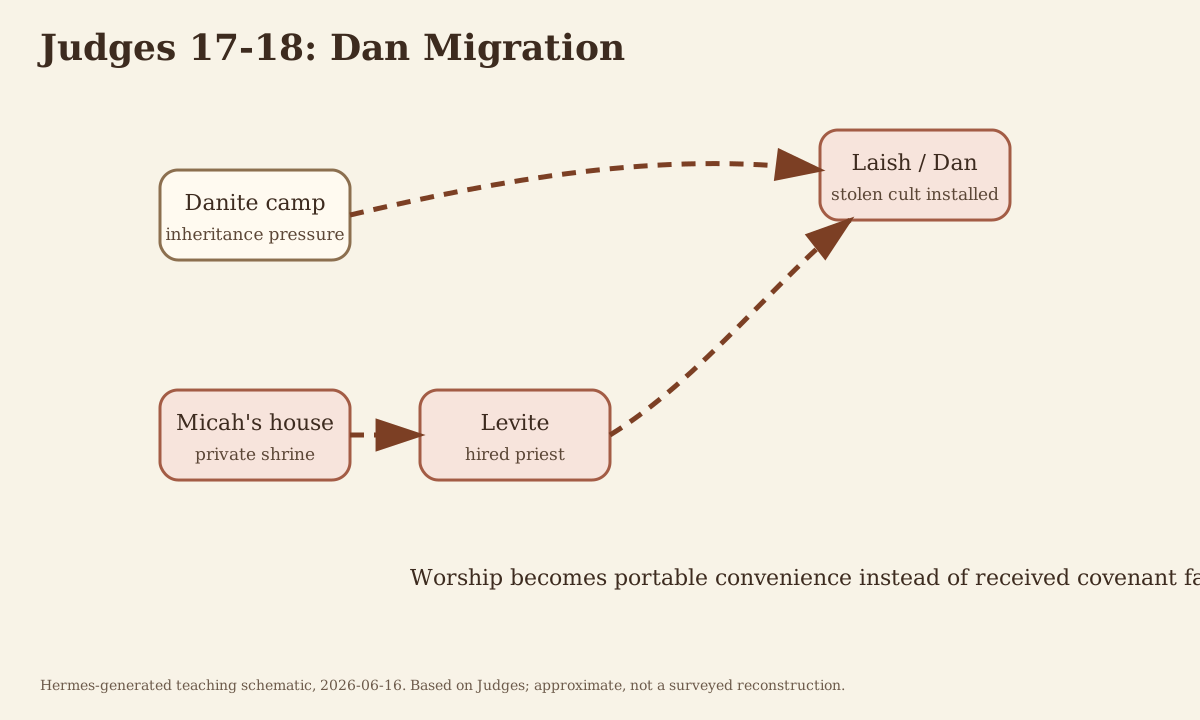 Source: Hermes-generated teaching schematic, 2026-06-16; approximate, not a surveyed reconstruction.
Light from the Word 🕯️
Judges 17:1-6 - Stolen silver, pious language, and a household shrine
1 And there was a man of mount Ephraim, and his name was Michaias. 2 And he said to his mother, The eleven hundred pieces of silver which thou tookest to thyself, and about which thou cursedst me, and spokest in my ears, behold, the silver is with me; I took it: and his mother said, Blessed be my son of the Lord. 3 And he restored the eleven hundred pieces of silver to his mother; and his mother said, I had wholly consecrated the money to the Lord out of my hand for my son, to make a graven and a molten image, and now I will restore it to thee. 4 But he returned the silver to his mother, and his mother took two hundred pieces of silver, and gave them to a silversmith, and he made it a graven and a molten image; and it was in the house of Michaias. 5 And the house of Michaias was to him the house of God, and he made an ephod and theraphin, and he consecrated one of his sons, and he became to him a priest.
6 And in those days there was no king in Israel; every man did that which was right in his own eyes.
The eleven hundred pieces of silver connect this household scene to the preceding Samson narrative. Judges 16:5 gives that amount as the offer of each Philistine lord to Delilah, not the combined payment. Here it is a mother’s missing money. The repeated sum brings silver back into view where faithfulness has again become negotiable; it does not prove that the two women are related or that this is the same silver.
Micah acknowledges taking the money and restores it. That is a real correction of the theft, but the narrative gives no account of a complete return to obedience. His mother responds with a blessing in the Lord’s name. The curse connected with the missing silver gives way to a dedication that will turn it into an idol. Deuteronomy 27:15 pronounces a curse on the person who makes a graven or molten image and conceals it. Her words condemn a loss within her household while her gift finances an act against which the covenant itself warns.
Her declaration that she had “wholly consecrated” the money stands beside the two hundred pieces actually handed to the craftsman. The contrast deserves attention, but the text does not explain what happened to the remaining silver or authorize certainty about her motive. Acts 5:1-4 provides a later comparison in which the appearance of complete devotion conceals a reservation. Peter makes clear that Ananias’ property and its proceeds had been at his disposal; the offense is deceit before God. The cases are not identical legal obligations. Both teach us to test sweeping religious words against what we actually do.
The deeper contradiction lies in the purpose of the dedication: an image made “to the Lord.” Exodus 32:4-5 offers the clear precedent. Aaron makes the calf and announces a feast of the Lord. Invoking the true God’s name cannot turn prohibited worship into obedience. Here the silver is restored to its owner but directed toward another wrong. Restitution must become the beginning of repentance, not a payment that permits the heart to preserve a different sin.
“The house of Michaias was to him the house of God” defines his project. He provides the objects, selects the priest, and keeps the sanctuary within the reach of his own authority. The refrain identifies the source of its law: his own eyes. For a Christian, the warning concerns control disguised as devotion. Prayer in the home, holy icons, and reverence for material things blessed in the Church are not what this text condemns. An idol is treated as a god; an icon bears witness to the incarnate Lord or to a person sanctified by Him. The danger is assigning divine authority to what serves our will, whether that is an object, an ambition, or our own supposedly unquestionable judgment.
Language insight: “consecrated” and “filled the hand”
Brenton’s “consecrated” in 17:5 conceals a vivid ordination idiom also used in 17:12: filling the priest’s hand. The Hebrew uses the verb “fill” with “hand”; Exodus 28:41 uses the same idiom for Aaron and his sons. Rahlfs’ Judges A has “ἐνέπλησεν τὴν χεῖρα” and B has “ἐπλήρωσεν τὴν χεῖρα,” two forms of filling the hand. NETS retains the concrete image in both translations.1 The familiar language makes Micah’s act more troubling. He imitates an appointment whose authority he has not been given. A recognizable religious act cannot confer legitimacy upon an arrangement that violates God’s command.
Judges 17:7-13 - The hired Levite and Micah’s false assurance
7 And there was a young man in Bethleem of the tribe of Juda, and he was a Levite, and he was sojourning there. 8 And the man departed from Bethleem the city of Juda to sojourn in whatever place he might find; and he came as far as mount Ephraim, and to the house of Michaias to accomplish his journey. 9 And Michaias said to him, Whence comest thou? and he said to him, I am a Levite of Bethleem Juda, and I go to sojourn in any place I may find. 10 And Michaias said to him, Dwell with me, and be to me a father and a priest; and I will give thee ten pieces of silver by the year, and a change of raiment, and thy living. 11 And the Levite went and began to dwell with the man; and the young man was to him as one of his sons. 12 And Michaias consecrated the Levite, and he became to him a priest, and he was in the house of Michaias. 13 And Michaias said, Now I know that the Lord will do me good, because a Levite has become my priest.
The young Levite arrives looking for somewhere to live. His need for provision is not itself a sin, and the lawful support of ministry must not be confused with the purchase of spiritual authority. The decisive issue is the arrangement he accepts. Micah’s idol remains in place. The Levite provides the household with a better credential without requiring it to surrender the shrine.
Micah offers ten pieces of silver by the year, clothing, and maintenance in the embedded translation. He asks the young man to be a “father and a priest,” then treats him “as one of his sons.” The juxtaposition exposes an unstable fatherhood. A father should speak truth to the household; this father lives under the patron whose religion he ought to challenge. Affection and hospitality could have been good things. Here they become part of an arrangement in which dependence replaces correction.
“Now I know that the Lord will do me good” is the household’s conclusion, not the narrator’s assurance. Micah counts the Levite as proof that the shrine works. Yet being a Levite is not identical with being an Aaronic priest. Numbers 3:10 reserves that charge to Aaron and his sons; Numbers 16:40, numbered 17:5 in the LXX, warns against unauthorized offering of incense. Jonathan’s genealogy will sharpen this distinction: descent from Moses, on the A reading, would be an honored ancestry but not descent from Aaron. A better pedigree cannot repair disobedience.
Christ the High Priest and the freedom of spiritual fatherhood
Hebrews 5:4 states, “And no man takes this honor to himself, but he who is called by God, just as Aaron was.” The next verse applies divine appointment to Christ Himself. His priesthood serves the Father’s saving will and gives us access to God through His self-offering. Micah instead takes the right to appoint and then assumes access on the strength of his appointment. The Christian receives priestly ministry as Christ’s gift to His Church, not as personal property secured by a donation.
Acts 8:18-23 gives the proper New Testament comparison for simony, the attempt to purchase spiritual power. Simon offers money for the authority to confer the Holy Spirit, and Peter calls him to repentance. Judges does not describe precisely that transaction, but it exposes the same wish to make sacred authority serve possession and advantage. A parishioner can repeat Micah’s mistake by expecting influence because of financial support; a servant can repeat the Levite’s by becoming unable to speak truth to an important benefactor. Generosity is healed when it makes service possible without buying obedience.
This is not a warrant for contempt toward priests. Micah’s arrangement is corrupt because priestly service is holy. A faithful spiritual father leads the household toward Christ even when correction costs him approval. The faithful, in turn, can help preserve that freedom by receiving an inconvenient word without withdrawing love or threatening support.
Judges 18:1-6 - Dan seeks an inheritance and consults a compromised priest
1 In those days there was no king in Israel; and in those days the tribe of Dan sought for itself an inheritance to inhabit, because no inheritance had fallen to it until that day in the midst of the tribes of the children of Israel. 2 And the sons of Dan sent from their families five men of valour, from Saraa and from Esthaol, to spy out the land and to search it; and they said to them, Go and search out the land. And they came as far as the mount of Ephraim to the house of Michaias and they lodged there, 3 in the house of Michaias, and they recognised the voice of the young man the Levite, and turned in thither; and said to him, Who brought thee in hither? and what doest thou in this place? and what hast thou here? 4 And he said to them, Thus and thus did Michaias to me, and he hired me, and I became his priest. 5 And they said to him, Enquire now of God, and we shall know whether our way will prosper, on which we are going. 6 And the priest said to them, Go in peace; your way in which ye go, is before the Lord.
The Danite scouts recognize the Levite’s voice, but the narrative does not tell us whether recognition depends on a prior acquaintance or on his manner of speech. Their questions lead to his own concise account: Micah hired him and he became Micah’s priest. They receive that answer as sufficient reason to seek an oracle. No one asks whether the shrine itself obeys the covenant.
Their question concerns prosperity on the road they are already taking. They seek confirmation of success, rather than instruction about the right course. The priest answers, “Go in peace; your way in which ye go, is before the Lord.” The words sound reassuring. They do not supply a divine command authorizing the later theft and violence. Both Rahlfs A and B place the way “ἐνώπιον κυρίου,” before the Lord, as NETS also reflects.2 God’s awareness of a road must not be confused with His approval of everything done upon it.
The narrative does not permit us to reconstruct a secret act of divination or to prove that the priest consciously lies. It does expose the source of the reassurance and the conduct that follows. A favorable religious answer obtained at an idol shrine cannot override known commandments. This is how conscience becomes negotiable: we stop asking what we must obey and look for someone willing to bless what we want.
Language insight: “hired” and “hireling”
In 18:4 both Greek texts use “ἐμισθώσατό με,” meaning that Micah hired him. John 10:12-13 uses “μισθωτός,” a hired worker or hireling. The verb and noun belong to the same hiring vocabulary, but they are not the same word, and their relationship does not prove that John is quoting Judges.3 The moral comparison rests on conduct. Jesus’ hireling abandons the sheep when danger makes service costly; this Levite will abandon Micah when a larger position becomes available. Christ, the Good Shepherd, gives His life for the sheep (John 10:11). He makes sacrificial care, rather than advantage, the measure of the shepherd’s heart.
The Church’s Voice in Worship ⛪
In the Coptic Liturgy of Saint Basil, the Prayer of Reconciliation asks God to fill our hearts with His peace and cleanse us from guile, hypocrisy, malice, and the remembrance of evil before the holy kiss and Communion.4 That is a concrete answer to the easy assurance offered here. The Church prays for peace that purifies the worshiper and reconciles the community. We can prepare for the Liturgy by naming the resentment or dishonesty we have tried to carry with us into prayer, seeking confession and making the restitution or reconciliation that is truly ours to make. This is a worship parallel, not a claim that Judges 17-18 is appointed for that service.
Judges 18:7-13 - Laish, easy prey, and the Danite search for a convenient future
7 And the five men went on, and came to Laisa; and they saw the people in the midst of it dwelling securely, at ease as is the manner of the Sidonians, and there is no one perverting or shaming a matter in the land, no heir extorting treasures; and they are far from the Sidonians, and they have no intercourse with any one. 8 And the five men came to their brethren to Saraa and Esthaol, and said to their brethren, Why sit ye here idle? 9 And they said, Arise, and let us go up against them, for we have seen the land, and, behold, it is very good, yet ye are still: delay not to go, and to enter in to possess the land. 10 And whensoever ye shall go, ye shall come in upon a people secure, and the land is extensive, for God has given it into your hand; a place where there is no want of anything that the earth affords.
11 And there departed thence of the families of Dan, from Saraa and from Esthaol, six hundred men, girded with weapons of war. 12 And they went up, and encamped in Cariathiarim in Juda; therefore it was called in that place the camp of Dan, until this day: behold, it is behind Cariathiarim.
13 And they went on thence to the mount of Ephraim, and came to the house of Michaias.
The scouts see both abundance and vulnerability. Laish lacks nothing the earth affords, yet it is far from the Sidonians and has no dependable outside relationship to protect it. The recommendation joins these two facts: a rich place and a people easy to overpower. The six hundred armed men then depart. A report about prosperity becomes a plan against other human beings.
The account resembles Israel’s earlier scouting of the promised land. Numbers 13-14 concerns the examination of a land, a report to the community, and a decision to enter. Numbers 14:7-9 joins the land’s goodness to the Lord’s pleasure and the command not to rebel against Him. The Danite scouts likewise report land that is “very good” and claim that God has given it into their hand. Read beside the wilderness story, this sounds like conquest language stripped of the obedience that should govern it. The comparison is a literary reading; the text never explicitly calls these men a parody of Joshua and Caleb.
“God has given it into your hand” remains their claim. The narrator records their confidence without issuing a fresh command from the Lord. We must not flatten all biblical conquests into the same event or treat every successful seizure as divinely authorized. This particular campaign is inseparable from the idol it acquires on the way. Its destination promises abundance; its chosen sanctuary promises reassurance; neither makes the tribe faithful.
The city’s quietness becomes an opportunity to the scouts. To a reader learning the mercy of Christ, it should also make its inhabitants visible. Their safety, families, and future cannot be reduced to resources awaiting acquisition. A community can speak of expansion while training itself to overlook the people who will bear its cost. The sin reaches beyond personal greed when respectable collective language allows many consciences to share the same evasion.
The pastoral comparison is precise. A family, business, or parish may avoid a difficult duty at home by pursuing an attractive project elsewhere. New numbers, income, or influence can make the project appear blessed while existing injustice is left untouched. The first question is whether the path is truthful and merciful, not whether it is achievable. Christ’s self-offering gives a different measure of strength: He spends Himself for those entrusted to Him, rather than treating their weakness as permission to take from them.
Judges 18:14-26 - The stolen shrine, the promoted priest, and Micah’s empty gods
14 And the five men who went to spy out the land of Laisa answered, and said to their brethren, Ye know that there is in this place an ephod, and theraphin, and a graven and a molten image; and now consider what ye shall do. 15 And they turned aside there, and went into the house of the young man, the Levite, even into the house of Michaias, and asked him how he was. 16 And the six hundred men of the sons of Dan who were girded with their weapons of war stood by the door of the gate. 17 And the five men who went to spy out the land went up, and entered into the house of Michaias, and the priest stood. 18 And they took the graven image, and the ephod, and the theraphin, and the molten image; and the priest said to them, What are ye doing? 19 And they said to him, Be silent, lay thine hand upon thy mouth, and come with us, and be to us a father and a priest: is it better for thee to be the priest of the house of one man, or to be the priest of a tribe and house for a family of Israel? 20 And the heart of the priest was glad, and he took the ephod, and the theraphin, and the graven image, and the molten image, and went in the midst of the people.
21 So they turned and departed, and put their children and their property and their baggage before them.
22 They went some distance from the house of Michaias, and, behold, Michaias and the men in the houses near Michaias’ house, cried out, and overtook the children of Dan. 23 And the children of Dan turned their face, and said to Michaias, What is the matter with thee that thou hast cried out? 24 And Michaias said, Because ye have taken my graven image which I made, and my priest, and are gone; and what have I remaining? and what is this that ye say to me, Why criest thou? 25 And the children of Dan said to him, Let not thy voice be heard with us, lest angry men run upon thee, and take away thy life, and the lives of thy house. 26 And the children of Dan went their way; and Michaias saw that they were stronger than himself, and he returned to his house.
The five scouts know where the objects are; the armed men make resistance dangerous. Their invitation to “consider what ye shall do” turns knowledge of the shrine into a plan to seize it. Religious goods are treated as useful property. The same men who asked for divine guidance now take an image without showing concern about the god it is supposed to represent.
The Levite initially asks what they are doing. Their answer is both silencing and enticing: put a hand over your mouth, come with us, and become priest to a tribe rather than to one household. They offer greater scope without any correction of the shrine’s false worship. The narrator says that “the heart of the priest was glad.” He becomes a willing participant, taking the objects and joining the people. His first loyalty has proved as transferable as his employer’s silver.
Micah’s pursuit ends in the same lesson on a smaller scale. He can make a god but cannot keep stronger men from taking it. He can hire a priest but cannot keep him from accepting a larger position. His phrase “my graven image which I made” names the contradiction, and “what have I remaining?” reveals its cost. The thing he trusted needs protection; the spiritual father he supported needs a better offer. Neither can save him.
The biblical criticism of handmade gods speaks directly to this scene. Isaiah 44:9-20 describes a person using part of a tree for ordinary needs and worshiping the remainder. Hosea 8:6 states that the craftsman made the calf and it is not God. Psalm 115:4-8 (LXX Ps 113:12-16) joins the idol’s helplessness to the spiritual danger of those who trust it. Wisdom 13:10-19 shows a worshiper fastening an image so it will not fall and then asking it for protection and a good journey. Wisdom 14:15-21 describes customs of image worship hardening into public authority. Micah and Dan give narrative form to that folly: the object made for security must itself be secured, and a household’s mistake becomes the practice of a people.
Gems from the Fathers 💎: The god that needs its maker
Saint Athanasius, writing against pagan image worship rather than commenting directly on Micah, exposes the reversal of maker and master. Human beings give an object its shape, buy it, maintain it, and then bow before it as though it possessed divine life. He writes: “Often, moreover, the image-maker, as though forgetting the work he has done himself, prays to his own productions, and calls gods what just before he was paring and chipping.”5 Micah’s words disclose exactly that dependence. Athanasius helps us see that idolatry is more than an inaccurate religious idea: it is the surrender of a living, rational person to what that person can control. Christian veneration of an icon does not confer deity upon wood or pigment; its honor concerns the person represented. The safeguard is communion with the living God, not suspicion of all visible beauty.
Christ and the ministry that gives itself
The Levite’s gladness at promotion stands beside Christ’s voluntary humility in Philippians 2:5-8. The Lord takes the form of a servant and obeys even to death on the Cross. This contrast examines ambition wherever it appears in the Church. Greater responsibility can be received faithfully, but greater visibility cannot be treated as evidence of greater holiness. Service asks whether the entrusted people are being loved. It asks whether a minister could remain truthful if a smaller place, a smaller audience, or a smaller income were the price.
Micah’s wrong does not excuse the Danites’ theft or threat to kill him and his household. An offender can still be wronged. We learn nothing righteous by delighting in his helplessness. His empty house calls us to relinquish false securities while the Lord still offers repentance, not to applaud the people who stripped him of them.
Judges 18:27-31 - Laish destroyed, Dan established, and idolatry enthroned beside Shiloh
27 And the children of Dan took what Michaias had made, and the priest that he had, and they came to Laisa, to a people quiet and secure; and they smote them with the edge of the sword, and burnt the city with fire. 28 And there was no deliverer, because the city is far from the Sidonians, and they have no intercourse with men, and it is in the valley of the house of Raab; and they built the city, and dwelt in it. 29 And they called the name of the city Dan, after the name of Dan their father, who was born to Israel; and the name of the city was Ulamais before.
30 And the children of Dan set up the graven image for themselves; and Jonathan son of Gerson son of Manasse, he and his sons were priests to the tribe of Dan till the time of the carrying away of the nation. 31 And they set up for themselves the graven image which Michaias made, all the days that the house of God was in Selom; and it was so in those days that there was no king in Israel.
The Danites destroy Laish, burn the city, rebuild it, and give it their ancestor’s name. The quiet people whom the scouts had studied are now killed by the edge of the sword. The account’s description of their isolation keeps the victims before us. A tribe has found a home by making others defenseless, and the shrine it places there gives that home an idolatrous center.
“There was no deliverer” turns the book’s language of rescue into a lament over those Israel attacks. This should not be called the sole instance of an absent rescuer in Judges: Jephthah already complains in 12:3 that there was no helper, with A using language of someone who saves. What is decisive here is the reversal. Israel, so often rescued in its distress, has become the power from which another people needs rescue. The verse explains their lack of outside help; it does not prove a judgment about every aspect of their life or authorize contempt toward them.
Language insight: Jonathan, “Moses,” and “Manasseh”
At the shrine’s establishment the unnamed young Levite is finally identified as Jonathan. Brenton prints “Jonathan son of Gerson son of Manasse” in the genealogy. Rahlfs B likewise has “Μανασση,” while A has “Μωυσῆ,” Moses, a difference also preserved by NETS.6 The Hebrew tradition writes the name “Manasseh” with a suspended letter nun, an elevated “n.” Without that consonant the underlying letters spell “Moses.” The traditional explanation is that the added letter protects Moses’ honor by altering the name associated with this disgrace. The textual feature is real; its motive and the reconstruction of the earliest wording require more caution than the feature itself.
Exodus 2:22 names Gershom, Brenton’s Gersam, as Moses’ son. The A genealogy therefore connects the corrupt priest with the family of the lawgiver. That connection deepens the warning: sacred ancestry does not make a person faithful. It does not make him an Aaronic priest either. Biblical “son” can express descent as well as immediate parentage, so the genealogy should not be forced into a precise generation count. Alongside Phinehas son of Eleazar son of Aaron in 20:28, it favors reading the final episodes as memories of the earlier period rather than a dated sequel to Samson. It cannot prove that both events occurred exactly one or two generations after Joshua.
“All the days that the house of God was in Selom” is the final contrast. True worship has not disappeared. Shiloh stands while Dan maintains its chosen shrine. The catastrophe is therefore not simply that people have lost every possible point of reference; they prefer the religious center attached to their own possessions and identity. The priest’s sons continue the arrangement. What one household tolerated becomes an inherited institution.
Gems from the Fathers 💎: Dan’s warning and the limits of speculation
The city’s later history gives this shrine a long biblical shadow. 3 Kingdoms 12:29-30 places Jeroboam’s calf at Dan; Amos 8:14 condemns those who swear by Dan’s god. Genesis 49:17 portrays Dan as a serpent beside the path, while the tribal list in Revelation 7:5-8 omits Dan. These texts should be read in their own settings, not assembled into a timetable from Judges.
Saint Irenaeus, in Against Heresies 5.30.2, connects Dan with Antichrist through Jeremiah 8:16 and interprets the omission in the Apocalypse accordingly: “This, too, is the reason that this tribe is not reckoned in the Apocalypse along with those which are saved.”7 That is a genuine early patristic interpretation, but it is neither direct commentary on these chapters nor an explanation explicitly supplied by Revelation. In 5.30.3 Irenaeus also urges caution about speculative identification. His witness gives spiritual seriousness to Dan’s history without allowing us to condemn every descendant, identify a present person as Antichrist, or turn genealogy into fatal destiny.
Christ, the sanctuary, and received worship
John 4:21-24 directs worship beyond rivalry over mountains toward the Father through the truth revealed in Christ. Hebrews 7-10 gives the one High Priest whose self-offering opens access to God. The Church’s unity in Him answers the habit of making sacred things serve household possession or tribal pride. Faithfulness to received worship is more than defending a familiar form: it is being formed by the holy gift we receive. The Christian who stands before the altar must also surrender the resentment, vanity, and desire for control that could turn even correct outward practice into Micah’s inward shrine.
Summary Table
| Text | Literal focus | Spiritual and Christological reading |
|---|---|---|
| Judges 17:1-6 | Returned silver becomes an image dedicated in the Lord’s name | Restitution must lead to obedience; pious words cannot sanctify self-rule |
| Judges 17:7-13 | Micah hires a Levite and presumes divine favor | Sacred ministry is God’s gift, not a purchased guarantee; Christ receives His priesthood from the Father |
| Judges 18:1-6 | Scouts obtain reassurance from the household priest | True peace purifies desire; the Good Shepherd cares for His sheep rather than his advantage |
| Judges 18:7-13 | The scouts recommend a rich and vulnerable city | Opportunity requires moral discernment; Christ’s strength is shown in self-offering |
| Judges 18:14-26 | Dan takes the objects and wins the priest with promotion | A made god cannot protect its maker; ministry must remain free to speak truth |
| Judges 18:27-31 | Laish is destroyed and a hereditary shrine established while Shiloh stands | Inherited holiness requires personal faithfulness; communion in Christ heals possessive religion |
Spiritual Fruit 🍇
Let restitution open the whole heart. Micah returns one thing he has taken and keeps another way of disobeying. When conscience brings us to confess a wrong, we can resist the wish to make the correction narrowly enough that our life remains otherwise untouched. Return what is owed, withdraw a false accusation, or repair an injury where possible. Then bring the hidden bargain into confession as well: the part of life we have tried to keep beyond God’s command. Repentance restores a person, not merely an account balance.
Receive spiritual care without buying control. Micah counts a priest as an acquired security; the Levite counts a larger flock as an advancement. In parish life, support ministry without expecting privileged access or exemption from correction. In service, notice the fear of becoming less visible or less necessary. Thank God for one faithful task that brings no recognition and do it attentively. Christ frees both giver and servant from the need to possess one another.
Ask for a purified will before reassurance. Dan obtains words of peace before it learns to seek peace truthfully. Before a consequential decision, place the proposed action beside God’s known commandments and the people it will affect. Ask for counsel that may correct you, not merely counsel that agrees. At the Prayer of Reconciliation, allow the petitions against guile and the remembrance of evil to name something real in your heart. The peace of Christ can cost us a cherished plan and still be mercy.
Refuse success purchased through another person’s vulnerability. The scouts see Laish’s safety as a weakness to exploit. We can learn to see the exposed neighbor as someone entrusted to our mercy. In work or family life, refuse an advantage that depends upon another’s inability to resist: a misleading agreement, withheld wages, an intimidating demand, or a public humiliation. The rescued people of God should become a refuge, not a new source of fear.
Give inherited worship a living answer. Jonathan’s ancestry and Shiloh’s existence show that the right inheritance can stand near an unfaithful life. Gratitude for the Church must become participation in her repentance, sacramental life, and mercy. Attend to the prayers you already know. Receive correction. Seek Communion with the preparation your priest teaches, rather than treating attendance or family history as proof that the Lord owes you good. The gift remains greater than our failures, and Christ continues to call us back to it.
Micah returns to a house emptied of the things he thought would keep him safe. The road north ends at a rebuilt city with an image at its center, while the house of God still stands at Shiloh. We need not wait until our false securities are carried away to discover their weakness. Christ gives Himself before we can purchase Him, and His mercy teaches us to release what we have tried to control. Let our prayer become a willing return to the Father, with hands open enough to receive and a heart ready to obey.
Teaching Notes
General guidance
- Teach the household shrine and the tribal shrine as connected stages of false worship in the Lord’s name, not as a curious digression about ancient objects.
- Keep lawful support of clergy distinct from simony and avoid anti-clerical caricature. The holiness of priesthood explains why its corruption matters.
- Do not use the image prohibition to dismiss Christian icons, home prayer, or sacramental materiality. Explain the difference between an object treated as a god and honor directed to the person represented.
- Treat the absence of a king as a diagnosis of public and covenant disorder, not a promise that any monarchy will cure Israel. Keep the Lord’s kingship and Christ’s fulfillment central.
- Keep Laish’s inhabitants visible. Neither Micah’s wrongdoing nor Dan’s need excuses theft, intimidation, or predatory violence.
- The genealogy, suspended nun, and A/B readings matter; avoid presenting a reconstructed chronology or a scribal motive as an established date or certain fact.
- No appointment of Judges 17-18 has been established by the sources cited here. The Prayer of Reconciliation is a verified worship comparison, not a Judges reading assignment.
- Use the schematic for the journey from household shrine to tribal shrine. It is approximate, not a surveyed itinerary or an Orthodox icon.
- If time is short, keep 17:3-6, 17:10-13, 18:5-6, 18:19-20, 18:24, and 18:30-31 together; these preserve the progression from dedication to possession to institutional inheritance.
Judges 17:1-6 - Stolen silver, pious language, and a household shrine
- Ask: How can Micah return stolen money yet remain unwilling to receive God’s rule over his worship?
- Watch for: Do not invent the mother’s motive or equate the unaccounted silver with the precise deceit and legal circumstances of Acts 5.
Judges 17:7-13 - The hired Levite and Micah’s false assurance
- Ask: What changes in the shrine when a Levite arrives, and what remains uncorrected?
- Watch for: Salary and maintenance are not themselves simony; the issue is purchased validation and unauthorized priesthood.
Judges 18:1-6 - Dan seeks an inheritance and consults a compromised priest
- Ask: What would the scouts have needed to ask if they wanted obedience rather than reassurance?
- Watch for: Do not claim the hiring verb is identical to John’s noun or that the word alone proves a deliberate allusion.
Judges 18:7-13 - Laish, easy prey, and the Danite search for a convenient future
- Ask: Which details of the scouts’ report turn another people’s security into an opportunity for aggression?
- Watch for: Do not call every successful conquest a divine command or claim that the narrator explicitly labels this expedition a parody.
Judges 18:14-26 - The stolen shrine, the promoted priest, and Micah’s empty gods
- Ask: What does “my graven image which I made” reveal about the security Micah has lost?
- Watch for: Micah’s guilt does not make the Danites’ threat to him or his family righteous.
Judges 18:27-31 - Laish destroyed, Dan established, and idolatry enthroned beside Shiloh
- Ask: Why does the narrator end by placing Dan’s image beside the continuing house of God at Shiloh?
- Watch for: Irenaeus’ reading of Dan is a patristic interpretation, not proof of fatal ancestry or permission for apocalyptic identification.
Sources
Embedded Scripture is from Brenton’s English Septuagint (LXX). New Testament wording cited in the exposition is from NKJV. Brenton’s spelling and verse wording remain unchanged; familiar place names are used in the explanation. The A/B comparisons concern Rahlfs’ two edited Greek texts, not two interchangeable labels for every manuscript.
Brenton Septuagint, Judges 17 and Judges 18; related Old Testament passages cited beside the explanation.
Alfred Rahlfs, Septuaginta (1935), Judges A and B; electronic transcription, with edition and licensing information. Compare Philip E. Satterthwaite’s NETS Judges, with introduction and both text forms. NETS is used for translation comparison, not substituted for the embedded Scripture.
Saint Athanasius, Against the Heathen (Contra Gentes) 13, translated by Archibald Robertson, NPNF2 4: direct section. Thematic witness to handmade gods, not direct commentary on Judges.
Saint Irenaeus, Against Heresies 5.30.2-3, translated by Alexander Roberts and William Rambaut, ANF 1: direct chapter. Read his interpretation of Dan with his warning about speculative identification.
Fr. Jacob Nadian, The Divine Liturgies of Saints Basil, Gregory and Cyril, Saint Bishoy Coptic Orthodox Church of Toronto, Prayer of Reconciliation in the Coptic Liturgy of Saint Basil; compare the English liturgical text. These verify the worship practice discussed here; no specific lectionary appointment for Judges 17-18 was established in the sources cited.
Hebrew Judges 18:30, with the suspended-nun note; Judges 17:5 Hebrew, Exodus 28:41 Hebrew, and John 10:12 Greek, used for the bounded language comparisons.
Footnotes
-
Judges 17:5,12, Rahlfs A and B, compared with NETS Judges; Hebrew ordination idiom in Exodus 28:41 and Judges 17:5. The Greek verbs differ between the two Judges text forms. ↩
-
Judges 18:6, Rahlfs A and B; compare NETS Judges. Both locate the road before the Lord; the narrative provides no separate divine command authorizing the campaign’s later deeds. ↩
-
Judges 18:4, Rahlfs A and B, compared with NETS Judges; John 10:12 Greek text. A related hiring verb and noun, not an identical term or a demonstrated quotation. ↩
-
Coptic Liturgy of Saint Basil, Prayer of Reconciliation before the holy kiss and Communion. ↩
-
Saint Athanasius, Against the Heathen 13.2, translated by Archibald Robertson, NPNF2 4, direct section; compare the complete treatise. ↩
-
Judges 18:30, Rahlfs A (Moses) and B (Manasseh), compared with NETS Judges; Hebrew text and suspended-nun note. The embedded Brenton reading is retained. ↩
-
Saint Irenaeus, Against Heresies 5.30.2, translated by Alexander Roberts and William Rambaut, ANF 1, direct chapter. Section 5.30.3 cautions against speculative identification. ↩