
The stars can make a person wonder and still fail to bring him to prayer. Wisdom 13 begins with that arrested wonder, then takes us into a carpenter’s workshop, where a man fastens an image to a wall so that it cannot fall and asks it to uphold his family. The two scenes share one failure: a created thing receives the trust that belongs to its Maker. The cure begins when beauty becomes thanksgiving and need becomes prayer to the living God.
Orientation
The Lord’s care for all in Wisdom 12 leads into the question of recognizing Him. Verses 1-9 consider those who mistake the beauty and power of nature for divinity; verses 10-19 expose a handmade idol. Romans 1:18-25 and Acts 17:24-31 provide the close apostolic companions. Both summon people from the creature to its Creator, and Acts brings the summons to repentance before the risen Christ.
The first author of beauty (Wisdom 13:1-9)
1 Surely vain are all men by nature, who are ignorant of God, and could not out of the good things that are seen know him that is: neither by considering the works did they acknowledge the workmaster; 2 but deemed either fire, or wind, or the swift air, or the circle of the stars, or the violent water, or the lights of heaven, to be the gods which govern the world. 3 With whose beauty if they being delighted took them to be gods; let them know how much better the Lord of them is: for the first author of beauty hath created them. 4 But if they were astonished at their power and virtue, let them understand by them, how much mightier he is that made them.
5 For by the greatness and beauty of the creatures proportionably the maker of them is seen. 6 But yet for this they are the less to be blamed: for they peradventure err, seeking God, and desirous to find him. 7 For being conversant in his works they search him diligently, and believe their sight: because the things are beautiful that are seen. 8 Howbeit neither are they to be pardoned. 9 For if they were able to know so much, that they could aim at the world; how did they not sooner find out the Lord thereof?
The passage begins with a generous and severe vision at the same time. It is generous because it admits that some idolaters were seeking God and desirous to find Him. They were moved by fire, wind, air, stars, water, and heavenly lights because these things are genuinely beautiful and powerful. Wisdom does not mock wonder. It says wonder must keep moving upward.
The severity is just as clear. The visible world is good, but it is not ultimate. The one who sees the works should acknowledge the workmaster. The one who delights in beauty should seek the first author of beauty. The one who is astonished by created power should recognize the greater power of the Maker. Creation bears witness to its Maker and directs worship beyond itself. Its witness is real, though it cannot contain the fullness of God.
Verse 5 gives the theological center: by the greatness and beauty of the creatures, the maker is seen proportionably. This does not mean creation explains God completely. It means creation bears enough witness to make refusal blameworthy. The world is not silent. Its beauty says that beauty has an Author. Its order says that it is not self-originating. Its power says that it is not the highest power.
Romans 1:18-25 presses the same burden. Saint Paul says that God’s invisible things are understood from the creation of the world through the things that are made, yet human beings do not glorify Him as God. The result is an exchange: the glory of the incorruptible God is traded for images and created things. Wisdom 13 and Romans 1:18-25 together show that idolatry is not simply intellectual error. It is refusal to let truth become worship.
Acts 17:24-31 adds the missionary answer. In Athens, Saint Paul does not begin by despising the Athenians. He begins with the God who made the world and all things in it, who does not dwell in temples made with hands, who gives life and breath and all things, and who now calls all people to repentance. The Creator is not far from us, but He is also not one more object inside creation.
The exchange becomes recognizable when a created good starts issuing commandments. A career that once supported a family begins demanding dishonesty and neglect of that family. Attraction becomes a demand to possess another person. A device becomes the place we take every fear before we have even tried to pray. The test is not whether a gift matters to us, but whether we will disobey God to keep it. Thanksgiving returns the gift to its proper place: something received, cared for, and offered to the Lord.
Because creation is good, the cure for idolatry is not suspicion of matter. It is thanksgiving, obedience, and right use. The Christian may paint icons, build churches, study science, use medicine, marry, cultivate beauty, and work with skill, provided the gift remains a gift. The line is crossed when the gift stops opening the heart to gratitude and begins demanding the obedience, fear, sacrifice, and trust that belong to God.
Language insight: “him that is” and “proportionably”
Wisdom 13:1 calls God τὸν ὄντα (ton onta), “him that is.” This recalls the Greek of Exodus 3:14, where God declares Himself as the One who is; Wisdom’s accusative form fits its own sentence.1 The Maker is therefore more than an unexplained force behind beautiful things. The language opens toward the God who revealed Himself to Moses and cares for His people.
In verse 5, ἀναλόγως (analogōs), “proportionably,” describes a recognition of the Maker through His works. It allows a real ascent of understanding without pretending that the scale or form of a creature contains God. We learn from beauty, but the Author exceeds what we see. Wonder becomes spiritually fruitful when it passes into gratitude and reverence rather than demanding that God become another object we can master.
Gems from the Fathers 💎
St. Athanasius directly cites Wisdom 13:5 in Against the Heathen 44. He describes the Word sustaining visible creation and the invisible powers, ordering them so that the Father’s goodness may be known. His account joins the world’s coherence to a personal divine act, not to a world that is itself God.2 In the following chapter he carries the recognition of the Word toward the Father. Creation’s witness has a Christian destination.
As a close thematic companion, St. John Chrysostom explains Romans 1:20 in Homily 3 on Romans. God set creation before every people so that visible beauty might raise the mind to Him. Chrysostom says why: “For it was not to bereave them of all excuse, that He set before them so great a system of teaching, but that they might come to know Him.”3 This corrects a cold reading of the chapter as if creation were merely evidence assembled for a prosecution. The world is given for knowledge of God. The tragedy is that its offered instruction can be refused.
The Church’s Voice in Worship ⛪
The Sixth Hour prophecy on the Thursday of the Covenant runs from Wisdom 12:13 through Wisdom 13:1.4 Only this opening verse of chapter 13 belongs to that appointed range. After the confession of God’s righteous care, it names the sorrow of looking at His good works without recognizing Him. In the light of Christ’s humility remembered that day, the warning becomes personal: we may handle the gifts of God, even holy gifts, while failing to turn toward the Giver.
The helpless idol made from refuse (Wisdom 13:10-19)
10 But miserable are they, and in dead things is their hope, who called them gods, which are the works of men’s hands, gold and silver, to shew art in, and resemblances of beasts, or a stone good for nothing, the work of an ancient hand. 11 Now a carpenter that felleth timber, after he hath sawn down a tree meet for the purpose, and taken off all the bark skilfully round about, and hath wrought it handsomely, and made a vessel thereof fit for the service of man’s life; 12 and after spending the refuse of his work to dress his meat, hath filled himself; 13 and taking the very refuse among those which served to no use, being a crooked piece of wood, and full of knots, hath carved it diligently when he had nothing else to do, and formed it by the skill of his understanding, and fashioned it to the image of a man; 14 or made it like some vile beast, laying it over with vermilion, and with paint colouring it red, and colouring every spot therein; 15 and when he had made a convenient room for it, set it in a wall, and made it fast with iron: 16 for he provided for it that it might not fall, knowing that it was unable to help itself; for it is an image, and hath need of help.
17 Then maketh he prayer for his goods, for his wife and children, and is not ashamed to speak to that which hath no life. 18 For health he calleth upon that which is weak: for life prayeth to that which is dead: for aid humbly beseecheth that which hath least means to help: and for a good journey he asketh of that which cannot set a foot forward: 19 and for gaining and getting, and for good success of his hands, asketh ability to do of him, that is most unable to do any thing.
The first idolatry section considered the person who looks at the majesty of creation and stops short of the Creator. This second section moves lower. Now the idol is not the sun or stars. It is the work of human hands. The text calls the worshipers miserable because their hope is in dead things.
Isaiah 44:9-20 supplies the great prophetic parallel: one part of a tree warms its owner and cooks his food, while another becomes the object from which he asks deliverance. Wisdom gives the workshop sequence an equally sharp finish. The craftsman has enough understanding to secure the image against falling, yet silences that understanding when he kneels. Related prophetic rebukes in Isaiah 46:6-7 and Jeremiah 10:3-5 expose the same reversal: an object has to be carried by the people who expect it to carry their lives. The Letter of Jeremiah likewise presses the helplessness of handmade gods. Scripture diagnoses a divided reason, capable in daily affairs and willfully confused in worship.
Wisdom’s satire is precise. The carpenter cuts timber, makes something useful from part of the wood, burns the refuse to cook his food, and then takes another useless piece, crooked and full of knots, to carve an idol. The same created material becomes fuel, tool, and false god. The absurdity is not in wood itself. Wood can serve human life. The absurdity is in a human being making a helpless object and then asking it for help.
Verse 16 is almost painful in its irony. The craftsman must fasten the idol to the wall because it cannot keep itself from falling. He knows this. He provides for the idol because it is unable to help itself. Then he prays to it for goods, wife, children, health, life, aid, travel, profit, and success. The worshiper gives life-support to the object and then asks the object for life.
The irony reaches beyond ancient carving. Even a ministry can become something we labor to sustain and then expect to sustain our own worth. We defend its success as if our life depended on it, resent the people who interrupt it, and become unable to receive correction. A work offered to God has quietly begun to receive what belongs to Him. The carpenter’s divided understanding gives us a way to recognize that exchange before it consumes the people we meant to serve.
The passage also exposes the hidden shame of idolatry. The worshiper is “not ashamed” to speak to what has no life. Sin often deadens shame in the wrong direction. We become ashamed to pray honestly to God, ashamed to confess weakness, ashamed to ask for mercy, yet unashamed to pour our fear into lifeless things. Wisdom reverses this. It teaches us to be ashamed of dead hope and unashamed before the living God.
Christ stands opposite the helpless idol. He is not a dead image fastened in place by human support. He is the living Image of the invisible God, the Word through whom all things were made, the One who walked among us, healed the sick, raised the dead, gave life, bore the Cross, and rose from the tomb. The idol cannot set a foot forward. Christ walks toward sinners. The idol cannot give breath. Christ breathes peace upon His disciples. The idol must be guarded from falling. Christ raises the fallen.
For our life, the question is simple and uncomfortable: What do I maintain with all my strength and then secretly ask to save me? Where am I praying, not with words, but with attention, anxiety, money, obedience, and sacrifice? Wisdom wants us to hear the foolishness before it becomes tragedy.
The Cross, icons, oil, water, relics, and other holy signs are not adored as rival gods or treated as self-sufficient powers. They are received in communion with the living God who sanctifies creation and who, in the Incarnation, truly entered material life. Orthodox veneration is directed relationally to the person honored; adoration belongs to God. Wisdom condemns a dead object asked to be a god, not creation received as a gift or sanctified through God’s presence. The same distinction examines us when we treat a blessed object as a substitute for repentance, prayer, or obedience.
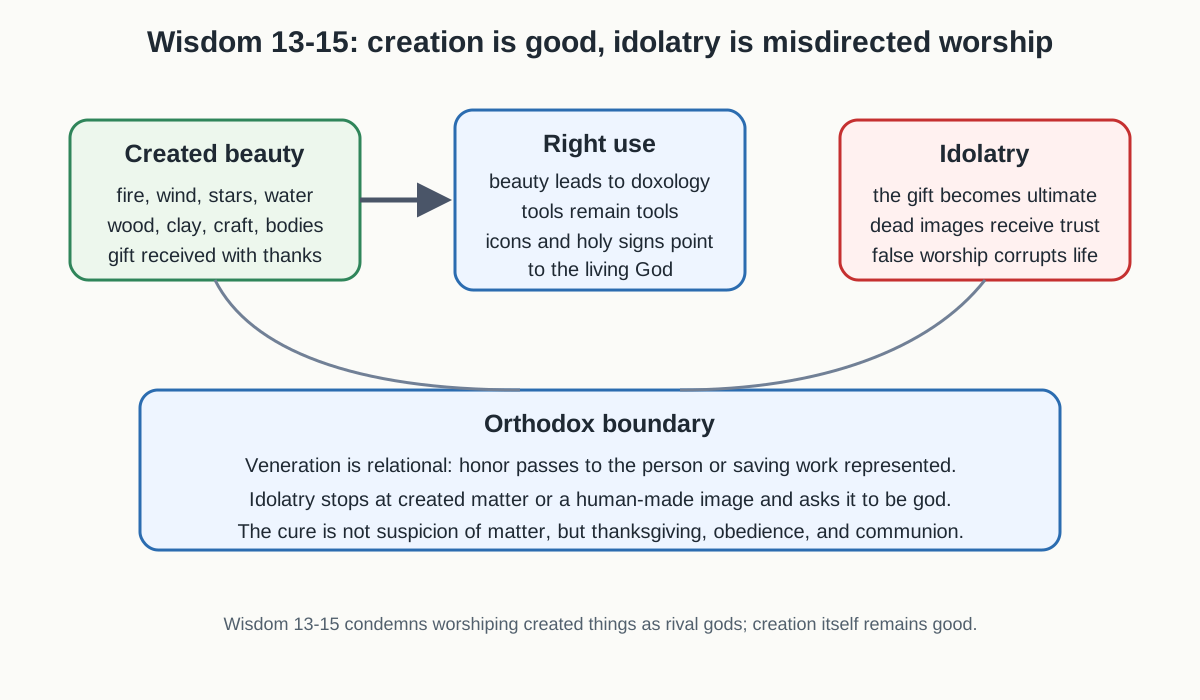 Creation, gift, and idolatry. Schematic based on Wisdom 13-15, Romans 1:18-25, and Acts 17:24-31.
Glossary
- First author of beauty: God as the origin of the beauty that creatures truly possess.
- Creator and creature: The difference between the Lord who gives being and everything that receives existence from Him.
- Idol: A creature or human product given the divine trust and worship that belong to God.
- Veneration: Honor offered in relation to the person honored, distinguished from the adoration due to God alone.
- Letter of Jeremiah: The biblical rebuke of idolatry also transmitted as Baruch 6 in some arrangements.
Spiritual Fruit 🍇
Finish the act of wonder. When something beautiful arrests your attention, turn admiration into thanksgiving. Name the gift before God without grasping at it as a possession or demanding that it make your life complete.
Notice what must be maintained to reassure you. The carpenter supports the image, then asks it for support. A useful question for conscience is whether your work, image, possessions, or relationships have become an exhausting substitute for trust. Choose one act of obedience that returns that good thing to its rightful place.
Receive holy signs through communion. Kiss the Cross, honor the saints, and receive blessed things with prayer and repentance. Refuse the wish to acquire protection while withholding the heart from the Lord. God gives Himself, not a technique for controlling Him.
The image in the workshop cannot keep itself upright. Its maker can, however, turn and pray to the One who gave him hands and breath. Stand with that possibility rather than only with the satire. The living God is nearer than the false thing you have labored to secure, and He hears the first honest prayer.
Teaching Notes
The first author of beauty (Wisdom 13:1-9)
- Ask: Why does Wisdom say creation’s beauty should have led people to the Creator?
- Emphasize: The passage is not anti-beauty. It teaches that beauty must become worship of the Maker, not worship of the created thing.
- Watch for: Treating idolatry as only an ancient statue. Ask which created good now demands disobedience to God.
- Connect: Romans 1:18-25 shows the same exchange, the creature served instead of the Creator. Acts 17:24-31 shows the apostolic call to repent and turn to the God who made all things.
- Show: Use the gift/idol/holy sign schematic, then ask where beauty becomes a window to God and where it becomes a prison.
- Emphasize: Only verse 1 belongs to the Covenant Thursday prophecy that begins at 12:13; do not extend that appointment through the whole chapter.
The helpless idol made from refuse (Wisdom 13:10-19)
- Ask: What makes the carpenter’s idol so absurd in this passage?
- Emphasize: The worshiper supports the idol, then asks the idol for support.
- Watch for: Laughing only at ancient idol-makers. The same pattern appears whenever we build, maintain, defend, and then seek salvation from a created thing.
- Connect: Christ is the living Image who walks toward sinners, gives life, and raises the fallen.
- Show: Invite the class to identify one thing people maintain anxiously and then expect to save them.
- Watch for: Collapsing Orthodox veneration into idolatry, or treating blessed material as an independent magical power. Keep the relation to the living God explicit.
Sources
Embedded Scripture is from Brenton’s English Septuagint (LXX).
St. Athanasius, Against the Heathen 44-45, and St. John Chrysostom, Homilies on Romans, Homily 3, cited above.
Coptic Holy Pascha lectionary, Covenant Thursday Sixth Hour, ending at Wisdom 13:1.
Footnotes
-
Wisdom 13:1, 5, Elpenor Greek Septuagint; compare Exodus 3:14, Greek Septuagint. ↩
-
St. Athanasius, Against the Heathen, 44-45, with the direct citation of Wisdom 13:5 in 44.3, New Advent. ↩
-
St. John Chrysostom, Homilies on Romans, Homily 3, on Romans 1:19-21, New Advent. ↩
-
Coptic Holy Pascha lectionary, Thursday of the Covenant, Sixth Hour, prophecy, Wisdom 12:13-13:1. The appointment follows the Katameros source tradition. Confirmation in Coptic Reader has not been established for this appointment. ↩