


This narration is from a previous version of the study and may include a combined recording of multiple chapters.
 Generated decorative cover art for orientation only. It is not a manuscript witness and not an Orthodox icon.
The gods are coming down the street on men’s shoulders, and a crowd is walking before them and behind them. That is the scene this letter expects. The exiles have already been told why they are going: their own sins. They have also been told that the wait will be long, and that God Himself is caring for their souls. Between those two words, judgment and care, the letter puts a sentence the heart can say when the procession passes: “O Lord, we must worship thee.”
The overview tells how the Greek Church kept this letter inside Jeremiah’s book, and why Western Bibles print it as Baruch 6. Here the work is the letter itself. It is one chapter. The refrain keeps returning, “fear them not,” until the last lines leave a beatitude instead of a threat: better is the just man who has no idols.
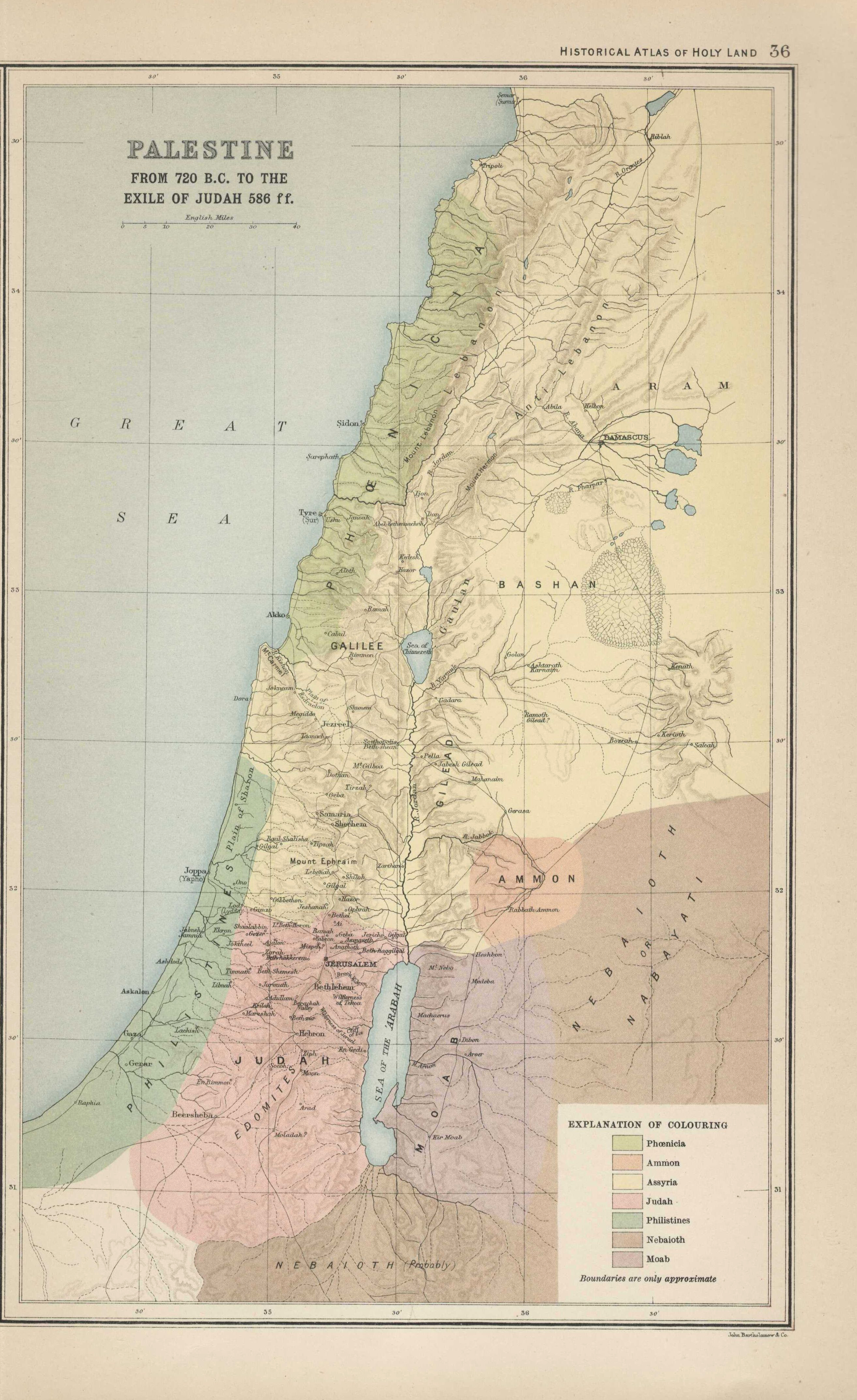 Historical map for broad location context: John Bartholomew & Co., Palestine from 720 B.C. to the exile of Judah 586, public domain, National Library of Israel / Wikimedia Commons. Use as a teaching locator, not as an exact reconstruction of the Letter’s route.
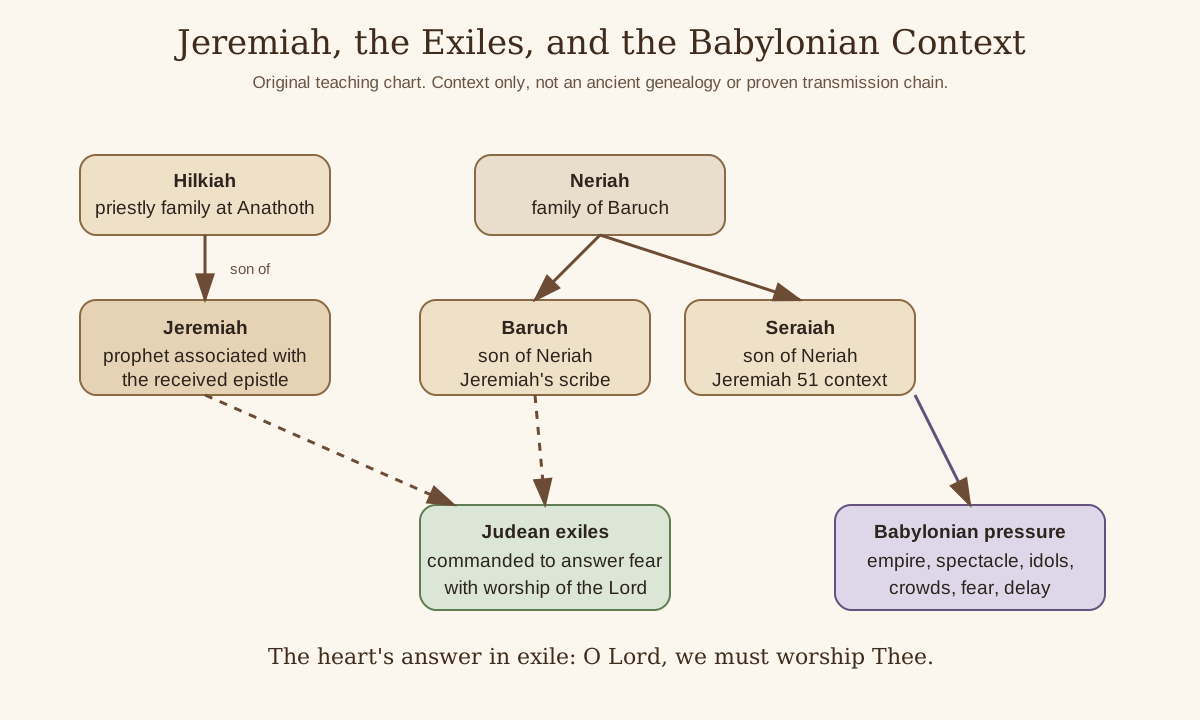 Original teaching chart created for this guide. It is context only, not an ancient genealogy, manuscript witness, or proven transmission chain. The Letter does not provide a meaningful genealogy tree, so a cautious context chart is better than inventing one.
The Church does not appoint this letter in the Coptic readings checked. She does appoint other passages that carry the same message. Those readings are named beside the verses they illuminate, always as passages the Church reads, never as a reading of this letter.
Exile and the heart’s confession (Letter of Jeremiah 1:1-7)
1 A copy of an epistle, which Jeremy sent unto them which were to be led captives into Babylon by the king of the Babylonians, to certify them, as it was commanded him of God.
2 Because of the sins which ye have committed before God, ye shall be led away captives into Babylon by Nabuchodonosor king of the Babylonians. 3 So when ye be come unto Babylon, ye shall remain there many years, and for a long season, namely, seven generations: and after that I will bring you away peaceably from thence.
4 Now shall ye see in Babylon gods of silver, and of gold, and of wood, borne upon shoulders, which cause the nations to fear. 5 Beware therefore that ye in no wise be like to strangers, neither be ye afraid of them, when ye see the multitude before them and behind them, worshipping them. 6 But say ye in your hearts, O Lord, we must worship thee. 7 For mine angel is with you, and I myself caring for your souls.
The first word is captivity, and the cause is named. “Because of the sins which ye have committed before God, ye shall be led away captives.” The letter does not flatter the people by calling exile a political accident. Idolatry has already wounded the covenant, and now the wounded will live among the idols of the empire that defeated them.
Judgment is not abandonment. Verse 3 gives a long season and then a peaceful return. Verse 7 gives something deeper than a date: “mine angel is with you, and I myself caring for your souls.” The idols must be carried. The Lord carries His people.
Verse 3 says the season will last “seven generations.” Jeremiah’s own letter to the exiles says seventy years. In the Hebrew Bible that letter is Jeremiah 29. In the Septuagint it stands in Jeremiah 36, where Brenton reads, “When seventy years shall be on the point of being accomplished at Babylon, I will visit you.” They are not the same sentence. Seventy years is a measured promise. Seven generations is a figure for a wait long enough that children will be born under it. It does not cancel the seventy years, and it does not invite a secret timetable. It tells the heart that the pressure will outlast a mood. God will still bring His people away peaceably, and until then He is caring for their souls.
Another book remembers this charge. 2 Maccabees 2:1-3 says that Jeremiah commanded those who were carried away not to forget the commandments of the Lord, “and that they should not err in their minds, when they see images of silver and gold, with their ornaments.” That is this opening, kept in the Church’s Scripture as a memory of the prophet’s care. The exiles were not left to invent their own resistance.
The pressure in verses 4 and 5 is public. Gods of silver, gold, and wood are “borne upon shoulders,” and they “cause the nations to fear.” A multitude walks before them and behind them. False worship often works that way. It surrounds the heart with numbers, noise, and the cost of standing apart. The letter answers before the body can be trained by fear: “say ye in your hearts, O Lord, we must worship thee.”
That sentence is a prayer, not a slogan. When safety is threatened, pray it. When belonging seems to require silence before sin, pray it. The heart must speak before Babylon teaches it another language.
Tertullian, an early Christian writer of the Latin West and not a saint, heard these verses as the martyrs’ text. In Scorpiace 8, a work from his later period after his separation from the Church, he says the three young men “remembered also the words of Jeremias writing to those over whom that captivity was impending,” and he ends the quotation with “Our duty is to worship You, O Lord.” When the golden image was dedicated and the citizens were pressed to worship, faith that had not been taken captive already knew what to do. The letter and Daniel 3 belong together in that reading. The young men did not wait to discover their duty in the fire. They had already been told whom to worship.
On Nayrouz, Tut 1, the feast of the martyrs, the Church reads a passage that carries the same message: Acts 17:16-34, Paul in a city full of idols. The same Acts reading is appointed on Thomas Sunday. The Catholic Epistle on Nayrouz is 1 John 2:7-17, a call not to love the world. James 1:22-27, with its care for widows and orphans, is read on the first Sunday of Tout, a different day. The martyr’s “no” and the widow’s need are both in this letter. They are not the same lectionary appointment.
Gems from the Fathers 💎: the three young men and the exile’s prayer
Tertullian does not treat the letter as a curiosity. He puts it in the mouths of the three who refused the image. They remembered Jeremiah’s words to those about to be taken captive, saw in advance the gods of gold, silver, and wood borne on shoulders, and answered in the mind, “Our duty is to worship You, O Lord.”1 Then, he says, they had confidence from God to tell the king that their God was able to deliver them from the furnace and from the king’s hands. The quotation is exact to his point. He is a witness from the early Church, and a complicated one. The link he makes is still true: this letter is a martyr’s preparation, learned before the threat arrives.
Decorated gods that cannot speak (Letter of Jeremiah 1:8-23)
8 As for their tongue, it is polished by the workman, and they themselves are gilded and laid over with gold; yet are they but false, and cannot speak. 9 And taking gold, as it were for a virgin that loveth to go gay, they make crowns for the heads of their gods. 10 Sometimes also the priests convey from their gods gold and silver, and bestow it upon themselves. 11 Yea, they will give thereof to the common harlots, and deck them as men with garments, [being] gods of silver, and gods of gold, and wood.
12 Yet cannot these gods save themselves from rust and moths, though they be covered with purple raiment. 13 They wipe their faces because of the dust of the temple, when there is much upon them. 14 And he that cannot put to death one that offendeth him holdeth a sceptre, as though he were a judge of the country. 15 He hath also in his right hand a dagger and an axe: but cannot deliver himself from war and thieves. 16 Whereby they are known not to be gods: therefore fear them not.
17 For like as a vessel that a man useth is nothing worth when it is broken; even so it is with their gods: when they be set up in the temple, their eyes be full of dust through the feet of them that come in. 18 And as the doors are made sure on every side upon him that offendeth the king, as being committed to suffer death; even so the priests make fast their temples with doors, with locks, and bars, lest their gods be spoiled with robbers.
19 They light them candles, yea, more than for themselves, whereof they cannot see one. 20 They are as one of the beams of the temple, yet they say their hearts are gnawed upon by things creeping out of the earth; and when they eat them and their clothes, they feel it not. 21 Their faces are blacked through the smoke that cometh out of the temple. 22 Upon their bodies and heads sit bats, swallows, and birds, and the cats also. 23 By this ye may know that they are no gods: therefore fear them not.
The letter attacks appearance first. The idol has a polished tongue, gilding, crowns, purple, a sceptre, a dagger, an axe, locked doors, and candles. Everything around it says authority. The first accusation undoes the display: it “cannot speak.” The mouth was finished by a workman. No word comes from it.
Psalm 115:4-8 (LXX Psalm 113:12-16) is the closest scriptural cousin of this exposure. “The idols of the nations are silver and gold, the works of men’s hands. They have a mouth, but they cannot speak; they have eyes, but they cannot see.” Verse 8 of the letter is that psalm’s silence. Verse 19 is its blindness: they light candles “whereof they cannot see one.” The psalm adds the fearful end of the comparison: those who make such gods, and those who trust them, become like them. A heart that serves what cannot speak will, in time, lose its own true speech.
Christ is the living Word. The idol has a decorated tongue and no voice. The idol has candles before it and cannot see them. Christ is the Light who gives sight. The idol’s face must be wiped because dust covers it, and smoke blackens it. Christ cleanses. The repeated command, “therefore fear them not,” is tied to these details. Do not fear what cannot speak truth to you, cannot see you, and must be locked up so thieves do not carry it away.
The Lord Himself takes up the refrain. In Matthew 10:26-28 He says not to fear those who can kill the body and after that have nothing more they can do, and to fear the One who can destroy both soul and body. The Church reads Matthew 10:24-33 as a Vespers Gospel on many commemorations, including Babah 26 and Abib 6. The verbal echo is worth hearing. The exile is told, “fear them not.” Christ says the same to disciples who will be hauled before councils. Fear has a right object. It is not the procession, the judge, or the crowd.
 Source: Franz Heinrich Weissbach, Babylonische Miscellen (1903), public domain, Wikimedia Commons: https://commons.wikimedia.org/wiki/File:Marduk_and_pet.jpg. Ancient Near Eastern divine-image context only; this is not the exact idol targeted by the Letter, not a biblical illustration, and not an Orthodox icon.
The Orthodox distinction belongs here, beside the polished tongue and the locked temple, because this is where a careless reader starts condemning every image. The letter condemns rival gods, falsely feared, trusted, and worshiped as divine. Orthodox icons are not gods, and they are not given the adoration that belongs to the Holy Trinity alone. St. Basil the Great, in On the Holy Spirit 18.45, gave the Church the rule, speaking first of the Son and the Father: “the honour paid to the image passes on to the prototype.” St. John of Damascus, in Part I of his apology, introduces it with “St Basil says, ‘Honouring the image leads to the prototype,’” and he confesses, “I adore Him alone with the worship of latreia.”2 Honor shown to an icon passes to the person represented. Wood and paint are not a competing deity.
That distinction is not a permission slip. A person can kiss an icon, light a candle, and wear a cross while refusing repentance, forgiveness, and obedience. Created things may serve God. They must never replace Him. Verse 12 already knows how decoration fails: these gods “cannot save themselves from rust and moths, though they be covered with purple raiment.” On the Sunday of the first week of Great Lent the Church reads Matthew 6:19-30, where moth and rust corrupt the treasures laid up on earth. The purple and the gold are not a refuge. The heart’s treasure is.
Gems from the Fathers 💎: honor that passes, worship that does not
St. John of Damascus is not commenting on this letter. He is defending the holy images against people who thought every image was an idol, and he will not let the defense blur into worship of a thing. He adores God alone with the worship of latreia, and he quotes St. Basil: the honor given to the image leads to the prototype.2 Read beside verses 8 to 23, the point is sharp. The idol’s honor stops at the wood. It has a polished tongue and cannot speak, candles and cannot see, locks because it cannot protect itself. The icon’s honor does not stop at the wood. It passes to Christ, to His Mother, to the saint. If it stops at the object, and if the heart wants the object to work without repentance, the letter’s warning has found a Christian address.
Idols cannot save, heal, or show mercy (Letter of Jeremiah 1:24-44)
24 Notwithstanding the gold that is about them to make them beautiful, except they wipe off the rust, they will not shine: for neither when they were molten did they feel it. 25 The things wherein there is no breath are bought for a most high price. 26 They are borne upon shoulders, having no feet, whereby they declare unto men that they be nothing worth.
27 They also that serve them are ashamed: for if they fall to the ground at any time, they cannot rise up again of themselves: neither, if one set them upright, can they move of themselves: neither, if they be bowed down, can they make themselves straight: but they set gifts before them, as unto dead men.
28 As for the things that are sacrificed unto them, their priests sell and abuse; in like manner their wives lay up part thereof in salt; but unto the poor and impotent they give nothing of it. 29 Menstruous women and women in childbed eat their sacrifices: by these things ye may know that they are no gods: fear them not. 30 For how can they be called gods? because women set meat before the gods of silver, gold, and wood. 31 And the priests sit in their temples, having their clothes rent, and their heads and beards shaven, and nothing upon their heads. 32 They roar and cry before their gods, as men do at the feast when one is dead.
33 The priests also take off their garments, and clothe their wives and children. 34 Whether it be evil that one doeth unto them, or good, they are not able to recompense it: they can neither set up a king, nor put him down. 35 In like manner, they can neither give riches nor money: though a man make a vow unto them, and keep it not, they will not require it. 36 They can save no man from death, neither deliver the weak from the mighty. 37 They cannot restore a blind man to his sight, nor help any man in his distress. 38 They can shew no mercy to the widow, nor do good to the fatherless.
39 Their gods of wood, and which are overlaid with gold and silver, are like the stones that be hewn out of the mountain: they that worship them shall be confounded.
40 How should a man then think and say that they are gods, when even the Chaldeans themselves dishonour them? 41 Who if they shall see one dumb that cannot speak, they bring him, and intreat Bel that he may speak, as though he were able to understand. 42 Yet they cannot understand this themselves, and leave them: for they have no knowledge.
43 The women also with cords about them, sitting in the ways, burn bran for perfume: but if any of them, drawn by some that passeth by, lie with him, she reproacheth her fellow, that she was not thought as worthy as herself, nor her cord broken. 44 Whatsoever is done among them is false: how may it then be thought or said that they are gods?
The letter now presses past appearance into mercy. The idols have no breath. They are bought at a high price, carried because they have no feet, set upright because they cannot rise, and treated “as unto dead men.” People bring gifts to what has no life. “Unto the poor and impotent they give nothing of it.” False worship is not a harmless private fancy. It spends love, money, fear, and attention before dead things while the wounded neighbor remains unseen.
Verse 43 is quieter than it first sounds, and it is not a spectacle. Women sit in the ways with cords about them. One is drawn aside by a passerby, then reproaches her companion because she was not thought as worthy, and her cord was not broken. The letter’s point is that false worship degrades the person. It can turn desire, shame, and competition into a religious system and call that system sacred. Ancient readers compared the scene with Herodotus, who describes Babylonian women sitting in a temple precinct with cords on their heads, waiting to be chosen by a stranger.3 The letter does not cite him, and the practices are not identical. One restrained comparison is enough. The verse is about bondage dressed as holiness, not about a curiosity.
Verses 36 to 38 are the heart of the contrast. The idols cannot save a man from death, deliver the weak from the mighty, restore sight to the blind, help anyone in his distress, show mercy to the widow, or do good to the fatherless. These are not random examples. They name the works by which Scripture reveals the living God. James says that pure religion before God the Father is to visit orphans and widows in their affliction. On the first Sunday of Tout the Church reads James 1:22-27, a passage that carries that test. Christ, in Matthew 25, receives as done to Himself the mercy shown to the hungry, the stranger, the sick, and the imprisoned.
In the Gospels, Christ does what these idols cannot do. He saves from death. He opens blind eyes. He receives the distressed. He has mercy on the widow of Nain and raises her only son. The Church reads Luke 7:11-17 on the fourth Sunday of Babah, and again on Thursday of the first week of the Holy Fifty Days. He blesses the poor, gathers children, touches the unclean, and gives Himself on the Cross for the life of the world. The idol is set upright by others. Christ is lifted up on the Cross through the hands of His enemies, yet by His own will (John 10:18), and turns that shame into salvation. The idol is treated like a dead man. Christ enters death and breaks it from within.
This is the strongest place to say what the whole letter has been preparing. Christ does what idols cannot do. Keep that sentence here, where the text itself lists the works. Money may promise protection, but it cannot raise the dead. Reputation may open doors, but it cannot cleanse the conscience. A tribe may give belonging, but it cannot make us love an enemy. If repentance is absent, religious appearance cannot help the distressed soul.
Verse 39 says that those who worship these gods of wood, overlaid with gold and silver, “shall be confounded.” Psalm 97:7 (LXX Psalm 96:7) sits beside that shame: “Let all that worship graven images be ashamed, who boast of their idols.” The Church sings that verse, in the Septuagint numbering, on Kiahk 22 at Matins, on Hator 24 at Vespers, on Baramhat 30 at Matins, and on Thursday of the fourth week of the Holy Fifty Days at Matins. The letter and the psalm name the same end. Worship of what has no life ends in confusion. Worship of the living God ends in mercy.
Verse 41 names Bel. The Chaldeans bring a man who cannot speak and entreat Bel that he may speak, “as though he were able to understand.” The Church’s Old Testament, in the Greek and Coptic tradition, carries both Daniel 3, the golden image, and Daniel 14, Bel and the Dragon, where the living God exposes a god that eats nothing and a dragon that is no god at all. On Bright Saturday, in the Midnight Praises, the Church reads Daniel 3:1-23, the three young men before the image. That is the scene Tertullian joined to this letter. The exile who has learned “fear them not” is already being taught how the martyrs stand.
Wisdom 13 to 15 and Habakkuk 2:18-19 belong to the same polemic, and they do not need to be stretched into a second essay. Habakkuk asks what profit there is in the graven image, and says, “Woe to him that says to the wood, Awake, arise; and to the stone, Be thou exalted! whereas it is an image, and this is a casting of gold and silver, and there is no breath in it.” Wisdom 13 tells of a carpenter who takes the refuse of his work, carves it into the image of a man, and then is not ashamed to speak to that which has no life. This letter is their cousin in the street. On Great Thursday, at the Sixth Hour, the Church reads Wisdom 12:13-13:1, a passage that carries the same refusal to call the works of human hands by the name of God.
Gems from the Fathers 💎: from a city full of idols to the risen Christ
St. John Chrysostom, in Homily 38 on Acts, follows Paul through Athens. He notes that Paul’s spirit was roused within him when he saw the city “all full of idols,” and the homily stays with Paul’s path from the unknown God to the Creator, to repentance, to judgment, and to the risen Christ.4 Paul does not flatter the idols, and he does not stop at mockery. He proclaims the God who made heaven and earth, who needs nothing from human hands, who commands all people to repent, and who will judge the world by the Man He raised from the dead. That is where verses 36 to 38 come to rest. The idols are exposed so that souls may turn. The test of mercy is not a sneer. It is a way of recognizing the Lord who saves, heals, and has pity.
On Nayrouz the Church reads that same Athens passage, Acts 17:16-34. Chrysostom’s homily and the feast of the martyrs meet there. The martyrs refused the idol. Paul named the God the idol could not be. This letter had already taught the exile how to see the difference.
What men make cannot become their lord (Letter of Jeremiah 1:45-58)
45 They are made of carpenters and goldsmiths: they can be nothing else than the workmen will have them to be. 46 And they themselves that made them can never continue long; how should then the things that are made of them be gods?
47 For they left lies and reproaches to them that come after. 48 For when there cometh any war or plague upon them, the priests consult with themselves, where they may be hidden with them. 49 How then cannot men perceive that they be no gods, which can neither save themselves from war, nor from plague? 50 For seeing they be but of wood, and overlaid with silver and gold, it shall be known hereafter that they are false: 51 and it shall manifestly appear to all nations and kings that they are no gods, but the works of men’s hands, and that there is no work of God in them.
52 Who then may not know that they are no gods? 53 For neither can they set up a king in the land, nor give rain unto men. 54 Neither can they judge their own cause, nor redress a wrong, being unable: for they are as crows between heaven and earth.
55 Whereupon when fire falleth upon the house of gods of wood, or laid over with gold or silver, their priests will flee away, and escape: but they themselves shall be burned asunder like beams. 56 Moreover they cannot withstand any king or enemies: how can it then be thought or said that they be gods? 57 Neither are those gods of wood, and laid over with silver or gold, able to escape either from thieves or robbers. 58 Whose gold, and silver, and garments wherewith they are clothed, they that are strong do take, and go away withal: neither are they able to help themselves.
“They are made of carpenters and goldsmiths: they can be nothing else than the workmen will have them to be.” That sentence is the center of this part. The makers die. Decoration does not make their works eternal. The idol receives a human shape and then asks human beings for fear.
The pattern is not ancient only, and it does not need every modern idol named again. Here the verse itself chooses the example. Verse 45 is the workshop: carpenters and goldsmiths. A person can manufacture a reputation, a ministry image, or a controlled story of the family, and then become afraid of losing what he made. If the construction demands sacrifice from the conscience, it has begun to act like a god. What the hands made cannot be lord.
On Wednesday of the seventh week of Great Lent the Church reads Acts 19:23-26, the opening of the silversmiths’ riot in Ephesus. The fuller narrative, Acts 19:23-41, is read on many commemorations. Demetrius and the craftsmen are not worried that Artemis has been insulted only as a doctrine. Their wealth is in the silver shrines. Verse 45 and that riot illuminate each other. The god and the trade protect one another. When the gospel threatens the trade, the city fills with confusion. The exile is told in advance: the thing the goldsmith finishes is nothing other than what the goldsmith wants it to be.
The letter then humiliates the finished god. If war or plague comes, the priests consult where they may hide with their gods. If fire falls on the temple, the priests flee and the gods burn like beams. If thieves come, they take the gold, the silver, and the garments. The false god cannot save itself.
Christ does not need to be hidden in order to remain Lord. He freely enters betrayal, arrest, scourging, shame, the Cross, and the tomb. He rises not because men protected Him, but because He is Life. True lordship is self-giving love, not decorated self-preservation. When a public image has exhausted you, the prayer returns in a concrete form: “O Lord, we must worship thee.” What men make cannot become their lord.
Creation obeys while idols remain dead (Letter of Jeremiah 1:59-69)
59 Therefore it is better to be a king that sheweth his power, or else a profitable vessel in an house, which the owner shall have use of, than such false gods; or to be a door in an house, to keep such things safe as be therein, than such false gods; or a pillar of wood in a palace, than such false gods.
60 For sun, moon, and stars, being bright, and sent to do their offices, are obedient. 61 In like manner the lightning when it breaketh forth is easy to be seen: and after the same manner the wind bloweth in every country. 62 And when God commandeth the clouds to go over the whole world, they do as they are bidden. 63 And the fire sent from above to consume hills and woods doeth as it is commanded: but these are like unto them neither in shew nor power.
64 Wherefore it is neither to be supposed nor said that they are gods, seeing they are able neither to judge causes, nor to do good unto men. 65 Knowing therefore that they are no gods, fear them not.
66 For they can neither curse nor bless kings: 67 neither can they shew signs in the heavens among the heathen, nor shine as the sun, nor give light as the moon. 68 The beasts are better than they: for they can get under a covert, and help themselves. 69 It is then by no means manifest unto us that they are gods: therefore fear them not.
A useful vessel, a door, and a pillar are better than false gods because they do what they were made to do. Sun, moon, stars, lightning, wind, clouds, and fire obey. “When God commandeth the clouds to go over the whole world, they do as they are bidden.” Creation is not divine. It is responsive.
The problem is not matter. Wood can become a cross, a door, a table, an idol, or an icon. Water can drown or baptize. Oil can be food or holy anointing. Bread and wine can remain a meal or become the Holy Communion by the grace of God in the Church. Matter becomes deadly when the heart gives it the fear, trust, and worship owed to God alone.
The Creed already destroys the idol’s claim by confessing one God, Maker of heaven and earth, of all things visible and invisible. Psalm 19 (LXX Psalm 18) says that the heavens declare the glory of God. This letter uses that instinct without turning creation into a god. The visible world is a witness, not a rival.
In the Gospel, this Lord is Christ. In Mark 4 the winds and the sea obey Him. Creation’s obedience becomes a witness against idols that cannot bless, curse, judge, shine, or help. On Monday of the third week of the Holy Fifty Days, at Vespers, the Church reads Psalm 96:5-6 (LXX Psalm 95:5-6): the gods of the nations are idols, but the Lord made the heavens. The season of the Resurrection sings what this letter has been saying. The Maker is not the thing made.
On the Saturday before Great Lent the Church reads 2 Corinthians 6:14-7:16, including the question of what agreement the temple of God has with idols. On Thursday of the fifth week of Great Lent she reads 1 Corinthians 10:14-11:1, “flee from idolatry.” Those are not readings of this letter. They are the apostolic form of its refrain, appointed when the Church is teaching the body not to share a table with a false god.
The just man without idols (Letter of Jeremiah 1:70-73)
70 For as a scarecrow in a garden of cucumbers keepeth nothing: so are their gods of wood, and laid over with silver and gold. 71 And likewise their gods of wood, and laid over with silver and gold, are like to a white thorn in an orchard, that every bird sitteth upon; as also to a dead body, that is cast into the dark. 72 And ye shall know them to be no gods by the bright purple that rotteth upon them: and they themselves afterward shall be eaten, and shall be a reproach in the country.
73 Better therefore is the just man that hath no idols: for he shall be far from reproach.
The final images are humiliating on purpose. The idol is like a scarecrow that keeps nothing, a thorn where birds perch, a dead body cast into darkness, and bright purple rotting on a lifeless thing. The splendor ends in reproach.
Then the beatitude: “Better therefore is the just man that hath no idols: for he shall be far from reproach.” This is freedom, not only warning. The just person may look small beside gold, crowds, and official confidence. He may lose belonging. He may not have the purple or the procession. He is alive before God.
Christ fulfills that freedom in the form of the Cross. He looks reproached before rulers, soldiers, and mockers, yet He is the living God. He is not protected by spectacle. He gives Himself, by His own will, and He rises. The heart that says, “O Lord, we must worship thee,” is not merely refusing Babylon. It is choosing life.
1 John 5 ends, “Little children, keep yourselves from idols.” The Church reads 1 John 5:13-21 on Tout 19, one of the days of the Feast of the Cross, and on the Sunday of the sixth week of Great Lent. She reads 1 John 5:5-21 on the Feast of Theophany, Tubah 11. The last line of the apostle and the last line of this letter can be prayed together. The just man without idols is far from reproach because his worship has a true object.
The Church’s Voice in Worship ⛪
The Letter of Jeremiah is not appointed in the Coptic readings checked, neither under its own name nor as Baruch 6. The Church reads other passages that carry the same message.
On Nayrouz, the feast of the martyrs, she reads Acts 17:16-34. Paul walks a city full of idols, and his spirit is provoked. The same reading is appointed on Thomas Sunday. The Catholic Epistle that day is 1 John 2:7-17. James 1:22-27, pure religion as care for widows and orphans, belongs to the first Sunday of Tout, not to Nayrouz itself. Both illuminate this letter. They are different days.
On Bright Saturday, in the Midnight Praises, she reads Daniel 3:1-23, the three young men and the golden image. That is the scene through which Tertullian heard verses 4 to 6.
She sings the shame of false worship in the Psalms. Psalm 97:7 (LXX Psalm 96:7) is read on Kiahk 22, Hator 24, Baramhat 30, and Thursday of the fourth week of the Holy Fifty Days. Psalm 96:5-6 (LXX Psalm 95:5-6), “the gods of the nations are idols,” is read on Monday of the third week of the Holy Fifty Days.
She appoints the apostolic refusals in the fast. 2 Corinthians 6:14-7:16 is the Pauline reading on the Saturday before Great Lent. 1 Corinthians 10:14-11:1 is read on Thursday of the fifth week of Great Lent. 1 John 5:13-21, ending in the warning against idols, is read on Tut 19 of the Feast of the Cross and on the Sunday of the sixth week of Great Lent. 1 John 5:5-21 is read on Theophany.
And she sets the Gospel works this letter says idols cannot do in the Church’s hearing. Matthew 6:19-30, moth and rust, is the Liturgy Gospel on the Sunday of the first week of Great Lent. Matthew 10:24-33, “fear them not,” is a Vespers Gospel on many commemorations, including Babah 26 and Abib 6. Luke 7:11-17, the widow of Nain, is read on the fourth Sunday of Babah and on Thursday of the first week of the Holy Fifty Days. Acts 19:23-41, the silversmiths, is read on many commemorations, and Acts 19:23-26 on Wednesday of the seventh week of Great Lent. Wisdom 12:13-13:1 is read at the Sixth Hour on Great Thursday.
None of these is a reading of this letter. Together they teach the same discernment: fear the living God, flee idolatry, and recognize Him by mercy.
Spiritual Fruit 🍇
Pray before fear becomes worship. The exiles are not first told to argue with Babylon. They are told to speak in their hearts. When fear rises, answer it before it becomes obedience: “O Lord, we must worship thee.”
Test the thing you fear by the works in verses 36 to 38. Can it save from death, open blind eyes, help the distressed, show mercy to the widow, and care for the fatherless? If it consumes gifts and neglects the wounded, it is not worthy of the heart. Christ does those works. The widow of Nain is not an illustration added later. She is how the contrast becomes prayer.
Keep holy honor free from superstition. The honor paid to an icon passes to the prototype, as St. Basil said and St. John of Damascus repeated. Divine worship belongs to God alone. Even a true icon is misused when the heart wants a blessing without repentance.
Do not serve what you made. Verse 45 is enough. Carpenters and goldsmiths finish a shape, and then the shape asks for fear. A reputation, a ministry image, or a family story can do the same if losing it would make you betray the truth.
Choose the freedom of the last verse. The just man without idols may look small beside the procession. He is far from reproach because he is alive before God. Better to lose status and keep worship pure than to look impressive while the heart has already bowed.
Teaching Notes
Exile and the heart’s confession (Letter of Jeremiah 1:1-7)
- Ask: What does the crowd before and behind the idol do to the heart before the body bows?
- Emphasize: “O Lord, we must worship thee” is the prayer of the whole study. Have the group answer one real fear with it.
- Watch for: Flattening seven generations into seventy years, or treating 2 Maccabees 2:1-3 as a direct quotation of this letter.
- Connect: Tertullian hears these verses through the three young men. Say clearly that he is an early Christian writer, not a saint, and that Scorpiace is from his later period.
- Show: Use the map and the context chart. Keep their captions. Do not call the chart a genealogy.
Decorated gods that cannot speak (Letter of Jeremiah 1:8-23)
- Ask: Which detail most exposes the idol: the polished tongue, the candles it cannot see, the locks, or the birds?
- Emphasize: Psalm 115:4-8 (LXX Psalm 113:12-16) and Matthew 10:26-28. Christ says “fear them not” to disciples, not only to exiles.
- Watch for: Using the passage against Orthodox icons. St. Basil’s rule, quoted by St. John of Damascus in Part I, is the guardrail. Superstition is the other one.
- Show: The Marduk image is Babylonian context only, not the letter’s idol and not an icon.
Idols cannot save, heal, or show mercy (Letter of Jeremiah 1:24-44)
- Ask: Why do verses 36 to 38 name death, weakness, blindness, distress, the widow, and the fatherless?
- Emphasize: This is the place to say that Christ does what idols cannot do. Keep the sentence here rather than repeating it in every section.
- Watch for: Sensationalizing verse 43. One restrained sentence on Herodotus is enough, and the letter does not cite him. Do not mock the women.
- Connect: Luke 7:11-17, Daniel 3 on Bright Saturday, and Bel in verse 41. Chrysostom’s Homily 38 on Acts is thematic, not a commentary on this letter.
What men make cannot become their lord (Letter of Jeremiah 1:45-58)
- Ask: What have we made, and then become afraid to lose?
- Emphasize: Stay with carpenters, goldsmiths, war, plague, fire, and thieves. One modern idol is enough. Acts 19 shows the trade defending the god.
- Watch for: A tour of contemporary culture that never returns to the verse.
- Connect: Christ enters death by His own will (John 10:18). Lordship here is self-giving, not self-protection.
Creation obeys while idols remain dead (Letter of Jeremiah 1:59-69)
- Ask: Why is a door, or the obedient sun, a better witness than the idol?
- Emphasize: Matter is not evil. The Creed’s “Maker of heaven and earth” already answers the idol.
- Watch for: Suspicion of icons, oil, water, or the Holy Communion.
- Connect: Psalm 19 (LXX Psalm 18). Say the NKJV number first.
The just man without idols (Letter of Jeremiah 1:70-73)
- Ask: Why is the unnoticed just man better than rotting purple?
- Emphasize: End with freedom, not only with warning.
- Watch for: Rushing the beatitude, and claiming the Church reads this letter.
- Connect: 1 John 5:21 on Theophany, Tut 19, and the Sunday of the sixth week of Great Lent.
Readings that carry the same message
- Ask: How do we name a lectionary connection without inventing a placement for this letter?
- Emphasize: “The Church reads a passage that carries the same message.”
- Watch for: Calling the first Sunday of Tout by the name Nayrouz. Acts 17:16-34 is Nayrouz. James 1:22-27 is the first Sunday of Tout.
- Connect: Baruch 3:36-4:4 at the Theophany Laqqan belongs to the Baruch overview, not to a reading of this letter.
Sources
Embedded Scripture is from Brenton’s English Septuagint. Brenton and the King James Apocrypha number seventy-three verses. Rahlfs-Hanhart and Ziegler present the Greek letter as seventy-two, so verse 73 here may appear as verse 72 in those editions.
No exact Coptic lectionary placement for the Letter of Jeremiah or Baruch 6 appears in the readings checked. The related appointments named above are readings of other books.
Direct early witness to this letter does exist. Tertullian quotes verses 4 to 6 in Scorpiace 8. He is an early Christian writer, not a saint, and the work comes from his later period, after his separation from the Church. St. Athanasius and St. Cyril witness to the letter’s place inside Jeremiah’s book; that canonical witness is set out in the overview. St. John Chrysostom’s homily is thematic, on Acts 17, not a commentary on this letter. St. Basil and St. John of Damascus are cited for the icon, not as commentators on Baruch 6.
- 2 Maccabees 2:1-3; Jeremiah 36:10 in Brenton (Hebrew Jeremiah 29:10); Jeremiah 10:11; Psalm 115:4-8 (LXX Psalm 113:12-16); Psalm 97:7 (LXX Psalm 96:7); Habakkuk 2:18-19.
- Sean A. Adams on the Greek text, the seventy-two-verse count, and 7Q2: https://eprints.gla.ac.uk/186389/7/186389.pdf
- Wikimedia Commons, Marduk and pet.jpg: https://commons.wikimedia.org/wiki/File:Marduk_and_pet.jpg
- Wikimedia Commons / National Library of Israel, John Bartholomew & Co., Palestine from 720 B.C. to the exile of Judah 586: https://commons.wikimedia.org/wiki/File:John_Bartholomew_%26_Co.,_Palesine_from_720_B.C._To_the_exile_of_Judah_586_ff_(FL36567167_3907302).jpg
Footnotes
-
Tertullian, Scorpiace 8, https://www.newadvent.org/fathers/0318.htm ↩
-
St. John of Damascus, Apologia Against Those Who Decry Holy Images, Part I, quoting St. Basil, On the Holy Spirit 18.45, https://sourcebooks.web.fordham.edu/basis/johndamascus-images.asp and https://www.ccel.org/ccel/schaff/npnf208.vii.xix.html ↩ ↩2
-
Herodotus, Histories 1.199, trans. A. D. Godley, https://www.perseus.tufts.edu/hopper/text?doc=Perseus%3Atext%3A1999.01.0126%3Abook%3D1%3Achapter%3D199 ↩
-
St. John Chrysostom, Homily 38 on Acts, https://www.ccel.org/ccel/schaff/npnf111.vi.xxxviii.html ↩