


This narration is from a previous version of the study and may include a combined recording of multiple chapters.
The king gathers a multitude to make them fall before an image. The three youths stand together and refuse. When they are thrown into the furnace, their answer becomes prayer, then praise, and finally a summons to all creation. The power that meant to silence them cannot decide whom they will worship.
Greek Daniel keeps the Prayer of Azariah and the Song within the furnace narrative. They belong to the chapter’s movement from coerced worship to free praise. The youths are Sedrach, Misach, and Abdenago in the court’s language, and Ananias, Misael, and Azarias in the prayer and Song. Daniel himself is not named as present at the dedication; the text does not explain his absence. We should not fill that silence with an invented scene.
An image, a command, and a refusal without bargaining (Daniel 3:1-18)
1 In his eighteenth year Nabuchodonosor the king made a golden image, its height was sixty cubits, its breadth six cubits: and he set it up in the plain of Deira, in the province of Babylon. 2 And he sent forth to gather the governors, and the captains, and the heads of provinces, chiefs, and princes, and those who were in authority, and all the rulers of districts, to come to the dedication of the image. 3 So the heads of provinces, the governors, the captains, the chiefs, the great princes, those who were in authority, and all the rulers of districts, were gathered to the dedication of the image which king Nabuchodonosor had set up; and they stood before the image. 4 Then a herald cried aloud, To you it is commanded, ye peoples, tribes, and languages, 5 at what hour ye shall hear the sound of the trumpet, and pipe, and harp, and sackbut, and psaltery, and every kind of music, ye shall fall down and worship the golden image which king Nabuchodonosor has set up. 6 And whosoever shall not fall down and worship, in the same hour he shall be cast into the burning fiery furnace. 7 And it came to pass when the nations heard the sound of the trumpet, and pipe, and harp, and sackbut, and psaltery, and all kinds of music, all the nations, tribes, and languages, fell down and worshipped the golden image which king Nabuchodonosor had set up. 8 Then came near certain Chaldeans, and accused the Jews to the king, saying, 9 O king, live for ever. 10 Thou, O king, hast made a decree, that every man who shall hear the sound of the trumpet, and pipe, and harp, sackbut, and psaltery, and all kinds of music, 11 and shall not fall down and worship the golden image, shall be cast into the burning fiery furnace. 12 There are certain Jews whom thou hast appointed over the affairs of the province of Babylon, Sedrach, Misach, and Abdenago, who have not obeyed thy decree, O king: they serve not thy gods, and worship not the golden image which thou hast set up. 13 Then Nabuchodonosor in wrath and anger commanded to bring Sedrach, Misach, and Abdenago: and they were brought before the king. 14 And Nabuchodonosor answered and said to them, Is it true, Sedrach, Misach, and Abdenago, that ye serve not my gods, and worship not the golden image which I have set up? 15 Now then if ye be ready, whensoever ye shall hear the sound of the trumpet, and pipe, and harp, and sackbut, and psaltery, and harmony, and every kind of music, to fall down and worship the golden image which I have made; well: but if ye worship not, in the same hour ye shall be cast into the burning fiery furnace; and who is the God that shall deliver you out of my hand? 16 Then answered Sedrach, Misach, and Abdenago, and said to king Nabuchodonosor, We have no need to answer thee concerning this matter. 17 For our God whom we serve is in the heavens, able to deliver us from the burning fiery furnace, and he will rescue us from thy hands, O king. 18 But if not, be it known to thee, O king, that we will not serve thy gods, nor worship the image which thou hast set up.
The golden image follows the dream of an image that could not endure. Daniel 2 ended with the king acknowledging the revealer of mysteries; Daniel 3 opens with him demanding an act of worship. A startling confession has not yet become a healed will. The narrative does not identify the image’s precise appearance or say that it is a portrait of the king. It is enough that he has set it up and requires people to bow.
The lists of officials, nations, and instruments make the command feel overwhelming. Political rank, public sound, collective movement, and fear of death converge on a single action. Music is not the evil here. It has been recruited into coercion. The same human capacity for ordered sound will later become praise offered freely to God. The chapter asks not whether worship should involve bodies and voices, but who is entitled to receive them.
The accusers identify the youths as Jews and mention their appointments over Babylon’s affairs. These are the companions whose promotion concluded chapter 2. Their service to the province does not give the king a right to their adoration. That distinction remains important wherever loyalty is tested by demands that exceed a person’s legitimate authority. We can serve a community, fulfill professional duties, and honour a ruler without giving any of them the worship due to God.
The king’s question exposes the spiritual claim behind the threat: who can deliver them out of his hand? The youths answer his claim without negotiating their allegiance. God is able to save. Yet “But if not” means that their worship is not a payment exchanged for survival. They will not serve the image even if no visible rescue comes. This is worship purified from bargaining, not despair and not doubt that God has power. They entrust the outcome to the One they will not betray.
The passage is not permission to seek danger or impose it on others. The youths refuse an actual command to worship an idol. A Christian enduring abuse may seek safety, legal protection, medical care, and help from trustworthy people. These are not failures of faith. The confession that God is able to deliver must never become a demand that a victim remain exposed until a miracle occurs. Nor does the death of a martyr prove that the martyr trusted less than these three servants. Hebrews 11:34-38 remembers both deliverance from fire and faithfulness through death.
The first companion study on the Prayer of Azariah and Song develops the place of this whole passage in the Church’s Bible and prayer.
Bound bodies and an unbound voice (Daniel 3:19-24)
19 Then Nabuchodonosor was filled with wrath, and the form of his countenance was changed toward Sedrach, Misach, and Abdenago: and he gave orders to heat the furnace seven times more than usual, until it should burn to the uttermost. 20 And he commanded mighty men to bind Sedrach, Misach, and Abdenago, and to cast them into the burning fiery furnace. 21 Then those men were bound with their coats, and caps, and hose, and were cast into the midst of the burning fiery furnace, 22 forasmuch as the king’s word prevailed; and the furnace was made exceeding hot. 23 Then these three men, Sedrach, Misach, and Abdenago, fell bound into the midst of the burning furnace, 24 and walked in the midst of the flame, singing praise to God, and blessing the Lord.
The refusal changes the king’s face before the fire touches the youths. His anger demands an excessive heat and the binding of men who have not fought him. The visible signs of control multiply, but inward freedom has already escaped his command. They fall into the furnace bound, then walk and bless God. In Greek Daniel, praise is heard before the longer prayer begins.
Gems from the Fathers 💎: Freedom within the furnace
Saint John Chrysostom dwells on the reversal between what the furnace receives and what it returns. The youths’ prayer does not cease in the place intended for their destruction. He writes that “whereas it received them bound, it restored them free.”1 The sentence sharpens the narrative’s contrast: the king can bind bodies, but cannot make the servants worship his image.
Chrysostom speaks to a congregation living under the fear of imperial punishment. His consolation should be received as courage in God, not turned into an accusation against a frightened or traumatized sufferer. The chapter’s particular deliverance is real; it is not a promise that every faithful body will remain physically unharmed. Christ’s final victory includes the resurrection of those who have been injured and killed. This is why Christian hope can be firm without pretending that present wounds are unreal.
A contrite heart when sacrifice is unavailable (Daniel 3:25-45)
25 Then Azarias stood up, and prayed on this manner; and opening his mouth in the midst of the fire said, 26 Blessed art thou, O Lord God of our fathers: thy name is worthy to be praised and glorified for evermore: 27 for thou art righteous in all the things that thou hast done to us: yea, true are all thy works, thy ways are right, and all thy judgments truth. 28 In all the things that thou hast brought upon us, and upon the holy city of our fathers, even Jerusalem, thou hast executed true judgment: for according to truth and judgment didst thou bring all these things upon us because of our sins. 29 For we have sinned and committed iniquity, departing from thee. In all things have we trespassed, and not obeyed thy commandments, 30 nor kept them, neither done as thou hast commanded us, that it might go well with us. 31 Wherefore all that thou hast brought upon us, and every thing that thou hast done to us, thou hast done in true judgment. 32 And thou didst deliver us into the hands of lawless enemies, most hateful forsakers of God, and to an unjust king, and the most wicked in all the world. 33 And now we cannot open our mouths, we are become a shame and reproach to thy servants, and to them that worship thee. 34 Yet deliver us not up wholly, for thy name’s sake, neither disannul thou thy covenant: 35 and cause not thy mercy to depart from us, for thy beloved Abraham’s sake, for thy servant Isaac’s sake, and for thy holy Israel’s sake; 36 to whom thou hast spoken and promised, that thou wouldest multiply their seed as the stars of heaven, and as the sand that lieth upon the seashore. 37 For we, O Lord, are become less than any nation, and be kept under this day in all the world because of our sins. 38 Neither is there at this time prince, or prophet, or leader, or burnt offering, or sacrifice, or oblation, or incense, or place to sacrifice before thee, and to find mercy. 39 Nevertheless in a contrite heart and an humble spirit let us be accepted. Like as in the burnt offerings of rams and bullocks, and like as in ten thousands of fat lambs: 40 so let our sacrifice be in thy sight this day, and grant that we may wholly go after thee: for they shall not be confounded that put their trust in thee. 41 And now we follow thee with all our heart, we fear thee, and seek thy face. Put us not to shame: 42 but deal with us after thy lovingkindness, and according to the multitude of thy mercies. 43 Deliver us also according to thy marvellous works, and give glory to thy name, O Lord: 44 and let all them that do thy servants hurt be ashamed; and let them be confounded in all their power and might, and let their strength be broken; 45 and let them know that thou art Lord, the only God, and glorious over the whole world.
Azarias begins by blessing God, not by denying the injustice of the king. He confesses the sins of his people and acknowledges God’s righteous judgment, while also naming their enemies lawless and their ruler unjust. Repentance does not require calling the persecutor innocent. The prayer can hold both truths because God’s justice is not identical with the enemy’s violence.
The repeated “we” gathers Azarias into the history of his people. He does not stand outside it as a faultless critic. This is solidarity in repentance, not a confession that refusing the image was a crime. We must not use his words to tell every sufferer that illness, injury, or persecution reveals a particular hidden sin. Confessing our own sins before God is different from assigning guilt to someone else because they are suffering.
The appeal to Abraham, Isaac, and Israel asks God to remember His covenant. The prayer’s ground is mercy already promised, not the youths’ ability to bargain with their pain. Verse 38 names the apparent desolation: no prince, prophet, leader, offering, incense, or place of sacrifice. Azarias does not conclude that worship has become impossible. He offers a contrite heart and a humble spirit, asking that this offering be accepted like the sacrifices they cannot bring.
This is not contempt for the temple or a declaration that bodily worship and sacramental life are unnecessary. The deprivation is lamented. A humbled heart is offered because it can still be given when other offerings have been taken away. That is a word of mercy for a person separated from church by illness, imprisonment, displacement, or unavoidable care of another. Pray from where you are, while desiring the communion you cannot presently reach. Do not confuse helplessness with God’s refusal to receive you.
The closing petitions ask that harmful power be broken and that the enemies know the Lord. Prayer for deliverance is not faithless. Refusing to bargain does not mean refusing to ask. The study of the Prayer of Azariah follows these petitions more fully.
The Lord’s messenger descends into the danger (Daniel 3:46-51)
46 And the king’s servants, that put them in, ceased not to make the oven hot with rosin, pitch, tow, and small wood; 47 so that the flame streamed forth above the furnace forty and nine cubits. 48 And it passed through, and burned those Chaldeans it found about the furnace. 49 But the angel of the Lord came down into the oven together with Azarias and his fellows, and smote the flame of the fire out of the oven; 50 and made the midst of the furnace as it had been a moist whistling wind, so that the fire touched them not at all, neither hurt nor troubled them. 51 Then the three, as out of one mouth, praised, glorified, and blessed, God in the furnace, saying,
The servants continue feeding the furnace even while Azarias prays. Deliverance is not achieved by persuading the persecutors to become gentle. The flame spreads beyond the oven and kills Chaldeans nearby. The account exposes the destructiveness of the king’s command; it does not authorize believers to reproduce that destruction against enemies.
The angel of the Lord comes down together with the youths. The direction matters: help reaches them within the place into which they have fallen. The fire becomes like a moist wind, and it neither hurts nor troubles them. This is God’s intervention, not proof that the youths have learned to withstand extreme heat by spiritual concentration. The next voice is their united praise, “as out of one mouth.” Rescue draws them into thanksgiving together rather than establishing a hierarchy among survivors.
A Christian reading recognizes here a Paschal likeness: Christ enters the place of death and breaks its claim from within. The analogy does not make the youths’ trial identical with Christ’s saving Passion. They receive deliverance; He is the Lord who conquers death. The study of the angel in the furnace considers this connection alongside the king’s sight of the fourth figure.
The furnace becomes a place of cosmic praise (Daniel 3:52-90)
52 Blessed art thou, O Lord God of our fathers: and to be praised and exalted above all for ever. And blessed is thy glorious and holy name: and to be praised and exalted above all for ever. 53 Blessed art thou in the temple of thy holy glory: and to be praised and glorified above all for ever. 54 Blessed art thou that beholdest the depths, and sittest upon the cherubim: and to be praised and exalted above all for ever. 55 Blessed art thou on the glorious throne of thy kingdom: and to be praised and glorified above all for ever. 56 Blessed art thou in the firmament of heaven: and above all to be praised and glorified for ever. 57 O all ye works of the Lord, bless ye the Lord: praise and exalt him above all for ever. 58 O ye heavens, bless ye the Lord: praise and exalt him above all for ever. 59 O ye angels of the Lord, bless ye the Lord: praise and exalt him above all for ever. 60 O all ye waters that be above the heaven, bless ye the Lord: praise and exalt him above all for ever. 61 O all ye powers of the Lord, bless ye the Lord: praise and exalt him above all for ever. 62 O ye sun and moon, bless ye the Lord: praise and exalt him above all for ever. 63 O ye stars of heaven, bless ye the Lord: praise and exalt him above all for ever. 64 O every shower and dew, bless ye the Lord: praise and exalt him above all for ever. 65 O all ye winds, bless ye the Lord: praise and exalt him above all for ever. 66 O ye fire and heat, bless ye the Lord: praise and exalt him above all for ever. 67 O ye winter and summer, bless ye the Lord: praise and exalt him above all for ever. 68 O ye dews and storms of snow, bless ye the Lord: praise and exalt him above all for ever. 69 O ye ice and cold, bless ye the Lord: praise and exalt him above all for ever. 70 O ye frost and snow, bless ye the Lord: praise and exalt him above all for ever. 71 O ye nights and days, bless ye the Lord: praise and exalt him above all for ever. 72 O ye light and darkness, bless ye the Lord: praise and exalt him above all for ever. 73 O ye lightnings and clouds, bless ye the Lord: praise and exalt him above all for ever. 74 O let the earth bless the Lord: praise and exalt him above all for ever. 75 O ye mountains and little hills, bless ye the Lord: praise and exalt him above all for ever. 76 O all ye things that grow on the earth, bless ye the Lord: praise and exalt him above all for ever. 77 O ye seas and rivers, bless ye the Lord: praise and exalt him above all for ever. 78 O ye fountains, bless ye the Lord: praise and exalt him above all for ever. 79 O ye whales, and all that move in the waters, bless ye the Lord: praise and exalt him above all for ever. 80 O all ye fowls of the air, bless ye the Lord: praise and exalt him above all for ever. 81 O all ye beasts and cattle, bless ye the Lord: praise and exalt him above all for ever. 82 O ye children of men, bless ye the Lord: praise and exalt him above all for ever. 83 O Israel, bless ye the Lord: praise and exalt him above all for ever. 84 O ye priests of the Lord, bless ye the Lord: praise and exalt him above all for ever. 85 O ye servants of the Lord, bless ye the Lord: praise and exalt him above all for ever. 86 O ye spirits and souls of the righteous, bless ye the Lord: praise and exalt him above all for ever. 87 O ye holy and humble men of heart, bless ye the Lord: praise and exalt him above all for ever. 88 O Ananias, Azarias, and Misael, bless ye the Lord; praise and exalt him above all for ever: for he hath delivered us from hell, and saved us from the hand of death, and delivered us out of the midst of the furnace and burning flame: even out of the midst of the fire hath he delivered us. 89 O give thanks unto the Lord, because he is gracious: for his mercy endureth for ever. 90 O all ye that worship the Lord, bless the God of gods, praise him and give him thanks: for his mercy endureth for ever.
The Song begins with God Himself: His name, temple, throne, and heavenly glory. It then calls on the works of the Lord, moving through heavens, angels, weather, land, waters, animals, and human beings. The furnace does not become the whole universe. Rather, those confined within it discover a voice large enough to praise the Creator of everything. The king commanded peoples and languages to bow before something he made. The youths invite everything God has made to bless Him.
Fire and heat are summoned to praise alongside cold, snow, light, and darkness. The element used for execution is not a rival deity. Even what has become terrifying remains a creature under God’s power. This is not a command to call cruelty beautiful. It is a refusal to let cruelty have the final interpretation of the created world.
The Song returns to the righteous, the holy and humble of heart, and the three youths by name. Cosmic breadth does not erase particular persons. At its close, gratitude remembers rescue from death and confesses enduring mercy. The longer study of the Song and the Third Hoos follows the hymn’s movement.
The Church’s Voice in Worship ⛪
The Third Hoos, or Third Canticle, gives this biblical summons a continuing voice in Coptic praise. Its text blesses the God of the fathers, calls on the works of the Lord, and names the three youths.2 The liturgical text is not simply another numbering system for every line of Brenton; the connection is the prayer it teaches the Church to offer.
The Bright Saturday service order used here lists Daniel 3:1-23, Daniel 3:25-51, and Daniel 3:91-97 in Midnight Praises / Praises of the Prophets, alongside Daniel 9:4-19 and Susanna 1:1-64.3 These are special-service appointments, not the readings of the Bright Saturday Liturgy. The Synaxarium also commemorates the Departure of the Three Holy Young Men Hananiah, Azariah and Mishael on Bashans 10.4
The Paschal resonance is powerful without pretending that the service order supplies an exhaustive explanation of its own intent. Praise begins before the door opens. In the night of waiting, the Church receives words from people whom the king had already consigned to death. The Bright Saturday companion study develops that meditation.
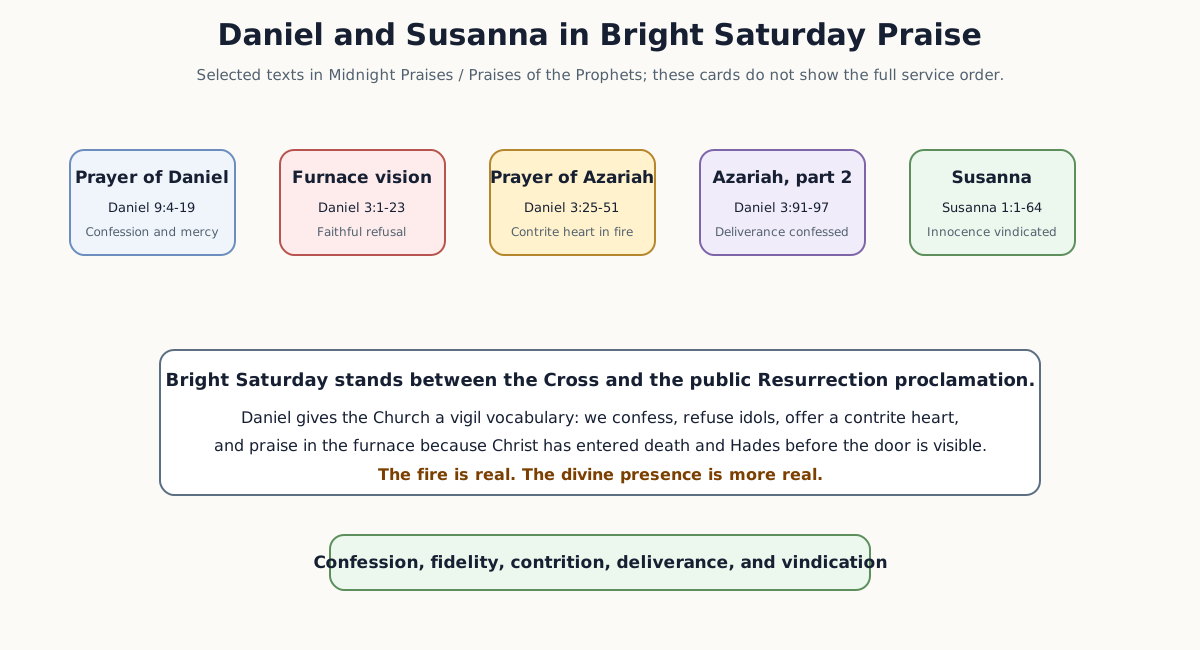 The furnace narrative, Azarias’s prayer, the Song, and the king’s witness belong to one movement from refusal to deliverance.
The fourth figure and the king’s unfinished conversion (Daniel 3:91-97)
91 And Nabuchodonosor heard them singing praises; and he wondered, and rose up in haste, and said to his nobles, Did we not cast three men bound into the midst of the fire? and they said to the king, Yes, O king. 92 And the king said, But I see four men loose, and walking in the midst of the fire, and there has no harm happened to them; and the appearance of the fourth is like the Son of God. 93 Then Nabuchodonosor drew near to the door of the burning fiery furnace, and said, Sedrach, Misach, and Abdenago, ye servants of the most high God, proceed forth, and come hither. So Sedrach, Misach, and Abdenago, came forth out of the midst of the fire. 94 Then were assembled the satraps, and captains, and heads of provinces, and the royal princes; and they saw the men, and perceived that the fire had not had power against their bodies, and the hair of their head was not burnt, and their coats were not scorched, nor was the smell of fire upon them. 95 And king Nabuchodonosor answered and said, Blessed be the God of Sedrach, Misach, and Abdenago, who has sent his angel, and delivered his servants, because they trusted in him; and they have changed the king’s word, and delivered their bodies to be burnt, that they might not serve nor worship any god, except their own God. 96 Wherefore I publish a decree: Every people, tribe, or language, that shall speak reproachfully against the God of Sedrach, Misach, and Abdenago, shall be destroyed, and their houses shall be plundered: because there is no other God who shall be able to deliver thus. 97 Then the king promoted Sedrach, Misach, and Abdenago, in the province of Babylon, and advanced them, and gave them authority to rule over all the Jews who were in his kingdom.
The king hears praise, rises, and asks about the number of men cast in bound. What he sees contradicts his intention: four are loose, walking, and unharmed. He calls the fourth like the Son of God. Verse 95 then speaks of God sending His angel. These descriptions must be read together rather than allowing one English phrase to cancel the others. Nor should we assume that a pagan king’s exclamation contains the full precision of the Church’s later confession.
Gems from the Fathers 💎: The Word and His saving presence
Hippolytus’s surviving Scholia on Daniel take the king’s words as a confession stirred by the Word Himself. He asks: “Tell me, Nebuchadnezzar, when didst thou see the Son of God, that thou shouldst confess that this is the Son of God?”5 His interpretation is that the Word enables recognition even in a Gentile persecutor. The divine presence is not summoned by the king’s power; it overturns his certainty that no God can deliver.
Jerome records a genuine interpretive distinction. He considers an angelic appearance and the reading, held by many in his account, that the figure is the Lord Himself. He raises a difficulty about the king’s vision, then says that, in its typological significance, the figure foreshadows Christ descending to free those held by death.6 His account should not be quoted as though he simply reproduces Hippolytus’s confidence without qualification. Their interpretations converge on Christ’s saving presence without making every question about the appearance identical.
The Christian confession also prevents a misleading conclusion from the word “angel.” Christ is not a created angel. A title of mission or sending must not erase who the eternal Word is. Brenton’s Isaiah 9:5 calls the promised child the “Messenger of great counsel.”7 That title helps us understand how language of divine sending can carry a messianic depth. It does not settle every historical question about what Nabuchodonosor understood, and it is not a license to identify every angelic appearance in Scripture as the Son.
The youths come out when called, and the officials inspect their bodies, hair, and clothing. The public authorities assembled for the image now witness its failure to secure the obedience the king demanded. The king praises their God and acknowledges that they yielded their bodies rather than worship another. Yet his new decree threatens death and plunder for anyone speaking against their God. The miracle has changed his confession more readily than his habits of rule.
This threat is reported, not given to the Church as a method of defending God’s honour. God has vindicated servants who would not coerce anyone. The king’s violent decree cannot become a Christian warrant for forced worship or punishment of dissent. The final promotion is welcome deliverance, but it is not the deepest victory. Their worship was already free when they said “But if not.” The king can recognize that freedom; he cannot confer it.
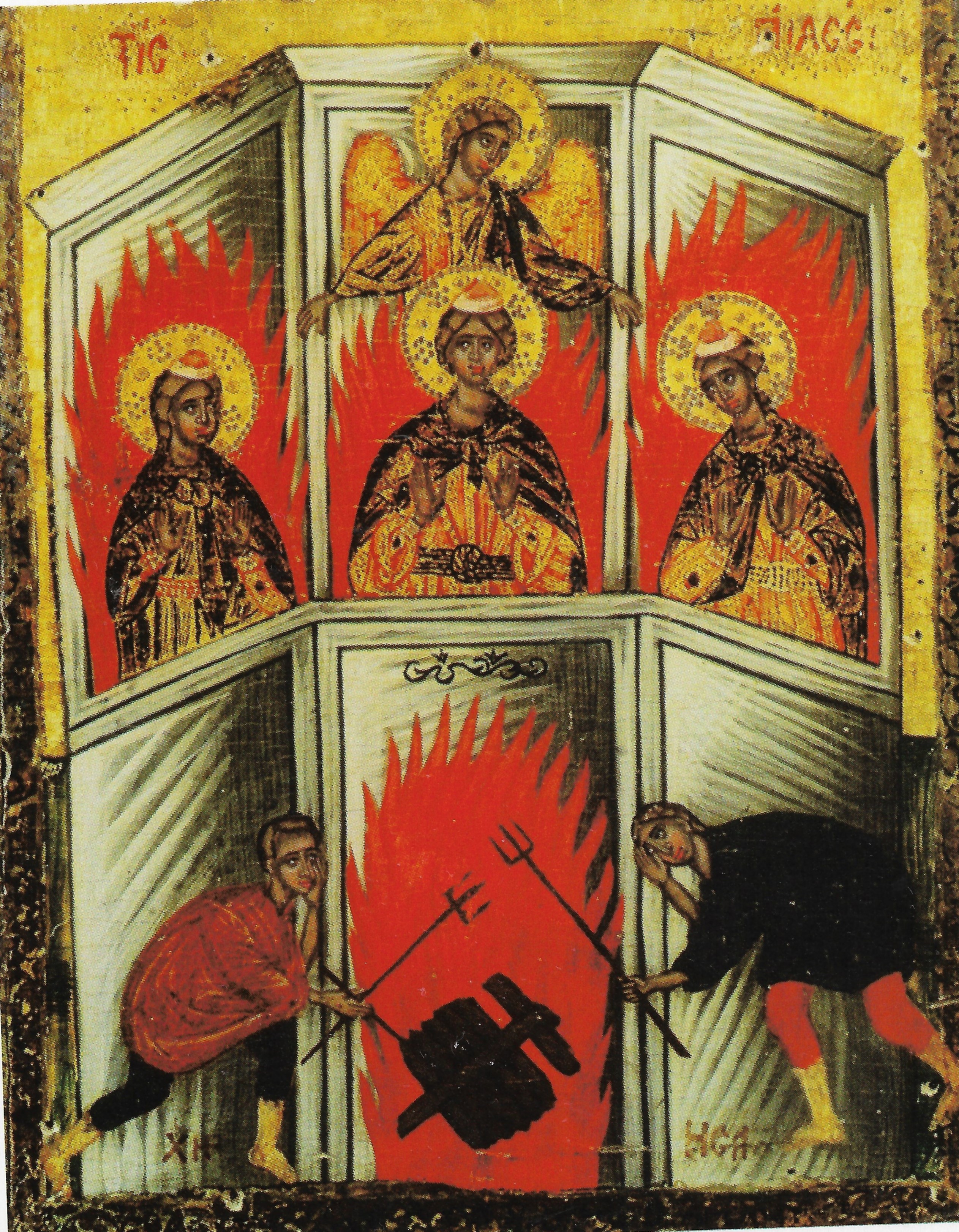 Sixteenth-century Levantine icon of the Three Holy Children. Wikimedia Commons, public domain.
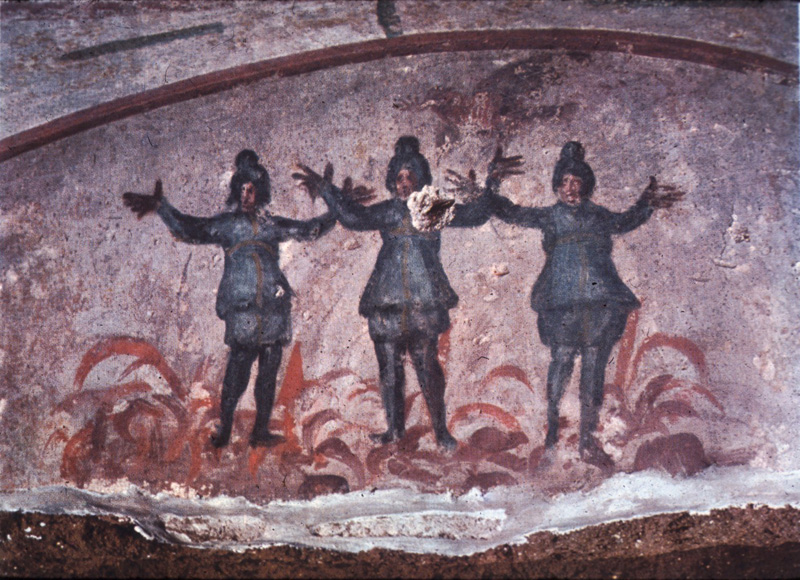 The Three Hebrews in the furnace, Catacombs of Priscilla. Wikimedia Commons, public domain.
Spiritual Fruit 🍇
Notice where prayer has become a bargain: if God removes this fear, grants this opportunity, or gives this relationship back, then I will trust Him. The youths do ask for deliverance, and so may we. But we can add a small act of obedience that is not waiting for the desired answer: tell the truth, refuse a harmful compromise, or keep an appointed prayer. “But if not” releases worship from the demand to control the outcome.
When you cannot pray expansively, begin with Azarias’s offering. Bring the contrite heart you actually have, not an imagined state of serenity. Name your own sins without taking responsibility for someone else’s violence. Ask for mercy without accusing yourself merely because you are wounded. If you need help, seek it. God does not require isolation as proof of loyalty.
Read a few invocations of the Song slowly. Let something outside your immediate trouble enter your attention: daylight, water, a living creature, the work of human hands. Thank the Creator for it. This is not a technique for denying grief. It is a way of refusing to let grief or fear occupy the entire horizon of prayer. The three youths do not praise the furnace as their saviour; they praise the Lord within it.
Finally, pray for someone whose power frightens you, without excusing wrongdoing or abandoning necessary boundaries. The king who threatened the youths becomes a witness, though his conversion remains unfinished. We can ask God to interrupt another person’s cruelty while also guarding against our own desire to retaliate. Christ does not free us so that we may become smaller copies of the tyrant.
Lord Jesus Christ, be near to those in danger. Deliver the oppressed, receive the prayers of those who cannot reach a place of worship, and keep us from offering our hearts to idols. Teach us to bless You before the door opens, and to trust Your Resurrection when we cannot yet see our deliverance.
Teaching Notes
An image, a command, and a refusal without bargaining (Daniel 3:1-18)
- Ask: What does “But if not” affirm, and what outcome does it decline to control?
- Watch for: Do not invent Daniel’s whereabouts or identify the image’s precise form beyond what the passage states. Faithfulness does not forbid seeking safety from abuse.
Bound bodies and an unbound voice (Daniel 3:19-24)
- Ask: Where does the narrative first show that the king cannot command the youths’ worship?
- Emphasize: Chrysostom’s contrast between receiving the bound and returning the free is consolation, not a diagnosis of a sufferer’s courage.
A contrite heart when sacrifice is unavailable (Daniel 3:25-45)
- Ask: How can Azarias confess Israel’s sin and still call the king unjust?
- Watch for: Do not confuse corporate repentance with blame for being persecuted, or deprivation of temple worship with contempt for it.
The Lord’s messenger descends into the danger (Daniel 3:46-51)
- Connect: Distinguish a Paschal type from identity with Christ’s unique saving Passion.
- Watch for: Divine deliverance is not an instruction to reproduce the violence described around the furnace.
The furnace becomes a place of cosmic praise (Daniel 3:52-90)
- Ask: Why does the Song name fire and heat among the works called to praise?
- Emphasize: Keep the Third Hoos, the Prayer of Azariah, and the special Bright Saturday prophetic readings distinct.
- Show: Use the vigil diagram to follow the narrative’s full return to the king in verses 91-97.
The fourth figure and the king’s unfinished conversion (Daniel 3:91-97)
- Ask: Why must verses 49, 92, and 95 be heard together?
- Watch for: Hippolytus and Jerome do not give identical accounts of the apparition. Christ is not a created angel. The king’s punitive decree is not a Christian law for protecting worship.
- Show: Let the icon and early Christian painting identify the shared witness of the three, without treating either image as a photographic reconstruction.
Sources
Embedded Scripture is from Brenton’s English Septuagint (LXX). The Prayer and Song are read within Greek Daniel; editions also print them with a separate numbering. The weather invocations at Daniel 3:67-70 follow Brenton’s English in the separately printed Prayer of Azarias 1:44-45 and 1:48-49, aligned here with the continuous Greek Daniel numbering. The separate Prayer places the ice/cold and frost/snow invocations after light/darkness; the continuous Greek order places them before nights/days.8
Saint John Chrysostom, Homilies on the Statues, Homily IV §6, on prayer and freedom in the furnace.
Hippolytus, Scholia on Daniel, on Daniel 3:92, in the surviving fragments printed in Ante-Nicene Fathers, volume 5.
Jerome, Commentary on Daniel, on 3:91-96, used as an early Christian exegetical witness.
Coptic Bright Saturday service order and Synaxarium commemoration of the Three Holy Young Men; the five companion studies linked above treat the Prayer, Song, and worship connections at greater length.
Tasbeha.org, Third Hoos, for the hymn text.
The icon and catacomb painting are reproduced from the Wikimedia Commons sources identified in their captions. The vigil diagram is an explanatory schematic.
Footnotes
-
Saint John Chrysostom, Homilies on the Statues, Homily IV §6, homily text. ↩
-
Coptic Midnight Praise, Third Hoos, Coptic, English, and Arabic hymn text. ↩
-
Coptic Bright Saturday service order, Midnight Praises / Praises of the Prophets, Daniel 3:1-23, Daniel 3:25-51, Daniel 3:91-97, Daniel 9:4-19, and Susanna 1:1-64. ↩
-
Coptic Synaxarium, Bashans 10, “Departure of the Three Holy Young Men Hananiah, Azariah and Mishael.” ↩
-
Hippolytus, Scholia on Daniel, on 3:92 (25), containing fragments. ↩
-
Jerome, Commentary on Daniel, on 3:91-92 and 3:95, translated by Gleason L. Archer, containing commentary. ↩
-
Brenton’s English Septuagint, Isaiah 9:5, chapter text. ↩
-
Brenton’s separately printed Prayer of Azarias 1:44-45, 48-49, compared with Greek Daniel 3:64-73. ↩