
A garden should have been a place of shade, lawful judgment, and a woman walking in the fear of the Lord. Two elders turned it into a trap. Susanna would not buy her life with sin. God heard her, and a young Daniel made their lie collapse at the name of a tree.
That is the story. This page is the doorway into it: where Susanna sits in the Church’s Bible, why the Greek Daniel tradition kept her, and why Coptic worship hears her on Bright Saturday, before the Resurrection is proclaimed. The verse-by-verse reading is Innocence Vindicated.
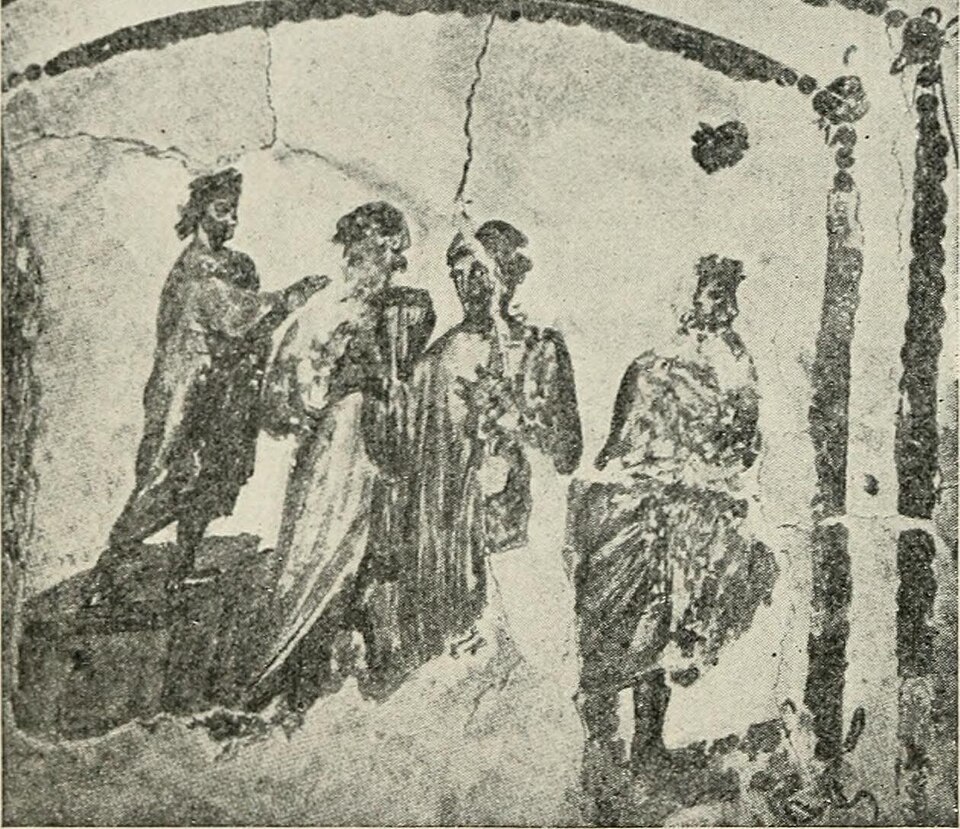 Source: Walter Lowrie, Monuments of the Early Church (1901), Fig. 67, Catacomb of Callistus, via Wikimedia Commons. No known copyright restrictions.
The early Church did not remember Susanna as a bathing scene. This catacomb image shows her case brought into judgment, with Daniel as the discerning witness. Innocence is vindicated when false testimony is examined.
Where the book sits
Susanna is not in the Hebrew and Aramaic Daniel, and it is not in the NKJV. The Orthodox Church received Daniel in Greek. That Greek Daniel includes Susanna, the Prayer of Azariah and the Song of the Three Holy Children within Daniel 3, and Bel and the Dragon. These are not decorations pinned on after the book was finished. They are part of the Daniel the Church read, sang, and handed on.
Brenton prints the Theodotion Greek form, and he prints Susanna at the beginning of Daniel, as its own sequence of verses 1-64. Some editions head that sequence as a first chapter, which is why an older citation may say Susanna 1:1-6. This study cites the same text as Susanna 1-64. Latin-based Bibles often number it Daniel 13. When a parish Bible says Daniel 13, it is this story.
Hippolytus already knew the placement and explained it. What is narrated here happened later, he says, “although it is placed before the first book (at the beginning of the book).”1 The writers of Scripture sometimes tell events out of chronological order. That is why the Theodotion text can call Daniel a “young youth” in verse 45. In the order of the Greek book, his public ministry in the court has not yet begun. The story is set first, even though Hippolytus says the events themselves came later.
The older Greek version did not tell the rescue in the same words. In the text of Alfred Rahlfs, as she is being led out to die, an angel of the Lord gives a spirit of understanding to Daniel, who is already a younger man.2 Brenton’s Theodotion text says the Lord heard her voice and “raised up the holy spirit of a young youth, whose name was Daniel.” The two Greek forms agree that God acts. They do not agree on whether an angel gives understanding to a youth already present, or whether the Lord raises up the holy spirit of a young youth named Daniel. The chapter study follows Brenton, and names the difference only where it changes what the reader hears.
Why the Church kept Susanna
In the third century, Julius Africanus wrote to Origen and called the History of Susanna a later Greek composition. His sharpest argument was the tree puns. In Greek, the mastic tree and the sentence of splitting sound alike, and the holm oak and the sentence of sawing sound alike. He could not see how that wordplay could have begun in Hebrew.
Origen answered that the History of Susanna “is found in every Church of Christ in that Greek copy which the Greeks use, but is not in the Hebrew.”3 He would not tell the Churches to put away the books they were already reading because a Hebrew copy lacked them. In the same letter he takes up the holm and the mastic directly. Africanus had mocked the examination as something a comic writer might invent. Origen sets it beside Solomon’s judgment of the two women: a wise question does not convince until the witnesses condemn themselves out of their own mouths. The trees are not a joke. They are the place where the lie becomes audible.
That is the best early witness for why Susanna belongs with Daniel. Not because a modern canon list added her, but because the Greek copy in the Churches already contained her, and a Father defended that use.
How Hippolytus reads her
Hippolytus reads the literal story and then looks through it. “Susannah prefigured the Church; and Joacim, her husband, Christ; and the garden, the calling of the saints, who are planted like fruitful trees in the Church.”4 Babylon, in his reading, is the world. The garden can be watched by enemies. Fruitfulness and watchfulness belong together.
He also reads the two elders as two peoples who plot against the Church, the people of the circumcision and the Gentiles, in the persecutions of his own early third century. That is his typology of hostile power, not an ethnic accusation for a parish to repeat. The chapter study keeps the safer phrase, powers hostile to the Church, and does not turn his historical reading into a charge against a people.
The rest of his commentary belongs beside the verses: the washing and the oil, the cry that chooses God, the tears that draw the regard of the Word, and the warning not to give obsequious obedience to rulers. Those readings are taken up in the chapter study.
Bright Saturday
On Bright Saturday, the Saturday of Light, the Church hears the Story of Susanna in the praises. Coptic Heritage, in its account of the Saturday of Light drawn from the deacon’s service, places “the story of Susanna the chaste” after the Prayer of Simeon the Elder, and immediately before Tenoueh `ncwk, the hymn taken from the Prayer of Azariah.5 Tasbeha.org files “The Story of Susanna” under Bright Saturday, in “The Praises and Matins,” between the New Testament prayers and that same Azariah hymn.6 The placement is a fact of the service books.
It is not a fact of the ordinary lectionary index. The lectionary records used for this study list nineteen Bright Saturday Midnight Praise rows. They include the Prayer of Simeon, the Prayer of Daniel, and the Three Youths in the furnace. They do not include Susanna. Susanna is therefore not claimed here as an ordinary annual Katameros reading, and not as one of those indexed praise rows. The service books are the witness for the story in the praises.
Why the Church hears her there is interpretation, not a line in the rubrics. The Church may hear Susanna on this night because an innocent woman was being led toward death, cried to the everlasting God, and was saved when God exposed a lie. The introduction to the same Coptic Heritage rite says the Church reads the account of Susanna, “who was to die despite her innocence but was saved and restored to life once more.” That is the service book’s own reason, stated briefly. It is not a claim that the praises exist because the Church is standing at the sealed tomb.
The sealed tomb has its own reading. Bright Saturday Matins, in those same lectionary records, appoints the Gospel Matthew 27:62-66, the sealing of the tomb, and Psalm 88:4-5 (LXX Ps 87:4-5), the soul drawn near to Hades. A reader who wants the image of a guarded grave should begin there, and then hear Susanna as a neighboring witness, not as the explanation of the Matins Gospel.
The Bright Saturday Liturgy, as those records list it, includes:
- Pauline: 1 Corinthians 15:1-11, 1 Corinthians 15:12-19, and 1 Corinthians 15:20-28. The appointed reading is 1 Corinthians 15:1-22, so it ends inside the third of those studies.
- Catholic: 1 Peter 1:1-12. The appointed reading is 1 Peter 1:1-9.
- Praxis: Acts 3:11-26. The appointed reading is Acts 3:12-21.
- Gospel: Matthew 28:1-20.
- Psalm 3:3 (LXX Ps 3:3) and Psalm 3:5 (LXX Ps 3:5).
One working list also names Psalm 82:8 (LXX Ps 81:8) at the Liturgy. That row has not been checked against Coptic Reader, so it is named here as a candidate, not as a confirmed appointment. If the Church does sing “Arise, O God, judge the earth,” the verse sits very near Susanna: God judging the judges. That nearness is the study’s reading, not a rubrical claim.
Inside the Liturgy Gospel itself, Matthew 28:11-15 is the closest Bright Saturday tie to this story, and it is the study’s own reading. The chief priests assemble with the elders and pay for a false report against the Resurrection. Elders fabricating testimony against the truth: the chapter study stays with that parallel beside Susanna’s trial, and does not ask a Father to say what the Gospel already shows.
Other hours offer interpretive company only. At the Sixth Hour the records list Isaiah 50:10-51:8, and Isaiah 51:7 says, “fear not the reproach of men.” At the Ninth Hour they list John 5:21-30, inside John 5:19-47, where judgment is committed to the Son and he says that his judgment is righteous. Neither hour appoints Susanna. Both can teach the soul that is about to read her.
The Synaxarium commemorates the Departure of the Great Prophet Daniel on 23 Baramhat. In 2026, 2027, and 2028 that day falls on April 1. The date is named because Daniel is named. It is not a claim that Susanna is read on his feast. It is also not the commemoration of the martyr Tosia, called Susanna, with Abba Or and their children, on 8 Baba. That Susanna is another person.
How to read the chapter
The narrative is one chapter. It is not split. Innocence Vindicated walks through it in five movements:
- Formed before the trial (Susanna 1-6). Fear of the Lord, and judges already named as wicked.
- Eyes turned from heaven (Susanna 7-14). Lust becomes a plan.
- The choice (Susanna 15-27). Coercion, and the refusal to make sin a way of escape.
- False witness and the prayer God hears (Susanna 28-43). A court that believes office, and a woman who looks up.
- Saved by the tree (Susanna 44-64). Daniel separates the witnesses, and their invented trees expose them.
Spiritual Fruit 🍇
Read Susanna as a person before reading her as a sign. She is a daughter of Israel, taught the law, coerced by men who held court, and heard by God. Hippolytus may then show the Church in her garden. The sign is true only if the woman remains real.
On Bright Saturday, let her story do one work: teach the soul to wait without calling a lie the truth. The tomb is still sealed at Matins. The praises remember those whom God saved from death. The Liturgy will proclaim that Christ is risen. Susanna stands in that night as a witness that human courts can condemn the innocent, and that God still hears.
Teaching Notes
Before the chapter study
- Ask: Where does a parish Bible put this story, and what does that placement teach about the Bible the Church received?
- Emphasize: Susanna 1-64 is Daniel 13 in many Latin-based Bibles, and it is absent from the NKJV because those editions follow the shorter Hebrew and Aramaic Daniel.
- Watch for: Turning Hippolytus’ “two peoples” into an ethnic accusation. He is describing persecution in his early third century. Keep the phrase as his reading of hostile power.
- Watch for: Confusing 23 Baramhat, the departure of the prophet Daniel, with 8 Baba, the martyr Tosia (Susanna).
- Watch for: Stating the Bright Saturday Liturgy list, or Psalm 82:8 (LXX Ps 81:8), as if Coptic Reader had been rechecked for this revision. The service books attest the Story of Susanna in the praises. The hour and Liturgy rows are the lectionary records named in the sources, and Psalm 82:8 (LXX Ps 81:8) is only a candidate.
- Connect: Send the class into the five sections of the chapter study rather than retelling the trial on this page.
Sources
Embedded Scripture is from Brenton’s English Septuagint (LXX). The chapter study carries the full Brenton text.
Hippolytus, Exegetical Fragments, “On Susannah,” opening placement and on v. 7, translated by S. D. F. Salmond, Ante-Nicene Fathers 5, New Advent.
Origen, Letter to Africanus 2 and 11, translated by Frederick Crombie, Ante-Nicene Fathers 4, New Advent.
Older Greek Susanna, Rahlfs/Hanhart, consulted for the difference at verses 44-45: die-bibel.de, Susanna 1.
Coptic Heritage, “Saturday of Light,” rite of the praises, citing Deacon Albair Gamal Mikhail, The Essentials in the Deacon’s Service (Shobra: Shikolani, 2002), pp. 621-624: copticheritage.org/17-saturday-of-light.
Tasbeha.org, “The Story of Susanna,” Bright Saturday, The Praises and Matins: tasbeha.org/hymn_library/view/1781.
Bright Saturday hour and Liturgy rows, and the Synaxarium titles for 23 Baramhat and 8 Baba, are taken from
@andraws/lectionary-data1.3.3. The Liturgy list also appears in a working Pascha source marked not yet checked against Coptic Reader. Psalm 82:8 (LXX Ps 81:8) appears only in that unchecked source. The nineteen Midnight Praise rows in these records do not include Susanna.Walter Lowrie, Monuments of the Early Church (1901), Fig. 67, Catacomb of Callistus: Wikimedia Commons.
Footnotes
-
Hippolytus, Exegetical Fragments, “On Susannah,” opening paragraph (ANF 5; New Advent). ↩
-
Rahlfs/Hanhart Greek text, Susanna 44-45, die-bibel.de. ↩
-
Origen, Letter to Africanus 2 and 11 (ANF 4; New Advent). ↩
-
Hippolytus, Exegetical Fragments, “On Susannah,” on v. 7 (ANF 5; New Advent). ↩
-
Coptic Heritage, “Saturday of Light,” copticheritage.org/17-saturday-of-light. ↩
-
Tasbeha.org, “The Story of Susanna,” hymn library 1781. ↩