
A king stands in a temple at dawn, sees an empty table, and cries that Bel is great and without deceit. Days later the same mouth cries that the Lord, the God of Daniel, is great, and that there is none beside Him. Between those two sentences a man is converted. Bel and the Dragon is that story. It exposes an idol, unmasks a dragon, and feeds a prophet in a den. The spine is the king.
Read it beside Susanna and the Prayer of Azariah and Song of the Three Holy Children. Those books, with Daniel 1-12, are the Greek Daniel the Church received. Susanna asks whether a hidden court can bury the innocent. The Prayer and Song ask whether praise can rise from inside the fire. Bel and the Dragon asks whether worship is alive because it eats, or alive because God is.
The two studies that follow keep that question on the page. Bel and the Dragon 1-22 stays in the temple, where ashes on the floor tell the truth the seal cannot. Bel and the Dragon 23-42 follows the dragon, the den, and the bread God sends.
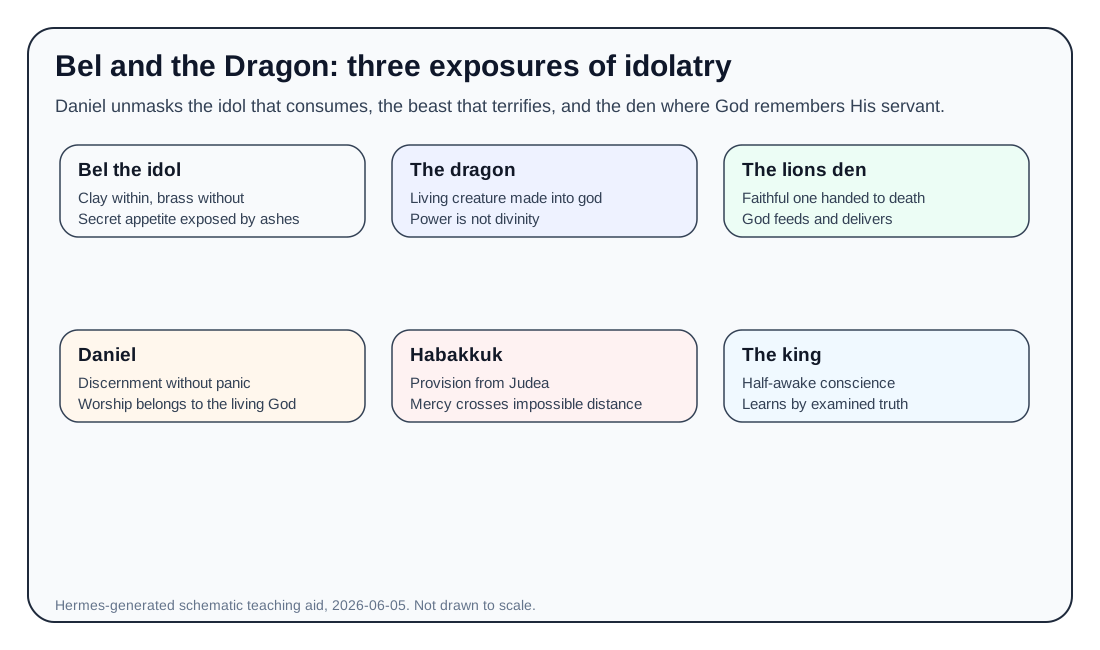 Source: Generated schematic teaching aid for this project, 2026-06-05. Labels revised 2026-10-19 so the den is not described as a sealed tomb.
Where the book sits
In the shorter Hebrew and Aramaic Daniel, the book ends at chapter 12. Bel and the Dragon is not in that form. It comes to us in Greek Daniel, with Susanna and the prayer and song placed in Daniel 3. The early Church’s ordinary Greek Daniel was largely the revision associated with Theodotion, so fully received that it displaced the older Greek Daniel in most church manuscripts. Orthodox Christians do not treat this as a late decoration pinned onto a finished book. It is part of the Daniel the Church read, sang, and handed on.
Standard NKJV editions do not include Bel and the Dragon. That is why these studies embed Brenton’s English Septuagint and do not pretend the passage can be opened in an ordinary NKJV Old Testament. Catholic and ecumenical editions that print the deuterocanonical books include it, often as Daniel 14. The difference is which Old Testament collection a Bible follows. It is not a quarrel about whether the story is ancient.
The Greek itself is two stories of one story. The New English Translation of the Septuagint, in its note “To the Reader,” distinguishes the Old Greek from Theodotion. The Old Greek opens with a superscription: a prophecy of Hambakoum, son of Iesous, of the tribe of Leui (Levi). It calls Daniel a priest, son of Habal, and a companion of the king of Babylon. It does not name Cyrus. Theodotion begins, “And King Astyages was added to his ancestors, and Cyrus the Persian received his kingdom.” “Dominion over all flesh,” in the confession NETS marks at verse 5, belongs to Theodotion and is absent from the Old Greek. Brenton’s opening follows that Theodotion setting: Astyages, then Cyrus. A second-century Father was already reading the Theodotion wording as Daniel’s own confession. That reception is taken up below.
How the numbers reached us
Brenton prints this as its own book, Bel and the Dragon 1-42. The Coptic Katameros cites the same material as Daniel 14. On Friday, 13 March 2026, the Katameros readings list the Matins prophecies as Deuteronomy 10:12-11:28, Isaiah 29:13-23, Job 21:1-34, and Daniel 14:1-42. A printed Lent Katameros of the Coptic Orthodox Diocese of the Midlands labels the same Friday reading Daniel 14:2-42, beginning at “Daniel conversed with the king.” Both witnesses agree that the Church reads this book as Daniel 14. They do not agree where verse 1 sits.
The opening verse, about Astyages and Cyrus, is the likely reason. In the Latin tradition that verse was often attached to the end of Susanna. Editions that count it with Susanna begin Daniel 14 at Daniel’s conversation with the king. Editions that keep it with Bel begin at 14:1. A reader who finds 14:2-42 in one book and 14:1-42 in another has not lost a verse. The verse has changed rooms.
These studies quote Brenton’s separate book, Bel and the Dragon, and name Daniel 14 when speaking of the Coptic reading. The Hebrew and Aramaic Daniel still ends at chapter 12. Greek Daniel, the Daniel of the Church’s older Bible, did not stop there.
The king’s two cries (Bel and the Dragon 18 and 41)
The seals on Bel’s door are whole. The table is empty. The king has the evidence he asked for, and he reads it backwards.
18 And as soon as he had opened the door, the king looked upon the table, and cried with a loud voice, Great art thou, O Bel, and with thee is no deceit at all.
That cry is the creed of a man who trusts the disappearance of offerings. Appetite has been doing the work of a god. Later, after the dragon, the threat, and the den, the same voice finds Daniel alive.
41 Then cried the king with a loud voice, saying, Great art thou, O Lord God of Daniel, and there is none other beside thee.
Between them the people say, “The king is become a Jew” (verse 28). They mean it as an accusation. The story lets it stand as a confession they do not yet understand. Bel and the Dragon is not only an exposure of fraud. It is the slow education of a ruler who must learn the difference between a god who must be fed and the God who feeds.
The Church’s Voice in Worship ⛪
On Friday of the fourth week of Great Lent, the Church reads this book in the Matins prophecies, not merely somewhere in “the Lent Katameros.” In 2026 that Friday falls on 13 March. The Katameros list gives Daniel 14:1-42 as the fourth prophecy, after Deuteronomy 10:12-11:28, Isaiah 29:13-23, and Job 21:1-34. The Midlands printed book gives Daniel 14:2-42. The spiritual placement is the same either way.
The morning’s other prophecies already name the disease. Brenton’s Deuteronomy 11:16 warns that the heart not be puffed up, and that the people not transgress, serve other gods, and worship them. Isaiah 29:13, in the same morning’s prophecy, says this people draws near with the mouth and honors God with the lips, while the heart is far away, and worships in vain by teaching the commandments of men. Christ quotes that sentence in Matthew 15:8-9. The Friday Liturgy Gospel is not that dispute. It is Matthew 15:21-31, the Canaanite woman whose faith will not be turned away. Lip worship has been exposed at dawn. By the Liturgy, a Gentile woman is asking the living God for mercy and receiving it.
The day before, Thursday of the fourth week, the Matins prophecies include Daniel 6:1-27, Daniel in the lions’ den. The Church sets the two den stories on consecutive mornings. One den is sealed with the king’s signet in Daniel 6. The den in Bel and the Dragon is not. The pairing is still exact: prayer under a law, then discernment under an idol, and in both the Lord remembers His servant among lions. That connection is opened in the second study and in Daniel 6.
Bel and the Dragon is not read in the Bright Saturday Midnight Praises. Those praises include Daniel 3:1-23, Daniel 3:25-51, Daniel 9:4-19, and Habakkuk 3:2-19, the Prayer of Habakkuk. The Church sings Habakkuk’s prayer that night, and again at the Theophany Laqqan. Tradition has linked that prophet with the Habakkuk of this book. The dates do not simply agree, and the second study says so plainly. What Bright Saturday does sing is the prayer of a prophet who has learned to rejoice before the deliverance is visible.
The Synaxarium keeps three commemorations near this world of names, without tying them to these readings. Baramhat 23 remembers the Departure of the Great Prophet Daniel. Bashans 10 remembers the Departure of the Three Holy Young Men Hananiah, Azariah, and Mishael. Bashans 24 remembers the Departure of Habakkuk the Prophet. Those are the Church’s dates. They are not a claim that the day’s lessons narrate the vita.
Gems from the Fathers 💎
St. Irenaeus, in Against Heresies IV.5.2, does not treat this book as a curiosity. He is answering the Sadducees’ denial of the resurrection, and Christ’s word that God is the God of the living. Into that argument he places Daniel before Cyrus. When the king asks why Daniel will not worship Bel, Irenaeus quotes him: “Because I do not worship idols made with hands, but the living God, who established the heaven and the earth and has dominion over all flesh.” Again: “I will adore the Lord my God, because He is the living God.”1 The God the prophets adored is the God Christ calls the God of the living. And the phrase “dominion over all flesh” is the Theodotion wording. A bishop of the second century was already reading that form as Daniel.
St. Cyprian sets the same confession among the righteous who would not bend. In the Exhortation to Martyrdom, addressed to Fortunatus, section 11, he has just recalled the Three Young Men refusing the golden image. Then: “And Daniel, devoted to God, and filled with the Holy Spirit, exclaims and says: I worship nothing but the Lord my God, who founded the heaven and the earth.”2 The wording is not Brenton’s. The company is the point. Daniel stands with the Three Youths, not as a clever detective, but as a confessor.
Origen, writing to Africanus, names the difficulty without surrendering the book. Africanus had called Susanna a forgery because it is absent from the Hebrew. Origen answers for Susanna and, in the same breath, for “the two other passages you mention at the end of the book containing the history of Bel and the Dragon, which likewise are not in the Hebrew copy of Daniel.”3 He urges his reader not to move the ancient landmarks the fathers set. The Church, he argues, should not discard the Scriptures she has received because another community’s copy is shorter. That is the canon argument these studies inherit. We do not need to pretend the Hebrew Daniel contains this chapter. We refuse to treat the Church’s Bible as a mistake.
How these studies move
The first study remains in Bel’s temple. Daniel will not worship a work of hands. The king thinks consumption is proof of life. Ashes on the pavement show the footprints of men, women, and children. The seals are whole, and the fraud is still there. Discernment looks at the floor.
The second study leaves the temple. A living dragon is offered as a better god, because it eats and drinks and is not brass. Daniel worships the Lord because He is the living God, and the creature bursts. The city then throws Daniel to seven lions for six days. Habakkuk, carrying a bowl toward reapers, is sent instead to the den. On the seventh day the king comes to mourn and finds Daniel sitting. The second cry replaces the first.
False worship eats the worshipper. True worship is kept by the God who carries His people, and who can send bread into a pit. That is the theology Isaiah already preached against Bel, and it is the mercy this book finally tastes.
Spiritual Fruit 🍇
Begin with the king’s mouth, not with a list of other people’s idols. What have we praised because it consumed so much of us? Attention, anger, reputation, a screen, a fear, a hidden appetite: these can look alive for the same reason Bel looked alive. Offerings disappeared, and we called the emptiness proof.
Lent, on the Friday this book is read, is training in that honesty. Deuteronomy has already warned against a puffed-up heart that turns to other gods. Isaiah has already said that nearness of the lips can hide a far heart. The ashes are not a technique for winning an argument. They are a way of asking where the private door is.
The hope is in the second cry. A man who blessed an idol can learn another sentence. The Church does not read this book to mock Babylon. She reads it so that a half-taught conscience can be finished, and so that the God of the living, whom Christ names, is the one our worship actually feeds on.
Teaching Notes
General guidance
- Ask: Where does the king’s sentence change, and what has he seen by then?
- Emphasize: This is a conversion story. Exposure serves the change of worship.
- Watch for: Do not open by shaming Protestant Bibles. Say plainly that standard NKJV editions omit the book because they follow the shorter Hebrew and Aramaic Old Testament, and that this is why the study quotes Brenton.
- Connect: Point to Susanna and the Prayer of Azariah as the other Greek Daniel books, and to Daniel 6 as the reading of the previous morning.
- Show: The three-exposures diagram can orient the two studies. It is a generated schematic, not an icon.
The king’s two cries (Bel and the Dragon 18 and 41)
- Ask: Why does a whole seal convince the king, and why should it not convince us?
- Watch for: The den in this book is never sealed. Do not import the seal of Daniel 6:17 into Bel 28-42. The king’s seal in this book is on Bel’s temple door.
- Connect: Irenaeus already heard “dominion over all flesh” as Daniel’s confession of the living God.
Sources
Embedded Scripture is from Brenton’s English Septuagint (LXX).
Brenton, The Septuagint Version of the Old Testament, for Bel and the Dragon and the companion Old Testament quotations in the studies.
A New English Translation of the Septuagint, Bel and the Dragon, “To the Reader,” for the Old Greek and Theodotion differences, including the Old Greek superscription, Daniel as priest, the absence of Cyrus in the Old Greek, and “dominion over all flesh” as Theodotion only. NETS Bel and the Dragon.
Katameros readings for 13 March 2026, Friday of the fourth week of Great Lent: Matins prophecies Deuteronomy 10:12-11:28; Isaiah 29:13-23; Job 21:1-34; Daniel 14:1-42.
Coptic Orthodox Diocese of the Midlands, The Katameros of the Holy Lent, Friday of the fourth week, Daniel 14:2-42. PDF.
@andraws/lectionary-data1.3.3: Thursday of the fourth week of Great Lent, Matins prophecies, Daniel 6:1-27; Bright Saturday Midnight Praises as named above; the Theophany Laqqan, the liturgy of the waters, also includes Habakkuk 3:2-19 among its prophecies. The Friday Matins prophecies are the Katameros readings for that Friday, Baramhat 4, 1742. Their Liturgy readings agree with the packaged readings for 13 March 2026.Packaged Synaxarium titles: Baramhat 23, the Departure of the Great Prophet Daniel; Bashans 10, the Departure of the Three Holy Young Men; Bashans 24, the Departure of Habakkuk the Prophet. Titles only. No vita is claimed from those entries.
Footnotes
-
St. Irenaeus, Against Heresies IV.5.2, New Advent. ↩
-
St. Cyprian, Exhortation to Martyrdom, Addressed to Fortunatus, section 11, New Advent. ↩
-
Origen, Letter to Africanus 2 and 5, New Advent. ↩