


This narration is from a previous version of the study and may include a combined recording of multiple chapters.
Babylon takes sacred vessels, young lives, familiar names, and control of the daily table. Yet Daniel 1 is governed by another action: God gives. He gives the king into another king’s hand, gives Daniel compassion in a foreign household, and gives four young captives understanding. Their faithfulness begins not with a spectacular confrontation, but with a settled heart and a courteous request.
The chapter introduces Daniel, Ananias, Azarias, and Misael before the furnace and the visions. Brenton’s Nabuchodonosor is the Nebuchadnezzar familiar from many English Bibles; Joakim is Jehoiakim. The Babylonian names Sedrach, Misach, and Abdenago correspond to Shadrach, Meshach, and Abednego. These are not separate groups of men. The reader will hear both sets of names because the story concerns people whose public identity is being taken into someone else’s hands.
Captivity, education, and imposed names (Daniel 1:1-7)
1 In the third year of the reign of Joakim king of Juda, came Nabuchodonosor king of Babylon to Jerusalem, and besieged it. 2 And the Lord gave into his hand Joakim king of Juda, and part of the vessels of the house of God: and he brought them into the land of Sennaar to the house of his god; and he brought the vessels into the treasure-house of his god. 3 And the king told Asphanez his chief eunuch, to bring in some of the captive children of Israel, and of the seed of the kingdom, and of the princes; 4 young men in whom was no blemish, and beautiful in appearance, and skilled in all wisdom, and possessing knowledge, and acquainted with prudence, and who had ability to stand in the house before the king, and the king gave commandment to teach them the learning and language of the Chaldeans. 5 And the king appointed them a daily portion from the king’s table, and from the wine which he drank; and gave orders to nourish them three years, and that afterwards they should stand before the king. 6 Now these were among them of the children of Juda, Daniel, and Ananias, and Azarias, and Misael. 7 And the chief of the eunuchs gave them names: to Daniel, Baltasar; and to Ananias, Sedrach; and to Misael, Misach; and to Azarias, Abdenago.
The opening sentence gives Babylon the visible action: the king comes, besieges, and carries away. Verse 2 gives the deeper theological account: the Lord gives Joakim into his hand. This is not a contest in which Babylon’s god has defeated the Lord. Even the removal of vessels from God’s house does not place God Himself in captivity. The conqueror can store holy vessels in a treasury; he cannot make the Lord an exhibit in it.
The distinction matters pastorally. Daniel is living through a catastrophe he did not choose. Acknowledging divine providence does not excuse the invader or require a displaced person to call violence good. Nor does this account authorize us to diagnose every refugee’s suffering as punishment for personal sin. Scripture interprets this particular history of Judah before God. It also shows that the faithful can suffer within a people’s disaster without being abandoned by Him. God’s government is larger than the damage we can see.
Sennaar is the land of Shinar, associated with Babel in Genesis 11:2. Jerome notices this connection when explaining verse 2.1 The vessels have been carried into the land where human beings once sought security and a great name by building upward together. The echoes sharpen the opening conflict: can a city that claims greatness for itself absorb everything holy into its own greatness? Later, the answer will be given through Babylon’s own rulers. Here it is given quietly through four captives.
The king wants capable young men, not ruined servants. Their appearance, intelligence, education, food, and future service are carefully managed. That makes the pressure difficult to recognize. An offer can be flattering and still carry a demand for inward surrender. Babylon offers a career in exchange for becoming the kind of person its court requires. Daniel must learn to distinguish a skill he can receive from a claim he cannot obey.
The renaming in verse 7 makes that distinction visible. The official can call Daniel Baltasar, but the narrator still calls him Daniel. The court’s vocabulary does not exhaust who he is before God. The significance of the Babylonian religious claim becomes explicit in Daniel 4:8, where the king associates Daniel’s name with his god. We need not reconstruct the meaning of every imposed name to see the attempt to relocate the youths’ allegiance. Their old names and their story are being placed under a foreign power’s interpretation.
Jerome, an early Christian commentator, compares this renaming with Joseph’s changed name in Egypt. He then contrasts imposed names with God’s gracious naming of Abraham, Sarah, and Peter.2 The difference is not that all change is wrong. It is whether a name serves God’s promise or another person’s possession of us. For a Christian, baptismal belonging cannot be cancelled by a hostile label, an employer’s assessment, or a reputation acquired through past failure.
Nor does fidelity require refusing to learn. These young men are taught another language and another people’s literature. The chapter will call their understanding a gift of God. Education is not the same as worship, and understanding a claim is not the same as consenting to it. A Christian student can study carefully, recognize what is true, and identify what is false without making ignorance a badge of purity. The coming refusal at the table will be discerning, not indiscriminate.
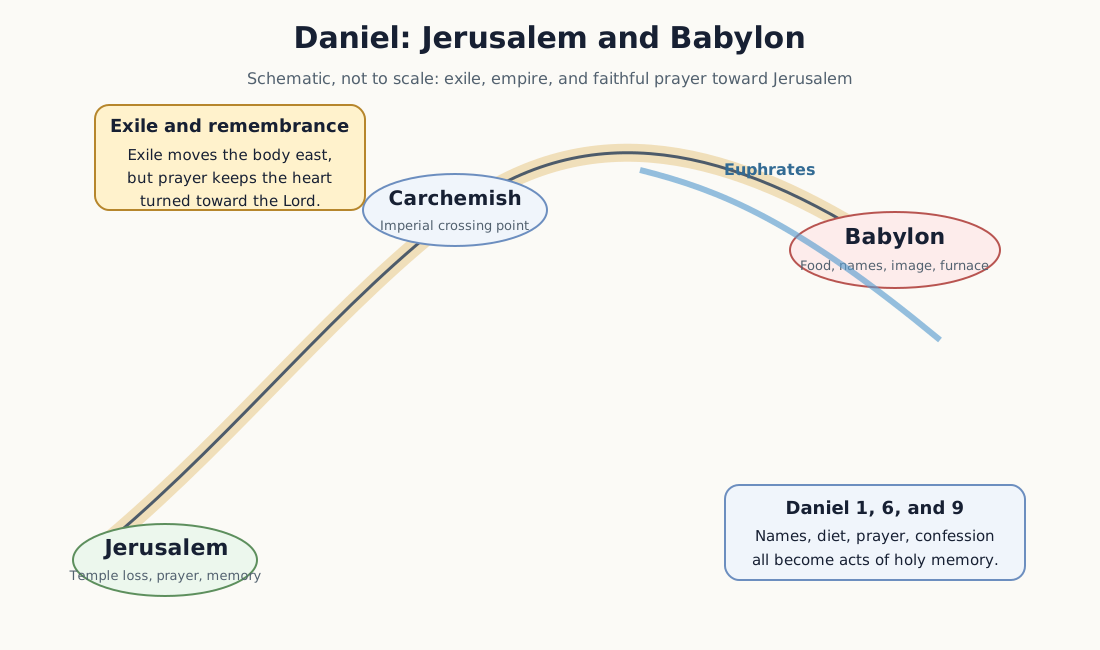 Jerusalem and Babylon: the displacement within which Daniel learns to serve God faithfully.
A settled heart and a merciful request (Daniel 1:8-16)
8 And Daniel purposed in his heart, that he would not defile himself with the king’s table, nor with the wine of his drink: and he intreated the chief of the eunuchs that he might not defile himself. 9 Now God had brought Daniel into favour and compassion with the chief of the eunuchs. 10 And the chief of the eunuchs said to Daniel, I fear my lord the king, who has appointed your meat and your drink, lest he see your countenances gloomy in comparison of the young men your equals; so shall ye endanger my head to the king. 11 And Daniel said to Amelsad, whom the chief of the eunuchs had appointed over Daniel, Ananias, Misael, and Azarias, 12 Prove now thy servants ten days; and let them give us pulse, and let us eat, and let us drink water: 13 and let our countenances be seen by thee, and the countenances of the children that eat at the king’s table; and deal with thy servants according as thou shalt see. 14 And he hearkened to them, and proved them ten days. 15 And at the end of the ten days their countenances appeared fairer and stouter in flesh than the children that fed at the king’s table. 16 So Amelsad took away their supper and the wine of their drink, and gave them pulse.
The decisive action begins in Daniel’s heart before it reaches his lips. He purposes not to defile himself and then entreats the official. Conviction does not become contempt. The same man who will not compromise is willing to ask, listen, and propose a practical arrangement. The narrative holds firmness and gentleness together. We often separate them, imagining that courtesy proves weakness or that faithfulness requires an insulting tone. Daniel needs neither assumption.
The text does not specify every reason the royal food and wine would defile him. Covenant faithfulness clearly governs the refusal, but it is unwise to supply an elaborate menu or an unmentioned ceremony as though the narrator had described it. What is explicit is that Daniel will not let royal provision decide the limits of his obedience. He receives neither pleasure nor security as an absolute good. A table that appears generous becomes a test of whom he serves.
God’s gift of favour in verse 9 does not make the official fearless. He explains that Daniel’s request could endanger his head. This is a household governed by terror as well as privilege. Daniel does not treat the servant’s fear as an inconvenience to his own spiritual ambition. He speaks next to Amelsad, the official placed over the four youths, and proposes an observable ten-day trial. Amelsad’s precise title may be unfamiliar, but his function is clear from verses 11 and 16: he supervises their food.
The request places Daniel’s own body under examination rather than demanding that another man immediately incur the maximum risk. It is a small but important form of mercy. When conscience forbids an action at work, in education, or in family life, we can sometimes offer a truthful alternative rather than only an accusation. That will not always remove conflict. It can prevent us from adding needless injury to necessary refusal. Daniel is not responsible for satisfying every demand, but he is attentive to the person hearing him.
“Pulse” means the simple plant food supplied instead of the royal fare. The account reports that these youths appear healthier after the trial; it does not establish a universal diet, a medical experiment for every reader, or a promise that fasting will improve appearance. The sign concerns God’s care for these servants in this danger. A person who is ill, pregnant, recovering from an eating disorder, or otherwise unable to follow a severe food rule has not thereby failed Daniel’s test. Orthodox fasting should be received with appropriate pastoral and medical guidance, not used against the body or against another person’s conscience.
Gems from the Fathers 💎
Saint Basil’s first homily on fasting brings Daniel and the three youths into a larger account of prayer strengthened by bodily discipline. His subject is not a modern nutrition scheme. Fasting helps a person cease treating appetite as master and become more available to God. He writes: “Fasting sends up prayer to Heaven, becoming, as it were, a wing for it on its upward journey.”3 This is a thematic illumination of Daniel’s discipline, not an additional promise that a particular fast will obtain a particular rescue.
The chapter also prepares a concrete Gospel contrast. In Matthew 4:3-4 the tempter asks Christ to use His power to turn stones into bread. Christ’s refusal places obedience to the Father’s word before the immediate demand of hunger. Daniel’s lesser obedience belongs within that greater victory; he does not save himself by superior willpower. Christian fasting draws life from Christ and returns us to Him.
The Eucharistic table gives this refusal its positive direction. Christians do not fast because food or the material world is evil. We refuse to make appetite sovereign because we are called into communion with the Lord who gives Himself as food (John 6:51; 1 Corinthians 10:16-21). Daniel’s vegetables are not a hidden description of the Eucharist. The connection concerns allegiance: not every table has the right to claim the whole person. Fasting makes room for gratitude, prayer, and generosity, so that restraint becomes a way of receiving rather than merely a way of saying no.
Wisdom received, excellence offered (Daniel 1:17-21)
17 And as for these four children, God gave them understanding and prudence in all learning and wisdom: and Daniel had understanding in all visions and dreams. 18 And at the end of the days, after which the king had given orders to bring them in, then the chief of the eunuchs brought them in before Nabuchodonosor. 19 And the king spoke with them; and there were not found out of them all any like Daniel, and Ananias, and Misael, and Azarias: and they stood before the king. 20 And in every matter of wisdom and knowledge wherein the king questioned them, he found them ten times wiser than all the enchanters and sorcerers that were in all his kingdom. 21 And Daniel continued till the first year of king Cyrus.
The ten-day trial is not the end of the formation. Verse 18 returns to the period appointed for their education, and the young men must stand before the king. Their refusal has not become permission for carelessness. They speak well because they have learned well. They can serve competently without agreeing that the king owns their conscience.
Verse 17 carefully distinguishes a gift shared by all four from a particular gift entrusted to Daniel. All receive understanding and prudence in learning and wisdom; Daniel also understands visions and dreams. Holiness is not measured by possession of the most unusual gift. The other three will stand faithfully in the furnace without being given Daniel’s narrative role as interpreter. In parish service, the person whose work is quiet is not spiritually secondary to the person whose speech attracts attention.
Jerome notices that God gives these young men understanding even in secular literature. Their learning enables judgment, not automatic submission to everything they read.4 His observation corrects two temptations. We need not idolize education as though knowledge could reveal God’s mysteries by itself. Neither need we despise learning because some of its teachers do not share our faith. Wisdom receives what is useful while remaining answerable to God. The next chapter will demonstrate both truths: Daniel has been educated at court, yet the king’s secret is disclosed only through God’s mercy.
The king finds them ten times wiser than the enchanters and sorcerers. This is the story’s emphatic verdict on their excellence, not a spiritual formula for earning tenfold examination results. Some faithful students struggle, and some conscientious workers remain unrecognized. Daniel’s vindication shows that Babylon does not have the final authority to define wisdom. It does not promise that every employer will recognize a Christian’s worth. The gift is God’s, and its use must remain service even when recognition is delayed or absent.
The final mention of Cyrus stretches the reader’s horizon beyond this first court. Daniel continues into another reign. The king who seemed to hold all the futures in verse 5 does not hold the last word. Verse 21 is not Daniel’s obituary; Daniel 10:1 will place a revelation in Cyrus’s third year. Here the point is continuity through the collapse of the world that once seemed permanent. God has preserved a servant beyond the power that took him captive.
Babylon appears to take, but God gives. That sentence does not deny loss. The vessels are really displaced, the names really changed, and the king’s household remains dangerous. It declares that what has been taken is not the measure of what God can still give: compassion within a hostile institution, intelligence for difficult work, friends in obedience, and the endurance to remain His.
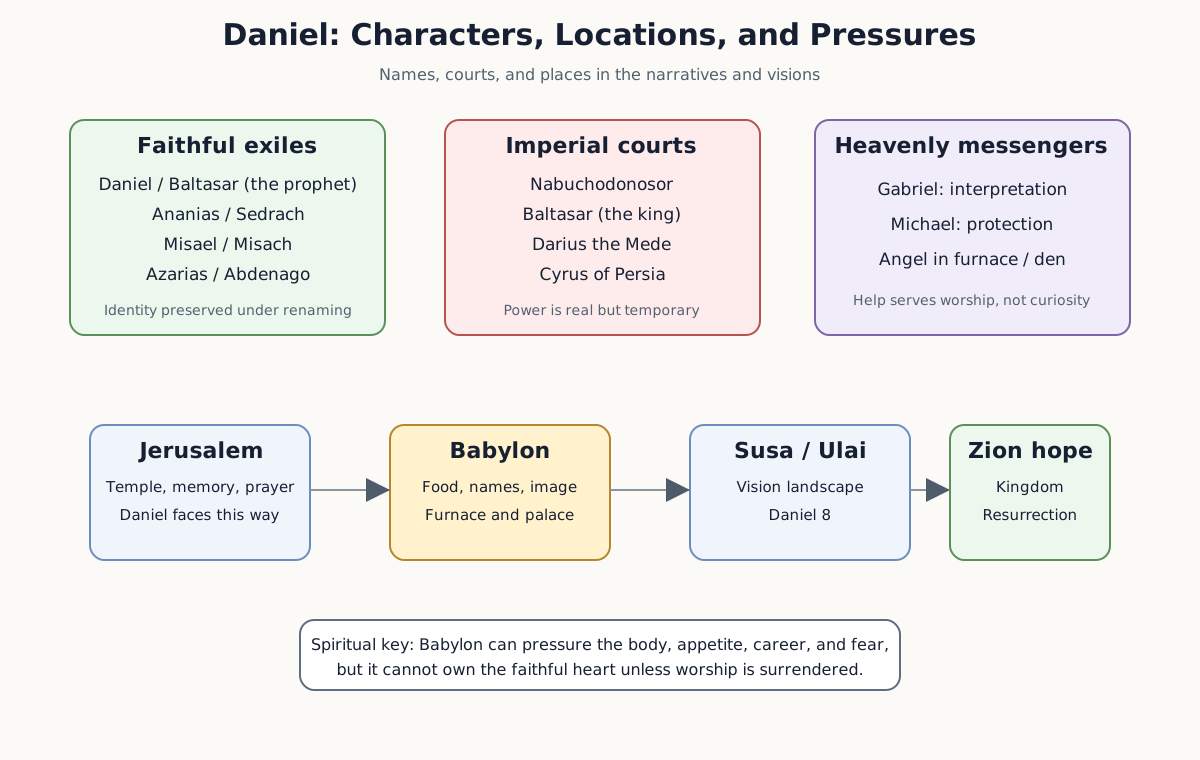 Place, name, education, food, and service: distinct pressures faced by the same four faithful companions.
Spiritual Fruit 🍇
Name one royal table that is training your appetite. It may be a stream of entertainment you cannot put down, the approval of an influential colleague, the pleasure of contempt for opponents, or a habit of buying comfort whenever you are anxious. Do not begin with a dramatic vow. Choose a modest, truthful restraint for this week and connect it to something positive: a short prayer, attention to a neglected person, or money set aside for someone in need. A fast that leaves us less merciful has missed Daniel’s courteous concern for the servant.
Before a necessary refusal, pray for the person who must hear it. Daniel sees that the official is also under pressure. We can tell the truth without pretending that other people have no fears. Ask whether there is an honest alternative that protects conscience and reduces another person’s danger. If no alternative is possible, retain the same gentleness in a firmer answer.
Offer your learning and work to God without making success the proof of His love. Prepare carefully for the task in front of you. Admit what you do not know. Thank a colleague who helped you. These ordinary acts keep excellence from becoming self-worship. The gift that makes us useful is not given to establish our superiority.
When a name or judgment has begun to imprison you, return to the deeper truth of belonging to Christ. This does not erase responsibility for sin; repentance is part of that belonging. It does mean that neither a humiliating label nor a prestigious title has the authority to become your whole identity. Babylon can assign a place in its household. It cannot decide whom the Lord may receive.
Lord Jesus Christ, who refused the tempter’s bread and gave Yourself for the life of the world, teach me to receive Your gifts without surrendering my heart to lesser masters. Give me a steady purpose, a gentle tongue, and the freedom to serve You in the place where I stand.
Teaching Notes
Captivity, education, and imposed names (Daniel 1:1-7)
- Ask: Which changes can the youths accept, and what would it mean to let the court determine their worship?
- Emphasize: Distinguish education from assent and public labels from belonging to God.
- Watch for: Do not infer that every captive’s suffering is punishment for that person’s sins. Daniel 1:1 and Jeremiah 25:1 use different regnal-year descriptions; acknowledge the comparison without presenting an unverified chronology as settled.
- Show: Locate Jerusalem, Sennaar/Shinar, and Babylon on the exile map.
A settled heart and a merciful request (Daniel 1:8-16)
- Ask: How does Daniel take the supervisor’s fear seriously without abandoning his purpose?
- Connect: Read Matthew 4:3-4 alongside Daniel’s refusal, distinguishing the disciple’s obedience from Christ’s saving victory.
- Watch for: The ten-day outcome is not a medical guarantee or a mandate for extreme food restriction.
Wisdom received, excellence offered (Daniel 1:17-21)
- Ask: What is the difference between receiving a gift and using it to prove superiority?
- Emphasize: All four receive wisdom; Daniel’s particular gift does not make the others less faithful.
- Watch for: Daniel 1:21 does not state that Daniel died in Cyrus’s first year; compare Daniel 10:1.
Sources
Embedded Scripture is from Brenton’s English Septuagint (LXX). No specific Coptic lectionary appointment is identified for Daniel 1.
Saint Basil the Great, Homily I on Fasting, §7, for the relation of fasting and prayer. This is a thematic witness, not a verse-by-verse commentary on Daniel 1.
Jerome, Commentary on Daniel, on Daniel 1:2, 1:7-8, and 1:17. Jerome is used as an early Christian exegetical witness.
The map and character diagram are explanatory schematics, not ancient maps or icons.
Footnotes
-
Jerome, Commentary on Daniel, on 1:2, translated by Gleason L. Archer, containing commentary. ↩
-
Jerome, Commentary on Daniel, on 1:7-8, containing commentary. ↩
-
Saint Basil the Great, Homily I on Fasting, §7, English text, part 2. ↩
-
Jerome, Commentary on Daniel, on 1:17, containing commentary. ↩