


This narration is from a previous version of the study and may include a combined recording of multiple chapters.
A king who commands a vast empire cannot command his own sleep. Nabuchodonosor’s dream exposes the limit beneath his power before it reveals the limit beneath every kingdom. Daniel answers the crisis by gathering his friends to seek mercy. Only then does he speak of the stone cut out without hands and the kingdom that will never be destroyed.
The order is essential. The chapter is not an empire chart with prayer attached. It shows how a servant receives knowledge without becoming proud, protects people he has no reason to flatter, and stands before power without pretending that revelation belongs to him. The dream’s great image is interpreted by a man who has learned not to become an image of his own importance.
The king’s demand and the limit of human power (Daniel 2:1-13)
1 In the second year of his reign Nabuchodonosor dreamed a dream, and his spirit was amazed, and his sleep departed from him. 2 And the king gave orders to call the enchanters, and the magicians, and the sorcerers, and the Chaldeans, to declare to the king his dreams. And they came and stood before the king. 3 And the king said to them, I have dreamed, and my spirit was troubled to know the dream. 4 And the Chaldeans spoke to the king in the Syrian language, saying, O king, live for ever: do thou tell the dream to thy servants, and we will declare the interpretation. 5 The king answered the Chaldeans, The thing has departed from me: if ye do not make known to me the dream and the interpretation, ye shall be destroyed, and your houses shall be spoiled. 6 But if ye make known to me the dream, and the interpretation thereof, ye shall receive of me gifts and presents and much honour: only tell me the dream, and the interpretation thereof. 7 They answered the second time, and said, Let the king tell the dream to his servants, and we will declare the interpretation. 8 And the king answered and said, I verily know that ye are trying to gain time, because ye see that the thing has gone from me. 9 If then ye do not tell me the dream, I know that ye have concerted to utter before me a false and corrupt tale, until the time shall have past: tell me my dream, and I shall know that ye will also declare to me the interpretation thereof. 10 The Chaldeans answered before the king, and said, There is no man upon the earth, who shall be able to make known the king’s matter: forasmuch as no great king or ruler asks such a question of an enchanter, magician, or Chaldean. 11 For the question which the king asks is difficult, and there is no one else who shall answer it before the king, but the gods, whose dwelling is not with any flesh. 12 Then the king in rage and anger commanded to destroy all the wise men of Babylon. 13 So the decree went forth, and they began to slay the wise men; and they sought Daniel and his fellows to slay them.
The opening scene reverses the apparent security of the royal court. The king has access to specialists, interpreters, rewards, and the power to execute. None can give him rest. He demands not only an interpretation but the dream itself. Brenton’s words, “The thing has departed from me,” place the difficulty plainly before us: the advisers cannot simply be given the dream and provide an impressive explanation. Their claim to privileged knowledge is being tested at a point where technique cannot help them.
Their answer in verses 10-11 contains a truth the king needs to hear. No human being can meet this demand by ordinary ability. But their description of the gods as dwelling apart from flesh leaves the king without a source of mercy. Daniel will not contradict the limit of human power. He will announce a God who freely reveals what human beings cannot seize. The contrast is not between incompetent advisers and a naturally more gifted competitor. It is between a demanded possession and a received gift.
Verse 4 marks the speech “in the Syrian language.” Here “Syrian” refers to Aramaic, not to a change of location to Syria. Jerome observes that the book changes from Hebrew to the language he calls Chaldee or Syriac at this point.1 The Aramaic section continues through Daniel 7:28. A language used across political and national boundaries carries these stories of God’s rule over the nations. We should not make the language itself a hidden code; it is a concrete feature of the book’s form.
When the advisers cannot perform the impossible, the king treats limitation as disloyalty. His threat expands from the people before him to all the wise men, including Daniel and his companions. This is arbitrary violence, not a model of strong leadership. The narrative exposes a ruler whose fear has made other people’s bodies disposable. A family, workplace, or ministry can imitate this in smaller ways whenever a powerful person’s anxiety becomes everyone else’s emergency and inability is treated as betrayal.
The crisis also breaks the illusion that Daniel’s excellence at the end of chapter 1 has made him safe. God gave him wisdom, yet he is sought for execution. Gifts are not immunity from the instability of a fallen world. Faithfulness will have to take a new form: calm inquiry, shared prayer, thanksgiving, and courageous speech. Daniel cannot control the ruler’s anger. He can refuse to let that anger become the source and measure of his own actions.
Shared prayer and thanksgiving before the answer is spoken (Daniel 2:14-23)
14 Then Daniel answered with counsel and prudence to Arioch the captain of the royal guard, who was gone forth to kill the wise men of Babylon; saying, 15 Chief magistrate of the king, wherefore has the peremptory command proceeded from the king? So Arioch made known the matter to Daniel. 16 And Daniel intreated the king to give him time, and that he might thus declare to the king the interpretation of it. 17 So Daniel went into his house, and made known the matter to Ananias, and Misael, and Azarias, his friends. 18 And they sought mercies from the God of heaven concerning this mystery; that Daniel and his friends might not perish with the rest of the wise men of Babylon. 19 Then the mystery was revealed to Daniel in a vision of the night: and Daniel blessed the God of heaven, and said, 20 May the name of God be blessed from everlasting and to everlasting: for wisdom and understanding are his. 21 And he changes times and seasons: he appoints kings, and removes them, giving wisdom to the wise, and prudence to them that have understanding: 22 he reveals deep and secret matters; knowing what is in darkness, and the light is with him. 23 I give thanks to thee, and praise thee, O God of my fathers, for thou hast given me wisdom and power, and hast made known to me the things which we asked of thee; and thou hast made known to me the king’s vision.
Daniel’s first response is described as counsel and prudence. He asks why the command is so urgent, learns the situation, and requests time. He does not pretend to know what has not yet been revealed. Even in an emergency, truth begins with acknowledging what we do not possess. His composure is not indifference to danger; he and his friends are named among the people who may perish.
The first thing he does with the time granted is return to his companions. Ananias, Misael, and Azarias are not an audience for his eventual success. They share the plea for mercy before there is anything to announce. The singular recipient of the night vision remains part of a praying fellowship. Verse 23 remembers this by thanking God for making known what “we asked.” A gift entrusted to one person does not erase those who prayed, suffered, or laboured with him.
The revelation is immediately followed by praise. Daniel does not rush from the vision to the palace and leave gratitude until after his promotion. His thanksgiving recognizes the source of everything the king and the advisers had tried to control: wisdom, power, changes of season, and the rise and removal of kings. God knows what is in darkness, but He is not darkness. The light is with Him. This is why a mystery can be approached in trust rather than panic.
The confession that God appoints and removes kings must not be twisted into approval of every ruler’s action. The same chapter calls the king’s anger destructive and places his empire beneath judgment. Providence means that rulers do not stand outside God’s government; it does not mean that their cruelty becomes righteous. We can confess God’s sovereignty while resisting injustice and seeking protection for endangered people. Daniel himself will use the revelation first to stop a killing.
The prayer gives us a way to live when we cannot see what is happening. Daniel does not thank God for making him important. He thanks Him for hearing a request and giving wisdom needed in danger. In our own crises, this may mean bringing one specific need to trustworthy fellow Christians rather than repeatedly rehearsing it alone. It may also mean thanking God for a measure of light before we know how the whole situation will end. Discernment is not proved by having a private explanation for everything. It is exercised through dependence, truthfulness, and communion.
Mercy for the threatened and the image in the dream (Daniel 2:24-35)
24 And Daniel came to Arioch, whom the king had appointed to destroy the wise men of Babylon, and said to him; Destroy not the wise men of Babylon, but bring me in before the king, and I will declare the interpretation to the king. 25 Then Arioch in haste brought in Daniel before the king, and said to him, I have found a man of the children of the captivity of Judea, who will declare the interpretation to the king. 26 And the king answered and said to Daniel, whose name was Baltasar, Canst thou declare to me the dream which I saw, and the interpretation thereof? 27 And Daniel answered before the king, and said, The mystery which the king asks the explanation of is not in the power of the wise men, magicians, enchanters, or soothsayers to declare to the king. 28 But there is a God in heaven revealing mysteries, and he has made known to king Nabuchodonosor what things must come to pass in the last days. Thy dream, and the visions of thy head upon thy bed, are as follows, 29 O king: thy thoughts upon thy bed arose as to what must come to pass hereafter: and he that reveals mysteries has made known to thee what must come to pass. 30 Moreover, this mystery has not been revealed to me by reason of wisdom which is in me beyond all others living, but for the sake of making known the interpretation to the king, that thou mightest know the thoughts of thine heart. 31 Thou, O king, sawest, and behold an image: that image was great, and the appearance of it excellent, standing before thy face; and the form of it was terrible. 32 It was an image, the head of which was of fine gold, its hands and breast and arms of silver, its belly and thighs of brass, 33 its legs of iron, its feet, part of iron and part of earthenware. 34 Thou sawest until a stone was cut out of a mountain without hands, and it smote the image upon its feet of iron and earthenware, and utterly reduced them to powder. 35 Then once for all the earthenware, the iron, the brass, the silver, the gold, were ground to powder, and became as chaff from the summer threshingfloor; and the violence of the wind carried them away, and no place was found for them: and the stone which had smitten the image became a great mountain, and filled all the earth.
Daniel’s first instruction after receiving the mystery is not a request for honour: it is that the wise men must not be destroyed. He does not need to settle every question about their profession before recognizing their lives as worth saving. The revelation is already bearing moral fruit. Knowledge from God does not authorize satisfaction at another person’s ruin. It makes Daniel an intercessor within the machinery of violence.
Arioch tells the king that he has found an interpreter. Daniel’s account is deliberately different. He repeats that no human specialist can disclose the mystery and then directs the king to the God of heaven. The negation protects both the truth and the advisers whom the king had condemned. Verse 30 goes further: this revelation is not proof that Daniel has more native wisdom than every other living person. The gift has a purpose for the hearer, that the king may understand the thoughts of his own heart.
The image is great, splendid, and terrible. Its materials invite admiration, but its structure contains weakness. Gold, silver, bronze, and iron belong to one image that can be struck at its mixed feet. The king sees glory; the dream also reveals instability. A life built on money, influence, achievement, and force can look impressive while remaining unable to bear its own weight. The spiritual warning is not that these gifts have no use, but that no arrangement of created strength can become an everlasting foundation.
The stone comes from outside the image’s system of power. Brenton states that it is cut “out of a mountain without hands” in verse 34. It is the stone that is cut out without human hands, not a stone described as never cut, and not a mountain that the verse calls uncut. That distinction matters before we draw a Christian interpretation. God’s kingdom is not one more component added to the statue, nor is it the final achievement of the statue’s makers. It breaks the whole false claim to permanence.
Gems from the Fathers 💎: The coming of Christ
Saint Irenaeus reads the stone’s arrival in the light of Christ’s birth from the Virgin. The phrase “without hands” points, for him, to a birth not brought about by a human father. He writes: “So, then, we understand that His advent in human nature was not by the will of a man, but by the will of God.”2 This is a direct Christian reading of Daniel 2:34, not a claim that the prophet was giving a geological description.
Its theological force is precise. Christ’s humanity is real and received from Mary; His coming is God’s saving initiative, not the product of royal succession or human engineering. Marian typology serves the confession of the Incarnation. It should not displace the passage’s central claim that God establishes a kingdom unlike the powers He judges. The One born in humility is not a smaller statue. Through His death and Resurrection, He gives the imperishable life no empire can manufacture.
Passing kingdoms and the kingdom that stands (Daniel 2:36-45)
36 This is the dream; and we will tell the interpretation thereof before the king. 37 Thou, O king, art a king of kings, to whom the God of heaven has given a powerful and strong and honourable kingdom, 38 in every place where the children of men dwell: and he has given into thine hand the wild beasts of the field, and the birds of the sky and the fish of the sea, and he has made thee lord of all. 39 Thou art the head of gold. And after thee shall arise another kingdom inferior to thee, and a third kingdom which is the brass, which shall have dominion over all the earth; 40 and a fourth kingdom, which shall be strong as iron: as iron beats to powder and subdues all things, so shall it beat to powder and subdue. 41 And whereas thou sawest the feet and the toes, part of earthenware and part of iron, the kingdom shall be divided; yet there shall be in it of the strength of iron, as thou sawest the iron mixed with earthenware. 42 And whereas the toes of the feet were part of iron and part of earthenware, part of the kingdom shall be strong, and part of it shall be broken. 43 Whereas thou sawest the iron mixed with earthenware, they shall be mingled with the seed of men: but they shall not cleave together, as the iron does not mix itself with earthenware. 44 And in the days of those kings the God of heaven shall set up a kingdom which shall never be destroyed: and his kingdom shall not be left to another people, but it shall beat to pieces and grind to powder all other kingdoms, and it shall stand for ever. 45 Whereas thou sawest that a stone was cut out of a mountain without hands, and it beat to pieces the earthenware, the iron, the brass, the silver, the gold; the great God has made known to the king what must happen hereafter: and the dream is true, and the interpretation thereof sure.
Daniel begins with the king’s actual authority, not with flattery and not with denial. Nabuchodonosor is the head of gold, but the kingdom, strength, and honour have been given by the God of heaven. The gift carries a limit: another kingdom will follow. Even the head of gold must hear that he is not the whole body and will not remain its head forever. Power becomes an occasion for humility when its holder remembers both its source and its end.
The later metals describe a succession of kingdoms. The fourth is destructive like iron; its mixture with earthenware introduces a weakness force cannot mend. Verse 43 says that mingling will not produce genuine cohesion. Whatever political arrangements the image encompasses, the explanation is clear about the result: hard power and fragile bonds do not make an enduring unity. We should not identify each toe with a present-day state or turn a disputed detail into a timetable. The text’s certainty concerns God’s kingdom, not our ingenuity at assigning contemporary names.
Gems from the Fathers 💎: The image and the Judge
Hippolytus reads the sequence as Babylon, the Medes and Persians, the Greeks, and Rome. In On Christ and Antichrist §28 he sets the image alongside Daniel 7 and identifies the stone with Christ.3 Jerome gives the same broad imperial sequence in his comments on Daniel 2:39-40.4 This is a substantial early Christian interpretation, not an identification explicitly supplied for all four kingdoms in this chapter. The reader can receive its witness to Christ without treating every later historical application as equally certain.
There is also a necessary distinction within Christian fulfillment. Irenaeus emphasizes the stone’s coming through the virginal birth; Hippolytus emphasizes Christ’s coming in judgment and the kingdom given to the saints. These are related confessions, not interchangeable moments on a chart. Christ has truly come and reigns; the final destruction of evil and the resurrection of the dead remain our hope. The passage does not require us to pretend that the world’s violence has already disappeared in order to confess that His kingdom has begun.
The mountain filling the earth gives the answer to the image’s fragile grandeur. What God establishes is not left to another people as one dynasty hands power to the next. Its permanence belongs to His faithfulness. Christians belong to this kingdom by union with Christ, not by achieving political domination or claiming an ethnic superiority. Its final victory is God’s judgment, not a permission for the Church to coerce belief by force. Jesus refuses a worldly defense of His kingship in John 18:36.
Do not envy the statue. Its gold head still falls. The sentence is a warning to the powerful and a consolation to those who feel invisible. We can work responsibly within earthly institutions without asking them to supply an everlasting home. To pray for God’s kingdom is to ask that our ambitions, resentments, and loyalties be judged by the King whom no institution can replace.
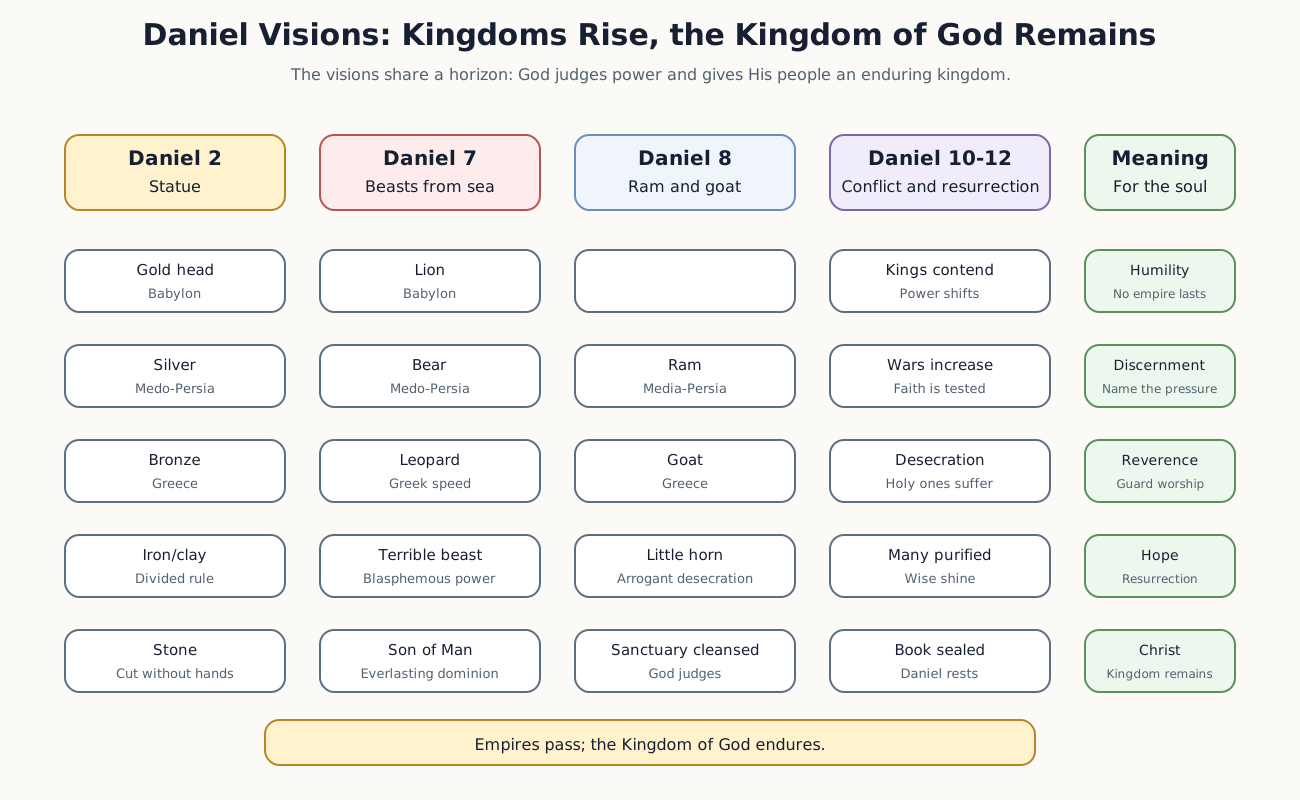 The image’s succession of materials contrasts with the stone and the kingdom established by God.
A king’s homage and a servant’s remembrance (Daniel 2:46-49)
46 Then king Nabuchodonosor fell upon his face, and worshipped Daniel, and gave orders to offer to him gifts and incense. 47 And the king answered and said to Daniel, Of a truth your God is a God of gods, and Lord of kings, who reveals mysteries; for thou hast been able to reveal this mystery. 48 And the king promoted Daniel, and gave him great and abundant gifts, and set him over the whole province of Babylon, and made him chief satrap over all the wise men of Babylon. 49 And Daniel asked of the king, and he appointed Sedrach, Misach, and Abdenago, over the affairs of the province of Babylon: but Daniel was in the king’s palace.
The king’s response is startling. He falls before Daniel and orders gifts and incense. A reader is right to ask whether this is worship wrongly offered to a human being. The narrative reports the act; it does not give a general command to repeat it or tell us that Daniel has become divine. The king’s own explanation in verse 47 directs attention to the revealer of mysteries, but his gestures still emerge from the habits of a pagan court.
Jerome refuses to make Scripture responsible for approving every action it describes. His commentary, under the lemma for verse 47, discusses both verses 46 and 47. He compares the attempted sacrifices to Paul and Barnabas in Acts 14, and offers two ways of understanding the king: honour reaching God through His servant, or an overwhelmed pagan not fully understanding his own response.5 We should preserve that caution rather than announce a conversion more complete than the story demonstrates. Chapter 3 will show that astonishment at a miracle is not yet a heart freed from idolatry.
Daniel’s promotion concludes with a different kind of action: he remembers his companions. The friends who sought mercy with him share the benefit when he is honoured. This is a small narrative answer to the great image. Babylon concentrates glory in a ruler; Daniel receives honour without forgetting the people beside him. The servant has not become the solitary genius the court expected to purchase.
We can imitate this remembrance without ever receiving a public promotion. Name the people whose unseen work supported a visible result. Share credit and practical opportunity. Use influence to protect, not only to advance. A revelation has been genuinely received when it makes the recipient more grateful to God and more responsible for others.
Spiritual Fruit 🍇
When anxiety makes you demand certainty, begin where Daniel begins. State the real need to God and ask one or two trustworthy people to pray with you. Do not require them to supply an explanation they do not have. There is mercy in shared uncertainty when it is brought before the God who knows what is in darkness.
Pray Daniel’s thanksgiving in verses 20-23 before reopening the task that frightens you. Let its claims correct the scale of your fear. The person who can affect your employment, reputation, or plans is not the lord of times and seasons. This does not make practical decisions unnecessary. It makes possible a decision not governed entirely by panic.
Ask whom you would be tempted to leave under judgment. Daniel first seeks to stop the execution of the wise men. A Christian response to another person’s failure need not deny wrongdoing, but it should resist the pleasure of their humiliation. Speak against an unjust punishment, correct a false allegation, or help someone find a truthful way out of danger. Mercy is part of discernment, not a distraction from it.
Finally, examine one piece of the statue you have mistaken for a foundation. It may be savings, professional competence, a political movement, family prestige, or the admiration of religious people. Give thanks for whatever good it contains, then consciously refuse to ask it for what only Christ can give. We do not need to make every earthly good collapse before learning its proper place. The stone announces a kingdom received from God. Our freedom begins when we stop trying to build its permanence out of our own success.
Teaching Notes
The king’s demand and the limit of human power (Daniel 2:1-13)
- Ask: At what point does the king turn fear into injustice?
- Emphasize: Daniel will affirm the advisers’ human limitation while witnessing to God’s freedom to reveal.
- Watch for: Aramaic is the language meant by “Syrian” here, not evidence that the scene has moved to Syria.
Shared prayer and thanksgiving before the answer is spoken (Daniel 2:14-23)
- Ask: Why does Daniel thank God before presenting the answer at court?
- Connect: Let the group notice “we asked” in verse 23 and name the difference between a particular gift and solitary self-sufficiency.
Mercy for the threatened and the image in the dream (Daniel 2:24-35)
- Ask: Why is saving the wise men part of interpreting the mystery faithfully?
- Emphasize: Read verse 34 precisely before introducing Irenaeus: the stone is cut out of a mountain without hands.
Passing kingdoms and the kingdom that stands (Daniel 2:36-45)
- Show: Use the kingdoms chart to distinguish the image’s materials from God’s kingdom, not to assign modern nations to toes.
- Watch for: Distinguish Christ’s Incarnation, His present reign, and the final judgment; do not turn complementary patristic emphases into a dated forecast.
A king’s homage and a servant’s remembrance (Daniel 2:46-49)
- Ask: Does reporting gifts and incense mean Scripture commands worship of Daniel? Compare Acts 14:11-18.
- Emphasize: The king’s astonishment and his confession do not prove that all his habits of worship have been healed.
- Connect: Daniel remembers the companions who prayed before he was promoted.
Sources
Embedded Scripture is from Brenton’s English Septuagint (LXX). No specific Coptic lectionary appointment is identified for Daniel 2.
Saint Irenaeus, Against Heresies 3.21.7, on the stone and the virginal birth.
Hippolytus, On Christ and Antichrist §§23-28, on the image, the sequence of kingdoms, and Christ’s judgment.
Jerome, Commentary on Daniel, on 2:4, 2:24-30, 2:39-49, used as an early Christian exegetical witness.
The kingdoms diagram is an explanatory schematic.
Footnotes
-
Jerome, Commentary on Daniel, on 2:4, translated by Gleason L. Archer, containing commentary. ↩
-
Saint Irenaeus, Against Heresies 3.21.7, chapter text. ↩
-
Hippolytus, On Christ and Antichrist §§23-28, especially §28, treatise text. ↩
-
Jerome, Commentary on Daniel, on 2:39-40, containing commentary. ↩
-
Jerome, Commentary on Daniel, the lemma headed “Verse 47,” discussing 2:46-47, containing commentary. ↩