


This narration is from a previous version of the study and may include a combined recording of multiple chapters.
Babylon still possesses Jerusalem’s temple vessels, but possession has never made them Babylon’s to profane. Daniel 5 begins with a feast and ends with a death. Between them stands a warning more searching than the mysterious writing: the king has failed to glorify the God who holds his breath. This is sacrilege with memory. He knows the warning of an earlier king’s humiliation, yet treats what belongs to God as material for his own display.
Embedded Scripture is from Brenton’s English Septuagint (LXX).
Holy vessels at an unholy feast (Daniel 5:1-9)
1 Baltasar the king made a great supper for his thousand nobles, and there was wine before the thousand. 2 And Baltasar drinking gave orders as he tasted the wine that they should bring the gold and silver vessels, which Nabuchodonosor his father had brought forth from the temple in Jerusalem; that the king, and his nobles, and his mistresses, and his concubines, should drink out of them. 3 So the gold and silver vessels were brought which Nabuchodonosor had taken out of the temple of God in Jerusalem; and the king, and his nobles, and his mistresses, and his concubines, drank out of them. 4 They drank wine, and praised the gods of gold, and of silver, and of brass, and of iron, and of wood, and of stone.
5 In the same hour came forth fingers of a man’s hand, and wrote in front of the lamp on the plaster of the wall of the king’s house: and the king saw the knuckles of the hand that wrote. 6 Then the king’s countenance changed, and his thoughts troubled him, and the joints of his loins were loosed, and his knees smote one another. 7 And the king cried aloud to bring in the magicians, Chaldeans, and soothsayers; and he said to the wise men of Babylon, Whosoever shall read this writing, and make known to me the interpretation, shall be clothed with scarlet, and there shall be a golden chain upon his neck, and he shall be the third ruler in my kingdom. 8 Then came in all the king’s wise men: but they could not read the writing, nor make known the interpretation to the king. 9 And king Baltasar was troubled, and his countenance changed upon him, and his nobles were troubled with him.
Brenton calls the king “Baltasar,” the name by which many readers know Belshazzar. It is also the Babylonian name given to Daniel in 1:7 and recalled here in 5:12. These are two different men: Baltasar the king and Daniel, who was renamed Baltasar at court. Keeping them distinct prevents a needless confusion at the very point where the king and God’s interpreter will face one another.
The feast is not condemned merely because many people eat together. The decisive action is the order to fetch vessels from the temple of God in Jerusalem. What had been taken in conquest is now turned into an instrument of religious contempt. The drinkers praise gods fashioned from gold, silver, brass, iron, wood, and stone while drinking from vessels dedicated to the living God. The scene joins appetite, royal prestige, and false worship. Its fault is not simply excess, but the refusal to acknowledge any holy limit on what power may use.
The vessels connect this scene with Daniel 1:2. There, their removal belonged to the catastrophe that brought Daniel into exile. Here, many years later in the narrative, they still witness to a God whose house was plundered but whose authority has not passed away. The silence of a sacred object is not evidence that its Lord is absent. The king’s possession of the vessels cannot turn defeat in war into the defeat of God.
A short historical distinction helps. Babylonian evidence identifies Belshazzar as Nabonidus’ son, not Nebuchadnezzar’s immediate son. The Verse Account of Nabonidus describes the father entrusting royal power to his eldest son during his absence; this supports speaking of Belshazzar as a regent, although calling the arrangement a formal co-kingship goes beyond the simple fact that he exercised delegated royal authority.1 The biblical description of Nebuchadnezzar as his “father” can be understood as royal ancestry or predecessor language, without supplying a demonstrable biological family tree. This explanation should not be made to carry more genealogical certainty than the evidence allows.
The hand appears “in the same hour,” close to the lamp. The king can see the sign, and his body can no longer sustain the appearance of mastery. The knees that once seemed secure shake. His wealth still gives him the power to offer a robe, chain, and rank, but none of these can give him understanding. There is no price at which the court can buy an answer to God’s judgment.
The promised place of “third ruler” may fit the setting of Nabonidus and his son exercising royal authority, with the rewarded interpreter below them. It is a plausible explanation, not independent proof that every detail of the political arrangement has been recovered. Even Jerome proposed more than one possible meaning for the rank. The narrative’s central irony does not depend on settling that question: the king promises power within a kingdom whose end is already written before him.
Fear, by itself, is not repentance. The king is troubled, his nobles are troubled, and specialists are summoned, but no confession has yet been made. A conscience can be alarmed and still seek only an explanation that will let life return to normal. Daniel’s later speech will not allow the sign to remain merely a frightening puzzle.
Remembered wisdom and a forgotten servant (Daniel 5:10-16)
10 Then the queen came into the banquet house, and said, O king, live for ever: let not thy thoughts trouble thee, and let not thy countenance be changed. 11 There is a man in thy kingdom, in whom is the Spirit of God; and in the days of thy father watchfulness and understanding were found in him; and king Nabuchodonosor thy father made him chief of the enchanters, magicians, Chaldeans, and soothsayers. 12 For there is an excellent spirit in him, and sense and understanding are in him, interpreting dreams as he does, and answering hard questions, and solving difficulties: it is Daniel, and the king gave him the name of Baltasar: now then let him be called, and he shall tell thee the interpretation of the writing.
13 Then Daniel was brought in before the king: and the king said to Daniel, Art thou Daniel, of the children of the captivity of Judea, which the king my father brought? 14 I have heard concerning thee, that the Spirit of God is in thee, and that watchfulness and understanding and excellent wisdom have been found in thee. 15 And now the wise men, magicians, and soothsayers have come in before me, to read the writing, and make known to me the interpretation: but they could not tell it me. 16 And I have heard concerning thee, that thou art able to make interpretations: now then if thou shalt be able to read the writing, and to make known to me the interpretation of it, thou shalt be clothed with purple, and there shall be a golden chain upon thy neck, and thou shalt be third ruler in my kingdom.
The queen enters with the memory missing from the banquet. Her identity is not supplied, and it is unnecessary to decide whether she is the king’s mother or another senior royal woman. What matters is the knowledge she brings: someone in this kingdom has already interpreted mysteries when Babylon’s usual sources of wisdom could not. Daniel has not ceased to exist because the reigning king has not called for him.
The queen describes him by his gifts, not by the new reward. His insight was known before this emergency and was exercised in an earlier reign. Her speech reminds us that faithful service need not remain publicly noticed to remain real. Daniel’s worth does not begin when a frightened ruler discovers he needs him.
The king’s first address, however, identifies Daniel as one of the captives of Judea. Even while asking his help, he speaks from the hierarchy of conqueror and conquered. The man from the defeated people is expected to explain the judgment of the victorious court. That reversal is characteristic of Daniel: God gives knowledge through a servant whom the empire can rename and employ but cannot make its spiritual possession.
The king repeats the promise of purple, gold, and high office. The repetition brings a quiet question into view: can a ruler receive truth that does not depend on his approval? Daniel’s reply will show that God’s word does not enter the room as a candidate for promotion. It comes with a claim upon the person who thinks he is evaluating it.
This scene also exposes a use of religion familiar beyond ancient courts. A person may ignore the voice of conscience and the ordinary counsel of faithful people, then seek spiritual insight when a crisis threatens his security. God can meet a person there, but the purpose of the meeting is more than the repair of interrupted comfort. Daniel will recall what the king ought to have learned long before the hand appeared.
Numbered, weighed, divided (Daniel 5:17-28)
17 And Daniel said before the king, Let thy gifts be to thyself, and give the present of thine house to another; but I will read the writing, and will make known to thee the interpretation of it. 18 O king, the most high God gave to thy father Nabuchodonosor a kingdom, and majesty, and honour, and glory: 19 and by reason of the majesty which he gave to him, all nations, tribes and languages trembled and feared before him: whom he would he slew; and whom he would he smote; and whom he would he exalted; and whom he would he abased. 20 But when his heart was lifted up, and his spirit was emboldened to act proudly, he was deposed from his royal throne, and his honour was taken from him. 21 And he was driven forth from men; and his heart was given him after the nature of wild beasts, and his dwelling was with the wild asses; and they fed him with grass as an ox, and his body was bathed with the dew of heaven; until he knew that the most high God is Lord of the kingdom of men, and will give it to whomsoever he shall please.
22 And thou accordingly, his son, O Baltasar, hast not humbled thine heart before God: knowest thou not all this? 23 And thou hast been exalted against the Lord God of heaven; and they have brought before thee the vessels of his house, and thou, and thy nobles, and thy mistresses, and thy concubines, have drunk wine out of them; and thou hast praised the gods of gold, and silver, and brass, and iron, and wood, and stone, which see not, and which hear not, and know not: and the God in whose hand are thy breath and all thy ways hast thou not glorified. 24 Therefore from his presence has been sent forth the knuckle of a hand; and he has ordered this writing.
25 And this is the ordered writing, Mane, Thekel, Phares. 26 This is the interpretation of the sentence: Mane; God has measured thy kingdom, and finished it. 27 Thekel; it has been weighed in the balance, and found wanting. 28 Phares; thy kingdom is divided, and given to the Medes and Persians.
Daniel refuses the gifts before announcing the interpretation. He will speak, but he will not let the hearers suppose that the answer has been purchased. His refusal protects both the freedom of the message and the seriousness of the moment. This is not an argument that every servant of the Church must refuse all material support. It is a judgment upon using spiritual authority to secure favor, especially when the truth being withheld concerns the hearer’s repentance.
Gems from the Fathers 💎: A word that cannot be purchased
Jerome directly links Daniel’s refusal to Christ’s command in Matthew 10:8. He writes:
We should follow the example of a man like Daniel, who despised the honor and gifts of a king, and who without any reward even in that early day followed the Gospel injunction: “Freely have ye received, freely give.”2
The point is not an attractive pose of independence. A witness who needs the powerful person’s approval can begin to measure truth by its effect on his own advancement. Daniel accepts the danger of an unwelcome answer before the king hears it.
Daniel then retells the previous king’s fall. God gave Nabuchodonosor his kingdom, but the ruler’s freedom to kill or promote people at will was not thereby morally endorsed. The gift of authority never makes its abuse holy. His proud heart brought him low until he acknowledged the Most High. As in chapter 4, this particular judgment does not authorize a general diagnosis of illness as punishment for personal sin. Sick people must not be treated as less human or presumed guilty because their capacities are impaired.
The accusation turns at verse 22. Baltasar has not humbled himself despite knowing the story. The issue is not that he failed an obscure religious examination. He has refused a warning already close to his own life. Memory increases responsibility when we know what mercy has taught and decline to live differently.
Verse 23 moves from the sacred vessels to the king’s breath. The gods he praises can neither see nor hear nor know. Meanwhile the God whom he dishonors sustains the life by which he dishonors Him. The king’s rebellion is radically dependent: every word spoken against Heaven requires a breath held by Heaven. That is why this verse is the spiritual center of the chapter. Judgment does not come from a distant rival who has finally entered the palace. It comes from the One without whom the king could not have lived there for a moment.
For the reader, this is an invitation to gratitude before it becomes a warning about the last breath. Our capacities are not self-created possessions. Intelligence can be used to ridicule faith, money to purchase indifference, speech to wound a neighbor, even knowledge of Scripture to prevail in an argument without love. Each misuse takes something received and makes it serve a refusal of the Giver. The vessels make the pattern visible; the breath brings it within every person.
The writing in the displayed Brenton text is “Mane, Thekel, Phares.” Hebrew-based Bibles commonly print the fuller sequence “MENE, MENE, TEKEL, UPHARSIN.” This is a difference of textual form and transliteration, not an instruction to insert a fourth word into the Scripture printed above. Daniel explains the words in order. The kingdom has been measured and brought to its end; it has been weighed and found deficient; it is divided and given to the Medes and Persians.
The words are therefore neither a magical formula nor a code that we can redeploy to identify today’s politicians. Their force lies in the divine verdict that Daniel announces. Numbering strips the king of the illusion of unlimited time. Weighing distinguishes visible splendor from true substance. Division denies the permanence of a power he treated as his own. Together they answer the feast’s self-confidence without requiring speculation about the handwriting’s shape or the court experts’ precise inability to read it.
We must also resist turning God’s balance into an instrument with which we weigh our neighbors. The right Christian response is self-examination under mercy. Paul calls the Church to examine itself before receiving the Lord’s Supper, distinguishing communion from a meal ruled by selfishness and disregard for other members (1 Corinthians 11:17-34). Daniel’s vessels and the Eucharist are not identical, but both confront the fiction that holy gifts can be separated from the manner in which we receive them.
Gems from the Fathers 💎: Reverence reaches the hungry neighbor
St. John Chrysostom, preaching on Matthew rather than commenting directly on Daniel 5, gives this application a necessary balance. Reverence for the Eucharist must not stop at the beauty of sacred vessels. He warns against offering an elaborate cup while the life of the giver remains unjust: “Let not this therefore be our aim, to offer golden vessels only, but to do so from honest earnings likewise.”3
He does not forbid beautiful offerings to the church. In the same passage he insists that care for those in need must accompany them and take priority over display. His reasoning joins Christ’s gift of His Body to His identification with the hungry and unclothed in Matthew 25:31-46. That is not a reduction of the Eucharist to social usefulness. The Lord truly gives Himself, and that gift calls for a truthful response from the whole person. We cannot honor Him in the chalice while calmly ignoring Him in a neighbor’s distress.
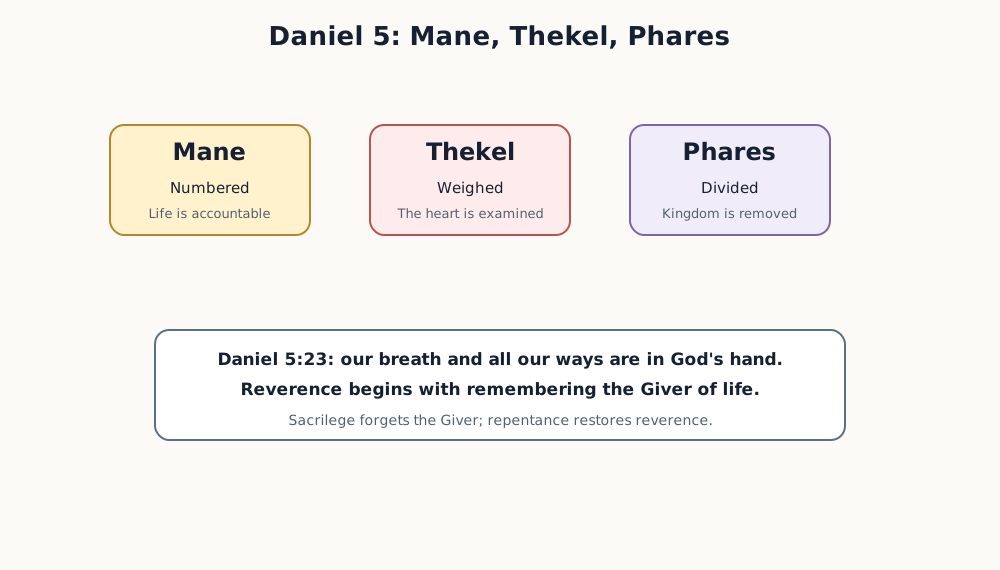 The three words announce a verdict on Babylon’s rule, not a technique for predicting another person’s judgment.
Honors that cannot postpone the night (Daniel 5:29-30)
29 Then Baltasar commanded, and they clothed Daniel with scarlet, and put the golden chain about his neck, and proclaimed concerning him that he was the third ruler in the kingdom. 30 In the same night was Baltasar the Chaldean king slain.
The robe is placed upon Daniel and the gold chain around his neck. The king can still arrange a ceremony, but he cannot lengthen the life of the kingdom by honoring its interpreter. The movement from proclamation to death occupies only two verses. Outward business continues almost to the end, and the narrator gives no scene of repentance between the reward and the final sentence.
Daniel’s earlier refusal and his later investiture are not necessarily contradictory. The first declares that he has not sold the message. The second records what the king commands after hearing it. Nor does accepting the honor cancel the judgment. A powerful person may honor a messenger without submitting to the God who sent him. Admiration of religion can remain a substitute for repentance.
The text reports the king’s killing without commanding readers to kill those who misuse holy things. Its warning belongs to God’s judgment, not to a private license for religious violence. Christians hear it under the lordship of the One who commanded love of enemies (Matthew 5:43-48) and bore human violence in His own Passion. Reverence cannot be defended by becoming cruel.
Brenton ends this chapter at verse 30. Darius the Mede’s succession appears as 6:1 here, though many English Bibles include it as 5:31. This small difference explains why a reader following another Bible may seem to have one verse left when this study stops. Babylon’s passing does not end Daniel’s service; the next chapter will ask whether his prayer remains faithful under another administration.
Spiritual Fruit 🍇
Before receiving the Holy Mysteries, take verse 23 into a short, honest examination. Have I thanked God for the life I bring to His altar? Am I using speech, work, possessions, or another person’s trust as if they were mine to misuse? Choose one matter to confess rather than turning the chapter into a general feeling of unease.
Examination is not a demand to make yourself worthy of Christ by your own strength. The Eucharist is the Lord’s gift to those who need Him. Prepare through repentance, reconciliation as far as it depends on you, and the guidance of your confessor. If fear has become obsessive or is keeping you from receiving pastoral help, bring that fear itself into the conversation. The purpose is a truthful approach to the Savior, not paralysis before an imagined scale.
Join reverence at church to one act of mercy outside it. If you can contribute to the church’s material needs, do so honestly and without using generosity as leverage. Also notice someone lacking food, rent, companionship, or practical help. The Lord who receives the offering is not absent from that person.
Finally, refuse to sell a truthful word for approval. In a family or ministry responsibility, there may be a gentle correction you have avoided because the hearer is influential. Ask first whether you have listened fairly and whether you are the right person to speak. Then seek the courage to serve the person’s good, without flattery and without Daniel’s solemnity becoming an excuse for harshness. The breath used to tell the truth is itself a gift of God.
Teaching Notes
The vessels and the two men called Baltasar (Daniel 5:1-9)
- Emphasize: Establish immediately that the king and Daniel are different people who share this form of name in Brenton.
- Ask: Why does the narrator identify where the vessels came from before describing the writing?
- Watch for: Separate the attested father-son relationship with Nabonidus from a more speculative reconstruction of a formal co-regency or Nebuchadnezzar’s family tree.
The queen’s memory (Daniel 5:10-16)
- Ask: What does the queen remember that the banquet has failed to take seriously?
- Watch for: Her role is clear without assigning her a precise place in a family tree the chapter does not provide.
The interpretation (Daniel 5:17-28)
- Ask: Why does Daniel recount chapter 4 before interpreting the words?
- Emphasize: Linger over verse 23. Let the class connect received breath with gratitude and responsibility before discussing the balance.
- Connect: Read 1 Corinthians 11:17-34 in context. Paul addresses the community’s treatment of one another as well as its reception of the Mysteries.
- Watch for: Chrysostom does not set mercy against the Eucharist or forbid beautiful church vessels.
The final night (Daniel 5:29-30)
- Ask: How can honoring a messenger become a way of avoiding the message?
- Watch for: The king’s death is not a command for believers to punish sacrilege themselves.
- Show: Use the writing chart only after reading Brenton’s three forms aloud: Mane, Thekel, Phares.
Sources
Brenton, The Septuagint Version of the Old Testament, Daniel 5. Compare NKJV Daniel 5:25 for the Hebrew-based sequence and Daniel 5:31-6:1 for numbering.
Jerome, Commentary on Daniel, chapter 5, especially 5:7, 17, 22-29. Used as an ancient exegetical witness, not as a source for a settled Babylonian genealogy or the identification of Darius.
St. John Chrysostom, Homilies on Matthew 50.3-5, on approaching Christ in the Eucharist and honoring Him in the poor; a thematic Christian application, not direct Daniel commentary.
British Museum, Nabonidus cylinder, K.1692 / BM 91128, on Nabonidus and his son Belshazzar; Verse Account of Nabonidus, column ii.5-6, on delegated royal power. The latter is a hostile ancient account and requires historical judgment, not unqualified acceptance of every accusation it makes.
Coptic lectionary: no verse-addressed appointment for Daniel 5 was found in the service data consulted. This does not establish absence from every prayer or hymn.
Footnotes
-
British Museum, cylinder K.1692 / BM 91128, https://www.britishmuseum.org/collection/object/W_K-1692; Verse Account of Nabonidus, ii.5-6, translation after A. Leo Oppenheim, https://www.livius.org/sources/content/anet/verse-account-of-nabonidus/. ↩
-
Jerome, Commentary on Daniel, chapter 5, on 5:17 (printed under “Verse 11 (sic!) (=17)”), trans. Gleason L. Archer, https://www.tertullian.org/fathers/jerome_daniel_02_text.htm. ↩
-
St. John Chrysostom, Homilies on Matthew 50.4, https://www.newadvent.org/fathers/200150.htm. ↩