


This narration was recorded before the latest revision of this study.
2 Kings ends with catastrophe and a small mercy. Judah collapses under Babylon. Jehoiakim, Jehoiachin, and Zedekiah reign in instability. Jerusalem is besieged, the temple is burned, the walls are broken, the people are exiled, and the Davidic kingdom appears ended. Yet the book closes not with rubble but with Jehoiachin lifted from prison and given a place at the king’s table.
The ending is restrained, but hope remains alive.
Historical and Scriptural Context
Babylon replaces Assyria as the dominant empire. Jeremiah prophesies during this period. The exile is not presented as bad luck but as covenant judgment, especially tied to Manasseh’s sins and Judah’s refusal to repent.
Geographical Significance ⛰️
Jerusalem, Zion, the temple, and the city walls are central. Babylon is the place of exile. Riblah appears as the place of Zedekiah’s judgment. The geography traces covenant loss: from the promised city to foreign captivity.
The Characters 👥
Jehoiakim rebels after serving Babylon for three years. Jehoiachin, his son, surrenders and is deported; the closing scene returns to his release. Zedekiah, first named Mattaniah, is installed and renamed by Babylon, then rebels and loses his sons and sight.
Nebuchadnezzar conquers Judah. Nebuzaradan, captain of the guard, burns the city, removes people and vessels, and takes officials for execution. Gedaliah governs the remnant until his assassination. Evil-Merodach later lifts Jehoiachin from prison and supplies him at the royal table. Seraiah, the high priest, is among those killed, but his priestly line is not extinguished.
Name Key
Joakim = Jehoiakim; Joachim = Jehoiachin; Batthanias = Mattaniah; Sedekias = Zedekiah; Nabuchodonosor = Nebuchadnezzar; Nabuzardan = Nebuzaradan; Reblatha = Riblah; Godolias = Gedaliah; Saraias = Seraiah; Sophonias = Zephaniah; Evialmarodec = Evil-Merodach; Achicam = Ahikam; Saphan = Shaphan; Massephath/Massepha = Mizpah. Joakim is the father and Joachim his son: one letter distinguishes the two kings in Brenton.
Jehoiakim, Babylon, and the beginning of collapse (2 Kings 24:1-7)
1 In his days went up Nabuchodonosor king of Babylon, and Joakim became his servant three years; and then he turned and revolted from him. 2 And the Lord sent against him the bands of the Chaldeans, and the bands of Syria, and the bands of Moab, and the bands of the children of Ammon, and sent them into the land of Juda to prevail against it, according to the word of the Lord, which he spoke by his servants the prophets. 3 Moreover it was the purpose of the Lord concerning Juda, to remove them from his presence, because of the sins of Manasses, according to all that he did. 4 Moreover he shed innocent blood, and filled Jerusalem with innocent blood, and the Lord would not pardon it. 5 And the rest of the acts of Joakim, and all that he did, behold, are not these written in the book of the chronicles of the kings of Juda?
6 And Joakim slept with his fathers: and Joachim his son reigned in his stead. 7 And the king of Egypt came no more out of his land: for the king of Babylon took away all that belonged to the king of Egypt from the river of Egypt as far as the river Euphrates.
The text explicitly says the Lord sends bands against Judah because of Manasseh’s sins and innocent blood. The collapse is theological before it is political. Foreign armies are real agents of destruction, but Judah’s history cannot be explained only by the size of its neighbors’ forces.
The refusal to pardon the bloodshed in verse 4 concerns the judgment narrated here. It should not be turned into a claim that Manasseh could never personally repent; 2 Chronicles 33 records his humbling. Forgiveness and the undoing of every historical consequence are not the same thing. The fall bears witness to how much suffering can accumulate when the powerful persist in sin and the innocent remain unprotected.
Egypt no longer comes out against Babylon, and the territory as far as the Euphrates passes under the conqueror’s power. Judah’s hope of maneuvering between empires narrows. Political calculation cannot replace the obedience repeatedly refused.
Jehoiachin and the deportation (2 Kings 24:8-17)
Translation note: Brenton says that Babylon made “Batthanias his son” king in 24:17. The NKJV calls Mattaniah Jehoiachin’s uncle. The reading below preserves Brenton; Mattaniah receives the name Zedekiah in both accounts.
8 Eighteen years old was Joachim when he began to reign, and he reigned three months in Jerusalem: and his mother’s name was Nestha, daughter of Ellanastham, of Jerusalem. 9 And he did that which was evil in the sight of the Lord, according to all that his father did.
10 At that time went up Nabuchodonosor king of Babylon to Jerusalem, and the city was besieged. 11 And Nabuchodonosor king of Babylon came against the city, and his servants besieged it. 12 And Joachim king of Juda came forth to the king of Babylon, he and his servants, and his mother, and his princes, and his eunuchs; and the king of Babylon took him in the eighth year of his reign. 13 And he brought forth thence all the treasures of the house of the Lord, and the treasures of the king’s house, and he cut up all the golden vessels which Solomon the king of Israel had made in the temple of the Lord, according to the word of the Lord. 14 And he carried away the inhabitants of Jerusalem, and all the captains, and the mighty men, taking captive ten thousand prisoners, and every artificer and smith: and only the poor of the land were left. 15 And he carried Joachim away to Babylon, and the king’s mother, and the king’s wives, and his eunuchs: and he carried away the mighty men of the land into captivity from Jerusalem to Babylon. 16 And all the men of might, even seven thousand, and one thousand artificers and smiths: all were mighty men fit for war; and the king of Babylon carried them captive to Babylon. 17 And the king of Babylon made Batthanias his son king in his stead, and called his name Sedekias.
Jehoiachin surrenders with his household and court. The treasures of the temple and palace are taken, and craftsmen, warriors, and leaders are deported. The repeated lists make exile more than the removal of a ruler: skills, households, public strength, and the means of rebuilding are carried away. The poor remain, but this is not a flourishing settlement free of loss.
Verse 13 says the taking of the treasures occurs according to the Lord’s word. Isaiah’s warning to Hezekiah in 2 Kings 20 has reached fulfillment. Follow the vessels through Daniel 1:2, their desecration at Belshazzar’s feast in Daniel 5:2-4, and their eventual return in Ezra 1:7-11. The objects retain a history of worship even in the houses of foreign kings.
Babylon installs Mattaniah and renames him Zedekiah. Naming makes foreign control visible within royal identity.
Zedekiah’s rebellion (2 Kings 24:18-20)
18 Twenty and one years old was Sedekias when he began to reign, and he reigned eleven years in Jerusalem: and his mother’s name was Amital, daughter of Jeremias. 19 And he did that which was evil in the sight of the Lord, according to all that Joachim did. 20 For it was according to the Lord’s anger against Jerusalem and on Juda, until he cast them out of his presence, that Sedekias revolted against the king of Babylon.
Zedekiah does evil and rebels against Babylon. His outward resistance to a foreign king does not establish inward fidelity to the Lord. The narrator connects the rebellion with the anger under which Jerusalem is being removed from God’s presence.
Jeremiah 38:17-26 records a genuine remaining call to obedience: surrender could spare the city from burning. Zedekiah fears what might happen to him at the hands of others and asks Jeremiah to keep their conversation private. His tragedy is not merely that an empire is stronger than he is. Fear leads him to refuse the hard counsel by which lives might still be saved.
Siege, famine, and Zedekiah’s fall (2 Kings 25:1-7)
1 And it came to pass in the ninth year of his reign, in the tenth month, that Nabuchodonosor king of Babylon came, and all his host, against Jerusalem; and he encamped against it, and built a mound against it. 2 And the city was besieged until the eleventh year of king Sedekias on the ninth day of the month. 3 And the famine prevailed in the city, and there was no bread for the people of the land. 4 And the city was broken up, and all the men of war went forth by night, by the way of the gate between the walls, this is the gate of the king’s garden: and the Chaldeans were set against the city round about: and the king went by the way of the plain. 5 And the force of the Chaldeans pursued the king, and overtook him in the plains of Jericho: and all his army was dispersed from about him. 6 And they took the king, and brought him to the king of Babylon to Reblatha; and he gave judgment upon him. 7 And he slew the sons of Sedekias before his eyes, and put out the eyes of Sedekias, and bound him in fetters, and brought him to Babylon.
The siege produces famine, breach, flight, capture, execution, and blindness. Before royal defeat comes the hunger of the people, who have no bread. The king escapes by night, but the army disperses and the Chaldeans overtake him near Jericho. He cannot protect either the city he leaves or the children brought before him at Riblah.
Zedekiah sees his sons killed, then loses his sight. Jeremiah 34:3 had said his eyes would see Babylon’s king; Ezekiel 12:13 had said he would be brought to Babylon but would not see it. The terrible sequence fulfills both warnings: he sees the king before being blinded and reaches the foreign land without sight. This is a concrete fulfillment, not only a symbol of spiritual blindness.
The killing of children must not become dramatic decoration for a moral lesson. The royal house and the people alike suffer the consequences of the ruler’s refusal to hear. The truth of judgment does not remove the need to grieve every life destroyed.
Temple burned and city broken (2 Kings 25:8-17)
8 And in the fifth month, on the seventh day of the month (this is the nineteenth year of Nabuchodonosor king of Babylon), came Nabuzardan, captain of the guard, who stood before the king of Babylon, to Jerusalem. 9 And he burnt the house of the Lord, and the king’s house, and all the houses of Jerusalem, even every house did the captain of the guard burn. 10 And the force of the Chaldeans pulled down the wall of Jerusalem round about. 11 And Nabuzardan the captain of the guard removed the rest of the people that were left in the city, and the men who had deserted to the king of Babylon, and the rest of the multitude. 12 But the captain of the guard left of the poor of the land to be vine-dressers and husbandmen.
13 And the Chaldeans broke to pieces the brazen pillars that were in the house of the Lord, and the bases, and the brazen sea that was in the house of the Lord, and carried their brass to Babylon. 14 And the caldrons, and the shovels, and the bowls, and the censers, and all the brazen vessels with which they minister, he took. 15 And the captain of the guard took the fire-pans, and the gold and silver bowls. 16 Two pillars, and one sea, and the bases which Solomon made for the house of the Lord: there was no weight of the brass of all the vessels. 17 The height of one pillar was eighteen cubits, and the chapiter upon it was of brass: and the height of the chapiter was three cubits: the border, and the pomegranates on the chapiter round about were all of brass: and so it was with the second pillar with its border.
This is the terrible center of the ending. The house of the Lord burns along with the palace and the homes of Jerusalem. The walls fall, people are removed, and the sacred vessels are broken or carried away. What Solomon’s kingdom had gathered for worship now leaves the city as metal in a conqueror’s possession. The text remembers pillars, capitals, borders, and pomegranates because the loss is particular. A sanctuary made with care is not an interchangeable building.
The brass is beyond weighing, yet abundance cannot protect the temple. Jeremiah 7:4 warns against repeating the temple’s name as though the building guaranteed safety while the people rejected the Lord. Ezekiel 10:18-19 and 11:22-23 describe the divine glory departing before the burning. God has not been defeated inside His own house. The visible ruin discloses the covenant betrayal already present.
The poor left to cultivate vineyards and fields are a remnant amid devastation, not evidence that the catastrophe was painless. Those deported lose home; those left must survive its ruins. Lamentations 1 and Lamentations 2 give grief a truthful voice, while Lamentations 3 teaches hope without refusing the affliction. Psalms 74 (LXX 73) and 79 (LXX 78) likewise lament the violated sanctuary. The Church learns to lament rather than hurry past the wound.
Second Chronicles 36:15-21 connects exile with refused prophetic warnings and the land’s sabbath rest. Jeremiah 25:11-12 names seventy years; Leviticus 26:34 had warned that the desolate land would enjoy its neglected sabbaths. The judgment reaches both the community’s worship and its use of the land. Neither cherished buildings nor productive activity can substitute for fidelity to their Giver.
Executions and exile (2 Kings 25:18-26)
18 And the captain of the guard took Saraias the high-priest, and Sophonias the second in order, and the three door-keepers. 19 And they took out of the city one eunuch who was commander of the men of war, and five men that saw the face of the king, that were found in the city, and the secretary of the commander-in-chief, who took account of the people of the land, and sixty men of the people of the land that were found in the city. 20 And Nabuzardan the captain of the guard took them, and brought them to the king of Babylon to Reblatha. 21 And the king of Babylon smote them and slew them at Reblatha in the land of Æmath. So Juda was carried away from his land.
22 And as for the people that were left in the land of Juda, whom Nabuchodonosor king of Babylon left, even over them he set Godolias son of Achicam son of Saphan. 23 And all the captains of the host, they and their men, heard that the king of Babylon had thus appointed Godolias, and they came to Godolias to Massephath, both Ismael the son of Nathanias, and Jona son of Careth, and Saraias, son of Thanamath the Netophathite, and Jezonias son of a Machathite, they and their men. 24 And Godolias swore to them and their men, and said to them, Fear not the incursion of the Chaldeans; dwell in the land, and serve the king of Babylon, and it shall be well with you. 25 And it came to pass in the seventh month that Ismael son of Nathanias son of Helisama, of the seed royal, came, and ten men with him, and he smote Godolias, that he died, him and the Jews and the Chaldeans that were with him in Massepha. 26 And all the people, great and small rose up, they and the captains of the forces, and went into Egypt; because they were afraid of the Chaldeans.
Priests, officials, and leaders are taken to Riblah and killed. Seraiah the high priest dies, but his son Jehozadak is carried into exile (1 Chronicles 6:14-15), and Joshua, Jehozadak’s son, later serves as high priest (Haggai 1:1; Zechariah 3). Ezra’s genealogy also traces him to Seraiah (Ezra 7:1). King and priest both pass through the exile. Survival does not erase grief; it preserves the possibility of a future the conqueror has not created.
Gedaliah urges the remnant to dwell in the land and serve Babylon without fear. His murder destroys a fragile chance of settled life. The flight to Egypt then reverses the direction of the exodus. Deuteronomy 28:68 had warned of return to Egypt; Jeremiah 42-43 records the refusal of the Lord’s warning and the taking of Jeremiah with the refugees. Fear drives them to the very place from which God had brought their fathers.
Psalm 137 (LXX 136), the Lamentations studies, and Baruch 1 and Baruch 2 allow exiled people to speak of loss, confession, and the need for mercy. Faithfulness can survive outside Jerusalem, but exile is not romantic freedom from the burden of worship. It is a wound within which the Lord still calls His people.
Jehoiachin lifted from prison (2 Kings 25:27-30)
27 And it came to pass in the thirty-seventh year of the carrying away of Joachim king of Juda, in the twelfth month, on the twenty-seventh day of the month, that Evialmarodec king of Babylon in the first year of his reign lifted up the head of Joachim king of Juda, and brought him out of his prison-house. 28 And he spoke kindly to him, and set his throne above the thrones of the kings that were with him in Babylon; 29 and changed his prison garments: and he ate bread continually before him all the days of his life. 30 And his portion, a continual portion, was given him out of the house of the king, a daily rate for every day all the days of his life.
The book ends with a surprising mercy: Jehoiachin is raised from prison, spoken to kindly, given garments, a place at the table, and continual provision. His release is not credited here to a newly righteous life, nor does it restore Jerusalem or make him an independent king. The mercy is real precisely at that limited scale.
The language of lifting a prisoner’s head and changing his garments recalls Joseph’s rise in Genesis 40:13, 20 and 41:14. The repeated eating at the king’s table also recalls David’s care for Saul’s grandson Mephibosheth in 2 Samuel 9:7, 13. A son of David now receives abroad what David once gave in his own kingdom. This creates a scriptural shape for hope without claiming that Evil-Merodach is a type of Christ in every respect.
The lamp promised to David in 2 Kings 8:19 is not extinguished. Jeremiah 22:24-30 speaks of the rejected signet ring, while Haggai 2:23 names Zerubbabel as God’s signet; Matthew 1:11-12 carries Jehoiachin’s line through the exile toward Christ. Jeremiah 52:31-34 repeats this closing mercy. Kings stops before full restoration, asking the reader to recognize a promise still living beneath judgment.
Orthodox Theological Reading
The fall of Jerusalem teaches that holy places do not protect unrepentant hearts automatically. The temple is holy, but treating it as a guarantee while rejecting the Lord brings judgment.
Jehoiachin’s release leaves David’s heir alive and provided for, though Jerusalem remains in ruins. The judgment has not extinguished God’s promise.
Christological Reading
The Davidic king is humiliated, but the line continues toward Christ. The Savior enters humanity’s deepest captivity and gives a freedom no foreign court can provide. Jehoiachin’s changed garments and royal provision offer a limited comparison with the welcomed son in Luke 15:22-23 and the promise of sharing Christ’s throne in Revelation 3:21. Their fulfillment is larger than a prisoner’s improved circumstances.
The burned temple does not directly predict every detail of Christ’s death. Yet John 2:19-21 identifies the true Temple as His body: the crucified Lord rises, and communion with God is not extinguished by the destruction of a building. We therefore grieve Jerusalem without treating the sanctuary as a charm, and hope in Christ without pretending the grief never mattered. The captive fed at a king’s table can illuminate received mercy; the narrative itself is not a prophecy that every element of that meal represents the Eucharist.
Gems from the Fathers 💎
St. John Chrysostom, in Homilies on Hebrews 26.7, turns to Daniel and the three young men when urging believers to remain faithful under hostile circumstances: “Therefore let us also, as being in Babylon, [do the same].”1 He observes that these captives became more glorious than the king who carried them away. This is a thematic witness drawn from the faithful life of Judah’s exiles, not direct commentary on every event of 2 Kings 24-25.
His exhortation refuses to let captivity determine the soul’s allegiance. Jerusalem’s burning remains a real wound, and no spiritual lesson makes the victims disposable. Yet Daniel’s prayer and the young men’s fidelity show that distance from home cannot place someone beyond the Lord’s care. Faithfulness begins again where the exile has been taken, not only where he wishes to return.
The Church’s Voice in Worship ⛪
No reading is appointed under 2 Kings 24-25 in the Coptic lectionary evidence considered here. Lamentations 1:1-4 is read at the Ninth Hour of Hosanna Sunday; Jeremiah 7:2-15 at the Sixth Hour of Great Thursday; Jeremiah 22:29-23:6 at the First Hour of Good Friday; and Lamentations 3:1-66 at the Twelfth Hour of Good Friday. In the Bright Saturday Praises of the Prophets, the Prayer of Jeremiah uses Lamentations 5:16-22 and the Prayer of Baruch uses Baruch 2:11-16.2
These appointments bring lament, judgment on false confidence in the temple, and promised royal righteousness into the Church’s contemplation of the Passion and burial of Christ. Their relationship to Kings is interpretive, not an assertion that these chapters themselves are assigned. The Synaxarium commemorates the Martyrdom of Jeremiah the Prophet on 5 Bashans. The refugees’ flight to Egypt, with Jeremiah taken along in Jeremiah 43, belongs to the scriptural background of that commemoration. Explore the Coptic lectionary.
Iconography and Visual References 🖼️
-
Visual source: Neo-Babylonian Empire map. Map of the Neo-Babylonian Empire under Nabonidus, CC BY-SA 4.0 via Wikimedia Commons.
-
Visual source: Tree of Jesse Armenian miniature. Tree of Jesse, Armenian manuscript miniature, public domain via Wikimedia Commons. Teaching aid for Davidic hope, not a political chronology.
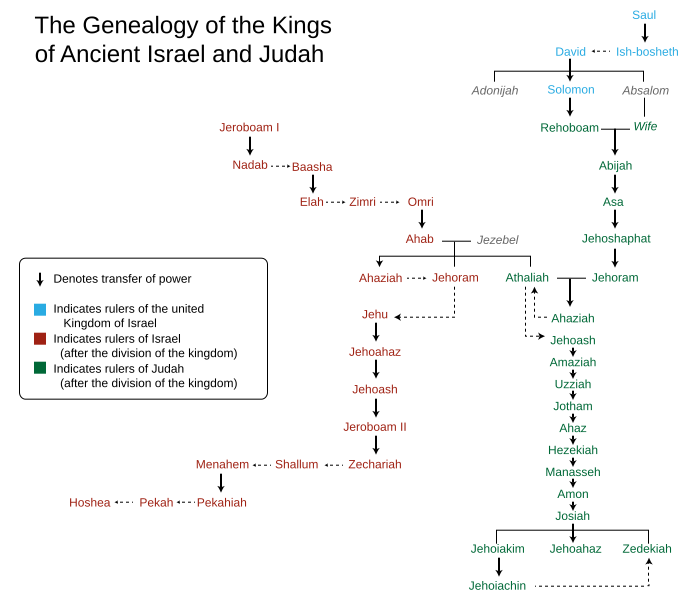
Source: Genealogy of the kings of Israel and Judah, public domain via Wikimedia Commons. Teaching aid only.
- Additional visual sources: Siege of Jerusalem (587 BC), Nebuchadnezzar II, and Tree of Jesse, Wikimedia Commons categories.
Summary Table
| Passage | What happens | Spiritual bearing |
|---|---|---|
| 2 Kings 24:1-7 | Jehoiakim, Babylon, and the beginning of collapse | Persistent violence and refusal of correction have public consequences. |
| 2 Kings 24:8-17 | Jehoiachin and the deportation | Exile removes skills and households as well as royal wealth. |
| 2 Kings 24:18-20 | Zedekiah’s rebellion | Fear can refuse hard counsel that would preserve life. |
| 2 Kings 25:1-7 | Siege, famine, and Zedekiah’s fall | The warnings are fulfilled without making the victims disposable. |
| 2 Kings 25:8-17 | Temple burned and city broken | Loss calls for truthful lament, not confidence in sacred objects alone. |
| 2 Kings 25:18-26 | Executions and exile | Faithfulness and hope can survive displacement. |
| 2 Kings 25:27-30 | Jehoiachin lifted from prison | Limited mercy preserves a promise before restoration is complete. |
Glossary
Exile. Removal from the land and community’s settled life by a foreign conqueror.
Remnant. Those remaining after devastation, not necessarily those free of suffering or guilt.
Signet. A seal associated with authority; Jeremiah and Haggai use it for royal rejection and renewed choice.
Davidic lamp. The surviving promise to David’s house, recalled in 2 Kings 8:19.
Brazen sea. The large bronze basin belonging to the temple’s furnishings, broken and carried away.
Spiritual Fruit 🍇
Hear correction before fear hardens
Zedekiah still receives counsel through Jeremiah but fears obedience. When truthful advice threatens your image or security, speak honestly with a trusted spiritual father and take the necessary step before concealment makes it harder.
Do not shelter sin behind holy things
Jerusalem’s temple is real and holy, yet it cannot make covenant betrayal safe. Let attendance, service, and reverence for sacred places lead to repentance rather than become evidence you use to excuse uncorrected harm.
Learn to lament without losing hope
The detailed loss of vessels and homes gives grief room to speak. Pray with Lamentations for your own losses and for those whose lives have been shattered, without forcing them to sound hopeful before they have been heard.
Choose faithfulness where you are
Daniel and the young men serve the Lord in captivity. Keep a small rule of prayer and one act of mercy even when displacement, illness, or family strain has taken away the conditions you once relied on.
Receive small mercies gratefully
Jehoiachin’s table is not the restored city, but it is food, kindness, and another day. Give thanks for limited relief without calling it complete healing, and let it strengthen patient hope in Christ.
Prayer
Lord Jesus Christ, true Temple and faithful Son of David, receive the grief of those who have lost home, safety, and those they love. Deliver us from using holy things to hide disobedience. Keep Your people faithful in exile, teach us to receive small mercies with thanksgiving, and lead us into the freedom of Your resurrection. Amen.
Kings ends with Jerusalem burned, but not with God’s promise dead. A captive son of David is lifted from prison and fed at a royal table. That small mercy points beyond exile toward Christ, the Son of David who raises captives, clothes them, and feeds them with life.
Teaching Notes
Jehoiakim, Babylon, and the beginning of collapse (2 Kings 24:1-7)
- Ask: How does the text connect political collapse to innocent blood and persistent unfaithfulness?
- Watch for: Do not infer that every present political defeat identifies a particular divine punishment.
- Connect: Distinguish Manasseh’s personal repentance from Judah’s historical consequences.
Jehoiachin and the deportation (2 Kings 24:8-17)
- Ask: What does the deportation of craftsmen and leaders take away besides wealth?
- Watch for: Explain Brenton’s “his son” before using the NKJV’s family relationship.
- Connect: Trace the vessels through 20:17, Daniel 1 and 5, and Ezra 1.
Zedekiah’s rebellion (2 Kings 24:18-20)
- Ask: What fear keeps Zedekiah from Jeremiah’s hard but life-preserving counsel?
- Watch for: Do not confuse resistance to Babylon with obedience to God.
- Connect: Read Jeremiah 38:17-23.
Siege, famine, and Zedekiah’s fall (2 Kings 25:1-7)
- Ask: How are Jeremiah’s and Ezekiel’s words about Zedekiah’s sight both fulfilled?
- Watch for: Do not reduce murdered children to a symbol of their father’s blindness.
- Connect: Compare Jeremiah 34:3 and Ezekiel 12:13 with 25:7.
Temple burned and city broken (2 Kings 25:8-17)
- Ask: Why is the burning of the temple so devastating, and what do its remembered details make us grieve?
- Watch for: Do not rush to hope before hearing the loss, or portray God as conquered by Babylon.
- Connect: Read Jeremiah 7:4 and Ezekiel 10:18-19; use siege imagery with restraint.
Executions and exile (2 Kings 25:18-26)
- Ask: Why does the flight to Egypt repeat the refusal to hear even after Jerusalem has fallen?
- Watch for: Do not romanticize exile or interpret the remaining poor as unhurt by the catastrophe.
- Connect: Trace the surviving priestly line and read Jeremiah 42-43.
Jehoiachin lifted from prison (2 Kings 25:27-30)
- Ask: Why does Kings end with Jehoiachin’s provision rather than with the city’s ruins?
- Watch for: Keep this limited mercy distinct from complete restoration or an exact Eucharistic allegory.
- Connect: Use Joseph, Mephibosheth, the Davidic lamp, and the Tree of Jesse to clarify surviving hope.
Visual teaching aids
- Show: Use the Neo-Babylonian map, the genealogy chart, and Tree of Jesse as teaching aids for exile and surviving Davidic hope. The Tree of Jesse teaches Messianic hope, not exact political chronology.
- Show: Use the Neo-Babylonian map and Jerusalem siege/fall artwork to help readers feel the scale of loss, then close with a Tree of Jesse or Davidic genealogy image to show surviving hope.
- Show: Do not let destruction artwork have the last word. End visually with mercy, Davidic continuity, and expectation of Christ.
Sources
Embedded Scripture is from Brenton’s English Septuagint (LXX). In the Septuagint tradition, 2 Kings is numbered 4 Kingdoms.
Biblical parallels and intertexts are identified where they illuminate the passage.
Coptic reading appointments and commemorations: Katameros, Holy Pascha and Bright Saturday service texts, and the Synaxarium, as represented in @andraws/lectionary-data 1.3.1.
Primary patristic witnesses are identified in the direct footnotes below.
Footnotes
-
St. John Chrysostom, Homilies on Hebrews 26.7, on Hebrews 11:20-22, using Daniel and the three young men as examples of fidelity in Babylon. Primary text. ↩
-
Coptic Katameros, Holy Pascha and Bright Saturday service texts, and Synaxarium, reading and commemoration records represented in @andraws/lectionary-data 1.3.1. Exact appointments are distinguished from interpretive connections in the worship section. ↩