
The healing of an exiled people begins when they hear the written word and do not argue with it. They weep, fast, pray, and send what they can for the altar. The scroll does not rebuild Jerusalem. It gives the scattered a true voice. The great prayer of confession starts in this chapter, at 1:15, and does not stop when the chapter ends. It runs through Baruch 2 and into the cry that opens Baruch 3.
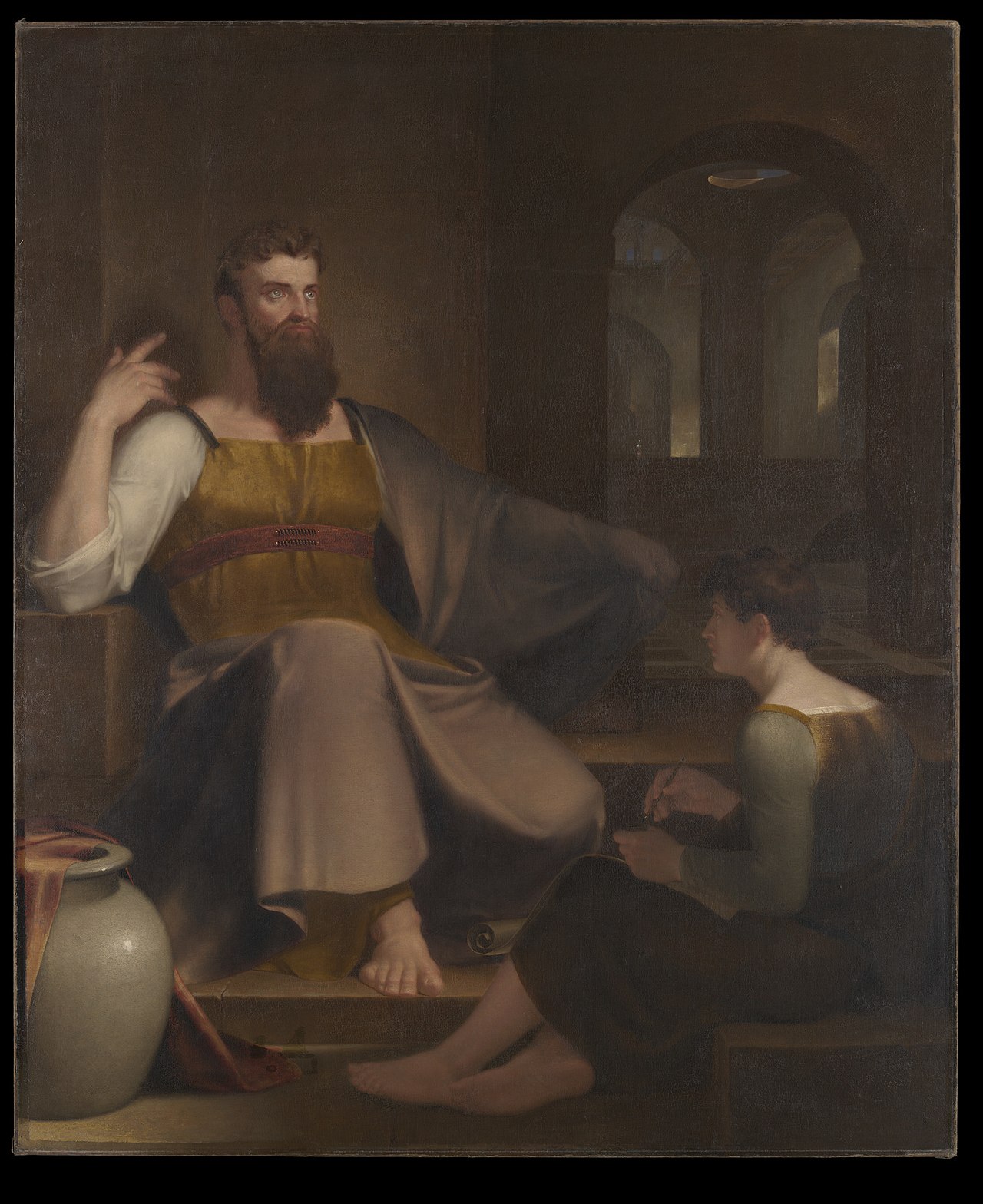 Source: Washington Allston, Jeremiah Dictating His Prophecy of the Destruction of Jerusalem to Baruch the Scribe, 1820, Yale University Art Gallery via Wikimedia Commons, public domain. This is Western biblical artwork related to Jeremiah 36, not an Orthodox icon and not a literal depiction of Baruch 1.
The Scroll Read in Exile (Baruch 1:1-14)
1 And these are the words of the book, which Baruch the son of Nerias, the son of Maasias, the son of Sedecias, the son of Asadias, the son of Chelcias, wrote in Babylon, 2 in the fifth year, and in the seventh day of the month, what time as the Chaldeans took Jerusalem, and burnt it with fire.
3 And Baruch did read the words of this book in the hearing of Jechonias the son of Joachim king of Juda, and in the ears of all the people that came to hear the book, 4 and in the hearing of the nobles, and of the king’s sons, and in the hearing of the elders, and of all the people, from the lowest unto the highest, even of all them that dwelt at Babylon by the river Sud. 5 Whereupon they wept, fasted, and prayed before the Lord.
6 They made also a collection of money according to every man’s power: 7 and they sent it to Jerusalem unto Joachim the high priest, the son of Chelcias, son of Salom, and to the priests, and to all the people which were found with him at Jerusalem, 8 at the same time when he received the vessels of the house of the Lord, that were carried out of the temple, to return them into the land of Juda, the tenth day of the month Sivan, namely, silver vessels, which Sedecias the son of Josias king of Juda had made, 9 after that Nabuchodonosor king of Babylon had carried away Jechonias, and the princes, and the captives, and the mighty men, and the people of the land, from Jerusalem, and brought them unto Babylon.
10 And they said, Behold, we have sent you money to buy you burnt offerings, and sin offerings, and incense, and prepare ye manna, and offer upon the altar of the Lord our God; 11 and pray for the life of Nabuchodonosor king of Babylon, and for the life of Balthasar his son, that their days may be upon earth as the days of heaven: 12 and the Lord will give us strength, and lighten our eyes, and we shall live under the shadow of Nabuchodonosor king of Babylon, and under the shadow of Balthasar his son, and we shall serve them many days, and find favour in their sight.
13 Pray for us also unto the Lord our God, for we have sinned against the Lord our God; and unto this day the fury of the Lord and his wrath is not turned from us. 14 And ye shall read this book which we have sent unto you, to make confession in the house of the Lord, upon the feasts and solemn days.
Baruch is named through his fathers because exile has not made the people a spiritual orphanage. They still have memory, priests, vessels, feasts, and the written word. The chart below is a reading aid for those names, not a complete genealogy.
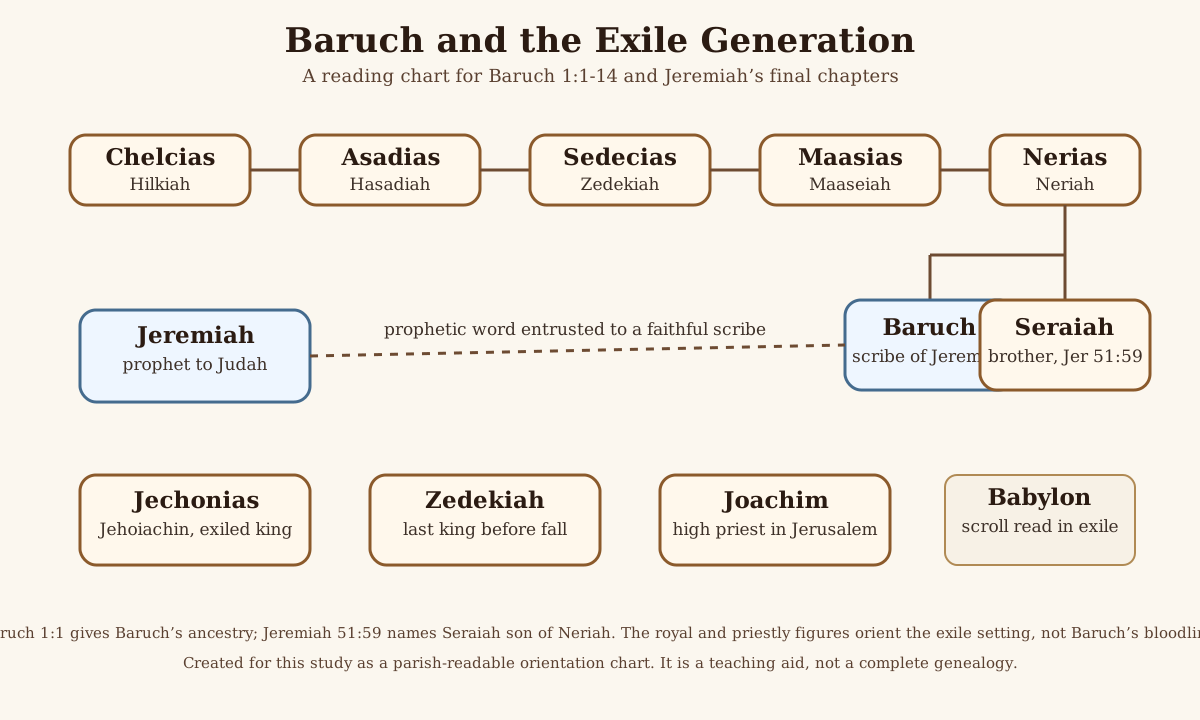 Source: Created for this study from Baruch 1:1, Jeremiah 36, Jeremiah 45, and Jeremiah 51:59. Teaching aid only, not a complete genealogy.
A parish reader who opens a study Bible will meet three hard details in these opening verses. They should be met here, plainly, before they are met as objections.
The date in 1:2 says “in the fifth year” and does not say of what. The book does not give a regnal year to finish the sentence. Do not invent one.
Verse 7 calls Joachim “the high priest.” That name does not appear in the priestly list of 1 Chronicles 6. The book still presents him as the priest who receives the exiles’ gift and the returned vessels. The study does not force him into a list that does not contain him.
Verse 11 calls Balthasar the son of Nabuchodonosor. Babylonian records name Belshazzar as the son of Nabonidus. Daniel 5 uses the same family language. In royal speech, “son” can mean successor as well as a son by birth. The prayer is not a chronology of the Babylonian court. It is a command to pray for the rulers under whom the people must live.
The people’s first answer to the scroll is not debate. They weep, fast, pray, and give, “according to every man’s power.” That is the same threefold path the Lord names in Matthew 6, and the path the Church walks in her fasts: fasting, prayer, and almsgiving. Hearing becomes a life, not a discussion. Their collection for the altar shows that exile has not cut off love for worship. They cannot all stand in Jerusalem. Their repentance still moves toward the house called by God’s name.
Brenton’s phrase “prepare ye manna” in verse 10 can confuse a modern reader. In this offering list it is the grain offering prepared for the altar, not a new miracle of wilderness manna. The exiles send what sacrifice, incense, and prayer require.
The command to pray for Nabuchodonosor and Balthasar is severe. It is not approval of Babylon’s violence. It is repentance learning to pray under chastening without hatred, as Jeremiah had told the exiles to seek the peace of the city where they had been carried. A Christian can pray for rulers and still refuse to call injustice righteous.
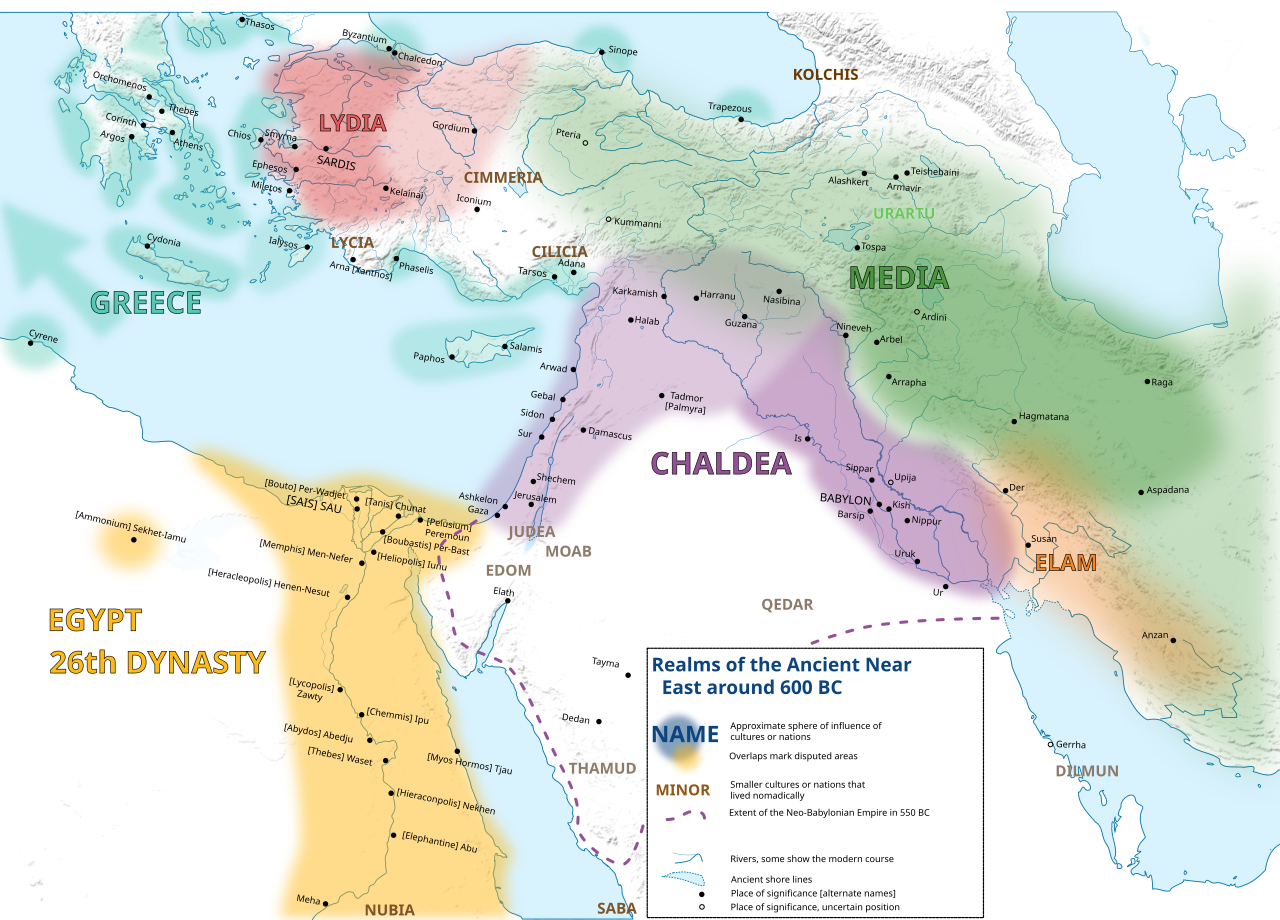 Source: Enyavar (German original) and Redx360 (English translation), Near East around 600 BC, Wikimedia Commons, CC BY-SA 4.0. Regional orientation for Judah, Babylon, Egypt, and neighboring powers, not a deportation route.
Verse 14 is easy to pass over, and it is one of the chapter’s deepest lines. The exiles send the book to be read “to make confession in the house of the Lord, upon the feasts and solemn days.” Scripture is not a private letter to the distressed. It is to be read aloud in worship, on the days the people gather. That is already the Church’s way. The later appointments of this book grow from the same conviction. At the Feast of the Theophany, in the Liturgy of the Waters, the Church reads Baruch 3:36-4:4 among the prophecies. Our lectionary data also lists Baruch 2:11-16 in the Midnight Praises of Bright Saturday. Chapter 1 is not itself one of those readings. It is the moment the book is handed to the feast.
Righteousness Belongs to the Lord (Baruch 1:15-22)
15 And ye shall say, To the Lord our God belongeth righteousness, but unto us the confusion of faces, as it is come to pass this day, unto them of Juda, and to the inhabitants of Jerusalem, 16 and to our kings, and to our princes, and to our priests, and to our prophets, and to our fathers: 17 for we have sinned before the Lord, 18 and disobeyed him, and have not hearkened unto the voice of the Lord our God, to walk in the commandments that he gave us openly: 19 since the day that the Lord brought our forefathers out of the land of Egypt, unto this present day, we have been disobedient unto the Lord our God, and we have been negligent in not hearing his voice.
20 Wherefore the evils cleaved unto us, and the curse, which the Lord appointed by Moses his servant at the time that he brought our fathers out of the land of Egypt, to give us a land that floweth with milk and honey, like as it is to see this day. 21 Nevertheless we have not hearkened unto the voice of the Lord our God, according unto all the words of the prophets, whom he sent unto us: 22 but every man followed the imagination of his own wicked heart, to serve strange gods, and to do evil in the sight of the Lord our God.
The prayer begins with a contrast that can save a soul: righteousness belongs to the Lord; shame belongs to us. This is not self-hatred. It is sanity. Repentance becomes possible when God is allowed to be righteous and the people stop defending what destroyed them.
The confession is corporate. Kings, princes, priests, prophets, fathers, and the present generation are all named. Ancestry is not used as an excuse. The prayer says, in effect, our fathers sinned, and we have continued in the same refusal to hear. Orthodox confession has this shape. We speak our own sins, and we also stand as members of one body.
Verse 22 names the root. Each person followed the imagination of his own wicked heart, and that private imagination became public idolatry. The strange gods were not a hobby beside an otherwise faithful life. They were the life the heart had already chosen.
This prayer does not end at 1:22. The next words, in Baruch 2, continue the same confession: the Lord has made good His word, and the people still have no righteousness of their own to offer. Stay inside the prayer. Do not close the book as if the confession were finished.
Spiritual Fruit 🍇
When the word of God is read, the first holy answer is not a clever comment. It is tears, fasting, prayer, and a gift given according to what you actually have. A fast that never becomes almsgiving has not yet heard Baruch 1:5-6. A gift that never becomes prayer has not yet heard it either.
Let the book be read on the feast, not only in private distress. Verse 14 asks that confession happen in the house of the Lord, on the solemn days. Bring the hard passage with you into the liturgy, especially when the Church is reading this book at Theophany, or when Bright Saturday gives you the Prayer of Baruch.
Begin confession where the prayer begins. Say that righteousness belongs to the Lord before you explain your circumstances. Shame, in this chapter, is the confusion of a people who have seen what their refusal produced. It is not a verdict that you are beyond mercy. If you can still say “we have sinned,” you are still inside the prayer.
Pray for rulers without baptizing their injustice. The exiles ask for the life of the king who burned their city. That prayer does not call the burning good. It refuses hatred as a substitute for repentance.
And do not stop at the chapter break. The confession you have started here is meant to continue until it reaches God’s name, and then His wisdom, and then the children coming home.
Teaching Notes
The Scroll Read in Exile (Baruch 1:1-14)
- Ask: What does weeping, fasting, prayer, and a collection of money show about true hearing?
- Emphasize: Exile does not end worship. The written word gathers the scattered into repentance, and verse 14 places that word in the feast.
- Watch for: Do not invent a regnal year for “the fifth year.” Do not force Joachim into 1 Chronicles 6. Do not treat “son” in 1:11 as a solved Babylonian genealogy.
- Watch for: Do not present prayer for Babylonian rulers as approval of Babylon’s violence.
- Connect: Matthew 6 holds fasting, prayer, and almsgiving together, as the people’s answer does here. Jeremiah 36 shows Baruch as scribe of the prophetic word. Jeremiah 29 tells the exiles to seek the peace of the city.
- Show: Use the Allston painting to explain Baruch’s scribal relationship to Jeremiah. Say clearly that it imagines Jeremiah 36 and is Western biblical artwork, not an icon.
- Show: Use the 600 BC map before discussing Babylon and Judah. Name Enyavar and Redx360, and say it is a regional orientation, not a route.
- Show: Use the relationship chart for Baruch 1:1 and the named exile-generation figures. Say it is a reading aid, not a complete genealogy.
Righteousness Belongs to the Lord (Baruch 1:15-22)
- Ask: Why must God’s righteousness be confessed before human shame is named?
- Emphasize: Orthodox confession is truthful, corporate, and still inside a prayer that has not ended.
- Watch for: Do not turn “confusion of faces” into contempt for the penitent, or into a weapon against a person already crushed.
- Connect: The same prayer continues in Baruch 2. Daniel 9 and Nehemiah 9 are the nearest biblical companions, and they belong to the next study as well.
- Show: No extra visual is needed. Let the contrast carry the weight.
Sources
Embedded Scripture is from Brenton’s English Septuagint (LXX). These studies use Brenton’s verse numbers.
Cross-references: Jeremiah 29, Jeremiah 36, Jeremiah 45, Jeremiah 51:59, Daniel 5, Deuteronomy 28, 1 Chronicles 6, and Matthew 6. The prayer continues in Baruch 2.
Visual sources: Washington Allston, Jeremiah Dictating His Prophecy of the Destruction of Jerusalem to Baruch the Scribe, 1820, public domain; Enyavar and Redx360, Near East around 600 BC, CC BY-SA 4.0, file page; relationship chart created for this study.