


This narration is from a previous version of the study and may include a combined recording of multiple chapters.
Baruch stands in the Orthodox Old Testament as Scripture for a people who have lost the temple, the land, and the monarchy, and are still being taught by God. The book moves from confession, to wisdom, to the clothing of Jerusalem with glory. It is not a side note to Jeremiah. It is a school for exile, and the Church still reads its heart over the waters of Theophany.
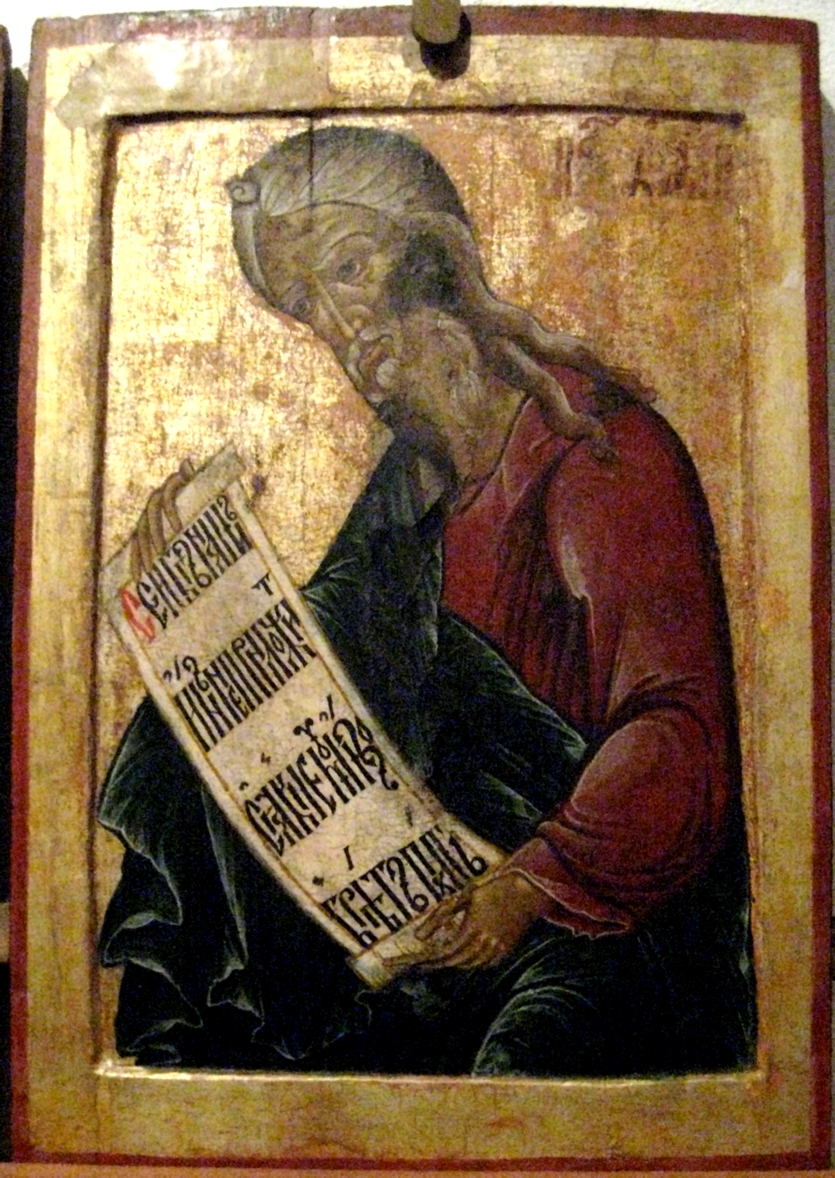 Source: Icon of the Prophet Baruch, attributed to Terentiy Fomin of Vologda (17th century, attribution uncertain), Church of St. Epiphanius of Cyprus, Kirillo-Belozersky Monastery. Photograph by Shakko, Wikimedia Commons, public-domain photograph of a public-domain icon. This is an Orthodox icon of the prophet with a scroll, not a portrait from his lifetime. The panel inscription is worn.
Why This Book Matters
Baruch teaches the Church how to pray after collapse. The people do not excuse sin, romanticize suffering, or pretend that judgment is someone else’s problem. They confess, fast, send support for worship in Jerusalem, remember the covenant, and learn again that wisdom is not found in power, wealth, travel, or prestige. It is found in the commandments of God, and in the God who gives them.
The book gives words for three states every Christian eventually meets. Repentance has to become honest, and not only private. A person can have information and still have forsaken the fountain of wisdom. Grief has to be put off, when God Himself clothes His people with glory, without the sorrow being denied.
Canonical Placement
In this project Baruch follows Jeremiah and precedes Lamentations. Jeremiah gives the prophetic wound. Baruch shows the exiles receiving the written word and praying through it. Lamentations gives voice to Jerusalem’s grief.
Readers who know another Bible should also know where the Letter of Jeremiah has gone. In Brenton’s order it follows Lamentations as its own book. Many Bibles, in the Catholic tradition and in some Orthodox editions, print that letter as Baruch chapter 6. This set does not. If you see “Baruch 6” elsewhere, it is the Letter of Jeremiah, not a missing chapter of the five studies below.
The studies use Brenton’s verse numbering. Brenton has no NKJV text of Baruch to set beside it, because Baruch is not in the Hebrew canon behind the NKJV. At the sentence “Afterward did he shew himself upon earth,” the RSV and the NRSV text checked for this revision also number the verse 3:37. The NABRE numbers that sentence 3:38, and numbers Brenton’s “This is our God” as 3:36. Follow the words when the numerals differ. The chapter studies say so where it matters.
Questions Readers Ask
A parish reader who checks a study Bible will meet three difficulties in the opening verses. They are named here so they are met in the Church’s study first, and they are treated again at the verses in Baruch 1.
Baruch 1:2 says “in the fifth year” and does not say of what. The book does not finish the date. Do not invent a regnal year.
Baruch 1:7 calls Joachim “the high priest.” That name is not in the priestly list of 1 Chronicles 6. The book still presents him as the priest who receives the exiles’ gift. The study does not force an identification the lists do not support.
Baruch 1:11 calls Balthasar the son of Nabuchodonosor. Babylonian records make Belshazzar the son of Nabonidus. Daniel 5 uses the same language. In royal speech, “son” can mean successor as well as a son by birth. The prayer is not a chronology of the Babylonian court.
Historical Setting
The setting is the Babylonian exile after the burning of Jerusalem. Baruch is remembered in Jeremiah as the prophet’s faithful scribe, the one who wrote Jeremiah’s words on a scroll and suffered with him when the word of God was rejected. Baruch 1 presents him among the exiles in Babylon, where the written word becomes confession, fasting, prayer, and renewed communion with Jerusalem.
This context changes the reading. Baruch is not teaching repentance from a stable religious life. It teaches repentance when the altar is wounded, the people are scattered, and obedience looks humiliating. The book refuses both despair and denial.
Where the Church Reads Baruch
Two placements govern the book. Thematic echoes are named after them, and they are echoes, not appointments.
At the Feast of the Theophany, in the Liturgy of the Waters, the Church reads Baruch 3:36-4:4 among the prophecies. The same service reads Isaiah 40:1-5 and the Baptism of the Lord. The God who “shewed himself upon earth” is proclaimed on the feast of His manifestation at the Jordan, and the reading ends with Jacob told to walk in the light and be illuminated. Baruch 3 and Baruch 4 share that reading across the chapter break.
Our lectionary data lists Baruch 2:11-16 in the Midnight Praises of Bright Saturday, in the Praises of the Prophets, under the name Prayer of Baruch. The dates in that data are 11 April 2026, 1 May 2027, and 15 April 2028. Coptic Reader, Special / Pascha / Saturday / Praises, selected 11 April 2026, prints that heading and an English body through verse 15, then the closing praise. Verse 16 is in the heading only. Verse 17 is not read. Baruch 2 reports that boundary.
The Coptic Synaxarium has no separate entry for Baruch. On Bashans 5 it commemorates the Martyrdom of Jeremiah the Prophet. That is a calendar note only. No reading of Baruch is tied to that commemoration.
Other connections remain useful if they are labeled as resonance. Baruch 1-2 resonates with the fasting, prayer, and confession of Great Lent. Baruch 3-4 resonates with the Church’s call to wisdom and return. Baruch 5 resonates with the joy of a people clothed by God. None of those resonances is a lectionary placement.
Christ the Wisdom, the Covenant, and the Gatherer
The strongest Christological line is the wisdom passage. Baruch 3:35 says, “This is our God,” and 3:37 says, “Afterward did he shew himself upon earth, and conversed with men.” St. Cyril of Jerusalem, in Catechetical Lecture 11.15, quotes those verses and calls the writer “the Prophet,” to show that the Son, begotten of the Father and later made man, is God. St. Athanasius, in Discourse I Against the Arians, Chapter VI, §19, takes “Thou hast forsaken the Fountain of wisdom” and teaches that the Son is that Wisdom, proper to the Father, not a created helper. To say the Son once was not, he writes, is to say the Fountain was once dry.
Baruch also prepares the reader for Christ through covenant and gathering. The everlasting covenant of Baruch 2:35 stands beside Jeremiah 31 and, more closely, Jeremiah 32:40, and reaches its fullness in Christ’s blood. The children gathered in Baruch 4 and 5 anticipate the Church gathered from the nations. St. Irenaeus quotes Baruch 4:36-5:9 to insist that this restoration is real, not a mere metaphor. The study cites him for that witness, and says plainly that the Church did not adopt the earthly-kingdom framework in which he read the passage.
The glory placed on Jerusalem points to the Church clothed by God, not by her own achievement.
Structure of the Study
- Baruch 1 - The Scroll Read in Exile: the scroll is read, the people weep, fast, pray, and give, and the confession begins.
- Baruch 2 - Prayer for the Name of God: the same prayer appeals to God’s name and ends in the everlasting covenant.
- Baruch 3 - The Fountain of Wisdom: anguish asks where wisdom is, and the God who showed Himself on earth is confessed.
- Baruch 4 - Zion Calls Her Children Home: the Theophany reading ends in illumination, and Zion calls her children to seek their Saviour.
- Baruch 5 - Put on the Beauty of Glory: Jerusalem puts off mourning and beholds her children gathered in the light of God’s glory.
The literary units cross the chapter lines. The great prayer runs from 1:15 to 3:8. The wisdom poem of chapter 3 is completed in 4:1-4. Baruch 4:36-37 flows straight into chapter 5. Each study says so, rather than pretending the chapter number is a wall.
Sources
Embedded Scripture is from Brenton’s English Septuagint (LXX).
St. Cyril of Jerusalem, Catechetical Lecture 11.15, https://www.newadvent.org/fathers/310111.htm. St. Athanasius, Discourse I Against the Arians, Chapter VI, §19, https://www.ccel.org/ccel/schaff/npnf204.xxi.ii.i.vi.html. St. Irenaeus, Against Heresies V.35.1-2, https://www.newadvent.org/fathers/0103535.htm. Eusebius of Caesarea, church historian, is cited in the Baruch 3 study, not here as a saint.
Theophany Laqqan and the Bright Saturday listing are taken from
@andraws/lectionary-data1.3.3. The Theophany row records Coptic Reader, Special / Lakkan / Theophany. The Bright Saturday row is a working local source and is not stated as Reader-confirmed. The Synaxarium entry is Bashans 5, the Martyrdom of Jeremiah the Prophet, with no separate Baruch commemoration.Icon: Terentiy Fomin of Vologda, attribution uncertain, Kirillo-Belozersky Monastery, photograph by Shakko, Wikimedia Commons.