


Jeremiah 52 is not a detached appendix. It is the historical weight of Jeremiah’s preaching coming to pass. The city falls, the temple burns, the king is blinded, the vessels are taken, and the people go into exile. Yet the last word is not ashes. Jehoiachin is lifted from prison and given bread. The sign is small, but in Jeremiah small mercy matters.
The chapter moves from Jerusalem to the plains near Jericho, to Riblah / Deblatha, and finally to Babylon. The geography traces the collapse of Judah’s last false security. Jerusalem is breached, the king is captured outside the city, judgment is pronounced in the north, and exile ends in Babylon.
Zedekiah is the last king to rule in Jerusalem before its fall. Nebuchadnezzar and his captain Nebuzaradan bring Babylonian conquest into the royal house and temple alike; priests and officers share in the catastrophe, while a poor remnant remains as vinedressers and husbandmen. The closing scene turns to the captive Jehoiachin, whose release keeps Davidic hope in view.
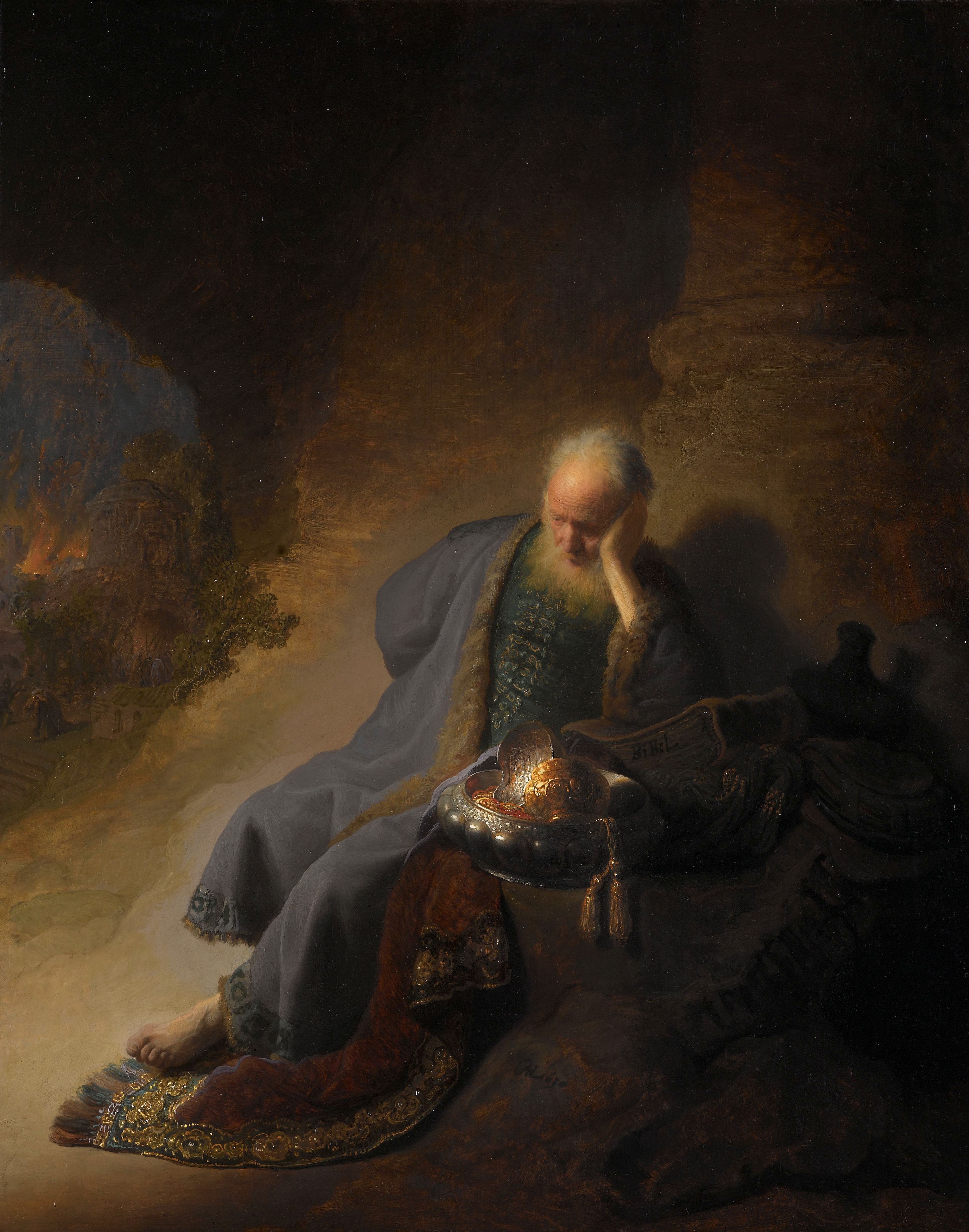 Source: Rembrandt, Jeremiah Lamenting the Destruction of Jerusalem, 1630, Wikimedia Commons / Rijksmuseum, public domain. Western biblical artwork, not an Orthodox icon.
Rembrandt portrays Jeremiah as a grieving witness rather than a triumphant predictor. This Western biblical artwork, not an Orthodox icon, holds the sorrow of the chapter before its quiet ending of mercy.
Jeremiah 52:1-11 - Zedekiah, siege, and the fall of the king
1 It was the twenty-first year of Sedekias, when he began to reign, and he reigned eleven years in Jerusalem. And his mother’s name was Amitaal, the daughter of Jeremias, of Lobena.
4 And it came to pass in the ninth year of his reign, in the ninth month, on the tenth day of the month, that Nabuchodonosor king of Babylon came, and all his host, against Jerusalem, and they made a rampart round it, and built a wall round about it with large stones.
5 So the city was besieged, until the eleventh year of king Sedekias, 6 on the ninth day of the month, and then the famine was severe in the city, and there was no bread for the people of the land. 7 And the city was broken up, and all the men of war went out by night by the way of the gate, between the wall and the outworks, which were by the king’s garden; and the Chaldeans were by the city round about; and they went by the way leading to the wilderness. 8 But the host of the Chaldeans pursued after the king, and overtook him in the country beyond Jericho; and all his servants were dispersed from about him. 9 And they took the king, and brought him to the king of Babylon to Deblatha, and he judged him. 10 And the king of Babylon slew the sons of Sedekias before his eyes; and he slew all the princes of Juda in Deblatha. 11 And he put out the eyes of Sedekias, and bound him in fetters; and the king of Babylon brought him to Babylon, and put him into the grinding-house, until the day when he died.
The siege becomes famine, the city is broken, and the king flees by night. Zedekiah’s last sight is devastating: his sons slain before him, then his eyes put out. The image is more than cruelty. It is the collapse of a kingship that refused the word of the Lord.
The chapter does not let the reader spiritualize away history. Prophetic warning becomes visible reality. Sin, leadership failure, and false confidence eventually take form in events.
Jeremiah 52:12-27 - The temple burned and the vessels taken
12 And in the fifth month, on the tenth day of the month, Nabuzardan the captain of the guard, who waited on the king of Babylon, came to Jerusalem; 13 and he burnt the house of the Lord, and the king’s house; and all the houses of the city, and every great house he burnt with fire. 14 And the host of the Chaldeans that was with the captain of the guard pulled down all the wall of Jerusalem round about.
16 But the captain of the guard left the remnant of the people to be vinedressers and husbandmen.
17 And the Chaldeans broke in pieces the brazen pillars that were in the house of the Lord, and the bases, and the brazen sea that was in the house of the Lord, and they took the brass thereof, and carried it away to Babylon. 18 Also the rim, and the bowls, and the flesh-hooks, and all the brazen vessels, wherewith they ministered; 19 and the basons, and the snuffers, and the oil-funnels, and the candlesticks, and the censers, and the cups, the golden, of gold, and the silver, of silver, the captain of the guard took away. 20 And the two pillars, and the one sea, and the twelve brazen oxen under the sea, which things king Solomon made for the house of the Lord; the brass of which articles was without weight.
21 And as for the pillars, the height of one pillar was thirty-five cubits; and a line of twelve cubits compassed it round; and the thickness of it all round was four fingers. 22 And there was a brazen chapiter upon them, and the length was five cubits, even the height of one chapiter; and there were on the chapiter round about network and pomegranates, all of brass: and correspondingly the second pillar had eight pomegranates to a cubit for the twelve cubits. 23 And the pomegranates were ninety-six on a side; and all the pomegranates on the network round about were a hundred.
24 And the captain of the guard took the chief priest, and the second priest, and those that kept the way; 25 and one eunuch, who was over the men of war, and seven men of renown, who were in the king’s presence, that were found in the city; and the scribe of the forces, who did the part of a scribe to the people of the land; and sixty men of the people of the land, who were found in the midst of the city. 26 And Nabuzardan the captain of the king’s guard took them, and brought them to the king of Babylon to Deblatha. 27 And the king of Babylon smote them in Deblatha, in the land of Æmath.
The burning of the Lord’s house is the deepest wound in the chapter. Jeremiah has warned repeatedly that the temple cannot be used as a shield for unrepentance. Here that warning becomes smoke, broken bronze, carried vessels, and executed priests.
This must be handled with Orthodox precision. The lesson is not that holy places and liturgical worship are meaningless. The lesson is that holy things judge us when we use them while refusing repentance, mercy, and justice.
Jeremiah 52:31-34 - Jehoiachin lifted up and given bread
31 And it came to pass in the thirty-seventh year after that Joakim king of Juda had been carried away captive, in the twelfth month, on the four and twentieth day of the month, that Ulæmadachar king of Babylon, in the year in which he began to reign, raised the head of Joakim king of Juda, and shaved him, and brought him out of the house where he was kept, 32 and spoke kindly to him, and set his throne above the kings that were with him in Babylon, 33 and changed his prison garments: and he ate bread continually before him all the days that he lived. 34 And his appointed portion was given him continually by the king of Babylon from day to day, until the day when he died.
The final movement is quiet and startling. Jehoiachin is brought out of prison, spoken to kindly, given a place above other captive kings, clothed differently, and fed continually. This is not full restoration. Jerusalem remains burned and exile remains real. But the Davidic line is not erased.
Jeremiah ends with a small sign of mercy inside exile. That is the right kind of hope for this book: not denial of judgment, but a pledge that God has not abandoned His covenant purpose.
Spiritual Fruit 🍇
The fruit of Jeremiah 52 is sober hope that has faced the worst. The reader must not rush past the ruin: the city is breached, the king blinded after watching his sons slain, the temple burned, the vessels carried away, the poor remnant left to scratch a living from the land. Sin takes form in history. Yet the chapter refuses to end in ashes. Jehoiachin is lifted from the grinding-house, spoken to kindly, given a throne above other captive kings, and fed bread continually. This is not full restoration or vindication of the failed kingship. It is a quiet pledge that the Lord has not abandoned His covenant purpose even in Babylon. For the soul, the lesson is double: do not minimize the cost of unrepented sin, and do not despair when everything visible is burned. Small mercy can survive in the place of exile; the Davidic line is preserved for the greater King.
Teaching Notes
Jeremiah 52:1-11 - Zedekiah, siege, and the fall of the king
- Ask: What does Zedekiah’s end reveal about refusing God’s word?
- Emphasize: Prophetic warnings are not symbolic only. They can become historical reality.
- Watch for: Treating the passage as political tragedy without spiritual meaning.
- Connect: Christ is the King who enters judgment willingly to save His people.
- Show: Use the royal succession chart to locate Zedekiah and Jehoiachin.
Jeremiah 52:12-27 - The temple burned and the vessels taken
- Ask: Why is the burning of the temple such a theological wound?
- Emphasize: Holy worship must be joined to repentance and justice.
- Watch for: Saying ritual does not matter. Jeremiah’s point is that holy things matter so much that misuse is judged.
- Connect: Christ, the true Temple, is destroyed and raised, opening worship in Spirit and truth.
- Show: Use Rembrandt’s painting to pause with lament before discussing hope.
Jeremiah 52:31-34 - Jehoiachin lifted up and given bread
- Ask: Why does the book end with Jehoiachin eating bread in Babylon?
- Emphasize: The ending is small mercy, not full restoration.
- Watch for: Overstating the ending as if exile is solved.
- Connect: The preserved Davidic line points forward to Christ.
- Show: Return to the royal chart and trace Jehoiachin’s place in the succession.
Sources
Embedded Scripture is from Brenton’s English Septuagint (LXX).
No established Coptic lectionary placement surfaced for Jeremiah 52 in the checked sources. The chapter still resonates with Holy Week and lament: burned sanctuary, failed kings, exiled people, and a mercy that appears only after judgment has been fully faced.