


Jeremiah 24-25 explains exile without romanticizing either those carried away or those left behind. The good figs are not morally impressive by nature. They are the humbled remnant whom God promises to look upon for good. The bad figs warn that staying near holy places while resisting the Lord is not safety. Then the seventy years and the oracle against Elam widen the view from Judah to the nations.
Jerusalem and Judah stand under Babylonian pressure, while the closing oracle turns toward Elam east of Babylon. The geographical widening begins here and continues through the Septuagint’s nations block in Jeremiah 26-32. The Lord who judges Judah also governs the empires and neighboring peoples beyond her borders.
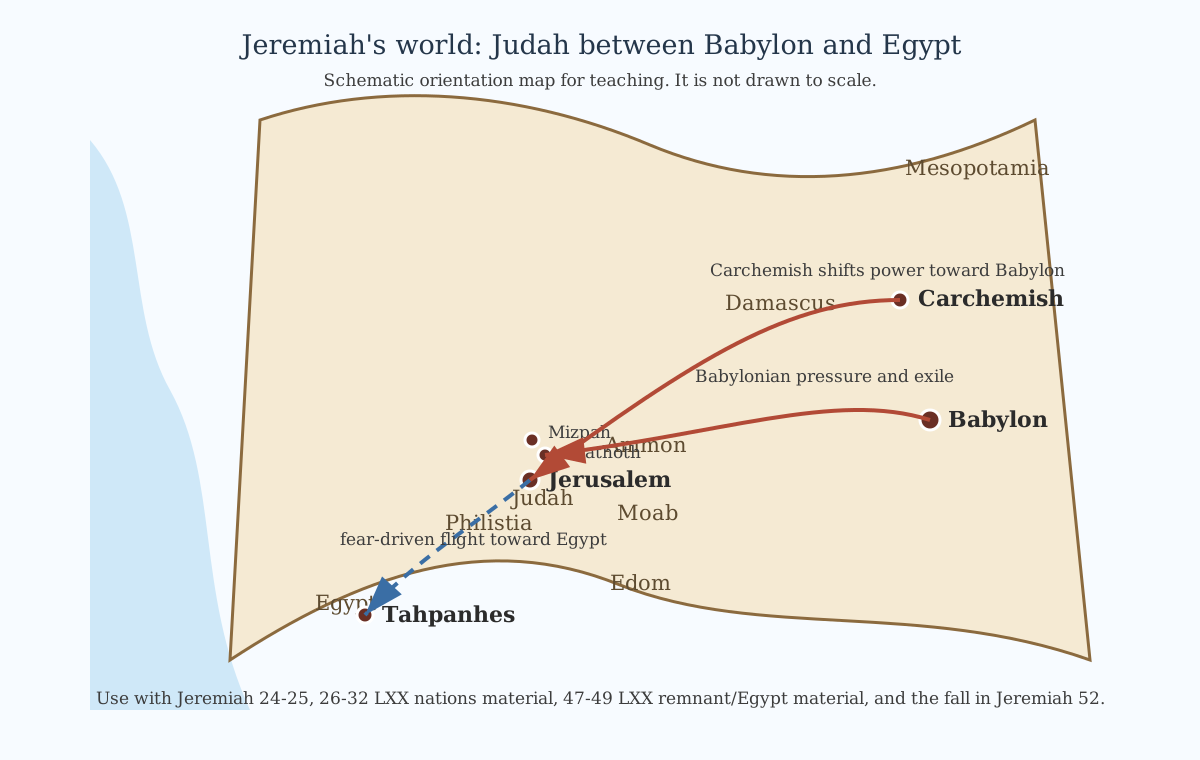 Source: Original schematic orientation map created for the Jeremiah guide set. It is not drawn to scale.
This schematic orientation map shows why Jeremiah’s world cannot be reduced to Jerusalem alone: Babylonian pressure, Egyptian refuge, Carchemish, Judah, and the surrounding nations all shape the book’s historical setting.
Jeremiah 24 - Good figs, bad figs, and the humbled remnant
1 The Lord shewed me two baskets of figs, lying in front of the temple of the Lord, after Nabuchodonosor king of Babylon had carried captive Jechonias son of Joakim king of Juda, and the princes, and the artificers, and the prisoners, and the rich men out of Jerusalem, and had brought them to Babylon. 2 The one basket was full of very good figs, as the early figs; and the other basket was full of very bad figs, which could not be eaten, for their badness. 3 And the Lord said to me, What seest thou, Jeremias? and I said, Figs; the good figs, very good; and the bad, very bad, which cannot be eaten, for their badness.
4 And the word of the Lord came to me, saying, 5 Thus saith the Lord, the God of Israel; As these good figs, so will I acknowledge the Jews that have been carried away captive, whom I have sent forth out of this place into the land of the Chaldeans for good. 6 And I will fix mine eyes upon them for good, and I will restore them into this land for good: and I will build them up, and not pull them down; and I will plant them, and not pluck them up.
7 And I will give them a heart to know me, that I am the Lord: and they shall be to me a people, and I will be to them a God: for they shall turn to me with all their heart.
8 And as the bad figs, which cannot be eaten, for their badness; thus saith the Lord, So will I deliver Sedekias king of Juda, and his nobles, and the remnant of Jerusalem, them that are left in this land, and the dwellers in Egypt. 9 And I will cause them to be dispersed into all the kingdoms of the earth, and they shall be for a reproach, and a proverb, and an object of hatred, and a curse, in every place whither I have driven them out. 10 And I will send against them famine, and pestilence, and the sword, until they are consumed from off the land which I gave them.
The two baskets of figs overturn easy assumptions. The exiles, whom many would have seen as rejected, are called good figs because the Lord will look upon them for good, bring them back, build them, plant them, and give them a heart to know Him. Their hope is not their natural superiority. It is God’s merciful purpose through chastisement.
The bad figs are those who remain in false security. They are near the land and symbols of covenant life, yet they resist the Lord. Jeremiah teaches that nearness to holy things is not the same as surrender to God.
Jeremiah 25:1-13 - Twenty-three years of warning and seventy years
1 The Word that came to Jeremias concerning all the people of Juda in the fourth year of Joakim, son of Josias, king of Juda; 2 which he spoke to all the people of Juda, and to the inhabitants of Jerusalem, saying,
3 In the thirteenth year of Josias, son of Amos, king of Juda, even until this day for three and twenty years, I have both spoken to you, rising early and speaking, 4 and I sent to you my servants the prophets, sending them early; (but ye hearkened not, and listened not with your ears;) saying, 5 Turn ye every one from his evil way, and from your evil practices, and ye shall dwell in the land which I gave to you and your fathers, of old and for ever. 6 Go ye not after strange gods, to serve them, and to worship them, that ye provoke me not by the works of your hands, to do you hurt. 7 But ye hearkened not to me.
8 Therefore thus saith the Lord; Since ye believed not my words, 9 behold, I will send and take a family from the north, and will bring them against this land, and against the inhabitants of it, and against all the nations round about it, and I will make them utterly waste, and make them a desolation, and a hissing, and an everlasting reproach. 10 And I will destroy from among them the voice of joy, and the voice of gladness, the voice of the bridegroom, and the voice of the bride, the scent of ointment, and the light of a candle. 11 And all the land shall be a desolation; and they shall serve among the Gentiles seventy years.
12 And when the seventy years are fulfilled, I will take vengeance on that nation, and will make them a perpetual desolation. 13 And I will bring upon that land all my words which I have spoken against it, even all things that are written in this book.
Jeremiah 25 gives time and scope to the judgment. Seventy years means discipline is neither endless chaos nor quick sentiment. The Lord governs even the duration of exile. Judgment is historical, but it is not uncontrolled.
The twenty-three years of warning reveal divine patience before judgment. The Lord rose early and sent His prophets, calling each person to turn from evil ways and the works of false gods. The seventy years begin only after repeated refusal. Even then, the period is measured. Babylon does not own Judah’s future; the Lord sets both the exile’s beginning and its end.
Jeremiah 25:14-20 - Elam and the nations horizon
14 The Prophecies of Jeremias against the Nations of Ælam. 15 Thus saith the Lord, The bow of Ælam is broken, even the chief of their power. 16 And I will bring upon Ælam the four winds from the four corners of heaven, and I will disperse them toward all these winds; and there shall be no nation to which they shall not come—even the outcasts of Ælam. 17 And I will put them in fear before their enemies that seek their life; and I will bring evils upon them according to my great anger; and I will send forth my sword after them, until I have utterly destroyed them. 18 And I will set my throne in Ælam, and will send forth thence king and rulers. 19 But it shall come to pass at the end of days, that I will turn the captivity of Ælam, saith the Lord. 20 In the beginning of the reign of king Sedekias, there came this word concerning Ælam.
The chapter turns abruptly from Judah’s seventy years to Elam’s broken bow. Military strength, kings, and rulers stand beneath the Lord’s throne, and scattering reaches “the four corners of heaven.” Yet the oracle does not end with annihilation. “At the end of days” the Lord promises to turn Elam’s captivity. The same God who measures Judah’s exile also keeps mercy within His judgment of the nations.
LXX / Brenton insight
In Brenton’s Septuagint, Jeremiah 25:14-20 begins the nations material with Elam. The longer sequence of oracles then unfolds through Jeremiah 26-32, where the cup given to all nations appears in chapter 32. English Bibles following the Masoretic order place much of this material later in Jeremiah. The order differs, but the theological claim is stable: no empire stands outside the Lord’s judgment, and no scattered people lies beyond His power to restore. This Elam unit corresponds in content to Jeremiah 49:34-39 in the Masoretic order: Brenton gives the heading in verse 14, the oracle in verses 15-19, and the Zedekiah-date superscription in verse 20 after the oracle.
The Church’s Voice in Worship ⛪
No specific Coptic Orthodox lectionary reading for Jeremiah 24-25 is attested in the sources consulted. The chapters still teach a deeply Orthodox discipline: chastisement can become restoration when received with repentance, while false security can become blindness even near holy places.
Spiritual Fruit 🍇
Jeremiah 24-25 teaches humble reception of discipline and refusal of false refuges. The good figs are not the naturally righteous; they are the humbled whom the Lord looks upon “for good” and to whom He gives a heart to know Him. The bad figs show that living near the temple while resisting the word can become deeper blindness.
The seventy years teach that God’s discipline has a measured scope and purpose. For the soul this means refusing political safety, cultural approval, or religious proximity as substitutes for repentance. Receive the correction that can become planting and building. The turn toward Elam widens hope and accountability together: the Lord is not confined to one people or land, and even the nation whose bow is broken may hear a promise of restored captivity.
Lord, give me the heart that knows You. Save me from mistaking nearness to holy things for obedience, and teach me to receive correction without despair. Plant what exile has uprooted, and make Your measured mercy stronger in me than every false refuge. Amen.
Teaching Notes
Jeremiah 24 - Good figs, bad figs, and the humbled remnant
- Ask: Why are the exiles called “very good figs” while those who remain near the temple are “very bad figs”?
- Emphasize: Goodness here is not moral superiority but God’s restoring purpose upon the humbled; the heart to know the Lord is gift, not achievement.
- Watch for: Assuming visible loss or exile always means divine rejection, or that proximity to holy places guarantees safety.
- Connect: Christ restores the humbled remnant and gives a new heart; He is the true good fig who draws the scattered to Himself.
- Show: Sketch two baskets labeled “humbled remnant (good figs)” and “false security (bad figs)” to make the reversal visible.
Jeremiah 25:1-13 - Twenty-three years of warning and seventy years
- Ask: What do twenty-three years of prophetic warning reveal about God’s patience before judgment?
- Emphasize: The seventy years are measured by the Lord; Babylon does not own Judah’s future.
- Watch for: Calling consequences sudden when God has been sending correction for years.
- Connect: Christ’s calls to watch, hear, and repent continue the prophetic mercy that speaks before judgment.
- Show: Place Josiah, Jehoiakim, Zedekiah, and the Babylonian exile on a simple timeline.
Jeremiah 25:14-20 - Elam and the nations horizon
- Ask: Why does the book turn from Judah’s exile to the breaking and eventual restoration of Elam?
- Emphasize: The Lord judges the power of the nations and still speaks a final word of restoration.
- Watch for: Reading the nations oracles as ethnic contempt or permission to gloat over collapse.
- Connect: Christ is Lord of all peoples; judgment exposes false power, while mercy gathers the scattered.
- Show: Locate Elam east of Babylon and trace how the nations sequence continues through LXX Jeremiah 26-32.
Sources
Embedded Scripture is from Brenton’s English Septuagint (LXX).