


Zechariah begins with the simplest command and the deepest mercy: return to the Lord, and He will return to you. The visions that follow are not religious spectacle. They show a wounded people that God still sees Jerusalem, still answers with consoling words, and still intends to rebuild His house.
Placement in the Book and Grouping Rationale
This chapter stands at the threshold of the whole book. Before measuring lines, clean garments, lampstands, crowns, and living waters, the Lord asks for repentance. The first six verses are also heard in Holy Pascha, where the Church begins the week of the Cross by remembering that the way to mercy is return.
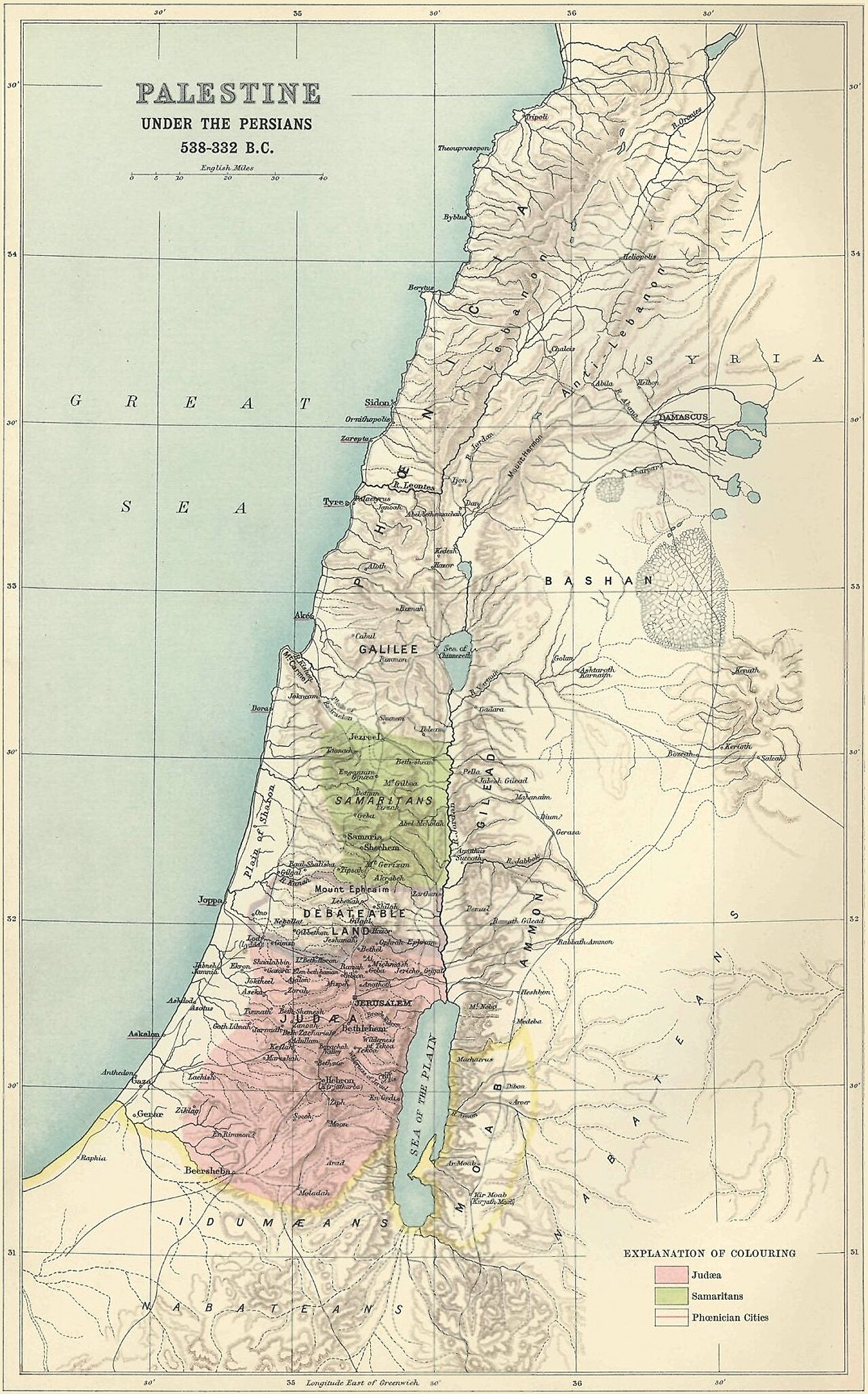 Source: Palestine under the Persians, George Adam Smith, 1915, public domain, via Wikimedia Commons.
Return to Me and I Will Return to You (Zechariah 1:1-6)
1 In the eighth month, in the second year of the reign of Darius, the word of the Lord came to Zacharias, the son of Barachias, the son of Addo, the prophet, saying,
2 The Lord has been very angry with your fathers. 3 And thou shalt say to them, Thus saith the Lord Almighty; Turn to me, saith the Lord of hosts, and I will turn to you, saith the Lord of hosts. 4 And be ye not as your fathers, whom the prophets before charged, saying, Thus saith the Lord Almighty: Turn ye from your evil ways, and from your evil practices: but they hearkened not, and attended not to hearken to me, saith the Lord.
5 Where are your fathers, and the prophets? Will they live for ever? 6 But do ye receive my words and mine ordinances, all that I command by my Spirit to my servants the prophets, who lived in the days of your fathers; and they answered and said, As the Lord Almighty determined to do to us, according to our ways, and according to our practices, so has he done to us.
The opening is deliberately unsentimental. The returned community can point to the sins of its fathers, the pain of exile, and the difficulty of rebuilding, but the Lord brings the matter to the heart: “Turn to me.” The past is not denied, but it cannot become an excuse for present disobedience.
The fathers died, and the prophets died, but the word of God did not die. That is the warning and the comfort. Human generations pass away. God’s call remains living, personal, and near. In Holy Pascha this passage becomes a doorway into repentance: the Church does not approach the Passion as a spectator, but as the people who must return to the Lord who returns to us with mercy.
The Horsemen and the Consoling Words (Zechariah 1:7-17)
7 On the twenty-fourth day in the eleventh month, this is the month Sabat, in the second year of the reign of Darius, the word of the Lord came to Zacharias, the son of Barachias, the son of Addo, the prophet, saying,
8 I saw by night, and behold a man mounted on a red horse, and he stood between the shady mountains; and behind him were red horses, and grey, and piebald, and white. 9 And I said, What are these, my lord? And the angel that spoke with me said to me, I will shew thee what these things are. 10 And the man that stood between the mountains answered, and said to me, These are they whom the Lord has sent forth to go round the earth. 11 And they answered the angel of the Lord that stood between the mountains, and said, We have gone round all the earth, and, behold, all the earth is inhabited, and is at rest.
12 Then the angel of the Lord answered and said, O Lord Almighty, how long wilt thou have no mercy on Jerusalem, and the cities of Juda, which thou hast disregarded these seventy years? 13 And the Lord Almighty answered the angel that spoke with me good words and consolatory sayings. 14 And the angel that spoke with me said to me, Cry out and say, Thus saith the Lord Almighty; I have been jealous for Jerusalem and Sion with great jealousy.
15 And I am very angry with the heathen that combine to attack her: forasmuch as I indeed was a little angry, but they combined to attack her for evil. 16 Therefore thus saith the Lord: I will return to Jerusalem with compassion; and my house shall be rebuilt in her, saith the Lord Almighty, and a measuring line shall yet be stretched out over Jerusalem. 17 And the angel that spoke with me said to me, Cry yet, and say, Thus saith the Lord Almighty; Yet shall cities be spread abroad through prosperity; and the Lord shall yet have mercy upon Sion, and shall choose Jerusalem.
The earth appears quiet, but heaven is not passive. The horsemen have gone through the earth, and the angel asks the aching question: “How long?” Jerusalem may look forgotten, but she is being spoken for before the Lord.
The answer is not military confidence. It is “good words and consolatory sayings.” The Lord is jealous for Zion, angered by nations that used His chastisement as permission for cruelty, and determined to rebuild His house. The spiritual lesson is important: God’s silence is not indifference, and chastisement is not abandonment. The repentant soul may feel like a ruined Jerusalem, but the Lord still speaks comfort over what He intends to rebuild.
The Church’s Voice in Worship ⛪
Zechariah 1:1-6 appears in Holy Pascha on Monday Eve and Tuesday Eve, First Hour. The placement is spiritually exact: before the Passion unfolds in its visible events, the Church hears the Lord call His people back. Pascha begins with repentance because the Cross is not merely something done to Christ; it reveals the condition of the human heart and the mercy that heals it.
Spiritual Fruit 🍇
Return is not vague religious feeling. It means letting God’s word judge our inherited habits, private excuses, family patterns, parish complacency, and personal laziness. Zechariah teaches us to repent without despair. The same Lord who says “Turn to me” also promises, “I will turn to you.”
Teaching Notes
Return to Me and I Will Return to You (Zechariah 1:1-6)
- Ask: What inherited patterns or repeated excuses does this passage expose?
- Emphasize: Repentance is the doorway into every later vision of hope.
- Watch for: Do not let students treat exile or family history as an excuse for present disobedience.
- Connect: Connect this passage to Pascha as the Church entering the Passion through repentance.
- Show: Show the Persian-period map to place the returned community in its small and fragile historical setting.
The Horsemen and the Consoling Words (Zechariah 1:7-17)
Ask: Where do you feel that the earth is at rest while God’s people suffer?
Emphasize: Heaven sees what earth ignores.
Watch for: Avoid presenting God’s jealousy as wounded ego; it is covenant love protecting His people.
Connect: Connect the consoling words to Christ, who intercedes and restores the ruined human temple.
Show: Show the visions-flow schematic from the Introduction if teaching the early visions together.
Sources
- Embedded Scripture is from Brenton’s English Septuagint (LXX).
- Brief New Testament references are cited by reference.
- Coptic Orthodox lectionary references are from the project’s lectionary reference tables and Holy Pascha reference tables.