


This narration is from a previous version of the study and may include a combined recording of multiple chapters.
Isaiah 9-12 belongs together as one sustained movement from darkness into light, from pride into judgment, from imperial terror into remnant trust, and from remnant trust into song. The group opens with a people in shadow and a child given in peace. It then refuses cheap consolation by returning to Israel’s pride, social corruption, and refusal to repent. From there it judges Assyria, promises a remnant, reveals the Root of Jesse, and ends with thanksgiving at the wells of salvation.
This is the right grouping because chapter 8 has already prepared the darkness and Galilee transition, while chapter 13 begins a new sequence of foreign-nation oracles. Chapters 9-12 therefore function as a compact messianic-remnant hymn cluster inside the larger first half of Isaiah.
Historical and Scriptural Context
These chapters still breathe air of the Assyrian crisis, but they rise above immediate politics into a larger horizon. The child of peace, the remnant saved, the Root of Jesse, the peaceable kingdom, and the new exodus imagery all show Isaiah speaking beyond one administration and one invasion. Judah’s present danger becomes the stage on which God reveals His enduring kingdom.
The sequence is important. Isaiah does not move from darkness to light and then forget judgment. The child-oracle in Brenton 9:1-6 is followed by death upon Jacob at 9:7 and the warning against pride. Chastening and a true seeking of the Lord must not be confused. Consolation in Isaiah is never detached from repentance. Hope is true hope because it passes through judgment rather than denying it.
Geographical Significance ⛰️
Galilee of the Gentiles opens the section’s geography. The light shines first into the borderlands and shadowlands, not into an untouched religious center. That is already a missionary sign.
The geography then widens through Samaria, Zion, Egypt, Assyria, and the nations. By chapter 11 the horizon reaches the four corners of the earth, and the Root of Jesse stands not only for Judah but for the Gentiles. Zion’s song in chapter 12 is therefore not private relief. It is the song of salvation made known among the nations.
The Characters 👥
The child / son
This promised ruler stands at the center of the section. Peace, righteous government, Davidic legitimacy, and enduring kingdom are concentrated in Him.
Israel and Ephraim
The northern kingdom is shown in pride, refusal to repent, and mutual destruction. The warning is severe because covenant people can still harden themselves against grace.
Assyria
Assyria is both instrument and object of judgment. God uses the empire without excusing its arrogance.
The remnant and the Root of Jesse
The remnant embodies preserved faithfulness, while the Root of Jesse reveals the true royal future, Spirit-filled, just, peace-giving, and sought by the nations.
🕯️ Light from the Word
Isaiah 9:1-6
1 O people walking in darkness, behold a great light: ye that dwell in the region and shadow of death, a light shall shine upon you. 2 The multitude of the people which thou hast brought down in thy joy, they shall even rejoice before thee as they that rejoice in harvest, and as they that divide the spoil. 3 Because the yoke that was laid upon them has been taken away, and the rod that was on their neck: for he has broken the rod of the exactors, as in the day of Madiam. 4 For they shall compensate for every garment that has been acquired by deceit, and all raiment with restitution; and they shall be willing, even if they were burnt with fire.
5 For a child is born to us, and a son is given to us, whose government is upon his shoulder: and his name is called the Messenger of great counsel: for I will bring peace upon the princes, and health to him. 6 His government shall be great, and of his peace there is no end: it shall be upon the throne of David, and upon his kingdom, to establish it, and to support it with judgment and with righteousness, from henceforth and for ever. The zeal of the Lord of hosts shall perform this.
The section begins with one of Isaiah’s most beloved reversals. Darkness is real. Shadow of death is real. Yet light arrives there. Isaiah does not imagine light where darkness never existed. He announces grace entering the actual place of oppression.
The child and son in verses 5-6 govern the whole section. The Brenton wording matters. Instead of the familiar English title “Wonderful Counselor,” Brenton reads “the Messenger of great counsel.” That should not be hidden. It is one of the most theologically suggestive Septuagint phrases in the book.
St. Irenaeus identifies the one Son of God, Jesus Christ, born of David’s line, as Emmanuel and calls Him “the messenger of great counsel of the Father”.1 That phrase belongs to his account of the same Christ announced by the prophets and proclaimed by the apostles. The child is not a mere symbol of national morale. He is the Davidic and divine answer to the darkness of the people.
Peace here is royal and moral. Before the child is named, Brenton 9:4 speaks of compensating for clothing acquired by deceit, “all raiment with restitution.” This is not the familiar battle-garment rendering. Peace restores what fraud has taken. The child’s government rests on judgment and righteousness, so receiving Him can begin with a very material question: what must I return?
Isaiah 9:7-20
7 The Lord has sent death upon Jacob, and it has come upon Israel. 8 And all the people of Ephraim, and they that dwelt in Samaria shall know, who say in their pride and lofty heart, 9 The bricks are fallen down, but come, let us hew stones, and cut down sycamores and cedars, and let us build for ourselves a tower. 10 And God shall dash down them that rise up against him on mount Sion, and shall scatter his enemies; 11 even Syria from the rising of the sun, and the Greeks from the setting of the sun, who devour Israel with open mouth. For all this his anger is not turned away, but still his hand is exalted.
12 But the people turned not until they were smitten, and they sought not the Lord. 13 So the Lord took away from Israel the head and tail, great and small, in one day: 14 the old man, and them that respect persons, this is the head; and the prophet teaching unlawful things, he is the tail. 15 And they that pronounce this people blessed shall mislead them; and they mislead them that they may devour them. 16 Therefore the Lord shall not take pleasure in their young men, neither shall he have pity on their orphans or on their widows: for they are all transgressors and wicked, and every mouth speaks unjustly. For all this his anger is not turned away, but his hand is yet exalted.
17 And iniquity shall burn as fire, and shall be devoured by fire as dry grass: and it shall burn in the thickets of the wood, and shall devour all that is round about the hills. 18 The whole earth is set on fire because of the fierce anger of the Lord, and the people shall be as men burnt by fire: no man shall pity his brother. 19 But one shall turn aside to the right hand, for he shall be hungry; and shall eat on the left, and a man shall by no means be satisfied with eating the flesh of his own arm. 20 For Manasses shall eat the flesh of Ephraim, and Ephraim the flesh of Manasses; for they shall besiege Juda together. For all this his anger is not turned away, but his hand is yet exalted.
Isaiah 10:1-4
1 Woe to them that write wickedness; for when they write they do write wickedness, 2 perverting the cause of the poor, violently wresting the judgment of the needy ones of my people, that the widow may be a prey to them, and the orphan a spoil. 3 And what will they do in the day of visitation? for affliction shall come to you from afar: and to whom will ye flee for help? and where will ye leave your glory, 4 that ye may not fall into captivity? For all this his wrath is not turned away, but his hand is yet exalted.
After the light comes the warning that pride can still refuse it. Ephraim answers collapse with self-rebuilding pride: the bricks fell, so let us hew better stones. This is the spiritual insanity of unrepentant religion. Instead of returning to God, the sinner doubles down on self-repair.
The repeated refrain, “For all this his anger is not turned away,” keeps the warning open. But verse 12 must be heard in its own wording: the people “turned not until they were smitten,” and then “they sought not the Lord.” The first clause does not say they never turned after being struck. A blow may arrest or redirect a people without bringing them to a true seeking of God. Repentance asks for more than an emergency change of course; it asks whom we now seek.
Fr Bishoy Kamel compares this sequence with the Prodigal Son, tracing pride, hardness of heart, and the social cruelty of Isaiah 10:1-2.2 His reflection uses a Hebrew-based wording of the verse on turning after chastening; it should not be made to explain away Brenton’s “until.” The comparison is useful when it sends us to the Father without silencing the actual text.
The added woe in 10:1-4 makes the moral center explicit: unjust writing, twisted judgment, widows consumed, orphans made spoil. Isaiah never lets spiritual darkness remain private. It becomes policy.
Isaiah 10:5-19
5 Woe to the Assyrians; the rod of my wrath, and anger are in their hands. 6 I will send my wrath against a sinful nation, and I will charge my people to take plunder and spoil, and to trample the cities, and to make them dust. 7 But he meant not thus, neither did he devise thus in his soul: but his mind shall change, and that to destroy nations not a few. 8 And if they should say to him, Thou alone art ruler; 9 then shall he say, Have I not taken the country above Babylon and Chalanes, where the tower was built? and have I not taken Arabia, and Damascus, and Samaria? 10 As I have taken them, I will also take all the kingdoms: howl, ye idols in Jerusalem, and in Samaria. 11 For as I did to Samaria and her idols, so will I do also to Jerusalem and her idols. 12 And it shall come to pass, when the Lord shall have finished doing all things on mount Sion and Jerusalem, that I will visit upon the proud heart, even upon the ruler of the Assyrians, and upon the boastful haughtiness of his eyes. 13 For he said, I will act in strength, and in the wisdom of my understanding I will remove the boundaries of nations, and will spoil their strength. 14 And I will shake the inhabited cities: and I will take with my hand all the world as a nest: and I will even take them as eggs that have been left; and there is none that shall escape me, or contradict me. 15 Shall the axe glorify itself without him that hews with it? or shall the saw lift up itself without him that uses it, as if one should lift a rod or staff? but it shall not be so; 16 but the Lord of hosts shall send dishonour upon thine honour, and burning fire shall be kindled upon thy glory. 17 And the light of Israel shall be for a fire, and he shall sanctify him with burning fire, and it shall devour the wood as grass. 18 In that day the mountains shall be consumed, and the hills, and the forests, and fire shall devour both soul and body: and he that flees shall be as one fleeing from burning flame. 19 And they that are left of them shall be a small number, and a child shall write them.
Assyria is one of Isaiah’s sharpest lessons in divine sovereignty. God uses the empire as rod and then judges the empire for its arrogant heart. Instrumentality is not innocence.
The key line is verse 15: “Shall the axe glorify itself without him that hews with it?” The empire imagines itself self-explanatory. Isaiah strips that illusion away. Power that becomes self-worship is already under sentence.
This unit is also spiritually useful because it shows how God may use even hostile circumstances without blessing their motives. A chastening instrument can still be wicked. A hard providence can still reveal the pride of the one carrying it.
Isaiah 10:20-34
20 And it shall come to pass in that day that the remnant of Israel shall no more join themselves with, and the saved of Jacob shall no more trust in, them that injured them; but they shall trust in the Holy God of Israel, in truth. 21 And the remnant of Jacob shall trust on the mighty God. 22 And though the people of Israel be as the sand of the sea, a remnant of them shall be saved. 23 He will finish the work, and cut it short in righteousness: because the Lord will make a short work in all the world.
24 Therefore thus saith the Lord of hosts, Be not afraid, my people who dwell in Sion, of the Assyrians, because he shall smite thee with a rod: for I am bringing a stroke upon thee, that thou mayest see the way of Egypt. 25 For yet a little while, and the indignation shall cease: but my wrath shall be against their council. 26 And God will stir up enemies against them, according to the stroke of Madiam in the place of affliction: and his wrath shall be by the way of the sea, even to the way that leads to Egypt. 27 And it shall come to pass in that day, that his yoke shall be taken away from thy shoulder, and his fear from thee, and the yoke shall be destroyed from off your shoulders.
28 For he shall arrive at the city of Angai, and shall pass on to Maggedo, and shall lay up his stores in Machmas. 29 And he shall pass by the valley, and shall arrive at Angai: fear shall seize upon Rama, the city of Saul. 30 The daughter of Gallim shall flee; Laisa shall hear; one shall hear in Anathoth. 31 Madebena also is amazed, and the inhabitants of Gibbir.
32 Exhort ye them to-day to remain in the way: exhort ye beckoning with the hand the mountain, the daughter of Sion, even ye hills that are in Jerusalem.
33 Behold, the Lord, the Lord of hosts, will mightily confound the glorious ones; and the haughty in pride shall be crushed, and the lofty shall be brought low: 34 and the lofty ones shall fall by the sword, and Libanus shall fall with his lofty ones.
The remnant promise arrives with a crucial correction: the saved of Jacob “shall no more trust in, them that injured them.” That is one of Isaiah’s clearest statements about repentance as revised trust. The deepest conversion is not merely feeling sorry. It is ceasing to lean on what wounded you.
The march imagery that follows makes Assyria feel near and heavy, but the end of the section belongs to the Lord. The haughty are cut down. The terrifying approach of the empire does not get the final word.
This is where the note prepares for chapter 11. The forest of human pride is cut down so that the true shoot may arise from Jesse.
Isaiah 11:1-10
1 And there shall come forth a rod out of the root of Jesse, and a blossom shall come up from his root: 2 and the Spirit of God shall rest upon him, the spirit of wisdom and understanding, the spirit of counsel and strength, the spirit of knowledge and godliness shall fill him; 3 the spirit of the fear of God. He shall not judge according to appearance, nor reprove according to report: 4 but he shall judge the cause of the lowly, and shall reprove the lowly of the earth: and he shall smite the earth with the word of his mouth, and with the breath of his lips shall he destroy the ungodly one. 5 And he shall have his loins girt with righteousness, and his sides clothed with truth.
6 And the wolf shall feed with the lamb, and the leopard shall lie down with the kid; and the young calf and bull and lion shall feed together; and a little child shall lead them. 7 And the ox and bear shall feed together; and their young shall be together: and the lion shall eat straw like the ox. 8 And an infant shall put his hand on the holes of asps, and on the nest of young asps. 9 And they shall not hurt, nor shall they at all be able to destroy any one on my holy mountain: for the whole world is filled with the knowledge of the Lord, as much water covers the seas. 10 And in that day there shall be a root of Jesse, and he that shall arise to rule over the Gentiles; in him shall the Gentiles trust, and his rest shall be glorious.
After royal failure and imperial arrogance, Isaiah goes back beneath David to Jesse. Hope does not come from patching the old pride. It comes from a fresh shoot raised by God.
The Root of Jesse is Spirit-filled, just to the lowly, truthful, and world-renewing. The peaceable kingdom imagery should be read both morally and eschatologically. It describes a world reordered under the Messiah’s righteous presence. At the very least it means that the reign of this king overturns predation at its roots.
St. Athanasius cites Isaiah 11:10 in On the Incarnation 35.6 as scriptural witness that the Saviour’s coming brings the nations to know God.3 The Root of Jesse sentence is the biblical text he cites, not a separate saying of his own. Its place in his argument makes the horizon clear: Christ is not for Judah alone.
The Church should also linger over verse 2. The Spirit rests on Him, and in Him the human life becomes fully receptive to divine wisdom, counsel, strength, knowledge, and fear of the Lord.
Isaiah 11:11-16
11 And it shall be in that day, that the Lord shall again shew his hand, to be zealous for the remnant that is left of the people, which shall be left by the Assyrians, and that from Egypt, and from the country of Babylon, and from Ethiopia, and from the Elamites, and from the rising of the sun, and out of Arabia. 12 And he shall lift up a standard for the nations, and he shall gather the lost ones of Israel, and he shall gather the dispersed of Juda from the four corners of the earth. 13 And the envy of Ephraim shall be taken away, and the enemies of Juda shall perish: Ephraim shall not envy Juda, and Juda shall not afflict Ephraim. 14 And they shall fly in the ships of the Philistines: they shall at the same time spoil the sea, and them that come from the east, and Idumea: and they shall lay their hands on Moab first; but the children of Ammon shall first obey them.
15 And the Lord shall make desolate the sea of Egypt; and he shall lay his hand on the river with a strong wind, and he shall smite the seven channels, so that men shall pass through it dry-shod. 16 And there shall be a passage for my people that is left in Egypt: and it shall be to Israel as the day when he came forth out of the land of Egypt.
The Lord stretches out His hand again, gathering the lost of Israel and dispersed of Judah. Egypt, Assyria, Babylon, and the ends of the earth become the map of a new exodus. The healing begins within the divided people: Ephraim’s envy and Judah’s affliction of Ephraim cease.
Yet verse 14 does not speak in the peaceable imagery of verses 6-9. It pictures spoiling and the subjection of named neighbours in ancient conquest language. We must hear that severity rather than smooth it away. A Christian reading under the Root of Jesse does not authorize plunder, ethnic hatred, or modern territorial violence. The nations are called to hope in Christ, not to become prey for His Church. The new-exodus hope opens toward deliverance from enmity, not permission to reproduce it.
Isaiah 12:1-6
1 And in that day thou shalt say, I will bless thee, O Lord; for thou wast angry with me, but thou hast turned aside thy wrath, and hast pitied me. 2 Behold, my God is my Saviour; I will trust in him, and not be afraid: for the Lord is my glory and my praise, and is become my salvation. 3 Draw ye therefore water with joy out of the wells of salvation. 4 And in that day thou shalt say, Sing to the Lord, call aloud upon his name, proclaim his glorious deeds among the Gentiles; make mention that his name is exalted. 5 Sing praise to the name of the Lord; for he has done great things: declare this in all the earth. 6 Exalt and rejoice, ye that dwell in Sion: for the Holy One of Israel is exalted in the midst of her.
The remnant is not merely spared. It is gathered, and chapter 12 gives that gathering a voice. Salvation is received as pity from the God whose wrath has been turned aside, not as the remnant’s proof of superiority.
Then comes one of Isaiah’s most liturgical endings: wrath turned aside, trust restored, wells of salvation opened, the Lord’s deeds proclaimed among the Gentiles. Chapter 12 is what healed judgment sounds like when it becomes song.
Fr Bishoy Kamel reads the third-week sequence through the Prodigal Son: movement from darkness into joy, pride exposed, life renewed in Christ, and praise rising from reconciliation.4 Repentance in this reading does not end in self-accusation. It opens into doxology, the praise of God.
“Draw ye therefore water with joy out of the wells of salvation” invites a thirsty people to receive, not to manufacture, salvation. Christian readers can hear its sacramental resonance while keeping that resonance distinct from an actual appointment at a water-blessing service.
The Church’s Voice in Worship 📖
Recurring third-week Matins readings preserved with Coptic Reader attestation are:
- Monday: Isaiah 8:13-9:7.
- Tuesday: Isaiah 10:12-20.
- Wednesday: Isaiah 9:9-10:4.
- Thursday: Isaiah 11:10-12:2.
These are the printed service references, not directions to alter Brenton’s labels. Its child-oracle ends at 9:6, while 9:7 already speaks of death upon Jacob. Tuesday’s companion prophecy is Proverbs 2:1-15. The boastful wisdom of Assyria can be heard beside the call to seek and receive wisdom from God, rather than treating strength as self-created.
A working Good Friday Sixth Hour witness includes Isaiah 12:2-13:10 alongside Numbers 21:1-9, Isaiah 53:7-12, Amos 8:9-12, Galatians 6:14-18, Psalm material, and Passion readings from Matthew, Mark, Luke, and John. The placement follows a working Pascha service witness. Heard within that whole hour, the wells of salvation lead our attention to the Crucified One and the life He gives. This is a Christian synthesis of the readings, not a claim that Isaiah 12:3 is itself appointed for a water rite.
Iconography Connection 🖼️
This guide has unusually strong iconographic range: Galilee receiving light, the Christ Child, the Root of Jesse, the peaceable kingdom, the banner lifted for the nations, and Zion drawing water with joy. Each image teaches a different aspect of messianic hope.
The Tree of Jesse icon gives Isaiah 11 a visual grammar. The Messiah does not arrive as a disconnected religious idea. He comes from the promised root, gathers Israel’s story into Himself, and opens the royal line toward the salvation of the nations. The Tree of Jesse is a received Christian visual genealogy of Christ’s royal line from Jesse and David; it is not a speculative reconstruction of every family relationship.
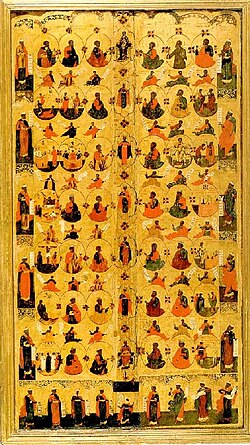 Source: Tree of Jesse icon, 17th century, via Wikimedia Commons, Public Domain Mark, https://commons.wikimedia.org/wiki/File:Tree_of_Jesse_icon_(17_c.).jpg
Spiritual Fruit 🍇
1. Let divine light reach the shadow you actually live in
Isaiah does not promise abstract brightness. He names shadow and death. Bring the darkest real chamber of your life under the Child’s rule. Where you have gained by deceit, ask what must be returned; His peace gives courage for a truthful repair.
2. Stop rebuilding pride with better bricks
Some repentance never happens because the heart answers collapse with upgraded self-sufficiency. Isaiah says that is still darkness.
3. Trust the King who judges the lowly rightly
The Root of Jesse is marked by righteousness, truth, and care for the lowly. Any spirituality that ignores the weak is not living under this king.
4. End where Isaiah ends, in praise
The goal of repentance is not permanent self-absorption. It is trust, joy, proclamation, and drawing water with thanksgiving from God’s salvation.
Closing Meditation
Light of those in shadow, break the yoke we keep polishing and still calling strength. Gather what is scattered in us, cut down what is proud, and let the wells of Your salvation become joy again in the midst of Your people.
Glossary
- Root of Jesse: The Davidic messianic figure arising from Jesse’s line, Spirit-filled and sought by the nations.
- Remnant: Those preserved and gathered by God after judgment.
- Messenger of great counsel: The Brenton Septuagint’s notable wording in Isaiah 9:5, carrying strong christological weight.
- New exodus: Isaiah’s pattern of salvation in which God gathers and leads His people again as in the first deliverance.
- Holy One of Israel: Isaiah’s defining title for God, joining holiness with covenant presence.
Translation and Source Notes
This guide uses Brenton’s English Septuagint for embedded Scripture. The most important translation note in this section is Isaiah 9:5, where Brenton reads Messenger of great counsel instead of the more familiar English wording Wonderful Counselor. The note keeps that wording visible because it shaped early Christian reading.
The guide also preserves the sequence in which chapter 8 closes with a Galilee transition and chapter 9 opens with the great light. That movement is part of the literary power of the section.
Sources
Primary sources
- Isaiah 9-12, Brenton Septuagint.
- St. Irenaeus, Against Heresies 3.16, on Christ as Emmanuel and the Messenger of great counsel.
- St. Athanasius, On the Incarnation 35.6, citing Isaiah 11:10 and the Root of Jesse as hope of the nations.
Coptic Orthodox / pastoral sources
- Fr. Bishoy Kamel, The Journey through Lent with Isaiah, especially the third-week Great Lent reading through the Prodigal Son and the return to praise.
Web pages and non-academic sources cited
- New Advent Fathers pages used as access points for Irenaeus and Athanasius.
- Coptic lectionary source material, especially Great Lent week 3 cycle references.
Source References
Scripture text
- Brenton Septuagint, Isaiah 9: https://biblehub.com/sep/isaiah/9.htm
- Brenton Septuagint, Isaiah 10: https://biblehub.com/sep/isaiah/10.htm
- Brenton Septuagint, Isaiah 11: https://biblehub.com/sep/isaiah/11.htm
- Brenton Septuagint, Isaiah 12: https://biblehub.com/sep/isaiah/12.htm
Patristic source pages
- St. Irenaeus of Lyons, Against Heresies 3.16, Emmanuel and Messenger of great counsel: https://www.newadvent.org/fathers/0103316.htm
- St. Athanasius of Alexandria, On the Incarnation, Root of Jesse and hope of nations: https://www.newadvent.org/fathers/2802.htm
Geography and visual context
- OpenBible.info, all places mentioned in Isaiah, interactive map and KML: https://www.openbible.info/geo/preview/isa
- Project Gutenberg, Hurlbut Bible Atlas, public-domain biblical geography background: https://www.gutenberg.org/cache/epub/41140/pg41140-images.html
- Wikimedia Commons, Tree of Jesse icon, Public Domain Mark: https://commons.wikimedia.org/wiki/File:Tree_of_Jesse_icon_(17_c.).jpg
Coptic readings
- Coptic reading references follow the retained Great Lent cycle and service witnesses in @andraws/lectionary-data 1.3.5. Working service witnesses and historical records are distinguished in the discussion; printed references are not silently remapped to Brenton verse labels.
Teaching Notes
Overall teaching emphases
- Why these chapters stay together: They move as one arc from darkness and the messianic child, through judgment and remnant, into the Root of Jesse and Zion’s thanksgiving.
- Where to linger: Isaiah 9:1-6, 9:12-13, 10:15, 10:20-21, 11:1-10, and 12:2-3.
- Where to be careful: Teach the peaceable kingdom with theological depth. Do not empty it into sentiment, but do not explain away its hope either.
- Pastoral warning: People often love Isaiah 9 and Isaiah 11 while skipping 9:7-10:4. Do not separate messianic hope from the call to repent.
- Key phrases to say slowly: “Messenger of great counsel,” “For all this his anger is not turned away,” “a remnant of them shall be saved,” and “Draw ye therefore water with joy.”
Consolidated section teaching cues
Isaiah 9:1-6
- Key phrases: “light arrives in the actual shadow,” “Messenger of great counsel,” “peace stands on righteousness.”
- Emphasize: The Brenton wording of Isaiah 9:5 is worth teaching, not smoothing over.
- Avoid: Letting the beauty of the child-oracle detach from the section’s moral and royal seriousness.
Isaiah 9:7-20 and 10:1-4
- Key phrases: “turned not until they were smitten,” “they sought not the Lord,” “darkness becomes policy.”
- Emphasize: Chastening can turn a people without becoming a true seeking of the Lord. Preserve both clauses of Brenton 9:12.
- Avoid: Using the refrain as mere threat language. It is diagnostic language.
Isaiah 10:5-19
- Key phrases: “instrumentality is not innocence,” “the axe is not the woodcutter,” “power becomes self-worship.”
- Emphasize: God’s sovereignty and moral judgment remain distinct but united.
- Avoid: Reading Assyria as though empire becomes righteous merely because God uses it.
Isaiah 10:20-34
- Key phrases: “repentance is revised trust,” “do not lean on what wounded you,” “the forest falls before the true shoot rises.”
- Emphasize: The remnant is defined not only by survival, but by purified dependence.
- Avoid: Treating remnant as a slogan of superiority. In Isaiah it is a mercy after judgment.
Isaiah 11:1-10
- Key phrases: “hope goes back beneath David to Jesse,” “the Root of Jesse is for the nations,” “predation is overturned at its roots.”
- Emphasize: This is royal, moral, and cosmic messianic hope.
- Show: Use the Tree of Jesse icon as visual genealogy of Christ’s royal line and the nations’ hope, not as a speculative family chart.
- Avoid: Reducing the peaceable kingdom to sentiment or, on the other side, reducing it to metaphor so completely that its hope disappears.
Isaiah 11:11-16 and 12:1-6
- Key phrases: “the remnant is gathered,” “healed judgment becomes song,” “draw water with joy.”
- Emphasize: Salvation in Isaiah is communal, missionary, and doxological.
- Avoid: Treating chapter 12 as a detached worship appendix, or using 11:14 as permission for plunder, ethnic hatred, or modern territorial violence.
Footnotes
-
St. Irenaeus of Lyons, Against Heresies 3.16.3, https://www.newadvent.org/fathers/0103316.htm. ↩
-
Fr Bishoy Kamel, The Journey through Lent with Isaiah, The Third Week of Lent, “Self-Righteousness And Pride” and “Hardness Of The Heart”; modern Coptic pastoral reflection on pride, hardness, and injustice. English archival text; translator and published edition are not identified. ↩
-
St. Athanasius, On the Incarnation 35.6, https://www.newadvent.org/fathers/2802.htm. The Root of Jesse wording is the Isaiah 11:10 text cited within his argument. ↩
-
Fr Bishoy Kamel, The Journey through Lent with Isaiah, The Third Week of Lent, “Repentance” and the closing reflections on Isaiah 11-12; modern Coptic pastoral reflection on new life, reconciliation, and praise. English archival text; translator and published edition are not identified. ↩