


This narration is from a previous version of the study and may include a combined recording of multiple chapters.
Isaiah 15-16 is a single oracle over Moab spoken with grief, not with cold delight. Cities collapse, roads fill with weeping, waters fail, fugitives scatter, pride is exposed, and even judgment itself sounds like lament. This is one of the passages that keeps the prophetic voice from being mistaken for hard triumphalism.
These two chapters belong together because chapter 15 announces Moab’s ruin through a landscape of tears, while chapter 16 turns to fugitives, shelter, a merciful throne in David, Moab’s pride, the prophet’s inward grief, and the timed certainty of the judgment. The grouping makes contextual sense. Chapter 13-14 dealt with the downfall of imperial arrogance in Babylon. Chapter 15-16 moves from taunt to lament. What follows in chapters 17-18 continues the wider sequence of nation-oracles, but Moab is given a particularly mournful treatment that deserves its own paired guide.
Historical and Scriptural Context
Moab was a near neighbor of Israel and Judah, often hostile, often entangled, and never spiritually neutral in the biblical imagination. But Isaiah’s oracle does not read like simple enemy denunciation. The geography is intimate, the tears are repeated, and the prophet’s own inward life enters the passage.
That is the key spiritual fact. Not all judgment in Scripture is voiced the same way. Babylon in Isaiah 13-14 is mocked in its downfall. Moab in Isaiah 15-16 is lamented. The difference matters. It teaches that divine judgment can be truthful without being cruel.
Geographical Significance ⛰️
These chapters are saturated with place names: Debon, Nabau, Esebon, Eleale, Jassa, Segor, Luith, Aroniim, Nemerim, Agalim, Ælim, Arnon, Jazer, and Sebama. The density of names matters. Isaiah is not denouncing an abstraction. He is walking the reader across a real map of collapse.
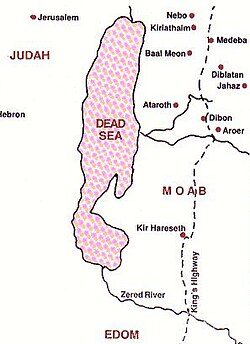 Source: Dan Fefferman, map of ancient Moabite territory, via Wikimedia Commons, GNU Free Documentation License 1.2 or later, https://commons.wikimedia.org/wiki/File:Moabite_territory_map_1.jpg
The failing waters and ruined vineyards also carry theological weight. The land itself joins the lament. Fertility dries up, joy leaves the winepresses, and the places that once sustained life become witnesses to emptiness.
The Characters 👥
Moab
Moab appears as both judged and mourned. The oracle does not hide its pride, but it also does not erase its suffering.
The fugitives
The fleeing, scattered, sheltered, and endangered refugees are central to chapter 16. This makes the note pastorally useful for teaching about mercy toward the displaced.
The Davidic king
In the middle of Moab’s crisis appears a throne established in mercy and truth in the tabernacle of David. That sudden appearance is not accidental. Isaiah places the only durable refuge for the nations under righteous Davidic rule.
🕯️ Light from the Word
Isaiah 15:1-9
1 The Word against the Land of Moab. By night the land of Moab shall be destroyed; for by night the wall of the land of Moab shall be destroyed.
2 Grieve for yourselves; for even Debon, where your altar is, shall be destroyed: thither shall ye go up to weep, over Nabau of the land of Moab: howl ye: baldness shall be on every head, and all arms shall be wounded. 3 Gird yourselves with sackcloth in her streets: and lament upon her roofs, and in her streets, and in her ways; howl all of you with weeping. 4 For Esebon and Eleale have cried: their voice was heard to Jassa: therefore the loins of the region of Moab cry aloud; her soul shall know. 5 The heart of the region of Moab cries within her to Segor; for it is as a heifer of three years old: and on the ascent of Luith they shall go up to thee weeping by the way of Aroniim: she cries, Destruction, and trembling. 6 The water of Nemerim shall be desolate, and the grass thereof shall fail: for there shall be no green grass. 7 Shall Moab even thus be delivered? for I will bring the Arabians upon the valley, and they shall take it. 8 For the cry has reached the border of the region of Moab, even of Agalim; and her howling has gone as far as the well of Ælim. 9 And the water of Dimon shall be filled with blood: for I will bring Arabians upon Dimon, and I will take away the seed of Moab, and Ariel, and the remnant of Adama.
The chapter opens with repeated night destruction and then moves almost entirely in the register of weeping. Streets, roofs, roads, loins, heart, waters, and borders all participate in lament. The oracle feels like it is moving from city to city listening to grief echo outward.
This alone is a major spiritual insight. The prophet does not speak as though enemy suffering were entertaining. He names ruin truthfully, but the tone refuses delight in it. That is a needed correction for hard-hearted readers.
Isaiah 16:1-5
1 I will send as it were reptiles on the land: is not the mount of the daughter of Sion a desolate rock? 2 For thou shalt be as a young bird taken away from a bird that has flown: even thou shalt be so, daughter of Moab: and then do thou, O Arnon, 3 take farther counsel, and continually make thou a shelter from grief: they flee in darkness at mid-day; they are amazed; be not thou led captive. 4 The fugitives of Moab shall sojourn with thee; they shall be to you a shelter from the face of the pursuer: for thine alliance has been taken away, and the oppressing ruler has perished from off the earth. 5 And a throne shall be established with mercy; and one shall sit upon it with truth in the tabernacle of David, judging, and earnestly seeking judgments, and hasting righteousness.
Brenton’s opening is genuinely difficult: reptiles, desolate Zion, and a young bird carried away do not resolve into a simple diplomatic request. Verse 3 calls for shelter from grief. Verse 4 then says the fugitives of Moab will sojourn with the addressee and, surprisingly, that they themselves will be a shelter to the addressee. The precise pronoun relation remains difficult; this is not enough to establish a reciprocal shelter arrangement or confidently name every addressee. We should preserve the surprise rather than reverse the sentence. Verse 5 gives the clear hope within it: a throne established with mercy, truth, judgment, and righteousness.
This is one of the strongest Christward turns in the nation-oracles. In the middle of foreign distress, Isaiah does not offer clever diplomacy as the answer. He offers the Davidic throne in mercy.
St. Irenaeus, in a thematic witness to David’s throne, cites Gabriel’s promise to Mary and asks who can reign over Jacob for ever except Jesus Christ. His argument joins the God of the prophets to the salvation revealed in Christ. That gives a Christian horizon to Isaiah 16:5 without pretending that Irenaeus is directly explaining Moab’s fugitives.1
St. Cyril of Jerusalem strengthens the same Christological reading when he warns catechumens not to look for David’s throne as a mere wooden seat, but as the authority and kingdom fulfilled in Christ. He gathers the blind men’s cry, Gabriel’s word to Mary, and Paul’s confession that Christ is of David’s seed, then tells the hearer to receive the One born of David. That keeps Isaiah 16:5 from becoming a vague royal image: mercy, truth, judgment, and righteousness are finally personal in Christ the King.2
Isaiah 16:6-12
6 We have heard of the pride of Moab; he is very proud. I have cut off his pride: thy prophecy shall not be thus, no not thus.
7 Moab shall howl; for all shall howl in the land of Moab: but thou shalt care for them that dwell in Seth, and thou shalt not be ashamed. 8 The plains of Esebon shall mourn, the vine of Sebama: swallowing up the nations, trample ye her vines, even to Jazer: ye shall not come together; wander ye in the desert: they that were sent are deserted, for they have gone over to the sea. 9 Therefore will I weep as with the weeping of Jazer for the vine of Sebama; Esebon and Eleale have cast down thy trees; for I will trample on thy harvest and on thy vintages, and all thy plants shall fall. 10 And gladness and rejoicing shall be taken away from the vineyards; and they shall not rejoice at all in thy vineyards; and they shall not at all tread wine into the vats; for the vintage has ceased. 11 Therefore my belly shall sound as a harp for Moab, and thou hast repaired my inward parts as a wall. 12 And it shall be to thy shame, (for Moab is wearied at the altars,) that he shall go in to the idols thereof to pray, but they shall not be at all able to deliver him.
Now the oracle explains why the judgment has come: “We have heard of the pride of Moab; he is very proud.” But even here, pride is not named in a sneering tone. It is named while the prophet continues to weep.
Verses 9 and 11 are especially important. The prophetic voice weeps and sounds inwardly like a harp for Moab. Verse 7 makes that grief practical: care for those who dwell in Seth, without shame. The oracle names a people’s pride and still commands care for its people. Feed or welcome someone whose community you distrust; another person’s need is not suspended until you approve of their history.
The idols at the end cannot save. That too is spiritually precise. Pride finally sends the suffering soul back to altars that have no power. False worship becomes most exposed when pain demands real refuge.
Isaiah 16:13-14
13 This is the word which the Lord spoke against Moab, when he spoke. 14 And now I say, In three years, of the years of an hireling, the glory of Moab shall be dishonoured with all his great wealth; and he shall be left few in number, and not honoured.
The oracle ends by tightening the time horizon. Moab’s fall is not indefinite rhetoric. It is measured and sure.
That final note protects the passage from becoming mere mood. The tears are real, but so is the verdict. Mercy of tone does not mean uncertainty of truth.
Iconography Connection 🖼️
This guide works best with images of the prophet mourning over ruined cities, displaced peoples seeking refuge, and Christ the righteous king seated in mercy on David’s throne. Avoid triumphalist visual pairings. The emotional atmosphere of the passage is lament and shelter, not victory-pageantry.
Spiritual Fruit 🍇
1. Tell the truth about pride without losing compassion
Isaiah names Moab’s pride clearly, but he does not harden his voice into contempt.
2. Let judgment make you more merciful, not less
If the prophet can weep over the judged, Christians should fear becoming colder than Isaiah. Let care for the people of Seth become a meal or welcome offered across an inherited boundary.
3. Know where shelter actually is
Alliances fail, idols fail, and glory fails. The throne established with mercy is the only real refuge.
4. Refuse false altars in the day of distress
Pain reveals what we actually trust. Isaiah shows how useless idols become when the heart most needs saving.
Closing Meditation
Merciful Lord, save us from the pride that destroys and from the hardness that cannot weep. Teach us to shelter the distressed, to flee false altars, and to seek the throne of David where truth and mercy meet in righteousness.
Glossary
- Moab: A neighboring people often in tension with Israel and Judah, here judged and mourned.
- Davidic throne: The righteous throne of mercy, truth, and justice appearing in Isaiah 16:5.
- Refuge / shelter: A dominant theme in chapter 16, especially in relation to fugitives and the failure of alliances.
- Pride: The stated moral center of Moab’s downfall in Isaiah 16:6.
- Oracle against the nations: The larger literary sequence in Isaiah 13-23 to which this Moab section belongs.
Translation and Source Notes
Embedded Scripture is from Brenton’s English Septuagint (LXX). Isaiah 16:1-4 remains difficult in this English witness. Its pronouns and direction of shelter are retained without importing another version’s lamb or resolving an unstated relation. The merciful Davidic throne in verse 5 supplies a firm Christian hope without solving every earlier image.
Sources
Primary sources
Isaiah 15-16, Brenton Septuagint.
St. Irenaeus, Against Heresies 3.10, on Christ receiving the throne of David and reigning without end.
St. Cyril of Jerusalem, Catechetical Lecture 12.23, on the Davidic throne as Christ’s kingdom, not a merely wooden seat.
Direct Source Pages and Verification Links
Scripture text
- Brenton Septuagint, Isaiah 15: https://biblehub.com/sep/isaiah/15.htm
- Brenton Septuagint, Isaiah 16: https://biblehub.com/sep/isaiah/16.htm
Patristic source pages
- St. Irenaeus of Lyons, Against Heresies 3.10, Davidic throne and visible salvation in Christ, used thematically for Isaiah 16:5: https://www.newadvent.org/fathers/0103310.htm
- St. Cyril of Jerusalem, Catechetical Lecture 12.23, Davidic throne as Christ’s kingdom, used thematically for Isaiah 16:5: https://www.newadvent.org/fathers/310112.htm
Geography and visual context
- OpenBible.info, all places mentioned in Isaiah, interactive map and KML: https://www.openbible.info/geo/preview/isa
- Project Gutenberg, Hurlbut Bible Atlas, public-domain biblical geography background: https://www.gutenberg.org/cache/epub/41140/pg41140-images.html
- Wikimedia Commons, Moabite territory map, GFDL 1.2 or later: https://commons.wikimedia.org/wiki/File:Moabite_territory_map_1.jpg
Teaching Notes
Overall teaching emphases
- Why these chapters stay together: They form one Moab oracle moving from ruin and tears to fugitives, the merciful throne, pride exposed, prophetic grief, and a timed judgment.
- Where to linger: Isaiah 15:5, 16:4-5, 16:6, 16:9, 16:11, and 16:12.
- Where to be careful: Do not turn Moab into a faceless enemy. The passage is deliberately full of tears.
- Pastoral warning: Some teachers are more interested in identifying pride than in learning to grieve for the proud. Isaiah refuses that imbalance.
- Key phrases to say slowly: “The heart of the region of Moab cries,” “a throne shall be established with mercy,” and “my belly shall sound as a harp for Moab.”
Consolidated section teaching cues
Isaiah 15:1-9
- Key phrases: “judgment without cruelty,” “the map itself begins to weep,” “truthful grief is not softness.”
- Emphasize: Isaiah’s tone matters as much as the announced disaster.
- Avoid: Treating Moab’s ruin as an object of detached curiosity.
Isaiah 16:1-5
- Key phrases: “alliances fail, mercy endures,” “the only stable shelter is righteous kingship,” “the Davidic throne appears in the middle of refugee grief.”
- Emphasize: Isaiah 16:5 is not decorative. It is the theological center of the oracle.
- Avoid: Losing the human refugee scene by jumping to Christ too quickly. The messianic throne is given as refuge for the distressed, not as an abstract doctrine.
Isaiah 16:6-12
- Key phrases: “pride named with tears,” “the prophet’s inward life mourns,” “idols fail when pain becomes urgent.”
- Emphasize: Isaiah condemns Moab’s pride without losing compassion for Moab’s ruin.
- Avoid: Preaching pride as though it cancels the need for pity.
Isaiah 16:13-14
- Key phrases: “tears do not make judgment vague,” “measured certainty,” “compassion and truth remain joined.”
- Emphasize: The prophecy is both emotionally tender and judicially firm.
- Avoid: Imagining that compassion weakens the seriousness of divine speech.
Footnotes
-
St. Irenaeus, Against Heresies 3.10.2: https://www.newadvent.org/fathers/0103310.htm. ↩
-
St. Cyril of Jerusalem, Catechetical Lecture 12.23: https://www.newadvent.org/fathers/310112.htm. ↩