


This narration is from a previous version of the study and may include a combined recording of multiple chapters.
Isaiah is the great prophetic book of holiness, judgment, repentance, comfort, the Servant, Zion, and new creation. It begins by exposing a people who still offer worship while their hearts are sick, and it ends with the Lord gathering all nations to worship Him. The Church reads Isaiah not as a museum of ancient oracles, but as a prophetic witness to Christ, His Cross, His Church, His Eucharistic banquet, His victory over death, and the healing of the nations. For an Orthodox reader, Isaiah trains the soul to hold together two truths that are often separated: God is terrifyingly holy, and God is astonishingly merciful.
The whole book asks one spiritual question in many forms: will the people of God trust the Holy One of Israel, or will they trust idols, rulers, alliances, wealth, pride, and religious performance? Isaiah’s answer is sharp. False worship cannot heal the soul. Political cleverness cannot save the city. Human pride cannot survive the day of the Lord. Yet the Lord Himself will cleanse, comfort, carry, suffer, redeem, gather, and renew.
Historical and Scriptural Context
Where Isaiah stands in the Old Testament
In the Hebrew Bible, Isaiah belongs to the Latter Prophets, alongside Jeremiah, Ezekiel, and the Twelve. In the Christian Old Testament order, it stands at the head of the Major Prophets, after the Law, historical books, and wisdom books, and before Jeremiah, Lamentations, Ezekiel, and Daniel. That placement matters spiritually. After Israel’s story has shown creation, covenant, worship, kingship, exile, wisdom, and failure, Isaiah speaks as a prophet who both diagnoses the wound and announces the cure.
The name Isaiah comes from the Hebrew Yeshayahu, usually understood as “The Lord is salvation” or “Yahweh saves.” That meaning is not decorative. It is the book’s heartbeat. Isaiah shows that salvation is not merely escape from Assyria, Babylon, sickness, exile, or guilt. Salvation is communion with the Holy One, forgiveness of sin, purified worship, a restored people, and finally a new heavens and a new earth.
The prophet and his historical world
Isaiah 1:1 names the prophet’s father and places his vision in the reigns of Uzziah, Jotham, Ahaz, and Hezekiah, using the older forms Ozias, Joatham, Achaz, and Ezekias in Brenton. This puts the prophet in the eighth century BC, centered in Judah and Jerusalem, during the rise of the Assyrian Empire. The world around Judah was not stable. Assyria pressed westward. The northern kingdom of Israel and Syria tried to force Judah into anti-Assyrian politics. Samaria fell in 722 BC. In 701 BC, Sennacherib came against Judah, and Jerusalem was delivered only by the mercy of God.
Isaiah therefore speaks into real fear. Ahaz is tempted to trust Assyria. Hezekiah is tempted, after deliverance, to display his treasures to Babylon. The people are tempted to believe that temple worship will protect them while injustice, pride, idolatry, and bloodshed remain unrepented. Isaiah’s prophecy is not abstract theology. It is a word to frightened rulers, compromised worshipers, wounded poor people, proud nations, and a remnant learning to trust God when every visible power looks stronger.
The shape of the book
Isaiah is one canonical book, but it moves through several historical horizons.
- Isaiah 1-39: Judah, Jerusalem, Assyria, judgment, the remnant, Immanuel, Zion, the nations, and the historical crisis under Hezekiah.
- Isaiah 40-55: comfort, the new exodus, the Lord’s sovereignty over idols and nations, Cyrus, the Servant, and the promise that God’s word will not return empty.
- Isaiah 56-66: restored worship, true fasting, inclusion of foreigners and eunuchs, Zion’s glory, divine judgment, and the final vision of new creation and gathered nations.
Modern scholarship often discusses compositional stages behind these sections. An Orthodox study guide should not be afraid of that discussion, but it should not let it control the spiritual reading. The Church receives the canonical Isaiah as inspired Scripture. The book’s final form deliberately joins Assyrian crisis, Babylonian exile, return, messianic hope, and eschatological renewal into one prophetic vision. The unity is theological before it is mechanical: the same Holy One judges sin, comforts the crushed, defeats idols, reveals the Servant, gathers the nations, and makes all things new.
Translation and Textual Background
Hebrew, Septuagint, and Christian reception
Isaiah was written in Hebrew and preserved in the Jewish Scriptures. The Greek Septuagint translated Isaiah before the Christian era and calls the book Esaias. The Orthodox Church receives the Septuagint as a central Old Testament textual tradition, especially because it shaped the Scripture world of the early Church and is deeply woven into Orthodox liturgical and patristic reading.
Embedded Scripture is from Brenton’s English Septuagint (LXX), a public-domain English translation of the Greek Old Testament. Brief New Testament references may use NKJV for limited personal study use. This matters in Isaiah because the Septuagint sometimes sharpens or phrases passages in ways that became important in Christian reception. The clearest example is Isaiah 7:14. The Greek uses parthenos, “virgin,” in the sign of Immanuel, the wording quoted in Matthew 1:23. Isaiah 9, 40, 53, and 61 also became major texts for Christian proclamation, worship, and theological reflection.
Dead Sea Scrolls and textual witness
Isaiah is also famous because the Great Isaiah Scroll from Qumran preserves nearly the whole book in Hebrew from before the time of Christ. This does not eliminate every textual question, but it shows how ancient and stable the Isaianic witness is. For Christian reading, the point is not merely that the text is old. The point is that the Church received Isaiah as a prophetic book already treasured, copied, translated, prayed, argued over, and heard as the word of God before the New Testament was written.
 Source: The Great Isaiah Scroll MS A (1QIsa), Israel Museum / Google Art Project via Wikimedia Commons, Public Domain Mark, https://commons.wikimedia.org/wiki/File:The_Great_Isaiah_Scroll_MS_A_(1QIsa)_-_Google_Art_Project.jpg
Also see The Digital Dead Sea Scrolls: http://dss.collections.imj.org.il/isaiah
How to read translation differences spiritually
When the Septuagint, Masoretic Hebrew, and familiar English translations differ, the study guides should not treat the difference as a distraction. Sometimes it is the place where the Church’s reading becomes clearer. The Orthodox reader should ask:
- Does the LXX wording affect how the passage points to Christ?
- Does it affect how the passage is heard in worship?
- Does it change the tone from threat to healing, or from history to typology?
- Does the New Testament quote or echo the LXX form?
The goal is not to win a textual argument. The goal is to hear Scripture with the mind of the Church. For example, the child is called the “Messenger of great counsel” in Brenton Isaiah 9:5. The familiar title-list beginning “Wonderful Counselor” belongs to the Hebrew-based Isaiah 9:6. Both have a place in Christian reception, but they are not the same English wording or verse label; neither should silently replace the other.
The Characters 👥
Isaiah son of Amoz
Isaiah is the prophet who sees the Lord, hears the seraphim cry “Holy, holy, holy,” is cleansed by the coal from the altar, and is sent to speak a hard word to a resistant people. He is not simply a predictor of future events. He is a worshiping prophet. The throne vision in chapter 6 reveals the source of his authority and carries the shock of holiness into public life. The book itself opens with the public indictment of chapter 1; this arrangement does not establish the chronology of every oracle.
Judah and Jerusalem
Judah is the covenant people in crisis. Jerusalem is both guilty city and future Zion. Isaiah refuses to flatter the holy city. He calls her unfaithful, violent, proud, and unjust. Yet he also sees her purified, restored, and made a mother of nations. This double vision protects the reader from both despair and cheap triumphalism.
The kings: Uzziah, Jotham, Ahaz, and Hezekiah
Isaiah’s title places him across four reigns. Uzziah’s death frames the throne vision in Isaiah 6. Ahaz embodies fearful unbelief in Isaiah 7. Hezekiah embodies both faithful prayer under Assyrian threat and dangerous pride before Babylonian envoys in Isaiah 36-39. The kings show that leadership is spiritually dangerous. A ruler can become a servant of God’s purposes, or he can make fear sound prudent.
Assyria, Babylon, Cyrus, and the nations
Assyria appears as an instrument of judgment that becomes proud and is itself judged. Babylon becomes the image of imperial arrogance and exile. Cyrus is named as the Lord’s instrument for return, showing that God’s sovereignty is not trapped inside Israel’s political imagination. Egypt, Moab, Tyre, Cush, Edom, and the nations are not background scenery. Isaiah shows God judging all nations and also gathering the nations into worship.
The Servant of the Lord
The Servant is one of Isaiah’s deepest mysteries. Sometimes the Servant language touches Israel’s vocation. At its highest point, especially Isaiah 52:13-53:12, the Church hears the suffering, obedient, rejected, sin-bearing Servant as Christ Himself. The Servant does not save by domination. He saves by obedience, suffering, intercession, and self-offering.
🕯️ Light from the Word
The spiritual movement of Isaiah
Isaiah moves from wound to worship. The book opens with sickness: “the whole head is pained, and the whole heart sad” (Isaiah 1:5, Brenton). It moves through cleansing, judgment, remnant hope, messianic promise, historical crisis, comfort, servant suffering, true fasting, Zion’s renewal, and the final gathering of all flesh before the Lord. This is not a straight line of easy encouragement. Isaiah’s comfort is holy comfort. It heals because it tells the truth.
The book’s opening chapters destroy the illusion that outward religion can cover inward corruption. Sacrifices, feasts, incense, and prayers become offensive when hands are full of blood. This is not an attack on worship. It is a defense of true worship. Isaiah teaches that liturgy and justice cannot be enemies. The God who receives incense also hears the cry of the orphan and widow.
The middle of the book reveals the folly of misplaced trust. Judah wants alliances. The nations boast in power. Idol-makers carve gods out of wood and then warm themselves with the leftovers. Isaiah makes idolatry look ridiculous because sin often survives by looking normal. The prophet exposes the absurdity of worshiping what our own hands can manage.
The Servant songs deepen the book’s hope. God will not save His people merely by replacing one empire with another. He will send His Servant, gentle enough not to break the bruised reed, obedient enough to give His back to suffering, and humble enough to be counted among transgressors. Isaiah 53 is not an isolated Christian prooftext. It is the center of a larger movement in which divine victory comes through suffering love.
The final chapters gather the book’s themes into worship and new creation. Foreigners and eunuchs are welcomed. False fasting is judged. Zion shines. The Spirit-anointed messenger brings good news to the poor. The Lord comes as warrior and comforter. The book ends with all nations drawn to worship, while also warning that rebellion and judgment are real.
Patristic anchors for the whole book
The witnesses below read Isaiah as a prophet of Christ and the Church, a teacher of repentance, and a guide to purified worship. Their particular readings illuminate the book without making every Christian interpretation identical.
St. Augustine gives a strong summary in City of God 18.29: “Isaiah, then, together with his rebukes of wickedness, precepts of righteousness, and predictions of evil, also prophesied much more than the rest about Christ and the Church, that is, about the King and that city which he founded; so that some say he should be called an evangelist rather than a prophet.”1 Augustine’s point is not that Isaiah stops being a prophet. It is that Isaiah sees Christ and the Church with such evangelical clarity that the boundary between prophecy and gospel begins to glow.
St. Athanasius uses Isaiah as part of the Church’s defense of the Incarnation. In On the Incarnation 33.3, he cites the Virgin and Emmanuel from Isaiah 7:14 among the scriptural witnesses to the Word becoming man.2 Isaiah 7 is not merely a decorative Christmas verse. It bears witness to the Lord entering our human life for our salvation.
St. Basil the Great reads Isaiah’s throne vision as a witness to the Holy Spirit’s work in heavenly worship. In On the Holy Spirit 16.38, he asks, “How could the Seraphim cry Holy, Holy, Holy, were they not taught by the Spirit how often true religion requires them to lift their voice in this ascription of glory?”3 This matters for Isaiah 6 and for the whole book. Even the seraphim praise by the Spirit; our worship too is received as a gift, not manufactured by religious skill.
Fr Bishoy Kamel’s The Journey through Lent with Isaiah offers a modern Coptic pastoral reading of the book as a journey of repentance and return to God, from the opening diagnosis toward resurrection hope.4 Isaiah is not only about ancient Judah. It accompanies fasting, confession, healing, illumination, the Cross, and hope beyond death.
Christological and typological reading
Isaiah gives the Church a language for Christ before the Incarnation is historically revealed.
- Immanuel: God with us, not merely God helping us from afar.
- The child and king: the government rests on the promised Son, whose peace has no end.
- The Branch and root of Jesse: royal hope grows from what looks cut down.
- The voice in the wilderness: preparation for the Lord’s coming becomes the ministry of John the Baptist.
- The Servant: Christ heals by bearing wounds, not by avoiding them.
- The feast on the mountain: Isaiah 25 opens toward the Eucharistic and eschatological banquet.
- The anointed preacher: Isaiah 61 is read by Christ in Luke 4 as fulfilled in Him.
- New heavens and new earth: Isaiah’s final hope opens toward Revelation’s vision of renewed creation.
The Orthodox reader should also notice that Isaiah’s Christology is never detached from ecclesiology. Christ gathers Zion. Christ forms a remnant. Christ brings foreigners near. Christ makes barren Zion fruitful. Christ turns worship from lip-service into Spirit-filled offering. Christ’s salvation creates a people.
The Church’s Voice in Worship
Coptic lectionary significance
Isaiah accompanies the weekday prophecies of Great Lent from the opening summons to repentance to the promise of renewed creation. Among the readings are the following, stated in the lectionary’s printed reference convention:
- First-week Monday prophecies: Isaiah 1:2-18, in the Katameros cycle witness.
- Second-week Friday Matins: Isaiah 7:1-14, in the recurring reading tradition preserved with Coptic Reader attestation.
- Third-week Monday Matins: Isaiah 8:13-9:7, in that same attested tradition.
- Sixth-week Thursday prophecies: Isaiah 45:1-10, in the Katameros cycle witness.
- Sixth-week Friday prophecies: Isaiah 45:11-17, in the Katameros cycle witness.
- Seventh-week Friday Matins: Isaiah 66:10-24, in the retained calendar-boundary witness.
The two readings from Isaiah 45 belong to different days, not to one continuous appointment. Printed lectionary endpoints must also be distinguished from the verse labels in Brenton’s embedded text.
Fr Bishoy Kamel sees Isaiah as a companion to the fast: repentance at the beginning, comfort in the middle, true fasting toward the end, and resurrection hope at the close.4 This is a fruitful way to pray through the readings, not a claim that every service follows one emotional sequence or that we know each compiler’s intention.
Working Pascha service witnesses also place Isaiah beside the events of the Passion:
- Pascha Monday, First Hour: Isaiah 5:1-9.
- Pascha Tuesday, Sixth Hour: Isaiah 1:1-9.
- Good Friday, Sixth Hour: Isaiah 53:7-12.
The Monday hour also contains Genesis 1:1-2:3, Psalm material, and Mark 11:12-24. The vineyard is heard beside the Lord’s visitation to the fig tree and temple. That comparison lets us ask what fruit His patient care has borne in us. These placements follow working Pascha service texts.
Worship logic
Isaiah’s throne vision reveals how worship and mission belong together. In chapter 6 he sees the Lord, hears the seraphic hymn, confesses his uncleanness, receives cleansing by the coal from the altar, and is sent. The sequence teaches dependence on God’s gift:
- We enter the presence of God.
- We discover our uncleanness.
- God cleanses by fire from the altar.
- Cleansed lips become confessing and serving lips.
This is why Isaiah 6 matters for deacons, chanters, readers, teachers, and servants. No one should speak for God without first being purified by God.
Iconography and hymnography
Isaiah appears in icons of the prophets, often holding scrolls that point to the Virgin, Emmanuel, the suffering Servant, or the light of the nations. In icons of the Nativity, the prophets silently stand behind the mystery they foretold. In Holy Week, Isaiah’s words are heard not as distant prediction, but as the Church’s own grief-filled witness to the Passion.
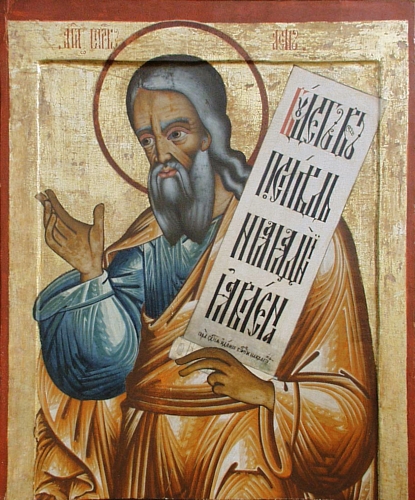 Source: Prophet Isaiah, Russian icon from the first quarter of the 18th century, iconostasis of the Transfiguration Church, Kizhi Monastery, via Wikimedia Commons, Public Domain Mark, https://commons.wikimedia.org/wiki/File:Isaiah.jpg
The following Renaissance frescoes are not Orthodox icons, but they are useful examples of Isaiah’s broader Christian artistic reception. Michelangelo emphasizes the prophet’s solemn inward attention; Raphael presents Isaiah as a monumental public witness holding the prophetic scroll.
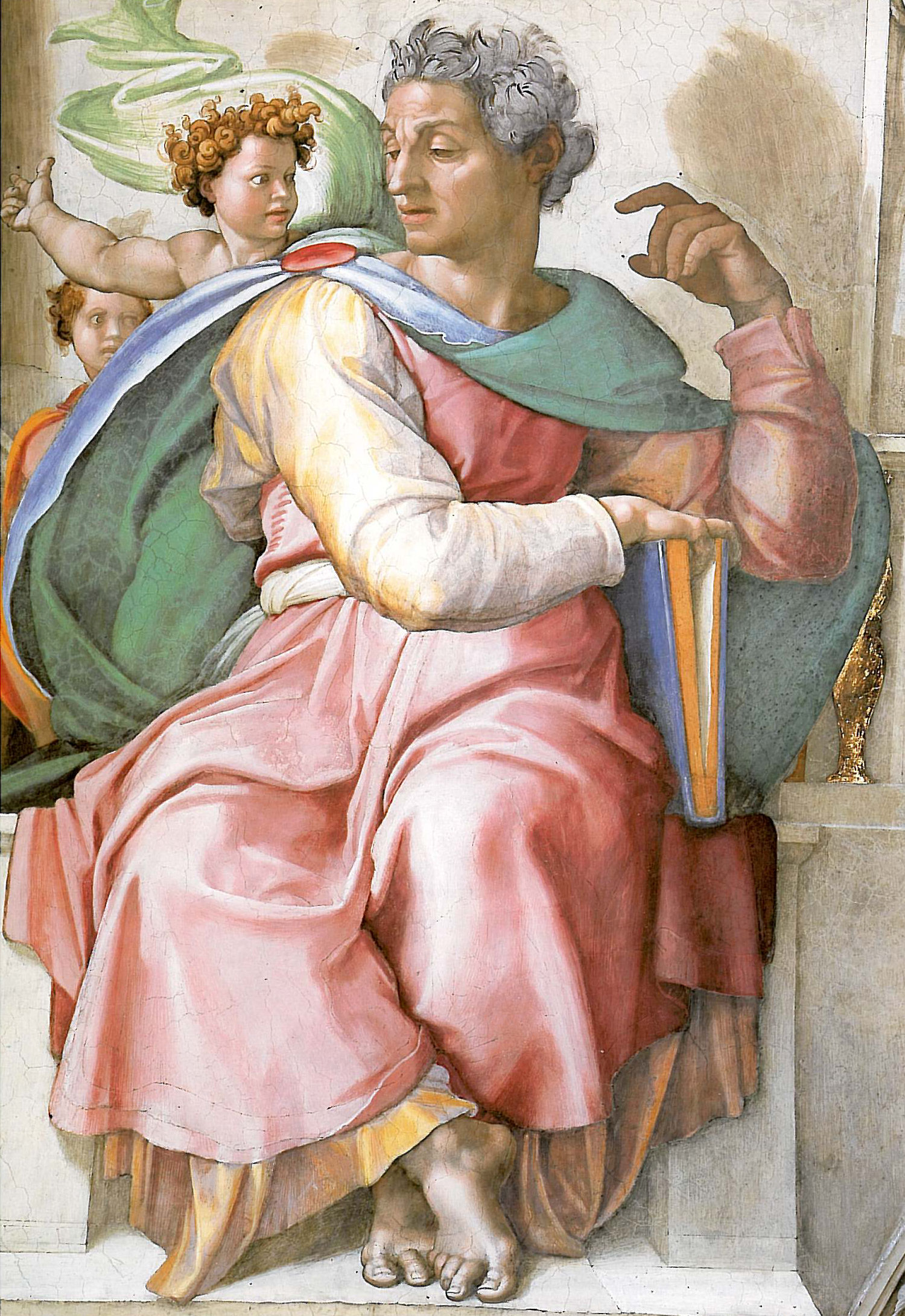 Source: Michelangelo, Prophet Isaiah, Sistine Chapel ceiling, via Wikimedia Commons, Public Domain Mark, https://commons.wikimedia.org/wiki/File:Jesaja_(Michelangelo).jpg
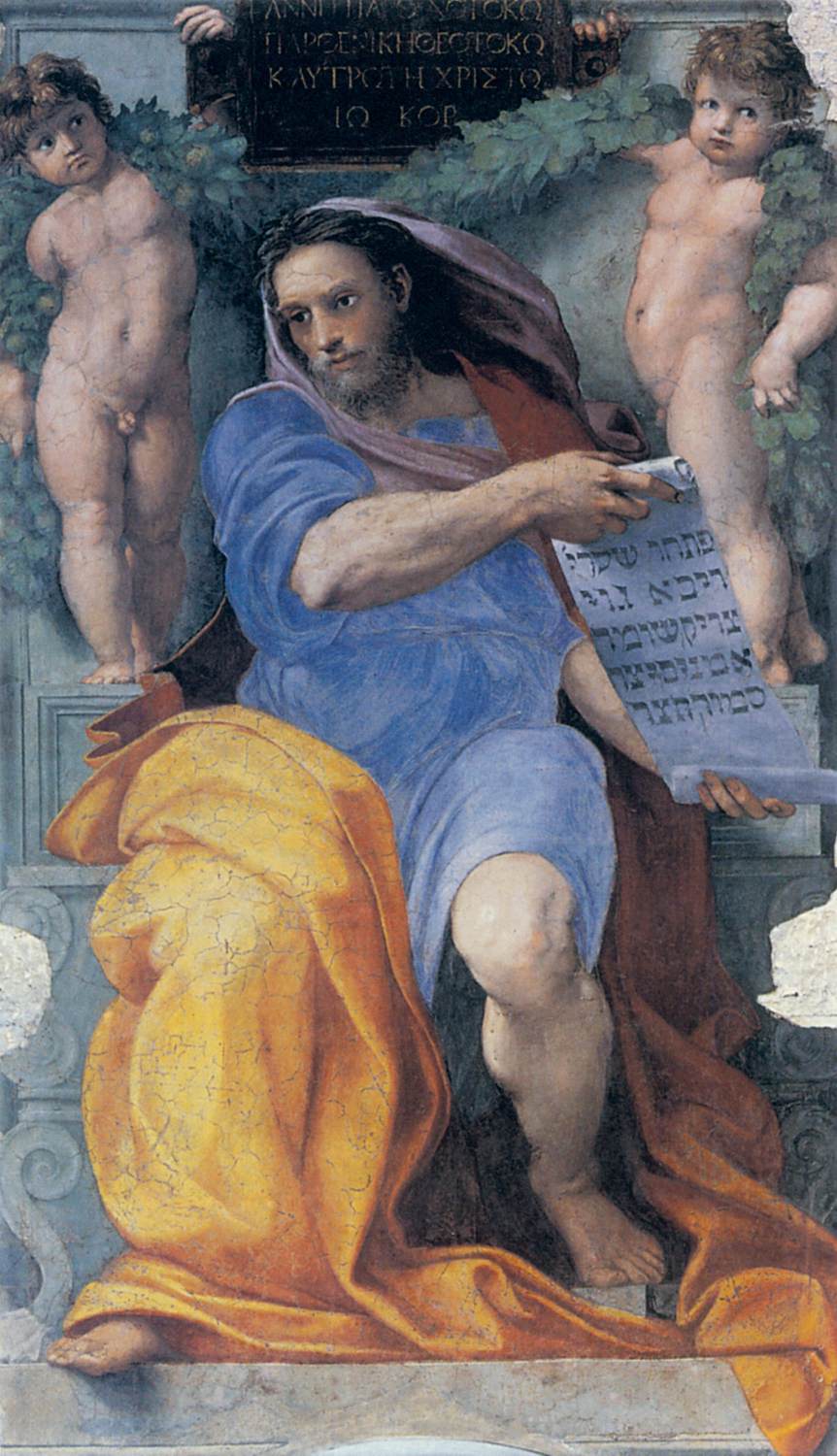 Source: Raphael, The Prophet Isaiah, fresco in Sant’Agostino, Rome, via Wikimedia Commons, Public Domain Mark, https://commons.wikimedia.org/wiki/File:Raffaello,_profeta_isaia.jpg
The coal from the altar in Isaiah 6 also resonates strongly with Eucharistic and liturgical language. The live coal touches the prophet’s lips and cleanses him. The Church receives Christ Himself from the altar, not as a symbol only, but as the divine gift that purifies soul and body. This connection should be handled reverently. Isaiah 6 does not erase its own historical meaning, but in the Church’s worship it opens naturally toward Eucharistic purification.
Spiritual Fruit 🍇
1. Let God name the wound before asking Him for comfort
Isaiah does not begin with comfort. He begins with exposure: sick head, faint heart, wounded body, polluted worship, injustice, and rebellion. The soul often wants Isaiah 40 without Isaiah 1. But the comfort of God is not anesthesia. It is healing. A practical fruit from Isaiah is to pray, “Lord, show me the wound I keep covering with religious language.”
2. Do not confuse religious activity with repentance
Isaiah is severe about worship without justice, prayer without mercy, fasting without humility, and offerings without a clean heart. This is especially important in Great Lent. More services, stricter fasting, and longer prayers can either heal the soul or hide the ego. Isaiah asks whether worship has made us more merciful, more truthful, less proud, more attentive to the poor, and more obedient to God.
3. Refuse the idols that look practical
Judah’s idols were not only carved images. They were alliances, calculations, military confidence, wealth, and fear dressed up as strategy. Modern idols often look responsible: control, status, image management, family reputation, financial security, productivity, even ministry success. Isaiah teaches the soul to ask, “What am I trusting because I am afraid to trust God?“
4. Learn comfort from the Servant, not from denial
Isaiah’s deepest comfort is not that suffering is unreal. It is that the Servant enters suffering, bears sin, intercedes for transgressors, and brings healing through His wounds. This makes Isaiah a book for wounded people who do not need shallow reassurance. Christ does not save us by explaining away pain. He saves by entering it, carrying it, defeating it, and making it a place of communion.
5. See the Church as Zion being healed, not as a finished trophy
Isaiah’s Zion is guilty and glorious, judged and restored, barren and fruitful, humiliated and radiant. This protects us from cynicism and triumphalism. The Church is holy because Christ is holy, but her people are still being purified. Isaiah teaches us to love the Church with repentance, not denial.
A Reader’s Map of Isaiah
This study collection contains one general introduction and thirty-three passage guides. The combined Isaiah 2-4 study follows one movement from Zion’s promised peace through judgment to purification and shelter. The map below follows the book’s literary movement; it is not a reconstructed chronology of Isaiah’s ministry.
| Guide | Why this grouping makes sense | What comes before and after |
|---|---|---|
| Introduction | Establishes authorship, history, translation, canon placement, liturgical use, and major Orthodox themes before the chapter notes. | Before Isaiah 1, it gives the reader the map for the whole book. |
| Isaiah 1 | Stands alone because it is the covenant lawsuit and spiritual diagnosis that opens the book. | It follows the title in 1:1 and prepares the Zion vision of 2-4. |
| Isaiah 2-4 | These chapters form an opening Zion unit: mountain of the Lord, day of the Lord, judgment of pride, and the Branch. | They follow the diagnosis of chapter 1 and lead into the vineyard song of chapter 5. |
| Isaiah 5 | The vineyard song deserves its own guide because it condenses love, judgment, injustice, and failed fruitfulness. | It follows Zion’s promised purification and precedes Isaiah’s personal call in chapter 6. |
| Isaiah 6 | Isaiah’s throne vision and cleansing stand alone as the spiritual source of the prophetic ministry. | It follows public indictment and prepares the Immanuel crisis of chapters 7-8. |
| Isaiah 7-8 | These chapters belong together around Ahaz, fear, Assyria, the sign of Immanuel, and the choice between trust and political panic. | They follow Isaiah’s commissioning and lead into the messianic light of 9-12. |
| Isaiah 9-12 | This is a coherent messianic and remnant movement: light in Galilee, the child, judgment, the rod from Jesse, and songs of salvation. | It follows Immanuel and precedes the oracles against the nations. |
| Isaiah 13-14 | Babylon and the fallen tyrant form the first major imperial judgment unit. | It opens the nations section after 9-12 and leads into Moab in 15-16. |
| Isaiah 15-16 | Moab is treated together because the oracle is one lament-shaped judgment. | It follows Babylon’s pride and leads to Damascus and Cush. |
| Isaiah 17-18 | Damascus and Cush show regional judgment and distant nations coming under the Lord’s gaze. | They follow Moab and prepare the Egypt oracle. |
| Isaiah 19-20 | Egypt’s humiliation and healing belong together with Isaiah’s sign-act against Egypt and Cush. | They follow regional oracles and lead to watchman oracles and Tyre. |
| Isaiah 21-23 | These shorter oracles share watchman imagery, desert burden, and the collapse of commercial glory in Tyre. | They complete the nations sequence before the cosmic apocalypse of 24-27. |
| Isaiah 24-27 | This section is rightly grouped as Isaiah’s apocalypse: world judgment, feast, death swallowed, songs, and resurrection hope. | It follows the nations oracles and leads into the woes of 28-33. |
| Isaiah 28-29 | These chapters expose pride, false refuge, drunken leadership, and lip-service worship. | They begin the woe sequence after the apocalypse and prepare the Egypt-trust warnings of 30-31. |
| Isaiah 30-31 | The two chapters belong together because both confront the temptation to seek security from Egypt instead of the Lord. | They follow blind worship and lead into the promised righteous king and secure Zion. |
| Isaiah 32-33 | These chapters pair the righteous king, Spirit-poured renewal, judgment, and Zion’s security. | They answer the false trusts of 30-31 and prepare the judgment-and-restoration contrast of 34-35. |
| Isaiah 34-35 | Edom’s judgment and the blossoming holy way form a strong contrast pair. | They close the pre-Hezekiah prophetic movement and prepare the historical hinge of 36-39. |
| Isaiah 36-39 | These chapters form the Hezekiah historical hinge: Assyria, prayer, deliverance, illness, pride, and Babylon. | They connect chapters 1-35 to the comfort section beginning in chapter 40. |
| Isaiah 40 | Kept standalone because it is the great turning point: comfort, new exodus, the voice in the wilderness, and the incomparable God. | It follows Hezekiah’s Babylon warning and opens the comfort movement. |
| Isaiah 41-42 | These chapters pair the Lord’s challenge to idols with the first major Servant presentation. | They follow comfort in chapter 40 and lead into the new exodus and anti-idol polemic of 43-44. |
| Isaiah 43-44 | These chapters belong together around redemption, “Fear not,” new exodus, witness, and the absurdity of idols. | They follow the Servant introduction and prepare Cyrus in 45-46. |
| Isaiah 45-46 | Cyrus, the Lord alone, and the collapse of idols form one sovereignty unit. | They follow the idol polemic of 43-44 and lead into Babylon’s fall in 47-48. |
| Isaiah 47-48 | Babylon’s fall and Israel’s call to depart belong together. | They complete the Cyrus/Babylon movement and prepare the Servant’s mission in 49-50. |
| Isaiah 49 | The Servant’s mission to Israel and the nations unfolds beside Zion’s fear of being forgotten and the Lord’s promise to gather her children. | It follows the departure from Babylon and prepares the obedient Servant of chapter 50. |
| Isaiah 50 | The obedient Servant listens, speaks, and gives His back to suffering while trusting the Lord’s vindication. | It follows the worldwide mission of chapter 49 and prepares Zion’s awakening in 51-52. |
| Isaiah 51:1-52:12 | Zion’s awakening, comfort, beautiful feet, holy departure, and new-exodus procession belong together. | They follow Isaiah 50’s obedient suffering and prepare the complete Fourth Servant Song by announcing the good news before revealing its cost. |
| Isaiah 52:13-53:12 | Kept as one complete Fourth Servant Song because 52:13-15 opens the exalted/marred Servant prophecy completed in chapter 53. | It stands at the heart of Holy Week and opens into covenant mercy, barren-Zion joy, and the invitation to the waters in 54-55. |
| Isaiah 54 | Barren Zion, restored bride, enlarged tent, covenant peace, jeweled city, and children taught by God stand as the immediate ecclesial fruit of the Suffering Servant’s Passion. | It follows Isaiah 52:13-53:12 and prepares Isaiah 55’s free invitation by showing the restored Zion who receives the Servant’s fruit. |
| Isaiah 55 | The free summons to the waters, the everlasting Davidic covenant, repentance while the Lord is near, and the effective Word form a distinct invitation unit. | It follows Zion’s restoration in Isaiah 54 and prepares Isaiah 56-57, where the question becomes who will cling to the covenant and who will persist in false worship. |
| Isaiah 56-57 | Kept together as one covenant-threshold unit: foreigners and eunuchs who take hold of the covenant are welcomed, false shepherds and idolatry are exposed, and the Most High heals the contrite with peace to those far and near. | They answer Isaiah 55 by showing who truly comes to the Lord, and they prepare Isaiah 58-59 by moving from false worship into the critique of false fasting and sin’s separation. |
| Isaiah 58-59 | Kept together as one false-worship-to-true-repentance diagnosis: Isaiah 58 exposes fasting without mercy, while Isaiah 59 shows sin’s separation, confession, collapse of truth, and the Lord’s own saving arm. | They follow false worship in 56-57 and prepare Zion’s glory in 60-62, where the Lord’s light answers the darkness confessed in 59. |
| Isaiah 60-62 | Kept together as one Zion-restoration unit: Isaiah 60 announces Zion illumined by the Lord and the nations gathered to her light; Isaiah 61 reveals the Spirit-anointed Christ who heals, frees, comforts, and clothes; Isaiah 62 shows Zion renamed, guarded by watchmen, and proclaimed not forsaken. Isaiah 61 has standalone Christological weight, but keeping it inside 60-62 preserves the movement from illuminated city to Anointed Restorer to renamed bride. | They follow the Lord’s intervention in 59, where sin’s darkness required divine rescue, and lead into the divine-warrior judgment and communal lament of 63-64, where promised glory still waits for mercy’s completion. |
| Isaiah 63-64 | Kept together as one divine-warrior-to-communal-lament unit: Isaiah 63:1-6 shows the Lord coming from Edom/Bosor with red garments, speaking righteousness and saving judgment; Isaiah 63:7-64:11 turns that vision into remembrance of mercy, confession of rebellion against the Holy Spirit, the cry to the Father, and the clay-in-the-potter’s-hands plea. Isaiah 63:1-7 has standalone Good Friday weight, but splitting at chapter 64 would sever the prayer because Brenton/LXX Isaiah 63:19 begins the open-heaven plea continued in Isaiah 64:1. | They follow Zion’s glory in 60-62 by showing the promised salvation confronting evil and sin, and they prepare the final answer in 65-66: judgment, true worship, comforted Jerusalem, new creation, and gathered nations. |
| Isaiah 65-66 | Kept together as Isaiah’s final answer to the unresolved lament of 63-64: Isaiah 65 distinguishes servants from rebels, gives a new name, and promises new heavens and new earth; Isaiah 66 tests final worship through humility, Zion’s sudden birth, Jerusalem’s consolation, the nations gathered and marked, and final judgment. Isaiah 65 has standalone new-creation weight and Isaiah 66 has standalone final-worship weight, but splitting them would weaken the book’s closing movement from answered lament to new creation, gathered nations, and holy worship. | They answer the lament of 63-64 and close the canonical book with all flesh called to worship before the Lord while rebellion is finally exposed. |
Glossary
- Amoz: Isaiah’s father. Not the prophet Amos.
- Assyria: The major imperial threat in Isaiah’s eighth-century setting.
- Babylon: Later imperial power associated with exile and human pride.
- Cyrus: Persian ruler named in Isaiah as an instrument used by the Lord for return.
- Great Isaiah Scroll: A near-complete Hebrew Isaiah manuscript from Qumran, before the Christian era.
- Holy One of Israel: A characteristic Isaianic title for God, holding together His holiness, covenant claim, judgment, and mercy.
- Immanuel: “God with us,” the sign in Isaiah 7:14, received by the Church in relation to Christ’s Incarnation.
- Latter Prophets: Hebrew Bible category that includes Isaiah, Jeremiah, Ezekiel, and the Twelve.
- Septuagint: The Greek Old Testament, central to Orthodox Scripture reception.
- Servant of the Lord: A key Isaianic figure fulfilled most deeply in Christ, especially in Isaiah 52:13-53:12.
- Zion: Jerusalem as both historical city and theological image of God’s purified people and gathered worship.
Translation and Source Notes
- Embedded Old Testament Scripture in the Isaiah chapter guides uses Brenton’s English Septuagint.
- Brenton titles the book Esaias. This project uses Isaiah in filenames and headings for readability.
- Brief New Testament references may use NKJV for limited personal study use.
- The Coptic Orthodox lectionary references were checked for Great Lent and Pascha-related Isaiah usage.
Sources
Primary sources
- Scripture: Isaiah, Brenton Septuagint; New Testament fulfillment and echo passages including Matthew 1, Matthew 3, Luke 4, Acts 8, Romans 10, and Revelation 21.
- St. Augustine, City of God 18.29, “What Things are Predicted by Isaiah Concerning Christ and the Church.”
- St. Athanasius, On the Incarnation 33-34.
- St. Basil the Great, On the Holy Spirit 16.38.
- Great Isaiah Scroll, Qumran, 1QIsaᵃ, for textual background.
Secondary academic sources
- Brevard S. Childs, Isaiah, Old Testament Library, for canonical and theological framing.
- John N. Oswalt, The Book of Isaiah, NICOT, for evangelical historical and exegetical background.
- Joseph Blenkinsopp, Isaiah 1-39, Isaiah 40-55, and Isaiah 56-66, Anchor Yale Bible, for critical background and compositional discussion.
Coptic Orthodox / pastoral sources
- Fr Bishoy Kamel, The Journey through Lent with Isaiah, modern Coptic pastoral reflections.
Web pages and non-academic sources cited
- New Advent Fathers access pages for Augustine, Athanasius, and Basil.
- Coptic lectionary references, especially Great Lent and Holy Week/Pascha readings.
Scripture text
- Brenton Septuagint, Isaiah entry point used for book-wide orientation: https://biblehub.com/sep/isaiah/1.htm
- Brenton Septuagint, Isaiah 40 as the comfort-section entry point: https://biblehub.com/sep/isaiah/40.htm
- Brenton Septuagint, Isaiah 53 as the Servant-song entry point: https://biblehub.com/sep/isaiah/53.htm
- Brenton Septuagint, Isaiah 66 as the final-vision entry point: https://biblehub.com/sep/isaiah/66.htm
Patristic source pages
- St. Augustine of Hippo, City of God 18.29, Isaiah on Christ and the Church: https://www.newadvent.org/fathers/120118.htm
- St. Athanasius of Alexandria, On the Incarnation, Isaiah and the Incarnation: https://www.newadvent.org/fathers/2802.htm
- St. Basil the Great, On the Holy Spirit, seraphic hymn and the Spirit: https://www.newadvent.org/fathers/3203.htm
Textual witness
- Israel Museum, Shrine of the Book, Dead Sea Scrolls / Great Isaiah Scroll context: https://www.imj.org.il/en/wings/shrine-book/dead-sea-scrolls
- Wikimedia Commons, Great Isaiah Scroll MS A image used in this guide, Public Domain Mark: https://commons.wikimedia.org/wiki/File:The_Great_Isaiah_Scroll_MS_A_(1QIsa)_-_Google_Art_Project.jpg
Geography and visual context
- OpenBible.info, all places mentioned in Isaiah, interactive map and KML: https://www.openbible.info/geo/preview/isa
- Project Gutenberg, Hurlbut Bible Atlas, public-domain biblical geography background: https://www.gutenberg.org/cache/epub/41140/pg41140-images.html
- Wikimedia Commons, Prophet Isaiah icon, Kizhi Monastery, Public Domain Mark: https://commons.wikimedia.org/wiki/File:Isaiah.jpg
- Wikimedia Commons, Michelangelo’s Prophet Isaiah, Public Domain Mark: https://commons.wikimedia.org/wiki/File:Jesaja_(Michelangelo).jpg
- Wikimedia Commons, Raphael’s The Prophet Isaiah, Public Domain Mark: https://commons.wikimedia.org/wiki/File:Raffaello,_profeta_isaia.jpg
- Also see The Digital Dead Sea Scrolls: http://dss.collections.imj.org.il/isaiah
Coptic readings
Coptic reading references follow the retained Great Lent cycle and service witnesses in @andraws/lectionary-data 1.3.5. Working service witnesses and historical records are distinguished in the discussion; printed references are not silently remapped to Brenton verse labels.
Teaching Notes
Overall teaching emphases
How to teach Isaiah as a whole book
A whole-book Isaiah study should not start by asking students to memorize scholarly divisions. Start with the spiritual movement: holiness, wound, repentance, trust, comfort, Servant, Zion, new creation. Then show how history and translation help us read that movement responsibly.
Suggested teaching flow
- 10 minutes: Isaiah’s historical crisis and canonical placement.
- 10 minutes: Why the Church reads Isaiah as a prophet of Christ and the Church.
- 15 minutes: Major themes: holiness, worship and justice, trust, Servant, Zion, nations, new creation.
- 10 minutes: Coptic Great Lent and Holy Week use.
- 10 minutes: How to read chapter groupings and translation notes.
- 5 minutes: Spiritual fruit and closing prayer.
Where to linger
Linger over Isaiah 6, Isaiah 7, Isaiah 25, Isaiah 40, Isaiah 53, Isaiah 58, Isaiah 61, and Isaiah 65-66. These are not the only important chapters, but they are major pillars for Orthodox teaching, worship, and spiritual formation.
Pastoral warnings
- Do not use Isaiah’s judgment language to sound harsh while avoiding repentance yourself.
- Do not reduce “justice” to political slogans. In Isaiah it begins with worship, mercy, truth, the poor, the widow, the orphan, and the fear of God.
- Do not reduce Isaiah’s messianic prophecies to apologetics. They are invitations to worship Christ.
- Do not teach the Servant’s suffering in a way that glorifies abuse or tells victims to remain in harm. Christ’s voluntary suffering saves; human cruelty remains sin.
- Do not treat Coptic lectionary placement as decoration. When a passage is read in Lent or Holy Week, explain the spiritual logic of that placement.
Consolidated section teaching cues
The spiritual movement of Isaiah
- Key phrases: “holy comfort,” “wound to worship,” “the Holy One heals by telling the truth.”
- Emphasize: Isaiah’s comfort is not sentimental. It comes through repentance, purification, and the Servant’s suffering.
- Avoid: Treating Isaiah as only messianic prooftexts or only social critique. The book is both, held in worship.
Patristic anchors for the whole book
- Key phrases: “Isaiah as evangelist,” “the prophet of Christ and the Church,” “Great Lent as Isaiah’s school of repentance.”
- Emphasize: Use direct patristic quotes sparingly, but let them shape the interpretation.
- Avoid: Dropping Father names into chapter notes without letting their insight actually explain the passage.
Christological and typological reading
- Key phrases: “Christ does not merely appear in Isaiah; He gathers a people through Isaiah’s promises.”
- Emphasize: Every moral exhortation in Isaiah must be anchored in Christ’s cleansing and victory.
- Avoid: Reducing Isaiah to a set of isolated predictions detached from repentance, worship, and the Church.
Footnotes
-
St. Augustine, City of God 18.29, https://www.newadvent.org/fathers/120118.htm. ↩
-
St. Athanasius, On the Incarnation 33.3, https://www.newadvent.org/fathers/2802.htm. ↩
-
St. Basil the Great, On the Holy Spirit 16.38, https://www.newadvent.org/fathers/3203.htm. The question concerns the Spirit’s work in the seraphim’s praise. ↩
-
Fr Bishoy Kamel, The Journey through Lent with Isaiah, Introduction; modern Coptic pastoral reflection on repentance, spiritual health, and the journey toward resurrection hope. English archival text; translator and published edition are not identified. ↩ ↩2