


This narration is from a previous version of the study and may include a combined recording of multiple chapters.
Isaiah 45-46 continues the movement that began in Isaiah 40: comfort after judgment, the exposure of idols, and the Lord’s sovereign promise to redeem His people. Here the Lord names Cyrus, a Persian king not yet born when Isaiah prophesies, as His instrument for returning Israel from exile and rebuilding Jerusalem. But the passage is not ultimately about Cyrus. It is about the Lord alone: the God who calls rulers by name, opens locked gates, forms light, governs history, saves the ends of the earth, carries His people from infancy to old age, and brings His righteousness near without delay.
The great spiritual contrast is simple and devastating: idols must be carried by tired worshipers, but the Lord carries His weary people. Babylon’s gods, Bel and Nabo, become baggage. The living God becomes salvation.
2. Why This Passage Matters
This passage matters because it teaches us how to see history without panic. Empires rise and fall. Political rulers may serve God’s providence without knowing Him. Human power can be real and still be secondary. Cyrus is called the Lord’s “anointed” because God appoints him for a historical deliverance, but Cyrus is not the Messiah in the full sense. He is a limited providential deliverer whose work points beyond itself to Christ, the true Anointed One, who opens not merely city gates but the gates of death and Hades.
Isaiah also presses a pastoral question: Who carries whom? The idolater carries his god, pays for it, fixes it in place, and cries to something that cannot answer. The faithful are carried by God from the womb, through old age, through exile, through repentance, and into salvation. This is not passive religion. It is repentance grounded in trust: “Return in your heart” (Isaiah 46:8).
3. Placement in Isaiah and Grouping Rationale
Why Isaiah 45-46 stay together
Isaiah 45 and 46 should stay together in one guide. Chapter 45 continues the Cyrus material introduced at the end of Isaiah 44: the Lord raises a foreign king, opens doors before him, and declares His universal sovereignty. Chapter 46 then shows the theological consequence: Babylon’s gods are exposed as helpless burdens, while the Lord alone carries, saves, and accomplishes His counsel.
Splitting the chapters would weaken the argument. Isaiah 45 explains who rules history; Isaiah 46 explains why idols cannot save within history. Together they form one proclamation: the Lord alone is God, and His salvation is not delayed.
What comes before
Before this passage, Isaiah 43-44 showed Israel redeemed by name, called through water and fire, summoned as witness, promised the Spirit, warned against idols, and prepared for Cyrus as the historical hinge into restoration.
What comes after
After this passage, Isaiah 47-48 turns directly to Babylon’s fall and Israel’s summons to leave Babylon in peace. Isaiah 45-46 therefore prepares the reader to understand Babylon’s collapse not as accident but as the Lord’s righteous act.
4. Historical and Scriptural Context
Cyrus II of Persia conquered Babylon in 539 BC. The biblical books of Ezra and 2 Chronicles remember him as the ruler through whom the Jews were permitted to return and rebuild the temple (Ezra 1:1-4; 2 Chronicles 36:22-23). Isaiah’s prophecy presents Cyrus not as an independent savior but as an instrument in the Lord’s hand.
Historical map: Cyrus invasion of Babylonia map. The map helps the reader see that Isaiah’s language about gates, bars, Babylon, and return belongs to real imperial history. At the same time, Cyrus remains a limited providential instrument. Christ alone is the true and final Anointed One who opens the gates of death and brings His people home.
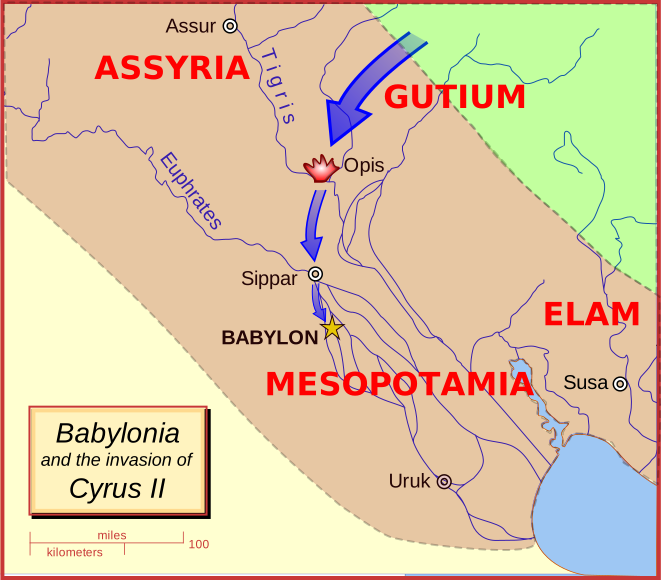 Source: ChrisO, Cyrus the Great’s invasion of Babylonia in 539 BC, via Wikimedia Commons, public domain, https://commons.wikimedia.org/wiki/File:Cyrus_invasion_of_Babylonia.svg
This has two important theological implications:
- God’s sovereignty is larger than Israel’s visible circumstances. Exile does not mean the Lord has lost control.
- God can use even those who do not fully know Him. Twice the Lord says of Cyrus, “thou hast not known me” (Isaiah 45:4-5). The effectiveness of God’s providence does not depend on Cyrus’s personal holiness.
Isaiah 46 shifts from Cyrus to Babylon’s gods: Bel and Nabo. These were major Babylonian deities, associated with royal power, wisdom, writing, and destiny. Isaiah mocks them not because spiritual worship is unimportant, but because false worship makes man smaller. The idol is heavy, silent, immobile, and unable to save. The Lord, by contrast, speaks, carries, remembers, foretells, acts, and saves.
5. Scripture Text - Brenton Septuagint
Isaiah 45
1 Thus saith the Lord God to my anointed Cyrus, whose right hand I have held, that nations might be obedient before him; and I will break through the strength of kings; I will open doors before him, and cities shall not be closed. 2 I will go before thee, and will level mountains: I will break to pieces brazen doors, and will burst iron bars. 3 And I will give thee the treasures of darkness, I will open to thee hidden, unseen treasures, that thou mayest know that I, the Lord thy God, that call thee by name, am the God of Israel. 4 For the sake of my servant Jacob, and Israel mine elect, I will call thee by thy name, and accept thee: but thou hast not known me. 5 For I am the Lord God, and there is no other God beside me; I strengthened thee, and thou hast not known me. 6 That they that come from the east and they that come from the west may know that there is no God but me. I am the Lord God, and there is none beside. 7 I am he that prepared light, and formed darkness; who make peace, and create evil; I am the Lord God, that does all these things.
8 Let the heaven rejoice from above, and let the clouds rain righteousness: let the earth bring forth, and blossom with mercy, and bring forth righteousness likewise: I am the Lord that created thee.
9 What excellent thing have I prepared as clay of the potter? Will the ploughman plough the earth all day? shall the clay say to the potter, What art thou doing that thou dost not work, nor hast hands? shall the thing formed answer him that formed it? 10 As though one should say to his father, What wilt thou beget me? and to his mother, What art thou bringing forth?
11 For thus saith the Lord God, the Holy One of Israel, who has formed the things that are to come, Enquire of me concerning my sons, and concerning the works of my hands command me. 12 I have made the earth, and man upon it: I with my hand have established the heaven; I have given commandment to all the stars. 13 I have raised him up to be a king with righteousness, and all his ways are right: he shall build my city, and shall turn the captivity of my people, not for ransoms, nor for rewards, saith the Lord of hosts.
14 Thus saith the Lord of hosts, Egypt has laboured for thee; and the merchandise of the Ethiopians, and the Sabeans, men of stature, shall pass over to thee, and shall be thy servants; and they shall follow after thee bound in fetters, and shall pass over to thee, and shall do obeisance to thee, and make supplication to thee: because God is in thee; and there is no God beside thee, O Lord. 15 For thou art God, yet we knew it not, the God of Israel, the Saviour. 16 All that are opposed to him shall be ashamed and confounded, and shall walk in shame: ye isles, keep a feast to me. 17 Israel is saved by the Lord with an everlasting salvation: they shall not be ashamed nor confounded for evermore.
18 Thus saith the Lord that made the heaven, this God that created the earth, and made it; he marked it out, he made it not in vain, but formed it to be inhabited: I am the Lord, and there is none beside. 19 I have not spoken in secret, nor in a dark place of the earth: I said not to the seed of Jacob, Seek vanity: I, even I, am the Lord, speaking righteousness, and proclaiming truth.
20 Assemble yourselves and come; take counsel together, ye that escape of the nations: they that set up wood, even their graven image, have no knowledge, nor they who pray to gods that do not save. 21 If they will declare, let them draw nigh, that they may know together, who has caused these things to be heard from the beginning: then was it told you. I am God, and there is not another beside me; a just God and a Saviour; there is none but me. 22 Turn ye to me, and ye shall be saved, ye that come from the end of the earth: I am God, and there is none other. 23 By myself I swear, righteousness shall surely proceed out of my mouth; my words shall not be frustrated; that to me every knee shall bend, and every tongue shall swear by God, 24 saying, Righteousness and glory shall come to him: and all that remove them from their borders shall be ashamed. 25 By the Lord shall they be justified, and in God shall all the seed of the children of Israel be glorified.
Isaiah 46
1 Bel has fallen, Nabo is broken to pieces, their graven images are gone to the wild beasts and the cattle: ye take them packed up as a burden to the weary, exhausted, hungry, and at the same time helpless man; 2 who will not be able to save themselves from war, but they themselves are led away captive.
3 Hear me, O house of Jacob, and all the remnant of Israel, who are borne by me from the womb, and taught by me from infancy, even to old age: 4 I am he; and until ye shall have grown old, I am he: I bear you, I have made, and I will relieve, I will take up and save you.
5 To whom have ye compared me? see, consider, ye that go astray. 6 They that furnish gold out of a purse, and silver by weight, will weigh it in a scale, and they hire a goldsmith and make idols, and bow down, and worship them. 7 They bear it upon the shoulder, and go; and if they put it upon its place, it remains, it cannot move: and whosoever shall cry to it, it cannot hear; it cannot save him from trouble.
8 Remember ye these things, and groan: repent, ye that have gone astray, return in your heart; 9 and remember the former things that were of old: for I am God, and there is none other beside me, 10 telling beforehand the latter events before they come to pass, and they are accomplished together: and I said, All my counsel shall stand, and I will do all things that I have planned: 11 calling a bird from the east, and from a land afar off, for the things which I have planned: I have spoken, and brought him; I have created and made him; I have brought him, and prospered his way.
12 Hearken to me, ye senseless ones, that are far from righteousness: 13 I have brought near my righteousness, and I will not be slow with the salvation that is from me: I have given salvation in Sion to Israel for glory.
6. The Text Broken Open
Isaiah 45:1-7 - Cyrus is held by the Lord’s hand
Cyrus is called the Lord’s “anointed” because he is appointed for a task: to break Babylon’s power, open gates, release captives, and allow Jerusalem and the temple to be rebuilt. Cyrus receives a royal task; Christ is the incarnate Son, the true Anointed One, who fulfills kingship, priesthood and prophecy and saves us.
The Lord says to Cyrus, “I will open doors before him” (45:1), and “I will break to pieces brazen doors” (45:2). Historically, this points to Babylon’s fall. In Christian contemplation, the broken gates can also recall Christ’s greater victory over death. That fulfillment does not turn Cyrus himself into the eternal Son.
Cyrus also receives “hidden, unseen treasures” (45:3). At the literal level, this refers to the spoils and treasures of conquered cities. At the spiritual level, the hidden treasure is the mystery of God’s saving work, revealed to the faithful when the Lord opens the Scriptures.
The repeated line, “thou hast not known me” (45:4-5), prevents sentimental reading. God uses Cyrus, but Cyrus is not Israel, not a prophet, not the final Savior. God’s freedom is the point: He can make even the decisions of empires serve His covenant mercy.
Isaiah 45:7 - Light, darkness, peace, and calamity
Brenton renders the verse: “I am he that prepared light, and formed darkness; who make peace, and create evil.” Here “evil” stands opposite peace: calamity and judgment, not wickedness as sin. The Lord does not surrender history to a rival power when peace gives way to disaster.
John Chrysostom explains that Isaiah uses ordinary speech, in which people call calamities evils. He distinguishes such affliction from the moral evil we choose.1 God is not the author of sin. Isaiah is not giving us permission to diagnose another person’s illness, injury or abuse as punishment. We may seek repentance in our own trials without blaming the wounded or excusing those who hurt them.
Isaiah 45:8 - The heavens rain righteousness
The command, “Let the heaven rejoice from above, and let the clouds rain righteousness,” turns cosmic imagery into hope. Creation itself is summoned to participate in salvation. Notice what the earth is to bring forth: mercy together with righteousness. The gift from above is not an excuse to abandon life below. Received mercy is to become truthful worship, justice, and care for our neighbors. In Christian life, baptism and the apostolic Gospel open this life of grace; they are not the literal meaning of the clouds in this verse.
Isaiah 45:9-13 - The Maker, our questions, and His saving work
Verse 9 asks whether the thing formed can answer back to its maker; verse 10 changes the image to a child challenging father and mother over its begetting. These are rebukes of the creature’s claim to sit in judgment over the source of its life. They do not make humble prayer a sin. The One who made heaven and earth also raises Cyrus to rebuild the city and turn captivity without ransom.
Yet verse 11 really does say, “Enquire of me concerning my sons, and concerning the works of my hands command me.” Its imperative is difficult beside the rebuke just heard. In context we may distinguish bringing our petitions to the Maker from demanding mastery over His work, but that pastoral distinction does not settle the precise force of “command me.” The clay is not asked to stop praying; neither is the Creator reduced to our instrument.
Isaiah 45:14-17 - God the Savior, once unrecognized
The nations confess, “God is in thee; and there is no God beside thee, O Lord” (45:14), followed by: “For thou art God, yet we knew it not, the God of Israel, the Saviour” (45:15). This wording stresses recognition of the God who saves, not a literal title “hidden God.” Christians recognize Christ, God and Savior, whose humility can conceal His glory from eyes trained to admire power.
Cyril of Jerusalem reads these verses with Christ’s words about the Father dwelling in Him: the Son is truly God, without separation from the Father or confusion of their persons.2 Verse 14 also speaks in ancient conquest images: servants, fetters, and obeisance. We must not glide past them. This oracle is not Christian permission to enslave peoples or compel belief. The saving invitation to the ends of the earth in verse 22 summons the nations to God, not to ethnic subjugation.
Isaiah 45:18-22 - Salvation to the ends of the earth
The Lord did not create the earth “in vain” but “formed it to be inhabited” (45:18). Salvation is not an escape from creation as if matter were evil. The Creator intends His world for life, communion, worship, and restoration. Methodius uses this verse to defend creation’s continuing purpose: renewal, not a universe made merely to be destroyed.3
Then the call widens: “Turn ye to me, and ye shall be saved, ye that come from the end of the earth” (45:22). The Lord who rules Cyrus is not a tribal deity. The God of Israel is the Savior of the ends of the earth.
Isaiah 45:23-25 - Every knee shall bend
Isaiah 45:23 is one of the most important Christological bridges in the chapter. The Lord swears by Himself: “to me every knee shall bend, and every tongue shall swear by God.” St. Paul applies this language to Christ in Philippians 2:10-11: “that at the name of Jesus every knee should bow… and that every tongue should confess that Jesus Christ is Lord, to the glory of God the Father” (NKJV).
The worship due to the Lord in Isaiah is fulfilled in the confession of Jesus Christ as Lord. The Son receives the bending of every knee without stealing glory from the Father; rather, this confession is “to the glory of God the Father.” Christian worship does not exchange one god for another. It confesses the incarnate Son in the glory of the one God.
Isaiah 46:1-2 - Bel and Nabo are burdens
Isaiah now shows the end of idolatry. Bel falls. Nabo is broken. Their images are packed onto animals like cargo. The satire is spiritually sharp: the gods who were supposed to carry Babylon’s destiny must themselves be carried away.
The images cannot rescue even themselves. Their worshipers spend strength protecting the objects from which they had hoped to receive protection. Isaiah exposes the reversal so that exhausted people may stop entrusting their lives to what cannot hear them.
This is also where the guide must distinguish carefully between idols and Orthodox icon veneration. Isaiah condemns manufactured gods that are worshiped as divine and trusted to save. Orthodox icons are not gods, not magical objects, and not replacements for Christ. They confess the Incarnation and direct honor to the prototype. So the anti-idolatry warning should lead to purified worship, not iconoclasm.
Isaiah 46:3-4 - The Lord carries His people
The heart of chapter 46 is the contrast between carried idols and the carrying God. The Lord says His people have been “borne by me from the womb” and that even to old age He will bear, relieve, take up, and save them.
Augustine turns this into prayer: “Thou wilt bear us up when we are little and even down to our gray hairs thou wilt carry us. For our stability, when it is in thee, is stability indeed; but when it is in ourselves, then it is all unstable.”4 The Christian life is not self-salvation with religious decoration. Our stability is God Himself.
Isaiah 46:5-8 - Return to the heart
After exposing idols, the Lord calls His people inward: “Remember ye these things, and groan: repent, ye that have gone astray, return in your heart” (46:8). Repentance is not merely external correction. It is a return to the place where the image of God must be healed.
Augustine reads the return to the heart as the beginning of return to the Lord: come back from outward wandering to the inner person, where Christ dwells and renews His image.5
This is spiritually essential. Idolatry scatters the soul outward into things that cannot answer. Repentance gathers the soul inward before God, not for self-absorption but for communion.
Isaiah 46:9-13 - The Lord’s counsel stands
The Lord declares the end from the beginning. His counsel stands. He calls the bird from the east and brings near His righteousness. Historically, this again evokes Cyrus and the overthrow of Babylon. Christian hope reaches beyond that deliverance: return from one exile is not yet humanity’s release from sin and death. We give thanks for a temporal rescue without asking it to do the work of the Savior.
The chapter ends with urgency and comfort: “I have brought near my righteousness, and I will not be slow with the salvation that is from me: I have given salvation in Sion to Israel for glory” (46:13). The Lord is not delayed. What feels slow to exiles is not negligence but providence.
7. Orthodox Theological Reading
The Lord alone rules history
Isaiah 45-46 rejects both pagan fatalism and secular randomness. History is not governed by idols, astrology, imperial force, or chance. The Lord forms light, governs darkness, raises kings, humbles cities, exposes false gods, and brings salvation to Zion. This does not make every ruler righteous. It means no ruler is ultimate.
Providence does not erase repentance
God’s sovereignty does not make repentance unnecessary. The same passage that says, “All my counsel shall stand” also says, “repent… return in your heart.” Orthodox spirituality holds these together: God’s grace acts first, but the human person must turn, confess, and respond.
True worship lightens the soul; idolatry burdens it
The idol is carried. The worshiper becomes exhausted. False worship always becomes a weight: fear, compulsion, pride, control, addiction, ideology, or self-justification. The Lord carries His people. True worship does not make life painless, but it moves the center of weight from the self to God.
Creation is good and destined for restoration
Isaiah 45:18 matters because it refuses a world-denying spirituality. God did not make the earth in vain. He formed it to be inhabited. Christian hope is not hatred of creation but the transfiguration and renewal of creation in Christ.
8. Christological Reading
Cyrus as limited type of Christ
Cyrus is called anointed because he is chosen for royal deliverance. He points typologically to Christ by opening doors, breaking bars, releasing captivity, and making return possible. But he remains limited: he does not fully know the Lord, and his deliverance is political and historical. Christ is the true Anointed One who knows the Father, is one with Him, and releases humanity from sin, death, and the devil.
The broken gates and Christ’s descent
Isaiah 45:2 says the Lord will break brazen doors and burst iron bars. Christian reading can contemplate Christ’s victory over death through this picture of opened captivity. The literal fall of Babylon remains the historical scene; the greater liberation is Christ’s Passion, Resurrection, and descent to Hades.
The hidden treasures and Hades
The treasures of darkness first belong to the conquest scene. As a Christian meditation, the image can also turn our attention toward the righteous dead awaiting Christ’s victory. This is a typological association, not a second dictionary meaning of “treasures.” Christ opens what no earthly ruler could open and gives life where imperial wealth could never save.
Every knee bends to Christ
Isaiah 45:23 is fulfilled in Christ according to Philippians 2. The worship of the Lord in Isaiah is not displaced but revealed in the confession of Jesus Christ as Lord. This is why the Church bows, worships, and confesses Christ without compromising monotheism.
Zion’s salvation and the Church
Isaiah 46:13 gives salvation in Zion. In Christian fulfillment, the historical return from exile becomes a sign of humanity’s return to God. The Church gathered in Christ receives a salvation wider than the particular release accomplished under Cyrus.
9. Christological Types and Prophecies
- Cyrus the anointed: A limited type of Christ’s royal deliverance. Cyrus opens Babylon; Christ opens death.
- Opened doors and broken bars: A type of liberation from bondage, fulfilled fully in Christ’s Passion, Resurrection, and descent to Hades.
- Treasures of darkness: Historically royal treasure; spiritually the righteous dead and hidden mysteries revealed by Christ.
- Righteousness raining from heaven: Fulfilled in the Incarnation, apostolic preaching, baptismal grace, and the Church’s sacramental life.
- The earth blossoming with mercy: A new-creation image fulfilled in Christ and extended through the life of the Church.
- Every knee bending: Explicitly applied to Christ in Philippians 2:10-11.
- The Lord carrying His people: Fulfilled in the Shepherd who bears the lost sheep and carries human nature through death into resurrection.
- Salvation brought near in Zion: Fulfilled in the Church as the restored people gathered in Christ.
10. Coptic Lectionary Connections
The Lenten cycle and Bright Saturday service-order witnesses used here place these readings as follows. These are bounded service witnesses, not a claim about every edition.
Readings and their companions
- Isaiah 45:1-10: Thursday of the sixth week of Great Lent, Matins prophecy set, with 2 Kings 4:8-37, Proverbs 9:1-11, Job 35:1-16, and Sirach 11:1-10.
- Isaiah 45:11-17: Friday of the sixth week of Great Lent, Matins prophecy set, with Genesis 22:1-18, Proverbs 9:12-18, Job 36:1-33, Job 37:1-4, and the Tobit sequence.
- Isaiah 45:15-20: Bright Saturday, Ninth Hour, with Jeremiah 31:31-34 and John 5:21-30.
Liturgical significance
The Lenten companions bring providence into contact with resurrection, Abraham’s testing, wisdom, and endurance. The king who opens a road home is not the source of life; the Lord who calls him is. This can train the penitent to receive God’s help without making an instrument into an idol.
At Bright Saturday Ninth Hour, the confession of God the Savior stands beside the new-covenant promise and the Son who gives life and calls the dead to rise. We may hear these readings together as an invitation to recognize Christ’s saving power even at the tomb. This is a Christian contemplation of the service, not a claim that Brenton calls Him literally “hidden” in verse 15.
11. Patristic Commentary Highlights
Chrysostom on calamity and sin
Chrysostom’s distinction protects the reading of Isaiah 45:7: affliction called evil in ordinary speech is not the same thing as wickedness. It does not authorize us to assign guilt to an injured neighbor.1
Cyril of Jerusalem on the Son’s divinity
Cyril joins Isaiah’s confession to the Gospel’s mutual indwelling of Father and Son. His interpretation guards both the Son’s true Godhead and the distinction of persons.2
Methodius on the purpose of creation
Methodius uses Isaiah 45:18 to argue that the world was not created merely to be destroyed. His resurrection hope illuminates the verse’s insistence that God made the earth for habitation.3
Augustine on being carried and returning
In Confessions IV.16.31, Augustine places the weakness of little children and old age within God’s faithful support. The prayer already quoted is a fitting companion to the promise of Isaiah 46:4.4 His exposition of returning to the heart directs inward attention toward Christ, not toward self-absorption.5
12. Spiritual Lessons
- Do not confuse God’s instruments with God Himself. Cyrus is useful, but the Lord alone saves.
- God can work through people who do not yet know Him. This should make us humble, not cynical.
- Affliction is not proof that God is absent. Seek repentance without diagnosing another sufferer’s guilt, and offer practical care to the wounded.
- False gods become burdens. Anything we must carry as ultimate will eventually exhaust us.
- The Lord carries His people. Christian stability is not self-mastery but life in God.
- Repentance begins by returning to the heart. The scattered soul must come home before God.
- Christ is the true Anointed One. Every partial deliverance points toward His complete deliverance.
- Christ is God and Savior, even when unrecognized in humility. Learn to recognize His saving work rather than measuring Him by worldly splendor.
- Every knee will bend. The only question is whether we bend now in love or later in exposure.
- Salvation is near. The Lord says He will not delay, even when the exile feels long.
14. Closing Meditation
The idols of Babylon fall because they were never alive. They are packed up, carried away, and unable to save those who trusted them. But the Lord speaks to His people with fatherly tenderness: “I bear you, I have made, and I will relieve, I will take up and save you.” This is the Gospel hidden in Isaiah’s prophecy. We do not carry God into history; He carries us through history. We do not open the gates of death; Christ breaks them. We do not manufacture salvation; the Lord brings His righteousness near.
Therefore return to the heart. Let the false gods become heavy enough to drop. Let every knee bend now in repentance and worship. The Lord who called Cyrus by name also calls His people by name, and His salvation will not be slow.
15. Translation, Version, and Source Notes
The Old Testament Scripture text embedded in this guide is from Brenton’s English Septuagint, public domain. Brenton uses the title Esaias; this project uses the standard English title Isaiah.
Brief New Testament references quoted from the New King James Version for limited personal study use.
Patristic witnesses are cited by work and section in the footnotes. Augustine and Methodius offer wider Christian witnesses alongside the received doctrinal and exegetical voices used here.
Direct Source Pages and Verification Links
Scripture text
- Brenton Septuagint, Isaiah 45: https://biblehub.com/sep/isaiah/45.htm
- Brenton Septuagint, Isaiah 46: https://biblehub.com/sep/isaiah/46.htm
Patristic source pages
- John Chrysostom, On the Power of Demons, Homily I.5: https://www.catholicculture.org/culture/library/fathers/view.cfm?recnum=2066
- Cyril of Jerusalem, Catechetical Lecture XI.16: https://www.ccel.org/ccel/schaff/npnf207.ii.xv.html#ii.xv-p96
- Methodius, On the Resurrection I.VIII: https://www.ccel.org/ccel/schaff/anf06.xi.v.i.html
- Augustine, Confessions IV.16.31: https://ccel.org/ccel/augustine/confessions.vii.html
- Augustine, Tractates on John XVIII.10: https://www.newadvent.org/fathers/1701018.htm
Geography and visual context
- OpenBible.info, all places mentioned in Isaiah, interactive map and KML: https://www.openbible.info/geo/preview/isa
- Project Gutenberg, Hurlbut Bible Atlas, public-domain biblical geography background: https://www.gutenberg.org/cache/epub/41140/pg41140-images.html
- Wikimedia Commons, Cyrus invasion of Babylonia map, public domain: https://commons.wikimedia.org/wiki/File:Cyrus_invasion_of_Babylonia.svg
Coptic lectionary provenance
- The service connections above follow the named Lenten cycle or local Pascha and Bright Saturday witnesses; no universal agreement of editions is asserted.
Teaching Notes
Overall teaching emphases
- Main teaching aim: Help the class read Isaiah 45-46 - Cyrus and the Lord Alone as part of Isaiah’s movement from judgment to hope, with Christ and the Church in view.
- Where to linger: Slow down at the guide’s stated turning points, verified lectionary anchors, patristic witnesses, and difficult pastoral guardrails rather than racing through every verse.
- Teacher preparation: Read the cited containing passages before quoting a Father; preserve each service witness’s scope and the distinction between direct exposition and Christian contemplation.
- Show: Use the Cyrus map to show providence through history, but say clearly that Cyrus is a limited instrument and Christ is the true and final Anointed One.
Class-use guardrails
- Keep the grouping rationale visible so the guide does not become a loose collection of devotional points.
- Distinguish verified lectionary evidence from broader liturgical resonance.
- Do not quote secondary access points as if they were direct patristic authority.
Discussion questions
Why does Isaiah call Cyrus “anointed,” and why must we still distinguish Cyrus from Christ?
What does this passage teach about God’s ability to use political rulers without making them spiritually ultimate?
Where do you see the contrast between idols being carried and God carrying His people?
What are modern forms of “heavy” idolatry that exhaust the soul?
How does Isaiah 45:23 deepen our understanding of Philippians 2:10-11?
What does it mean to “return in your heart” during Lent?
Why is Isaiah 45:15-20 fitting for Bright Saturday?
How does the Lord’s sovereignty comfort rather than crush the faithful?
Footnotes
-
John Chrysostom, On the Power of Demons, Homily I.5. https://www.catholicculture.org/culture/library/fathers/view.cfm?recnum=2066. ↩ ↩2
-
Cyril of Jerusalem, Catechetical Lecture XI.16. https://www.ccel.org/ccel/schaff/npnf207.ii.xv.html#ii.xv-p96. ↩ ↩2
-
Methodius, On the Resurrection I.VIII. https://www.ccel.org/ccel/schaff/anf06.xi.v.i.html. ↩ ↩2
-
Augustine, Confessions IV.16.31, Albert C. Outler translation. https://ccel.org/ccel/augustine/confessions.vii.html. ↩ ↩2
-
Augustine, Tractates on John XVIII.10. https://www.newadvent.org/fathers/1701018.htm. ↩ ↩2