


This narration is from a previous version of the study and may include a combined recording of multiple chapters.
The king opens a sealed door, sees an empty table, and blesses the idol. “Great art thou, O Bel, and with thee is no deceit at all.” The seals are whole. That is what he trusts. He has not yet looked at the floor.
This is the first half of a conversion. The second cry, “Great art thou, O Lord God of Daniel,” belongs to the next study. Here the king is still being schooled, and Daniel is still the man who will not feed a dead thing with the worship that belongs to the living God. The overview sets the book in Greek Daniel and in the Church’s Lent.
Brenton prints these verses as Bel and the Dragon 1-22, a separate book. The Coptic Katameros cites the whole story as Daniel 14. One 2026 readings list gives Daniel 14:1-42. A printed Midlands Lent Katameros gives 14:2-42, beginning at “Daniel conversed with the king,” because the verse about Astyages and Cyrus was often counted with Susanna in the Latin Bible. The Hebrew and Aramaic Daniel ends at chapter 12. Greek Daniel, which the Church received, did not. Standard NKJV editions omit this book. The words below are Brenton’s.
Bel’s temple and the footprints (Bel and the Dragon 1-22)
1 And king Astyages was gathered to his fathers, and Cyrus of Persia received his kingdom. 2 And Daniel conversed with the king, and was honoured above all his friends.
3 Now the Babylonians had an idol, called Bel, and there were spent upon him every day twelve great measures of fine flour, and forty sheep, and six vessels of wine. 4 And the king worshipped it, and went daily to adore it: but Daniel worshipped his own God. And the king said unto him, Why dost not thou worship Bel? 5 Who answered and said, Because I may not worship idols made with hands, but the living God, who hath created the heaven and the earth, and hath sovereignty over all flesh.
6 Then said the king unto him, Thinkest thou not that Bel is a living god? seest thou not how much he eateth and drinketh every day? 7 Then Daniel smiled, and said, O king, be not deceived: for this is but clay within, and brass without, and did never eat or drink any thing.
8 So the king was wroth, and called for his priests, and said unto them, If ye tell me not who this is that devoureth these expences, ye shall die. 9 But if ye can certify me that Bel devoureth them, then Daniel shall die: for he hath spoken blasphemy against Bel. And Daniel said unto the king, Let it be according to thy word.
10 Now the priests of Bel were threescore and ten, beside their wives and children. 11 So Bel’s priests said, Lo, we go out: but thou, O king, set on the meat, and make ready the wine, and shut the door fast, and seal it with thine own signet; 12 and to-morrow when thou comest in, if thou findest not that Bel hath eaten up all, we will suffer death: or else Daniel, that speaketh falsely against us. 13 And they little regarded it: for under the table they had made a privy entrance, whereby they entered in continually, and consumed those things.
14 So when they were gone forth, the king set meats before Bel. Now Daniel had commanded his servants to bring ashes, and those they strewed throughout all the temple in the presence of the king alone: then went they out, and shut the door, and sealed it with the king’s signet, and so departed. 15 Now in the night came the priests with their wives and children, as they were wont to do, and did eat and drink up all.
16 In the morning betime the king arose, and Daniel with him. 17 And the king said, Daniel, are the seals whole? And he said, Yea, O king, they be whole. 18 And as soon as he had opened the door, the king looked upon the table, and cried with a loud voice, Great art thou, O Bel, and with thee is no deceit at all.
19 Then laughed Daniel, and held the king that he should not go in, and said, Behold now the pavement, and mark well whose footsteps are these. 20 And the king said, I see the footsteps of men, women, and children. And then the king was angry, 21 and took the priests with their wives and children, who shewed him the private doors, where they came in, and consumed such things as were upon the table. 22 Therefore the king slew them, and delivered Bel into Daniel’s power, who destroyed him and his temple.
Daniel’s answer in verse 5 is the theological center of the temple scene. He will not worship idols made with hands. He worships the living God who created heaven and earth and has sovereignty over all flesh. The king is looking at a different proof. Bel seems alive because the offerings vanish. Twelve measures of flour, forty sheep, six vessels of wine: the god’s glory is his appetite. Daniel smiles, and the smile is not cruelty. It is the calm of a man who is not frightened by consumption. Clay within, brass without, and never a mouth that ate. A thing can devour a household and still be dead.
The priests are seventy, besides their wives and children. That detail should not be hurried past. False worship has become an economy. It pays for status, habit, and a table. People defend it because they live by it, not only because they have argued themselves into it. Under the table is a private door. The public rite stays impressive. The real eating happens where the king is not supposed to look.
So Daniel does not begin with a speech against Babylon. He asks for ashes. The door is shut and sealed with the king’s own signet. In the morning the king asks the question that matters to him: are the seals whole? They are. And because they are whole, he blesses Bel. This is the spiritual trap of the scene. A seal can be intact and the fraud still inside. Discernment looks at the floor, not at the seal. Lent has always understood ashes this way. They do not humiliate the heart for sport. They make tracks visible. Where did the anger enter after the door was shut? Which private entrance lets the old hunger eat again once the lips have said the fast is sealed?
The king sees the footsteps of men, women, and children. The lie was shared. Then the text turns severe. The priests show him the doors, and the king slays them, their wives, and their children, and gives Bel to Daniel, who destroys the idol and the temple. The story reports the king’s judgment. It does not say that Daniel commanded the deaths. Verse 22 distinguishes the two acts: the king slew them; Daniel destroyed Bel and his temple. Christians read this in the light of Christ, who unmasks devouring religion and does not build the kingdom by the sword that falls on a household. The exposure is Daniel’s. The executions are the king’s, and they are not ours to baptize. The verse stays in the story so that zeal is not mistaken for holiness.
What Daniel does with Bel is still unambiguous. The idol is handed over and broken, and the temple that housed the fraud comes down. Truth does not leave the dead god standing as a harmless monument. The next study will show a different kind of false worship, a creature that really lives. This one was never alive. It only had priests.
Isaiah’s Bel, and the god who carries
Long before this story, Isaiah had already preached the theology of Bel. In Brenton’s Isaiah 46, Bel has fallen and Nabo is broken to pieces. Their images are packed up as a burden on a weary, hungry, helpless man. They cannot save themselves from war. Then the Lord speaks to the house of Jacob: “who are borne by me from the womb, and taught by me from infancy, even to old age: I am he… I bear you, I have made, and I will relieve, I will take up and save you.” The idols must be carried. God carries His people. That is the exact contrast of this chapter. False worship eats the worshipper. The living God bears the worshipper from the womb to old age. Isaiah 46:6-7 even describes the manufacture: gold from a purse, silver by weight, a hired goldsmith, a god bowed to and then set in its place, unable to move, unable to hear, unable to save. Daniel’s “clay within, and brass without” is the same unmasking in a temple at dawn. The Isaiah 45-46 study sits beside this scene for that reason.
Jeremiah’s Bel is a useful caution about editions. Brenton’s Jeremiah 28:44, the Greek form of the verse numbered Jeremiah 51:44 in the Hebrew Bible, says the Lord will take vengeance on Babylon and “bring forth out of her mouth what she has swallowed down.” The Greek speaks of Babylon and her mouth. The Hebrew verse names Bel and what he has swallowed. The image is kin to this story either way: the god, or the city that fed him, is made to give back what worship poured in. Brenton does not let us pretend the Greek line says “Bel” when it says “Babylon.”
The Letter of Jeremiah draws the priestly economy without mercy. “Sometimes also the priests convey from their gods gold and silver, and bestow it upon themselves.” And of the sacrifices: “As for the things that are sacrificed unto them, their priests sell and abuse; in like manner their wives lay up part thereof in salt; but unto the poor and impotent they give nothing of it.” Bel’s household eats in secret. The poor receive nothing. Habakkuk’s bowl, in the next study, is the counter-image: ordinary food carried toward workers, then redirected by God to a man in a pit. The idol’s table and the prophet’s bowl should be seen together.
Psalm 113:12-16 in Brenton, which is Psalm 115:4-8 in the Hebrew numbering, says the idols of the nations are silver and gold, the works of men’s hands. They have mouths and cannot speak, eyes and cannot see, ears and cannot hear. “Let those that make them become like to them, and all who trust in them.” The tragedy is not only that Bel is clay. It is that the worshipper starts to share the idol’s emptiness. A heart that keeps feeding a dead thing grows less able to hear the living God. Daniel’s refusal is mercy toward his own soul, not a pose of superiority.
Gems from the Fathers 💎
St. Irenaeus leads here because he comments on this confession, not on a nearby theme. In Against Heresies IV.5.2 he is showing that the God of Abraham, and the God who spoke to Moses, is the God of the living whom Christ names. He puts Daniel in that line. When Cyrus asks why Daniel will not worship Bel, Daniel says, in Irenaeus’s quotation, “Because I do not worship idols made with hands, but the living God, who established the heaven and the earth and has dominion over all flesh.”1 Brenton says “created” and “sovereignty.” Irenaeus’s “established” and “dominion over all flesh” are the Theodotion form. The Father is not decorating an argument with a strange book. He is letting Daniel’s refusal prove that the prophets adored the living God, the God who is not the God of the dead.
St. Cyprian hears the same sentence as a martyr’s confession. In the Exhortation to Martyrdom 11, after the Three Young Men refuse the golden image, he writes: “And Daniel, devoted to God, and filled with the Holy Spirit, exclaims and says: I worship nothing but the Lord my God, who founded the heaven and the earth.”2 Again the wording is not Brenton’s. The setting is. Daniel belongs with Hananiah, Azariah, and Mishael: people who will not let empire rename their worship.
St. Athanasius, in Against the Heathen 13, speaks to the folly Daniel makes visible, though he is not commenting on this chapter. Worshippers of wood and stone, he says, tread and burn material no different from their idols, and still “they call portions of these materials gods.” What they used a little while ago, they carve and worship, “not seeing, nor at all considering that they are worshipping, not gods, but the carver’s art.”3 The ashes are a way of making that sentence undeniable. The same floor people walk on is the floor that records who ate the offering.
St. John Chrysostom’s word on gluttony belongs here because of where he says it. Homily 45 on John is on John 6:28-40, the Bread of Life discourse. Section 1 opens on the crowd that followed Christ because they had eaten the loaves and were filled. “There is nothing worse, nothing more shameful, than gluttony; it makes the mind gross, and the soul carnal; it blinds, and permits not to see clearly.”4 Bel’s whole claim to be a living god is that he eats and drinks. The king is blind in exactly Chrysostom’s sense: appetite has made the evidence unreadable. The same homily will not stay at the rebuke. Christ says, “I am the bread of life.” The meal God sends into the den, in the next study, should be heard with that sentence nearby. This chapter is not a prophecy of the Eucharist. It does train the Church to tell the difference between a god who consumes and the Christ who gives Himself as food.
St. John Cassian names gluttony, “or the pleasures of the palate,” as the first of the eight principal faults. In the Institutes, Book V, chapter 5, he says that “it is not only the quality, but also the quantity of food taken which dulls the keenness of the mind.”5 Bel’s table is grotesque for that reason. A god who must be fed in such measure is a mirror of the soul whose clarity has been dulled by what it keeps setting out. Fasting, in Cassian’s account, is not the same quantity for every body. The aim is that no one be overburdened beyond the measure of appetite. Daniel’s fast, back in Daniel 1, and this exposure belong to one schooling: the mind stays keen when it stops calling consumption divine.
The Church’s Voice in Worship ⛪
On Friday of the fourth week of Great Lent this chapter is read in the Matins prophecies. The morning already includes Deuteronomy’s warning that the heart not be puffed up, and that the people not serve other gods, and Isaiah 29:13, the people who draw near with the mouth while the heart is far away. Christ quotes that Isaiah verse in Matthew 15:8-9. The Friday Liturgy Gospel is Matthew 15:21-31, the Canaanite woman, not the dispute about lips. The day still holds together. Dawn exposes false worship. The Liturgy shows a faith that will not be sent away.
Thursday’s Matins prophecy is Daniel 6:1-27. The two lions’ den stories stand on consecutive days. This study is the temple. The den, and the difference between a sealed stone and an unsealed pit, belongs to the next reading and to Daniel 6.
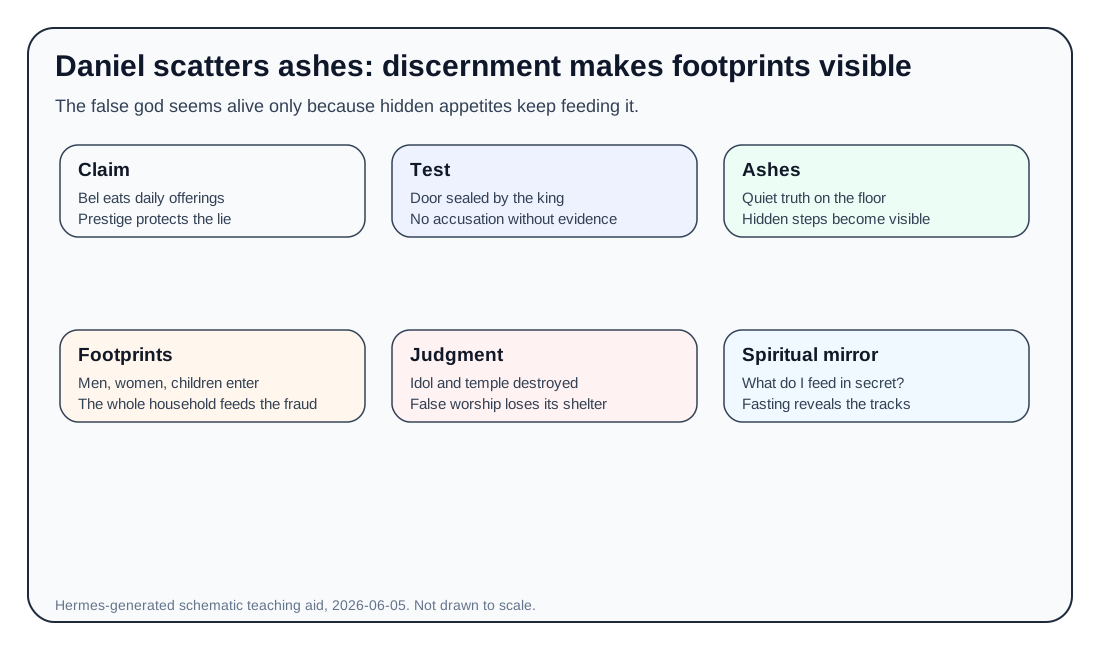 Source: Generated schematic teaching aid for this project, 2026-06-05.
Spiritual Fruit 🍇
Stop defending the idol by explaining how much it consumes. A passion is not holy because it is powerful. It is powerful because it has been fed. Ask what receives the day’s attention, imagination, resentment, and fear, and whether that thing has ever given life back.
Then look for footprints rather than for a speech. The private door is usually ordinary: a return to the old argument after prayer, a purchase that keeps an image alive, a conversation that feeds contempt, a fast kept in public and undone in secret. The seals can be whole. Confession begins when the floor is examined.
The king’s violence is not the fruit. Zeal that needs a household to punish has already left Daniel’s work. Daniel breaks the idol. He does not ask for the sword. If exposure makes us hungry to see someone fall, the idol has only changed clothes.
What the passage does offer is a clearer worship. Isaiah’s God carries. Bel must be carried, and then he eats the carriers. Lent is the time to stop packing burdens onto the heart and to let the living God bear what we cannot. The first cry of the king is a warning. It can still be unlearned.
Teaching Notes
General guidance
- Ask: Why do some Bibles include this chapter and standard NKJV editions omit it?
- Emphasize: The Orthodox Church receives Greek Daniel. Say that many Protestant editions follow the shorter Hebrew and Aramaic collection. Do not say that all modern Bibles removed the book.
- Watch for: Numbering. Brenton 1-22 is Daniel 14 in the Katameros. Some printings begin at 14:2.
- Connect: Overview, then the dragon and the den.
- Show: The ashes diagram only. It is a schematic, not an icon. Do not use the old Wikimedia paintings; the Rubens image is Daniel 6, and the others are not Coptic iconography.
Bel’s temple and the footprints (Bel and the Dragon 1-22)
- Ask: What false god looks powerful mainly because it consumes so much?
- Emphasize: The seals are whole, and the fraud is on the floor. Daniel creates conditions where truth can be seen.
- Watch for: Verses 21-22. The king slays the priests with their wives and children. That is the king’s act, reported by the text, not Daniel’s command and not a Christian method. Daniel destroys the idol and the temple.
- Connect: Isaiah 46, the Letter of Jeremiah, and Psalm 113 (Hebrew Psalm 115). False worship eats. God carries and feeds.
- Show: Place the diagram beside verse 19, when Daniel tells the king to mark the pavement.
Sources
Embedded Scripture is from Brenton’s English Septuagint (LXX).
The book’s setting, the Katameros range, and the patristic reception of the whole story are in the overview.
St. Irenaeus, Against Heresies IV.5.2, New Advent.
St. Cyprian, Exhortation to Martyrdom, Addressed to Fortunatus 11, New Advent.
St. Athanasius, Against the Heathen 13, New Advent.
St. John Chrysostom, Homily 45 on the Gospel of John, section 1, on John 6:28-40, New Advent.
St. John Cassian, Institutes, Book V, chapter 5, New Advent.
Isaiah 46, Jeremiah 28:44, Letter of Jeremiah 10 and 28, and Psalm 113:12-16 are quoted from Brenton. Hebrew Jeremiah 51:44 names Bel; Brenton’s corresponding verse names Babylon.
Footnotes
-
St. Irenaeus, Against Heresies IV.5.2, New Advent. ↩
-
St. Cyprian, Exhortation to Martyrdom 11, New Advent. ↩
-
St. Athanasius, Against the Heathen 13, New Advent. ↩
-
St. John Chrysostom, Homily 45 on John, section 1, New Advent. ↩
-
St. John Cassian, Institutes V.5, New Advent. ↩