


This narration is from a previous version of the study and may include a combined recording of multiple chapters.
A new ruler governs Babylon, but Daniel’s allegiance has not changed. The king values his service; other officials cannot tolerate his faithfulness. Their trap is therefore aimed at the one habit they can predict: Daniel will pray. The decree does not create his prayer life. It exposes the steady belonging to God that was already there.
Embedded Scripture is from Brenton’s English Septuagint (LXX). Brenton includes Darius’ succession as 6:1, where many English Bibles have 5:31; the verses that follow therefore run one number ahead.
Faithful service and a manufactured offense (Daniel 6:1-10)
1 And Darius the Mede succeeded to the kingdom, being sixty-two years old.
2 And it pleased Darius, and he set over the kingdom a hundred and twenty satraps, to be in all his kingdom; 3 and over them three governors, of whom one was Daniel; for the satraps to give account to them, that the king should not be troubled. 4 And Daniel was over them, for there was an excellent spirit in him; and the king set him over all his kingdom.
5 Then the governors and satraps sought to find occasion against Daniel; but they found against him no occasion, nor trespass, nor error, because he was faithful. 6 And the governors said, We shall not find occasion against Daniel, except in the ordinances of his God.
7 Then the governors and satraps stood by the king, and said to him, King Darius, live for ever. 8 All who preside over thy kingdom, captains and satraps, chiefs and local governors, have taken counsel together, to establish by a royal statute and to confirm a decree, that whosoever shall ask a petition of any god or man for thirty days, save of thee, O king, shall be cast into the den of lions. 9 Now then, O king, establish the decree, and publish a writ, that the decree of the Persians and Medes be not changed. 10 Then king Darius commanded the decree to be written.
Daniel passes from the Babylonian court into another administration. His life is not secured by a single ruler’s patronage, nor does his service depend upon the permanence of one empire. The opening describes a hierarchy intended to keep the kingdom accountable: satraps, or provincial governors, report to senior officers so that the king does not suffer loss or administrative trouble. Daniel’s fidelity is visible within this ordinary work before it becomes visible in a miracle.
That order makes the conspiracy especially grave. Officials entrusted with accountability turn their attention toward removing an honest colleague. They search for an offense and cannot find one. The narrative does not suggest that Daniel has no need of God’s mercy or that every accusation against a believer must be false. It gives a particular description of a faithful servant whose conduct cannot supply the pretext his enemies want.
We should pause over that fidelity. Prayer is not a substitute for doing one’s work honestly. Daniel’s religious life has not made him careless with other people’s affairs. A Christian whose employer or family cannot trust his word has missed part of this chapter even if he admires the miracle at its end. The story begins with integrity that can survive scrutiny.
The officials finally decide to turn the ordinances of Daniel’s God into an offense. They propose thirty days in which petitions may be made only to the king. A temporary requirement may appear easier to accept than permanent apostasy. But a month of treating the king as the necessary recipient of every petition is not religiously empty. The decree demands the kind of authority over prayer that no ruler possesses.
“All” the officers have agreed, the plotters claim. The narrative has already shown that Daniel is among the senior officials, so their comprehensive language conceals the exclusion of the very person they intend to destroy. False consensus and flattery work together: the king is offered an exalted position, and the intended victim is made to seem the only unreasonable exception.
Darius the Mede cannot be confidently identified with a known ruler in the surviving evidence. Proposals have included a governor under Cyrus, Cyrus himself, and another Median royal figure; no identification needs to be treated as settled here. He should not simply be equated with the later Darius I. Acknowledging the historical question allows us to read the king’s actual role in this narrative without presenting a conjecture as recovered fact.
Within the story, the law’s supposed permanence creates its own judgment upon royal pretension. The king can sign a decree that he cannot later undo to save a valued servant. A human command advertised as unchangeable proves less powerful than the God whose servant it condemns. The narrator is exposing a form of power that can bind a ruler as well as injure his subject.
Prayer continued, the den sealed (Daniel 6:11-18)
11 And when Daniel knew that the decree was ordered, he went into his house; and his windows were opened in his chambers toward Jerusalem, and three times in the day he knelt upon his knees, and prayed and gave thanks before his God, as he used to do before.
12 Then these men watched, and found Daniel praying and supplicating to his God. 13 And they came and said to the king, O king, hast thou not made a decree, that whatsoever man shall ask a petition of any god or man for thirty days, but of thee, O king, shall be cast into the den of lions? And the king said, The word is true, and the decree of the Medes and Persians shall not pass. 14 Then they answered and said before the king, Daniel of the children of the captivity of Judea, has not submitted to thy decree; and three times in the day he makes his requests of his God. 15 Then the king, when he heard the saying, was much grieved for Daniel, and he greatly exerted himself for Daniel to deliver him: and he exerted himself till evening to deliver him.
16 Then those men said to the king, Know, O king, that the law of the Medes and Persians is, that we must not change any decree or statute which the king shall make. 17 Then the king commanded, and they brought Daniel, and cast him into the den of lions. But the king said to Daniel, Thy God whom thou servest continually, he will deliver thee. 18 And they brought a stone, and put it on the mouth of the den; and the king sealed it with his ring, and with the ring of his nobles; that the case might not be altered with regard to Daniel.
Daniel knows the decree. His next action is neither a speech before the court nor a new religious display. He goes home and prays as before. The open windows are part of an established practice, not evidence that he has staged a provocation. The enemies must watch him to find the offense they have manufactured. His worship is public enough to be discovered but is not described as a performance for them.
He kneels, prays, and gives thanks. Thanksgiving under the threat is a particularly demanding detail. Daniel does not thank God for his enemies’ malice; he continues to acknowledge God’s goodness when obedience has become dangerous. The act refuses to let fear decide whether the Giver remains worthy of praise.
The windows face Jerusalem. Solomon’s prayer had asked God to hear His people when, captive in a foreign land, they turned toward the land, city, and temple associated with His promise (1 Kings 8:46-50). Daniel’s body thus participates in memory and hope. The geography does not confine God to a ruined city. It makes the exile’s dependence concrete: the king’s palace is not the final center of his world.
Christian prayer toward the East is not simply the same geographical act. From Babylon, Jerusalem lies in another direction. St. Basil, explaining Christian tradition in On the Holy Spirit 27.66, connects eastward prayer with longing for Paradise planted in the East. The meaningful comparison is that bodily orientation can school the heart in hope; it is not a claim that Daniel was already performing every detail of a later Christian rite.1
Gems from the Fathers 💎: Hours that gather the day to God
St. Cyprian reads Daniel’s threefold prayer within the Church’s reception of the third, sixth, and ninth hours. He writes: “And in discharging the duties of prayer, we find that the three children with Daniel, being strong in faith and victorious in captivity, observed the third, sixth, and ninth hour, as it were, for a sacrament of the Trinity, which in the last times had to be manifested.”2 He goes on to connect these hours with Pentecost, Peter’s prayer, and Christ’s Passion.
This is Christian interpretation of Daniel’s pattern. The verse itself says three times daily, without identifying those three hours by name. Cyprian sees the older rhythm fulfilled within the revelation of the Trinity and the saving work of Christ. The third, sixth, and ninth hours prayed through the Agpeya can therefore become more than divisions in a schedule: they recall the God to whom the day belongs and the salvation accomplished within human time.
Tertullian, an early Christian writer, gives the same pattern a practical edge. In On Prayer 25, he says that fixed hours can “tear us out from our businesses unto such a duty”3. That is a useful account of why a prayer rule helps. Work will rarely announce that it has finished demanding our attention. A chosen hour interrupts our illusion that every demand must be obeyed before God may be addressed.
The conspiracy then reveals its cruelty. Before naming Daniel, the accusers secure the king’s acknowledgment that his decree is binding. They describe him again as a captive of Judea, diminishing the man whose service had benefited the kingdom. The king tries until evening to deliver him, but the administration he empowered now supplies reasons that he must not do so. Personal affection has not made his rule just.
At the den, Darius speaks of the God Daniel serves “continually.” Even the ruler who has failed him recognizes the continuity of his worship. A stone and two sets of seals are meant to prevent an alteration of the sentence. What human authority calls final will become the setting in which its own limits are disclosed.
The Church’s Voice in Worship ⛪
The Coptic Lenten service order appoints Daniel 6:1-27, using the numbering familiar from Hebrew-based English Bibles, at Matins on Thursday of the fourth week of Great Lent. In the Brenton text printed here this is Daniel 6:2-28. The reading joins disciplined prayer, false accusation, divine deliverance, and confession of the living God. Its Lenten placement invites perseverance in worship rather than fascination with danger.
The Coptic Synaxarium commemorates the Departure of the Great Prophet Daniel on Baramhat 23. That remembrance concerns the prophet’s departure, not a claim that the lions’ rescue occurred on that date. Together, reading and commemoration help the Church receive Daniel as a living witness to fidelity, not merely the subject of a childhood story.
The fasting king and the living servant (Daniel 6:19-24)
19 And the king departed to his house, and lay down fasting, and they brought him no food; and his sleep departed from him. But God shut the mouths of the lions, and they did not molest Daniel.
20 Then the king arose very early in the morning, and came in haste to the den of lions. 21 And when he drew near to the den, he cried with a loud voice, Daniel, servant of the living God, has thy God, whom thou servest continually, been able to deliver thee from the lion’s mouth? 22 And Daniel said to the king, O king, live for ever. 23 My God has sent his angel, and stopped the lions’ mouths, and they have not hurt me: for uprightness was found in me before him; and moreover before thee, O king, I have committed no trespass. 24 Then the king was very glad for him, and he commanded to bring Daniel out of the den. So Daniel was brought out of the den, and there was found no hurt upon him, because he believed in his God.
The narrative moves between the palace and the den. Darius lies down fasting, without the comforts that might have filled his evening, and cannot sleep. Brenton tells the reader already in verse 19 that God has shut the lions’ mouths. The king, however, does not yet share the reader’s knowledge. His haste at dawn and his question at the den express the distance between what God has done and what a frightened human being can yet see.
The king’s fasting shows real concern, but it does not erase his responsibility for the unjust sentence. Compassion is more than regret after a harmful decision. The episode warns those who hold authority to test flattering proposals before they harm someone, rather than relying upon distress afterward as evidence of a good heart. Nevertheless, Darius’ vigil is not dismissed. The story allows us to see a ruler’s helplessness and grief without pretending that either makes him innocent.
Gems from the Fathers 💎: Lions made to fast
St. Basil’s first homily on fasting gathers Daniel’s ascetic discipline and his deliverance into one vivid picture: Daniel “taught even lions to fast.”4 In the same section he writes, “Fasting sends up prayer to Heaven, becoming, as it were, a wing for it on its upward journey.”5 His homiletic picture is not a claim that dietary discipline gives the body physical invulnerability. It teaches the strength of a life no longer governed by appetite and fear, a life offered to God in prayer.
That qualification matters in Lent. We do not fast in order to compel God to keep us from injury. Nor should sickness, age, pregnancy, or another need for a modified fasting rule become a cause of shame. Fasting is undertaken with pastoral guidance and care for the person. Daniel’s deliverance belongs to God’s free action, not to an ascetical technique that makes harm impossible.
Daniel answers with respect for the king and gratitude to God. His disobedience to the decree has not become contempt for every human obligation. He can say both that he has been upright before God in this matter and that he has committed no wrong against the king. The distinction is essential: refusing an impious command can be an act of faithful service, not an attack upon legitimate authority.
The angel shuts the lions’ mouths. Daniel does not credit his own courage with making them harmless. The narrator then gives the reason for his preservation: “because he believed in his God.” Hebrews 11:33 recalls people who, through faith, stopped lions’ mouths. Yet the same chapter also names faithful people who were tortured, imprisoned, and killed (Hebrews 11:35-38). The Church must hear both. Faith can receive rescue and can endure martyrdom; suffering does not prove that faith was absent.
The sealed den and dawn vindication naturally turn Christian thought toward the sealed tomb and the discovery at dawn (Matthew 27:66; 28:1-6). Daniel is not Christ. Daniel survives the night because God preserves him; Christ truly enters death and rises victorious over it. The correspondence prepares our hope without erasing that decisive difference. The Lord’s Resurrection promises more than one servant’s escape: in Him even those who die faithfully are not abandoned to death.
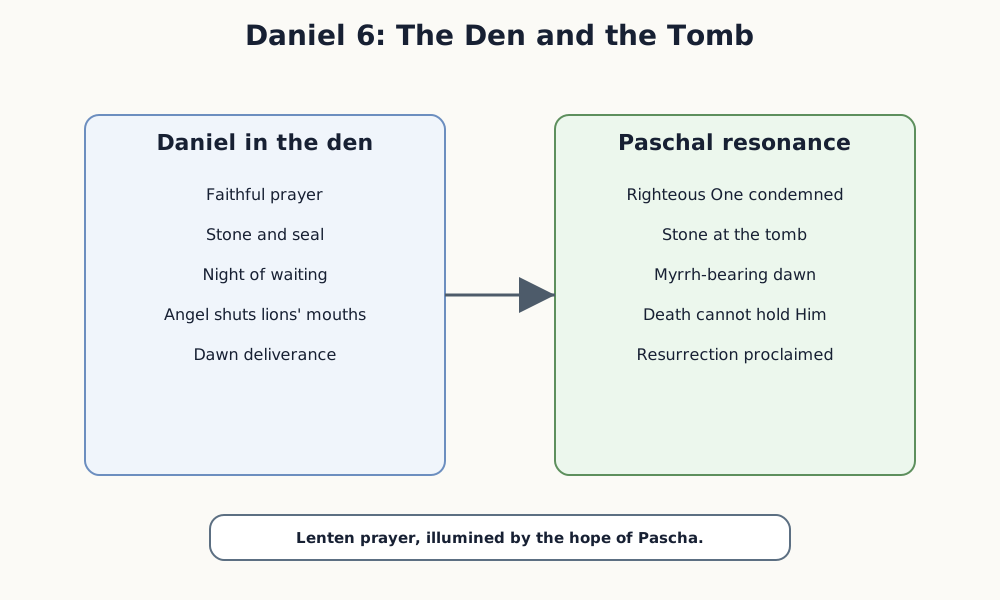 Daniel is preserved alive in the den; Christ truly dies and rises. The resemblance points toward Pascha without making the two events identical.
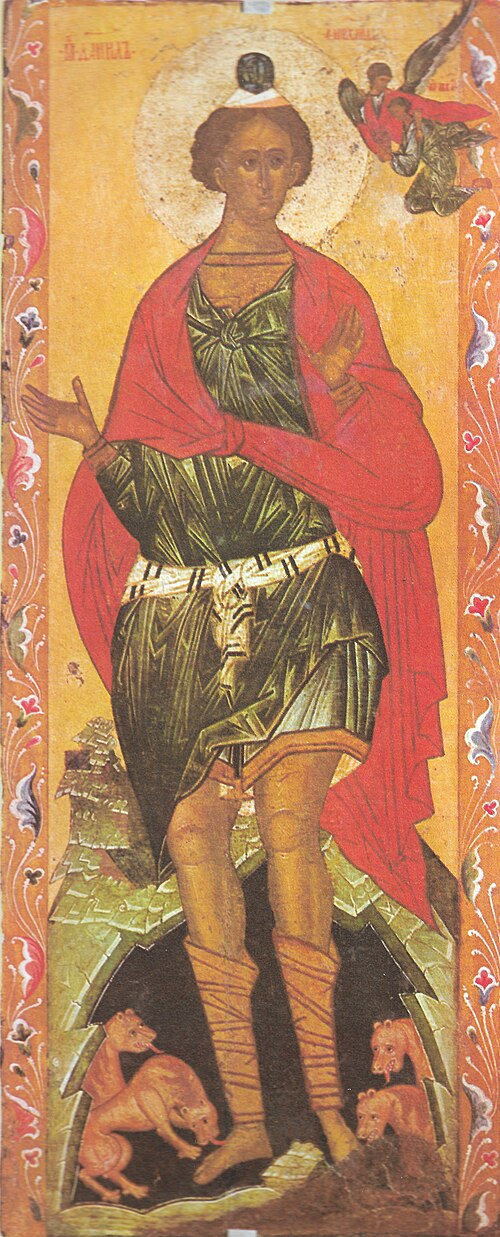 Source: Wikimedia Commons, 16th century Russian icon, public domain.
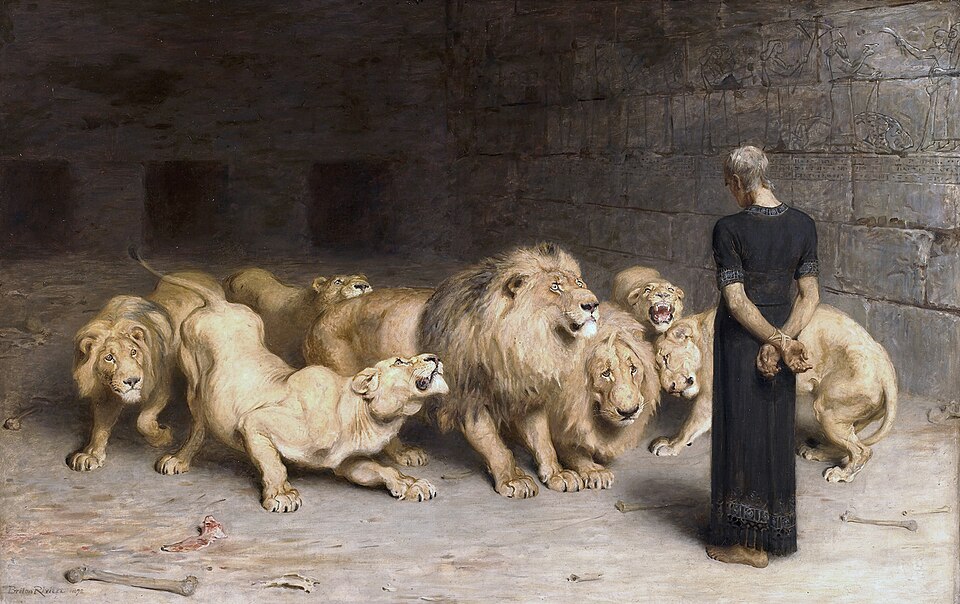 Source: Wikimedia Commons, public domain painting (Walker Art Gallery, Liverpool).
A cruel reprisal and a true confession (Daniel 6:25-29)
25 And the king commanded, and they brought the men that had accused Daniel, and they were cast into the den of lions, they, and their children, and their wives: and they reached not the bottom of the den before the lions had the mastery of them, and utterly broke to pieces all their bones.
26 Then king Darius wrote to all nations, tribes, and languages, who dwell in all the earth, saying, Peace be multiplied to you. 27 This decree has been set forth by me in every dominion of my kingdom, that men tremble and fear before the God of Daniel: for he is the living and eternal God, and his kingdom shall not be destroyed, and his dominion is for ever. 28 He helps and delivers, and works signs and wonders in the heaven and on the earth, who has rescued Daniel from the power of the lions. 29 And Daniel prospered in the reign of Darius, and in the reign of Cyrus the Persian.
The killing of the accusers’ wives and children is a terrible part of the account. The king commands it, not Daniel, and the narrator does not give the families individual responsibility for the plot. This is a report of a royal reprisal under Persian rule, not a command from God or a model of justice for Christians. The biblical law expressly rejects putting children to death for their fathers’ wrongdoing (Deuteronomy 24:16; compare Ezekiel 18:20). We must not celebrate the killing of families as if their destruction were necessary to enjoy Daniel’s rescue.
The renewed fierceness of the lions does make clear that Daniel’s safety was not due to harmless animals. But that narrative function does not make every act of the king morally right. Deliverance and human revenge must be distinguished. A Christian facing accusation may seek protection, truth, and just accountability, but must not ask for an enemy’s children to suffer or turn another person’s destruction into a devotional pleasure.
Darius’ confession names the living and eternal God whose kingdom cannot be destroyed. Its truth exceeds the ruler who announces it. We can receive the confession without endorsing the preceding cruelty or treating coercive royal decrees as the Church’s method of making disciples. Christ sends His disciples to teach and baptize the nations (Matthew 28:18-20), not to reproduce the violence of a frightened court.
Daniel prospers under Darius and Cyrus. The chapter closes with continuing life and service, not with a command to keep seeking dramatic ordeals. The prayer that preceded the den still has a place after it. Deliverance is not the end of dependence on God; the ordinary day remains the place where faithfulness is lived.
Spiritual Fruit 🍇
Do not wait for the den to build the prayer rule. Choose one Agpeya hour you can keep daily, in consultation with your confessor where needed, and attach it to a realistic point in the day. Begin with attention rather than an ambitious promise that leaves you discouraged. When work presses, remember that its demands are precisely why an appointed hour can help. If you miss it, return without turning either failure or success into your identity.
Let Daniel’s kneeling and thanksgiving reach your body and your speech. Put aside the device that keeps bringing the office, argument, or unfinished task into prayer. Give thanks for one mercy before naming the present fear. Where bodily limitation prevents kneeling, pray in the posture you can sustain. God does not confuse physical ability with devotion.
Examine the other end of the story as carefully as the beginning. When falsely accused, do you long only to be vindicated, or also to see the accuser humiliated and the family injured? Ask Christ to separate the desire for justice from the appetite for revenge. Seeking help, reporting abuse, and establishing safety are compatible with refusing hatred. Forgiveness does not require returning to danger or concealing wrongdoing.
If a feared outcome has not changed, pray with the whole witness of Hebrews 11. Ask plainly for rescue, and ask for the grace to remain Christ’s if rescue comes differently than you hoped. His tomb was not merely a den from which He emerged untouched by death. He entered death for us, so that neither an unanswered accusation nor the grave can have the final word over those who belong to Him.
Teaching Notes
Integrity before the accusation (Daniel 6:1-10)
- Ask: What would Daniel’s coworkers have discovered if he had been dishonest before the religious trap was devised?
- Emphasize: Give the historical qualification about Darius once. Do not solve it by confidently identifying him with Darius I or an unnamed governor.
- Watch for: A false accusation in this account does not establish that every charge against a religious person is false.
Three times daily (Daniel 6:11-18)
- Ask: What does “as he used to do before” change about the meaning of the open windows?
- Connect: Read 1 Kings 8:46-50, then distinguish Jerusalem-facing prayer from Basil’s explanation of Christian prayer toward the East.
- Emphasize: Daniel supplies the threefold pattern; Cyprian and Tertullian witness to its Christian reception in named hours. The verse does not itself list those hours.
The dawn deliverance (Daniel 6:19-24)
- Ask: Why must Hebrews 11:33 be read together with 11:35-38?
- Show: Compare the den and tomb diagram while stating explicitly that Christ dies and rises, whereas Daniel is preserved from death.
The reprisal and the confession (Daniel 6:25-29)
- Ask: What must be distinguished between the king’s words about God and his treatment of the accusers’ families?
- Watch for: Keep the safeguard at verse 25 in the main discussion. God saves Daniel; the king orders the killing of families. These are not interchangeable acts.
Sources
Brenton, The Septuagint Version of the Old Testament, Daniel 6; 1 Kings 8:46-50; Deuteronomy 24:16; Ezekiel 18:20; Hebrews 11:33-38; Matthew 27:66-28:6.
St. Cyprian, On the Lord’s Prayer 34-36, on the three hours and prayer throughout the day.
Tertullian, On Prayer 25, an early historical Christian witness to fixed times of prayer; not presented as a normative Coptic saint.
St. Basil the Great, Homily on Fasting 7, on Daniel and the lions; On the Holy Spirit 27.66, on prayer toward the East. The homily’s ascetical comparison is not a clinical or dietary prescription.
Coptic service order for Thursday of Great Lent’s fourth week, Matins fourth prophecy, Daniel 6:1-27 in its service numbering; Coptic Synaxarium, Baramhat 23, Departure of the Great Prophet Daniel. The service numbering corresponds to Brenton 6:2-28; the commemorative title does not supply a narrative date for the rescue.
Alberith, “Darius the Mede”, a survey of proposed identifications. Its confidence about eventual historical vindication is not needed for the limited conclusion here: the identification remains disputed.
Footnotes
-
St. Basil the Great, On the Holy Spirit 27.66, https://www.newadvent.org/fathers/3203.htm. ↩
-
St. Cyprian, On the Lord’s Prayer 34, https://www.newadvent.org/fathers/050704.htm. ↩
-
Tertullian, On Prayer 25, https://www.newadvent.org/fathers/0322.htm. ↩
-
St. Basil the Great, Homily on Fasting 7, https://www.johnsanidopoulos.com/2011/03/st-basil-greats-homily-on-fasting-2-of.html. ↩
-
St. Basil the Great, Homily on Fasting 7, https://www.johnsanidopoulos.com/2011/03/st-basil-greats-homily-on-fasting-2-of.html. ↩