


This narration is from a previous version of the study and may include a combined recording of multiple chapters.
Ezra 4 is the first great opposition chapter in the returned community’s rebuilding story. The altar has been restored, the temple foundation has been laid, and the people have begun to recover worship after exile. Then resistance appears in four forms: false partnership, discouragement, accusation, and imperial delay.
The chapter teaches that not every offer of help is communion, not every delay is defeat, and not every official accusation is true simply because it is written in the language of power. The returned people must discern without hatred, endure without panic, and wait without surrendering the holy work. For the Church, Ezra 4 resonates with the Lord’s warning in John 15:18-20, the apostolic prayer for boldness in Acts 4, the armor of God in Ephesians 6:10-18, and St Peter’s counsel in 1 Peter 4:12-19 to entrust the soul to God while doing good.
This distinction matters pastorally. Discernment is not suspicion toward every outsider, and hospitality is not surrender of the altar. A partnership is judged by whether it serves obedience to God or changes the purpose of the work.
Historical and Scriptural Context
Ezra 3 ended with the foundation of the Lord’s house laid in Jerusalem, accompanied by joy, tears, trumpets, cymbals, and the ancient refrain that the Lord is good and His mercy endures forever. Ezra 4 shows what often comes after beginnings of restoration: resistance. The people are not opposed because they have done evil in this chapter. They are opposed because the worship of God is being restored and Jerusalem is no longer only a ruin.
The chapter has an important chronological feature. Ezra 4:1-5 concerns opposition during the rebuilding of the temple from the days of Cyrus until the reign of Darius. Ezra 4:6-23 then widens the lens and gives examples of accusations during later Persian reigns, including Assuerus and Arthasastha, before verse 24 returns to the temple work standing still until the second year of Darius. This is not a clumsy interruption. The narrator is showing a pattern: resistance to the restoration of Judah and Jerusalem continues across reigns, officials, letters, and political languages.
Scripturally, Ezra 4 belongs with other places where God’s work is resisted through fear, official pressure, or manipulated law. Nehemiah 4 shows mockery, threats, prayer, and guarded building. Daniel 6 shows a faithful servant trapped by a legal decree. Psalm 2 (LXX Psalm 2) speaks of rulers gathering against the Lord and His Anointed, a passage Acts 4 receives as fulfilled in the opposition to Christ and His apostles. These are resonances and fulfillments in the larger biblical pattern, not direct commentaries on Ezra 4.
Geographical Significance ⛰️
The geography of Ezra 4 matters because the conflict is not only personal. It is regional and imperial. Jerusalem and Judah sit inside the Persian province often called Beyond-the-River, the territory west of the Euphrates. Samaria, called Somoron in Brenton’s text, is the local administrative and political center from which opposition can be organized and sent upward through imperial channels.
This means the returned community is small, exposed, and dependent on Persian permission. The opponents do not need to defeat Judah in open battle first. They can frame Jerusalem as a danger to imperial revenue, send a letter through official language, and let the weight of empire do the stopping. The spiritual pressure is therefore larger than personal dislike. Opposition is not only someone saying no. It is the pressure of systems, documents, fears, memories, and force brought against a fragile rebuilding people.
The Characters 👥
- The adversaries of Juda and Benjamin: The local peoples who hear that the returned exiles are rebuilding the house of the Lord. Brenton calls them those who afflicted Judah and Benjamin. Their first tactic is not open war but an offer to join the work.
- Zerubbabel: Zerubbabel, leader of the return and a Davidic-line figure. He must protect the temple project from compromised partnership.
- Jesus son of Josedec: Jeshua or Joshua son of Jehozadak, the high priestly figure associated with the restored altar and temple worship.
- The heads of families of Israel: The lay leaders of the returned community. Their discernment matters because rebuilding is communal, not private.
- Assuerus: Ahasuerus or Xerxes in common English naming. Ezra 4 mentions accusation at the beginning of his reign as part of a broader pattern of opposition.
- Arthasastha: Artaxerxes in common English naming. The letter in verses 7-16 is addressed to him.
- Tabeel, Mithradates, Reum, and Sampsa: Officials and scribal figures involved in the letter against Jerusalem. Reum and Sampsa are Rehum and Shimshai in familiar English forms. Their names remind us that accusation can travel through respectable channels.
- Assenaphar: Osnappar in common English editions, usually identified with Ashurbanipal, the Assyrian king. He is named as having relocated peoples into the cities of Samaria. The letter uses imperial memory and deportation history to strengthen its case.
- The king of Persia: The distant imperial authority whose decree can stop or permit work. In Ezra 4, the king receives a framed report and acts within the limits of the information presented to him.
Ezra 4 moves from subtle compromise to open coercion. The chapter traces false partnership and discernment, discouragement and accusation, the framed letter against Jerusalem, and imperial delay until God’s appointed time.
The apostolic passages used below, including John 15, Acts 4, Ephesians 6, and 1 Peter 4, are not presented as direct comments on Ezra 4. They show how the Church receives the repeated biblical pattern of God’s work meeting opposition and of the faithful answering with prayer, truth, endurance, and hope.
False partnership and discernment (Ezra 4:1-3)
1 And they that afflicted Juda and Benjamin heard, that the children of the captivity were building a house to the Lord God of Israel. 2 And they drew near to Zorobabel, and to the heads of families, and said to them, We will build with you; for as ye do, we seek to serve our God, and we do sacrifice to him from the days of Asaradan king of Assur, who brought us hither.
3 Then Zorobabel, and Jesus and the rest of the heads of the families of Israel said to them, It is not for us and you to build a house to our God, for we ourselves will build together to the Lord our God, as Cyrus the king of the Persians commanded us.
Light from the Word 🕯️
The first opposition sounds cooperative: “We will build with you.” The speakers trace their sacrifices to Asaradan, Brenton’s form of Esarhaddon, king of Assyria. Second Kings 17:24-41 supplies the background to this resettled population: they feared the Lord while also serving their own gods (2 Kings 17:33). The danger is divided worship, or syncretism, the mixing of devotion to the Lord with idolatry. The offer to help cannot by itself make that divided worship faithful.
Zerubbabel, Joshua, and the heads of families refuse the partnership. Cyrus had entrusted this rebuilding to the returned community, and the altar could not serve a convenient religious mixture. Yet the boundary concerns faithfulness to God, not the worth of a people. Ezra 6:21 later includes everyone who turns from the nations’ uncleanness to seek the Lord. The refusal here and the welcome there belong together.
This is a hard lesson for servants because false partnership often arrives at the moment when a ministry is weak and help is tempting. Ezra 4 does not teach suspicion toward every outsider or refusal of all cooperation. It teaches that holy work needs truthful boundaries. The altar restored in Ezra 3 cannot become a bargaining table in Ezra 4.
Apostolic reading
The Gospel refuses to make Samaria a permanent emblem of exclusion. Christ speaks to the Samaritan woman of worship in spirit and truth (John 4:21-24). Samaria receives the word and the Holy Spirit through the apostles (Acts 8:5-17), and a Samaritan returns to thank the Lord after being healed (Luke 17:11-19). Ephesians 2:14-22 reveals Christ as our peace, breaking down the dividing wall and building one holy dwelling. Holiness is preserved by conversion to the true God, not by treating a neighboring people as beyond mercy.
Spiritual application
A servant must learn the difference between peace and confusion. There are times when charity requires welcome, patience, and broad cooperation. There are also times when love for God requires a gentle but firm no. The test is not whether the offer sounds religious. The test is whether it preserves the altar, the faith, the teaching of the Church, and obedience to the command of God.
This applies in parish life, family life, and the inner life. A person rebuilding prayer after spiritual exile may be offered habits that seem to help but actually dilute repentance: self-justifying talk, spiritual shortcuts, entertainment disguised as rest, or relationships that keep old sins alive. Discernment does not mean fear of everyone. It means truthfully asking whether this partnership will help rebuild the house of God in the heart.
Discouragement, fear, hired counsellors, and accusation (Ezra 4:4-6)
4 And the people of the land weakened the hands of the people of Juda, and hindered them in building, 5 and continued hiring persons against them, plotting to frustrate their counsel, all the days of Cyrus king of the Persians, and until the reign of Darius king of the Persians.
6 And in the reign of Assuerus, even in the beginning of his reign, they wrote a letter against the inhabitants of Juda and Jerusalem.
Light from the Word 🕯️
Once false partnership fails, opposition becomes more direct. The people of the land weaken the hands of Judah, hinder the building, hire people against them, and plot to frustrate their counsel. The attack is psychological, political, and practical. They do not only attack the stones. They attack the builders’ courage.
The phrase “weakened the hands” is vivid. Hands are what build, lift, carry, and obey. To weaken the hands is to make the work feel impossible before it is finished. Fear can stop a project before external force ever arrives. Hired counsellors then add a second pressure: voices are paid to confuse, delay, or redirect the work. Finally, a letter of accusation is written under Assuerus. Opposition has moved from local pressure to official complaint.
This movement is important because many holy works do not fail through one dramatic collapse. They fail when discouraged people begin to believe that the burden is too heavy, the process too long, and the resistance too constant. Ezra 4 names that pressure honestly.
Gems from the Fathers 💎
St. John Chrysostom, in Homily 11 on Acts, opens the apostles’ prayer after threats against them. He says, “These are not words of imprecation.” “And observe, they do not say, Crush them, cast them down; but what? And grant unto Your servants, that with all boldness they may speak Your word. Let us also learn thus to pray.”1 The prayer asks for faithful speech, not an enemy’s ruin. When discouragement weakens the hands, this is the prayer that keeps resistance from becoming revenge.
Spiritual application
Discouragement is often more dangerous than open conflict because it enters the heart quietly. The servant may keep attending, keep preparing, keep speaking, but inwardly the hands have become weak. Prayer becomes mechanical. Ministry becomes defensive. The person begins to ask, “What is the point?”
Ezra 4 calls the faithful to name discouragement without obeying it. Fear is real, but it is not sovereign. Accusation is painful, but it is not final. Hired counsel, public misunderstanding, or administrative delay may frustrate a holy work for a time, but the servant still belongs to God. John 15:18-20 prepares the Church not to be shocked when obedience meets hatred. 1 Peter 4:12-19 tells believers not to think fiery trial strange, but to entrust their souls to the faithful Creator while doing good.
The letter against Jerusalem and the power of framed accusation (Ezra 4:7-16)
7 And in the days of Arthasastha, Tabeel wrote peaceably to Mithradates and to the rest of his fellow-servants: the tribute-gatherer wrote to Arthasastha king of the Persians a writing in the Syrian tongue, and the same interpreted. 8 Reum the chancellor, and Sampsa the scribe wrote an epistle against Jerusalem to king Arthasastha, saying, 9 Thus has judged Reum the chancellor, and Sampsa the scribe, and the rest of our fellow-servants, the Dinæans, the Apharsathachæans, the Tarphalæans, the Apharsæans, the Archyæans, the Babylonians, the Susanachæans, Davæans, 10 and the rest of the nations whom the great and noble Assenaphar removed, and settled them in the cities of Somoron, and the rest of them beyond the river. 11 This is the purport of the letter, which they sent to him: Thy servants the men beyond the river to king Arthasastha.
12 Be it known to the king, that the Jews who came up from thee to us have come to Jerusalem the rebellious and wicked city, which they are building, and its walls are set in order, and they have established the foundations of it. 13 Now then be it known to the king, that if that city be built up, and its walls completed, thou shalt have no tribute, neither will they pay anything, and this injures kings. 14 And it is not lawful for us to see the dishonour of the king: therefore have we sent and made known the matter to the king; 15 that examination may be made in thy fathers’ book of record; and thou shalt find, and thou shalt know that that city is rebellious, and does harm to kings and countries, and there are in the midst of it from very old time refuges for runaway slaves: therefore this city has been made desolate. 16 We therefore declare to the king, that, if that city be built, and its walls be set up, thou shalt not have peace.
Light from the Word 🕯️
The letter concerns Jerusalem as a city and its walls, not simply the temple (verses 12-16). 1 Esdras 2:16-30 places its related Artaxerxes letter immediately after Cyrus and speaks of stopping temple foundations. 1 Esdras 5:66-73 parallels Ezra’s earlier refusal. The Greek accounts arrange and describe these events differently.
The letter is carefully framed. It is written in the administrative world of the empire, in the “Syrian tongue,” meaning Aramaic, interpreted, carried by named officials, and presented as loyal concern for the king. Ezra 4:8-6:18 preserves these imperial documents in Aramaic in the Hebrew-Aramaic book. It does not say, “We dislike Judah’s worship.” It says, “This city threatens revenue, order, and royal peace.”
There is a partial truth inside the accusation, which makes it more powerful. Jerusalem did have kings. Jerusalem had resisted foreign rule in the past. The city had a political memory that an imperial archive could interpret as danger. But the letter uses that memory to misrepresent the present rebuilding. The returned people are not described as worshipers rebuilding after exile. They are called people of a “rebellious and wicked city.” The letter turns restoration into sedition.
This is the power of framed accusation. It selects facts, arranges them under fear, and gives the ruler a conclusion before he has seen the whole truth. Daniel 6 gives a similar pattern: law is manipulated to trap faithfulness. Psalm 2 (LXX Psalm 2) gives the theological horizon: rulers and peoples can gather against the Lord’s purpose while imagining that they are protecting their own authority. Acts 4 receives Psalm 2 (LXX Psalm 2) as fulfilled in the opposition to Christ, and then as the pattern through which the apostles understand their own threats.
Language insight: “peaceably” and “Bishlam”
Brenton’s “Tabeel wrote peaceably” differs from the Hebrew, which lists Bishlam as a personal name alongside Mithredath and Tabeel. The Greek rendering treats a form associated with peace as part of the manner of writing rather than preserving the same list of names.2 This explains the different English wording without changing the displayed text or claiming to know how every witness developed.
Apostolic reading
Acts 4:24-30 places official threats within the Psalm 2 (LXX Psalm 2) pattern of rulers gathering against the Lord and His Anointed. The apostles name what has happened, then ask God for boldness to speak His word. They refuse both denial and revenge. A truthful defense of the work can coexist with prayer for the people who oppose it.
Spiritual application
Many souls have been wounded by accusation, especially when a partial fact has been framed in the most damaging way. Ezra 4 does not tell the faithful to pretend this pain is small. Written accusation can affect reputation, work, ministry, and confidence. It can make a person feel powerless because the story has already been told to someone with authority.
The Christian response is neither passivity nor retaliation. We answer truthfully when we must. We keep records honestly when needed. We accept rightful accountability. But we refuse to let accusation remake the heart into an accuser. The Lord Jesus was accused before rulers and remained the faithful Witness. The apostles were threatened and prayed for boldness. The servant who reads Ezra 4 must learn to defend truth without losing peace.
Imperial delay and the work ceases until God’s time (Ezra 4:17-24)
17 Then the king sent to Reum the chancellor, and Sampsa the scribe, and the rest of their fellow-servants who dwelt in Samaria, and the rest beyond the river, saying, Peace; and he says, 18 The tribute-gatherer whom ye sent to us, has been called before me. 19 And a decree has been made by me, and we have examined, and found that that city of old time exalts itself against kings, and that rebellions and desertions take place within it. 20 And there were powerful kings in Jerusalem, and they ruled over all the country beyond the river, and abundant revenues and tribute were given to them. 21 Now therefore make a decree to stop the work of those men, and that city shall no more be built. 22 See that ye be careful of the decree, not to be remiss concerning this matter, lest at any time destruction should abound to the harm of kings.
23 Then the tribute-gatherer of king Arthasastha read the letter before Reum the chancellor, and Sampsa the scribe, and his fellow-servants: and they went in haste to Jerusalem and through Juda, and caused them to cease with horses and an armed force. 24 Then ceased the work of the house of God in Jerusalem, and it was at a stand until the second year of the reign of Darius king of the Persians.
Light from the Word 🕯️
The king’s answer shows how quickly a framed accusation can become policy. The archives confirm that Jerusalem had powerful kings and a history of resistance. The king therefore commands that the work be stopped. The local officials act in haste and enforce the decree with horses and armed force. The damage can be read alongside Nehemiah 1:3, where the walls are broken and the gates burned. Identifying that report as the direct aftermath of this action is a possible historical reading, not something either passage states.
Verse 24 leaves these later city-wall events and returns to the earlier temple rebuilding line: the work of the house of God in Jerusalem ceased and stood still until the second year of Darius. The phrase is painful, but it is not hopeless. The work ceases until a time. Haggai 1:1 dates the prophetic call to that second year. Ezra 5 will show that Haggai and Zechariah speak, the elders build again, and the eye of God is upon them. In Ezra 4, God is not absent because the work is delayed. The chapter asks whether the people can endure a pause without concluding that the promise has failed.
This is one of Scripture’s most practical lessons for rebuilding after exile. There are seasons when a holy work is clearly commanded, yet doors close. There are seasons when power says stop, when force arrives, when leaders cannot simply push forward without causing greater harm. Faithfulness then takes the form of waiting, remembering, refusing despair, and being ready to obey when God opens the next moment.
Apostolic reading
First Peter 4:12-19 teaches believers under trial to entrust their souls to the faithful Creator while continuing to do good. Christ’s Passion is the supreme revelation of willing, sovereign obedience. Rulers, accusations, and armed force could not turn His saving self-offering into helpless defeat. A delayed building is not the Cross itself, but the crucified and risen Lord teaches His servants how to endure without making fear or hatred their master.
Spiritual application
The phrase “until the second year of Darius” is a word of mercy. It means the delay has a boundary known to God. We often do not know that boundary while we are inside the delay. We only know that obedience has become harder and that visible progress has stopped.
When a ministry, repentance, reconciliation, or family healing is delayed by forces beyond our control, Ezra 4 teaches watchfulness. Do not call delay defeat. Do not let force make you hate. Do not surrender the memory of what God commanded. Do not improvise disobedience because obedience has become blocked. Wait with prayer, keep the altar of the heart, and be ready when God sends the prophetic word that calls the builders back to work.
The Church’s Voice in Worship ⛪
No reading from Ezra is appointed in the Coptic lectionary. Its difficult refusal is best heard beside the Church’s readings about the conversion and healing of Samaria.
John 4:1-42 is read on the fourth Sunday of Great Lent, the Sunday of the Samaritan Woman. Acts 8:3-13 is read on Thursday of the first week of Great Lent, and Luke 17:11-19 is the Matins Gospel on the fourth Sunday of Amshir.3 Christ speaks, heals, and gathers where a reader might be tempted to see only an outsider.
Ephesians 2:1-22 is a Pauline reading for the Feast of the Lord’s Entrance into Egypt, Bashans 24, including its appointment in 2026.3 Its confession of Christ as our peace keeps temple boundaries from becoming contempt. The Book of Acts also gives an appointed response to threats: Acts 4:19-31 is read on Thursday of the fourth week of Great Lent. Acts 4:23-27 and Acts 4:27-31 are read on Monday and Tuesday of the third week of the Holy Fifty Days.4 The Church learns to pray for faithful speech when obedience is costly.
The Coptic Synaxarium commemorates the Departure of Haggai the Prophet on Kiahk 20 and the Martyrdom of the Righteous Zechariah the Prophet, son of Berechiah and Iddo, on Amshir 15.5 Their remembrance directs us from the suspended work toward the prophetic call that will revive it.
Iconography and Visual Teaching 🖼️
The empire map supplies the setting of the letters and their power: Judah is a small territory within a vast administration.
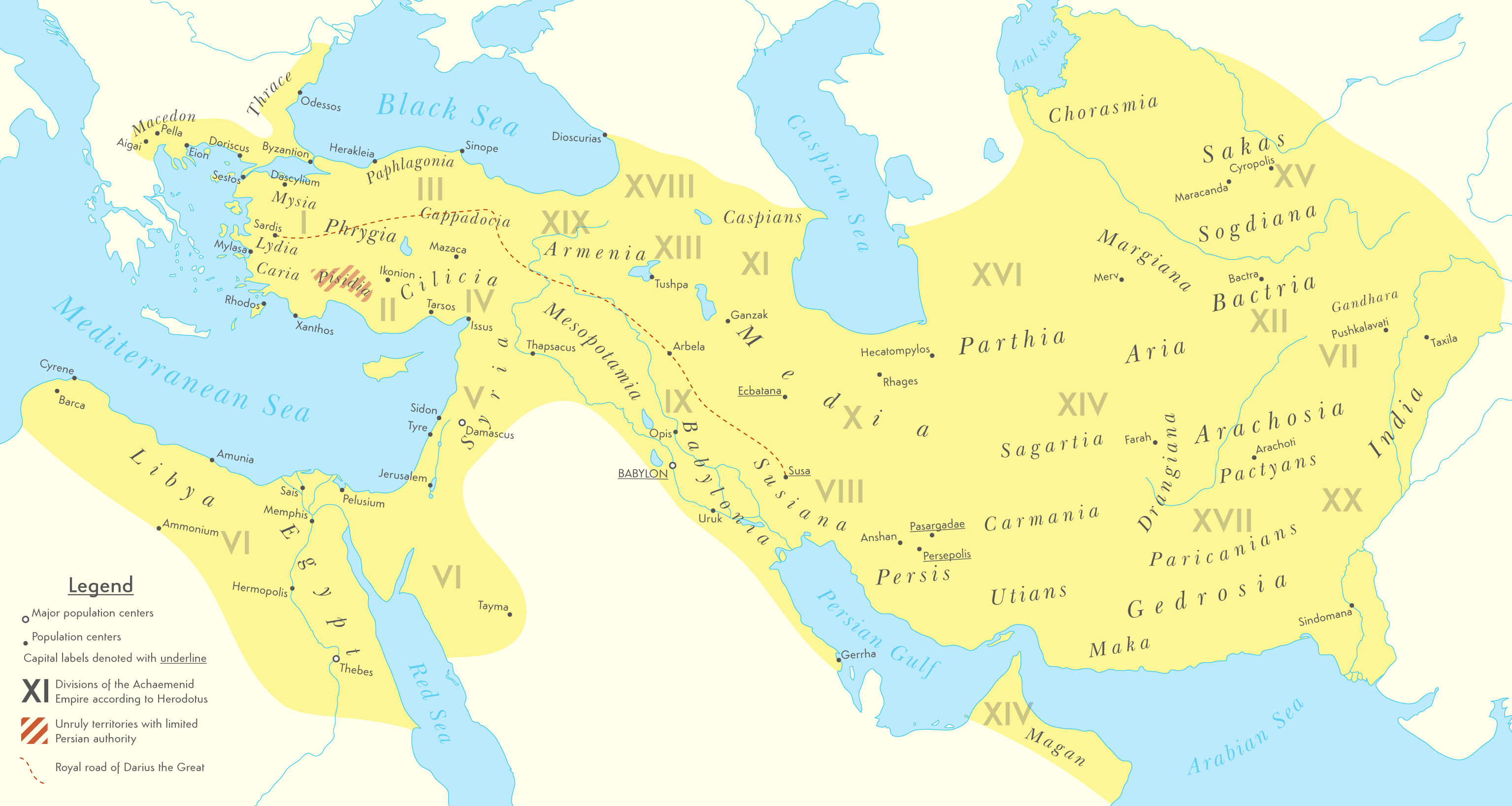 Source: Cattette, Achaemenid Empire 500 BCE, CC BY 4.0 via Wikimedia Commons.
The map clarifies why letters, tribute, and imperial fear matter in the chapter. The king is far away; the accusers are local; the empire is large enough that a carefully framed accusation can carry real force.
Ezra the scribe has not yet entered this part of the story. The leaders here are the returned community, while opposition moves from the region to the royal court.
Glossary
- Arthasastha: Brenton’s form of Artaxerxes, the Persian king addressed in the letter against Jerusalem.
- Assuerus: Brenton’s form of Ahasuerus or Xerxes, mentioned as another reign in which accusation was made.
- Beyond-the-River: Persian administrative term for the region west of the Euphrates, including Judah and Samaria.
- Discernment: Spiritual judgment that distinguishes truth from appearance without falling into suspicion or contempt.
- Juda: Brenton’s form of Judah.
- Jesus son of Josedec: Brenton’s form of Jeshua or Joshua son of Jehozadak, the priestly leader of the return.
- Somoron: Brenton’s form of Samaria, the regional center involved in the opposition letter.
- Syrian tongue: The administrative Aramaic language used in the imperial letter section.
- Zerubbabel: Named Zorobabel in Brenton, leader of the first return and temple rebuilding.
Spiritual Fruit 🍇
-
Guard holy beginnings with truth. When God begins rebuilding prayer, ministry, family trust, or parish life, compromise often comes disguised as help. Ask whether the proposed help protects the altar or confuses it.
-
Name discouragement before it rules you. Ezra 4 says the people’s hands were weakened. Do not spiritualize this away. Tell God when your hands are weak, and ask Him for strength before discouragement becomes obedience to fear.
-
Do not answer accusation by becoming an accuser. False or framed words hurt. The apostolic pattern in Acts 4 is not revenge, but prayer for boldness. Defend truth when needed, but do not let the enemy teach your tongue his work.
-
Respect authority without worshiping it. The Persian decree stops the work for a time, but it does not become God’s final word. Christians can obey lawful constraints, seek proper remedy, and still know that God is Lord over kings.
-
Wait without surrendering the promise. The work ceased until the second year of Darius. Some holy delays have an end only God can see. Faithfulness in the meantime means prayer, memory, readiness, and refusal to despair.
Bring before Christ the accusation you keep rehearsing. Ask Him for the courage to speak truth and the mercy to leave revenge unspoken. The hands that feel weak can still fold in prayer. Let that prayer prepare them for the work He will ask of you next.
Teaching Notes
- Suggested timing: 10 minutes for context and geography, 15 minutes for verses 1-6, 20 minutes for the letter in verses 7-16, 15 minutes for verses 17-24, and 10 minutes for Spiritual Fruit and discussion.
- Where to linger: Spend time on the difference between discernment and suspicion. This is one of the main pastoral risks in the chapter.
- Where to compress: The long list of official and ethnic names in verses 8-10 can be summarized after reading it aloud. Do not let the names swallow the teaching point: accusation is being organized through imperial channels.
- Key phrase to say slowly: “Not every delay is defeat.”
- Pastoral warning: Do not use Ezra 4 to train servants in paranoia. The chapter teaches sober discernment, prayerful endurance, and truthful response.
- Pastoral warning: Do not turn the passage into partisan commentary about modern politics. Keep the focus on rebuilding, accusation, power, and spiritual perseverance.
False partnership and discernment (Ezra 4:1-3)
- Ask: Why is the offer in verse 2 tempting, and why do the leaders refuse it?
- Emphasize: Ezra 4 teaches discernment, not contempt. Holy boundaries protect worship.
- Watch for: Reading the refusal as ethnic hatred. The issue is covenant faithfulness and the purity of temple worship.
- Connect: Ephesians 6 calls the faithful to stand with truth. Truth is the first protection of rebuilding.
Discouragement, fear, hired counsellors, and accusation (Ezra 4:4-6)
- Ask: What weakens the hands of servants today, and how can a community strengthen them again?
- Emphasize: The enemy often attacks courage before he attacks the visible work.
- Watch for: Turning the class into complaint about opponents. The passage is about faithful endurance, not bitterness.
- Connect: Acts 4 teaches the Church to answer threats with prayer for boldness, not with revenge.
The letter against Jerusalem and the power of framed accusation (Ezra 4:7-16)
- Ask: What makes the letter in verses 12-16 persuasive to a king, and what does it leave out?
- Emphasize: Framed accusation often contains selected facts, but selected facts are not the whole truth.
- Watch for: Teaching this as cynicism about all authority. The passage warns against manipulation, not against order itself.
- Connect: Acts 4 receives Psalm 2 (LXX Psalm 2) through Christ. The Church answers opposition by prayer, truth, and bold witness.
Imperial delay and the work ceases until God’s time (Ezra 4:17-24)
- Ask: What is the difference between a delayed work and a defeated work?
- Emphasize: The work ceases until God’s time. Delay is real, but it is not sovereign.
- Watch for: Encouraging reckless defiance. Faithfulness may require patience as well as courage.
- Connect: 1 Peter 4 teaches believers under trial to entrust their souls to God while doing good.
Sources
Embedded Scripture is from Brenton’s English Septuagint (LXX).
Brenton, The Septuagint Version of the Old Testament, Ezra 4; 2 Kings 17:24-41; Nehemiah 1; Daniel 6; Psalm 2 (LXX Psalm 2); John 4:21-24; Acts 4:18-31; Acts 8:5-17; Luke 17:11-19; Ephesians 2:14-22; 1 Peter 4:12-19.
1 Esdras 5:66-73 and 1 Esdras 2:16-30, parallel accounts with different narrative arrangement.
Footnotes
-
St. John Chrysostom, Homilies on Acts, Homily 11 (Acts 4:23-31), opening exposition of Acts 4:27-29, paragraph beginning “These are not words of imprecation,” text. ↩
-
Ezra 4:7, Hebrew text and analysis, Bishlam as a proper name, text. Compare Brenton’s Greek-based rendering; Assenaphar/Osnappar is commonly identified as Ashurbanipal, as reflected in translation comparison at Ezra 4:10. ↩
-
Coptic Katameros, fourth Sunday of Great Lent, John 4:1-42; Thursday of the first week of Great Lent, Acts 8:3-13; fourth Sunday of Amshir, Matins, Luke 17:11-19; Entrance into Egypt, Bashans 24, Pauline Epistle, Ephesians 2:1-22. ↩ ↩2
-
Coptic Katameros, Thursday of the fourth week of Great Lent, Acts 4:19-31; Monday and Tuesday of the third week of the Holy Fifty Days, Acts 4:23-27 and Acts 4:27-31 respectively. ↩
-
Coptic Synaxarium, Kiahk 20, “The Departure of Haggai the Prophet”; Amshir 15, “The Martyrdom of the Righteous Zechariah the Prophet the Son of Berechiah, the Son of Iddo.” ↩