


This narration is from a previous version of the study and may include a combined recording of multiple chapters.
Ezra 5-6 is the moment when a stopped work becomes a completed house. Ezra 4 returned from later opposition to the city walls to the earlier suspension of temple work. Ezra 5 begins not with a new political strategy, but with the prophetic word of Haggai and Zechariah. The elders rise, the eye of God rests upon them, the inquiry of Tattenai is answered with truthful testimony, and Darius confirms the decree first given by Cyrus.
This is a deep pattern of restoration: the word of God gives courage before the visible circumstances are safe. Legal protection matters, but prophecy comes first. Without the prophetic word, the people may have used uncertainty as an excuse to remain still.
The passage ends with dedication, ordered priestly and Levitical service, purification, Passover, the feast of unleavened bread, and joy. This is important for Orthodox teaching: the goal is not merely that a building be finished. The goal is that God’s people be restored to worship, sacrifice, purity, obedience, remembrance, and gladness before Him. Christians read this completed house in light of Christ, who says in John 2:19-21 that the true Temple is His Body, and in light of the apostolic word that the Church is built as a holy temple in the Lord.
The Passover is not an appendix to the building project. The house is completed so worship can be purified and the people can keep feast before the Lord. Construction serves communion, repentance, and joy. For the Christian reader, this keeps the temple theme from becoming architectural nostalgia: the true Temple is Christ, and the Church is built in Him for praise, thanksgiving, repentance, Eucharistic life, and joy before the Father.
Historical and Scriptural Context
Ezra 5-6 follows the delay recorded at the end of Ezra 4. The work of the house of God had ceased until the second year of Darius king of Persia. Historically, this places the renewed building effort in the period when Haggai and Zechariah preached to the returned community. Haggai 1 rebukes the people for dwelling in paneled houses while the Lord’s house lies waste. Haggai 2 encourages them that the Lord is with them and promises a glory beyond their visible weakness. Zechariah 1 calls the people not to be like their fathers who ignored the prophets, and Zechariah 4 gives the word, “Not by mighty power, nor by strength, but by my Spirit, saith the Lord Almighty” in Brenton’s wording.
Ezra’s narrator does not quote the prophetic sermons at length. He shows their fruit. The prophets assist the builders, the elders do not stop under inquiry, and the official investigation becomes the occasion for the old decree to be found. Tattenai’s letter records the people’s own theology of their history: they are servants of the God of heaven and earth, Solomon’s temple was destroyed because their fathers provoked God, and Cyrus ordered the house rebuilt and the vessels restored. This is not propaganda. It is confession, memory, and obedience spoken under scrutiny.
Scripturally, this passage belongs with Haggai 1-2, Zechariah 1, Zechariah 4, Zechariah 8, John 2:19-21, Hebrews 12:26-29, Ephesians 2:19-22, and 1 Corinthians 3:9-17. The prophets call the people back to the visible work. The apostles teach the Church how to receive temple language through Christ and His Body. The completed house in Ezra is real and holy in its covenant setting, but it is not the final dwelling of God with man. It points forward to the Incarnate Lord, to the Church built in Him, and to the unshakeable kingdom.
Geographical Significance ⛰️
The geography of Ezra 5-6 matters because the rebuilding happens in Jerusalem while the political decision moves through the wider Persian Empire. The returned community is in Juda and Jerusalem, a small restored people under the authority of officials “on this side the river,” meaning the Persian administration west of the Euphrates. Tattenai and his associates inspect the work locally, but their question is sent upward to Darius. The answer depends on records kept in royal storehouses and palaces far from Jerusalem.
The distance between the builders and the royal records gives the chapter its tension. The builders are local, exposed, and spiritually dependent. The archive is imperial, remote, and powerful. Yet God is Lord over both the elders in Jerusalem and the records of kings. The eye of God is upon the elders before the royal record is found. By the end, the same imperial system that once halted rebuilding is made to fund, protect, and supply it.
The Characters 👥
- Aggæus: Brenton’s form of Haggai, the prophet who rebukes neglect and encourages the rebuilding of the Lord’s house. His word awakens the builders from discouragement and misplaced priorities.
- Zacharias son of Addo: Zechariah, prophet of return, mercy, and the Lord’s presence with His people. His visions give theological depth to the rebuilding: the work is not by mere human strength but by the Spirit of God.
- Zerubbabel son of Shealtiel: Named Zorobabel son of Salathiel in Brenton, leader of the returned community and Davidic-line figure. He rises again to build after the stoppage of Ezra 4.
- Jesus son of Josedec: Jeshua or Joshua son of Jehozadak, priestly leader of the return. With Zerubbabel, he embodies the joining of royal and priestly responsibility around the restored house.
- Thanthanai: Brenton’s form of Tattenai, governor on this side of the river. He investigates the building and writes to Darius. In this chapter he functions as an official examiner rather than a simple villain.
- Satharbuzanai: Shethar-Boznai, associated with Tattenai in the inquiry and correspondence.
- The elders of the Jews: The leaders who continue building because the eye of God is upon them. They answer with confession and memory rather than panic.
- Darius: King of Persia who orders the archive search, confirms Cyrus’s decree, protects the builders, and supplies the work.
- Cyrus: The earlier Persian king whose decree first permitted the rebuilding and restoration of the vessels.
- Sabanasar: Sheshbazzar, the official entrusted with the temple vessels and associated with laying the foundation. Brenton also writes Sabanazar in verse 16.
- The priests and Levites: Ministers of restored worship. They are purified for Passover and set in their divisions according to the book of Moses.
- The children of the captivity: The returned exiles. Ezra keeps this name even in celebration because their joy is mercy after judgment.
- Those who separated themselves from the uncleanness of the nations: People who join Israel in seeking the Lord God of Israel. The issue is not race but separation from uncleanness and movement toward the Lord.
Ezra 5-6 forms one connected account. Prophecy awakens the work, inquiry tests the builders, testimony tells the truth about sin and mercy, Darius’s decree turns imperial power toward the house, and the completed temple leads to dedication, ordered worship, Passover, and joy.
The account moves from resumed labor to a feast of redemption. The completed building matters because it becomes a place where a cleansed people worships with joy.
The prophets awaken the builders, and the eyes of God guard the returned community (Ezra 5:1-5)
1 And Aggæus the prophet, and Zacharias the son of Addo, prophesied a prophecy to the Jews in Juda and Jerusalem in the name of the God of Israel, even to them. 2 Then rose up Zorobabel the son of Salathiel, and Jesus the son of Josedec, and began to build the house of God that was in Jerusalem: and with them were the prophets of God assisting them.
3 At the same time came there upon them Thanthanai, the governor on this side the river, and Satharbuzanai, and their fellow-servants, and spoke thus to them, Who has ordained a decree for you to build this house, and to provide this preparation? 4 Then they spoke thus to them, What are the names of the men that build this city? 5 But the eyes of God were upon the captivity of Juda, and they did not cause them to cease till the decree was brought to Darius; and then was sent by the tribute-gatherer concerning this
Light from the Word 🕯️
The work resumes because God sends His prophets. Ezra does not say first that the elders found courage inside themselves, or that the political climate suddenly became easier. Haggai and Zechariah prophesy “in the name of the God of Israel,” and then Zerubbabel and Jesus son of Josedec rise. The prophets are not ornamental religious voices standing near a construction site. Verse 2 says they are “assisting them.” Prophecy becomes help.
This matters because Ezra 4 ended with stoppage. A stopped work can become a settled condition. People can begin to treat delay as normal, ruins as permanent, and obedience as too risky. Haggai’s message, read alongside Ezra, exposes this danger. The people cannot be content with private comfort while the Lord’s house lies desolate. Zechariah adds hope: the Lord returns to Jerusalem with mercy, and the work is not by human strength alone.
The inquiry comes immediately. As soon as the work resumes, Thanthanai and his associates ask who authorized it and who is responsible. This is not yet the violent stoppage of Ezra 4, but it is pressure. The elders are named and questioned. Verse 5 gives the theological center: “the eyes of God were upon the captivity of Juda.” Before the king answers, before the archive is searched, before any document protects them, God sees them. The visible inquiry does not erase the invisible guardianship.
Gems from the Fathers 💎: Gratitude before an unshakeable kingdom
St. John Chrysostom, in Homily 33 on Hebrews, section 1, teaches perseverance through thanksgiving. “For not only we ought not to be discouraged at present things, but even to show the greatest gratitude to Him, for those to come.”1 Gratitude looks toward the kingdom God promises while remaining faithful within today’s pressure. Ezra’s builders are questioned, yet God’s care precedes the royal answer. We can pray and work under that care without requiring the world to become safe first.
Spiritual application
When a holy work has been stopped, the soul often needs a prophetic word before it needs a technique. A parish, a family, or a servant may have accepted delay for so long that the unfinished state feels safe. God may then send a word that is both rebuke and comfort: return to the work, not because the pressure is gone, but because He is present.
The Psalms join God’s eyes to His care for those who fear Him and His attention to the righteous: Psalm 33:18 (LXX Psalm 32:18) and Psalm 34:15 (LXX Psalm 33:16). First Peter 3:12 receives that promise in its counsel about doing good amid suffering. Here Brenton says that God’s eyes were upon “the captivity of Juda,” the exiled community itself, not only its elders. His gaze reaches beyond the leaders.
The eye of God is not sentimental. It does not mean no one will question the work. It means that the questioned servant is not abandoned. A person rebuilding prayer after failure, restoring honesty after sin, or renewing ministry after discouragement must learn to live under God’s gaze more than under the gaze of critics. The question is not only, “Who authorized you?” The deeper answer is, “The God of Israel has called us back to obedience.”
Tattenai’s inquiry and the people’s testimony about sin, judgment, and Cyrus (Ezra 5:6-17)
6 the copy of a letter, which Thanthanai, the governor of the part on this side the river, and Satharbuzanai, and their fellow-servants the Apharsachæans who were on this side of the river, sent to king Darius. 7 They sent an account to him, and thus it was written in it: All peace to king Darius.
8 Be it known to the king, that we went into the land of Judea, to the house of the great God; and it is building with choice stones, and they are laying timbers in the walls, and that work is prospering, and goes on favourably in their hands. 9 Then we asked those elders, and thus we said to them, Who gave you the order to build this house, and to provide this preparation? 10 And we asked them their names, in order to declare them to thee, so as to write to thee the names of their leading men. 11 And they answered us thus, saying, We are the servants of the God of heaven and earth, and we are building the house which had been built many years before this, and a great king of Israel built it, and established it for them. 12 But after that our fathers provoked the God of heaven, he gave them into the hands of Nabuchodonosor the Chaldean, king of Babylon, and he destroyed this house, and carried the people captive to Babylon. 13 And in the first year of king Cyrus, Cyrus the king made a decree that this house of God should be built. 14 And the gold and silver vessels of the house of God, which Nabuchodonosor brought out from the house that was in Jerusalem, and carried them into the temple of the king, them did king Cyrus bring out from the temple of the king, and gave them to Sabanasar the treasurer, who was over the treasure; 15 and said to him, Take all the vessels, and go, put them in the house that is in Jerusalem in their place. 16 Then that Sabanazar came, and laid the foundations of the house of God in Jerusalem: and from that time even until now it has been building, and has not been finished. 17 And now, if it seem good to the king, let search be made in the treasure-house of the king at Babylon, that thou mayest know if it be that a decree was made by king Cyrus to build that house of God that was in Jerusalem, and let the king send to us when he has learnt concerning this matter.
Light from the Word 🕯️
Tattenai’s letter is strikingly different from the hostile letter in Ezra 4. It still places the builders under scrutiny, but it reports what he saw: the house of the great God is being built with choice stones, timber is being laid, and the work is prospering. The officials ask about authorization and names. These are serious questions, but the letter does not immediately twist the work into rebellion.
The people’s answer is the heart of the movement. They begin, “We are the servants of the God of heaven and earth.” They do not first say, “We are victims of Babylon,” or, “We are protected by Persian policy.” Their identity is service to God. Jonah makes a related confession under questioning: he serves the Lord, the God of heaven, who made the sea and dry land (Jonah 1:9). In both accounts, the Creator’s authority is larger than the immediate human tribunal. They then remember Solomon’s temple, but they do not romanticize their past. Verse 12 gives one of the most important acts of truth in the book: “our fathers provoked the God of heaven.” The destruction of the first temple is not explained only by Babylonian strength. It is explained by covenant provocation and divine judgment.
This truthful memory protects the rebuilding from triumphalism. The returned people are not rebuilding because they were innocent and history was unfair. They are rebuilding because God showed mercy after deserved judgment. Cyrus’s decree and the restoration of the vessels are therefore signs of grace. The officials’ request for a search in the treasure-house at Babylon becomes the path by which this remembered mercy is publicly confirmed.
Apostolic reading
Christian confession joins truth about sin to hope in mercy (1 John 1:8-9). The elders confess that their fathers provoked God, and testify that God nevertheless moved Cyrus to restore the house and its vessels. Remembered judgment neither excuses sin nor closes the road home. Their answer gives a pattern for speaking about failure without evasion or despair.
Spiritual application
A restored life must learn to tell the truth about the past. Many people can say, “Something bad happened to me.” Fewer can say, with humility and care, “I also provoked God. I also sinned. I also needed mercy.” Ezra 5 does not erase the violence of Babylon, but it refuses to hide the spiritual cause of exile.
This is a servant’s lesson. When we speak about a wounded parish, a broken family, a failed ministry, or a personal collapse, we must neither shame people harshly nor excuse everything. Truthful testimony says: God is just, sin has consequences, mercy is real, and obedience can begin again. The vessels can be restored to holy use, but they return to the house of God, not to private possession.
Darius finds the decree and turns imperial power toward the work (Ezra 6:1-12)
1 Then Darius the king made a decree, and caused a search to be made in the record-offices, where the treasure is stored in Babylon. 2 And there was found in the city, in the palace, a volume, and this was the record written in it.
3 In the first year of king Cyrus, Cyrus the king made a decree concerning the holy house of God that was in Jerusalem, saying, Let the house be built, and the place where they sacrifice the sacrifices. (Also he appointed its elevation, in height sixty cubits; its breadth was of sixty cubits.) 4 And let there be three strong layers of stone, and one layer of timber; and the expense shall be paid out of the house of the king. 5 And the silver and the gold vessels of the house of God, which Nabuchodonosor carried off from the house that was in Jerusalem, and carried to Babylon, let them even be given, and be carried to the temple that is in Jerusalem, and put in the place where they were set in the house of God.
6 Now, ye rulers beyond the river, Satharbuzanai, and their fellow-servants the Apharsachæans, who are on the other side of the river, give these things, keeping far from that place. 7 Now let alone the work of the house of God: let the rulers of the Jews and the elders of the Jews build that house of God on its place. 8 Also a decree has been made by me, if haply ye may do somewhat in concert with the elders of the Jews for the building of that house of God: to wit, out of the king’s property, even the tributes beyond the river, let there be money to defray the expenses carefully granted to those men, so that they be not hindered. 9 And whatever need there may be, ye shall give both the young of bulls and rams, and lambs for whole-burnt-offerings to the God of heaven, wheat, salt, wine, oil: let it be given them according to the word of the priests that are in Jerusalem, day by day whatsoever they shall ask; 10 that they may offer sweet savours to the God of heaven, and that they may pray for the life of the king and his sons. 11 And a decree has been made by me, that every man who shall alter this word, timber shall be pulled down from his house, and let him be lifted up and slain upon it, and his house shall be confiscated. 12 And may the God whose name dwells there, overthrow every king and people who shall stretch out his hand to alter or destroy the house of God which is in Jerusalem. I Darius have made a decree; let it be diligently attended to.
Light from the Word 🕯️
Darius orders a search, and the record is found. Ezra wants the reader to feel the providence in this. A document from the first year of Cyrus, preserved in the empire’s records, now protects the work of God. The decree concerns “the holy house of God” and the place where sacrifices are offered. It includes dimensions, building materials, royal expense, and the return of the gold and silver vessels. Cyrus’s authorization gives sixty cubits of height and sixty of breadth. Those figures exceed the twenty-five cubits of height and twenty of breadth in Brenton’s 1 Kings 6:2 for Solomon’s house; they do not supply the same set of dimensions or prove that every part was built to the authorized size. The elders’ tears in Ezra 3:12 need not be reduced to a comparison of measurements. Haggai 2:3-9 asks about former glory and promises a greater glory, which St. Augustine reads through the Church’s living stones (City of God 18.48).2 What the elders testified in Ezra 5 is confirmed by the archive in Ezra 6.
Darius does more than repeat Cyrus. He commands the officials to keep far from the place, to let the elders build, to fund the expenses from royal tribute, and to supply animals and materials for offerings according to the word of the priests. This is a reversal of pressure. In Ezra 4 imperial authority stopped the work. In Ezra 6 imperial authority is made to protect and support it.
The decree needs a sober reading. Ezra is not saying that empire is holy in itself or that political power is safe because it sometimes helps the Church. Darius’s threat in verse 11 is severe, and the Persian king’s motives include royal concern, public order, and prayer for the king and his sons. The theology of the passage is not imperial flattery. It is God’s providence. He can make even distant rulers, archives, taxes, and decrees serve the restoration of worship.
Apostolic reading
Darius asks that the people pray for the king and his sons. Jeremiah had told the exiles to seek the peace of the city and pray for it (Jeremiah 29:7, LXX Jeremiah 36:7). St. Paul asks for prayer for kings and all in authority (1 Timothy 2:1-2). Such prayer places rulers before God rather than making them gods. We can receive lawful protection with gratitude, ask for rulers’ welfare, and still refuse to make political power our final security.
Spiritual application
God can use channels we do not control. A record may be found. A decision may turn. A person who once questioned the work may become the messenger of provision. This does not mean we manipulate power or trust paperwork more than prayer. It means we obey faithfully while God governs what is beyond us.
There is also a practical lesson for servants. The elders gave a truthful account, and the officials searched the records. Holy work should not depend on chaos, vagueness, or invented claims. Keep memory, records, commitments, and accountability. God can bless order. The same Lord whose eye is upon the elders can also cause a written decree to be found at the right time.
The house is completed through prophecy and command (Ezra 6:13-15)
13 Then Thanthanai the governor on this side beyond the river, Satharbuzanai, and his fellow-servants, according to that which king Darius sent, so they did diligently. 14 And the elders of the Jews and the Levites built, at the prophecy of Aggæus the prophet, and Zacharias the son of Addo: and they built up, and finished it, by the decree of the God of Israel, and by the decree of Cyrus, and Darius, and Arthasastha, kings of the Persians.
15 And they finished this house by the third day of the month Adar, which is the sixth year of the reign of Darius the king.
Light from the Word 🕯️
The officials obey Darius diligently, but the verse that matters most is verse 14. The house is completed through two kinds of command held together: the prophecy of Haggai and Zechariah, and the decree of the God of Israel, with the Persian decrees named underneath His providence. The text does not let the reader choose between spiritual encouragement and historical administration. Prophets speak, elders and Levites build, officials obey, kings decree, and God governs.
The completion date is given: the third day of Adar, in the sixth year of Darius. Adar is the last month of the ordinary year, so the story moves from a finished house to Passover in the first month. Zechariah 1:12 had spoken of seventy years of desolation. The dated completion answers that long grief with a house ready for renewed worship. Scripture records dates because God’s mercy enters time. This house had been delayed, questioned, and threatened. Now it stands completed. The date is not a decoration. It testifies that the unfinished work did not remain unfinished forever.
Verse 14 also names Arthasastha, Artaxerxes, alongside Cyrus and Darius. Artaxerxes reigned after the completion under Darius; the list therefore reaches beyond this building date to the wider restoration supported in Ezra-Nehemiah. The theological point remains clear: kings appear in sequence, but the decree of the God of Israel stands over them. Human rulers assist for a time. God completes what He wills.
Gems from the Fathers 💎: The Temple raised in three days
St. John Chrysostom, in Homily 23 on John, section 2, mentions Ezra 6:15 while discussing the temple’s construction. His exposition then turns to the greater mystery of John 2:19-22: Christ speaks of His own Body and its Resurrection. In section 3 he explains how the disciples came to understand: “Therefore He at first allowed the meaning of His words to be concealed; but when by their experience He had verified His sayings, He after that gave them understanding of His words, and such gifts of the Spirit that they received them all at once.”3
Ezra’s house is completed through God’s mercy in history. Christ willingly goes to His Passion and raises the Temple of His Body in divine power. His Resurrection gives the completed stone house its Christian horizon: God dwells with us in the incarnate Son, and the Spirit forms us into His holy dwelling. The historical restoration is honored without being mistaken for the final victory over death.
Spiritual application
Completion is a mercy, not a trophy. The elders could not honestly say, “We finished because we were strong enough.” They finished because God spoke through prophets, watched over them under inquiry, preserved the decree, turned Darius’s command, and strengthened their hands. A servant who reaches the end of a long obedience should give thanks before making plans for the next task.
The date of completion also helps the weary soul. Some holy works take years. Some stop and restart. Some need rebuke, courage, permission, provision, and patient labor. Ezra 6 says that a delayed work can still have an Adar day. God knows the date when obedience will stand finished, even if we only know the burden of the present day.
Dedication, priesthood, Levites, and ordered worship (Ezra 6:16-18)
16 And the children of Israel, the priests, and the Levites, and the rest of the children of the captivity, kept the dedication of the house of God with gladness. 17 And they offered for the dedication of the house of God a hundred calves, two hundred rams, four hundred lambs, twelve kids of the goats for a sin-offering for all Israel, according to the number of the tribes of Israel. 18 And they set the priests in their divisions, and the Levites in their separate orders, for the services of God in Jerusalem, according to the writing of the book of Moses.
Light from the Word 🕯️
The completed house immediately becomes a place of worship. The people keep the dedication with gladness. Ezra still calls them “the children of the captivity,” not to shame them, but to keep mercy visible. These are the exiles restored to worship. Their gladness has memory inside it.
The sacrifices include a sin-offering of twelve goats “for all Israel,” according to the number of the tribes. This is profound. The returned community is small compared with the former kingdom, yet their worship remembers all Israel. They do not reduce God’s promise to the visible size of the remnant. They stand in Jerusalem as representatives of a larger covenant memory and hope.
Verse 18 completes the movement by restoring order: priests in their divisions, Levites in their separate orders, the services of God in Jerusalem according to the writing of the book of Moses. Joy is not disorder. Restoration is not improvisation. The house is dedicated with sacrifice, gladness, priesthood, Levites, and obedience to Scripture.
Language insight: “dedication”
The Greek word in Ezra 6:16-17 is enkainia, meaning dedication or renewal. John 10:22 uses the same word for the Feast of Dedication, but John’s feast commemorates the later Maccabean rededication, not this event (1 Maccabees 4:59).4 At that feast Christ declares His unity with the Father (John 10:30). The connection is the renewal of God’s house and the identity of its Lord, not an identification of two distinct dedications.
Apostolic and spiritual reading
The apostolic temple passages give the Church’s reception of this movement. Ephesians 2:19-22 teaches that the faithful are no longer strangers and foreigners but are built on the foundation of apostles and prophets, Christ Himself being the chief cornerstone, into a holy temple in the Lord. First Corinthians 3:9-17 calls the Church God’s building and warns that God’s temple is holy.
These apostolic texts do not cancel Ezra’s dedication. They reveal its fulfillment. The Old Testament house is ordered according to Moses. The Church is ordered in Christ, built by the apostolic faith, sanctified by the Spirit, and called to holiness. The restored divisions of priests and Levites teach that worship has form, obedience, and reverent service. The Christian fulfillment is not casual spirituality. It is life in the Body of Christ, where every member is called to be holy.
Spiritual application
Gladness needs order. Many people want the feeling of restoration without the discipline of restored worship. Ezra 6 refuses that split. The people rejoice, offer, remember all Israel, and set the ministers according to the book of Moses. Joy becomes stable when it is joined to obedience.
This applies to parish life. Beautiful worship is not merely emotion, music, or architecture. It is ordered service before God. It also applies to the heart. A person who has been restored should not only feel relief. He should ask: What needs to be set in order? What offering belongs to God? What practices of prayer, confession, fasting, and Scripture will keep this joy from becoming shallow?
Passover, purification, joy, and God turning the king’s heart (Ezra 6:19-22)
19 And the children of the captivity kept the passover on the fourteenth day of the first month. 20 For the priests and Levites were purified, all were clean to a man, and they slew the passover for all the children of the captivity, and for their brethren the priests, and for themselves. 21 And the children of Israel ate the passover, even they that were of the captivity, and every one who separated himself to them from the uncleanness of the nations of the land, to seek the Lord God of Israel. 22 And they kept the feast of unleavened bread seven days with gladness, because the Lord made them glad, and he turned the heart of the king of Assyria to them, to strengthen their hands in the works of the house of the God of Israel.
Light from the Word 🕯️
The chapter ends with Passover. This is not accidental. Passover remembers deliverance from Egypt, the blood of the lamb, and the birth of Israel as a redeemed people. Now the children of the captivity, delivered from Babylon and restored to the house, keep Passover in the first month. The rebuilt temple leads the people back into the memory of redemption.
Purification is central. The priests and Levites are purified, all are clean to a man, and they slaughter the Passover for the returned exiles, for their brethren the priests, and for themselves. Worship after restoration is not casual access. It requires cleansing. The feast includes “every one who separated himself to them from the uncleanness of the nations of the land, to seek the Lord God of Israel.” This line is very important for pastoral teaching. Separation is from uncleanness, not from ethnicity as such. The door is open to those who seek the Lord and separate from uncleanness.
The final verse gives the source of joy: “the Lord made them glad.” This joy is not merely relief after construction. It is a gift. The verse also says God turned the heart of the king of Assyria to strengthen their hands. Darius is a Persian king, but the phrase “king of Assyria” gathers the older imperial memory into the story. The powers that once dominated and scattered God’s people are now turned by God to strengthen their hands in the work of His house.
Apostolic reading
St. Paul names Christ as our Passover and calls the Church to keep the feast with sincerity and truth (1 Corinthians 5:7-8). Ezra’s returned exiles keep a real Passover after captivity; Christian fulfillment is deliverance from sin and death through Christ’s willing sacrifice and Resurrection. The inclusion of those who turn from uncleanness in verse 21 also illuminates the refusal in Ezra 4:1-3 and the later covenant crisis in Ezra 9 and Ezra 10. The boundary is a turning from impurity to seek the Lord, not a declaration that ancestry makes a person beyond mercy.
Proverbs 21:1 places the king’s heart in God’s hand. Ezra ends this feast by saying that God turned a king’s heart and made His people glad. The ruler can strengthen their hands; only the Lord gives the gladness for which the house was built.
Spiritual application
The Lord made them glad. This is one of the most tender lines in the passage. Human beings can finish a project and still be joyless. A parish can complete a building and still lack peace. A servant can accomplish a ministry and feel only exhaustion. Ezra 6 shows a better end: purification, Passover, unleavened bread, and gladness given by God.
The movement also teaches how to welcome without confusion. Those who separated themselves from uncleanness and sought the Lord ate the Passover with Israel. Holiness is not contempt. It is a clear turning away from uncleanness toward God. In the Church, this becomes the call to repentance, baptismal identity, Eucharistic life, confession, and communion in Christ.
The Church’s Voice in Worship ⛪
No reading from Ezra is appointed in the Coptic lectionary. Related readings draw its restored house and feast toward Christ and the Church’s worship.
John 2:12-25 is the Liturgy Gospel on Jonah’s Feast and on Wednesday of the first week of the Holy Fifty Days.5 The risen Lord is the true Temple, so dedication becomes more than an architectural memory. The church consecration service’s readings include 2 Chronicles 3:1-6:11 and 2 Chronicles 7:1-18, 1 Kings 8:22-61, Ezekiel 43:1-7, and Ezekiel 44:1-5.6 Construction, prayer, and God’s presence belong together.
John 10:22-38, the Gospel at the Feast of Dedication, is appointed for the Feast of the Cross on Baramhat 10 and also on Mesra 12.7 The feast directs our hope toward the Son who is one with the Father.
First Peter 3:8-15 is a Catholic Epistle reading on Abib 11, Abib 20, and Abib 22, and 1 Timothy 2:1-3:4 is a Pauline reading on Thursday of the sixth week of Great Lent.8 God’s care for the righteous and prayer for rulers remain part of the Church’s response to pressure. The Synaxarium remembers Haggai on Kiahk 20 and Zechariah on Amshir 15.9 The people who encouraged the unfinished house are remembered in the Church that confesses Christ as its foundation.
Iconography and Visual Teaching 🖼️
The temple model and empire map give two scales of the account: the house around which the people worship, and the world of rulers and records in which they build.
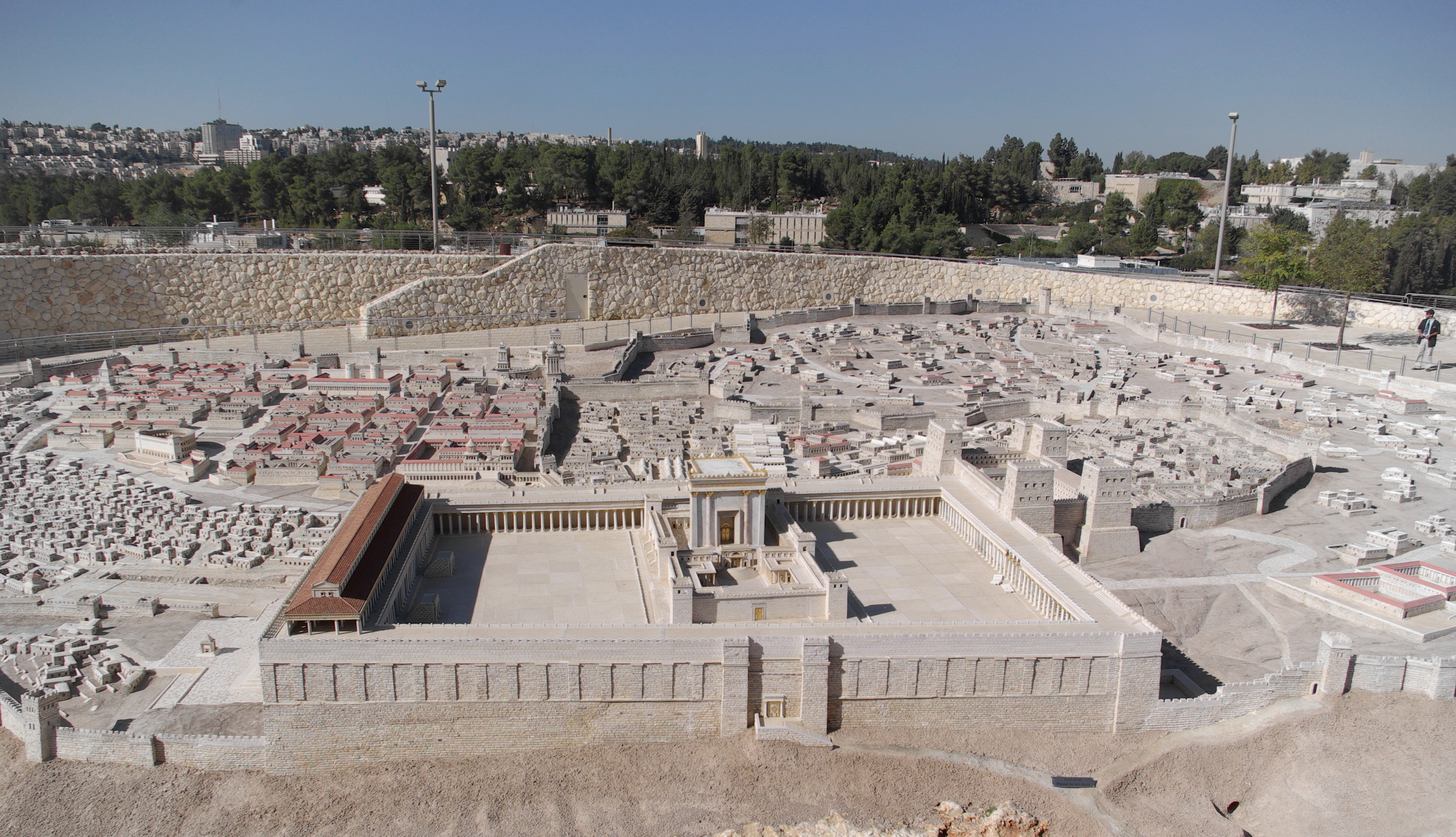 Source: Berthold Werner, Holyland Model of Jerusalem, public domain via Wikimedia Commons. Later Second Temple context, not an exact reconstruction of Zerubbabel’s temple.
This is later Second Temple Jerusalem, not the exact house completed in Ezra 6.
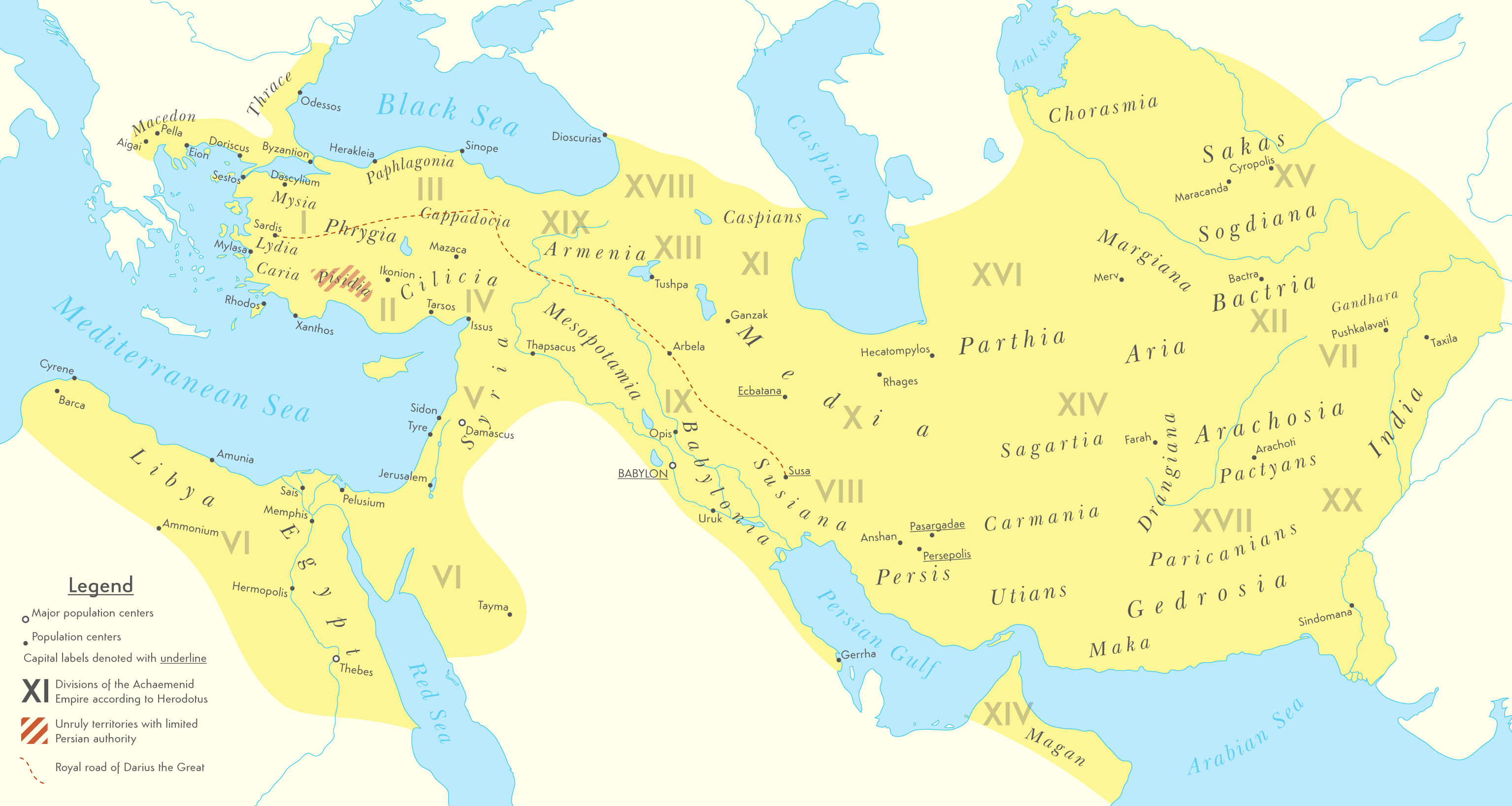 Source: Cattette, Achaemenid Empire 500 BCE, CC BY 4.0 via Wikimedia Commons.
The map helps readers see why imperial correspondence could stop or support the work. The spiritual point is not that empire becomes holy, but that God can turn even imperial mechanisms toward worship without making the empire identical with His Kingdom.
Glossary
- Adar: The month named in Ezra 6:15, when the house is completed in the sixth year of Darius.
- Aggæus: Brenton’s form of Haggai, prophet who encouraged the rebuilding of the temple.
- Apharsachæans: A group associated with the officials beyond the river in Tattenai’s correspondence.
- Arthasastha: Brenton’s form of Artaxerxes, named with Cyrus and Darius in Ezra 6:14.
- Beyond the river: Persian administrative language for the region west of the Euphrates, including Judah.
- Children of the captivity: The returned exiles, named this way to keep the memory of judgment and mercy visible.
- Darius: Persian king who confirms Cyrus’s decree and orders support for the rebuilding.
- Dedication: The joyful setting apart of the completed house of God for worship.
- Jesus son of Josedec: Brenton’s form of Jeshua or Joshua son of Jehozadak, priestly leader of the return.
- Passover: The feast remembering Israel’s deliverance from Egypt. In Christian reception, it points to Christ the true Passover.
- Sabanasar: Brenton’s form of Sheshbazzar, the treasurer or official entrusted with the temple vessels.
- Satharbuzanai: Brenton’s form of Shethar-Boznai, associated with Tattenai in the inquiry.
- Thanthanai: Brenton’s form of Tattenai, governor on this side of the river.
- Zacharias son of Addo: Brenton’s form of Zechariah son of Iddo, prophet of return and encouragement.
- Zerubbabel: Named Zorobabel in Brenton, Davidic-line leader of the returned community.
Spiritual Fruit 🍇
-
Receive prophetic correction before seeking easier circumstances. Ezra 5 does not begin with a safer political environment. It begins with Haggai and Zechariah. Ask what word of God you have been avoiding because it would require you to return to unfinished obedience.
-
Tell the truth about sin without losing hope. The elders confess that their fathers provoked the God of heaven, and they also testify to Cyrus’s decree and the restored vessels. Christian repentance must hold both: honest grief and confidence in mercy.
-
Do not trust power, but do not deny that God can use it. Darius’s decree helps the work, but God is the one turning hearts, preserving records, and strengthening hands. Pray for rulers and accept providential help, but put your hope in the unshakeable kingdom.
-
Let joy become ordered worship. The house is completed, but the chapter does not end with applause. It ends with dedication, sacrifice, priestly and Levitical order, purification, Passover, and unleavened bread. In your own life, let restored joy become prayer, confession, Scripture, fasting, and Eucharistic faithfulness.
-
Ask God for the joy only He can give. “The Lord made them glad.” Do not settle for the thin relief that comes from finishing a task. Ask for the deeper gladness of a clean heart, a restored altar, and communion with Christ.
Stand with the returned people at the feast, remembering how long the house stood unfinished. Ask the Lord to cleanse the work you have completed and the heart that completed it. Let thanksgiving replace the hunger for recognition. The Lord who strengthened their hands can also make them glad.
Teaching Notes
- Suggested timing: 10 minutes for context and geography, 12 minutes for Ezra 5:1-5, 15 minutes for Ezra 5:6-17, 15 minutes for Ezra 6:1-12, 10 minutes for Ezra 6:13-15, 10 minutes for Ezra 6:16-18, and 12 minutes for Ezra 6:19-22 and Spiritual Fruit.
- Where to linger: Spend time on Ezra 5:11-12. The people’s testimony joins identity, confession, judgment, and mercy. This is a strong spiritual formation moment for servants.
- Where to compress: The dimensions and administrative details of the decree can be summarized after reading them. Do not skip them, but keep the focus on providence and worship.
- Key phrase to say slowly: “The eyes of God were upon the captivity of Juda.”
- Key phrase to say slowly: “The Lord made them glad.”
- Pastoral warning: Do not politicize the chapter. It is not a lesson in trusting empire. It is a lesson in God’s providence over rulers and records.
- Pastoral warning: Do not make the temple completion sound like mere institutional success. The passage ends with purification, Passover, and joy because restoration is liturgical and spiritual.
The prophets awaken the builders, and the eyes of God guard the returned community (Ezra 5:1-5)
- Ask: What changed first in verses 1-2: the political situation, or the people’s obedience to the prophetic word?
- Emphasize: Prophecy assists the work by calling the people back to God’s command and presence.
- Watch for: Treating Haggai and Zechariah as motivational speakers. They are prophets speaking in the name of the God of Israel.
- Connect: Hebrews 12 teaches the Church to stand in gratitude and reverence because the final kingdom cannot be moved.
Tattenai’s inquiry and the people’s testimony about sin, judgment, and Cyrus (Ezra 5:6-17)
- Ask: Why does the people’s answer include both Solomon’s temple and their fathers’ sin?
- Emphasize: True restoration remembers mercy and judgment together.
- Watch for: Teaching the exile as only political tragedy. Ezra says the fathers provoked the God of heaven.
- Connect: Confession in the Church is not despair. It is truthful return to the God who restores holy things to holy use.
Darius finds the decree and turns imperial power toward the work (Ezra 6:1-12)
- Ask: What does Darius’s decree change, and what does it not change about the builders’ true source of security?
- Emphasize: God can turn structures of power toward His work, but the faithful receive an unshakeable kingdom from God, not from empire.
- Watch for: Presenting Darius as a saintly ruler or treating severe royal threats as a Christian model.
- Connect: Hebrews 12 helps the Church receive providential help with gratitude while serving God with reverence and godly fear.
The house is completed through prophecy and command (Ezra 6:13-15)
- Ask: Why does Ezra 6:14 name both prophecy and royal decrees in the completion of the house?
- Emphasize: The decree of the God of Israel stands above every human decree.
- Watch for: Turning completion into self-congratulation. The passage teaches thanksgiving for providence.
- Connect: John 2 leads Christians from the completed house to Christ’s risen Body, the true Temple.
Dedication, priesthood, Levites, and ordered worship (Ezra 6:16-18)
- Ask: Why does the dedication include a sin-offering for all Israel, not only celebration?
- Emphasize: Biblical joy is joined to sacrifice, purification, order, and Scripture.
- Watch for: Presenting order as cold formalism. In Ezra 6, order serves gladness before God.
- Connect: Ephesians 2 and 1 Corinthians 3 receive temple language in the Church, the holy dwelling place of God in Christ.
Passover, purification, joy, and God turning the king’s heart (Ezra 6:19-22)
- Ask: Why is Passover the right feast to close the temple-completion story?
- Emphasize: The Lord Himself makes the restored people glad.
- Watch for: Reading separation language as ethnic superiority. The verse says separation from uncleanness to seek the Lord God of Israel.
- Connect: Christ is the true Passover and the true Temple. Restoration reaches its fullness in His death and Resurrection.
Sources
Embedded Scripture is from Brenton’s English Septuagint (LXX).
Brenton, The Septuagint Version of the Old Testament, Ezra 5-6; 1 Kings 6:2; Zechariah 1:12; Proverbs 21:1; 1 Maccabees 4:59.
John 2:19-22; John 10:22-30; Hebrews 12:26-29; Ephesians 2:19-22; 1 Corinthians 3:9-17; 1 Corinthians 5:7-8; 1 Peter 3:8-15; Jeremiah 29:7; 1 Timothy 2:1-2.
The parallel history in 1 Esdras 6-7.
Achaemenid Empire map and Israel Museum Second Temple model.
Footnotes
-
St. John Chrysostom, Homilies on Hebrews, Homily 33 (Hebrews 12:28-29), section 1, text. ↩
-
St. John Chrysostom, Homilies on John, Homily 23, sections 2-3, on John 2:19-22; quotation from section 3, text. ↩
-
Greek Ezra 6:16-17 (2 Esdras 6), Septuagint text; compare Greek John 10:22. ↩
-
Coptic Katameros, Jonah’s Feast and Wednesday of the first week of the Holy Fifty Days, Liturgy Gospel, John 2:12-25. ↩
-
Coptic church consecration service, principal Scripture readings: 2 Chronicles 3:1-6:11; 2 Chronicles 7:1-18; 1 Kings 8:22-61; Ezekiel 43:1-7; Ezekiel 44:1-5. ↩
-
Coptic Katameros, Feast of the Cross, Baramhat 10, and Mesra 12, Liturgy Gospel, John 10:22-38. ↩
-
Coptic Katameros, Abib 11, Abib 20, Abib 22, Catholic Epistle, 1 Peter 3:8-15; Thursday of the sixth week of Great Lent, Pauline Epistle, 1 Timothy 2:1-3:4. ↩
-
Coptic Synaxarium, Kiahk 20, Departure of Haggai the Prophet; Amshir 15, Martyrdom of the Righteous Zechariah the Prophet, son of Berechiah and Iddo. ↩