


This narration is from a previous version of the study and may include a combined recording of multiple chapters.
Haggai 1 is a prophetic examination of the heart. The returned people have enough energy to improve private life, but the Lord’s house remains desolate. God therefore interrupts their delay with a repeated command: consider your ways.
Why This Passage Matters
This chapter teaches that worship cannot be postponed without disordering the whole life. The people are not atheists. They are postponed worshippers. Their problem is not that they deny the Lord, but that they keep placing obedience after comfort, timing, and private security.
The chapter also shows the mercy of divine discipline. Scarcity wakes the people from spiritual sleep. The Lord does not expose their priorities in order to crush them, but to bring them back to obedience, reverence, and the joy of His presence.
Placement in the Book
Haggai 1 is the first of the book’s four dated words: the sixth month, day 1, in the second year of Darius. The people begin the work on day 24 of that same month. Chapter 2 will address discouragement, holiness, future glory, and the Davidic hope through Zerubbabel. But first the people must face the simple truth: the Lord’s house is desolate because their hearts have learned to say, “Not yet.”
A delayed house and divided priorities (Haggai 1:1-4)
1 In the second year of Darius the king, in the sixth month, on the first day of the month, the word of the Lord came by the hand of the prophet Aggæus, saying, Speak to Zorobabel the son of Salathiel, of the tribe of Juda, and to Jesus the son of Josedec, the high priest, saying, 2 Thus saith the Lord Almighty, saying, This people say, The time is not come to build the house of the Lord. 3 And the word of the Lord came by the hand of the prophet Aggæus, saying,
4 Is it time for you to dwell in your ceiled houses, whereas our house is desolate?
The first wound in the chapter is delay. The people do not say, “We will never build.” They say, “The time is not come.” That is why the passage is so searching. Much spiritual neglect hides behind reasonable postponement. Prayer can wait. Repentance can wait. Service can wait. The house of God can wait until life feels more settled.
The Lord answers by contrasting their ceiled houses with His desolate house. The issue is not that private shelter is evil. The issue is that their private world has received care, finish, and attention while worship has been left ruined. Haggai reveals what their calendar, spending, labor, and imagination have already confessed.
Brenton says “our house.” Hebrew-based Bibles say “this house” or “this temple.” The Septuagint lets the Lord speak of the ruin as His own house, not as a public project standing at a distance from Him.
Brenton’s names are worth noticing but not overloading. Aggæus is Haggai. Zorobabel is Zerubbabel, and Brenton calls him “of the tribe of Juda,” not governor. Jesus the son of Josedec is Joshua the high priest, not Jesus Christ. This matters because Haggai addresses civil leadership, priestly leadership, and the remnant together. Rebuilding worship is not one person’s private project. It is the shared obedience of the people of God.
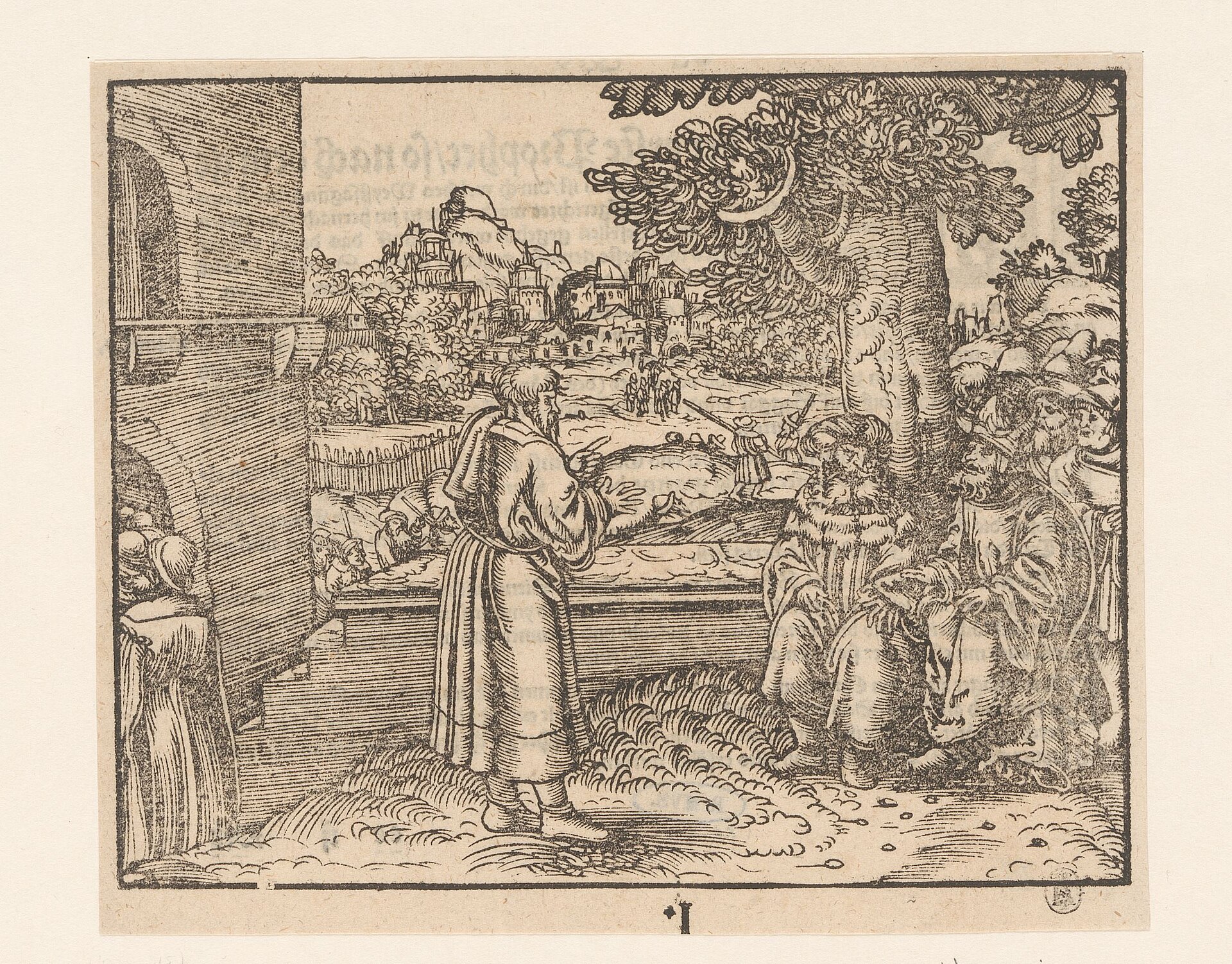 Source: Profeet Haggai predikend, Rijksmuseum, CC0, via Wikimedia Commons. The print helps visualize Haggai’s word addressing both civil and priestly leadership.
Consider your ways under the discipline of scarcity (Haggai 1:5-11)
5 And now thus saith the Lord Almighty; Consider your ways, I pray you. 6 Ye have sown much, but brought in little; ye have eaten, and are not satisfied; ye have drunk, and are not satisfied with drink, ye have clothed yourselves, and have not become warm thereby: and he that earns wages has gathered them into a bag full of holes.
7 Thus saith the Lord Almighty; Consider your ways. 8 Go up to the mountain, and cut timber; build the house, and I will take pleasure in it, and be glorified, saith the Lord. 9 Ye looked for much, and there came little; and it was brought into the house, and I blew it away. Therefore thus saith the Lord Almighty, Because my house is desolate, and ye run every one into his own house; 10 therefore shall the sky withhold dew, and the earth shall keep back her produce. 11 And I will bring a sword upon the land, and upon the mountains, and upon the corn, and upon the wine, and upon the oil, and all that the earth produces, and upon the men, and upon the cattle, and upon all the labours of their hands.
“Consider your ways” is the spiritual spine of the chapter. The command is not mere self-improvement. It is examination of conscience before God: What do my habits reveal? What am I willing to build first? Where have I mistaken postponement for prudence?
The people are working, eating, drinking, earning, and gathering, yet nothing satisfies. Their labor leaks away like wages placed into a bag full of holes. This is not a simplistic rule that every hardship is caused by one sin. Haggai is speaking into a specific covenant moment. The futility list in verse 6 echoes the covenant curses of Deuteronomy 28:38-40 and Leviticus 26:20: much seed and little harvest, vineyards that do not gladden, olive trees that give no oil, strength spent in vain. The withheld dew and produce in verse 10 echo Deuteronomy 28:23-24, where heaven turns to brass and the rain becomes dust. The warning is covenantal because Scripture already named it.
The scarcity is severe, but it is merciful. God frustrates false fullness so the people can return to true life. He exposes the emptiness of comfort-first living before it becomes permanent. The discipline is a call back to worship.
Brenton’s verse 11 says, “I will bring a sword upon the land.” Hebrew-based Bibles say “drought.” The Hebrew consonants can be read either as drought, which is the Masoretic reading, or as sword, which is what the Greek translators read. There is also a wordplay in the Hebrew. The house lies desolate (Haggai 1:4, 1:9), and God sends a matching ruin. The punishment mirrors the neglect. The Septuagint intensifies that ruin as a sword. Either reading refuses to treat the empty barns as bad luck. Creation itself will not pretend that disordered worship is harmless.
The command in verse 8 is concrete: go up, cut timber, build. Repentance is not only regret. It becomes obedient action. The Lord says, “I will take pleasure in it, and be glorified.” This is the goal: not institutional success, but the pleasure and glory of God among His people.
The fear of the Lord becomes obedience (Haggai 1:12-15)
12 And Zorobabel the son of Salathiel, of the tribe of Juda, and Jesus the son of Josedec, the high priest, and all the remnant of the people, hearkened to the voice of the Lord their God, and the words of the prophet Aggæus, according as the Lord their God had sent him to them, and the people feared before the Lord. 13 And Aggæus the Lord’s messenger spoke among the messengers of the Lord to the people, saying, I am with you, saith the Lord.
14 And the Lord stirred up the spirit of Zorobabel the son of Salathiel, of the tribe of Juda, and the spirit of Jesus the son of Josedec, the high priest, and the spirit of the remnant of all the people; and they went in, and wrought in the house of the Lord Almighty their God, 15 on the four and twentieth day of the sixth month, in the second year of Darius the king.
The chapter does not end with shame. It ends with obedience. The order is plain in the text: the word of the Lord is heard, the people fear before the Lord, the Lord promises His presence, the Lord stirs their spirits, and they begin the work.
Holy fear here is not panic. It is the awakening of reverence. The people recognize that the prophetic word is not Haggai’s opinion but the voice of the Lord their God. That fear becomes obedience because God adds the promise: “I am with you.” The Lord does not merely command a weak people to work. He gives Himself to them.
Brenton’s verse 13 is longer than the Hebrew. The Hebrew is roughly “the Lord’s messenger, with the Lord’s message.” The Septuagint says the Lord’s messenger “spoke among the messengers of the Lord.” That expansion is LXX only. It is still worth hearing. Haggai bears the title messenger, the same word that is Malachi’s name. The prophet is presented as one sent by God, speaking among those God sends.
Verse 14 uses the same language Ezra uses for the return itself. “The Lord stirred up the spirit of Cyrus” (Ezra 1:1), and then “all whose spirit the Lord stirred up to go up to build the house” (Ezra 1:5). Grace begins the return. The people’s obedience answers it. Haggai’s remnant is not manufacturing zeal. The same Lord who stirred Cyrus now stirs Zerubbabel, Joshua, and the people, and they go in and work.
Christological reading
Haggai 1 first concerns the actual post-exilic temple. That historical burden must remain first. But Christian readers also hear the passage in the light of Christ, who calls His Body the true Temple and makes the Church a dwelling place for God.
The movement of the chapter prepares that reading. The desolate house reveals disordered worship. Christ comes as the true dwelling of God with man. The stirred remnant begins to rebuild. In Christ, the Church is built as a living temple. The promise “I am with you” finds its fullness in Emmanuel, God with us, and in the abiding presence of the Holy Spirit.
The practical edge remains. If Christ is the true Temple, then worship, repentance, Eucharistic life, and care for the Church cannot be treated as optional additions after private comfort is secured.
The Church’s Voice in Worship ⛪
The Coptic lectionary data used on this site assigns no reading from Haggai 1. The Church commemorates the prophet on Kiahk 20. That commemoration is not the same as saying Haggai 1 is read liturgically. The day readings, and the reason they may be heard beside this chapter, are set out in haggai-general-introduction.
Inferred. Two Gospels of the temple’s cleansing can be heard beside this chapter, and the connection is inference, not a rubric. The Palm Sunday Liturgy Gospel, Luke 19:29-48, includes the cleansing of the temple. John 2:12-25 is the Liturgy Gospel on Jonah’s Feast and on Wednesday of the first week of the Holy Fifty Days. Both support the reading of Christ as the true Temple. The temple study is john-2-13-25-the-true-temple-and-the-cleansing-of-worship. The Palm Sunday entry and the tears over the temple are luke-19-28-40-the-king-enters-jerusalem and luke-19-41-48-tears-over-jerusalem-temple-and-teaching.
The spiritual question remains. Kiahk teaches the Church to prepare for the coming of Christ. Haggai 1 teaches the heart to stop postponing the Lord’s house. Both press the same question: is there room for the Lord, or have we filled the house with ourselves?
Spiritual Fruit 🍇
Haggai 1 asks each reader to examine the practical order of life. What receives first attention? What is carefully paneled while prayer is left unfinished? Where have I said, “not yet,” to obedience that God has already made plain?
The fruit of this chapter is concrete repentance. Consider your ways. Receive the Lord’s correction as mercy. Put worship back at the center. Begin the obedient work God has already placed before you. Trust that His command is joined to His presence: “I am with you.”
Teaching Notes
Do not use this chapter as a fundraising speech or a guilt tactic for church projects. The Lord is not poor. The Church does not manipulate. The prophetic burden is worship: when God’s house is neglected, the people themselves become disordered.
A delayed house and divided priorities (Haggai 1:1-4)
- Ask: What kinds of spiritual delay sound reasonable at first but slowly become disobedience?
- Emphasize: The issue is not that private homes are evil. The issue is that private comfort has received priority over worship. Brenton says “our house,” not “this temple.”
- Watch for: Do not turn this into institutional pressure. Haggai exposes disordered worship, not God’s need for buildings.
- Connect: Christ is the true Temple, but the historical temple still matters in the passage. Let the historical burden come first.
- Show: Use the Haggai-before-Zerubbabel-and-Joshua print to show that the prophetic word addresses leadership, priesthood, and people together.
Consider your ways under the discipline of scarcity (Haggai 1:5-11)
- Ask: What does the image of wages in a bag full of holes reveal about life without rightly ordered worship?
- Emphasize: Scarcity in this chapter is mercy waking the people, not a formula for explaining every hardship. Ground the warning in Deuteronomy 28:23-24, 38-40 and Leviticus 26:20.
- Watch for: Avoid prosperity-gospel logic. Haggai is not saying that temple work mechanically produces wealth. If you mention the sword, explain the Hebrew consonants before treating Brenton’s reading as a different event.
- Connect: Examination of conscience belongs to Orthodox repentance. “Consider your ways” should become prayer, confession, and obedient change.
- Show: If using the map from the introduction, remind the group that obedience happens under Persian rule and economic pressure, not ideal conditions.
The fear of the Lord becomes obedience (Haggai 1:12-15)
- Ask: What sequence do you see from hearing the word to beginning the work?
- Emphasize: The Lord gives presence before the work begins: “I am with you.” The same stirring language is in Ezra 1:1 and 1:5.
- Watch for: Holy fear is not panic or despair. It is reverent awakening before God. Verse 13’s “among the messengers” is an LXX expansion.
- Connect: The stirred spirits of Zerubbabel, Joshua, and the remnant point toward the Church as a community moved by grace into obedience.
- Show: Contrast the unfinished house at the start with the stirred people at the end. The real rebuilding begins in the heart before it appears in timber and stone.
Sources
Embedded Scripture is from Brenton’s English Septuagint (LXX).
- St-Takla English Synaxarium, 20 Kiahk: The Departure of the Upright Haggai the Prophet.
- Fr. Tadros Yacoub Malaty, Book of Haggai, Coptic Treasures Project. Used as a Coptic Orthodox commentary lead, not as early patristic commentary.