


This narration is from a previous version of the study and may include a combined recording of multiple chapters.
Haggai is God interrupting delayed obedience. The returned people are not being called first to a building campaign, but to repentance: worship has slipped behind comfort, courage has been weakened by comparison with former glory, and the Lord’s house lies unfinished while private life continues. Haggai teaches that the people of God cannot postpone worship and still expect life to be rightly ordered.
Historical and Scriptural Context
Haggai speaks after the exile, in the second year of Darius, to a community that has returned to Judah but has not finished the temple. The book is unusually direct and dated. God does not leave the people in vague guilt. He names the delay, calls them to consider their ways, promises His presence, and gives them courage to work.
The whole book holds four dated words, all in 520 BC:
| Word | Passage | Date in the second year of Darius |
|---|---|---|
| First | Haggai 1:1-15 | Sixth month, day 1. The people hear, fear, and begin the work on day 24 of the same month. |
| Second | Haggai 2:1-9 | Seventh month, day 21, the last day of the Feast of Tabernacles. |
| Third | Haggai 2:10-19 | Ninth month, day 24. |
| Fourth | Haggai 2:20-23 | The same day, a second word, spoken to Zerubbabel. |
Between the second and third words, in the eighth month of that same year, the Lord speaks to Zechariah (Zechariah 1:1). Haggai and Zechariah are companions in one season of rebuilding. Ezra 5-6 remembers both prophets encouraging the work, and 1-esdras-6-7-prophets-decree-temple-and-passover names Aggeus among those who urged the house to be raised again. The prophetic word itself is here: consider your ways, be strong, I am with you, My Spirit remains among you, and the latter glory will be greater than the former. For Zechariah’s opening word, see zechariah-general-introduction.
The temple matters because it is the visible center of covenant worship. The problem is not that God needs human architecture. The people have ordered their lives as if worship can wait. Their ceiled houses and the desolate house of the Lord reveal a divided heart.
Where Hebrew-based Bibles call Zerubbabel “governor of Judah,” Brenton never uses that title. He says “of the tribe of Juda.” The Septuagint keeps the Davidic tribe in view. The office of governor is a Hebrew-based reading, not Brenton’s wording.
Septuagint and Hebrew differences in Haggai
These are the differences that change what a reader hears. Each chapter study explains the ones that belong to its passage.
| Place | What differs | Why it matters |
|---|---|---|
| 1:1 | Brenton: “of the tribe of Juda.” Hebrew-based Bibles: “governor of Judah.” | Leadership is named by tribe, not by Persian office. |
| 1:4 | Brenton: “our house.” Hebrew-based Bibles: “this house” or “this temple.” | The Lord claims the desolate house as His own. |
| 1:11 | Brenton: “sword.” Hebrew-based Bibles: “drought.” | The same Hebrew consonants can be read either way, and the punishment mirrors the desolate house. |
| 1:13 | Brenton: “spoke among the messengers of the Lord.” The Hebrew is closer to “the Lord’s messenger, with the Lord’s message.” | An LXX expansion. Haggai bears the title messenger. |
| 2:5 | The LXX lacks the Hebrew opening about the word God covenanted when they came out of Egypt. | Brenton begins with the Spirit remaining in their midst. |
| 2:6 | Brenton: “Yet once,” with no “it is a little while.” | Hebrews 12:26-27 quotes this form and builds on the word “once.” |
| 2:7 | Brenton: “the choice portions of all the nations.” Hebrew-based Bibles: “the desire” or “the treasure” of the nations. | Augustine reads both, and reads the greater glory as the Church. |
| 2:9 | Brenton adds “peace of soul for a possession to every one that builds.” | An LXX expansion, and still a gift worth treasuring. |
| 2:14 | A bracketed clause not in the Hebrew, ending with hatred of the one who reproved in the gates. | An LXX expansion that echoes Amos 5:10. |
| 2:21 | Brenton adds “the sea and the dry land.” The Hebrew has heaven and earth. | The second shaking is as wide as the first. |
Why Haggai Matters
Haggai’s message is short, but it cuts deeply:
- Worship before comfort: the Lord’s house cannot be treated as an afterthought while private life is carefully improved.
- Scarcity as mercy: God uses frustration to wake the people, not merely to punish them.
- Divine presence as courage: the command to work is held together with the promise, “I am with you.”
- Holiness as real life before God: holy work does not automatically heal an unrepentant heart.
- Hope beyond the visible size of the work: the Lord can fill a small, weak, post-exilic beginning with glory.
The book does not ask, “Are we building enough?” It asks, “What have our choices revealed about what we actually worship?”
Geographical Significance ⛰️
Haggai’s setting is Jerusalem and Judah under Persian imperial rule. The returned community is small, politically dependent, economically fragile, and still called to obey the Lord. The map below is broad, not a detailed Yehud map, but it helps the reader see the scale of the empire around the people of God. The Lord’s word comes to His remnant even when they live under a foreign king.
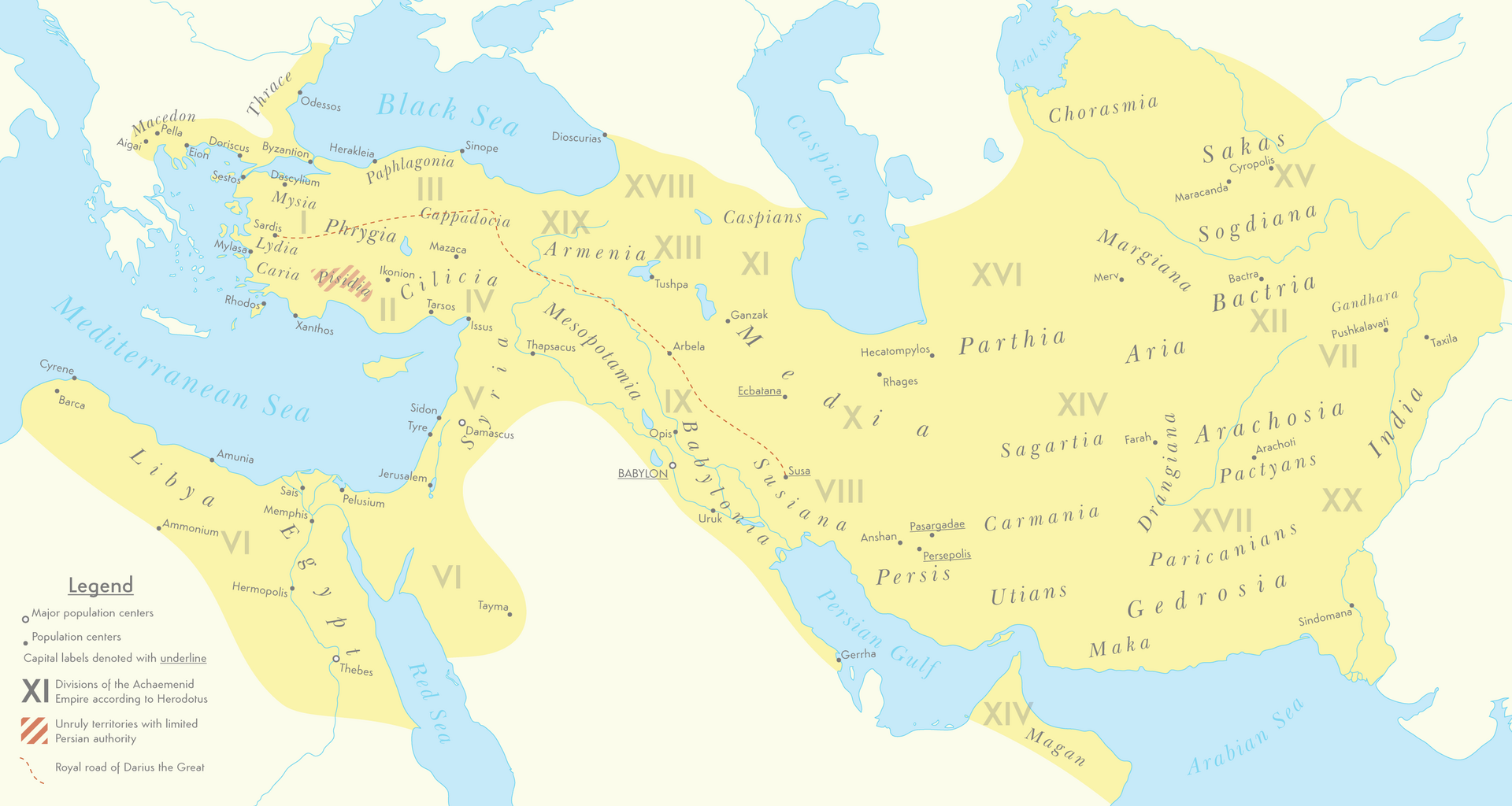 Source: Achaemenid Empire 500 BC, CC BY 4.0, via Wikimedia Commons. Used as broad Persian-period context, not as a detailed map of Haggai’s Jerusalem.
The Characters 👥
- Haggai / Aggæus: Brenton’s English Septuagint uses the form Aggæus. He is the Lord’s messenger, the same Hebrew title that becomes Malachi’s name. His word exposes delay and gives courage. The Synaxarium remembers him as a Levite of Aaron’s line, born in Babylon during the exile, one who returned with Zerubbabel, and one buried in the tomb of the priests in Jerusalem. That is Synaxarium tradition, preserved in the St-Takla English Synaxarium, not a claim proved from Haggai’s own book. It does illuminate Haggai 2:11-13, where the prophet questions the priests about the law.
- Zerubbabel / Zorobabel: Brenton calls him “of the tribe of Juda,” not governor. Haggai’s last word makes him the Lord’s chosen seal, a sign that God has not abandoned the Davidic promise. The Synaxarium calls him governor of Judah. That is the Synaxarium’s wording.
- Joshua son of Jehozadak / Jesus son of Josedec: Brenton uses Jesus for Joshua the high priest. This should not be confused with Jesus Christ. The name does, however, help Christian readers notice the priestly shape of the scene: civil leadership, priesthood, and remnant must respond together.
- Darius: the Persian king whose reign anchors the dates. Haggai’s obedience happens under imperial rule, not in ideal circumstances.
- The remnant of the people: the returned community whose obedience begins when they hear, fear, and respond to the word of the Lord.
Iconography and Visual Teaching 🖼️
The Prophet Haggai icon below is a Russian icon from the first quarter of the eighteenth century. It is not a Coptic icon. It is a useful Orthodox visual witness to Haggai as a prophet of the Lord, not merely a historical reformer. He stands with the authority of a prophetic word, and that word is concrete: reorder worship, labor, courage, and hope before God.
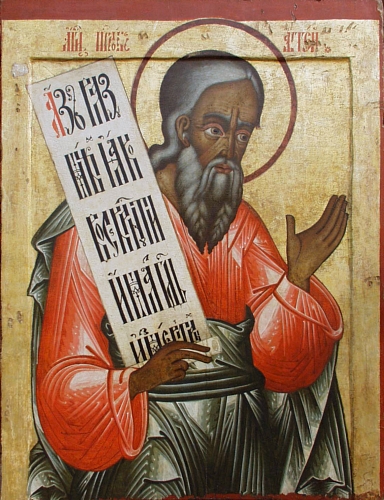 Source: Prophet Haggai, Russian icon from Kizhi monastery, public domain, via Wikimedia Commons.
The Church’s Voice in Worship ⛪
The Coptic lectionary data used on this site, @andraws/lectionary-data
1.3.3, assigns no reading from Haggai 1 or Haggai 2. That absence should be stated honestly. The Church remembers the prophet. It does not, in the packaged lectionary, read his chapters as appointed lessons.
Date-based. On Kiahk 20, the day the Church remembers Haggai, the packaged title is “The Departure of Haggai the Prophet.” On that day it reads:
- Vespers Gospel: Luke 11:37-51
- Matins Gospel: Matthew 17:1-9
- Liturgy: Hebrews 11:17-27; 2 Peter 1:19-2:8; Acts 15:21-29; Psalm 99:6-7 (LXX Psalm 98:6-7); Matthew 23:13-36
Any thematic reason for those lessons is inference, not a rubric. A reader may hear prophets, the prophetic word, and the tombs of the prophets in Luke 11 and Matthew 23. That hearing is ours, not a printed instruction of the lectionary.
Explicit. On Hator 8, the Commemoration of the Four Incorporeal Creatures, the Liturgy Pauline Epistle is Hebrews 12:21-13:2. Hebrews 12:26 quotes Haggai 2:6. This is how Haggai’s word is actually heard in Coptic worship. The exposition of that shaking is in hebrews-26-you-have-come-to-mount-zion.
Inferred. On Friday of the second week of Great Lent, the Liturgy Pauline Epistle is Hebrews 12:28-13:16, the “kingdom that cannot be shaken,” which is Hebrews’ conclusion from the Haggai quotation. That connection is inferred from the argument of Hebrews, not from a Haggai rubric.
Explicit name, inferred tie. Zerubbabel is named in two Nativity-season Vespers Gospels: Matthew 1:1-17 on the Paramoun (Kiahk 28), and Luke 3:23-38 on the Nativity (Kiahk 29). They strengthen the Kiahk lens already native to this book. The tie to Haggai’s seal is inferred.
Kiahk still gives a fitting spiritual lens. Haggai calls the people to prepare the house of the Lord. Kiahk forms the Church to prepare the heart for the coming of Christ.
How the book is read
| Guide | What it holds |
|---|---|
| haggai-1-consider-your-ways-and-rebuild-the-house | The first word: sixth month, day 1, and the obedience of day 24. Delayed worship is exposed. Scarcity becomes a merciful alarm. Obedience begins when the people fear the Lord and receive His presence. |
| haggai-2-greater-glory-holiness-and-the-shaking-of-nations | The other three words, read as one chapter: courage on the last day of Tabernacles, holiness on the twenty-fourth of the ninth month, and, that same day, the seal restored to Zerubbabel. |
Sources
Embedded Scripture is from Brenton’s English Septuagint (LXX).
- St-Takla English Synaxarium, 20 Kiahk: The Departure of the Upright Haggai the Prophet. Source for the Synaxarium narrative. The packaged commemoration title is “The Departure of Haggai the Prophet.”
- Fr. Tadros Yacoub Malaty, Book of Haggai, Coptic Treasures Project. Used as a Coptic Orthodox commentary lead, not as early patristic commentary.
- Visual captions in the guides provide direct source links for embedded assets.