
Peter has just named the virtues that must be present and increasing in the Christian life. He now turns to the question that shadows every generation: what will keep the Church faithful when the apostolic voice seems distant and familiar truth begins to lose its hold on the heart? Peter’s answer is holy remembrance. He will stir up believers who already know the truth, recall the majesty he saw on the mountain, and direct them to the prophetic word that shines until Christ’s day. His body is failing; the witness entrusted to the Church will remain.
Remembrance Before Departure (2 Peter 1:12-15)
12 For this reason I will not be negligent to remind you always of these things, though you know and are established in the present truth. 13 Yes, I think it is right, as long as I am in this tent, to stir you up by reminding you, 14 knowing that shortly I must put off my tent, just as our Lord Jesus Christ showed me. 15 Moreover I will be careful to ensure that you always have a reminder of these things after my decease.
“For this reason” joins Peter’s reminder to the virtues of verses 5-11. Faith must become virtue, knowledge, self-control, perseverance, godliness, brotherly kindness, and love; yet even believers established in the truth can forget how received grace is meant to shape life. In 1:9, blindness and fruitlessness grow from forgotten cleansing; in 1:12, Peter’s repeated reminder begins the cure by returning believers to the mercy from which the virtue sequence grows. Peter therefore repeats what they know. A truth stored in memory can still cease to govern speech, desire, prayer, or service. His repetition is pastoral vigilance: he keeps placing the truth before the heart until knowledge becomes obedience.
This helps explain why repetition has a holy place in the Church. The Creed is confessed again, the Scriptures are read again, the feasts return, and confession brings recurring wounds into the light again. The point is not to keep Christians at the beginning. Repeated truth stirs a drowsy soul. When familiarity says, “I already know this,” Peter asks whether the known truth is still alive and fruitful.
Peter speaks of his body as a “tent.” The Greek word skēnōma describes a temporary dwelling, but the image does not make the body worthless.1 A tent matters because the pilgrim is still called to faithfulness within it. Peter also says that Christ Himself has shown him that death is near. The letter does not identify how that disclosure came, so the manner is best left unnamed. Its effect is clear: Peter receives his remaining embodied life as time for service. Knowing that death is near does not turn him inward; it sharpens his responsibility to strengthen others.
He then calls his death his exodos, his departure or exodus.1 Luke uses the same noun when Moses and Elijah speak at the Transfiguration about the exodus Christ would accomplish at Jerusalem.2 The lexical echo should be held with care; it does not prove direct literary dependence. It does, however, place Peter’s departure within the world revealed on the mountain. Christ’s glory led toward Jerusalem, the Cross, and the Resurrection. Peter can face death as a servant who follows the Lord’s Passover, entrusting both his life and the Church to the One who has passed through death and opened the way to life.
Peter’s desire that the Church retain his reminder after his death gives the letter’s ancient reception a particular spiritual weight. Eusebius records that 2 Peter was not universally received in his day, though it was known and useful to many; St Athanasius later explicitly lists two epistles of Peter among the accepted Catholic Epistles.3 This history does not settle every modern critical question, nor should it be hidden. It shows how Peter’s concern for a reminder “after my decease” was lived within the Church’s long work of receiving, testing, and preserving apostolic testimony. The Church now hears the letter in the canonical voice she has received.
Peter’s final concern is therefore neither his reputation nor the survival of a private school. “You always have a reminder” is authority purified by service. The faithful servant prepares people to remember Christ after the servant is gone. Parents, teachers, clergy, and ministry leaders meet a searching measure here: will those entrusted to us remember our importance, or will they remember the Lord more clearly?
Eyewitnesses of His Majesty (2 Peter 1:16-18)
16 For we did not follow cunningly devised fables when we made known to you the power and coming of our Lord Jesus Christ, but were eyewitnesses of His majesty. 17 For He received from God the Father honor and glory when such a voice came to Him from the Excellent Glory: “This is My beloved Son, in whom I am well pleased.” 18 And we heard this voice which came from heaven when we were with Him on the holy mountain.
Peter now names what the Church must remember. The apostolic proclamation of Christ’s “power and coming” did not grow from a cleverly constructed religious tale. The Transfiguration disclosed the majesty of the Lord whose glory will be manifested at His coming. Peter saw Christ honored and glorified, and he heard the Father’s testimony: “This is My beloved Son.” Christian hope rests on Jesus Christ as He was revealed, not on an inspiring idea made impressive by human skill.
The word translated “eyewitnesses,” epoptai, is a forceful word for spectators or direct witnesses.4 Peter does not claim that sight alone explains the mystery. He pairs what the apostles saw with the word they heard from the Father. The event is received through both majesty and testimony: the Son shines in glory, and the Father identifies Him. The apostolic witness therefore has a definite center. Peter does not point to the intensity of his own experience. He points to the beloved Son.
Second Peter calls the place “the holy mountain,” while the Synoptic accounts speak of a high mountain or the mountain. None of these texts names the site.5 Mount Tabor belongs to later Christian tradition, but Peter’s wording directs attention to why the mountain is holy: God manifested the Son’s glory there. The holiness lies in divine presence, not in our ability to supply a coordinate the text withholds.
The Father’s voice is real testimony received by human ears, yet it does not reduce the invisible God to bodily composition. St Severus of Antioch, in Letter XCV (95) to Isidore the Count, speaks thematically about the voice heard at Christ’s Baptism and Transfiguration and explains that such an utterance is truly heard while God remains beyond human bodily organs.6 His care protects the verse from two opposite errors. The voice is neither imaginary nor a crude picture of the Father. God truly reveals the Son in a manner His creatures can receive.
St John Chrysostom says that Christ showed the disciples the glory of His coming “so far as it was possible for them to learn it” in their present life.7 Chrysostom is preaching on Matthew’s Transfiguration account rather than commenting directly on 2 Peter, but his insight opens Peter’s phrase “eyewitnesses of His majesty.” The disciples are given a true sight of glory before they face the Cross, their own fear, and the apparent defeat of their Lord. The mountain does not cancel Golgotha. It teaches them whose glory is hidden within the path to Golgotha.
That same mercy reaches believers who have not stood on the mountain. Grief can make the Cross look like abandonment; delay can make Christ’s coming feel unreal; repeated failure can make His power seem remote. Peter does not answer by promising constant spiritual intensity. He gives the Church a witnessed event and the Father’s word. The beloved Son who went toward the Cross is the Lord of majesty. His hiddenness in suffering does not make His glory less true.
Iconography and Visual Teaching 🖼️
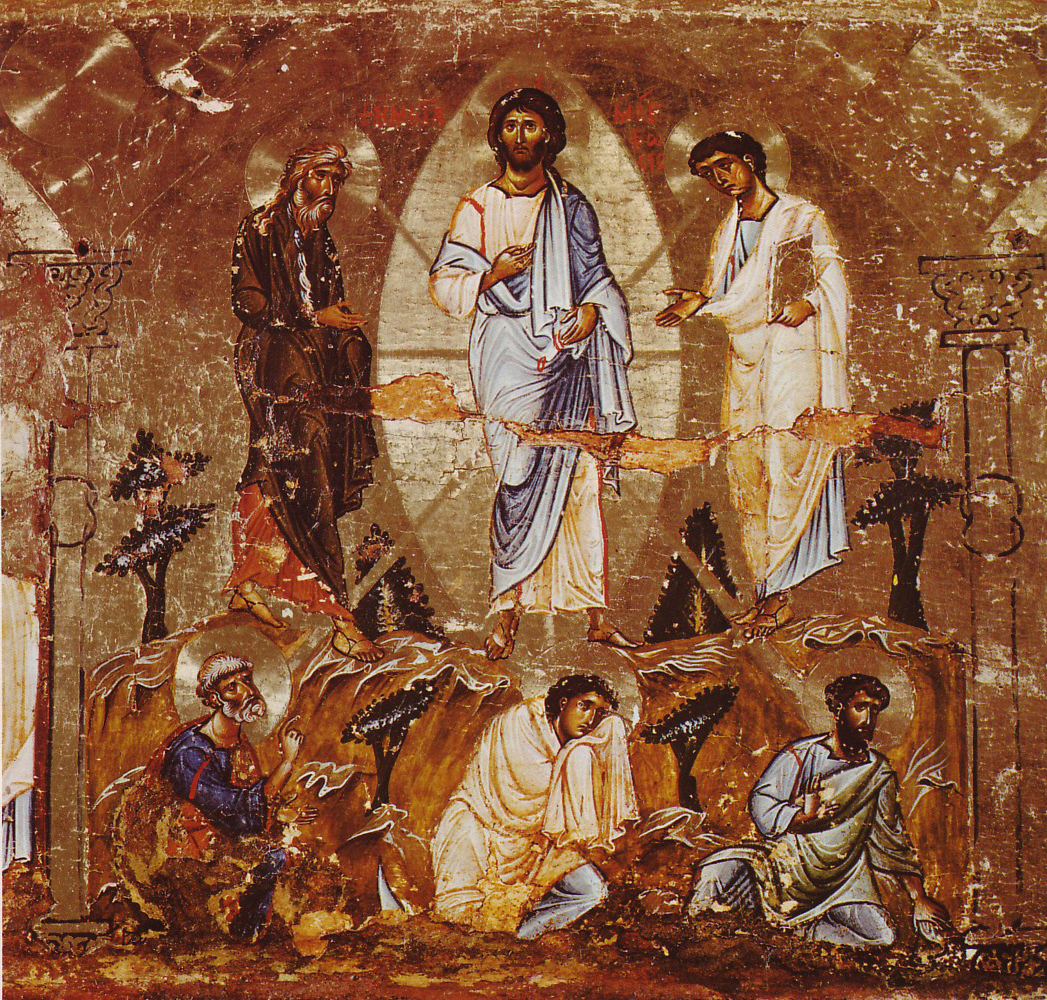 Source: Wikimedia Commons, public-domain file page for the twelfth-century Transfiguration icon from Saint Catherine’s Monastery, Sinai.
The twelfth-century Transfiguration icon from Saint Catherine’s Monastery places Christ in glory at the center, with Moses and Elijah beside Him and the apostles receiving the revelation below.8 Its location at Sinai does not identify Peter’s holy mountain. Its theological composition serves the passage: Peter’s authority comes from receiving and handing on the revelation of Christ, not from placing himself at the center.
The Prophetic Word and the Spirit-Borne Witness (2 Peter 1:19-21)
19 And so we have the prophetic word confirmed, which you do well to heed as a light that shines in a dark place, until the day dawns and the morning star rises in your hearts; 20 knowing this first, that no prophecy of Scripture is of any private interpretation, 21 for prophecy never came by the will of man, but holy men of God spoke as they were moved by the Holy Spirit.
Peter moves from the mountain to Scripture without dividing them into rival authorities. The Transfiguration confirms the prophetic promise of Christ’s glory, while the prophetic word teaches the Church how to understand the glory the apostles witnessed. The exact force of the Greek comparative in verse 19 is debated: translations variously present the prophetic word as confirmed, more fully confirmed, or more certain.9 The secure pastoral claim is their convergence. Apostolic eyewitness and prophetic Scripture bear one testimony to the power and coming of Jesus Christ.
The faithful “do well to heed” this word. Peter’s verb asks for sustained attention, not a passing glance. Scripture is compared to a portable lamp shining in a “dark place,” and the Greek adjective can suggest a murky or dingy place.10 A lamp does not remove the whole night at once. It gives enough light to see the next faithful step and to recognize what the darkness was hiding. Resentment calls itself justice, ambition borrows the language of service, and fear disguises itself as prudence. The prophetic word exposes such distortions because its light comes from beyond the self.
The lamp shines “until the day dawns and the morning star rises in your hearts.” Peter’s image holds together Christ’s promised appearing and the heart’s illumination. The identification of the morning star with Christ is likely in this eschatological setting, though the phrase’s exact scope remains debated.10 What is clear is that the inward rising never becomes a private light that replaces Scripture. The heart is illumined as it heeds the prophetic lamp and waits for the full day of Christ. Scripture trains desire for dawn.
Language insight
A repeated Greek verb binds the Father’s voice, prophecy, and the Holy Spirit together. The verb pherō means to bear, carry, or bring. In verses 17-18, the voice is “borne” from the Excellent Glory and from heaven. In verse 21, prophecy is not “borne” by human will, while the prophets speak as they are “borne” by the Holy Spirit.11 The NKJV naturally varies the English with “came” and “moved,” so the verbal thread is easy to miss.
Once the repetition is heard, Peter’s argument becomes more unified. On the mountain, the apostles receive the voice God bears to them. In Scripture, the prophets speak while the Holy Spirit bears them. The Father bears witness to the beloved Son; the Spirit bears the prophetic servants; the apostles hand on what they received. The repeated verb does not by itself define a complete doctrine of inspiration, but it clearly locates the initiative in God. The Church’s faith is received witness before it becomes our confession.
Verse 21 also clarifies verse 20. “No prophecy of Scripture is of any private interpretation” is followed by “for prophecy never came by the will of man.” The explanatory “for” strongly supports an origin-focused reading: prophecy does not arise from a prophet’s private will or self-generated explanation.12 The verse should never be used to shame lay Christians for reading Scripture, asking honest questions, or studying carefully. Peter’s concern is the divine source of prophecy.
That origin carries an ecclesial consequence. What the Spirit bears cannot become private property bent around one person’s appetite, grievance, or ambition. Humble reading therefore belongs with the apostolic faith, prayer, repentance, worship, and willingness to receive correction in the Church. Private self-rule is rejected, but attentive personal reading is welcomed. The same Spirit who bore the prophets teaches the reader to approach their words without trying to master them.
St Justin Martyr gives a thematic early witness to this understanding of prophecy. He describes the prophets as speaking what they saw and heard while “being filled with the Holy Spirit.”13 Justin is not commenting directly on 2 Peter 1:21. His words nevertheless echo Peter’s central claim: the prophet does not possess the word as a personal invention. God gives, the Spirit bears, and the servant speaks.
The Church’s Voice in Worship ⛪
The Coptic lectionary appoints the full passage, 2 Peter 1:12-21, as the Liturgy Catholic Epistle for the Feast of the Transfiguration on Mesra 13.14 The placement lets the feast interpret the whole paragraph. The Church celebrates manifested glory by hearing Peter’s eyewitness testimony, the Father’s voice, the prophetic lamp, and the Spirit who bore the prophets. The mountain is not left as a moment of brightness from the past; it becomes enduring apostolic memory and Scripture heeded until Christ’s dawn.
The full passage is also appointed as the Liturgy Catholic Epistle for the Circumcision of the Lord and the Entrance of the Lord into the Temple.15 Those occurrences are verified, but the precise historical or rite-based rationale was not established in the sources used here. Nativity appoints 2 Peter 1:12-17, and Theophany Paramoun appoints 2 Peter 1:12-19; these are subranges rather than readings of the entire session passage.16 Their presence modestly shows how the Church returns to Peter’s witness around feasts in which the beloved Son is manifested and the promises of God come into view.
Spiritual Fruit 🍇
-
Receive a familiar truth again before pride makes it harmless. Peter speaks to people who already know and are established. Choose one familiar word from the passage, such as “remind,” “beloved Son,” “heed,” or “carried,” and ask where it has stopped governing your life. Bring that place into prayer and take one concrete step of obedience before seeking something new.
-
Mortality can stir fear or self-importance; spend the remaining day on durable love. Peter answers his approaching departure by strengthening other people’s memory of Christ. A parent can pray and speak the faith plainly at home; a servant can prepare others rather than guard a role; a friend can leave reconciliation instead of unfinished resentment. Ask what will help another person remember the Lord when your voice is absent.
-
When suffering hides Christ’s glory, hold the mountain and the Cross together. The beloved Son revealed in majesty is the same Lord who goes toward Jerusalem. In grief, delay, or spiritual dryness, do not demand a new spectacle. Return to the Father’s testimony, confess Christ’s glory even when it is hidden, and follow Him through the next act of patient obedience toward the hope of resurrection.
-
Let the prophetic lamp name the darkness in the heart. Resentment may call itself righteousness; avoidance may call itself peace; the need to be admired may call itself service. Read slowly enough for the prophetic lamp to correct your account of yourself. Then answer the light through confession, an apology, a guarded boundary, restitution, or a work of mercy.
-
When private certainty resists correction, remember who bears the word. Prophecy did not come by human will, and Scripture does not belong to our preferred impulse. Study with confidence and humility: pray before reading, attend to the actual words, receive the Church’s faith, and allow a trusted priest or mature believer to challenge an interpretation that conveniently excuses anger, appetite, or pride. The Spirit-borne word makes the heart teachable as it leads us toward Christ’s day.
Teaching Notes
Remembrance Before Departure (2 Peter 1:12-15)
- Ask: Why does Peter keep reminding people who already know and are established in the truth?
- Emphasize: Remembrance protects the growth described in verses 5-11. Peter uses his remaining life to establish others in Christ.
- Clarify: The ancient reception paragraph belongs here because verses 12-15 concern a durable apostolic reminder after Peter’s death. Eusebius and Athanasius witness stages of reception; they do not settle every modern authorship question.
- Watch for: Treating the body as worthless because Peter calls it a tent, romanticizing death, or turning apostolic authority into attachment to a personality.
- Practice: Invite each person to name one truth they know but have stopped practicing in an observable way.
Eyewitnesses of His Majesty (2 Peter 1:16-18)
- Ask: How do what Peter saw and what he heard work together in his testimony?
- Emphasize: The Transfiguration reveals the majesty of the beloved Son and strengthens disciples who must face the Cross, suffering, and delay.
- Watch for: Reducing the event to apologetic spectacle, making personal experience the center, or claiming that the canonical text names Mount Tabor.
- Show: Use the public-domain twelfth-century Sinai icon to identify Christ, Moses and Elijah, and the apostles. Explain why Christ occupies the center.
- Practice: Have the group name one circumstance where Christ’s glory feels hidden and pray the Father’s words, “This is My beloved Son.”
The Prophetic Word and the Spirit-Borne Witness (2 Peter 1:19-21)
- Ask: How does the repeated verb pherō, “bear” or “carry,” join the heavenly voice and prophetic Scripture?
- Emphasize: Apostolic hearing and prophetic speech converge as God-initiated testimony to Christ. Scripture remains the lamp until the fullness of His day.
- Clarify: Verse 21 points first to prophecy’s divine origin. Its ecclesial consequence is humble, accountable reading, not fear of personal Bible study.
- Watch for: Making eyewitness testimony and Scripture compete, turning the morning star into private revelation that supersedes Scripture, or using “private interpretation” to silence honest questions.
- Practice: Ask each person to identify one decision or relationship where Scripture needs to correct perception before speech or action.
Sources
Scripture is from NKJV.
Greek text aids for this passage: BibleHub interlinear pages for 2 Peter 1:13, 1:15, 1:16, 1:17, 1:18, 1:19, 1:20, and 1:21.
Translation comparison for 2 Peter 1:19-21: ESV, NRSVUE, NASB, and NET.
Patristic witnesses: St John Chrysostom, Homily 56 on Matthew, CCEL; St Severus of Antioch, Letter XCV (95) to Isidore the Count, Tertullian.org; St Justin Martyr, Dialogue with Trypho 7, CCEL. These are thematic witnesses rather than direct commentaries on 2 Peter 1:12-21.
Coptic lectionary occurrences: Transfiguration, August 19, 2020, Circumcision, January 15, 2020, Entrance into the Temple, February 16, 2020, Nativity, January 7, 2020, and Theophany Paramoun, January 18, 2020.
Ancient reception: Eusebius, Church History 3.3, New Advent; St Athanasius, Festal Letter 39, New Advent. For a modern orientation to the critical discussion, see Bible Odyssey, “2 Peter”.
Visual teaching source: Transfiguration of Christ icon, Saint Catherine’s Monastery, Sinai, twelfth century, Wikimedia Commons file page, with public-domain status noted there.
Footnotes
-
BibleHub, 2 Peter 1:13 interlinear, 2 Peter 1:15 interlinear, and Strong’s Greek 1841, ἔξοδος. ↩ ↩2
-
BibleHub, Luke 9:31 interlinear. ↩
-
Eusebius, Church History 3.3, New Advent; St Athanasius, Festal Letter 39, New Advent; Bible Odyssey, “2 Peter”. Eusebius records disputed reception; Athanasius explicitly lists two Petrine epistles. Neither source by itself resolves modern critical arguments. ↩
-
BibleHub, 2 Peter 1:16 interlinear, and Strong’s Greek 2030, ἐπόπτης. ↩
-
BibleHub, 2 Peter 1:18 interlinear, Matthew 17:1 interlinear, Mark 9:2 interlinear, and Luke 9:28 interlinear. ↩
-
St Severus of Antioch, Letter XCV (95) to Isidore the Count, thematic witness on the divine voice at the Baptism and Transfiguration, Tertullian.org. ↩
-
St John Chrysostom, Homily 56 on Matthew, thematic Transfiguration witness, CCEL. ↩
-
Wikimedia Commons, Transfiguration of Christ Icon Sinai 12th century, public-domain file page. ↩
-
BibleHub, 2 Peter 1:19 interlinear; BibleGateway comparison for ESV, NRSVUE, and NASB. ↩
-
BibleHub, 2 Peter 1:19 interlinear, Strong’s Greek 3088, λύχνος, Strong’s Greek 850, αὐχμηρός, Strong’s Greek 1306, διαυγάζω, and Strong’s Greek 5459, φωσφόρος. ↩ ↩2
-
BibleHub, 2 Peter 1:17 interlinear, 2 Peter 1:18 interlinear, 2 Peter 1:21 interlinear, and Strong’s Greek 5342, φέρω. ↩
-
BibleHub, 2 Peter 1:20 interlinear, 2 Peter 1:21 interlinear, Strong’s Greek 1955, ἐπίλυσις, and NET, 2 Peter 1:19-21. ↩
-
St Justin Martyr, Dialogue with Trypho 7, thematic witness on the prophets speaking while filled with the Holy Spirit, CCEL. ↩
-
CopticChurch.net, readings for August 19, 2020. The Catholic Epistle is 2 Peter 1:12-21. ↩
-
CopticChurch.net, readings for January 15, 2020, and readings for February 16, 2020. The Catholic Epistle is 2 Peter 1:12-21 in both occurrences; the detailed rite rationale is not established by these pages alone. ↩
-
CopticChurch.net, readings for January 7, 2020, and readings for January 18, 2020. The former uses 2 Peter 1:12-17 and the latter uses 2 Peter 1:12-19. ↩