


This narration is from a previous version of the study and may include a combined recording of multiple chapters.
Matthew has already shown that Jesus Christ enters the full wound and promise of Israel’s history. Now he shows how the King is born. The infancy narrative is already conflict, worship, prophecy, obedience, exile, grief, and return. The child is Emmanuel, God with us, and He is with us inside a world where righteous people tremble, rulers rage, mothers weep, strangers worship, and God’s providence works through hidden obedience.
Joseph and Emmanuel (Matthew 1:18-25)
18Now the birth of Jesus Christ was as follows: After His mother Mary was betrothed to Joseph, before they came together, she was found with child of the Holy Spirit. 19Then Joseph her husband, being a just man, and not wanting to make her a public example, was minded to put her away secretly. 20But while he thought about these things, behold, an angel of the Lord appeared to him in a dream, saying, “Joseph, son of David, do not be afraid to take to you Mary your wife, for that which is conceived in her is of the Holy Spirit. 21And she will bring forth a Son, and you shall call His name Jesus, for He will save His people from their sins.” 22So all this was done that it might be fulfilled which was spoken by the Lord through the prophet, saying: 23“Behold, the virgin shall be with child, and bear a Son, and they shall call His name Immanuel,” which is translated, “God with us.” 24Then Joseph, being aroused from sleep, did as the angel of the Lord commanded him and took to him his wife, 25and did not know her till she had brought forth her firstborn Son. And he called His name Jesus.
Matthew moves from genealogy to conception, from public ancestry to hidden mystery. Joseph stands at the threshold of something he cannot explain by ordinary sight. Mary is betrothed, and before they come together she is found with child of the Holy Spirit. The child is conceived by the Holy Spirit and born of the Virgin Mary. The Greek wording holds both truths together: the child is ἐκ πνεύματός ἐστιν ἁγίου, of the Holy Spirit, and the mother is ἡ παρθένος, the virgin. The Church confesses the virginal conception as the Incarnation of the Son, not as a puzzle for crude speculation or as an occasion for slander against Mary.
Joseph is called a just man, and Matthew shows his righteousness through mercy. Before he understands the mystery, he refuses cruelty. His justice is guarded, reverent, and unwilling to turn another person’s apparent shame into spectacle. Joseph’s discernment belongs to this unique mystery; it is not a universal rule for marriage crises, and it never authorizes silencing a person who is in danger or being abused.
The angel addresses him as “Joseph, son of David.” This matters. Joseph is summoned as the son of David to serve the mystery. He will give the child public shelter in David’s house. He will name Him. He will protect Mary and the child. He will obey without demanding full control.
Matthew connects the name Jesus with His mission to save His people from their sins. Matthew first names the deepest captivity: sin. The Gospel will later touch Rome, poverty, exile, sickness, and political humiliation, yet the King is born as Savior from sins. His throne will be revealed by forgiveness, Cross, Resurrection, and judgment filled with truth.
Matthew then reads the birth of Christ through Isaiah 7. The sign is that the virgin bears a Son. The mystery is both deeply human and wholly divine. Christ receives real flesh from Mary. He is truly born. The Holy Spirit acts, and the Virgin Birth proclaims that salvation is God’s work entering human history.
Matthew gives both names together. Jesus names His saving mission: He saves His people from their sins. Immanuel names the wonder of His presence: God is with us. These belong to one truth. God is with us in order to save us. He saves by coming near.
This is the heart of Orthodox wonder at the Nativity. The Son Himself comes. He is carried in the womb, born in weakness, guarded by Joseph, and held by Mary His mother. The Creator enters creation without ceasing to be Creator.
Gems from the Fathers 💎: Emmanuel Made Manifest
Saint John Chrysostom reads “Immanuel” as the event of God’s presence becoming manifest among men: “Therefore, to say, ‘they shall call’ Him ‘Emmanuel,’ means nothing else than that they shall see God amongst men. For He hath indeed always been amongst men, but never so manifestly.”1
Joseph’s holiness appears in action. He rises and does as the angel commands. Matthew records no speech from Joseph. His obedience is his speech. He receives Mary. He guards the mystery. He names the child Jesus.
This silence is the form of his holiness. Joseph is entrusted with the safety of the Theotokos and the child. He obeys when obedience costs reputation, certainty, sleep, and later homeland. Matthew wants the Church to see righteousness as humble participation in God’s will.
The statement that Joseph “did not know her till she had brought forth her firstborn Son” protects the truth of the Virgin Birth before Christ’s birth. In Orthodox reading, it does not reduce Mary’s perpetual virginity. The point here is that Jesus is born of Mary by the Holy Spirit, and Joseph’s role is guardianship, obedience, and naming, not biological fatherhood.
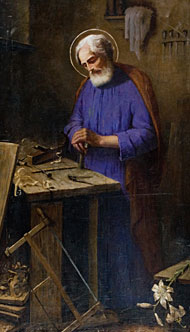 Source: Maria Gazhych, Saint Joseph Carpenter, public domain, via Wikimedia Commons.
Joseph is not the biological father of Christ, but Matthew presents him as a righteous guardian who obeys God in silence. This Western-style devotional painting portrays him at a carpenter’s workbench. His holiness in Matthew appears in chastity, restraint, protection, and obedience under mystery.
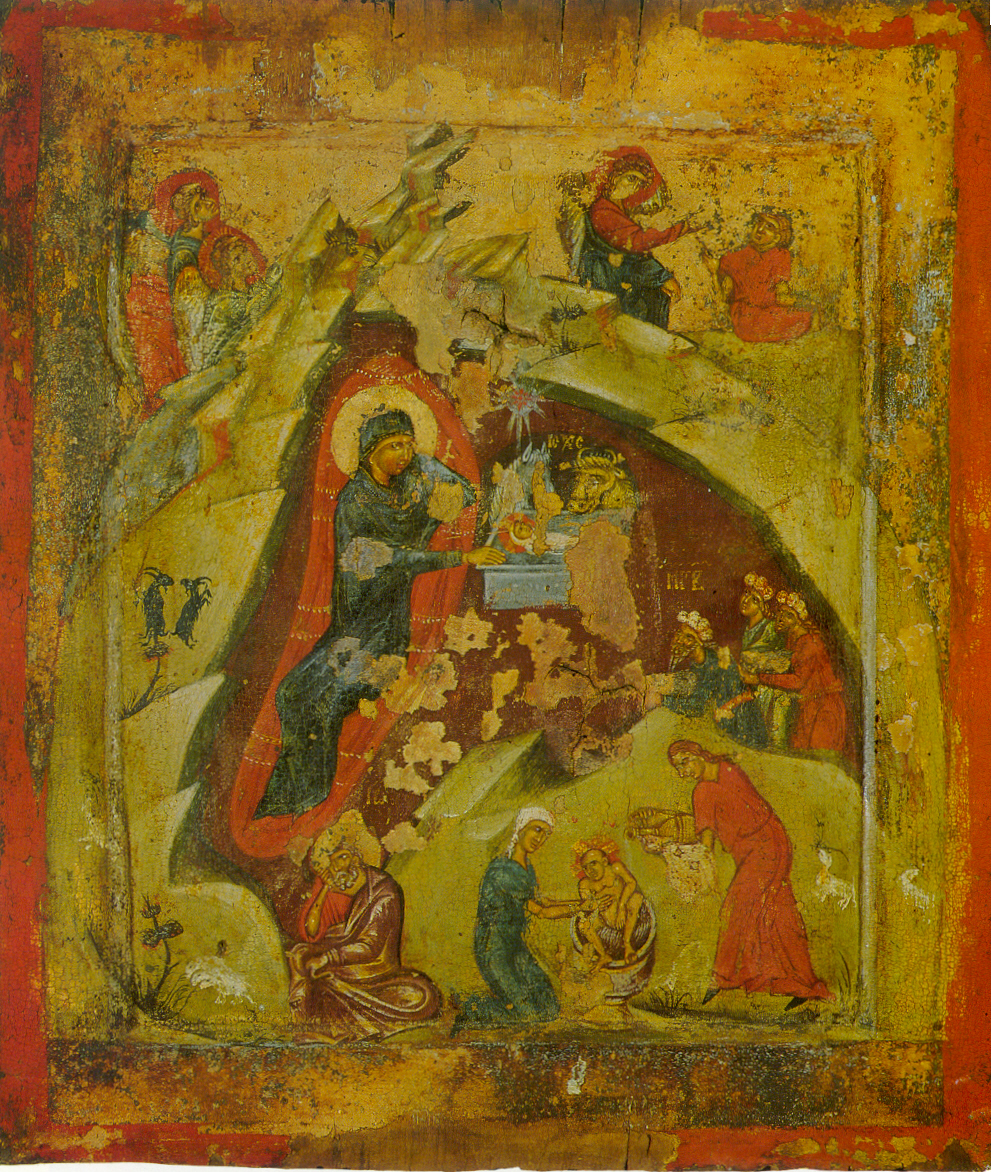 Source: Nativity of Christ icon, Kastoria, public domain, via Wikimedia Commons.
The Nativity icon confesses the birth of God with us, not merely a legal ancestry. Joseph’s presence in Nativity iconography recalls his struggle and obedience without making him the source of the Child’s divine conception.
Magi and Herod (Matthew 2:1-12)
1Now after Jesus was born in Bethlehem of Judea in the days of Herod the king, behold, wise men from the East came to Jerusalem, 2saying, “Where is He who has been born King of the Jews? For we have seen His star in the East and have come to worship Him.” 3When Herod the king heard this, he was troubled, and all Jerusalem with him. 4And when he had gathered all the chief priests and scribes of the people together, he inquired of them where the Christ was to be born. 5So they said to him, “In Bethlehem of Judea, for thus it is written by the prophet: 6‘But you, Bethlehem, in the land of Judah, Are not the least among the rulers of Judah; For out of you shall come a Ruler Who will shepherd My people Israel.’ ” 7Then Herod, when he had secretly called the wise men, determined from them what time the star appeared. 8And he sent them to Bethlehem and said, “Go and search carefully for the young Child, and when you have found Him, bring back word to me, that I may come and worship Him also.” 9When they heard the king, they departed; and behold, the star which they had seen in the East went before them, till it came and stood over where the young Child was. 10When they saw the star, they rejoiced with exceedingly great joy. 11And when they had come into the house, they saw the young Child with Mary His mother, and fell down and worshiped Him. And when they had opened their treasures, they presented gifts to Him: gold, frankincense, and myrrh. 12Then, being divinely warned in a dream that they should not return to Herod, they departed for their own country another way.
The first people in Matthew who seek the newborn King are wise men from the East. The nations begin to come to the light of Israel’s King. Matthew has already named Gentile women in the genealogy. Now Gentile worshippers arrive with a question that exposes the whole city: “Where is He who has been born King of the Jews?”
The question troubles Herod because false kingship is always afraid of the true King. Herod has power, a court, and soldiers, but he is inwardly unstable. The birth of Christ threatens possessive power that cannot bear to lose control. Herod remains a first-century ruler whose fear becomes murder; the passage does not license using his name as a slogan for modern adversaries, nor does it excuse political violence.
Jerusalem is troubled with him. This is spiritually sobering. The Scriptures are near. The chief priests and scribes know the text. They can answer from Micah 5 that the ruler will come from Bethlehem. Yet knowledge of the right verse stays knowledge. The Magi move. Herod schemes. Jerusalem trembles. The teachers know the location but remain where they are.
Bethlehem is small, but not least. God delights to reveal majesty through humility. David came from Bethlehem. Ruth and Boaz belong to Bethlehem’s memory. Now the Shepherd King is born there. Matthew’s quotation joins kingship and shepherding, recalling the Lord’s commission of David to shepherd Israel (2 Samuel 5:2; Brenton 2 Kings 5:2). Christ rules as the Shepherd of His people.
Herod speaks the language of worship while planning murder. This is one of the passage’s sharpest warnings. Religious words can be used by a heart that wants control. Herod says, “that I may come and worship Him also,” but he wants information in order to destroy. The repeated verb of worship, προσκυνῆσαι, exposes the contrast: Herod uses holy speech as a net; the Magi fall down before the Child.
The Magi worship at cost. They have traveled far, entered a dangerous city, asked a politically dangerous question, and carried treasures. Their worship is costly going toward Christ.
Matthew says they saw the young Child with Mary His mother. The child is central, and Mary is the mother through whom the King is revealed to the nations. The Magi fall down and worship Him. Matthew names the gifts without describing the Magi’s understanding of them. St Irenaeus reads gold as a sign of Christ’s kingship, frankincense of His divinity, and myrrh of His death and burial for the human race.2
They depart another way first as a literal change of road; only then does the story teach that true worship refuses Herod’s path. Encounter with Christ redirects the life. Worship teaches discernment. The one who bows before the true King must stop cooperating with the false king’s violence.
Gems from the Fathers 💎: The Nations Bow Before the Child
Chrysostom refuses to treat the star as permission for astrology. He sees God’s merciful condescension in calling the Magi by what they could recognize: “God calleth them by the things that are familiar, in exceeding condescension; and He shows a large and extraordinary star, so as to astonish them.”3 The star does not validate astrology; God uses what the Magi can recognize in order to lead them to the worship of Christ and then to obedience.
On the gifts, Chrysostom sees worship deeper than objects: “for it was knowledge and obedience and love that they offered unto Him.”4 The gold, frankincense, and myrrh matter, but the true gift is the heart turned toward Christ.
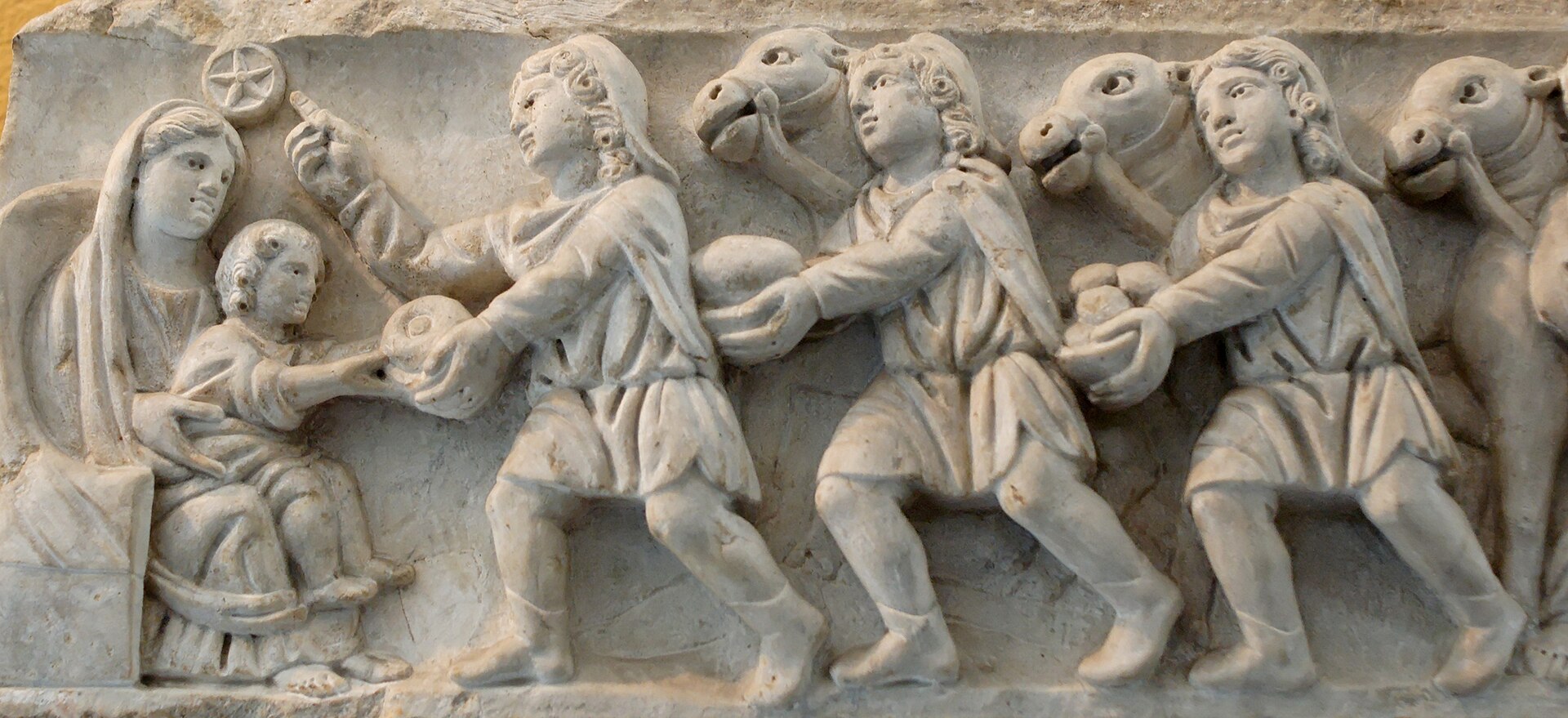 Source: Adoration of the Magi, Pio Cristiano Museum relief, public domain, via Wikimedia Commons.
The early Christian relief makes the Magi scene feel ancient, not merely sentimental. The nations are already being drawn to the Child. Their movement toward Him is the first visual sign in Matthew that Abraham’s blessing is opening outward to all peoples.
Egypt and Rachel (Matthew 2:13-18)
13Now when they had departed, behold, an angel of the Lord appeared to Joseph in a dream, saying, “Arise, take the young Child and His mother, flee to Egypt, and stay there until I bring you word; for Herod will seek the young Child to destroy Him.” 14When he arose, he took the young Child and His mother by night and departed for Egypt, 15and was there until the death of Herod, that it might be fulfilled which was spoken by the Lord through the prophet, saying, “Out of Egypt I called My Son.” 16Then Herod, when he saw that he was deceived by the wise men, was exceedingly angry; and he sent forth and put to death all the male children who were in Bethlehem and in all its districts, from two years old and under, according to the time which he had determined from the wise men. 17Then was fulfilled what was spoken by Jeremiah the prophet, saying: 18“A voice was heard in Ramah, Lamentation, weeping, and great mourning, Rachel weeping for her children, Refusing to be comforted, Because they are no more.”
The child who is “God with us” becomes a refugee. Joseph receives another command in a dream, and again he obeys immediately. Matthew gives no heroic speech and no dramatic resistance. Joseph rises in the night, takes the child and His mother, and flees.
Matthew reads the flight into Egypt through Hosea 11: “Out of Egypt I called My Son.” In Hosea, the line looks back to Israel’s exodus. Brenton’s English Septuagint reads “his children” where Matthew’s NKJV quotation has “My Son”; the two editions are not identical word for word. Matthew sees Christ recapitulating Israel’s story. Israel was called out of Egypt as God’s son. Now the true Son goes into Egypt and returns. He gathers Israel’s history into Himself in order to fulfill and heal it.
The direction is spiritually startling. Egypt was once the house of bondage. Now Egypt becomes a place of shelter for the Savior. The Lord is free to turn old places of pain into places of preservation. The old wound remains in memory, and God’s sovereignty over history remains. Matthew gives no route, length of stay, or list of Egyptian stopping places. Later memory of the Holy Family in Egypt may be cherished, but it must not be read back into the Gospel as a reconstructed itinerary.
He enters displacement, danger, and hidden survival. He is carried by His mother, guarded by Joseph, hunted by a king, and preserved by God. The Gospel begins by telling suffering families that God has walked the road of flight. Christ’s flight forms concrete mercy toward displaced people; it is not a slogan for any one political program.
Gems from the Fathers 💎: Egypt Receives the Persecuted Child
Chrysostom hears a reversal in these verses: the land remembered for bondage becomes the place that receives and preserves the hunted Child, while the ruler in the land of promise plots His death. “Palestine plots, and Egypt receives and preserves Him that is the object of the plots.”5 The point is the Lord’s freedom to shelter His Son where human power does not expect Him.
Matthew lets the lament stand. Rachel weeps and refuses to be comforted because the children are no more. The Holy Innocents must not be explained away, blamed, or used to promise that obedience prevents catastrophe; Herod’s evil is real, and Rachel’s grief remains grief.
Jeremiah 31 originally speaks into the grief of exile. Rachel, mother in Israel’s memory, weeps for her children as they are carried away. Yet Jeremiah’s chapter also contains hope: God promises restoration, return, and a new covenant. Matthew quotes the lament first. The grief is real, and the promise is real. Both must be allowed to stand.
Herod’s rage shows what fearful power does when it cannot possess the future. He vents his fury on the innocent. This is the anti-kingdom. Christ comes as Shepherd. Herod devours. Joseph obeys the warning and shelters the Child; the mothers’ loss is not a failure of obedience. Herod orders the killing.
The Christian can believe God is faithful while still calling the death of children terrible. Prayer can stay near the mothers’ lament without trying to explain away their loss. Matthew places lament inside the infancy of Christ. The Savior’s birth is surrounded by angels, worship, and tears.
Gems from the Fathers 💎: Rachel’s Lament and Herod’s Cruelty
Chrysostom is careful not to blame Christ for Herod’s crime: “That Christ was not the cause of their slaughter, but the king’s cruelty.”6 That distinction is pastorally important. God’s saving work exposes evil; it does not make evil innocent.
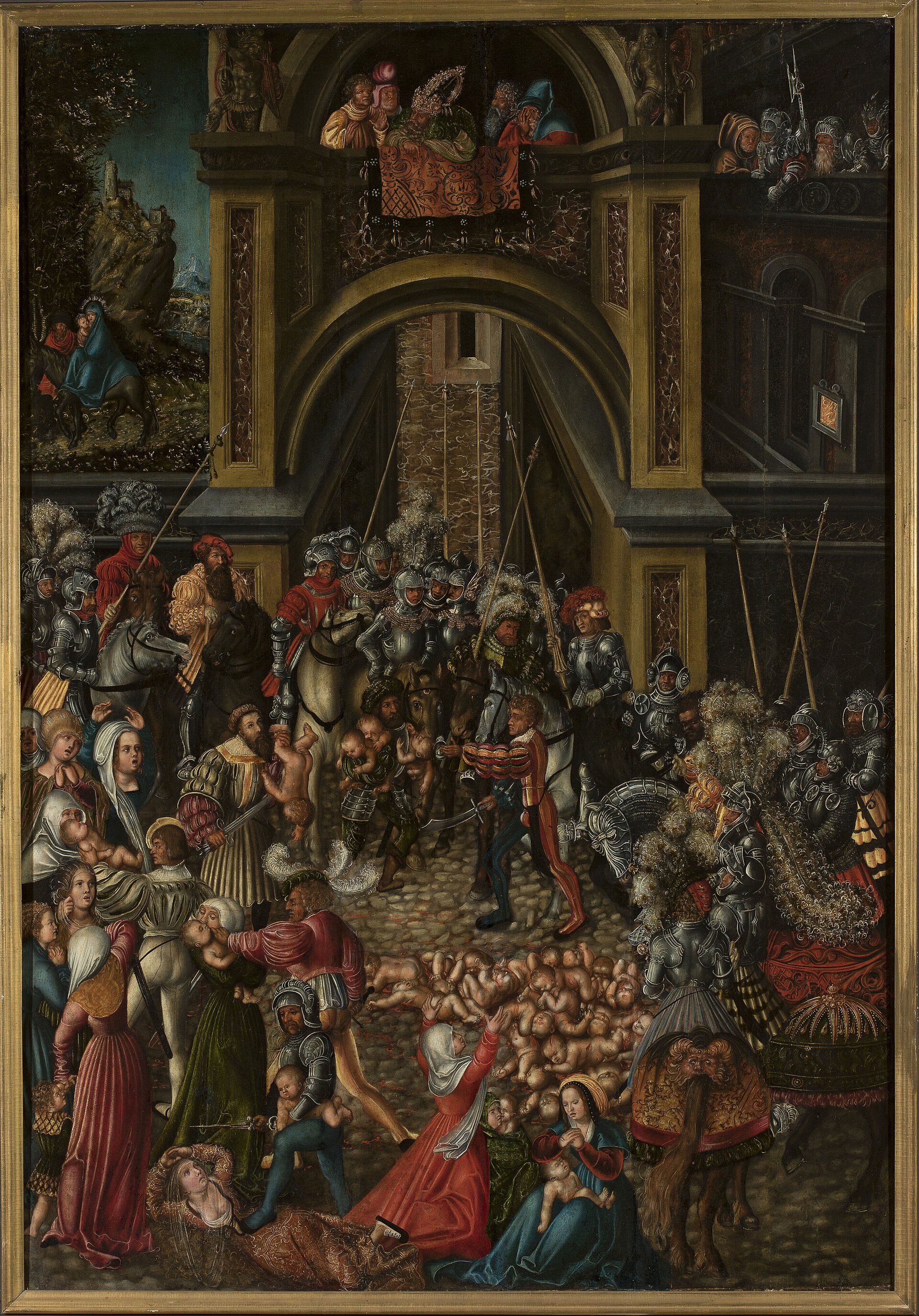 Source: Lucas Cranach, Massacre of the Innocents (Matthew 2:16), public domain, via Wikimedia Commons.
The massacre should not be softened. Rachel’s lament gives the mothers’ grief a voice within the story of fulfillment. The newborn King is not born into a safe world. He enters the grief of mothers, the fear of children, and the violence of rulers who cling to power.
The Church’s Voice in Worship ⛪
The Coptic Church hears Joseph’s obedience at Christmas Paramoune Matins (Matthew 1:18-25) and the Magi’s worship at Christmas Liturgy (Matthew 2:1-12). The flight, lament, and return are heard at Liturgy on the first Sunday of Toba and on Toba 3 (Matthew 2:13-23). Nativity joy can therefore bear the world’s darkness: Emmanuel truly enters a world of hunting kings, weeping mothers, and obscure towns, and saves His people from their sins from within that world.
The Feast of the Lord’s Entry into Egypt on 24 Bashans (Pashons) also receives Matthew 2:13-23 as a Liturgy Gospel in a retained local service reference. This witness is distinct from the public Nativity and Toba appointments; it does not establish every printed edition or local rite. The reading invites the Church to welcome the displaced Lord and show mercy to displaced neighbors.
Nazareth and Hidden Obedience (Matthew 2:19-23)
19Now when Herod was dead, behold, an angel of the Lord appeared in a dream to Joseph in Egypt, 20saying, “Arise, take the young Child and His mother, and go to the land of Israel, for those who sought the young Child’s life are dead.” 21Then he arose, took the young Child and His mother, and came into the land of Israel. 22But when he heard that Archelaus was reigning over Judea instead of his father Herod, he was afraid to go there. And being warned by God in a dream, he turned aside into the region of Galilee. 23And he came and dwelt in a city called Nazareth, that it might be fulfilled which was spoken by the prophets, “He shall be called a Nazarene.”
Herod dies, and the world remains dangerous. Archelaus reigns in Judea, and Joseph must still discern danger. Obedience includes seeing harm clearly. Joseph is warned by God and turns aside to Galilee.
Nazareth introduces another form of humility. Bethlehem has prophetic honor. Egypt has biblical memory. Nazareth is obscure and later despised. In John, Nathanael will ask, “Can anything good come out of Nazareth?” Matthew says the child dwells there so that He may be called a Nazarene.
This fulfillment line is more complex than the direct quotations from Isaiah, Micah, Hosea, and Jeremiah. Matthew says “prophets” in the plural, διὰ τῶν προφητῶν, not one prophet. The safest reading is that Nazareth gathers a prophetic theme rather than quoting a single line. Christ will be identified with lowliness, hiddenness, and rejection. The King is born in humble Bethlehem and raised in a place people can dismiss. Matthew says “the prophets,” not one prophet, and a certain single Old Testament source is not claimed here, nor is a netser explanation treated as settled.
This is spiritually necessary. The Son of God inhabits humble conditions. He accepts a name that sounds unimpressive to the proud. He grows in hidden obedience. Before public preaching, there are years of quietness. Before the Sermon on the Mount, there is Nazareth.
The passage ends with a hidden home. This is revelation. God’s Kingdom can be present in what the world overlooks. The Savior truly shares our hidden human life.
| Promise in Israel | The sign or event here | Fulfillment in Christ |
|---|---|---|
| Isaiah 7:14 | The virgin bears a Son named Immanuel | God is with us in the flesh to save from sins |
| Micah 5:2; 2 Samuel 5:2 | Bethlehem and the Davidic shepherd-ruler | The Shepherd-King is born and rules by gathering, not devouring |
| Hosea 11:1 | The Holy Family flees and later returns | The true Son gathers Israel’s exodus story into Himself |
| Jeremiah 31:15 | Rachel weeps and will not be comforted | The King enters real grief; restoration remains God’s work, not a denial of tears |
Glossary
- Betrothal: A binding covenantal commitment before the final coming together of husband and wife. Matthew’s wording protects both Mary’s betrothed status and the virginal conception of Christ.
- Jesus: The name connected in Matthew 1:21 with His mission to save His people from their sins.
- Immanuel: “God with us.” Matthew links Isaiah’s prophecy to the birth of Christ, showing that God’s presence has become manifest in the Incarnation.
- Theotokos: A title for Mary meaning God-bearer. It protects the confession that the One born of her is truly God the Son in the flesh.
- Magi: Wise men from the East who come to worship Christ. In Matthew, they signal the nations being drawn to Israel’s King.
- Herod: The ruler whose fear of losing power becomes violence. He is a picture of false kingship resisting the true King.
- Rachel weeping: Jeremiah’s image of Israel’s grief, applied by Matthew to the slaughter of the innocents. It allows lament to remain real within the story of fulfillment.
- Nazarene: The name connected with Jesus’ dwelling in Nazareth. Matthew presents it as prophetic fulfillment in a broad thematic sense, tied to humility, hiddenness, and despised lowliness.
Spiritual Fruit 🍇
-
Obey before everything is emotionally settled. Joseph does not understand the whole mystery before he obeys. When a word from God is clear and the next step is humble, rise and do it: receive the person entrusted to you, keep a difficult confidence, or take the night road of protection rather than waiting for a settled feeling.
-
Let righteousness be merciful. Joseph’s justice refuses public shame. In a world eager to expose, practice guarded mercy: refuse gossip about a family crisis, refuse to make another person’s weakness a spectacle, and refuse to treat private discernment as a license to control or silence someone who is unsafe.
-
Worship Christ at cost, then leave by another way. The Magi travel, risk, bow, and give. After they have seen the Child, they do not return to Herod. If worship has been real, some road of cooperation with fear, flattery, or violent control must be refused.
-
Pray honestly with grief and protect the small. Rachel refuses shallow comfort. Do not tell a bereaved parent that obedience would have prevented the blow. Name Herod’s evil as evil. Stay near the lament, pray for children, and do the next concrete act of protection that belongs to your household or parish.
-
Receive God in exile and hiddenness. Egypt and Nazareth both reveal Emmanuel. Show mercy to the displaced without turning Christ’s flight into a campaign slogan. Keep faith in the quiet years: the unnoticed job, the small town, the long obedience that prepares the soul for later public work.
Joseph rises in the night and takes the young Child and His mother toward Egypt. The Magi, having fallen down and worshiped Him, go home another way. Rachel weeps in Ramah and will not be comforted, and the Church stays near that lament. Egypt becomes shelter for the hunted Son. Nazareth receives Him under an unimpressive name. Worship Him there, and ask Him to save you from the sins that still hunt the heart.
Teaching Notes
Joseph and Emmanuel (Matthew 1:18-25)
- Ask: What does Joseph’s first response reveal about righteousness before he understands the full mystery?
- Emphasize: The Virgin Birth confesses that salvation is God’s act and that the Son truly takes flesh from Mary.
- Watch for: Reducing Joseph to a passive extra. Matthew presents him as obedient, righteous, protective, and necessary to the public Davidic shelter of the child. Do not turn his planned private action into a universal rule for marriage crises, and do not use his silence to demand silence from people facing danger or abuse.
- Connect: Link “Jesus” and “Immanuel” carefully. Jesus saves from sins because God Himself has come to be with us.
- Show: Use the embedded Saint Joseph devotional painting and Kastoria Nativity icon to keep Joseph visible as righteous guardian while stressing that the Child is conceived by the Holy Spirit. A simple two-column note can then connect Jesus, “He will save,” and Immanuel, “God with us.”
Magi and Herod (Matthew 2:1-12)
- Ask: Why are Gentile wise men moving toward worship while Jerusalem is troubled and Herod is scheming?
- Emphasize: Knowledge of Scripture is not the same as obedience to Scripture. The scribes know Bethlehem, but the Magi go.
- Watch for: Turning the star into astrology. Follow Chrysostom’s caution: God condescends to call them by what they can recognize, then leads them higher. Keep “another way” literal before the spiritual application. Do not turn Herod into a slogan for present-day opponents.
- Connect: Tie the gifts to worship, kingship, priestly fragrance, and the shadow of death, but do not overbuild beyond the text.
- Show: Use the embedded early Christian Adoration of the Magi relief to show the nations moving toward Christ. Add a simple East, Jerusalem, Bethlehem map only if it serves the spiritual contrast between worship and fearful resistance.
Egypt and Rachel (Matthew 2:13-18)
- Ask: What does it mean that the Savior’s childhood includes flight, danger, and exile?
- Emphasize: Hosea 11 is not a random proof text. Christ gathers Israel’s exodus story into Himself as the true Son.
- Watch for: Explaining the massacre too quickly. Let the grief remain grief. Avoid sentimentalizing the Holy Innocents. Do not promise that obedience prevents catastrophe.
- Connect: Jeremiah 31 contains both lament and hope. The guide should not flatten either one. Use the flight to form mercy toward displaced people, not a policy slogan.
- Show: Use the Massacre of the Innocents artwork only with pastoral care, letting Rachel’s grief remain grief rather than spectacle.
Nazareth and Hidden Obedience (Matthew 2:19-23)
- Ask: Why might Matthew end the infancy narrative not with public glory, but with Nazareth?
- Emphasize: “He shall be called a Nazarene” is best handled as a broad prophetic theme of humility and despised hiddenness, not as a simplistic single-verse quotation.
- Watch for: Overclaiming the exact Old Testament source. Matthew says “prophets” in the plural, so teach modestly. Do not present a netser explanation as settled.
- Connect: Nazareth prepares the class for the hidden years of Christ before public ministry.
- Show: A contrast between Herod’s palace and Nazareth’s hidden home can help students see the difference between worldly power and divine humility.
Lectionary and worship note. Distinguish Christmas Paramoune Matins (Matthew 1:18-25), Christmas Liturgy (Matthew 2:1-12), and the first Sunday of Toba and Toba 3 Liturgy (Matthew 2:13-23). The Entry into Egypt Liturgy reference on 24 Bashans is retained from a local service witness and should not be treated as certification of every edition or rite.
Sources
Scripture is from NKJV.
Coptic Orthodox lectionary: Christmas Paramoune Matins, Matthew 1:18-25; Christmas Liturgy, Matthew 2:1-12; first Sunday of Toba and Toba 3 Liturgy, Matthew 2:13-23. A retained local service reference places Matthew 2:13-23 at the Entry into Egypt Liturgy on 24 Bashans. The St-Takla Coptic Synaxarium commemorates the Entry of the Lord Christ into Egypt on that day: https://st-takla.org/Full-Free-Coptic-Books/Coptic-Synaxarium-or-Synaxarion_English/09-Bashans/Coptic-Calendar_24-Pashans.html.
Primary biblical anchors for this guide include Isaiah 7:14, Micah 5:2, Hosea 11:1, Jeremiah 31:15-17, John 1:45-46, and Matthew 3:13-17.
Patristic material includes St John Chrysostom’s Homilies on the Gospel of Matthew, especially Homilies V, VI, VIII, and IX, NPNF1 10, translated by George Prevost and revised by M. B. Riddle, hosted by CCEL; and St Irenaeus of Lyons, Against Heresies III.9.2, on the Magi’s gifts: https://www.newadvent.org/fathers/0103309.htm.
Footnotes
-
St John Chrysostom, Homilies on the Gospel of Matthew, Homily V on Matthew 1:22-23, NPNF1 10, trans. George Prevost, revised by M. B. Riddle, https://www.ccel.org/ccel/schaff/npnf110.iii.V_1.html#iii.V_1-p19. ↩
-
St Irenaeus of Lyons, Against Heresies III.9.2, on gold, frankincense, and myrrh as signs of kingship, divinity, and death and burial: https://www.newadvent.org/fathers/0103309.htm. ↩
-
St John Chrysostom, Homilies on the Gospel of Matthew, Homily VI on Matthew 2:1-2, NPNF1 10, trans. George Prevost, revised by M. B. Riddle, https://www.ccel.org/ccel/schaff/npnf110.iii.VI_1.html#iii.VI_1-p21. ↩
-
St John Chrysostom, Homilies on the Gospel of Matthew, Homily VIII on Matthew 2:11-15, NPNF1 10, trans. George Prevost, revised by M. B. Riddle, https://www.ccel.org/ccel/schaff/npnf110.iii.viii.html#iii.VIII-p7. ↩
-
St John Chrysostom, Homilies on the Gospel of Matthew, Homily VIII on Matthew 2:13, NPNF1 10, trans. George Prevost, revised by M. B. Riddle, https://www.ccel.org/ccel/schaff/npnf110.iii.VIII.html#iii.VIII-p22. ↩
-
St John Chrysostom, Homilies on the Gospel of Matthew, Homily IX on Matthew 2:16, NPNF1 10, trans. George Prevost, revised by M. B. Riddle, https://www.ccel.org/ccel/schaff/npnf110.iii.ix.html#iii.IX-p8. ↩