


This narration is from a previous version of the study and may include a combined recording of multiple chapters.
Ruth 1 begins with famine and ends with return. A family leaves Bethlehem for Moab, death empties Naomi’s house, and Ruth makes one of Scripture’s most costly acts of faithful attachment. The chapter is not sentimental. It is a study in grief, migration, widowhood, spiritual return, and the mystery that God can begin redemption while the soul still feels bitter.
The spiritual center is Ruth’s holy clinging. Ruth’s love takes the form of a pledge: she joins herself to Naomi’s people and Naomi’s God, accepting a future she cannot secure. Through this costly fidelity, the road back to Bethlehem becomes the first visible step toward David and Christ.
Lesson Guide
- Key phrases: famine in the house of bread; grief that still returns; holy clinging; Bethlehem receives the bitter soul.
- Emphasize: Ruth’s pledge is covenantal, not merely emotional.
- Avoid: judging Naomi for grieving or turning Ruth into a simple loyalty slogan.
Historical and Scriptural Context
Ruth 1 is set “when the judges ruled.” The closing refrain of Judges describes everyone doing what is right in his own eyes; Ruth shows fidelity within that troubled age. Its history unfolds through one household rather than an army. Famine drives the family abroad, bereavement leaves three widows exposed, and two women return without any assurance that Bethlehem will receive or support them.
The genealogy at the end of Ruth changes how a Christian reader hears these ordinary decisions. Naomi cannot see Obed, Jesse, and David ahead of her. Ruth cannot know that Matthew 1:1-17 will name her among Christ’s ancestors. Their uncertainty remains real even while the reader sees their place in salvation history.
Lesson Guide
- Key phrases: faithful people can still appear in the days of Judges; providence begins before anyone feels redeemed.
- Emphasize: the chapter’s pain is real. Do not rush to the happy ending.
- Avoid: treating Moab only as geography. It is also a spiritual boundary in Israel’s memory.
Geographical Significance ⛰️
Bethlehem means “house of bread,” but the chapter opens with famine there. Elimelech’s family seeks food in Moab, east of the Dead Sea. The name’s irony becomes a promise when Naomi hears that the Lord has given His people bread again.
Moab’s background explains why Ruth’s origin matters. Genesis 19:30-38 traces Moab’s ancestry to Lot’s household. Numbers 22-24 tells of Balak’s attempt to have Balaam curse Israel; Numbers 25 describes Moabite seduction and idolatry at Peor. Deuteronomy 23:3-6 recalls the failure to offer bread and water and the hiring of Balaam, and restricts Moabite admission to the assembly. These are serious memories, yet Ruth’s own conduct must be heard rather than prejudged by them. Assembly exclusion and marriage prohibitions are distinct questions; the General Introduction considers the legal difficulty and its patristic interpretation more fully.
The Characters 👥
Elimelech
Elimelech’s name confesses “my God is king.” His departure occurs during famine in the days of the judges. Scripture records his death without explaining it as punishment for leaving Judah; speculation about his guilt would outrun the account.
Naomi / Noemin
Brenton calls Naomi “Noemin.” Her name is associated with pleasantness, but at Bethlehem she asks to be called “Bitter.” She blesses her daughters-in-law even while she feels that the Lord’s hand has gone against her. Generosity and wounded speech coexist in her.
Ruth
Ruth is a Moabite widow whose attachment becomes a confession: “thy people shall be my people, and thy God my God.” She accepts shared poverty and burial away from her homeland. Her allegiance reaches beyond gratitude to Naomi into belonging to Israel’s God.
Orpha
Brenton’s “Orpha” is the woman more often called Orpah. She kisses Naomi and follows her counsel to return. The narrator records the separation without pronouncing a judgment on her soul. Ruth’s exceptional choice needs no condemnation of the other widow to make it shine.
Famine in Bethlehem and Death in Moab (Ruth 1:1-5)
1 And it came to pass when the judges ruled, that there was a famine in the land: and a man went from Bethleem Juda to sojourn in the land of Moab, he, and his wife, and his two sons. 2 And the man’s name was Elimelech, and his wife’s name Noemin, and the names of his two sons Maalon and Chelaion, Ephrathites of Bethleem of Juda: and they came to the land of Moab, and remained there.
3 And Elimelech the husband of Noemin died; and she was left, and her two sons. 4 And they took to themselves wives, women of Moab; the name of the one was Orpha, and the name of the second Ruth; and they dwelt there about ten years. 5 And both Maalon and Chelaion died also; and the woman was left of her husband and her two sons.
The family leaves to “sojourn,” seeking a place to survive. What begins as residence abroad lasts through marriages and about ten years. The sentence keeps naming those who disappear: first Elimelech, then both sons. Twice the narrative says that Naomi was “left.” Loss is measured in the people who no longer stand beside her.
The women of Moab whom the sons marry will become central to what remains of the household. Their marriage does not shelter them from bereavement; each now shares Naomi’s vulnerability. The text offers no explanation of the deaths, no hidden charge to justify the pain. Its restraint matters. We are not entitled to make another person’s tragedy into evidence of divine displeasure.
Brenton’s names, Noemin, Maalon, and Chelaion, reflect the Greek forms of Naomi, Mahlon, and Chilion. The different spellings do not introduce different people. Their story belongs to the scriptural history into which Christ enters: a history containing displacement and bereavement as well as promise. Christian hope rests in the Lord’s victory over death, not in the expectation that faithful families will escape it.
Naomi Hears of Bread and Begins to Return (Ruth 1:6-10)
6 And she rose up and her two daughters-in-law, and they returned out of the country of Moab, for she heard in the country of Moab that the Lord had visited his people to give them bread. 7 And she went forth out of the place where she was, and her two daughters-in-law with her: and they went by the way to return to the land of Juda.
8 And Noemin said to her daughters-in-law, Go now, return each to the house of her mother: the Lord deal mercifully with you, as ye have dealt with the dead, and with me. 9 The Lord grant you that ye may find rest each of you in the house of her husband: and she kissed them; and they lifted up their voice, and wept. 10 And they said to her, We will return with thee to thy people.
The turn begins with news: the Lord has visited His people and given them bread. Naomi acts on that report before her grief has changed. She rises and leaves the place of her losses. Her return is a real journey home; in Christian meditation it also gives a picture of returning to God while consolation is still absent. The passage does not establish that her original departure was a sin.
Naomi’s blessing in verse 8 recognizes the kindness her daughters-in-law have already shown “with the dead, and with me.” They have honored the husbands they lost and cared for the mother who survives them. She wishes them rest in a husband’s household, a prospect of security in their vulnerable circumstances. Her words release them rather than demand repayment for her sorrow.
Both women weep and both initially promise to go with her. Faithfulness is being tested within love, not in a contest between a cold heart and a warm one. Naomi’s concern for their future is itself mercy: she can acknowledge their goodness even when she can see little hope for herself.
Language insight: “mercifully” and “visited”
Behind “deal mercifully” in verse 8 stands Hebrew ḥesed, loyal kindness expressed in action; the Greek speaks of mercy. Naomi’s blessing remembers actual service to the living and honor toward the dead. Mercy here has a history, not merely a feeling.1
The Greek of verse 6 uses ἐπέσκεπται (epeskeptai), “has visited,” from ἐπισκέπτομαι (episkeptomai). Luke 1:68 uses the same verb when Zacharias blesses God for visiting His people and bringing redemption. The forms and full phrases differ, but their shared language joins God’s attentiveness to His saving action. Ruth begins with bread given to a hungry people and ends with a family restored through kinship; the Benedictus proclaims the greater saving visitation in Christ. This is a Christian connection between the passages, not a claim that Luke is quoting Ruth.2
Orpha Returns and Ruth Follows (Ruth 1:11-18)
11 And Noemin said, Return now, my daughters; and why do ye go with me? have I yet sons in my womb to be your husbands? 12 Turn now, my daughters, for I am too old to be married: for I said, Suppose I were married, and should bear sons; 13 would ye wait for them till they should be grown? or would ye refrain from being married for their sakes? Not so, my daughters; for I am grieved for you, that the hand of the Lord has gone forth against me.
14 And they lifted up their voice, and wept again; and Orpha kissed her mother-in-law and returned to her people; but Ruth followed her.
15 And Noemin said to Ruth, Behold, thy sister-in-law has returned to her people and to her gods; turn now thou also after thy sister-in-law. 16 And Ruth said, Intreat me not to leave thee, or to return from following thee; for whithersoever thou goest, I will go, and wheresoever thou lodgest, I will lodge; thy people shall be my people, and thy God my God. 17 And wherever thou diest, I will die, and there will I be buried: the Lord do so to me, and more also, if I leave thee, for death only shall divide between me and thee. 18 And Noemin seeing that she was determined to go with her, ceased to speak to her any more.
Naomi’s argument names the future she cannot provide. She has no sons to give them, and even an imagined remarriage and birth could not offer a practical answer. The women would have to spend their lives waiting. Behind the questions lies her conviction that God’s hand has gone against her. She fears that remaining with her will bring them only further deprivation.
Orpha kisses Naomi and returns. Ruth remains determined to go with her. When Naomi points to the sister-in-law’s people and gods, Ruth answers with an allegiance that cannot be reduced to family affection: “thy people shall be my people, and thy God my God.” The vow embraces travel, lodging, death, and burial. Ruth commits herself to the whole future of belonging, including what cannot benefit her in this life.
Her pledge is one of Scripture’s great confessions:
“whithersoever thou goest, I will go, and wheresoever thou lodgest, I will lodge; thy people shall be my people, and thy God my God.” (Ruth 1:16, Brenton)
In verse 17 she invokes the Lord to judge her if she abandons that promise. The Hebrew names YHWH, Israel’s covenant God; Brenton renders this “the Lord.” A Moabite woman places her word under the authority of Naomi’s God. Read with verse 16, the oath expresses religious allegiance as well as personal fidelity. The narrative gives this confession, not the record of a formal conversion ceremony.1
Naomi finally ceases urging her to leave. Ruth’s freely given pledge answers the older woman’s repeated attempts to release her. That freedom is important for Christian application. Sacrificial love cannot be demanded as proof of another person’s devotion, and constancy never requires submitting to violence, coercion, or the concealment of wrong. Ruth’s care is joined to the Lord and to truth.
Language insight: “followed” and “clung”
The displayed Brenton text says “but Ruth followed her.” The Rahlfs-based Greek reads ἠκολούθησεν (ēkolouthēsen), “followed.” Hebrew has דָּבְקָה (dābəqāh), “clung,” from dābaq. The Hebrew root also describes attachment to a spouse in Genesis 2:24 and adherence to the Lord in Deuteronomy 10:20 and 13:4. Here it describes Ruth’s loyal attachment to Naomi.3
The two readings give complementary ways of hearing her choice: the Hebrew stresses attachment, while the Greek expresses it by following. That is a difference in how the action is rendered; the witnesses do not establish the translator’s precise motive. In Matthew 9:9, Matthew follows Christ with the same inflected Greek verb. A Christian reader can therefore hear discipleship in Ruth’s following without making the Greek translator anticipate the Gospel. Her love goes where it has promised to belong.
Gems from the Fathers 💎: Comforting the Lonely
St Jerome, in Letter 39 to Paula, section 5, remembers Ruth while writing to a bereaved mother. His example places companionship beside the loss of those who once protected Naomi:
“Naomi, fleeing because of famine to the land of Moab, there lost her husband and her sons. Yet when she was thus deprived of her natural protectors, Ruth, a stranger, never left her side. And see what a great thing it is to comfort a lonely woman! Ruth, for her reward, is made an ancestress of Christ.”4
Jerome sees an act of comfort gathered into Christ’s ancestry. That does not make caring for a lonely person a bargain for visible reward. It gives the apparently small work its true dignity: a person who feels abandoned is worth remaining beside. His praise of Ruth’s companionship gives no reason to shame a mourner.
Naomi Returns Bitter (Ruth 1:19-22)
19 And they went both of them until they came to Bethleem: and it came to pass, when they arrived at Bethleem, that all the city rang with them, and they said, Is this Noemin? 20 And she said to them, Nay, do not call me Noemin; call me ‘Bitter,’ for the Mighty One has dealt very bitterly with me. 21 I went out full, and the Lord has brought me back empty: and why call ye me Noemin, whereas the Lord has humbled me, and the Mighty One has afflicted me?
22 So Noemin and Ruth the Moabitess, her daughter-in-law, returned from the country of Moab; and they came to Bethleem in the beginning of barley harvest.
Bethlehem’s question, “Is this Noemin?”, meets a woman whose old name now feels impossible to bear. “Bitter” is how her life tastes to her. She recalls going out full and returning empty, though Ruth is standing beside her. The comparison measures the husband and sons she has lost; it need not mean that she despises the daughter-in-law who has come with her.
Naomi attributes her affliction to the Mighty One. Scripture allows her to speak before it shows how partial her sight is. The narrator places barley harvest beside her account of emptiness. Food will be available; Ruth is present; a field and a kinsman await them. None of these replaces the dead, and none requires Naomi to feel thankful on command. They show that her grief cannot yet describe everything God is doing.
Language insight: “Bitter” and “humbled”
The Greek name in verse 20 is Πικρά, Pikra, “Bitter,” rather than a transliteration of Hebrew Mara. It can be read beside Exodus 15:23-25, where Israel encounters the bitter waters of Marah and the Lord shows Moses wood through which the water becomes sweet. The names and spellings are not identical; the bitterness supplies the scriptural echo. Marah gives a grieving Christian reason to ask for God’s healing without pretending the water already tastes sweet. The comparison does not establish that Ruth’s author intentionally quoted Exodus.5
In verse 21, Brenton reads “the Lord has humbled me,” corresponding to Greek ἐταπείνωσέν με (etapeinōsen me), “brought me low.” The Hebrew-based NKJV reads “the LORD has testified against me.” One wording sounds like being brought down; the other like testimony against her. Related Hebrew root consonants occur in words for answering or testifying and for affliction, but grammatical form and context also matter. A simple explanation that different vowels alone caused the Greek reading would claim more than these witnesses establish.6
Both renderings are Naomi’s lament. Neither authorizes us to declare that God has convicted her of a hidden sin or that her losses were a lesson she needed. Christian humility begins by surrendering our claim to explain another person’s suffering. We can bring wounded speech to God and ask Him to heal what we cannot understand.
Christological and Typological Reading
Ruth’s confession joins belonging to a people with allegiance to God. In Christian reading it foreshadows the gathering of the nations into the Church: the stranger is received into a shared life of worship, responsibility, and hope. Israel’s story is honored as the history through which this promise comes to us, not dismissed as a failed preparation.
Her renunciation and confession also have baptismal resonance. In Baptism the Christian turns from the old allegiance and belongs to Christ within His Church. Ruth’s pledge is an earlier act of faith, not Christian Baptism itself. It helps expose the weakness of a faith that admires God while refusing the obligations of belonging to His people.
Bethlehem and the Ephrathites of verse 2 place the story on the road toward David. Micah 5:2 and Matthew 2:6 later name Bethlehem in the promise and proclamation of the Messiah’s birth. The chapter supplies a place and a household history, not a direct prediction of every detail of the Nativity. Christ enters that history to redeem the people whose grief it contains.
Gems from the Fathers 💎: Allegiance and the Bridegroom
St John Chrysostom reads Ruth in Homilies on the Gospel of Matthew, Homily 3, section 5. Her departure from her former household becomes an image of the Church’s turning from inherited customs toward Christ:
“But even as Ruth, if she had not before left her father, and renounced household and race, country and kindred, would not have attained unto this alliance; so the Church too, having forsaken the customs which men had received from their fathers, then, and not before, became lovely to the Bridegroom.”7
The point is allegiance, not contempt for family or ethnicity. Ruth carries her Moabite identity into the story, while her worship and future are entrusted to Israel’s God. For the Christian, an inherited custom must yield when it contradicts Christ, whether it is idolatry, vengeance, or the belief that strangers deserve less mercy. Leaving it may be costly; belonging to the Bridegroom makes that cost fruitful.
The Church’s Voice in Worship ⛪
The Gospel genealogy names Ruth among Christ’s ancestors. The Coptic lectionary evidence records Matthew 1:1-17 as the Vespers Gospel of the Nativity Paramoun, the preparation for the feast. This gives Ruth’s road toward Bethlehem a worshipful horizon: the woman who pledged herself to Naomi’s God belongs to the history proclaimed as Christ’s own ancestry.8
No reading from Ruth itself was found in the Coptic lectionary sources checked. The Gospel bridge does not make Ruth 1 an appointed reading. As a prayerful resonance, her confession helps us hear the Nativity genealogy as more than a succession of names: Christ comes within a history where the stranger has been received and costly mercy has borne fruit.
Iconography and Visual Teaching 🖼️
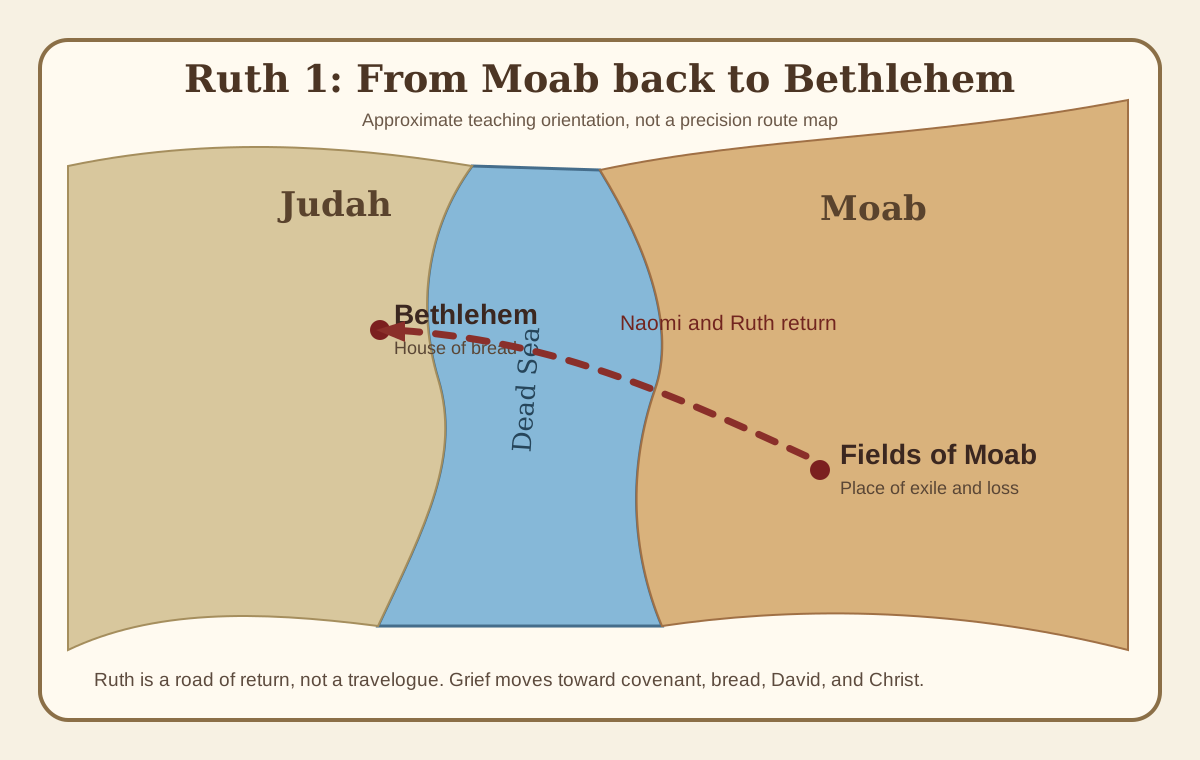 Source: Hermes original orientation map, 2026-06-19. Approximate teaching aid, not a precision archaeological route map.
The map places Moab east of the Dead Sea and Bethlehem in Judah. It gives geographical shape to the return without claiming the precise itinerary followed by the women.
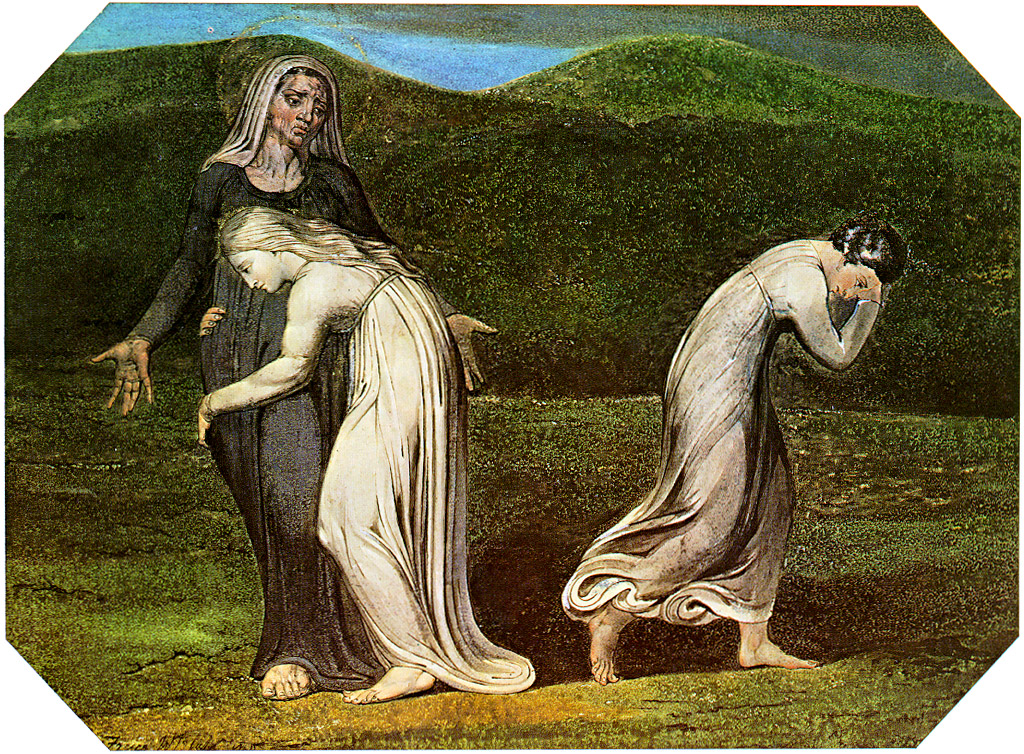 Source: William Blake, Naomi entreating Ruth and Orpah to return to Moab, public domain via Wikimedia Commons.
Blake’s image is Western biblical artwork, not an Orthodox icon. Its subject holds the three women together at the point of separation, where affection and uncertainty are shared before their paths divide.
Summary Table
| Element in Ruth 1 | Meaning within the chapter | Christian connection |
|---|---|---|
| Bread given after famine | Naomi hears that the Lord has visited His people | Luke 1:68 proclaims God’s saving visitation in Christ |
| Mercy toward the dead and Naomi | The widows’ kindness has already taken practical form | Love honors the departed and cares for those left alone |
| Ruth’s following and oath | Attachment becomes allegiance to a people and their God | Discipleship and baptismal belonging, read as Christian resonances |
| Naomi’s “Bitter” and “empty” | Lament describes real loss without seeing the whole future | Grief can be brought to God without being made a verdict of guilt |
| Arrival at barley harvest | Provision is beginning while grief remains | Hope can be received before consolation is felt |
Spiritual Fruit 🍇
Return before you feel restored
Naomi acts on the news of bread while she still feels emptied. We often postpone prayer until we can pray without resentment, or worship until we can stand in church without tears. Begin with what is possible: pray one Psalm, ask your priest for help, or return quietly to the Liturgy. If there is a sin to confess, confess it; grief itself is not a sin requiring an apology. Christ receives a wounded person, not a carefully composed appearance.
Let mercy remember the lonely
Naomi blesses the kindness already shown to her. Ruth carries it further by sharing the road. The grieving person may need a meal, transport, help with a form, or someone who still calls after the first weeks of attention have ended. Choose a definite act and keep it. Service becomes burdensome when we demand that the person we help recover quickly enough to reassure us.
Place your allegiance under the Lord
Ruth joins her promise to the name of God. Examine one custom or loyalty that competes with obedience to Christ: family pressure to preserve a dishonest appearance, resentment treated as an inherited duty, or fear of receiving someone outside a familiar circle. Bring that conflict into prayer and confession. Faithful belonging to the Church should enlarge truthful love, not make us proud of our ancestry or our circle.
Accompany without possessing
Naomi repeatedly releases Ruth; Ruth freely chooses to stay. Holy care makes room for truth and another person’s freedom. It neither controls the bereaved nor requires a carer to remain in danger. Ask what support would actually serve the person, accept appropriate help from others, and keep promises within honest limits. The Lord is the Savior of both the one who suffers and the one who serves.
Receive a beginning without demanding an ending
The barley harvest does not undo the graves in Moab. Yet its beginning is real. When sorrow makes every kindness seem meaningless, try to receive one provision without requiring it to explain your loss: food on the table, a friend’s presence, the words of prayer when your own words fail. Gratitude for that gift can coexist with lament.
At Bethlehem’s entrance, Naomi names her emptiness while Ruth stands beside her. Harvest is beginning, though neither woman yet knows where she will find food. Bring your own wounded account of life before Christ, and ask Him to help you receive the mercy already near you. If you are walking beside someone who grieves, remain truthful, gentle, and patient; their sorrow need not be solved before your love can serve them.
Teaching Notes
Suggested timing for a 55-minute study
- Opening, context, and geography: 8 minutes.
- Ruth 1:1-5: 10 minutes.
- Ruth 1:6-10: 10 minutes.
- Ruth 1:11-18: 12 minutes.
- Ruth 1:19-22: 8 minutes.
- Spiritual Fruit and discussion: 7 minutes.
Famine in Bethlehem and Death in Moab (Ruth 1:1-5)
- Ask: What does the repetition of being “left” show about Naomi’s loss?
- Watch for: Treating death as proof that Elimelech’s departure or his sons’ marriages incurred punishment. The account does not give that explanation.
- Show: Use the Moab-to-Bethlehem map for orientation, without proposing a precise road or travel duration.
Naomi Hears of Bread and Begins to Return (Ruth 1:6-10)
- Ask: What kindness can Naomi still recognize while she grieves?
- Connect: Read Luke 1:68 alongside verse 6, distinguishing a shared visitation verb from a direct quotation.
- Watch for: Calling Naomi’s journey a confession of a sin the text never identifies. The return supplies a Christian image of repentance without establishing her earlier guilt.
Orpha Returns and Ruth Follows (Ruth 1:11-18)
- Ask: How do people, God, death, and burial give Ruth’s promise its full weight?
- Emphasize: Brenton displays “followed.” Explain the Hebrew “clung” rather than silently making it the quoted Greek reading.
- Show: Use Blake’s artwork to consider what each widow risks at the separation; distinguish the painting’s imagination from biblical detail.
- Watch for: Ranking Orpha’s soul, demanding sacrificial care from others, or using Ruth’s pledge to justify coercion or dangerous dependency.
- Connect: Jerome’s comfort of the lonely and Chrysostom’s allegiance to the Bridegroom illuminate different aspects of the same pledge. Neither supplies detailed commentary on every verse.
Naomi Returns Bitter (Ruth 1:19-22)
- Ask: What does Naomi see, and what can the reader see beside her lament?
- Emphasize: “Humbled” and “testified against” belong to her account of suffering, not to an announced verdict that she deserved it.
- Watch for: Forced gratitude, promises that companionship replaces the dead, or treating bitterness as her final God-given name.
- Connect: Exodus 15:23-25 supplies an echo of bitterness and healing. A Cross interpretation of its wood is not attributed to a Father here.
Source and worship cautions
- The Greek comparator is the CCAT Rahlfs-based electronic text, not a full critical apparatus. Translator intention and a specific repointing theory for Ruth 1:21 remain unestablished.
- The Nativity Paramoun placement is attested in the designated lectionary evidence; a qualified Coptic Reader confirmation of that particular appointment remains pending. It is not the Nativity feast Gospel or an appointment of Ruth itself.
- Jerome’s selected words commend companionship; the surrounding letter contains sterner grief counsel. Do not use that context to shame a mourner. Chrysostom’s selected Ruth/Church paragraph is used without its adjacent polemical contrasts.
Glossary
- Noemin: Brenton’s form of Naomi; associated with pleasantness.
- Mara / Bitter: Naomi’s self-description in sorrow; Brenton translates the Greek name as “Bitter.”
- Ḥesed: Loyal kindness expressed in action, here remembered in Naomi’s blessing.
- Following / clinging: Greek and Hebrew ways of describing Ruth’s committed attachment.
- YHWH: The covenant name of Israel’s God, invoked in the Hebrew oath; rendered “the Lord” in Brenton.
- Paramoun: A period of preparation before the Nativity or Theophany feast; the Gospel connection here concerns Nativity Paramoun Vespers.
Translation and Source Notes
Embedded Scripture is from Brenton’s English Septuagint (LXX). Hebrew-based NKJV wording is identified where it differs. The original passage quotations are retained; explanatory Greek comparisons use the CCAT Rahlfs-based electronic text, whose edition notes describe later verification and adaptation. This comparison is not a manuscript apparatus.
Coptic appointments are drawn from @andraws/lectionary-data 1.3.1. Its records attest the Nativity Paramoun Vespers genealogy; confirmation of that appointment in Coptic Reader remains pending. The sources examined contained no Ruth reading or separate Synaxarium entry-title for Ruth, Boaz, Naomi, or Obed. This is a scoped finding, not a claim about every quotation or mention in all worship texts.
Sources
Ruth 1, Brenton Septuagint; Matthew 1:1-17; Genesis 19:30-38; Genesis 2:24; Numbers 22-25; Deuteronomy 10:20; 13:4; Deuteronomy 23:3-6 and Deuteronomy 24:19-22; Exodus 15:23-25; Luke 1:68; Matthew 9:9; Micah 5:2; Matthew 2:6.
St Jerome, Letter 39 to Paula, section 5, NPNF Second Series, volume 6. Text.
St John Chrysostom, Homilies on the Gospel of Matthew, Homily 3, section 5, NPNF First Series, volume 10. Text.
CCAT Rahlfs-based Greek Ruth, with its edition description; Hebrew Ruth 1; Brown-Driver-Briggs entries for attachment, kindness, testimony, and affliction.
@andraws/lectionary-data 1.3.1, reverse Coptic lectionary index and Synaxarium; the Nativity Paramoun record preserves the dated public reading reference. Coptic Reader confirmation of this appointment remains pending.
For further study: Robert L. Hubbard Jr., The Book of Ruth, NICOT; Edward F. Campbell Jr., Ruth, Anchor Bible; Katharine Doob Sakenfeld, Ruth, Interpretation. These are further-reading recommendations, not locations for the specific textual explanations above.
Footnotes
-
Ruth 1:8, 17, Hebrew text; Brown-Driver-Briggs, חסד; CCAT Greek Ruth. ↩ ↩2
-
Ruth 1:6, CCAT Greek Ruth; Luke 1:68 Greek comparison, for the Gospel visitation form. ↩
-
Ruth 1:14, Hebrew text and BDB דבק; CCAT Greek Ruth; Matthew 9:9 Greek. ↩
-
St Jerome, Letter 39 to Paula, section 5, NPNF Second Series, volume 6; primary text. Biblical reference apparatus has been omitted from the connected excerpt. ↩
-
Ruth 1:20, CCAT Greek Ruth; Exodus 15:23-25, CCAT Greek Exodus. ↩
-
Ruth 1:21, Hebrew text and CCAT Greek Ruth; Brown-Driver-Briggs, ענה I and ענה III. The witnesses establish the differing senses, not a complete history of the translation. ↩
-
St John Chrysostom, Homilies on the Gospel of Matthew, Homily 3, section 5, NPNF First Series, volume 10; Ruth paragraph. Editorial footnote apparatus is omitted from the sentence. ↩
-
@andraws/lectionary-data 1.3.1, Nativity Paramoun, Vespers Gospel, Matthew 1:1-17; preserved public reading reference. The appointment is package-attested, pending Coptic Reader confirmation. ↩