


This narration was recorded before the latest revision. The text on this page is current.
Nehemiah begins with news of a broken city and ends with a prayer to be remembered by God. Between the two stand walls rebuilt, poor families delivered from exploitation, Scripture read aloud, a covenant sealed, and thanksgiving heard far beyond Jerusalem. Yet the last chapter brings another discovery of compromise. A city can be repaired while its people still need healing.
The wall matters because worship matters. The gates protect a common life in which families, the poor, priests, Levites, and singers all have a place before God. Nehemiah’s concern reaches beyond the completion of a public work. He longs for a people who remember God’s mercy and order their lives in answer to it. His story speaks to the parish that has completed a building but neglected its poor, to the servant who has become efficient while ceasing to pray, and to the believer who mistakes a past repentance for a heart that no longer needs guarding.
Canonical and Textual Orientation
Ezra and Nehemiah belong together. They recount the restoration after exile: the return of the people, the rebuilding of the temple and city, and the renewed hearing of God’s Law. Ezra gives particular attention to priestly teaching and covenant fidelity; Nehemiah brings the city’s walls, administration, economic life, and worship into view. Together they ask whether the people have returned only to their land or also to the Lord.
In the Septuagint, Ezra and Nehemiah form one book, 2 Esdras, also called Esdras B. Nehemiah 1-13 is 2 Esdras 11-23. The separate book called 1 Esdras is not another title for Nehemiah. Brenton’s Septuagint follows Codex Vaticanus, while Rahlfs also prints readings from other witnesses. A verse absent from Brenton must therefore not be assumed absent from every Greek witness.
The title here remains Nehemiah. Prose uses familiar NKJV names: Nehemiah and Ezra, whom Brenton calls Neemias and Esdras. Brenton also uses the Greek name Jesus for both Joshua son of Nun and the high priest Jeshua. These are distinct people; their shared Greek name becomes significant in Christian typology, the reading of earlier persons and events as anticipations fulfilled in Christ.
Gems from the Fathers 💎: One restoration witness
Direct. St Jerome explicitly joins Ezra and Nehemiah in his account of the biblical books. His description holds the temple, the city, the returned families, and their service together. He calls Ezra and Nehemiah “the Lord’s helper and His consoler” and says they “are united in a single book.”1 The restoration belongs to God’s dealings with His people, not to two isolated biographies of capable men.
Gems from the Fathers 💎: Scripture restored to the people
Thematic. St John Chrysostom, in Homilies on Hebrews, speaks of God’s patient care in giving and preserving Scripture. After describing war and the burning of books, he says that God “inspired another admirable man to publish them, Ezra I mean”2. His concern is the gift of Scripture and our responsibility to receive it. That theme illuminates Nehemiah: a rebuilt city reaches a decisive moment when its people can hear, understand, and obey God’s Word. Chrysostom is speaking about Ezra and Scripture here, rather than explaining Nehemiah verse by verse.
Historical Setting (Nehemiah 1-2; Nehemiah 13:6)
Nehemiah serves as cupbearer at Susa, a Persian royal center also known as Shushan. His position gives him access to King Artaxerxes, but distance from Jerusalem has not loosened his bond with its people. Hanani, his brother, brings news of distress and reproach. The same Hanani will later be entrusted with responsibility for Jerusalem’s gates (Nehemiah 1:2; Nehemiah 7:2). The messenger of the city’s suffering becomes a guardian of its restored life.
 William Robert Shepherd, map of the Achaemenid Empire. Public domain; Wikimedia Commons.
 Archers frieze from the palace of Darius I at Susa, Louvre. Public domain; Wikimedia Commons.
The news reaches Nehemiah in Chislev of the twentieth year of Artaxerxes. He appears before the king in Nisan of that same regnal year, some months later (Nehemiah 1:1; Nehemiah 2:1). The narrative places a season of prayer between the first report and the royal audience. Much later, Nehemiah returns to the king in the thirty-second year, then obtains permission to come back to Jerusalem (Nehemiah 13:6-7). The book spans sustained responsibility, absence, and the discovery of renewed disorder.
The first report gives the reason for his grief:
- And they said to me, The remnant, even those that are left of the captivity, are there in the land, in great distress and reproach: and the walls of Jerusalem are thrown down, and its gates are burnt with fire.
- And it came to pass, when I heard these words, that I sat down and wept, and mourned for several days, and continued fasting and praying before the God of heaven.
Nehemiah sits down before he acts. He allows the suffering of people far away to interrupt the security of his own position. His grief becomes confession and intercession, then courage before the king. The brief prayer at the royal audience rests upon these months before God. When an opportunity opens, his dependence on the Lord has already been formed in secret.
The Wall as Servant of Worship
Jerusalem needs walls because its people need a guarded common life. Gates require honest administration; worship requires provision; families need safety; the poor need justice within the city as much as protection from threats outside it. The wall is therefore a servant of worship. Its meaning becomes clear when Scripture is proclaimed and thanksgiving fills the city it encloses.
Two bad readings obscure this. One turns Nehemiah into a productivity manual: cast a vision, organize a team, ignore critics, finish the project. The other makes the wall a permission slip for suspicion and hostility: keep everyone out and treat every disagreement as an attack. Both lose the people whom Nehemiah seeks to serve. Chapter 5 makes the first reading impossible, because construction cannot excuse exploitation. The prayers and confessions of chapters 1 and 9 expose the second, because the people rebuilding the city must acknowledge their own sins.
The Church’s disciplines also serve communion. Fasting, confession, canons, sacramental discipline, and liturgical order guard the reverent reception of holy things. Their fruit should be repentance, mercy, truthful speech, and love. When we use a boundary to protect our importance or excuse contempt, we have turned a servant of holiness into a shelter for pride.
Major Movements of the Book (Nehemiah 1-13)
Holy grief becomes sent obedience (Nehemiah 1-2)
In Nehemiah 1, the news from Jerusalem leads to fasting, confession, and prayer grounded in God’s promises through Moses. Nehemiah includes himself among the sinful people. He asks for mercy before asking for success.
Months of prayer lead into Nehemiah 2. Artaxerxes grants permission, letters, and timber; Nehemiah receives these as gifts under God’s good hand. His night inspection comes before his public appeal. He sees the damage honestly rather than asking others to share an enthusiasm detached from the city’s actual condition.
The builders face threats outside and injustice within (Nehemiah 3-6)
Nehemiah 3 remembers the builders by name and by the portions they repair. The list gives dignity to varied, often uncelebrated service. Nehemiah 4 holds prayer and practical watchfulness together under mockery and threat.
Then Nehemiah 5 interrupts the building narrative with the cry of indebted families. Their suffering is not a distraction from restoration. It reveals whether restoration is truthful. Nehemiah confronts the demands that crush the poor and refuses to make his own authority another burden upon them.
In Nehemiah 6, invitations, accusations, and a religious warning threaten to divert the work. The danger also runs through relationships within the community. Meshullam son of Berechiah repairs two portions of the wall, yet his daughter is married to Tobiah’s son (Nehemiah 3:4, 30; Nehemiah 6:18). Visible service and divided loyalty can coexist. The completion of the wall calls for gratitude, but it cannot end the need for discernment.
The people are remembered, then taught (Nehemiah 7-8)
Nehemiah 7 appoints guardians and recalls the returned exiles. The register preserves the memory of people through whom communal life has survived. Jerusalem needs inhabitants and servants, not simply finished gates.
In Nehemiah 8, the people gather to hear the Law:
- And they read in the book of the law of God, and Esdras taught, and instructed them distinctly in the knowledge of the Lord, and the people understood the law in the reading.
- And Neemias, and Esdras the priest and scribe, and the Levites, and they that instructed the people, spoke and said to all the people, It is a holy day to the Lord our God; do not mourn, nor weep. For all the people wept when they heard the words of the law.
- And the governor said to them, Go, eat the fat, and drink the sweet, and send portions to them that have nothing; for the day is holy to our Lord: and faint not, for the Lord is our strength.
The sequence matters: reading, explanation, understanding, tears, and a feast that includes those who have nothing. Reverence does not dispense with clarity, and understanding does not end in private emotion. The people receive God’s Word together and make room at their joy for the poor. The Feast of Booths follows, with daily reading of the Law and great gladness.
Feast gives way to fasting, and confession to commitments (Nehemiah 9-10)
The feast of chapter 8 comes before the fast and sackcloth of Nehemiah 9. Repentance does not cancel the joy God has commanded, nor does joy make repentance unnecessary. The same people who have celebrated His goodness now confess their resistance to it.
The great prayer retells creation, Abraham’s calling, the Exodus, the wilderness, the gift of the Spirit, the prophets, rebellion, and repeated mercy. Brenton names Ezra as the speaker at Nehemiah 9:6; in the NKJV no new speaker is named there, and the prayer flows from the Levites’ call in Nehemiah 9:5. The Greek presents the priest leading the confession explicitly; the NKJV keeps the prayer within the Levites’ summons and the gathered assembly. Both readings place the people’s repentance inside the history of God’s faithfulness.
Nehemiah 10 gives that confession an outward shape. Time, marriage, debt, first-fruits, tithes, labor, and temple service all come under covenant obligations. Repentance reaches the household and the account book. The vows become especially searching when read beside chapter 13, where the very commitments made here have been neglected.
The holy city is inhabited and filled with praise (Nehemiah 11-12)
Nehemiah 11 records the people who settle in Jerusalem and its surrounding villages. Some are chosen by lot; others volunteer and receive the people’s blessing. The holy city requires ordinary lives given to its daily responsibilities.
In Nehemiah 12, purification precedes thanksgiving. Two choirs process along the wall and gather at the house of God. Nehemiah walks behind the singers in the second procession (Nehemiah 12:38). Brenton lacks that verse, but Rahlfs includes it, as does the NKJV. The scene completes the meaning of his leadership: the man who directed the building now follows the praise.
- And in that day they offered great sacrifices, and rejoiced; for God had made them very joyful: and their wives and their children rejoiced: and the joy in Jerusalem was heard from afar off.
The sound carries beyond the city. Wives and children share the gladness, and God is named as its giver. The rebuilt wall has become a path of thanksgiving rather than a monument to the governor.
The promises are tested after dedication (Nehemiah 13)
Nehemiah 13 is chapter 10 broken, vow by vow. The correspondence gives the ending its force:
| Commitment in Nehemiah 10 | Failure or repair in Nehemiah 13 |
|---|---|
| Covenant fidelity in marriage (10:30) | Compromised marriages and household formation (13:23-27) |
| Refusal of Sabbath trade (10:31) | Buying, selling, and burdens at the gates (13:15-22) |
| Support for the temple, tithes, and Levites (10:32-39) | Withheld portions and Levites returning to their fields (13:10-13) |
| Provision of the wood offering (10:34) | The wood offering restored at the book’s close (13:31) |
The vow “we will not forsake the house of our God” is answered by Nehemiah’s accusation, “Wherefore has the house of God been abandoned?” (Nehemiah 10:39; Nehemiah 13:11). A solemn promise has not made later neglect impossible. The book’s last verse brings humble provisions and prayer together:
- And the offering of the wood-bearers was at certain set times, and in the times of the first-fruits. Remember me, O our God, for good.
The ending remains uncomfortable. Nehemiah acts as a Jewish governor within an Old Covenant civic order, and his physical force and hair-plucking are not a Christian pastoral model. The warning concerns fidelity to God, the care of worship, and the formation of households; it grants no permission for violence or ethnic contempt. Ruth the Moabite, welcomed into Israel and named in Christ’s genealogy, forbids that distortion (Ruth 1:16; Matthew 1:5).
Reading Jerusalem Orthodoxly
Jerusalem is first the real city: wounded, rebuilt, inhabited, and dedicated. The gates, chambers, households, and routes belong to an actual communal life. The spiritual reading gains its force from this history rather than replacing it.
 Jerusalem at the time of Nehemiah. Map from the 1911 Encyclopaedia Britannica; public domain, Wikimedia Commons.
Jerusalem is also a picture of the worshiping community. Priests, Levites, singers, gatekeepers, families, and donors depend on one another. A neglected portion for the Levites becomes a neglected ministry; a private alliance can become a compromise in the temple itself. Holiness includes the way common life is sustained.
Eliashib’s course is especially sobering. The high priest sanctifies the Sheep Gate at the beginning of the rebuilding (Nehemiah 3:1) and appears in the high-priestly line in Nehemiah 12:10. Later, Eliashib gives Tobiah a chamber in the house of God, and a grandson of Eliashib marries into Sanballat’s household (Nehemiah 13:4-7, 28). Consecration at the beginning has not guaranteed fidelity at the end. Relapse enters through the priesthood itself, not only through opponents outside the walls.
Malachi is the prophetic companion to this restoration setting. Malachi 2 confronts a corrupted priesthood, the covenant of Levi, and faithlessness in marriage. Malachi 3 names the withholding of tithes and speaks of God’s remembrance of those who fear Him. These are the same wounds exposed by Nehemiah’s final reforms. The prophet and the governor address a people whose restored institutions still need truthful worship.
Jerusalem may also be read as the soul. Damaged gates suggest habits of discernment weakened by repeated consent to temptation. Tobiah’s chamber gives a concrete image of a cherished compromise occupying room meant for God. Such a reading is searching only if it becomes particular: the resentment protected from confession, the dishonest gain defended as necessary, the prayer displaced whenever work presses. The soul needs more than a respectable exterior. It needs the Lord dwelling within and every room surrendered to Him.
Visual Orientation 🖼️
The imperial map and the Susa frieze locate Nehemiah’s service within Persian power. The Jerusalem map keeps the city’s gates and walls in view. The relationship diagram brings together the governor, the priest and scribe, the people, their opponents, and the responsibilities of worship.
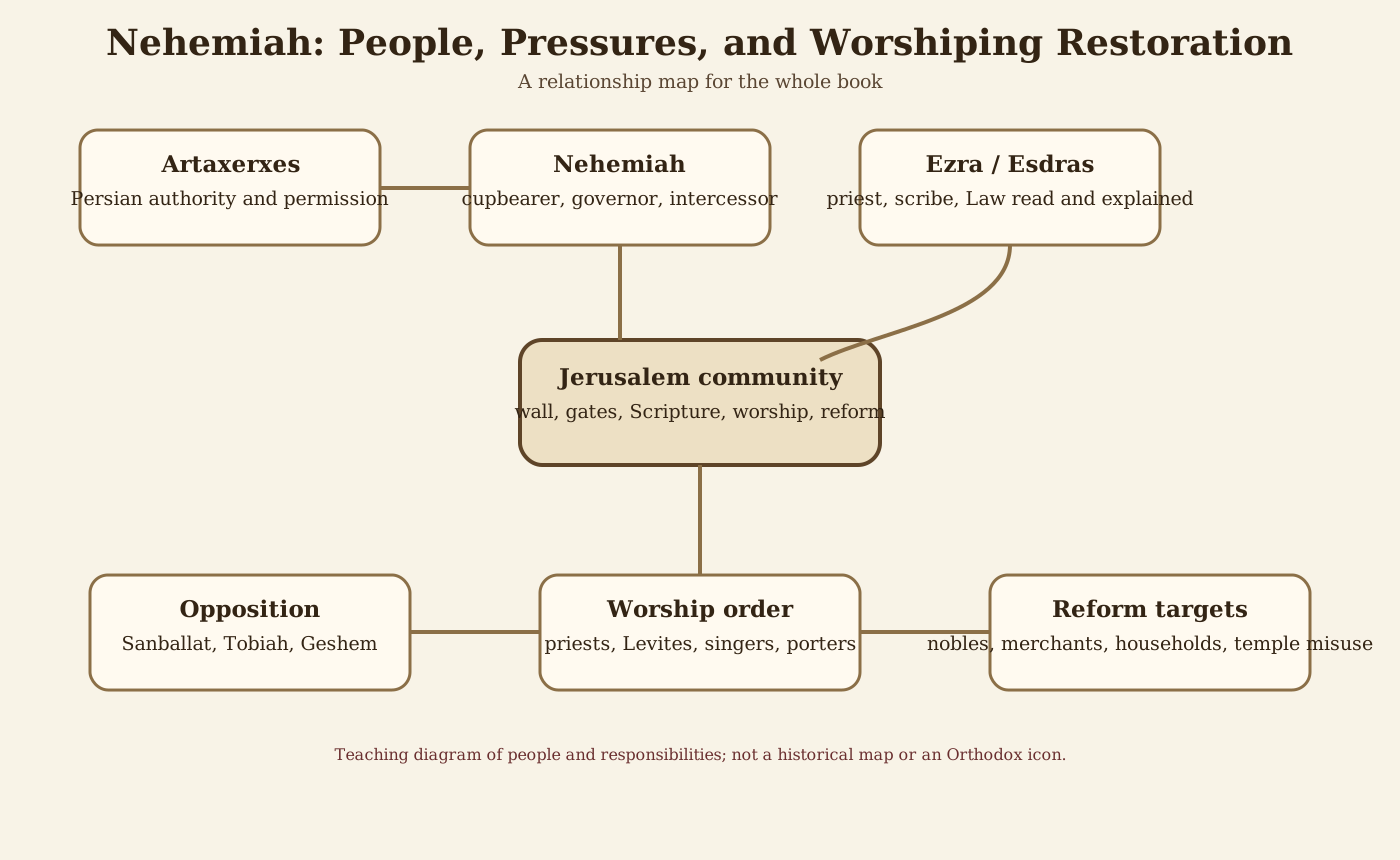 Teaching diagram of the book’s people and pressures; not a historical map or an Orthodox icon.
Maps and artifacts supply historical context; the diagram summarizes relationships. None of these images has the authority of Scripture or serves as liturgical iconography. Their usefulness lies in making the literal story clearer, so that its spiritual meaning remains joined to the people and events the book actually records.
Christological Fulfillment
Nehemiah is read in the light of Christ without making every action of the governor an action of the Lord. His prayer, service, and courage prepare our attention for a greater fulfillment; his limitations and the people’s relapse reveal how much remains to be healed.
Christ bears the grief of His people and weeps over Jerusalem (Luke 19:41). He builds His Church, gives His Body as the true Temple, and opens the Scriptures to His disciples (Matthew 16:18; John 2:19-21; Luke 24:27, 45). The people gathered to hear Ezra are brought, in Christian reading, toward the living Word who makes God known. Their dedication joy looks toward a communion that cannot be secured by stones alone: life in Christ and the heavenly Jerusalem (Hebrews 12:22-24; Revelation 21:2-3).
The shared Greek name Jesus also directs attention toward fulfillment without confusing the histories of Joshua son of Nun, Jeshua the high priest, and Jesus Christ. Joshua leads Israel into the land; Christ brings His people into the fullness of God’s rest. Jeshua’s priestly service belongs to the restoration; Christ’s priesthood brings the enduring access to God for which restored worship longs (Hebrews 4:8-11; Hebrews 7:24-25).
Daniel 9 joins confession, the rebuilding of Jerusalem, and the promise of God’s saving purpose. Nehemiah’s opening prayer and the prayer of chapter 9 share Daniel’s confession of the great God who keeps covenant and mercy (Nehemiah 1:5; Nehemiah 9:32; Daniel 9:4). Daniel 9:25 also speaks of the rebuilding of Jerusalem under distress. The pressures of Nehemiah 4-6 give concrete form to a city being restored amid opposition.
Gems from the Fathers 💎: The rebuilding within Daniel’s promise
Direct. Julius Africanus, in Fragment 16 of his Chronography, reckons Daniel’s seventy weeks from Artaxerxes’ twentieth year, when “Nehemiah his cup-bearer besought him”. He connects the resulting rebuilding of the street and wall with what had happened “as had been prophesied”3. This is Africanus’s reckoning, not a settled chronology imposed on every Christian reading of Daniel. Its lasting interpretive value is his refusal to isolate Jerusalem’s rebuilding from the promise that reaches its fulfillment in Christ.
The book finally leaves the governor praying to be remembered. Nehemiah’s unfinished restoration and last appeal for good find their Christian horizon at the Cross, where the King grants what no rebuilt wall can give: a place with Him. The penitent thief entrusts himself directly to that crucified King: “Lord, remember me when You come into Your kingdom” (Luke 23:42).
The Church’s Voice in Worship ⛪
Nehemiah is not among the Scripture readings in the Coptic lectionary this site follows (Coptic Reader).
The chapter studies trace its themes through the Church’s prayer. Nehemiah 1 and Nehemiah 2 turn to the Agpeya’s Psalms of exile and return, including Psalm 137 (LXX 136) and Psalm 126 (LXX 125). Nehemiah 9 hears the Creed’s confession of the Holy Spirit, “who spoke in the prophets,” beside the prayer’s testimony to the Spirit speaking through God’s messengers. Nehemiah 12 considers alternating choirs and communal thanksgiving. Nehemiah 13 brings the final appeal for remembrance before the penitent thief’s prayer. Exile, instruction, praise, and the plea for mercy belong together in a people learning to live before God.
Spiritual Fruit 🍇
Six short prayers of remembrance run through Nehemiah’s service: Nehemiah 5:19; Nehemiah 6:14; Nehemiah 13:14; Nehemiah 13:22; Nehemiah 13:29; Nehemiah 13:31. Four entrust his service and need to God’s goodness and mercy. Two ask God to remember wrongdoers: those who sought to frighten him and those who defiled the priestly covenant. Work, opposition, reform, and personal need are all brought before the same Judge.
The requests concerning wrongdoers place injustice before God rather than making vengeance our possession. In Christ, we pray for enemies while entrusting judgment to Him (Matthew 5:44; Romans 12:19). That can mean refusing to rehearse an accusation in every conversation, telling the truth through responsible channels, and asking God to free both the injured person and the wrongdoer from the rule of sin.
The prayers for Nehemiah himself also correct the hunger to be noticed. A servant can give generously and then become bitter because nobody mentions the sacrifice. Nehemiah’s final words turn toward God. Hidden work can be entrusted to Him: the practical provision, the difficult act of restitution, the care of someone who cannot repay. God’s remembrance frees service from the need to keep an audience.
At Nehemiah 13:22, his appeal includes a request to be spared according to God’s abundant mercy. He does not stand above the people he has corrected. We can bring our own promises beside chapters 10 and 13: the time promised for prayer, the money intended for mercy, the reconciliation repeatedly postponed. One honest repair today is a truer response than admiration for someone else’s zeal.
The wood offering is arranged, and the book leaves Nehemiah praying. There is still ordinary work to do, and still a heart in need of mercy. At the Cross, a man with no achievement left to offer asks to be remembered by Jesus. We can finish our own day’s service there, relinquishing both self-defense and despair: “Lord, remember me when You come into Your kingdom” (Luke 23:42).
Teaching Notes
General session guidance
- Ask: How does a successful project differ from a community learning to live before God?
- Emphasize: Keep the story’s order: grief, prayer, obedience, rebuilding, justice, Scripture, confession, dedication, and continuing repentance. Nehemiah serves God’s restoration; he is not its final object.
- Watch for: Leadership slogans, suspicion of every critic, and the assumption that visible success proves spiritual health. Keep the chapter 13 safeguards explicit rather than treating them as an optional qualification.
- Connect: The final plea for remembrance to Luke 23:42. No claim about a particular Good Friday hymn or hour is needed for that scriptural connection.
Canonical and Textual Orientation (Nehemiah 1-13)
- Ask: What becomes clearer when Ezra and Nehemiah are read as one restoration witness?
- Emphasize: Nehemiah 1-13 is 2 Esdras 11-23; 1 Esdras is a different book. Distinguish Brenton’s edition from the whole Greek textual tradition.
- Watch for: Confusing Joshua son of Nun with Jeshua the high priest because Brenton calls both Jesus. Distinguish Jerome’s direct witness, Chrysostom’s thematic witness, and Africanus’s chronological interpretation.
- Connect: The recovery of Scripture to the people’s need to hear and obey it in Nehemiah 8.
Historical Setting (Nehemiah 1-2; Nehemiah 13:6)
- Ask: What makes Nehemiah’s grief an act of solidarity rather than a passing reaction to bad news?
- Emphasize: Chislev and Nisan belong to the twentieth regnal year in the narrative; months of prayer precede the audience. Preserve grief before strategy without turning patience into an excuse never to act.
- Watch for: Invented daily details of the intervening months or the assumption that the king’s permission makes later faithfulness automatic.
- Connect: Hanani’s report in Nehemiah 1:2 with his responsibility in Nehemiah 7:2.
- Show: Locate Susa and Jerusalem on the imperial map. Use the archers frieze as Persian royal context, not a depiction of Nehemiah’s audience.
The Wall as Servant of Worship (Nehemiah 3-6; Nehemiah 8-12)
- Ask: What do our parish’s arrangements actually protect: communion and mercy, or convenience and importance?
- Emphasize: The wall serves worship, justice, memory, and dedication. Teach it as a servant rather than an idol.
- Watch for: Either bad reading: a productivity manual or a justification for contempt. External opposition never excuses injustice inside the community.
- Connect: The disciplines of the Church to repentance, reverence, and love rather than tribal superiority.
Major Movements of the Book (Nehemiah 1-13)
- Ask: Why must Nehemiah 5 stand in the middle of the rebuilding, and why must Nehemiah 13 follow the dedication?
- Emphasize: Linger over the understanding, tears, joy, and generosity of Nehemiah 8. Follow the feast of chapter 8 into the fast of chapter 9, then compare chapter 10 with chapter 13 vow by vow.
- Watch for: Calling the chapter 9 prayer exclusively the Levites’ speech without explaining Brenton’s Ezra at 9:6. Do not describe Nehemiah 12:38 as absent from all Septuagint witnesses.
- Connect: Nehemiah walking behind the singers to authority fulfilled in shared worship. In the marriage passages, connect covenant fidelity with formation in faith, never ethnic contempt; Ruth and Matthew 1:5 supply the scriptural safeguard.
Reading Jerusalem Orthodoxly (Nehemiah 3; Nehemiah 12-13)
- Ask: What does Eliashib’s course reveal about the need for repentance after an honored beginning?
- Emphasize: Begin with the real city, then the worshiping community, then the soul. Keep spiritual application attached to the narrated events.
- Watch for: Allegorizing every gate, treating office as a guarantee of holiness, or presenting Nehemiah’s physical force and hair-plucking as Christian discipline.
- Connect: Malachi 2-3 with priestly fidelity, marriage, tithes, and God’s remembrance. For the contrast in responses to mixed marriages, compare Ezra 9: Ezra tears his own hair; Nehemiah tears others’ hair (Ezra 9:3; Nehemiah 13:25).
- Show: Locate the city and gates on the Jerusalem map before drawing spiritual applications. Treat the map as historical orientation rather than a final archaeological reconstruction.
Visual Orientation (Nehemiah 1-13)
- Ask: Which relationship in the diagram explains a tension that a wall map alone cannot show?
- Emphasize: Distinguish maps, museum artifacts, and teaching diagrams. Only move from the literal story to spiritual application after the actual people and responsibilities are clear.
- Watch for: Treating the diagram as a historical map, ancient chart, or Orthodox icon.
- Connect: Ezra’s teaching, Nehemiah’s governance, and the people’s service as different responsibilities within one restoration.
- Show: Follow the relationship diagram from the Jerusalem community to authority, teaching, worship, opposition, and reform.
Christological Fulfillment (Nehemiah 1-13; Daniel 9:25; Luke 23:42)
- Ask: What can Christ give His people that rebuilding, administration, and repeated reform cannot secure by themselves?
- Emphasize: Christ fulfills the longings of the restoration without endorsing every action of the governor. Present Africanus’s seventy-weeks calculation as his reckoning rather than settled chronology.
- Watch for: One-to-one allegory or a claim that every liturgical parallel is a direct reading from Nehemiah.
- Connect: The Psalms of exile and return, the Creed’s confession of the Spirit, alternating praise, and the thief’s prayer through the linked chapter studies. The overview offers orientation; those studies supply the fuller treatment.
Spiritual Fruit (Nehemiah 5:19; Nehemiah 6:14; Nehemiah 13:14, 22, 29, 31)
- Ask: Which promise needs a concrete repair, and which unnoticed service needs to be released into God’s care?
- Emphasize: Trace all six remembrance prayers, distinguishing the four personal appeals from the two concerning wrongdoers. Mercy remains necessary for the reformer as well as the people.
- Watch for: Reading the prayers as self-congratulation or using the petitions against wrongdoers to justify revenge.
- Connect: End with the penitent thief addressing Jesus, so the session closes in prayer rather than admiration of Nehemiah.
Sources
Embedded Scripture is from Brenton’s English Septuagint (LXX).
The Septuagint Version of the Old Testament, translated by Sir Lancelot Charles Lee Brenton. Digitized edition. Short quotations from Nehemiah are retained here; the chapter studies provide the extended readings.
Alfred Rahlfs, Septuaginta, 2 Esdras 11-23; CCAT Greek text. Used for the book’s Greek identity and the presence of Nehemiah 12:38 in Rahlfs.
St Jerome, Letter 53 to Paulinus, section 8, NPNF, Second Series, volume 6. Text.
St John Chrysostom, Homilies on Hebrews, Homily 8, section 9, NPNF, First Series, volume 14. Text.
Julius Africanus, Chronography, Fragment 16, sections 1-3, ANF, volume 6. Text.
The Coptic Agpeya and Nicene-Constantinopolitan Creed, for the prayer connections introduced here and developed in the chapter studies.
William Robert Shepherd, Achaemenid Empire map; the Louvre archers frieze from Susa; and the 1911 Encyclopaedia Britannica map of Jerusalem at the time of Nehemiah. Public-domain images reproduced through Wikimedia Commons.
Nehemiah relationship diagram: a teaching schematic of the book’s principal people, pressures, and responsibilities, not a historical map or liturgical image.
World History Encyclopedia, Susa, for Persian royal context.
Footnotes
-
St Jerome, Letter 53 to Paulinus, section 8, NPNF, Second Series, volume 6 (1893), English translation by W. H. Fremantle, G. Lewis, and W. G. Martley; New Advent text. ↩
-
St John Chrysostom, Homilies on Hebrews, Homily 8, section 9, NPNF, First Series, volume 14 (1889), English translation by Frederic Gardiner; New Advent text. ↩
-
Julius Africanus, Chronography, Fragment 16, “On the Seventy Weeks of Daniel,” sections 1-3, ANF, volume 6 (1886); New Advent text. The calculation is cited as Africanus’s interpretation, not as an agreed chronology. ↩