


This narration was recorded before the latest revision. The text on this page is current.
The man who led the building now walks behind the singers. Nehemiah 12 brings the governor onto the completed wall, but the thanksgiving goes before him. The stones that had carried Jerusalem’s shame become a path of praise, and the two choirs gather at last in the house of God. This is the humility the book has been training: to labor faithfully, then receive the finished work as a gift rather than make it a monument to oneself.
The chapter begins with generations of priests and Levites and ends with daily portions for those who serve. Between those lists comes the dedication: purification, procession, sacrifice, and joy shared by wives and children. The celebration has both a history and a future. The people receive worship from those before them, and their provision helps keep it alive after the feast is over.
Remembered priests, Levites, and singers (Nehemiah 12:1-26)
A note on numbering. Nehemiah 12 is 2 Esdras 22 in the Septuagint. The references here follow NKJV chapter and verse numbering. Nehemiah 12:4-6 is absent from both Rahlfs’ Greek edition and Brenton, which preserve a shorter priestly list. Brenton follows Codex Vaticanus and also lacks 12:38, 12:40, and 12:41; all three verses are present in Rahlfs and in the Hebrew text represented by the NKJV. These later gaps belong to Brenton’s edition, not to the Septuagint as a whole. Their account of the second choir and the gathering in God’s house is explained below without changing the displayed Brenton text.
1 Now these are the priests and the Levites that went up with Zorobabel the son of Salathiel and Jesus: Saraia, Jeremia, Esdra, 2 Amaria, Maluch, 3 Sechenia.
7 These were the chiefs of the priests, and their brethren in the days of Jesus. 8 And the Levites were, Jesus, Banui, Cadmiel, Sarabia, Jodae, Matthania: he was over the bands, 9 and his brethren were appointed to the daily courses. 10 And Jesus begot Joakim, and Joakim begot Eliasib, and Eliasib begot Jodae, 11 and Jodae begot Jonathan, and Jonathan begot Jadu. 12 And in the days of Joakim, his brethren the priests and the heads of families were, belonging to Saraia, Amaria; to Jeremia, Anania; 13 to Esdra, Mesulam; to Amaria, Joanan; 14 to Amaluch, Jonathan; to Sechenia, Joseph; 15 to Are, Mannas; to Marioth, Elcai; 16 to Adadai, Zacharia; to Ganathoth, Mesolam; 17 to Abia, Zechri; to Miamin, Maadai; to Pheleti, one; 18 to Balgas, Samue; to Semia, Jonathan; 19 to Joarib, Matthanai; to Edio, Ozi; 20 to Salai, Callai; to Amec, Abed; 21 to Elkia, Asabias; to Jedeiu, Nathanael. 22 The Levites in the days of Eliasib, Joada, and Joa, and Joanan, and Idua, were recorded heads of families: also the priests, in the reign of Darius the Persian. 23 And the sons of Levi, heads of families, were written in the book of the chronicles, even to the days of Joanan son of Elisue. 24 And the heads of the Levites were Asabia, and Sarabia, and Jesu: and the sons of Cadmiel, and their brethren over against them, were to sing hymns of praise, according to the commandment of David the man of God, course by course. 25 When I gathered the porters, 26 it was in the days of Joakim son of Jesus, son of Josedec, and in the days of Neemia: and Esdras the priest was scribe.
The first return under Zerubbabel and Jeshua stands behind the present celebration. Brenton calls them Zorobabel and Jesus; his forms for Nehemiah and Ezra are Neemias, also Neemia here, and Esdras. Jeshua is the high priest of the return, not our Lord Jesus Christ. The names place this worship within a history of exile, return, and service handed on through families.
Verses 10-11 trace the high-priestly line from Jeshua through Joiakim, Eliashib, Joiada, Jonathan, and Jaddua. Eliashib, Brenton’s Eliasib, is a name to remember. He helped sanctify the Sheep Gate in Nehemiah 3:1; Nehemiah 13 will show him making room for Tobiah in the house of God and his grandson marrying into Sanballat’s family (13:4-7, 28). The succession is real, and so is the danger of unfaithfulness within it. A holy beginning does not remove the need for continuing repentance.
The singers also receive an order of service. Their brethren stand “over against them,” praising “course by course” according to David’s commandment. The NKJV makes the alternating pattern clearer: “group alternating with group” (12:24).1 This is antiphonal praise, in which one choir answers another. The Coptic Church likewise chants with two alternating choirs. Each receives the other’s voice and then offers its own; the whole assembly’s prayer is larger than any one singer’s part.
Hymnody here belongs to obedience, memory, and thanksgiving. The singers carry Israel’s received praise; the gatekeepers attend to the entrances; families preserve the record of service. Many of these people will never be famous beyond their generation. Their names nevertheless stand in Scripture. Restoration needs those who will serve their appointed course, including on an ordinary day when no great celebration is taking place.
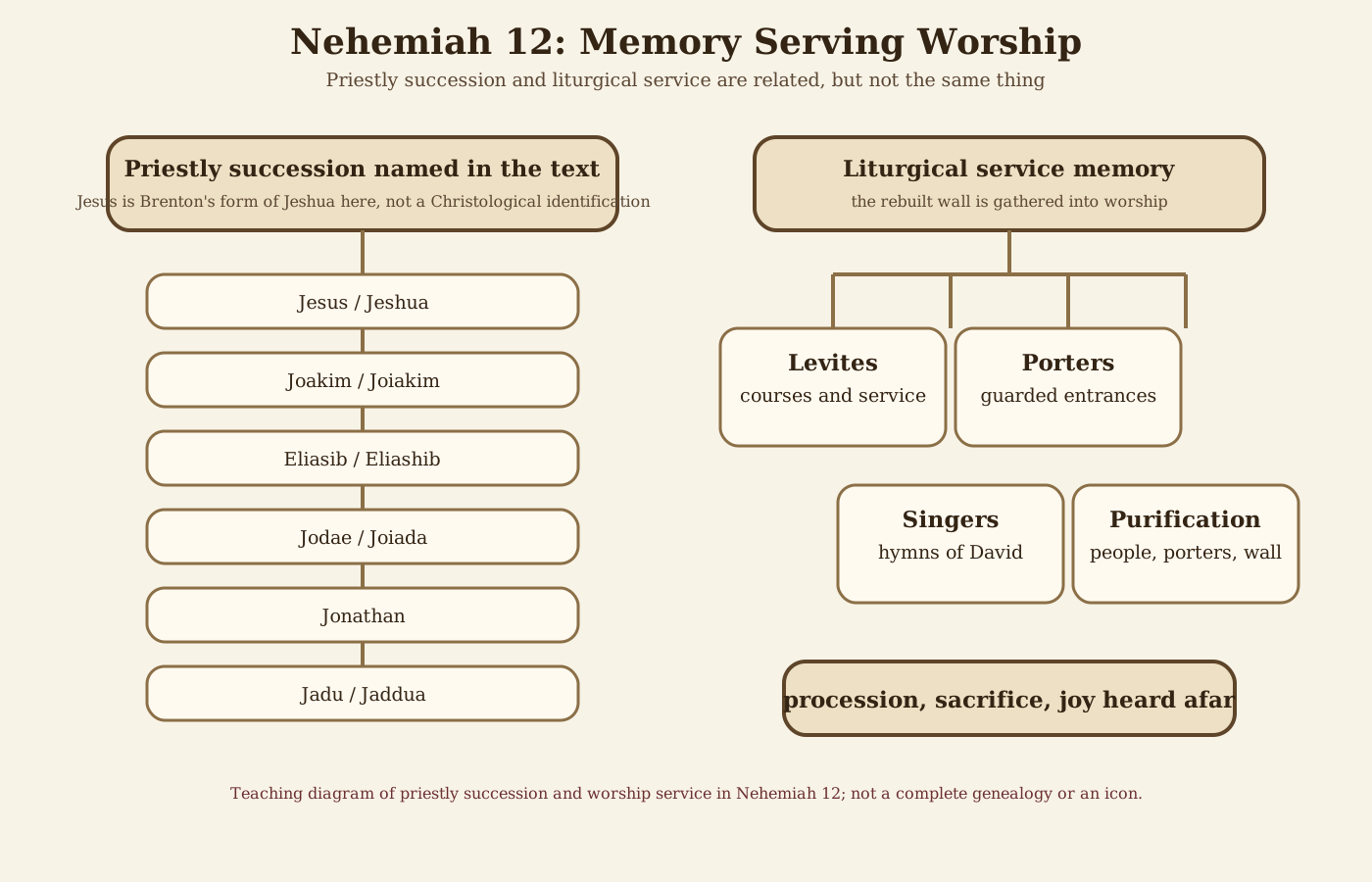 Teaching diagram of priestly succession and worship service in Nehemiah 12; not a complete genealogy.
Gathering for dedication and purification (Nehemiah 12:27-30)
27 And at the dedication of the wall of Jerusalem they sought the Levites in their places, to bring them to Jerusalem, to keep a feast of dedication and gladness with thanksgiving, and they sounded cymbals with songs, and had psalteries and harps. 28 And the sons of the singers were assembled both from the neighbourhood round about to Jerusalem, and from the villages, 29 and from the country: for the singers built themselves villages by Jerusalem. 30 And the priests and the Levites purified themselves, and they purified the people, and the porters, and the wall.
The Levites are sought in their own places, and the singers come from the surrounding villages. Jerusalem’s gladness draws the region into praise. Cymbals, songs, psalteries, and harps give sound to thanksgiving for a mercy the people have lived through together.
Yet those leading the celebration first purify themselves. Priests and Levites cannot prepare everyone else while treating themselves as already clean. Then the people, porters, and wall are purified; the NKJV names the gates rather than the porters in 12:30.2 Both readings bring the life of the city before God’s holiness. The wall is dedicated as something entrusted to God, not displayed as a trophy of human achievement.
Christian joy is purified joy. Repentance does not spoil a feast; it frees us to receive it without pretending that all is well in the heart. A person can sing beautifully while nursing resentment, or serve a celebration while demanding recognition. The order of verse 30 meets us there. We offer ourselves with what we have built, asking that our praise become truthful.
The Greek word behind “dedication” in 12:27 is “encaenia,” the word John uses for the Feast of Dedication (John 10:22).3 These are different celebrations, but the shared word brings a striking Gospel scene into view. At the Feast of Dedication, Christ walks in the temple’s porch of Solomon. His hearers ask whether He is the Christ; He points to the works done in His Father’s name, then speaks of His sheep hearing His voice and following Him. He gives them eternal life, and no one can snatch them from His hand or His Father’s hand. The passage reaches His declaration, “I and My Father are one” (John 10:22-30).
The true Temple stands at the feast of dedication: John elsewhere identifies the temple of which Christ speaks as His body (John 2:19-21). The security Jerusalem seeks in strengthened gates reaches its fulfillment in the living Lord who keeps His people. Christian dedication therefore calls for more than attachment to a holy place. It calls us to hear His voice and follow Him. The beauty of a consecrated building must help us give our life to the One worshiped within it.
The Church’s Voice in Worship ⛪
Nehemiah is not among the Scripture readings in the Coptic lectionary this site follows (Coptic Reader).
The Church does, however, pray the praise that fits this dedication. Psalm 147:12-20 (LXX Psalm 147) belongs to the Agpeya Twelfth Hour and the Midnight Third Watch. Its opening summons Jerusalem to praise because God “has strengthened the bars of your gates” (Psalm 147:12-13; LXX Psalm 147). The rebuilt city confesses that its protection is God’s gift. At the close of the day, we too entrust what we cannot secure by our own vigilance to Him.
John 10:22-38 is the Liturgy Gospel on Mesra 12 and occurs during Great Lent when the readings of the Feast of the Cross on Baramhat 10 are appointed. Its scene at the Feast of Dedication makes the connection more than a resemblance between ceremonies. The Church hears the Son reveal His unity with the Father and His care for the sheep. Praise of God’s gifts leads to faith in the Giver.
Revelation 21 is read at the consecration of a church. The holy city in that vision descends from God, and the Lord God Almighty and the Lamb are its temple (Revelation 21:2, 22). A church’s dedication points beyond its present walls toward that communion. We honor material things offered to God because the Word became flesh; we await the city in which nothing unclean enters and God’s people dwell with Him (Revelation 21:3, 27).
Thanksgiving upon the wall (Nehemiah 12:31-41)
31 And they brought up the princes of Juda on the wall, and they appointed two great companies for thanksgiving, and they passed on the right hand on the wall of the dung-gate. 32 And after them went Osaia, and half the princes of Juda, 33 and Azarias, and Esdras, and Mesollam, 34 and Juda, and Benjamin, and Samaias and Jeremia. 35 And some of the sons of the priest with trumpets, Zacharias son of Jonathan, son of Samaias, son of Matthania, son of Michaia, son of Zacchur, son of Asaph: 36 and his brethren, Samaia, and Oziel, Gelol, Jama, Aia, Nathanael, and Juda, Anani, to praise with the hymns of David the man of God; and Esdras the scribe was before them, 37 at the gate, to praise before them, and they went up by the steps of the city of David, in the ascent of the wall, above the house of David, even to the water-gate
39 of Ephraim, and to the fish-gate, and by the tower of Anameel, and as far as the sheep-gate.
The people walk on the very wall that had been broken, mocked, threatened, and rebuilt under pressure. The place of reproach becomes the path of thanksgiving. The named gates and towers keep this reversal concrete. Praise passes through the places where the people had worked and feared.
The displayed reading announces two companies but leaves out the verses that explain the second route and their meeting. In 12:38, preserved in Rahlfs and the NKJV, the second thanksgiving choir goes in the opposite direction, with Nehemiah behind it and half the people accompanying him. Verse 40 brings the two thanksgiving choirs together in the house of God, with Nehemiah and half the rulers; verse 41 names the priests with trumpets.4 The choirs take different paths around the same restored wall and come to one place of worship.
Ezra goes before the first company (12:36), while Nehemiah follows the second. The governor walks behind the singers. He has borne responsibility, faced accusations, and refused to abandon the work. Now his place is among those giving thanks. Leadership has brought him to a point where he can follow. This is a searching form of humility for anyone who has labored for a parish or family: to rejoice when the completed work belongs to God and others lead the praise.
 Teaching diagram of the dedication processions around Jerusalem; approximate routes, not an archaeological reconstruction. Ori229, CC0, Wikimedia Commons.
The hymns of David are named again. Received praise accompanies bodily movement: the people walk, sing, and gather together. Procession can school the heart in belonging to a people before God. Its meaning is fulfilled when the person moving with the congregation also yields pride, resentment, and self-importance to the Lord. The two choirs meet in His house, not at a monument to the governor.
Gems from the Fathers 💎
Thematic witness (worship practice). St. Basil the Great describes Christians gathering at night, confessing their sins to God with tears, then rising from prayer to sing psalms antiphonally. The congregation sings “divided into two parts.”5 He explains that this common psalmody helps the heart become attentive and free from distraction. He is describing Christian worship, not commenting directly on Nehemiah’s procession.
His account illuminates both the answering choirs of 12:24 and the path from confession in Nehemiah 9 to thanksgiving here. Confession teaches us that we live by mercy; praise gives that mercy a voice. Alternating choirs also require a humble attentiveness: we must listen while others sing and take our part without trying to possess the whole prayer. The purification and thanksgiving of this chapter belong together in the heart as well as in the ceremony.
Joy heard afar and worship sustained (Nehemiah 12:42-47)
42 And the singers were heard, and were numbered. 43 And in that day they offered great sacrifices, and rejoiced; for God had made them very joyful: and their wives and their children rejoiced: and the joy in Jerusalem was heard from afar off. 44 And in that day they appointed men over the treasuries, for the treasures, the first-fruits, and the tithes, and for the chiefs of the cities who were assembled among them, to furnish portions for the priests and Levites: for there was joy in Juda over the priests and over the Levites that waited. 45 And they kept the charges of their God, and the charges of the purification, and ordered the singers and the porters, according to the commandments of David and his son Solomon. 46 For in the days of David Asaph was originally first of the singers, and they sang hymns and praise to God. 47 And all Israel in the days of Zorobabel, and in the days of Neemias, gave the portions of the singers and the porters, a daily rate: and consecrated them to the Levites: and the Levites consecrated them to the sons of Aaron.
The reason for Jerusalem’s joy is stated plainly: “God had made them very joyful.” The people offer sacrifices and rejoice because they have received mercy. Wives and children share in the celebration. Those who could not bear every responsibility of leadership or building still belong fully to the people who give thanks.
Ezra 3:13 also describes a sound heard far away, when the temple’s foundation was laid. There the noise mingled the people’s joy with the weeping of those who remembered the former temple. Nehemiah 12 now gives us the gladness of the restored city. Neither scene permits us to forget what restoration has cost. The Gospel brings a greater announcement: the angel’s good tidings of great joy are for all the people, because the Savior has been born (Luke 2:10-11). Jerusalem’s audible thanksgiving prepares us to recognize joy that is received from God and shared rather than kept for ourselves.
Then the text turns immediately to treasuries, first-fruits, tithes, and portions for those serving. There is joy over the priests and Levites, and that joy takes the form of provision. Verse 47 calls it “a daily rate.” The singers and gatekeepers must eat after the procession ends. Admiration without support would leave the celebration unable to endure.
Christ tells His messengers that the laborer is worthy of his wages (Luke 10:7). St. Paul makes the temple connection explicit: those who serve at the altar share in its offerings, and the Lord has commanded that those who preach the Gospel should live from the Gospel (1 Corinthians 9:13-14). Nehemiah’s arrangements already join gratitude for ministry to care for the minister. This is no permission to exploit a congregation. It is a summons to fair and faithful support, so that those appointed to serve are not abandoned while others enjoy the fruit of their labor.
A parish feast has a tomorrow. Thanksgiving continues in honest stewardship, preparation, cleaning, hymn practice, and care for the people who give their time to worship. The warning in Nehemiah 13:10-11 will be severe: when their portions are withheld, the Levites return to their fields, and the house of God is forsaken. Here the daily portions show how joy can remain faithful after its first intensity has passed.
Spiritual Fruit 🍇
Follow the thanksgiving. Nehemiah walks behind the singers without becoming less responsible or less faithful. When a work you have helped complete is celebrated, thank God for the others who carried it. Let someone else’s service be seen without quietly measuring how much credit remains for you. The work has reached a good end when you can join the praise freely.
Offer a truthful heart. The priests and Levites begin by purifying themselves. Before the next feast or Liturgy, bring one concealed resentment, neglected duty, or hunger for praise into prayer and confession. Seek reconciliation where it is possible. Repentance clears the heart for joy; it need not leave us afraid to rejoice in God’s mercy.
Listen as well as sing. The answering choirs make room for both receiving and offering. When another voice carries the hymn, attend to the words instead of waiting impatiently for your own part. At home, let children hear the Church’s prayer and join what they can. Verse 43 gives them a place in the joy, not merely a place at the edge of adult worship.
Give joy a tomorrow. The daily portions turn gratitude into a dependable practice. Choose a regular contribution of money, time, or practical care that supports worship and those serving it, according to your means. A small faithful offering can carry more love than enthusiasm that disappears after the feast.
The choirs come to rest in the house of God. Nehemiah stands with the people whose labor he has guided, and the thanksgiving belongs to them all. Christ knows His sheep and keeps them in His hand. May He cleanse our praise of the need to possess it, and teach us the gladness of belonging to Him.
Teaching Notes
Remembered priests, Levites, and singers (Nehemiah 12:1-26)
- Ask: What does the list preserve that a description of the dedication alone would leave out?
- Emphasize: Verses 10-11 preserve the high-priestly line; verse 24 describes alternating praise according to David. Succession and daily service carry worship across generations.
- Watch for: Jeshua is the high priest of the return, though Brenton calls him Jesus. Do not confuse him with Christ or assume priestly descent guarantees personal faithfulness. Explain the shorter list at 12:4-6 before reading.
- Connect: Eliashib in Nehemiah 3:1, 12:10, and 13:4-7, 28; the answering voices of Coptic hymnody.
- Show: Use the priestly line and worship service diagram to distinguish family succession from service roles. Identify Eliashib and trace his later failure without treating the whole line as corrupt.
Gathering for dedication and purification (Nehemiah 12:27-30)
- Ask: Why do the priests and Levites purify themselves before purifying the people?
- Emphasize: Purified joy joins repentance to thanksgiving. The shared word “encaenia” connects the language of dedication to John 10:22, without making the two celebrations identical.
- Watch for: Brenton reads “porters” in 12:30; the NKJV reads “gates.” Do not attribute the NKJV detail to the displayed wording. Confirm the proposed Myron anointing of the altar, walls, and icons in the Coptic church-consecration rite book before presenting it as fact; it is not established here.
- Connect: John 10:22-30 and John 2:19-21; Psalm 147:12-13 (LXX Psalm 147); Revelation 21:2-3, 22, 27. The worship placements come from the attested Coptic readings, not from a claimed Nehemiah appointment.
Thanksgiving upon the wall (Nehemiah 12:31-41)
- Ask: What changes in our understanding of leadership when the governor walks behind the singers?
- Emphasize: The place of reproach becomes the path of thanksgiving. The second choir goes the opposite way, Nehemiah follows with half the people, and both thanksgiving choirs meet in the house of God.
- Watch for: Brenton lacks 12:38, 12:40, and 12:41, but Rahlfs includes all three. Do not call these Septuagint-wide omissions. Basil’s Letter 207.3 is a thematic witness to worship practice, not direct commentary on Nehemiah.
- Connect: The confession of Nehemiah 9 and the purification of 12:30 prepare for praise; Basil joins confession and antiphonal psalmody in Christian worship.
- Show: Use the procession diagram to distinguish the two routes and their common destination. The routes are approximate; do not treat the diagram as an archaeological map.
Joy heard afar and worship sustained (Nehemiah 12:42-47)
- Ask: What would become of the joy in verse 43 if the daily portions in verse 47 were withheld?
- Emphasize: God gives the joy, wives and children share it, and dependable provision supports those who serve. The feast has a tomorrow.
- Watch for: Avoid treating loudness as a measure of holiness or temple support as permission for financial pressure. Encourage faithful giving according to means and accountable care for servants.
- Connect: Ezra 3:13; Luke 2:10-11; Luke 10:7; 1 Corinthians 9:13-14; Nehemiah 13:10-11. Luke 2:1-20 is the Liturgy Gospel of the Christmas Paramoun, where the Church hears the announcement of joy in the Savior’s birth.
Sources
Embedded Scripture is from Brenton’s English Septuagint (LXX).
Lancelot Charles Lee Brenton, The Septuagint Version of the Old Testament, Nehemiah 12 (2 Esdras 22), the English text following Codex Vaticanus.
Alfred Rahlfs, Septuaginta, 2 Esdras 22; CCAT Greek text. The comparison distinguishes the absent 12:4-6 from 12:38, 12:40, and 12:41, which this Greek edition preserves.
New King James Version, Nehemiah 12:24, 30, 38, 40-41; John 10:22-30; John 2:19-21; Ezra 3:13; Luke 2:10-11; Luke 10:7; 1 Corinthians 9:13-14; Revelation 21.
St. Basil the Great, Letter 207 to the Clergy of Neocaesarea, section 3, in Nicene and Post-Nicene Fathers, Second Series, vol. 8, translated by Blomfield Jackson. Letter 207.
Coptic Orthodox readings and the Book of Agpeya, as attested in
@andraws/lectionary-data1.3.3: John 10:22-38 at the Liturgy on Mesra 12 and in the Baramhat 10 Feast of the Cross appointments; Revelation 21 at church consecration; Psalm 147:12-20 (LXX Psalm 147) in the Twelfth Hour and Midnight Third Watch; Luke 2:1-20 at the Christmas Paramoun Liturgy. The antiphonal-choir connection describes worship practice, not a reading assignment for Nehemiah.Nehemiah 12 priestly line and worship service tree, teaching diagram of the named succession and service roles; not a complete genealogy.
Ori229, Inauguration of the Walls of Jerusalem during the Time of Nehemiah, teaching diagram, CC0, Wikimedia Commons; approximate processional routes.
Footnotes
-
Nehemiah 12:24, NKJV. “Group alternating with group” clarifies the antiphonal arrangement described by Brenton as brethren standing “over against them” and praising “course by course.” NKJV comparison. ↩
-
Nehemiah 12:30, NKJV, has “the gates” where Brenton has “the porters.” The displayed Scripture retains Brenton’s wording; the NKJV includes the entrances themselves with the people and wall in the purification. NKJV comparison. ↩
-
Rahlfs, Septuaginta, 2 Esdras 22:27, uses the Greek dedication word “encaenia” (ἐγκαίνια); John 10:22 uses the same word for the Feast of Dedication. The shared term does not identify Nehemiah’s wall dedication with the later feast. For Christ’s words and the temple setting, see John 10:22-30, NKJV. ↩
-
Nehemiah 12:38, 40-41, NKJV; Rahlfs, Septuaginta, 2 Esdras 22:38, 40-41. The second choir’s opposite route, Nehemiah following with half the people, the two choirs standing in God’s house, and the priests with trumpets are present in these sources but absent from Brenton’s Vaticanus-based edition. This comparison supplements the explanation, not the displayed Brenton reading. NKJV comparison. ↩
-
St. Basil the Great, Letter 207 to the Clergy of Neocaesarea, section 3, Nicene and Post-Nicene Fathers, Second Series, vol. 8, translated by Blomfield Jackson, edited by Philip Schaff and Henry Wace (1895). Full text. This is a thematic witness to Christian worship practice: confession with tears, then antiphonal psalmody, with the congregation “divided into two parts.” ↩