


This narration was recorded before the latest revision. The text on this page is current.
The wall is finished, but Jerusalem is still sparsely inhabited and its houses remain unbuilt. Nehemiah turns from the stones to the people: those who will guard the gates, those who will sing, and those whose families came home from exile. A long register stands where we might expect a triumphant conclusion. Its names make us slow down. God restored actual households, actual servants, and actual worship; the completed wall must now shelter a people who remember His mercy.
Gates, watches, and trustworthy guardians (Nehemiah 7:1-3)
A note on numbering. Nehemiah 7 is 2 Esdras 17 in the Septuagint, where Ezra and Nehemiah form one book. The headings here follow NKJV chapter and verse numbering.
1 And it came to pass, when the wall was built, and I had set up the doors, and the porters and the singers and the Levites were appointed, 2 that I gave charge to Ananias my brother, and Ananias the ruler of the palace, over Jerusalem: for he was a true man, and one that feared God beyond many. 3 And I said to them, The gates of Jerusalem shall not be opened till sunrise; and while they are still watching, let the doors be shut, and bolted; and set watches of them that dwell in Jerusalem, every man at his post, and every man over against his house.
Nehemiah, called Neemias in Brenton, appoints gatekeepers, singers, and Levites as soon as the doors are set. Guarding and praise belong together in the city’s daily life. The gates must be secure so that the people can dwell, gather, and worship without abandoning the vigilance learned during the building.
The two men entrusted with Jerusalem are Hanani, Nehemiah’s brother, and Hananiah, the leader of the citadel. Brenton calls both Ananias.1 Hanani is the brother whose report first brought Jerusalem’s distress to Nehemiah in Susa (1:2; see Nehemiah 1). The man who carried news of the ruin is now entrusted with the restored city. Hananiah is commended as a faithful man who fears God beyond many. The strongest qualification named at the gates is a conscience answerable to God.
The instructions in verse 3 make that trust concrete. The gates remain shut until sunrise; doors are bolted while guards are still present; residents stand at assigned posts and opposite their own homes. Responsibility has a place and a time. A household cannot leave its own entrance unguarded while praising the strength of the city’s defenses.
The same weakness appears in the soul when we celebrate a victory over one sin and stop guarding the habits that feed it. Resentment returns through rehearsed arguments; impurity through an invitation we keep leaving open; carelessness through the small duty we always postpone. Nehemiah’s appointed watches suggest a sober response: identify the entrance, accept responsibility for it, and keep the watch without becoming suspicious of everyone outside.
A wide city and a found register (Nehemiah 7:4-7)
4 Now the city was wide and large; and the people were few in it, and the houses were not built. 5 And God put it into my heart, and I gathered the nobles, and the rulers, and the people, into companies: and I found a register of the company that came up first, and I found written in it as follows: 6 Now these are the children of the country, that came up from captivity, of the number which Nabuchodonosor king of Babylon carried away, and they returned to Jerusalem and to Juda, every man to his city; 7 with Zorobabel, and Jesus, and Neemia, Azaria, and Reelma, Naemani, Mardochaeus, Balsan, Maspharath, Esdra, Boguia, Inaum, Baana, Masphar, men of the people of Israel.
The city is “wide and large,” yet its population is small and its houses are unbuilt. The contrast checks the excitement of chapter 6. Visible completion can coexist with a fragile common life. Nehemiah must consider who will inhabit the city and how the restored community will be gathered.
“God put it into my heart” repeats the language of 2:12, when Nehemiah went out at night to inspect Jerusalem. The God who moved him to examine broken stones now moves him to gather living people. In both cases, the inward prompting leads to patient attention: first an inspection, now a register. Reverence for God’s initiative does not make careful administration beneath us.
The register looks back to the first return from Babylon under Zerubbabel and Jeshua, Brenton’s “Zorobabel, and Jesus.” Almost the same register appears in Ezra 2:1-70. Scripture prints these households twice. Some individual numbers differ between the two accounts, and the entries should not be forced into an artificial agreement; both nevertheless give the congregation’s total as 42,360 (Ezra 2:64; Nehemiah 7:66).2 The repeated list bears witness to a people preserved through exile, not to Nehemiah’s private achievement. God does not tire of remembering His people.
The name “Jesus” in verse 7 is the Greek form of Jeshua, the high priest associated with the first return. The shared name alone does not make him Christ. Zechariah supplies the deeper connection: Jeshua son of Jehozadak is crowned as a sign pointing to the Man called the Branch, who will build the Lord’s temple and unite royal and priestly dignity (Zechariah 6:11-13). The historical priest serves a promised restoration greater than his own. In Christ, the true High Priest and King, that promise reaches its fulfillment. Zechariah 3 shows the same priest receiving cleansing and standing before the promise of the Branch.
Nehemiah’s generation receives a mercy that began before it. So does a parish. We enter prayer taught by others, hear Scripture preserved by others, and serve beside people whose years of hidden faithfulness made our own service possible. Remembering them loosens the pride that treats the work of God as if it began with us.
Families and places remembered by name (Nehemiah 7:8-38)
8 The children of Phoros, two thousand one hundred and seventy-two. 9 The children of Saphatia, three hundred and seventy-two. 10 The children of Era, six hundred and fifty-two. 11 The children of Phaath Moab, with the children of Jesus and Joab, two thousand six hundred and eighteen. 12 The children of Aelam, a thousand two hundred and fifty-four. 13 The children of Zathuia, eight hundred and forty-five. 14 The children of Zacchu, seven hundred and sixty. 15 The children of Banui, six hundred and forty-eight. 16 The children of Bebi, six hundred and twenty-eight. 17 The children of Asgad, two thousand three hundred and twenty-two. 18 The children of Adonicam, six hundred and sixty-seven. 19 The children of Bagoi, two thousand and sixty-seven. 20 The children of Edin, six hundred and fifty-five. 21 The children of Ater, the son of Ezekias, ninety-eight. 22 The children of Esam, three hundred and twenty-eight. 23 The children of Besei, three hundred and twenty-four. 24 The children of Ariph, a hundred and twelve: the children of Asen, two hundred and twenty-three. 25 The children of Gabaon, ninety-five. 26 The children of Baethalem, a hundred and twenty-three: the children of Atopha, fifty-six. 27 The children of Anathoth, a hundred and twenty-eight. 28 The men of Bethasmoth, forty-two. 29 The men of Cariatharim, Caphira, and Beroth, seven hundred and forty-three. 30 The men of Arama and Gabaa, six hundred and twenty. 31 The men of Machemas, a hundred and twenty-two. 32 The men of Baethel and Ai, a hundred and twenty-three. 33 The men of Nabia, a hundred an fifty-two. 34 The men of Elamaar, one thousand two hundred and fifty-two. 35 The children of Eram, three hundred and twenty. 36 The children of Jericho, three hundred and forty-five. 37 The children of Lodadid and Ono, seven hundred and twenty-one. 38 The children of Sanana, three thousand nine hundred and thirty.
This passage is easy to rush through, but Scripture does not rush. Some groups are identified by fathers, others by towns. Anathoth, Bethlehem, Bethel, Ai, Jericho, and the other places belong to the story of households finding their way home. Exile had torn people from homes and inheritances. The register records that scattering was not the last word.
The numbers are not trophies. They are signs of preservation. Babylon carried these families away, but Babylon did not erase them. The register becomes a litany of survival by mercy. We need not know each family’s later story to honor the fact that it is remembered here.
Psalm 87:6 (LXX Psalm 86) speaks of the Lord recording the peoples. The psalm’s register reaches beyond one ancestry: those born among other nations are counted as belonging to Zion. Christ gives His disciples a still greater ground of joy than their power over demons: their names are written in heaven (Luke 10:20). St Paul names fellow workers whose names are in the Book of Life (Philippians 4:3), and the gates of the new Jerusalem bear the names of Israel’s twelve tribes (Revelation 21:12). These texts do not turn Nehemiah’s civic register into the Book of Life. They reveal the hope toward which holy remembrance opens: belonging before God, received by grace and lived in faithfulness.
That hope corrects our habit of remembering only the visible or successful. A name spoken in prayer is not a statistic. It belongs to someone whom Christ calls us to love, someone whose salvation matters more than the impression he or she makes on us.
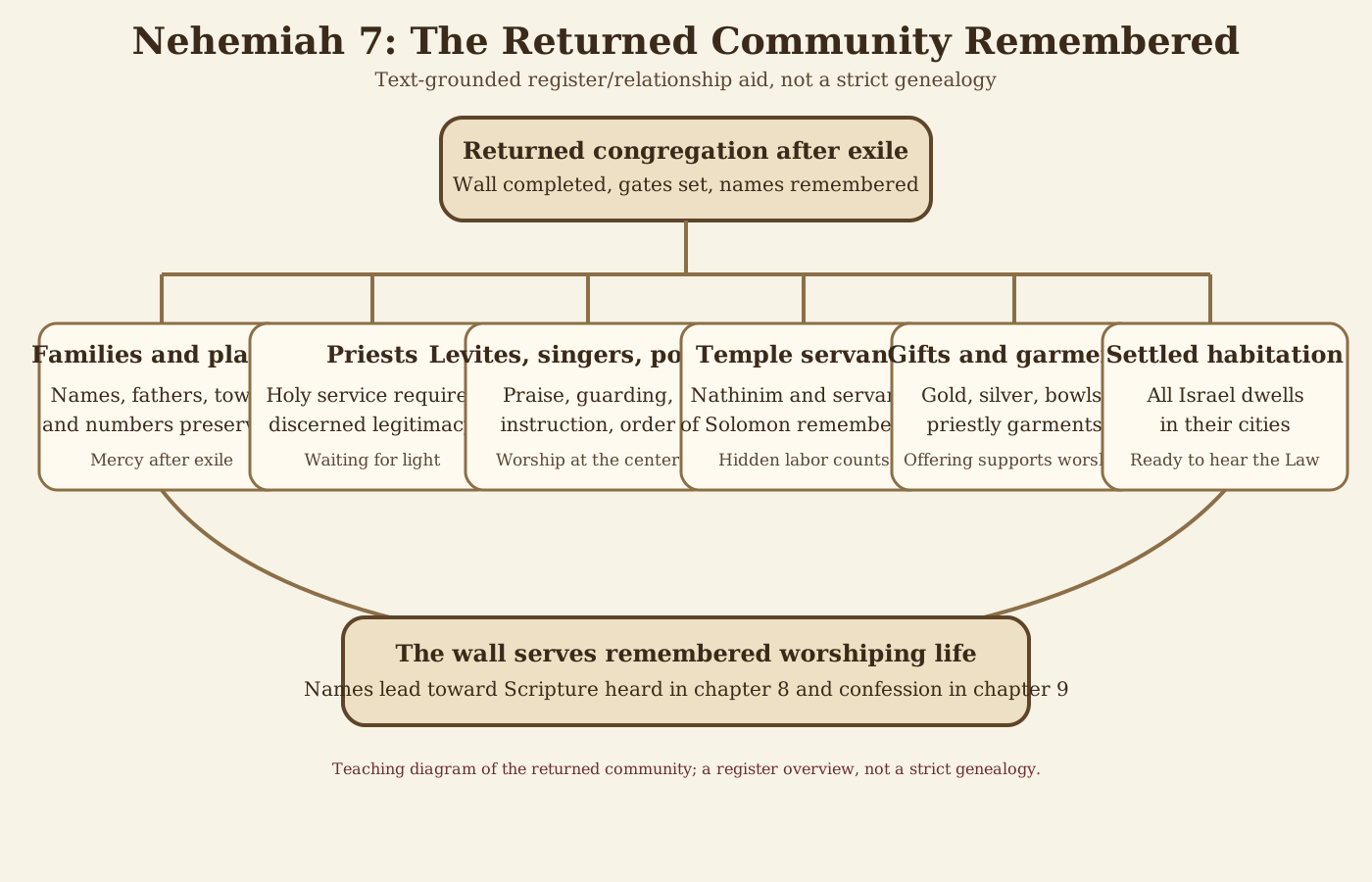 Teaching diagram of the returned community; a register overview, not a strict genealogy.
Gems from the Fathers 💎: A register with spiritual depth
Direct witness. St Jerome, describing Ezra and Nehemiah in Letter 53, names the returning Israelites, priests, Levites, proselytes, and families. He reads the recorded community as history with a spiritual depth, rather than dismissing its details as an obstacle to devotion. He writes, “These references convey one meaning upon the surface, but another below it.”3 His words give us permission to linger over the register. Its families really returned, and their return also teaches the Church to recognize God’s gathering mercy.
The Church’s Voice in Worship ⛪
Nehemiah is not among the Scripture readings in the Coptic lectionary this site follows (Coptic Reader).
Psalm 87 (LXX Psalm 86) is prayed in the Agpeya Sixth Hour. Its vision of peoples registered in Zion gives prayerful breadth to this chapter’s list: the God who remembers the returned families also gathers the nations into His city. Luke 10:1-20 is a Liturgy Gospel on days including Abib 6, Amshir 4, and Babah 22. Heard beside Nehemiah’s register, Christ’s direction to rejoice in names written in heaven turns our desire for recognition toward the only remembrance that can sustain us eternally.
Philippians 3:20-4:9, which includes the fellow workers named in the Book of Life, is a Pauline reading on days including the Fast of Nineveh. Revelation 21 is read at the consecration of a church. Together these readings hold earthly belonging within the promise of the heavenly city. Their use does not assign Nehemiah 7 a feast or reading day; it allows the chapter’s remembered people to be heard in the light of Christ’s completed gathering.4
Priests, singers, porters, and temple servants (Nehemiah 7:39-60)
39 The priests; the sons of Jodae, pertaining to the house of Jesus, nine hundred and seventy-three. 40 The children of Emmer, one thousand and fifty-two. 41 The children of Phaseur, one thousand two hundred and forty-seven. 42 The children of Eram, a thousand and seventeen. 43 The Levites; the children of Jesus the son of Cadmiel, with the children of Uduia, seventy-four. 44 The singers; the children of Asaph, a hundred and forty-eight. 45 The porters; the children of Salum, the children of Ater, the children of Telmon, the children of Acub, the children of Atita, the children of Sabi, a hundred and thirty-eight. 46 The Nathinim; the children of Sea, the children of Aspha, the children of Tabaoth, 47 the children of Kiras, the children of Asuia, the children of Phadon, 48 the children of Labana, the children of Agaba, the children of Selmei, 49 the children of Anan, the children of Gadel, the children of Gaar, 50 the children of Raaia, the children of Rasson, the children of Necoda, 51 the children of Gezam, the children of Ozi, the children of Phese, 52 the children of Besi, the children of Meinon, the children of Nephosasi, 53 the children of Bacbuc, the children of Achipha, the children of Arur, 54 the children of Basaloth, the children of Mida, the children of Adasan, 55 the children of Barcue, the children of Sisarath, the children of Thema, 56 the children of Nisia, the children of Atipha. 57 The children of the servants of Solomon; the children of Sutei, the children of Sapharat, the children of Pherida, 58 the children of Jelel, the children of Dorcon, the children of Gadael, 59 the children of Saphatia, the children of Ettel, the children of Phacarath, the children of Sabaim, the children of Emim. 60 All the Nathinim, and children of the servants of Solomon, were three hundred and ninety-two.
The register turns to those whose service sustains the house of God. Priests, Levites, singers, gatekeepers, temple servants, and the descendants of Solomon’s servants are all remembered. Brenton’s “Nathinim” are the temple servants called Nethinim in the NKJV. The list makes room for labor whose dignity can disappear when we notice only the person standing before the congregation.
Singers preserve praise; gatekeepers attend entrances; the temple servants provide less prominent help. These duties are distinct, yet all belong to the same restored life. The register does not make every servant a priest in order to make every servant matter. Faithfulness has dignity in the duty actually given.
A parish depends on this truth. Someone prepares the vessels, someone teaches a child, someone cleans after the gathering, someone arrives early to open the building. When such service goes unnoticed, resentment can make us inwardly withdraw while continuing the outward task. The register offers a gentler freedom: the work may be hidden from the congregation without being forgotten before God.
Gems from the Fathers 💎: Remembering those who have fallen asleep
Thematic witness to liturgical practice. St Cyril of Jerusalem describes the Eucharistic commemoration of patriarchs, prophets, apostles, martyrs, bishops, and all the faithful departed. The Church brings her remembered people before God in worship, seeking the saints’ intercession and praying for those who have fallen asleep. Cyril says, “we commemorate also those who have fallen asleep before us”.5 This is his account of Christian worship, not a commentary on Nehemiah 7. It shows why an Orthodox reader can hear the register with affection: the life of the people of God includes those whose service is finished on earth and whose names remain in our prayer.
Priestly legitimacy and waiting for light (Nehemiah 7:61-65)
61 And these went up from Thelmeleth, Thelaresa, Charub, Eron, Jemer: but they could not declare the houses of their families, or their seed, whether they were of Israel. 62 The children of Dalaia, the children of Tobia, the children of Necoda, six hundred and forty-two. 63 And of the priests; the children of Ebia, the children of Acos, the children of Berzelli, for they took wives of the daughters of Berzelli the Galaadite, and they were called by their name. 64 These sought the pedigree of their company, and it was not found, and they were removed as polluted from the priesthood. 65 And the Athersastha said, that they should not eat of the most holy things, until a priest should stand up to give light.
The register now records a painful uncertainty. Some returning families cannot establish their ancestry, and some claiming priestly descent cannot produce their records. The priestly claim matters because access to the most holy portions belongs to a service received under God’s command. Desire for the office cannot establish the right to it.
The word “polluted” in verse 64 must be read within this question of priestly eligibility. The passage does not give us permission to despise people of uncertain ancestry. It restricts priestly service and the eating of the most holy things while the claim remains unresolved. Human dignity and entitlement to a sacred office are different questions.
“Athersastha” in verse 65 is the title “governor,” corresponding to Tirshatha, not the name of King Artaxerxes. The NKJV uses the title of Nehemiah himself in 8:9 and 10:1.6 The governor directs that the disputed priests wait “until a priest should stand up to give light.” The NKJV speaks of a priest consulting the Urim and Thummim, the priestly means of seeking God’s answer associated with the breastplate in Exodus 28:30. The Greek phrase about a priest who will give light is connected by many with “Urim,” understood as “lights.”7 The immediate need is for God’s authoritative answer where the available records cannot settle the claim.
The waiting is spiritually searching. The community refuses both rash permission and a verdict pretending to know more than it does. Reverence can say, “We cannot yet authorize this,” without saying, “You have no worth.” In parish life, a disputed responsibility calls for patient inquiry and proper pastoral judgment, not gossip, self-appointment, or public humiliation.
Christian readers must bring the question of priestly descent to Hebrews 7. Verse 3 describes Melchizedek as Scripture presents him, without a recorded genealogy, and sees in him a likeness to the Son of God. Christ’s priesthood does not depend on descent from Aaron; it rests on the power of an endless life (7:16), and He holds it permanently because He continues forever (7:24). This does not deny Christ’s true human ancestry or erase the Old Covenant’s command. It reveals the High Priest whose risen life can accomplish what no register can secure. Those who come to God through Him receive salvation from One who always lives to intercede for them (7:25).
Gems from the Fathers 💎: Illumination before the holy things
Typological connection, not commentary on Nehemiah. St Justin Martyr describes people preparing for baptism through faith, repentance, prayer, and fasting, and then receiving the washing in the name of the Father, the Son, and the Holy Spirit. He writes, “this washing is called illumination”.8 His account helps Christian readers hear the language of waiting for light with sacramental seriousness. We approach the holy things through the light Christ gives, not through a right we confer on ourselves. The connection is typological: Nehemiah’s priestly inquiry is not itself a description of Christian baptism, and Justin is explaining the Church’s initiation, not interpreting this verse.
The whole congregation, gifts, and settled homes (Nehemiah 7:66-73)
Numbering in 7:68-69. Brenton’s edition, following Codex Vaticanus, omits 7:68 and gives only the donkeys in 7:69. Rahlfs’ Greek Septuagint includes both the horses and mules in 7:68 and the camels and donkeys in 7:69, as do the NKJV and the parallel in Ezra 2:66-67. The gap and shortened animal list below belong to Brenton’s edition, not to the Septuagint as a whole.9
66 And all the congregation was about forty-two thousand three hundred and sixty, 67 besides their men-servants and their maid-servants: these were seven thousand three hundred and thirty seven: and the singing-men and singing-women, two hundred and forty-five.
69 Two thousand seven hundred asses. 70 And part of the heads of families gave into the treasury to Neemias for the work a thousand pieces of gold, fifty bowls, and thirty priests’ garments. 71 And some of the heads of families gave into the treasuries of the work, twenty thousand pieces of gold, and two thousand three hundred pounds of silver. 72 And the rest of the people gave twenty thousand pieces of gold, and two thousand two hundred pounds of silver, and sixty-seven priests’ garments. 73 And the priests, and Levites, and porters, and singers, and some of the people, and the Nathinim, and all Israel, dwelt in their cities.
Brenton prints “And the seventh month arrived” as 8:1; the NKJV and the Greek place it at the end of 7:73.
The whole congregation is counted, then servants, singers, animals, gifts, bowls, and priestly garments. The shared total of 42,360 links this chapter once more to Ezra 2. Return from captivity involved households traveling, settling, working, and making provision for worship. The animals belong to that ordinary material life; the gold and garments belong to its willing offering.
The heads of families give, and then “the rest of the people” give. Restored life is sustained by an offering that reaches beyond a few prominent households. The garments make the purpose tangible: someone else’s gift will clothe a priest for service. Generosity often bears fruit in a duty we will never perform ourselves.
The chapter ends quietly. Priests, Levites, singers, gatekeepers, temple servants, and all Israel dwell in their cities. They are counted and placed, ready for the gathering around the Law in Nehemiah 8. The register has brought us from guarded entrances to inhabited homes. Mercy has given the people somewhere to stand, something to offer, and a word from God they must now hear.
Spiritual Fruit 🍇
Remember a person rather than a category. The long register resists the haste that sees only “the elderly,” “the servants,” or “the difficult family.” Bring particular names into prayer, including someone whose quiet service you have stopped noticing. Thank a person whose labor makes the parish’s worship possible. Such remembrance begins to heal the coldness that can live beneath efficient church work.
Keep the watch nearest your own house. Verse 3 gives each resident a post. Choose one entrance through which a familiar sin returns: the conversation that becomes gossip, the screen used without restraint, or the evening habit that leaves no room for prayer. Make one definite change there. A sober watch over oneself is more fruitful than anxious inspection of everyone else.
Wait for light without withdrawing love. The unresolved priestly claims expose our desire to settle uncertainty quickly. We may become severe because patience costs us, or permissive because careful discernment is uncomfortable. Ask for proper guidance, respect the limits of what is known, and refuse to humiliate the person whose situation remains unsettled. The holy things and the person both deserve reverence.
Our deepest security lies in the living High Priest, not in how conspicuous our place has become. Christ knows those who labor without praise and those who fear they have no place at all. Before Him, we can offer the small duty that is actually ours, remember the people He has given us, and rejoice that belonging in His kingdom is a gift of mercy. Lord Jesus Christ, give light to our judgment, faithfulness to our service, and love to the names we bring before You.
Teaching Notes
Gates, watches, and trustworthy guardians (Nehemiah 7:1-3)
- Ask: Why is the fear of God a qualification for guarding Jerusalem?
- Emphasize: Hanani carries the story from the grievous report in 1:2 to responsibility in the restored city; Hananiah is the other official in 7:2.
- Watch for: Brenton repeats Ananias. Do not collapse the two men into one, or make spiritual watchfulness a reason to distrust people.
- Connect: The post opposite one’s own home gives a concrete starting point for repentance and responsibility.
A wide city and a found register (Nehemiah 7:4-7)
- Ask: What remains unfinished when the wall is complete but the houses are unbuilt?
- Emphasize: “God put it into my heart” recalls 2:12, and the repeated register joins Nehemiah’s generation to the earlier return.
- Watch for: Ezra 2 and Nehemiah 7 differ in some individual figures. Their common total does not remove those differences or prove that every entry matches.
- Connect: Jeshua is Brenton’s Jesus. Use Zechariah 6:11-13 and Zechariah 3 to explain the priest-and-Branch typology without identifying the historical priest with Christ.
Families and places remembered by name (Nehemiah 7:8-38)
- Ask: Which people disappear from our attention when we think only about the visible work of a parish?
- Emphasize: The register is a litany of survival by mercy; Psalm 87:6 (LXX Psalm 86) and Luke 10:20 widen the hope of remembered belonging.
- Watch for: The historical register is not identical with the Book of Life. The worship placements cited are attested in the lectionary data, not claimed as a new Coptic Reader check.
- Connect: Philippians 4:3 and Revelation 21:12 join remembered workers and Israel’s named tribes to the heavenly city.
- Show: Use the returned-community register tree to distinguish families, worshiping servants, gifts, and settlement. It is a register overview, not a strict genealogy.
Priests, singers, porters, and temple servants (Nehemiah 7:39-60)
- Ask: What forms of service would become noticeable only if no one performed them?
- Emphasize: Distinct duties have real dignity; honoring a temple servant does not require confusing that duty with the priesthood.
- Watch for: Hidden service can become resentful when it seeks recognition. Address the wound without treating exhaustion or neglect as virtues.
- Connect: Cyril’s Lecture 23.9 witnesses to liturgical commemoration of the saints and departed, not to direct exegesis of Nehemiah.
Priestly legitimacy and waiting for light (Nehemiah 7:61-65)
- Ask: How can a community withhold authorization for a sacred duty while preserving love and dignity?
- Emphasize: Athersastha means governor. The priest who will give light is connected with the inquiry by Urim and Thummim in the NKJV.
- Watch for: Avoid ethnic superiority, contempt for uncertain ancestry, self-appointed sacramental authority, and the claim that Hebrews denies Christ’s human genealogy.
- Connect: Hebrews 7:3, 16, 24-25 contrasts hereditary qualification with Christ’s enduring priesthood. Justin’s baptismal illumination is a typological connection, not commentary on this verse.
The whole congregation, gifts, and settled homes (Nehemiah 7:66-73)
- Ask: What does a gift of priestly garments reveal about serving through someone else’s work?
- Emphasize: The common total with Ezra 2, the gifts from both leading households and the rest of the people, and the quiet dignity of settled life.
- Watch for: Rahlfs includes both animal verses. Call the omission a Brenton-edition gap, not a Septuagint gap.
- Connect: The seventh month and settled community prepare for the public hearing of the Law in chapter 8.
Sources
Embedded Scripture is from Brenton’s English Septuagint (LXX). Nehemiah 7, eBible edition.
The Holy Bible, New King James Version, Nehemiah 7; Ezra 2; Exodus 28:30; Zechariah 3; Zechariah 6:11-13; Psalm 87 (LXX Psalm 86); Luke 10:20; Philippians 4:3; Hebrews 7; Revelation 21:12.
Alfred Rahlfs, ed., Septuaginta, 2 Esdras 17, especially 17:68-69 and the end of 17:73, in the CCAT Greek edition. Brenton follows Codex Vaticanus; his omissions do not by themselves establish what all Greek witnesses contain.
St Jerome, Letter 53 to Paulinus, section 8, NPNF, Second Series, volume 6. Text.
St Justin Martyr, First Apology, chapter 61, ANF, volume 1. Text.
St Cyril of Jerusalem, Catechetical Lecture 23 (Mystagogical 5), section 9, NPNF, Second Series, volume 7. Text.
Coptic lectionary placements:
@andraws/lectionary-data1.3.3, Agpeya Sixth Hour, Psalm 87 (LXX Psalm 86); Liturgy Gospel, Luke 10:1-20; Pauline Epistle, Philippians 3:20-4:9; consecration of a church, Revelation 21. These are the package-attested placements supplied for this study, not an independent confirmation in Coptic Reader.Returned-community register tree: teaching diagram based on Nehemiah 7, not a historical reconstruction or strict genealogy.
Footnotes
-
Nehemiah 7:2: Brenton has “Ananias my brother, and Ananias the ruler of the palace”; the NKJV distinguishes “Hanani my brother, and Hananiah the leader of the citadel.” Hanani is the brother who reports on Jerusalem in 1:2, where Brenton calls him Anani. ↩
-
Compare Ezra 2:1-70 with Nehemiah 7:6-73. Some household and town figures differ, as do some supporting details. Ezra 2:64 and Nehemiah 7:66 share the congregation’s total, 42,360. The texts preserve the differences; the total should not be used to conceal them. ↩
-
St Jerome, Letter 53 to Paulinus, section 8, NPNF, Second Series, volume 6, translation by W. H. Fremantle, G. Lewis, and W. G. Martley. Text. Jerome describes the returning community and the families assigned to build, then distinguishes the historical account from its deeper spiritual meaning. ↩
-
Worship placements are attested in
@andraws/lectionary-data
1.3.3: Agpeya Sixth Hour, Psalm 87 (LXX Psalm 86); Liturgy Gospel on Abib 6, Amshir 4, and Babah 22, Luke 10:1-20; Pauline Epistle on days including the Fast of Nineveh, Philippians 3:20-4:9; consecration of a church, Revelation 21. These related readings are not a lectionary appointment for Nehemiah 7. ↩ -
St Cyril of Jerusalem, Catechetical Lecture 23 (Mystagogical 5), section 9, NPNF, Second Series, volume 7, translated by Edwin Hamilton Gifford. Text. ↩
-
Nehemiah 7:65: Brenton’s “Athersastha” is the governor’s title, corresponding to the NKJV’s “the governor” and the title Tirshatha. Compare Nehemiah 8:9 and 10:1 in the NKJV. It is distinct from the Persian king’s name, Artaxerxes, despite the similar Brenton spellings. ↩
-
Nehemiah 7:65: Brenton reads “until a priest should stand up to give light”; the NKJV has “until a priest could consult with the Urim and Thummim.” Compare Exodus 28:30. Many connect the Greek light-giving expression with the Hebrew “Urim,” understood as “lights”; the connection explains the wording without identifying the historical inquiry with Christian baptism. ↩
-
St Justin Martyr, First Apology, chapter 61, ANF, volume 1, translated by Marcus Dods and George Reith. Text. The quotation concerns baptismal illumination; its use here is typological, not direct commentary on Nehemiah. ↩
-
Nehemiah 7:68-69 corresponds to 2 Esdras 17:68-69. Both verses are present in Rahlfs’ Septuagint: horses and mules, then camels and donkeys. Brenton’s Vaticanus-based edition lacks 7:68 and prints only “Two thousand seven hundred asses” at 7:69. Compare Ezra 2:66-67 and the NKJV’s Nehemiah 7:68-69. ↩