


This narration is from a previous version of the study and may include a combined recording of multiple chapters.
1 Esdras ends not with a battle, a palace, or a private vision, but with Scripture read aloud to the assembled people. The priest and reader brings the Law of Moses, the people listen from morning to midday, they stand, answer Amen, worship, understand, weep, and then receive holy joy.
Why This Passage Matters
This closing passage shows the goal of restoration: a people gathered before God, listening to His word, worshipping with their bodies, understanding what is read, and sharing joy with those who have nothing.
The book began with a great Passover before Judah’s collapse. Its surviving text leaves us with the Law heard, grief answered by holy joy, and food shared with those who have nothing. That spiritual arc is real even though the Greek ending is abrupt; it need not be called an intentionally finished conclusion.
The Place of This Passage
This passage parallels the end of Nehemiah 7 and Nehemiah 8:1-12. The community gathers in the seventh month, asks for the Law, receives explanation, and is sent into feast and generosity. It closes the surviving book, while Nehemiah continues beyond this scene.
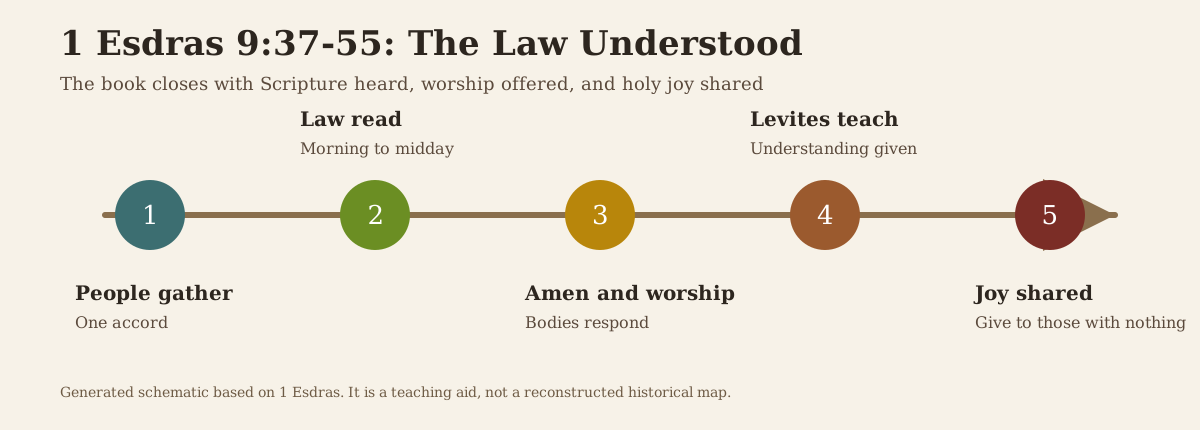
Scripture schematic of 1 Esdras 9:37-55, not a reconstructed historical map.
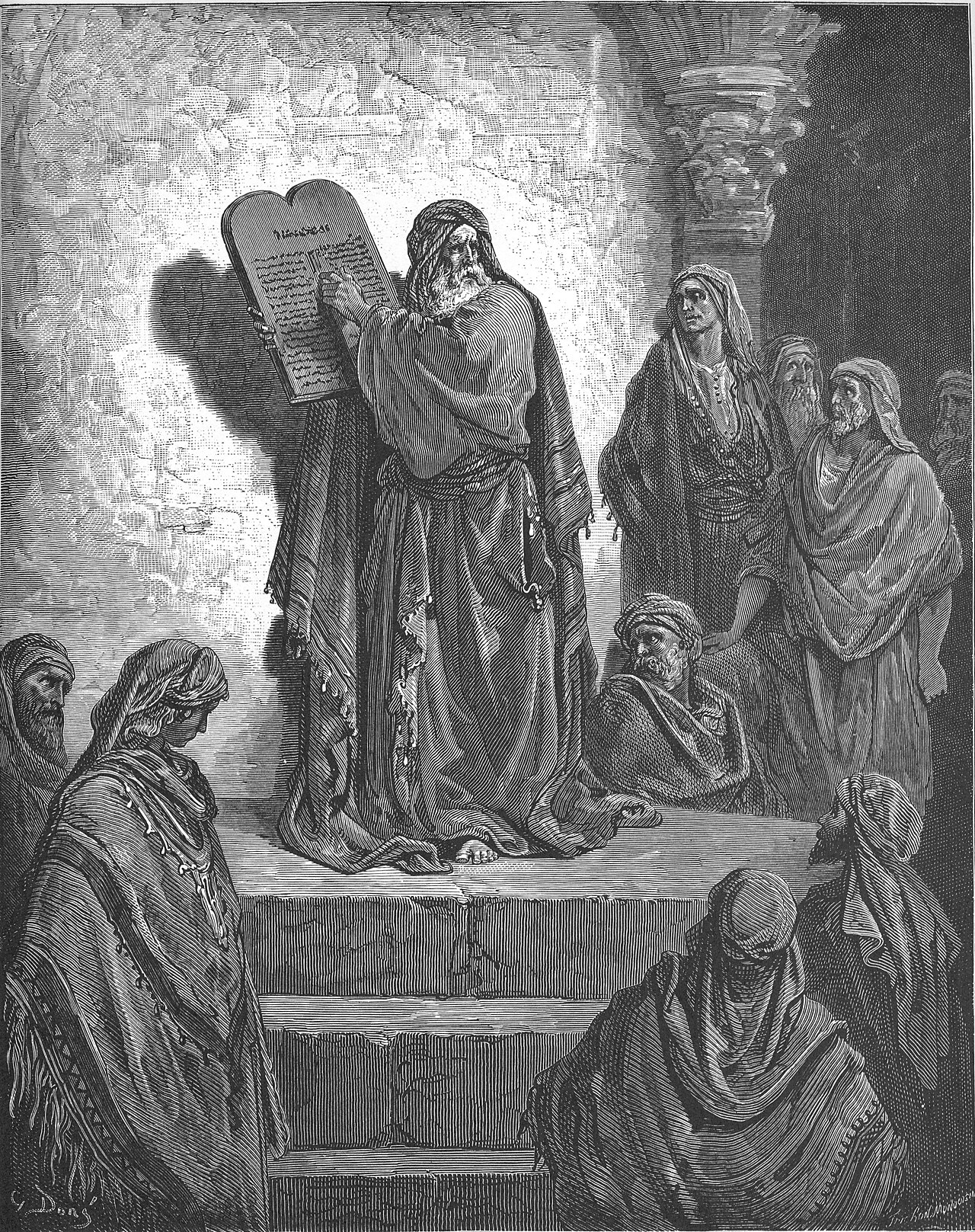
Source: Gustave Dore, Ezra Reads the Law to the People, public domain via Wikimedia Commons. Western biblical artwork for visual attention, not an Orthodox icon and not a direct ancient witness.
1 Esdras is not included in the NKJV. The Scripture below follows Brenton’s wording and verse numbers; other Greek editions and translations sometimes divide the verses differently.
The People Ask for the Law (1 Esdras 9:37-40)
37 And the priests and Levites, and they that were of Israel, dwelt in Jerusalem, and in the country, in the first day of the seventh month: so the children of Israel were in their habitations.
38 And the whole multitude came together with one accord into the broad place of the holy porch toward the east: 39 and they spake unto Esdras the priest and reader, that he would bring the law of Moses, that was given of the Lord God of Israel. 40 So Esdras the chief priest brought the law to the whole multitude from man to woman, and to all the priests, to hear the law in the first day of the seventh month.
The people dwell in their habitations, then gather with one accord in the broad place. They ask Esdras, Ezra in the familiar spelling, to bring the Law of Moses, given by the Lord God of Israel.
This is a beautiful reversal. The people are not forced to hear against their will. The restored community desires the word. Men, women, priests, and the multitude are all gathered to hear.
The “holy porch toward the east” recalls the eastern gate where the altar-gathering began in 1 Esdras 5:47. Here the gathering asks for the Law. Worship and understanding are brought into the same place; Scripture is given to the multitude, not held as the possession of a learned few.
Esdras is called “the chief priest” in verses 40 and 49. The Greek title is “archiereus,” high priest. This distinctive portrayal brings the priest and reader into one figure and gives a literary resonance to the waiting in 1 Esdras 5:40 for a high priest clothed with doctrine and truth. It does not establish that Ezra historically held the high-priestly office, or that the Urim and Thummim have been recovered. For a Christian reader, the fuller answer belongs to Christ, our High Priest who is Himself the Truth.1
Light from the Word 🕯️
“That he would bring the law” begins with a request from the people. Desire for Scripture can be restored along with a city. In Luke 4:16-21, Christ stands to read and declares the prophecy fulfilled in His hearers’ presence. Esdras brings what was given by the Lord; Christ reveals Himself as the fulfillment of the word He reads.
For Our Life
A parish is healthier when its people hunger for Scripture. That desire can be practiced: ask what will be read, attend to it, and return to the difficult word instead of passing over it as someone else’s concern.
The Law Is Read from Morning to Midday (1 Esdras 9:41-44)
41 And he read in the broad court before the holy porch from morning unto midday, before both men and women; and all the multitude gave heed unto the law.
42 And Esdras the priest and reader of the law stood up upon a pulpit of wood which was made for that purpose. 43 And there stood up by him Mattathias, Sammus, Ananias, Azarias, Urias, Ezecias, Baalsamus, upon the right hand: 44 and upon his left hand Phaldaius, and Misael, Melchias, Lothasubus, Nabarias, Zacharias.
Esdras reads from morning to midday, and the multitude gives heed. The text honors attention. Restoration requires listening long enough for the word to search and shape the heart.
The pulpit of wood and the named helpers show that the reading is public, ordered, and communal. The word is not hidden. It is lifted up among the people.
This is one of the clearest images of restoration in the book: not a private spiritual mood, but a whole assembly giving time, posture, attention, and understanding to the word of God.
Light from the Word 🕯️
“All the multitude gave heed” joins the long reading to an act of attention. The wooden platform makes the reader visible, but visibility is not the goal. The named helpers stand beside him so that the whole people can hear. Service succeeds when attention reaches God’s word rather than resting on the speaker.
For Our Life
The people give heed from morning to midday; the text places their standing when the Law is opened in verse 46, without saying they remain standing for all those hours. Their sustained attention is nevertheless demanding. Put away one avoidable distraction, read a whole passage, and let the difficult sentence receive more than a glance.
The People Stand, Answer Amen, and Worship (1 Esdras 9:45-48)
45 Then took Esdras the book of the law before the multitude: for he sat honourably in the first place in the sight of them all. 46 And when he opened the law, they stood all straight up. So Esdras blessed the Lord God most High, the God of hosts, Almighty. 47 And all the people answered, Amen; and lifting up their hands they fell to the ground, and worshipped the Lord.
48 Also Jesus, Anniuth, Sarabias, Adinus, Jacubus, Sabateas, Auteas, Maiannas, and Calitas, Azarias, and Joazabdus, and Ananias, Phalias, the Levites, taught the law of the Lord, and read the law of the Lord to the multitude, making them withal to understand it.
When Esdras opens the Law, the people stand. He blesses the Lord God most High, and the people answer Amen, lift their hands, fall to the ground, and worship. The Levites read and teach so that the multitude understands.
The passage shows that Scripture is not merely information. The reading of the Law leads to blessing, Amen, lifted hands, prostration, worship, teaching, and understanding. The whole person responds.
Gems from the Fathers 💎
St. John Chrysostom insists that reverence must include learning. In Homily 8 on Hebrews he tells hearers that “it is needful to exercise our hearing by divine studies” and concludes, “It follows therefore certainly that the fear of God needs teaching.”2 These words occur in his exhortation to trained hearing, not in a commentary on 1 Esdras. They illuminate why the Levites make the reading understandable: a body that stands before the book also needs a mind formed to receive it.
Light from the Word 🕯️
“Making them withal to understand it” shows why the Levites teach as well as read. Acts 8:30-31 places the same need in the mouth of the Ethiopian reader of Isaiah: understanding may require a guide. Reverence is no reason to hide a difficulty, and a question need not be irreverent. In Luke 24:45, the risen Christ opens His disciples’ understanding of the Scriptures. Teaching in the Church serves His illumination, not a teacher’s control over the listener.
The Church’s Voice in Worship ⛪
The Coptic lectionary has no verse-addressed reading from 1 Esdras. The bodily reverence of verse 46 still has a precise liturgical counterpart. Before the Holy Gospel the deacon calls, “Stand with the fear of God. Let us hear the Holy Gospel.”3 The Greek-derived formula begins “Stathēte,” stand; the biblical phrase is “orthoi estēsan,” they stood upright. The shared act is reverent standing to hear God’s word, not an identical formula or proof that the Coptic response is borrowed from this verse.
At Nayrouz, Tout 1, the Liturgy Gospel is Luke 4:14-30, including Christ standing to read in Nazareth. The Church’s new year opens with the acceptable year proclaimed by the Lord, while this assembly gathers on the first day of Israel’s seventh month. Luke 24:13-35 is read on Monday of the first week of the Holy Fifty Days, and Luke 24:36-53 at the Ascension. The risen Christ opens Scripture and understanding together. These are related Gospel readings, not appointments of the Esdras passage itself.4
Holy Joy Is Shared with Those Who Have Nothing (1 Esdras 9:49-55)
49 Then spake Attharates unto Esdras the chief priest and reader, and to the Levites that taught the multitude, even to all, saying, 50 This day is holy unto the Lord; (for they all wept when they heard the law:) 51 go then, and eat the fat, and drink the sweet, and send part to them that have nothing: 52 for this day is holy unto the Lord: and be not sorrowful; for the Lord will bring you to honour.
53 So the Levites published all things to the people, saying, This day is holy to the Lord; be not sorrowful. 54 Then went they their way, every one to eat and drink and make merry, and to give part to them that had nothing, and to make great cheer; 55 because they understood the words wherein they were instructed, and for the which they had been assembled.
The people weep when they hear the Law, but they are told that the day is holy to the Lord. They are sent to eat, drink, make merry, and give part to those who have nothing. Their joy is not selfish celebration. It becomes generosity.
Attharates represents the Persian title Tirshatha, the governor; the parallel Nehemiah 8:9 names Nehemiah in that role. The Greek account treats the title as a personal designation, as it does the related form Attharias in 1 Esdras 5:40. His reassurance is distinctive: “the Lord will bring you to honour.” The familiar Hebrew-based Nehemiah 8:10 speaks of the joy of the Lord as strength, while Brenton’s Nehemiah says “the Lord is our strength.” Here the accent falls on God’s promise to lift a humbled people. The precise textual history of these differing forms remains uncertain.5
The final verse gives the reason for the feast: they understood the words in which they were instructed. Understanding has become food, joy, and a portion sent to someone who has none. It is possible to accumulate biblical knowledge while staying closed to a neighbor’s need. This assembly measures its reception of the word by a shared table.
The Greek text ends with “kai episynēchthēsan,” “and they were assembled.” Brenton folds the phrase into a complete English sentence, but the abrupt Greek ending has often been understood as a break in a once longer work. The proposal of a lost continuation, sometimes associated with Nehemiah’s Feast of Tabernacles, remains an explanation, not a surviving chapter we can reconstruct.6 The verb shares its word-family with the noun “episynagōgē,” assembling together, in Hebrews 10:25.7 This vocabulary gives a fitting spiritual resting-place without proving a deliberate authorial conclusion: the people are still gathered to hear and receive.
Light from the Word 🕯️
“Send part to them that have nothing” prevents holy joy from becoming an enclosure for the comfortable. The command is carried out in verse 54. Where Scripture has truly opened the heart, another person’s lack enters the feast rather than remaining outside it.
For Our Life
If hearing Scripture makes us more self-absorbed, we have not understood it rightly. The people who understand are sent to share with those who have nothing.
Christological Types and Prophecies
Esdras brings the Law to the people, and the Levites help them understand. Christ brings the Scriptures to fulfillment and opens the understanding of His disciples. The Church’s gathering is therefore more than a meeting of attentive minds: it is a people receiving the living Word, learning to worship, and making room for the neighbor at the table.
Spiritual Fruit 🍇
Ask for the word instead of waiting passively for someone to offer it. Read the appointed passage before worship when you can, and carry one phrase into prayer afterward. A restored appetite grows through receiving real food, not through admiring the idea of being spiritually hungry.
Give attention a bodily form. Put the phone away, listen to the whole reading, and stand reverently as you are able. The people’s Amen answers a blessing; let your own response become assent to God rather than a sound made while the mind is elsewhere.
Seek understanding without shame. Ask a priest or faithful teacher about the word you do not understand, then return to the passage. The Levites serve the multitude by explaining it. A good question can be the beginning of obedience.
Let holy joy include a portion for someone who has none. Choose a person whose need is easily forgotten and offer food, help, or companionship without making the gift a display. The word has reached the table when the neighbor is remembered there.
The book is open before the assembly. The people have wept, listened, understood, and begun to share. Christ still gathers His Church and opens the Scriptures to her. Remain with those who hear Him, answer Him, and feed one another: assembled.
Teaching Notes
The People Ask for the Law (1 Esdras 9:37-40)
- Ask: What does the gathered multitude request?
- Emphasize: Restored people desire the word of God.
- Watch for: Do not treat Scripture as a burdensome add-on to worship.
- Connect: Christ is the Word who fulfills the Law.
- Show: Compare the Passover before collapse in 1 Esdras 1:1 with the Law heard in 1 Esdras 9:37-55. Distinguish a real theological arc from certainty about the original ending.
The Law Is Read from Morning to Midday (1 Esdras 9:41-44)
- Ask: What does the people’s attention reveal?
- Emphasize: Hearing the word requires time and reverence.
- Watch for: Avoid making Bible study entertainment only.
- Connect: Orthodox worship trains sustained attention to Scripture.
- Show: Use the Dore artwork as Western biblical art to visualize public reading, then return to the text: pulpit, named helpers, attention, and understanding.
The People Stand, Answer Amen, and Worship (1 Esdras 9:45-48)
- Ask: How do the people respond bodily to the Law?
- Emphasize: Scripture leads to worship and understanding together.
- Watch for: Do not separate learning from prayer.
- Connect: The Church stands, answers Amen, bows, and receives teaching in worship.
- Show: Trace the bodily responses: standing, Amen, lifted hands, prostration. Compare with Orthodox worship without claiming a direct lectionary placement.
Holy Joy Is Shared with Those Who Have Nothing (1 Esdras 9:49-55)
- Ask: Why are the people told not to remain sorrowful?
- Emphasize: Understanding the word leads to holy joy and mercy.
- Watch for: Do not confuse repentance with permanent despair.
- Connect: Christ turns mourning into joy and sends His people to care for the poor.
- Show: Compare Brenton’s complete sentence with the Greek final phrase, “and they were assembled.” End with the gathered people, without claiming the surviving ending is certainly intentional.
Sources
Embedded Scripture is from Brenton’s English Septuagint (LXX).
Biblical parallels: Nehemiah 8; 1 Esdras 5:40 and 1 Esdras 5:47; Luke 4:16-21; Luke 24:45; Acts 8:30-31; Hebrews 10:25.
Footnotes
-
Greek 1 Esdras 9:40 and 9:49, https://sacred-texts.com/bib/sep/es1009.htm; R. Glenn Wooden, “1 Esdras: To the Reader,” on the book’s priestly emphasis, https://ccat.sas.upenn.edu/nets/edition/15-1esdras-nets.pdf. ↩
-
St. John Chrysostom, Homilies on Hebrews, Homily 8, sections 8 and 10; his recollection of Ezra is in section 9, https://www.newadvent.org/fathers/240208.htm. ↩
-
Coptic Euchologion, Raising of Incense, introduction to the Gospel, https://st-takla.org/Lyrics-Spiritual-Songs/Words-of-Coptic-Alhan-Tasbeha-Kodas/Arabic-Coptic-Liturgy-Lyrics/1-Slat-3asheya-Vespers-Prayer/Arab-Copts-Mass-Book-024-Mokademat-Al-Enjeel.html. Compare The Coptic Liturgy of St. Basil, Gospel introduction, http://www.coptic.net/prayers/stbasilliturgy.html. ↩
-
Coptic Orthodox lectionary, Nayrouz (Tout 1), Liturgy Gospel, Luke 4:14-30; Monday of the first week of the Holy Fifty Days, Luke 24:13-35; Ascension, Luke 24:36-53. ↩
-
Compare Greek 1 Esdras 9:49-52, https://sacred-texts.com/bib/sep/es1009.htm, with Brenton’s Nehemiah 8:9-10; International Standard Bible Encyclopedia, “Attharates,” https://www.internationalstandardbible.com/A/attharates.html. ↩
-
Greek 1 Esdras 9:55, https://sacred-texts.com/bib/sep/es1009.htm; Charles L. Souvay, “Esdras,” Catholic Encyclopedia, section II.C, discussion of the incomplete Greek ending and Latin completion, https://www.catholic.com/encyclopedia/esdras. This is a textual observation, not adoption of the article’s Roman Catholic canon judgment. ↩
-
Greek Hebrews 10:25, the form “episynagōgēn” of “episynagōgē,” https://biblehub.com/text/hebrews/10-25.htm; compare “episynēchthēsan” in Greek 1 Esdras 9:55. ↩