


This narration is from a previous version of the study and may include a combined recording of multiple chapters.
After the temple is completed and Passover is kept, the book turns to the formation of the people through the Law. Esdras, Ezra in the more familiar English spelling, comes as a priest descended from Aaron and a ready scribe in the Law of Moses. Restoration now needs teaching.
Why This Passage Matters
Buildings can be rebuilt while hearts remain unformed. The temple has been restored, but the people still need the Law read, taught, and embodied. Esdras enters as priest, reader, scribe, and teacher.
This passage also shows that spiritual authority is received as service. Esdras is honored by the king, but he blesses God. He receives a commission, but he understands that God put these things into the king’s heart to glorify the house in Jerusalem.
The Place of This Passage
This passage covers Esdras’s genealogy, journey, commission, authority to teach and judge, and thanksgiving. It is the hinge from temple restoration to Torah-formed community.
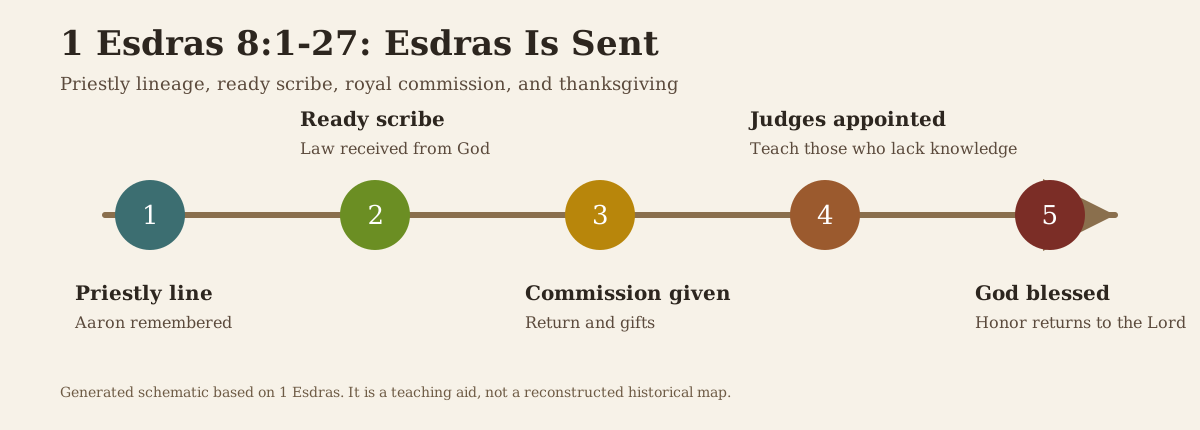
Scripture schematic of 1 Esdras 8:1-27, not a reconstructed historical map.
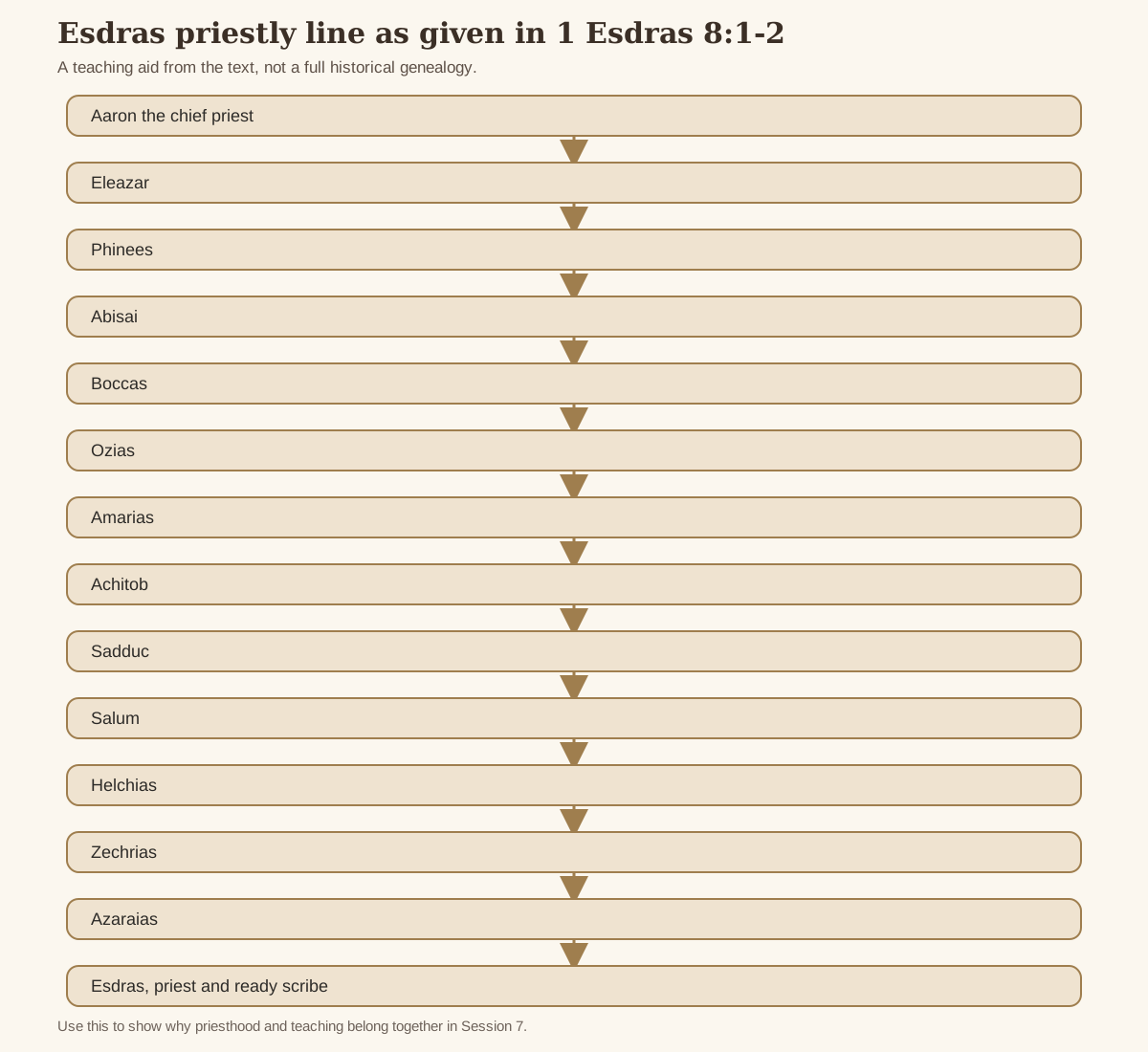
Scripture schematic of the priestly line in 1 Esdras 8:1-2, not a full historical genealogy.
1 Esdras is not included in the NKJV. The Scripture below follows Brenton’s wording and verse numbers; other Greek editions and translations sometimes divide the verses differently.
Esdras Comes as Priest and Ready Scribe (1 Esdras 8:1-7)
1 And after these things, when Artaxerxes the king of the Persians reigned, came Esdras the son of Azaraias, the son of Zechrias, the son of Helchias, the son of Salum, 2 the son of Sadduc, the son of Achitob, the son of Amarias, the son of Ozias, the son of Boccas, the son of Abisai, the son of Phinees, the son of Eleazar, the son of Aaron the chief priest. 3 This Esdras went up from Babylon, as a scribe, being very ready in the law of Moses, that was given by the God of Israel. 4 And the king did him honour: for he found grace in his sight in all his requests.
5 There went up with him also certain of the children of Israel, of the priests, of the Levites, of the holy singers, porters, and ministers of the temple, unto Jerusalem, 6 in the seventh year of the reign of Artaxerxes, in the fifth month, this was the king’s seventh year; for they went from Babylon in the first day of the first month, and came to Jerusalem, according to the prosperous journey which the Lord gave to him. 7 For Esdras had very great skill, so that he omitted nothing of the law and commandments of the Lord, but taught all Israel the ordinances and judgments.
Esdras is rooted in priestly lineage, reaching back to Aaron the chief priest. The text then names his work: he is a scribe, very ready in the Law of Moses given by the God of Israel.
The word ready
matters. Esdras is not merely literate. He is prepared, formed, and available for the service of the Law. His skill is not detached from worship; it belongs to priestly service and the restoration of the people.
The genealogy is therefore not decoration. It tells the reader that teaching the Law is not free-floating expertise. In this passage, the scribe comes as a priestly servant. The rebuilt temple now needs a formed teacher, because stones can be restored while hearts remain untaught.
Phinees is Phinehas, son of Eleazar, whose zeal at Peor is answered by God’s covenant of peace and perpetual priesthood (Numbers 25:10-13). Esdras’s ancestry places him within that vocation of guarding worship. Later, in 1 Esdras 8:68-9:36, his zeal will first take the form of grief, fasting, and prayer. An ancestral act of violence is not made a model for Christian ministry by this genealogy.
Light from the Word 🕯️
“Very ready in the law” names a trained readiness. Psalm 45:1 (LXX Psalm 44:2, where the superscription has its own verse) compares the tongue to a skilled writer’s pen; Matthew 13:52 describes the scribe instructed for the Kingdom bringing out things new and old. These are illuminating parallels, not an assertion that all three expressions are identical in Greek. Esdras’s knowledge becomes a gift because he can place it at the service of Israel.
Verse 7 joins great skill to omitting nothing of the commandments and teaching Israel. The parallel Ezra 7:10 expresses the order as seeking, doing, and teaching. Christ likewise honors the one who does and teaches (Matthew 5:19), and Acts 1:1 describes what Jesus began to do and teach. Knowledge becomes trustworthy when the teacher is also under the word he explains.
For Our Life
The Church needs servants who are ready in the word, not merely opinionated about it. Readiness comes through study, obedience, prayer, and humility before the God who gave the Law.
Gems from the Fathers 💎
St. Irenaeus remembers Esdras within God’s preservation of Scripture. In Against Heresies 3.21.2, while defending the Septuagint’s witness to Christ, he says that God “inspired Esdras the priest, of the tribe of Levi, to recast all the words of the former prophets, and to re-establish with the people the Mosaic legislation.”1 This ancient tradition goes beyond the events explicitly narrated here. Its spiritual force is clear: the God who returns the people to their land also returns His teaching to their life. A restored library alone would not accomplish the latter; the Law must again be received and lived.
Artaxerxes Commissions the Return (1 Esdras 8:8-14)
8 Now the copy of the commission, which was written from Artaxerxes the king, and came to Esdras the priest and reader of the law of the Lord, is this that followeth;
9 King Artaxerxes unto Esdras the priest and reader of the law of the Lord sendeth greeting: 10 Having determined to deal graciously, I have given order, that such of the nation of the Jews, and of the priests and Levites, being within our realm, as are willing and desirous, should go with thee unto Jerusalem. 11 As many therefore as have a mind thereunto, let them depart with thee, as it hath seemed good both to me and my seven friends the counsellors; 12 that they may look unto the affairs of Judea and Jerusalem, agreeably to that which is in the law of the Lord; 13 and carry the gifts unto the Lord of Israel to Jerusalem, which I and my friends have vowed, and all the gold and silver that in the country of Babylon can be found, to the Lord in Jerusalem, 14 with that also which is given of the people for the temple of the Lord their God at Jerusalem: and that silver and gold may be collected for bullocks, rams, and lambs, and things thereunto appertaining;
Artaxerxes sends Esdras with permission for willing priests, Levites, and people to go to Jerusalem. The commission is voluntary in its language: those who are willing and desirous may depart.
The purpose is not tourism or political expansion. They are to look to the affairs of Judea and Jerusalem according to the Law of the Lord, and to carry gifts for the Lord of Israel. Return is again ordered toward worship and obedience.
Light from the Word 🕯️
“As are willing and desirous” makes room for a real response to the invitation. Royal permission opens the road, but cannot supply the heart that chooses to travel it. The gifts come from the king and counsellors as well as the people: restoration draws distinct acts of generosity into a common purpose before the Lord.
Guardrail for Reading
Do not treat the king as the spiritual source of Esdras’s mission. The king writes the commission, but the Law belongs to the Lord, and Esdras later blesses God as the one who moved the king’s heart.
Gifts and Vessels Are Given for Worship (1 Esdras 8:15-21)
15 to the end that they may offer sacrifices unto the Lord upon the altar of the Lord their God, which is in Jerusalem.
16 And whatsoever thou and thy brethren will do with the silver and gold, that do, according to the will of thy God. 17 And the holy vessels of the Lord, which are given thee for the use of the temple of thy God, which is in Jerusalem, thou shalt set before thy God in Jerusalem. 18 And whatsoever thing else thou shalt remember for the use of the temple of thy God, thou shalt give it out of the king’s treasury.
19 And I king Artaxerxes have also commanded the keepers of the treasures in Syria and Phenice, that whatsoever Esdras the priest and the reader of the law of the most high God shall send for, they should give it him with speed, 20 to the sum of an hundred talents of silver, likewise also of wheat even to an hundred cors, and an hundred pieces of wine, and other things in abundance. 21 Let all things be performed after the law of God diligently unto the most high God, that wrath come not upon the kingdom of the king and his sons.
The commission provides sacrifices, holy vessels, and supplies for the temple. Verse 20 names silver, wheat, wine, and “other things in abundance.” The parallel Ezra 7:22 explicitly includes oil and salt; those words are not in this displayed verse. The two commissions share their purpose without listing every provision in the same way.
The holy vessels return as a repeated sign in the book. They are set before God in Jerusalem because sacred things must be restored to sacred use. The gifts are not for Esdras’s private honor; they are for the altar and the house of God.
Light from the Word 🕯️
“According to the will of thy God” limits the discretion entrusted to Esdras and his brethren (8:16). Funds are not made holy by generous amounts alone. Their use must answer to the Lord’s purpose. That is why the vessels are set “before thy God,” not displayed as the teacher’s achievement.
For Our Life
Money, food, vessels, time, and skill can serve God when they are offered rightly. Stewardship is not only budgeting. It is the conversion of resources into worship and mercy.
Esdras Is Sent to Teach and Judge (1 Esdras 8:22-27)
22 I command you also, that ye require no tax, nor any other imposition, of any of the priests, or Levites, or holy singers, or porters, or ministers of the temple, or of any that have doings in this temple, and that no man have authority to impose any thing upon them.
23 And thou, Esdras, according to the wisdom of God ordain judges and justices, that they may judge in all Syria and Phenice all those that know the law of thy God; and those that know it not thou shalt teach. 24 And whosoever shall transgress the law of thy God, and of the king, shall be punished diligently, whether it be by death, or other punishment, by penalty of money, or by imprisonment.
25 Then said Esdras the scribe, Blessed be the only Lord God of my fathers, who hath put these things into the heart of the king, to glorify his house that is in Jerusalem: 26 and hath honoured me in the sight of the king, and his counsellors, and all his friends and nobles. 27 Therefore was I encouraged by the help of the Lord my God, and gathered together men of Israel to go up with me.
The commission exempts temple servants from taxes and authorizes Esdras to appoint judges and justices. It specifies judgment among those who know the Law, and instruction for those who do not. Teaching comes before the list of punishments. Death, other punishment, monetary penalty, and imprisonment belong to the coercive authority of this Persian commission; they are not a mandate for the Church. Christian correction seeks healing through instruction, repentance, and the sacraments, under Christ’s commandments.
Esdras responds with blessing. He sees God’s hand beneath royal favor. He does not say, My wisdom accomplished this.
He says the Lord put these things into the heart of the king to glorify His house.
Light from the Word 🕯️
“Those that know it not thou shalt teach” prevents ignorance from becoming an excuse to abandon another person. It calls the teacher to work before he pronounces judgment. At the same time, Esdras’s blessing locates authority beneath God: honor received is turned into thanksgiving, and courage comes from “the help of the Lord my God.”
For Our Life
A good servant blesses God when doors open. Esdras receives honor but returns glory to the Lord. This is the pattern of safe leadership: receive responsibility, teach faithfully, and give thanks.
The Church’s Voice in Worship ⛪
The Coptic lectionary has no verse-addressed reading from 1 Esdras. Its related Gospel readings draw together the scribe’s knowledge and his obedience. Matthew 13:44-52, the Vespers Gospel of Nayrouz, includes the scribe instructed for the Kingdom. Matthew 5:17-24 is read on Wednesday of the second week of Great Lent and includes the Lord’s command to do and teach. Instruction is received as a vocation to conversion, not as spiritual prestige.2
Christological Types and Prophecies
Esdras serves the Law that Christ fulfills. His priestly ancestry, instruction, and thanksgiving prepare a reader to recognize the greater Priest and Teacher, who brings us to the Father and writes His law in our hearts. The human teacher remains a servant; salvation comes through the Lord whom the Scriptures reveal.
Spiritual Fruit 🍇
Become ready for the person you are called to help. Before teaching, read the passage attentively, ask what obedience it requires of you, and explain one truth without trying to display everything you know. Esdras’s readiness serves Israel, not his reputation.
When responsibility or recognition comes, turn it into thanksgiving before it becomes self-importance. Name the people whose help made the work possible, and acknowledge God’s mercy in the opening you have received. The vessels are set before God; the teacher’s honor should be placed there too.
“Those that know it not thou shalt teach” applies closely when a child, seeker, or fellow servant asks a question you find elementary. Resist the impatience that punishes someone for not having learned what you have. Give patient instruction, invite practice, and remain available when understanding takes time.
Esdras stands at the threshold of a long road with a commission in his hand. The king has honored him, but his blessing goes to the Lord. Bring your own learning and authority into that thanksgiving. Ask to be useful to someone who needs the word, and obedient to it yourself.
Teaching Notes
Esdras Comes as Priest and Ready Scribe (1 Esdras 8:1-7)
- Ask: Why does the text begin with Esdras’s priestly lineage?
- Emphasize: Teaching the Law belongs within worship and priestly service.
- Watch for: Do not reduce Esdras to a bureaucrat or scholar only.
- Connect: Christ is the true High Priest and Word of God.
- Show: Use the Esdras priestly-line chart to trace Aaron, priesthood, Law, and Jerusalem as one restoration line. Say clearly that the chart follows the text and is not a full historical genealogy.
Artaxerxes Commissions the Return (1 Esdras 8:8-14)
- Ask: What is the purpose of the commission?
- Emphasize: Return is ordered according to the Law of the Lord.
- Watch for: Do not make imperial permission the source of spiritual life.
- Connect: God can use rulers while remaining the true Lord of history.
- Show: List the repeated worship words: priest, Law, Jerusalem, gifts, Lord.
Gifts and Vessels Are Given for Worship (1 Esdras 8:15-21)
- Ask: Why are offerings, vessels, and provisions named so carefully?
- Emphasize: Worship requires concrete stewardship.
- Watch for: Avoid making resources private trophies.
- Connect: In Christ, all gifts are offered back to God.
- Show: Discuss how money, food, vessels, and time can be consecrated.
Esdras Is Sent to Teach and Judge (1 Esdras 8:22-27)
- Ask: What must be done for those who do not know the Law?
- Emphasize: They must be taught, not merely condemned.
- Watch for: Avoid harsh correction without instruction.
- Connect: The Church teaches in order to heal and illumine.
- Show: Compare Esdras’s thanksgiving with prideful leadership.
Sources
Embedded Scripture is from Brenton’s English Septuagint (LXX).
Biblical parallels: Ezra 7, Numbers 25:10-13, Psalm 45:1 (LXX Psalm 44:2), Matthew 13:52, Matthew 5:19, Acts 1:1, and 2 Timothy 3:14-17.
Footnotes
-
St. Irenaeus, Against Heresies, Book 3, chapter 21, section 2, https://www.newadvent.org/fathers/0103321.htm. ↩
-
Coptic Orthodox lectionary, Nayrouz (Tout 1), Vespers Gospel, Matthew 13:44-52; Wednesday of the second week of Great Lent, Matins Gospel, Matthew 5:17-24. ↩