


This narration is from a previous version of the study and may include a combined recording of multiple chapters.
This is the distinctive center of 1 Esdras. A royal feast becomes a contest over strength: wine, the king, women, and truth. The passage is not a clever court game for its own sake. It prepares the way for Jerusalem’s restoration by teaching that every created power becomes unstable apart from truth, while truth endures, conquers, and belongs to God.
Why This Passage Matters
1 Esdras 2 placed Cyrus’s restoration decree beside the opposition preserved in a later royal letter. This passage pauses the narrative inside the Persian court. That pause matters. Before Zerubbabel, called Zorobabel in the displayed text, asks for Jerusalem to be remembered, the book makes him confess that truth is stronger than intoxication, royal command, human desire, and every corruptible work.
The argument moves through powers that can command a human life: intoxication, royal authority, birth and nurture, and desire. Its climax subjects every one of them to truth. The question is larger than who wins a debate: can what rules us also make us righteous?
Context in the Book
The contest has no parallel in Ezra-Nehemiah. It interrupts the history of decrees with a judgment about the powers behind decrees. At 4:42, Zerubbabel will ask for Jerusalem; before that request, the people acclaim truth as mighty above all things. Wisdom is about to become intercession.
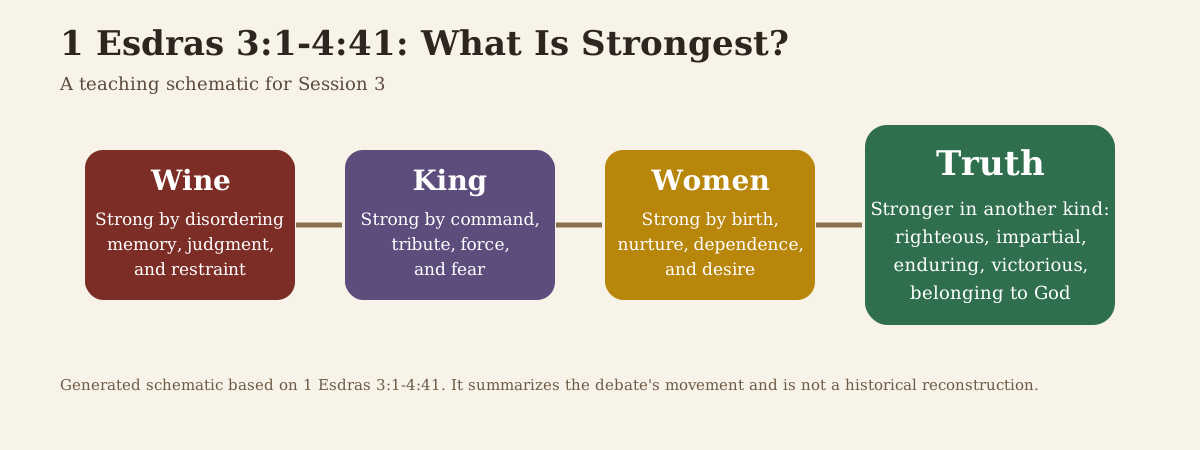
Generated schematic based on 1 Esdras 3:1-4:41. It summarizes the debate movement and is not a historical reconstruction.
The schematic follows the sequence of the speeches and their final acclamation.
1 Esdras is not included in the NKJV. The Scripture below follows the wording and verse numbers of the Brenton edition.
The Feast and the Question of Strength (1 Esdras 3:1-12)
1 Now when Darius reigned, he made a great feast unto all his subjects, and unto all his household, and unto all the princes of Media and Persia, 2 and to all the governors and captains and lieutenants that were under him, from India unto Ethiopia, in the hundred twenty and seven provinces. 3 And when they had eaten and drunken, and being satisfied were gone home, then Darius the king went into his bedchamber, and slept, and soon after awaked.
4 Then three young men, that were of the guard that kept the king’s body, spake one to another; 5 Let every one of us speak a sentence: he that shall overcome, and whose sentence shall seem wiser than the others, unto him shall the king Darius give great gifts, and great things in token of victory: 6 as to be clothed in purple, to drink in gold, and to sleep upon gold, and a chariot with bridles of gold, and an headtire of fine linen, and a chain about his neck: 7 and he shall sit next to Darius because of his wisdom, and shall be called Darius’s cousin.
8 And then every one wrote his sentence, sealed it, and laid it under the pillow of king Darius; 9 and said that, when the king is risen, some will give him the writing; and of whose side the king and the three princes of Persia shall judge that his sentence is the wisest, to him shall the victory be given, as was appointed. 10 The first wrote, Wine is the strongest. 11 The second wrote, The king is strongest. 12 The third wrote, Women are strongest: but above all things Truth beareth away the victory.
The setting is imperial abundance. Darius gathers subjects, household, princes, governors, captains, and lieutenants from India to Ethiopia. Wine, power, rank, and reward surround the scene. Three young guards propose a contest: whoever speaks the wisest sentence will receive royal honor.
The description of 127 provinces from India to Ethiopia recalls Esther 1:1. The shared imperial language places the question of strength inside the world of court favor, danger, and dependence; it does not identify Darius with Esther’s king.
The three claims are simple, but the third already contains the real answer. Wine is strongest. The king is strongest. Women are strongest, but above all things truth bears away the victory. From the beginning, the passage aims beyond the visible powers of the court.
Light from the Word 🕯️
The contest begins under a pillow in the king’s chamber, but it will end with a public cry that truth is mighty. Hidden words become public judgment. In Scripture, truth does not remain private opinion. It comes into the open and judges every other claim to power.
Wine Makes Men Forget and Err (1 Esdras 3:13-24)
13 Now when the king was risen up, they took their writings, and delivered them unto him, and so he read them: 14 and sending forth he called all the princes of Persia and Media, and the governors, and the captains, and the lieutenants, and the chief officers; 15 and sat him down in the royal seat of judgment; and the writing was read before them. 16 And he said, Call the young men, and they shall declare their own sentences. So they were called, and came in. 17 And he said unto them, Declare unto us your mind concerning the writings. Then began the first, who had spoken of the strength of wine;
18 and he said thus, O ye men, how exceeding strong is wine! it causeth all men to err that drink it: 19 it maketh the mind of the king and of the fatherless child to be all one; of the bondman and of the freeman, of the poor man and of the rich: 20 it turneth also every thought into jollity and mirth, so that a man remembereth neither sorrow nor debt: 21 and it maketh every heart rich, so that a man remembereth neither king nor governor; and it maketh to speak all things by talents: 22 and when they are in their cups, they forget their love both to friends and brethren, and a little after draw out swords: 23 but when they are from the wine, they remember not what they have done. 24 O ye men, is not wine the strongest, that enforceth to do thus? And when he had so spoken, he held his peace.
The first speaker argues that wine is strongest because it overcomes distinctions and dissolves restraint. King and orphan, slave and free, poor and rich all become alike under its influence. Wine makes people forget sorrow and debt, forget rulers, forget friends and brethren, and even draw swords.
Scripture can also bless wine: Psalm 104:15 (LXX 103:15) speaks of gladness, and Christ gives wine at Cana (John 2:1-11). Here the speech portrays drunkenness and the loss of judgment. It is a description of domination. Wine appears strong because it can seize the mind, blur memory, and loosen the passions. Its power is not life-giving. It is the false strength of compulsion. The court’s wine makes people forget friends and brethren; the Eucharistic Cup is received in remembrance of Christ (1 Corinthians 11:25), joining sober remembrance to self-giving love.
Light from the Word 🕯️
The speech exposes how easily the human person can be ruled from below. A person may think he is free because he is laughing, spending, speaking boldly, or ignoring burdens. But if his memory, love, and judgment are conquered, he is not free. He is under another power.
For Our Life
The same pattern applies beyond literal wine. Anything that makes us forget God, love, responsibility, repentance, or our brother can become a false king over the heart. The Christian question is not only, What do I enjoy?
It is also, What makes me forget who I am before God?
The King Commands, Yet Remains One Man (1 Esdras 4:1-12)
1 Then the second, that had spoken of the strength of the king, began to say, 2 O ye men, do not men excel in strength, that bear rule over sea and land, and all things in them? 3 But yet the king is more mighty: for he is lord of all these things, and hath dominion over them; and whatsoever he commandeth them they do. 4 If he bid them make war the one against the other, they do it: if he send them out against the enemies, they go, and break down mountains, walls, and towers. 5 They slay and are slain, and transgress not the king’s commandment: if they get the victory, they bring all to the king, as well the spoil, as all things else.
6 Likewise for those that are no soldiers, and have not to do with wars, but use husbandry, when they have reaped again that which they had sown, they bring it to the king, and compel one another to pay tribute unto the king. 7 And yet he is but one man: if he command to kill, they kill; if he command to spare, they spare; 8 if he command to smite, they smite; if he command to make desolate, they make desolate; if he command to build, they build; 9 if he command to cut down, they cut down; if he command to plant, they plant. 10 So all his people and his armies obey him: furthermore he lieth down, he eateth and drinketh, and taketh his rest: 11 and these keep watch round about him, neither may any one depart, and do his own business, neither disobey they him in any thing. 12 O ye men, how should not the king be mightiest, when in such sort he is obeyed? And he held his tongue.
The second speaker argues from command. The king rules over land and sea. Soldiers fight, kill, spare, build, destroy, plant, and cut down at his order. Farmers bring tribute. Armies obey. The king’s power reaches into war, labor, money, life, and death.
Yet the speech also reveals the king’s weakness. He is one man. He eats, drinks, lies down, sleeps, and must be guarded by others. Royal power is real, but it is not ultimate. The king commands many people, but he cannot escape dependence, sleep, mortality, or judgment.
Light from the Word 🕯️
Empire often presents itself as if command were the same as truth. This passage separates them. A king may command building or destruction, life or death, tribute or war, but command alone does not make a thing righteous.
Christological Reading
Christ is King, but not like this. He does not reign by needing guards while others die for His security. He reigns by laying down His own life for the sheep. Earthly kings reveal the limits of command; Christ reveals kingship as truth, sacrifice, and life.
Women, Birth, Nurture, and Human Dependence (1 Esdras 4:13-17)
13 Then the third, who had spoken of women, and of the truth, (this was Zorobabel) began to speak. 14 O ye men, it is not the great king, nor the multitude of men, neither is it wine, that excelleth: who is it then that ruleth them, or hath the lordship over them? are they not women? 15 Women have borne the king and all the people that bear rule by sea and land. 16 Even of them came they: and they nourished them up that planted the vineyards, from whence the wine cometh. 17 These also make garments for men; these bring glory unto men; and without women cannot men be.
Zerubbabel begins the third speech by naming women together with truth. His first argument is not contemptuous. He says kings and rulers are born of women, nourished by women, clothed through women’s labor, and unable to be without women. This rebukes the fantasy of male self-sufficiency.
In the court, men have been boasting about wine and kings. Zerubbabel reminds them that every king, soldier, farmer, and speaker began as a child received, borne, and nourished. Human power is dependent before it is commanding.
Light from the Word 🕯️
‘Without women cannot men be’ answers the court’s fantasy of self-sufficient strength. Birth and nurture precede every command a king can issue. Receiving our lives through others is cause for gratitude; acknowledging it dismantles the pride that pretends to have created itself.
Desire, Apame, and the Humbling of Royal Power (1 Esdras 4:18-32)
18 Yea, and if men have gathered together gold and silver, or any other goodly thing, do they not love a woman which is comely in favour and beauty? 19 And letting all those things go, do they not gape, and even with open mouth fix their eyes fast on her; and have not all men more desire unto her than unto silver or gold, or any goodly thing whatsoever?
20 A man leaveth his own father that brought him up, and his own country, and cleaveth unto his wife. 21 He sticketh not to spend his life with his wife, and remembereth neither father, nor mother, nor country. 22 By this also ye must know that women have dominion over you: do ye not labour and toil, and give and bring all to the woman? 23 Yea, a man taketh his sword, and goeth his way to rob and to steal, to sail upon the sea and upon rivers; 24 and looketh upon a lion, and goeth in the darkness; and when he hath stolen, spoiled, and robbed, he bringeth it to his love. 25 Wherefore a man loveth his wife better than father or mother. 26 Yea, many there be that have run out of their wits for women, and become servants for their sakes. 27 Many also have perished, have erred, and sinned, for women.
28 And now do ye not believe me? is not the king great in his power? do not all regions fear to touch him? 29 Yet did I see him and Apame the king’s concubine, the daughter of the admirable Bartacus, sitting at the right hand of the king, 30 and taking the crown from the king’s head, and setting it upon her own head; she also struck the king with her left hand. 31 And yet for all this the king gaped and gazed upon her with open mouth: if she laughed upon him, he laughed also: but if she took any displeasure at him, the king was fain to flatter, that she might be reconciled to him again. 32 O ye men, how can it be but women should be strong, seeing they do thus?
The speech now moves from dependence to desire. Men leave goods, country, and family for the woman they love. Some spend their lives, lose judgment, and fall into sin. Zerubbabel then points to Apame, the king’s concubine, sitting beside Darius, taking his crown, wearing it, striking him, and receiving his flattery.
The line about leaving father and cleaving to a wife recalls Genesis 2:24, but it is not an exact quotation of the whole verse. Marriage is a good created bond; the speech uses its strength as part of a rhetorical comparison. The later robbery and flattery expose something different: a man surrendering conscience to desire. Apame is the named concubine in the court example, not a universal portrait of women. Verse 27 must therefore never become blame of women for men’s sins. The hearer is called to govern his own passions and to receive women with gratitude and equal human dignity.
Light from the Word 🕯️
This section humbles royal power. The king who commands armies can be mastered by a smile, a frown, and the desire to be pleased. The passage asks whether any human authority is truly free when the heart is enslaved.
Truth Endures and Conquers Forever (1 Esdras 4:33-41)
33 Then the king and the princes looked one upon another: so he began to speak of the truth. 34 O ye men, are not women strong? great is the earth, high is the heaven, swift is the sun in his course, for he compasseth the heavens round about, and fetcheth his course again to his own place in one day. 35 Is he not great that maketh these things? therefore great is the truth, and stronger than all things. 36 All the earth calleth upon the truth, and the heaven blesseth it: all works shake and tremble at it, and with it is no unrighteous thing. 37 Wine is wicked, the king is wicked, women are wicked, all the children of men are wicked; and such are all their wicked works, and there is no truth in them; in their unrighteousness also they shall perish.
38 As for the truth, it endureth, and is always strong; it liveth and conquereth for evermore. 39 With her there is no accepting of persons or rewards: but she doeth the things that are just, and refraineth from all unjust and wicked things; and all men do well like of her works. 40 Neither in her judgment is any unrighteousness; and she is the strength, kingdom, power, and majesty of all ages. Blessed be the God of truth.
41 And with that he held his peace. And all the people then shouted, and said, Great is Truth, and mighty above all things.
Zerubbabel now turns from comparison to confession. The earth is great, heaven is high, the sun is swift, but the Maker of these things is greater. Therefore truth is great and stronger than all things. Truth has no unrighteousness, accepts no bribes, shows no partiality, and endures forever.
Verse 37 is severe: wine, king, women, and all the children of men are wicked when set beside truth. This does not single out women for special condemnation. It gathers every human power and every human work under judgment when they are separated from truth. Wine, kingship, desire, and humanity itself cannot save themselves. Truth alone endures.
Gems from the Fathers 💎
St. Augustine reads this very contest as a possible prophecy of Christ. The victory of truth becomes intelligible in the Gospel: ‘For by consulting the Gospel we learn that Christ is the Truth.’1 The strongest power is thus received as the Lord whose righteousness survives royal judgment and death.
St. Athanasius, defending Dionysius of Alexandria, quotes Dionysius’s distinction between Christ the Truth and the God of truth: ‘Christ is truth: but “Blessed,” saith He, “be the God of truth”’.2 He is answering two errors together. Against Sabellius, who collapses Father and Son into one person, the Father of the Word is distinguished from the Word. Against Arius, who treats the Son as a creature, Athanasius confesses the Son as eternally and indivisibly from the Father. The distinction in verse 40 serves communion within the divine life, not a division between two gods.
St. Cyprian also quotes this passage: ‘Truth endures and grows strong to eternity, and lives and prevails for ever and ever.’3 His setting is the dispute with Stephen of Rome over baptism outside the Church. He appeals to truth against a custom he judges mistaken. That historical controversy is not settled merely by citing the sentence here; its lasting challenge is that habit must answer to Christ’s truth rather than become its own authority.
Christological Reading
When Christians hear truth
, we do not hear an abstraction only. Christ says, I am the way, the truth, and the life.
The court contest does not know the fullness of that revelation yet, but it prepares the reader to confess that truth is not merely useful. Truth is living, righteous, victorious, and divine.
Light from the Word 🕯️
Truth is not strongest because it manipulates more effectively than wine, commands more forcefully than the king, or stirs desire more deeply than beauty. Truth is strongest because it cannot be corrupted into falsehood and still remain truth. It judges every lesser strength.
The Church’s Voice in Worship ⛪
1 Esdras is not read in the Coptic lectionary. John 14:1-11 is appointed at the Liturgy on Saturday and Sunday of the fifth week of the Holy Fifty Days. Christ’s promise of the Father’s house and His revelation as the way, truth, and life give the contest’s acclamation a personal center.4
John 8:31-39, the promise of freedom through abiding in Christ’s word, is read on Tuesday of the third week of Great Lent and Friday of the third week of the Holy Fifty Days. The truth that frees is inseparable from discipleship; it cannot be reduced to winning an argument.5
The Good Friday First Hour order lists John 18:28-40, including Pilate’s question about truth. The contrast is searching: a governor holds public authority yet does not receive the Truth standing before him. Christ goes willingly to His Passion; earthly judgment cannot remove His sovereign saving obedience.6
Christological Types and Prophecies
Zerubbabel’s confession prepares 1 Esdras 4:42-5:6, where truth becomes intercession for Jerusalem. This is important. In Scripture, truth is not sterile correctness. Truth moves toward restoration, worship, and covenant faithfulness.
In Christ, truth is personal and saving. He exposes intoxication, judges false power, purifies desire, and restores humanity to communion with God. The cry Great is Truth
finds its fullness in the Lord who stands before rulers, is condemned by false witnesses, and rises as the faithful and true One.
Spiritual Fruit 🍇
Notice what makes you forget a brother. The wine speech names damaged memory and broken love, not merely excess drink. If entertainment, anger, or the need to win has made you careless toward someone, stop long enough to remember him before God and make one act of repair.
Practice freedom from applause. The king’s commands fill the world, yet he remains one dependent man. When an authority asks you to soften a truth for advantage, answer respectfully without making favor your measure of righteousness. Truth can be spoken without humiliation or aggression.
Bring desire into the light. The king flatters Apame because he needs her approval. Confess the comparable place where attraction, reputation, or praise governs your choices. Receive the people you love as persons to serve, not as instruments of your appetite or proof of your worth.
Hear the court fall silent before the acclamation. The One we confess as Truth will stand before Pilate without surrendering Himself to falsehood. Ask Christ for the courage to remain in His word. Let His impartial judgment begin with your own excuses, and His mercy free you to love.
Teaching Notes
The Feast and the Question of Strength (1 Esdras 3:1-12)
- Ask: Why does the book place this debate inside an imperial feast?
- Emphasize: The third written answer already points to the true climax.
- Watch for: Do not reduce the passage to trivia or a clever contest.
- Connect: Truth prepares the way for restoration in 1 Esdras 4:42-5:6.
- Show: Use the 1 Esdras 3:1-4:41 schematic to preview the movement from wine, king, and women to truth.
Wine Makes Men Forget and Err (1 Esdras 3:13-24)
- Ask: What kind of strength does wine have in this speech?
- Emphasize: False strength often works by making the soul forget.
- Watch for: Keep the application wider than literal wine while still naming drunkenness honestly.
- Connect: Christian sobriety is freedom for love, memory, prayer, and repentance.
- Show: A two-column board works well: what wine promises, and what it makes a person forget.
The King Commands, Yet Remains One Man (1 Esdras 4:1-12)
- Ask: What does the king command, and what does the speech reveal about his limits?
- Emphasize: Command is not the same as truth.
- Watch for: Avoid glorifying empire or state power.
- Connect: Christ’s kingship is shown through truth and self-giving love.
- Show: Contrast royal command words with Christ’s words about serving and laying down His life.
Women, Birth, Nurture, and Human Dependence (1 Esdras 4:13-17)
- Ask: How does this section challenge male self-sufficiency?
- Emphasize: The speech first names birth, nurture, and dependence.
- Watch for: Do not turn the passage into mockery of women.
- Connect: Christian humility begins by admitting that no one is self-made.
- Show: A simple dependency map can help students see how every human life is received.
Desire, Apame, and the Humbling of Royal Power (1 Esdras 4:18-32)
- Ask: Is this passage blaming women, or exposing disordered desire?
- Emphasize: The danger is the heart mastered by desire, vanity, and approval.
- Watch for: Stop any misogynistic or battle-of-the-sexes framing immediately.
- Connect: Christ purifies desire so love can become truthful and holy.
- Show: Compare the king commanding armies with the king flattering Apame. Which power actually rules him?
Truth Endures and Conquers Forever (1 Esdras 4:33-41)
- Ask: Why is truth stronger in kind, not only stronger in degree?
- Emphasize: Truth is righteous, impartial, enduring, victorious, and belongs to God.
- Watch for: Do not treat truth as mere personal sincerity or opinion.
- Connect: Christ is Truth, the Word and Wisdom of the Father.
- Show: Read the Athanasius quote after verse 40 to show how the Church receives the God-of-truth confession Christologically.
Sources
Embedded Scripture is from Brenton’s English Septuagint (LXX). The patristic texts below receive the truth saying directly; they are not extended commentaries on every speech.
Footnotes
-
St. Augustine, City of God, Book 18, chapter 36, About Esdras. ↩
-
St. Athanasius, On the Opinion of Dionysius (De Sententia Dionysii), section 25, quoting Dionysius, NPNF, Second Series, volume 4, text. ↩
-
Coptic Katameros, Liturgy Gospel, Saturday and Sunday of the fifth week of the Holy Fifty Days, John 14:1-11. ↩
-
Coptic Katameros, Liturgy Gospel, Tuesday of the third week of Great Lent and Friday of the third week of the Holy Fifty Days, John 8:31-39. ↩
-
Holy Pascha day-hour order, Good Friday, First Hour, John 18:28-40. ↩