


Genesis 2 slows the pace of creation so the Church can behold the mystery of man in the presence of God. The Lord forms Adam from dust, breathes into him the breath of life, plants Eden as a place of delight, gives a life-guarding commandment, entrusts the garden to human care, and fashions woman from the man’s side. The chapter reveals that human life is breathed gift, obedient freedom, priestly vocation, and covenant communion.
Why this passage matters
This chapter matters because it gives Scripture’s foundational account of embodied human life. Man is not a soul accidentally trapped in matter, nor a merely biological organism. He is dust personally formed by God and made alive by divine breath. Work appears before the fall as vocation rather than punishment. Commandment appears before sin as the shape of freedom rather than the loss of it. Marriage appears before history’s distortions as a gift grounded in shared humanity, wonder, and one-flesh union.
Genesis 2 also matters because the Church reads it Christologically. Eden is more than scenery; it bears the character of a sanctuary. Adam prefigures Christ, and the woman taken from Adam’s side prepares the Church to contemplate the Bride drawn from the pierced side of the true Bridegroom. The chapter therefore stands behind Orthodox teaching on the goodness of the body, the sacredness of marriage, the holiness of obedience, and the restoration of communion in Christ.
Visual teaching aid: human vocation before the fall
This locally generated teaching diagram is meant to help the reader keep the chapter’s spiritual movement in view. It is not decorative clip art. It summarizes the chapter’s main theological sequence: dust, breath, garden, commandment, and one-flesh communion.
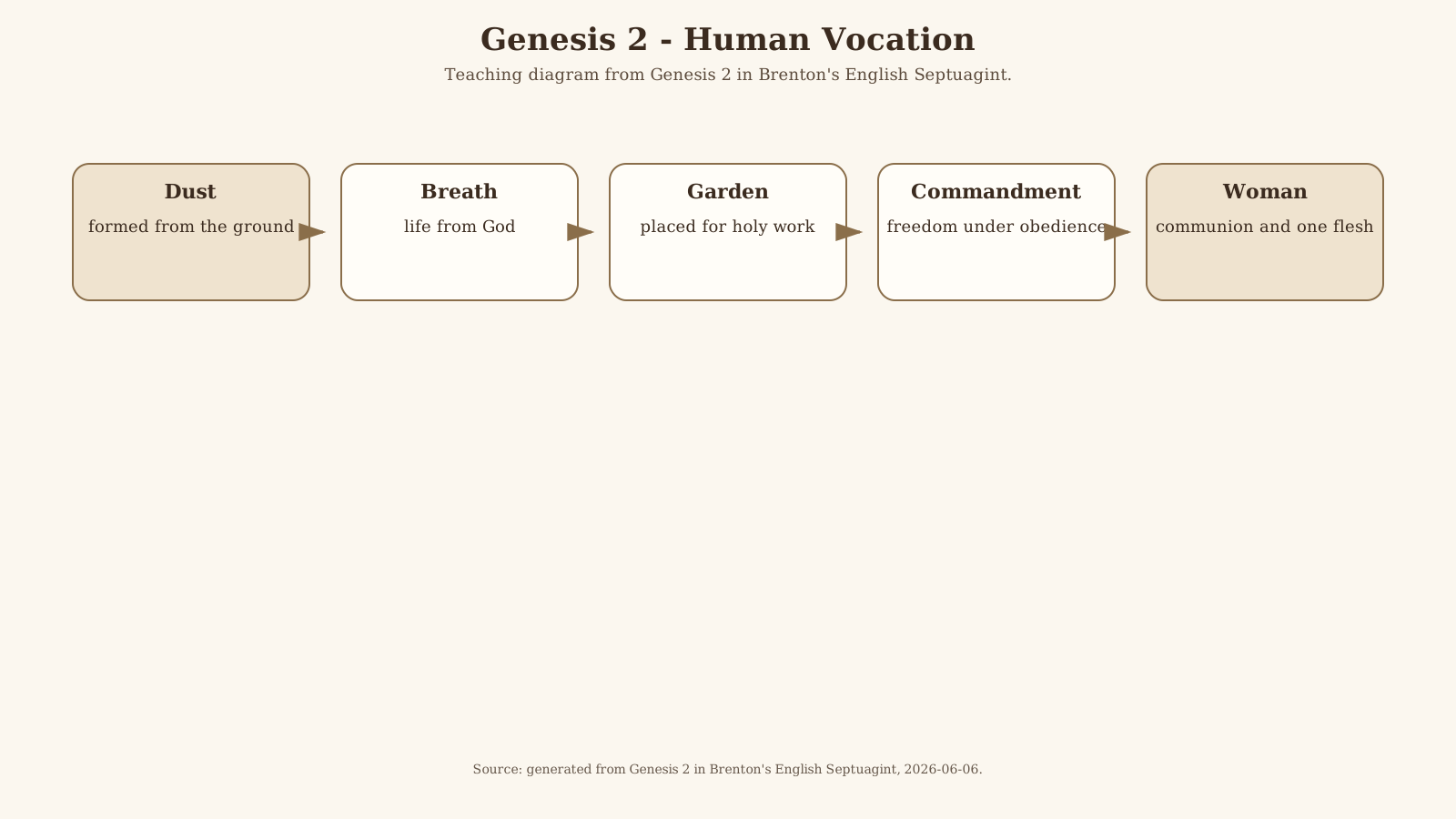 Source: generated for this Genesis audit from Genesis 2 human vocation in Brenton’s English Septuagint, 2026-06-06.
Historical and Scriptural Context
Genesis 2 does not compete with Genesis 1; it deepens it. Genesis 1 gives the cosmic and royal view of creation. Genesis 2 narrows the frame from heavens and earth to garden, commandment, and communion. The question becomes not only, “Who made the world?” but, “What is man before God, and how is human life meant to be lived?”
The imagery of Eden also matters for the rest of Scripture. The garden contains beauty, precious materials, flowing water, a central tree, and a human commission to cultivate and keep. Those features later resonate with sanctuary and temple patterns. Without flattening the chapter into a technical code, the Church has long read Eden as a holy place of divine-human fellowship.
The chapter also places commandment before transgression. That alone is crucial. Obedience is not introduced as a punishment after sin. It belongs to unfallen human flourishing. Orthodox teaching therefore reads Genesis 2 as a foundational text for body and soul together, for freedom through obedience, and for marriage as a creation gift rather than a merely social contract.
The sanctified seventh day crowns creation (Genesis 2:1-3)
1 And the heavens and the earth were finished, and the whole world of them.
2 And God finished on the sixth day his works which he made, and he ceased on the seventh day from all his works which he made. 3 And God blessed the seventh day and sanctified it, because in it he ceased from all his works which God began to do.
Genesis 2 begins with God’s rest. This is not divine exhaustion, but divine completion, blessing, and sanctification. The world is not made for endless production. It is made to dwell in God’s order and peace.
The sanctified day shows that time itself can be made holy. Creation is already oriented toward worshipful communion. Later liturgical rhythms do not invent this truth; they unfold it. The human creature is made not merely to do, but to receive God’s blessed world and dwell in it rightly.
Dust and breath reveal the human mystery (Genesis 2:4-7)
4 This is the book of the generation of heaven and earth, when they were made, in the day in which the Lord God made the heaven and the earth, 5 and every herb of the field before it was on the earth, and all the grass of the field before it sprang up, for God had not rained on the earth, and there was not a man to cultivate it. 6 But there rose a fountain out of the earth, and watered the whole face of the earth. 7 And God formed the man of dust of the earth, and breathed upon his face the breath of life, and the man became a living soul.
The Lord forms man from the dust of the earth and breathes into his face the breath of life. Scripture thereby teaches humility and dignity together. Man is earth-formed, not self-generated. Yet he is also personally enlivened by God’s breath and called to communion with the One who formed him.
This guards Orthodox theology from two opposite errors. The body is not an embarrassment, and the soul is not a detachable essence that makes embodiment irrelevant. The living human being is one creature, receiving life as gift. St. Gregory of Nyssa, in the Church’s larger reflection on human dignity, helps us keep that balance: what is lowly in origin is lifted by divine generosity into a vocation beyond itself. Gregory argues that human nature is more precious than visible creation, not because man is self-made, but because God crowns dust with divine breath.
Eden is a place of abundance and priestly vocation (Genesis 2:8-15)
8 And God planted a garden eastward in Edem, and placed there the man whom he had formed. 9 And God made to spring up also out of the earth every tree beautiful to the eye and good for food, and the tree of life in the midst of the garden, and the tree of learning the knowledge of good and evil. 10 And a river proceeds out of Edem to water the garden, thence it divides itself into four heads. 11 The name of the one, Phisom, this it is which encircles the whole land of Evilat, where there is gold. 12 And the gold of that land is good, there also is carbuncle and emerald. 13 And the name of the second river is Geon, this it is which encircles the whole land of Ethiopia. 14 And the third river is Tigris, this is that which flows forth over against the Assyrians. And the fourth river is Euphrates. 15 And the Lord God took the man whom he had formed, and placed him in the garden of Delight, to cultivate and keep it.
The Lord plants a garden in Eden and places the man there. Trees are both beautiful and nourishing. A river waters the garden and then moves outward. Precious stones are named. The scene is not bare survival. It is abundance ordered toward delight and communion.
Then Adam is placed there “to cultivate and keep it.” Work precedes the curse on the ground in Genesis 3. Cultivation is therefore not a punishment; the later burden of sweat is a wound in an existing vocation. The Hebrew verbs behind this verse can also mean to serve and to guard, language that invites comparison with later sacred service, though the verbal echo alone cannot prove that Eden was a built temple. Adam receives the garden before he can claim any fruit from his labor. Keeping what God has given is a form of gratitude, not ownership.
The commandment teaches freedom through obedience (Genesis 2:16-17)
16 And the Lord God gave a charge to Adam, saying, Of every tree which is in the garden thou mayest freely eat, 17 but of the tree of the knowledge of good and evil—of it ye shall not eat, but in whatsoever day ye eat of it, ye shall surely die.
God gives permission before prohibition: “Of every tree which is in the garden thou mayest freely eat.” The moral world begins with generosity. Only one tree is forbidden. This means the commandment must never be imagined as divine stinginess.
The commandment is the boundary of life, not the sabotage of life. The serpent in the next chapter will reframe God’s generosity as deprivation, but Genesis 2 establishes the truth first. St. John Chrysostom repeatedly reads such divine warnings as medicinal rather than tyrannical. In that spirit, the Church understands Eden’s commandment as the form by which freedom remains rooted in trust, gratitude, and communion with God.
It is not good that the man should be alone (Genesis 2:18-20)
18 And the Lord God said, It is not good that the man should be alone, let us make for him a help suitable to him. 19 And God formed yet farther out of the earth all the wild beasts of the field, and all the birds of the sky, and he brought them to Adam, to see what he would call them, and whatever Adam called any living creature, that was the name of it. 20 And Adam gave names to all the cattle and to all the birds of the sky, and to all the wild beasts of the field, but for Adam there was not found a help like to himself.
This is the first “not good” in Scripture. A creation repeatedly declared good now reaches a point of incompleteness. The problem is not inefficiency, but aloneness. Man cannot fulfill the image of God through isolated dominance.
The naming of the animals highlights both Adam’s authority and his solitude. He can name the creatures, but none of them is his corresponding companion. Humanity is not complete through control of the world alone. It is ordered toward communion.
Woman from the side and the mystery of one flesh (Genesis 2:21-25)
21 And God brought a trance upon Adam, and he slept, and he took one of his ribs, and filled up the flesh instead thereof. 22 And God formed the rib which he took from Adam into a woman, and brought her to Adam. 23 And Adam said, This now is bone of my bones, and flesh of my flesh; she shall be called woman, because she was taken out of her husband. 24 Therefore shall a man leave his father and his mother and shall cleave to his wife, and they two shall be one flesh. 25 And the two were naked, both Adam and his wife, and were not ashamed.
God causes Adam to sleep, takes from his side, forms the woman, and brings her to the man. Adam’s first words over her are not words of rivalry but recognition: “This now is bone of my bones, and flesh of my flesh.” The text protects the full shared humanity of man and woman.
Her formation from his side and Adam’s recognition of his own bone and flesh affirm kinship, dignity, and shared life. The text gives no warrant to treat the woman as a lesser creature or the man as entitled to control her. The one-flesh union calls for fidelity that honors both persons. In his homily on Ephesians 5, Chrysostom likewise stresses the close bond between husband and wife and urges households toward a life of prayer.1 The chapter ends with nakedness without shame: each can be present to the other without fear or concealment. That trust will be broken in the very next chapter.
Eden geography and visual caution
Genesis 2 names real geographical language: a river from Eden, four heads, Phison, Geon, Tigris, and Euphrates. The Tigris and Euphrates are known rivers, but the full Eden geography cannot be mapped with confidence from the text as if it were a modern atlas entry. Phison, Geon, Evilat, and the reference to Ethiopia have been interpreted in several ways across Jewish, Christian, and scholarly traditions.
For that reason this guide intentionally does not embed a speculative Eden map. The spiritual point is stronger and safer: Eden is a holy source-place, watered by God, fruitful before human anxiety, and ordered so that life flows outward. The river imagery prepares later Scripture for temple water, baptismal life, and the river of life in Revelation. Teachers should acknowledge the named geography, but should not turn uncertain identifications into a false certainty.
This also protects the reading of man. Adam is not created as a detached idea in an abstract world. He is formed, breathed into, placed, commanded, and given holy work in a real created setting. Even when the precise map cannot be recovered, the theology is clear: human life begins as embodied communion in a world received from God.
💎 Gems from the Fathers
St. Ephrem the Syrian is one of the Church’s most fruitful guides to Genesis 2 because he reads Paradise with reverence rather than reduction. For him, Eden is rich with holiness, order, symbolism, and divine intimacy. That helps modern readers resist the false choice between wooden literalism and dismissive allegory.
St. Gregory of Nyssa deepens the Church’s reflection on the human person. Genesis 2 is not embarrassed by creatureliness. Dust itself becomes the place where divine breath is received. Orthodox anthropology is therefore neither anti-body nor anti-spiritual; it is unified, reverent, and sacramental in tone. Gregory sees the dignity of man in the deliberate counsel of God: “counsel precedes the making of man,” and Scripture examines beforehand “to what archetype it is fitting that it should bear a likeness, and for what it shall be made, and what its operation shall be when it is made, and of what it shall be the ruler.”2 Man is therefore not an afterthought in creation, but a creature made for image-bearing, vocation, and communion.
St. John Chrysostom, preaching on Ephesians 5 rather than commenting directly on every detail of Genesis 2, draws out what one-flesh kinship asks of a Christian household. His call is not for rank to replace love but for common life ordered toward Christ. “For indeed a house is a little Church,” he says, urging husbands and wives to make the home a place of shared piety.1 This is a thematic application of the Genesis marriage text, not a license to attribute the popular head-and-feet saying to him.
Christological and ecclesial fulfillment
Genesis 2 is one of the Church’s great Bridegroom chapters. Adam prefigures Christ, the true Man. The garden anticipates the communion later restored by the Incarnate Lord. The tree of life, lost to fallen man, is fulfilled in Christ’s victory and in the life-giving mystery of the Cross.
The nuptial pattern is especially profound. As Eve is contemplated from Adam’s side after his deep sleep, so the Church contemplates her own birth from the pierced side of Christ the Bridegroom, from whom blood and water flow. Ephesians 5 therefore does not borrow marriage language as a mere illustration. It reveals the deeper truth toward which Genesis 2 was already pointing: human marriage is honored because it participates analogically in the mystery of Christ and His Church.
Ecclesially, the chapter teaches that human life is fulfilled neither in autonomy nor in appetite, but in communion, obedience, sanctified labor, and covenant love. The Church is where these goods, fractured by sin, begin to be healed.
Coptic Orthodox liturgical and worship connection
Verified local Coptic Pascha placements: Genesis 2:1-3 is read with Genesis 1 on Monday of Holy Pascha, First Hour, and Genesis 2:15-3:24 is read Monday of Holy Pascha, Ninth Hour. That means the Church hears the garden, commandment, communion, and fall as part of the road to the Cross. Eden is not a detached beginning. It is read in the week when the Bridegroom comes to restore what Adam lost.
Spiritual Fruit 🍇
- Begin with received breath. Before the day’s work, pray as someone whose life was given, not manufactured. Dust humbles ambition; God’s breath protects against contempt for the body.
- Hear the permission before the prohibition. When obedience feels like deprivation, remember “of every tree … thou mayest freely eat” (2:16). Give thanks for a concrete gift before facing a difficult boundary.
- Cultivate and keep. Choose one entrusted responsibility, at home, work, or church, and tend it without treating people or creation as possessions. The burden of fallen labor should not erase the goodness of service.
- Honor the person beside you. The man recognizes shared flesh rather than a tool for his solitude. Let that recognition govern how you speak to a spouse, family member, or lonely neighbor; do not use this marriage passage to disparage unmarried people.
Teaching Notes
The sanctified seventh day crowns creation (Genesis 2:1-3)
- Ask: What does God bless when His creative work is complete?
- Emphasize: Holy time is a gift, not a reward for human productivity.
Dust and breath reveal the human mystery (Genesis 2:4-7)
- Ask: What does Genesis 2 add to Genesis 1’s account of human dignity?
- Emphasize: The human person is both formed from dust and made alive by God’s breath, so humility and glory belong together.
- Watch for: Do not treat the body as a prison or Eden as merely decorative scenery.
- Connect: The Church’s sacramental life assumes this union of material creation, divine gift, and priestly vocation.
- Show: Use the human-vocation diagram to hold together dust, breath, garden, commandment, and communion.
Eden is a place of abundance and priestly vocation (Genesis 2:8-15)
- Ask: What is already given before Adam receives his work?
- Emphasize: Cultivation belongs to the good world before the fall; the later sweat is a distortion of work.
- Watch for: The verbal echo with priestly service suggests a fruitful comparison, not proof of a built temple.
The commandment teaches freedom through obedience (Genesis 2:16-17)
- Ask: Why does the commandment appear inside paradise rather than after the fall?
- Emphasize: Obedience is the form of free communion with God, not a rival to freedom.
- Watch for: God permits eating from every tree before naming the one restriction.
- Connect: Obedience in the garden opens the contrast with Christ’s obedience.
It is not good that the man should be alone (Genesis 2:18-20)
- Ask: What can Adam’s naming of the animals not give him?
- Emphasize: The fitting companion is a fellow human, not a subordinate instrument.
Woman from the side and the mystery of one flesh (Genesis 2:21-25)
- Ask: What does Adam recognize in the woman before the text speaks of marriage?
- Emphasize: Shared humanity and trust ground the one-flesh union.
- Watch for: Do not use this passage to justify coercion or to belittle unmarried people.
- Connect: Ephesians 5 reads marriage in the light of Christ and the Church.
Sources
Scripture and apostolic witnesses
Embedded Scripture is from Brenton’s English Septuagint (LXX).
- Public-domain Brenton edition: https://archive.org/details/septuagintversio00bren
- Matthew 19:3-6; John 19:34; Ephesians 5:22-33; Hebrews 4:9-11.
Patristic and Orthodox sources
- St. Ephrem the Syrian, Commentary on Genesis, for Paradise, Eden, and symbolic reading: https://archive.org/details/selectedprosewor0000ephr
- St. Gregory of Nyssa, On the Making of Man, for human dignity and vocation: https://www.newadvent.org/fathers/2914.htm
- St. John Chrysostom, Homilies on Genesis, for pastoral reflection on commandment and vocation: https://www2.iath.virginia.edu/anderson/commentaries/ChrGen.html
- St. John Chrysostom, Homily 20 on Ephesians, for marriage as one-flesh union in Christ: https://www.newadvent.org/fathers/230120.htm
Secondary academic sources
- Gordon J. Wenham, Genesis 1-15.
- Victor P. Hamilton, The Book of Genesis: Chapters 1-17.
- Kenneth A. Mathews, Genesis 1-11:26.
- Claus Westermann, Genesis 1-11.
For the Hebrew verbs in Genesis 2:15 and their possible priestly echo, see Israel Institute of Biblical Studies, “What Was Adam’s Job in Eden?”. The comparison is interpretive, not a claim that the verse explicitly names Adam a priest.
Coptic Orthodox / pastoral sources
- The Orthodox Study Bible, notes on Genesis 2, Matthew 19, and Ephesians 5.
- Fr. Tadros Yacoub Malaty, commentary on Genesis and Paradise.
- Pope Shenouda III on obedience, purity of heart, and the holiness of marriage.
- Fr. Bishoy Kamel on Christian love, vocation, and sanctified family life.
Visual sources
Genesis 2 human vocation diagram, created for this guide from Genesis 2 in Brenton’s English Septuagint. No external visual-source URL exists for this schematic.
Footnotes
-
St. John Chrysostom, Homily 20 on Ephesians, https://www.newadvent.org/fathers/230120.htm. ↩ ↩2
-
St. Gregory of Nyssa, On the Making of Man, chapter 2, https://www.newadvent.org/fathers/2914.htm. ↩