


This narration was recorded before the latest revision. The text on this page is current.
Names are engraved before the garments are worn. Gold becomes thread, stones become memorials, and a plate declares “Holiness to the Lord.” After the calf, the work of human hands is learning to answer God’s command. Yet the chapter does not end with the craftsmen admiring their achievement. The completed work is brought to Moses, examined, and blessed. Sacred beauty must serve people faithfully and remain willing to come into the light.
Context: the command becomes a finished work
Exodus 28 gave the garments’ instruction and purpose. Here Israel makes them. The ephod bears names upon the shoulders; the oracle bears all twelve tribes upon the breast; the blue tunic, linen vestments, and gold plate prepare Aaron and his sons for ministry. The gifts and skill gathered for the sanctuary now become a common work whose fidelity can be recognized.
The closing presentation gathers clothing, furnishings, coverings, and small fittings together. The workers submit the whole to Moses rather than displaying only the parts most likely to win praise. Exodus 40 will carry this distinction further: people can finish the appointed work, but the glory that fills the dwelling comes from God.
The ephod and the names upon the shoulders (Exodus 39:1-7; Greek/Brenton 36:8-14)
A note on numbering. This study follows the NKJV’s chapter and verse numbers, while the Scripture printed is Brenton’s Septuagint. The Greek construction account arranges and abbreviates the material differently: the garments come from Septuagint 36:8-38, followed by the completion, presentation, and blessing in 39:11-23. Its additional surplus notices in 39:12-13 have no direct NKJV counterpart as surplus notices; the presentation list is also shorter and differently arranged, so the dual references indicate corresponding contents, not identical verse divisions. The source numbers remain as printed, and nothing is left out by mistake.1
8: And every wise one among those that wrought made the robes of the holy places, which belong to Aaron the priest, as the Lord commanded Moses. 9: And he made the ephod of gold, and blue, and purple, and spun scarlet, and fine linen twined. 10: And the plates were divided, the threads of gold, so as to interweave with the blue and purple, and with the spun scarlet, and the fine linen twined, they made it a woven work; 11: shoulder-pieces joined from both sides, a work woven by mutual twisting of the parts into one another. 12: They made it of the same material according to the making of it, of gold, and blue, and purple, and spun scarlet, and fine linen twined, as the Lord commanded Moses; 13: and they made the two emerald stones clasped together and set in gold, graven and cut after the cutting of a seal with the names of the children of Israel; 14: and he put them on the shoulder-pieces of the ephod, as stones of memorial of the children of Israel, as the Lord appointed Moses.
The opening statement names the robes belonging to Aaron’s ministry and the Lord’s command to Moses (39:1). The ephod is made from gold, coloured thread, and fine linen (39:2-5). Gold must become thread and be interwoven with the fabric before the costly offering can become useful. Its value alone cannot make the garment. The joined shoulder-pieces likewise require patient, competent hands: someone must make what will be worn strong enough to carry what it is entrusted to bear.
The stones are engraved like seals with Israel’s names and placed on the shoulders as memorial-stones (39:6-7). Brenton calls them emeralds. Here the craftsmen make the remembrance commanded in Exodus 28:12 possible. The labour of the makers and the intercession of the wearer belong to one service. Persons are the reason the stones receive names; sacred beauty should deepen remembrance rather than draw attention away from those being carried before God.
Luke 15:5 gives this image a tender fulfillment: the shepherd who finds the lost sheep places it on his shoulders rejoicing. Aaron bears a memorial; Christ seeks and carries the living person. Hebrews 7:25 declares His continuing intercession for those who come to God through Him. A servant can faithfully remember another person’s name while knowing that the person’s hope rests in the living Lord, whose strength does not fail.2
Isaiah 49:16 gives God’s answer to Zion’s fear of being forgotten: “Behold, I have painted thy walls on my hands, and thou art continually before me.”3 These are Brenton’s words about Zion’s walls, not a quotation of the NKJV’s wording about engraving. The connection with the memorial-stones lies in enduring remembrance. The Lord’s people are before Him when their own confidence in being remembered has grown weak.
The oracle and all twelve names (Exodus 39:8-14; Greek/Brenton 36:15-21)
15: And they made the oracle, a work woven with embroidery, according to the work of the ephod, of gold, and blue, and purple, and spun scarlet, and fine linen twined. 16: They made the oracle square and double, the length of a span, and the breadth of a span, - double. 17: And there was interwoven with it a woven work of four rows of stones, a series of stones, the first row, a sardius and topaz and emerald; 18: and the second row, a carbuncle and sapphire and jasper; 19: and the third row, a ligure and agate and amethyst; 20: and the fourth row a chrysolite and beryl and onyx set round about with gold, and fastened with gold. 21: And the stones were twelve according to the names of the children of Israel, graven according to their names like seals, each according to his own name for the twelve tribes.
The oracle is made in harmony with the ephod and from the same materials (39:8). “Oracle” is Brenton’s name for the breast-worn piece associated with divine judgment in Exodus 28, not an independent prophetic voice speaking out of a jewel. Its square, doubled form has the breadth and length of a span, a hand-based measure (39:9). Shape, scale, and fabric remain answerable to the instruction.
Four rows of stones follow (39:10-13). Their purpose is stated in 39:14: twelve names for twelve tribes, each engraved individually like a seal. Their shared setting preserves their distinction. The community is held together as named people, not melted into an anonymous mass. The text gives no separate Christian doctrine for each mineral, and modern identifications should not displace its stated purpose.
A servant tempted to remember only responsive, agreeable people meets a quiet correction here. The whole twelve must be carried. Intercession makes room for the difficult, unnoticed, and absent person too. The beauty of the object serves a love wider than the maker’s favourites.
Wisdom 18:24 interprets the priest’s garment at the moment when he stands between the dead and living to arrest destruction: “For in the long garment was the whole world, and in the four rows of the stones was the glory of the fathers graven, and thy Majesty upon the diadem of his head.”4 The garment is contemplated through the intercession it serves. Sirach 45:6-22 similarly recalls Aaron’s ornaments, memorial, sacrifice, teaching, and blessing, then ends with the Lord as his portion and inheritance. These passages carry us beyond another catalogue of beautiful objects: glory is entrusted for reconciliation and the care of God’s people, while its minister must receive his own life from God.5
Fastenings that keep the oracle joined (Exodus 39:15-21; Greek/Brenton 36:22-28)
22: And they made on the oracle turned wreaths, wreathen work, of pure gold, 23: and they made two golden circlets and two golden rings. And they put the two golden rings on both the upper corners of the oracle; 24: and they put the golden wreaths on the rings on both sides of the oracle, 25: and the two wreaths into the two couplings. And they put them on the two circlets, and they put them on the shoulders of the ephod opposite each other in front. 26: And they made two golden rings, and put them on the two projections on the top of the oracle, and on the top of the hinder part of the ephod within. 27: And they made two golden rings, and put them on both the shoulders of the ephod under it, in front by the coupling above the connexion of the ephod. 28: And he fastened the oracle by the rings that were on it to the rings of the ephod, which were fastened with a string of blue, joined together with the woven work of the ephod; that the oracle should not be loosed from the ephod, as the Lord commanded Moses.
Pure-gold wreaths, circlets, and rings connect the oracle to the shoulders of the ephod (39:15-18). Other points of attachment are made inside and below (39:19-20). “Wreaths” here describes worked, intertwined gold attachments, not a floral crown upon the head. The details allow the completed oracle to remain in place while the priest serves.
The blue string completes the joining, with an explicit purpose: “that the oracle should not be loosed from the ephod” (39:21). The command serves the stability of the thing made. An attachment can be unseen and still be essential. An impressive oracle held insecurely would fail the intention of its making.
This practical purpose gives the spiritual analogy its force. A record accurately kept, a garment repaired, a promise honoured, or a task clearly passed to the next servant can keep a ministry dependable. Such labour seldom attracts notice. Judge service by whether it holds what has been entrusted, not only by what first catches the eye. This analogy offers no reason to keep a person bound to abuse; truthful care includes correction, repair, and protection.
The blue tunic, pomegranates, and bells (Exodus 39:22-26; Greek/Brenton 36:29-33)
29: And they made the tunic under the ephod, woven work, all of blue. 30: And the opening of the tunic in the midst woven closely together, the opening having a fringe round about, that it might not be rent. 31: And they made on the border of the tunic below pomegranates as of a flowering pomegranate tree, of blue, and purple, and spun scarlet, and fine linen twined. 32: And they made golden bells, and put the bells on the border of the tunic round about between the pomegranates: 33: a golden bell and a pomegranate on the border of the tunic round about, for the ministration, as the Lord commanded Moses.
The tunic under the ephod is woven all of blue (39:22). Its opening is closely woven and reinforced against tearing (39:23). Beauty is made to endure the actual conditions of ministry. The maker considers how the garment will be worn, not merely how it will look when displayed.
The lower border bears pomegranate forms in coloured thread and fine linen; gold bells are placed between them around the hem (39:24-26). The reading gives their purpose as “for the ministration.” Exodus 28:35 had explained Aaron’s audible entry and departure before the Lord. Here that instruction receives its physical form. The bells belong to obedient approach in the service God appoints, without inviting magical claims or conjectured rituals.
Gems from the Fathers: the garments and Eucharistic awe
St. John Chrysostom, On the Priesthood III.4, expressly recalls “the bells, the pomegranates, the stones on the breastplate and on the ephod, the girdle, the mitre, the long robe, the plate of gold”. He turns from these earlier signs of awe toward the greater gift of the Eucharist: “For the priestly office is indeed discharged on earth, but it ranks among heavenly ordinances”.6 His reason is the institution of ministry by the Holy Spirit and the gift of the Lord Himself, not the social prestige of the wearer. The garments train reverence; Christ gives the reality toward which reverence reaches.
This is a Christian contemplation of the vestments, not a verse-by-verse commentary on their manufacture. Chrysostom’s awe calls the minister to purity and the congregation to prayer. It cannot make a wearer morally untouchable. Holy office imposes responsibility before God and grants no exemption from accountability for harm.
Linen vestments, head coverings, and girdles (Exodus 39:27-29; Greek/Brenton 36:34-36)
34: And they made vestments of fine linen, a woven work, for Aaron and his sons, 35: and the tires of fine linen, and the mitre of fine linen, and the drawers of fine linen twined; 36: and their girdles of fine linen, and blue, and purple, and scarlet spun, the work of an embroiderer, according as the Lord commanded Moses.
Aaron and his sons receive woven linen vestments, head coverings, linen drawers, and embroidered girdles. “Tires” and “mitre” are Brenton’s terms for the head coverings; “drawers” names linen undergarments. These are provisions for bodies doing sacred work, not a vague collection of religious accessories.
Exodus 28:40-43 explained honour, consecration, and the covering of nakedness. The accomplished work serves those purposes. Modesty receives the body within reverent order. It should never become contempt for the body, shame imposed on vulnerable people, or blame directed at someone who has been harmed. Fine linen and embroidery require careful hands even where few people will see the work.
Galatians 3:27 gives the Christian horizon: those baptized into Christ have put on Christ. Sacred clothing serves worship, while the baptized person is called to conduct consistent with that belonging. Correct apparel cannot substitute for truthfulness, mercy, or repentance. Hebrews 7:11-19 also teaches a change of priesthood and locates Christ’s priesthood in the order of Melchizedek. Coptic vestments therefore belong within fulfillment in Christ; they are not replicas of Aaron’s entire outfit.
The Church’s Voice in Worship: clothing received in prayer
The Coptic preparation rite places vesting within the psalms. Psalm 30 (LXX 29) begins “I will extol You, O Lord, for You have lifted me up”; Psalm 93 (LXX 92) begins “The Lord reigns, He is clothed with majesty.”7 Thanksgiving for rescue and acknowledgment of God’s kingship accompany the clothing. These prayers, also discussed with Exodus 28, direct the wearer toward the mercy that permits him to serve and the majesty that belongs to the Lord.
The gold plate and holiness upon the mitre (Exodus 39:30-31; Greek/Brenton 36:37-38)
37: And they made the golden plate, a dedicated thing of the sanctuary, of pure gold; and he wrote upon it graven letters as of a seal, Holiness to the Lord. 38: And they put it on the border of blue, so that it should be on the mitre above, as the Lord commanded Moses.
The pure-gold plate is a dedicated thing of the sanctuary, engraved like a seal with “Holiness to the Lord” (39:30). It is attached with blue upon the mitre (39:31). The forehead receives a declaration of belonging. Holiness is directed toward the Lord, not claimed as the personal achievement of the wearer.
Translation insight: “Holiness of the Lord” and “Holiness to the Lord”
Brenton’s instruction in Exodus 28:36 reads “Holiness of the Lord”; the making recorded here reads “Holiness to the Lord.”8 Both renderings remain as printed. The first draws attention to holiness belonging to Him; the second makes dedication to Him explicit. The English difference should not be inflated into rival doctrines of priesthood.
Exodus 28:38 had given the plate a sobering purpose: Aaron would bear away the sins of Israel’s holy things. Even gifts brought for holy use require mediation. This chapter faithfully makes the object; it does not announce that maker or wearer has become incapable of sin. Aaron’s part in the calf makes that distinction particularly necessary. Mercy restores a people to ordered service while keeping their need for cleansing before them.
Hebrews 7:26-27 names Christ as the holy and undefiled High Priest who offers Himself once for all. We approach God through the Lord whose holiness is complete, bringing the mixture in our own motives into repentance. The plate declares the Lord’s claim upon service. It must never conceal wrongdoing beneath a sacred title.
Visual reference
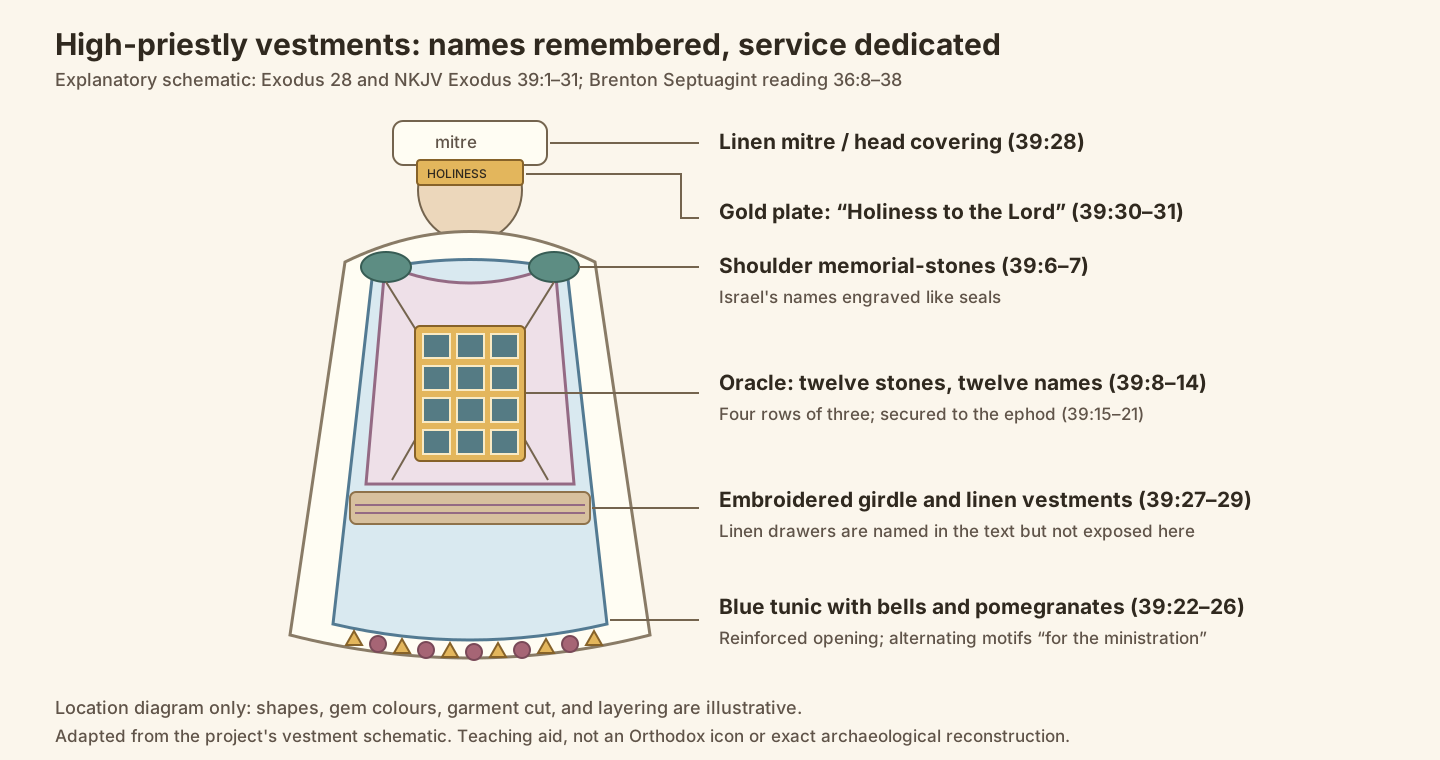
Source: Copied and adapted project-created vestment schematic, based on Exodus 28 and the garment-making account now read under Exodus 39. Explanatory aid, not an Orthodox icon or an exact reconstruction of ancient costume.
The diagram distinguishes the mitre from its plate and the shoulder memorial-stones from the twelve stones of the oracle. Its shapes locate the named objects without claiming an exact ancient cut, gem appearance, or wearing arrangement.
The work answers the command (Exodus 39:32; Greek/Brenton 39:11)
11: And the children of Israel did as the Lord commanded Moses, so did they.
The brief completion statement supplies the measure for everything that has been made: “as the Lord commanded Moses, so did they.” Willingness has endured through patient work. After the calf, human making is again placed under God’s word. The restored people can serve without pretending that their former failure never happened.
Completion now leads toward presentation rather than possession. What was received for the Lord’s service is ready to be entrusted beyond its makers. Faithful service learns to finish a task and allow it to be examined, used, and cared for by others.
After Exodus 39:32: what remains still belongs to the offering (Septuagint addition 39:12-13; no exact NKJV counterpart)
Septuagint addition: These two surplus notices have no direct NKJV counterpart as surplus notices; the textile and ministry-garment themes also occur in NKJV Exodus 39:1 and 39:41.1
12: And of the gold that remained of the offering they made vessels to minister with before the Lord. 13: And the blue that was left, and the purple, and the scarlet they made into garments of ministry for Aaron, so that he should minister with them in the sanctuary;
Remaining gold becomes vessels for ministry before the Lord; leftover blue, purple, and scarlet become garments for Aaron’s sanctuary service. These notices concern the continued dedication of surplus materials, not a second detailed making of the ephod and oracle. The largest task may be finished, but the remaining gift retains its purpose.
John 6:12 gives a fitting Christian parallel: after the multitude has eaten, Christ commands the fragments to be gathered so that nothing is lost.9 Abundance does not cancel care. The Lord who feeds freely also teaches His disciples to protect the remainder. An unused donation, spare material, or the unspent part of a collected fund should remain answerable to the purpose for which it was offered, with honest permission for any change of use.
The whole work comes before Moses (Exodus 39:33-41; Greek/Brenton 39:14, 21, 15, 18, 16-17, 20, 19)
14: and they brought the garments to Moses, and the tabernacle, and its furniture, its bases and its bars and the posts; 21: and all the vessels of the tabernacle and all its instruments: and the skins, even rams’ skins dyed red, and the blue coverings, and the coverings of the other things, and the pins, and all the instruments for the works of the tabernacle of witness. 15: and the ark of the covenant, and its bearers, and the altar and all its furniture. 18: and the table of shewbread, and all its furniture, and the shewbread upon it, 16: And they made the anointing oil, and the incense of composition, and the pure candlestick, 17: and its lamps, lamps for burning, and oil for the light, 20: and the curtains of the court, and the posts, and the veil of the door of the tabernacle, and the gate of the court, 19: and the garments of the sanctuary which belong to Aaron, and the garments of his sons, for the priestly ministry;
The whole source verses are gathered in NKJV inventory order by their primary subject: the tent and its equipment, coverings, ark, table, lamp and oil, court, and priestly garments. Brenton combines several subjects within individual verses, so a garment or altar can also occur alongside an earlier item. The sentences retain their internal wording and order; the dual references disclose this composite correspondence rather than promising an exact verse-by-verse match. The presentation keeps together what our attention might divide into impressive objects and ordinary necessities.
“And they made” occurs within the gathering of completed equipment. It need not be forced into a claim that oil and lampstand were first manufactured only after everything already listed. The passage brings the finished work into view. Each item serves a distinct task; none is detached from the worship for which the Lord ordered the dwelling.
The repeated “all” matters. Moses receives the whole rather than a selection of what will attract praise. Accountability becomes relational as well as material: gifts came from real people, whose trust must be honoured. Someone else’s labour should be explained as truthfully as someone else’s money. Bringing the work into the light protects the offering and allows its makers to receive a blessing instead of living indefinitely under suspicion.
Work examined, obedience recognized, people blessed (Exodus 39:42-43; Greek/Brenton 39:22-23)
22: Whatsoever things the Lord appointed Moses, so did the children of Israel make all the furniture. 23: And Moses saw all the works; and they had done them all as the Lord commanded Moses, so had they made them; and Moses blessed them.
The conclusion returns to the Lord’s appointment, then adds Moses’ sight: “Moses saw all the works.” He recognizes that the people have made them as commanded, and “Moses blessed them” (39:43). Examination and blessing belong together. The standard is received from God, and the people receive the blessing. Moses neither praises his own leadership nor turns the work into a monument to the craftsmen’s importance.
Genesis 1:31 says that God saw all He had made and that it was very good; Genesis 2:1-3 joins completed creation to God’s blessing and sanctification of the seventh day.10 Seeing, completion, and blessing give the sanctuary’s ending a creation-like cadence. The dwelling is a place where a redeemed people learn again to live under their Maker. Moses is not another Creator, but his recognition of obedient work belongs within this restoration of ordered life before God.
The craftsmen receive an examination and blessing from outside their own judgment. That is the sound lesson of accountability here. It would be false to turn the episode into an absolute rule that nobody can bless anything he has done: Genesis itself shows God blessing His creation. Nor is Moses’ blessing payment that purchases divine favour. Matthew 25:21 carries the hope toward the Master’s welcome of His faithful servant and participation in His joy.11 Service can end in thanksgiving, without the worker needing to keep proving his worth.
Paul calls ministers servants of Christ and stewards of God’s mysteries in 1 Corinthians 4:1-2. The required quality is faithfulness. Oversight should protect the entrusted work and the people served; where fidelity is found, it should be able to thank and bless. Inspection becomes harmful when it is used to keep a person anxious or dependent upon approval.
The Church’s Voice in Worship: completion at the threshold of consecration
Coptic Reader appoints Exodus 39:43-40:33 for church consecration, Part 2, and Exodus 39:43-40:38 for consecration of the Holy Myron, the consecrated chrism.12 Both readings begin with the inspection and blessing at NKJV Exodus 39:43, printed above as Septuagint 39:23. They do not appoint the whole garment-making passage. At this threshold, the Church hears completed work brought under God’s blessing: gifts and labour are real, while the holiness for which they are offered comes from Him.
Spiritual Fruit
Carry a name, not a category. Pray for someone your service easily reduces to “a difficult family,” “a weak student,” or “an absent member.” The memorial-stones are engraved individually. Let the person’s name restore the patience and care that a label can remove, and entrust him to Christ who carries the lost sheep with joy.
Make one hidden support dependable. The oracle’s fastenings matter because something entrusted must remain secure. Keep an overlooked promise, correct a record on which another person relies, or repair a fault that admiration would allow you to conceal. Love can be present in the attachment nobody praises.
Release the secret claim upon the gift. The remaining gold and cloth still serve the Lord. If a completed task has left you possessive of its supplies, reputation, or people, make the account clear and let the work pass into other hands. Gratitude can receive the good as God’s gift without making it your private territory.
Receive correction and offer truthful blessing. A fair examination need not be a verdict upon your whole worth. Accept what needs repair without reflexively defending yourself. If you oversee others, recognize particular faithfulness and thank them; do not keep them under permanent review to preserve your influence.
The stones carry names, the fastenings hold, and the plate directs the service toward the Lord. The completed work comes into Moses’ sight, and the people receive his blessing. Stand there without concealing what needs correction or demanding praise for what was given. Ask Christ to make your service truthful enough to be examined and free enough to rejoice when another person’s labour is blessed.
Teaching Notes
Discuss: The ephod and the names upon the shoulders (Exodus 39:1-7; Greek/Brenton 36:8-14)
- Ask: How do the engraved names direct the costly workmanship toward people?
- Emphasize: The memorial-stones serve remembrance before God; gold thread requires patient transformation.
- Watch for: Brenton says emeralds; preserve the printed wording rather than silently substituting another gem name.
- Connect: Luke 15:5, Isaiah 49:16, and Hebrews 7:25 illuminate being carried, remembered, and interceded for.
Discuss: The oracle and all twelve names (Exodus 39:8-14; Greek/Brenton 36:15-21)
- Ask: Whom does our intercession leave out when it remembers only agreeable people?
- Emphasize: The shared setting holds twelve distinct names together.
- Watch for: Avoid invented doctrines for individual stones and conjectured mechanisms of divination.
- Connect: Wisdom 18:24 and Sirach 45:6-22 contemplate garments through intercession, reconciliation, teaching, and dependence on the Lord.
Discuss: Fastenings that keep the oracle joined (Exodus 39:15-21; Greek/Brenton 36:22-28)
- Ask: Which hidden support makes our shared service dependable?
- Emphasize: The reading itself gives the fastening’s purpose: the oracle must not come loose.
- Watch for: The analogy of joining cannot be used to bind someone to abuse.
- Connect: Repair, accurate records, kept promises, and faithful handovers make entrusted care reliable.
Discuss: The blue tunic, pomegranates, and bells (Exodus 39:22-26; Greek/Brenton 36:29-33)
- Ask: Why do reinforced fabric and the sound of ministry belong to one garment?
- Emphasize: The opening resists tearing; bells and pomegranates are made for the appointed ministration.
- Watch for: No magical claims about bells or moral immunity for their wearer.
- Connect: Chrysostom, On the Priesthood III.4, carries the garments’ awe toward Eucharistic ministry and purity.
Discuss: Linen vestments, head coverings, and girdles (Exodus 39:27-29; Greek/Brenton 36:34-36)
- Ask: How can clothing serve reverence while keeping the Lord, rather than the wearer, central?
- Emphasize: Bodily care and skilled work extend to the less conspicuous garments.
- Watch for: Avoid body-shaming and the claim that Christian vestments exactly reproduce Aaron’s clothing.
- Connect: Galatians 3:27; Hebrews 7:11-19; Psalm 30 (LXX 29) and Psalm 93 (LXX 92) in Coptic vesting.
Discuss: The gold plate and holiness upon the mitre (Exodus 39:30-31; Greek/Brenton 36:37-38)
- Ask: What mixture in our motives needs cleansing when our work is offered to the Lord?
- Emphasize: Preserve “Holiness to the Lord” here and “Holiness of the Lord” in the instruction at 28:36.
- Watch for: The inscription confesses dedication; it does not certify sinlessness or excuse concealed harm.
- Connect: Exodus 28:38 and Hebrews 7:26-27 distinguish Aaron’s mediation from Christ’s complete holiness.
Discuss: The work answers the command (Exodus 39:32; Greek/Brenton 39:11)
- Ask: How does this completion answer the misuse of human making at the golden calf?
- Emphasize: God’s received command measures the accomplished work.
- Watch for: Faithful service is not a means of pretending the former failure never happened.
- Connect: Repentance can receive renewed work without possessing its fruit.
Discuss: After Exodus 39:32: what remains still belongs to the offering (Septuagint addition 39:12-13; no exact NKJV counterpart)
- Ask: What happens to a gift’s purpose when the largest task is finished?
- Emphasize: Surplus gold and textiles remain dedicated to service.
- Watch for: The surplus notices are additional Greek material, not exact NKJV counterparts or a second full garment-making account.
- Connect: John 6:12 joins abundant provision to care that nothing be lost.
Discuss: The whole work comes before Moses (Exodus 39:33-41; Greek/Brenton 39:14, 21, 15, 18, 16-17, 20, 19)
- Ask: Why bring the ordinary fittings alongside the most impressive objects?
- Emphasize: The whole work is presented; gifts, materials, and other people’s labour remain entrusted goods.
- Watch for: The dual ranges identify corresponding inventories, not exact item-by-item order or fresh manufacture chronology.
- Connect: An honest account honours the real persons whose gifts and work made the service possible.
Discuss: Work examined, obedience recognized, people blessed (Exodus 39:42-43; Greek/Brenton 39:22-23)
- Ask: How can examination protect the work while freeing the worker to receive a blessing?
- Emphasize: Moses sees all the works and blesses the people after recognizing obedience.
- Watch for: God blesses His own creation; do not invent an absolute prohibition on blessing one’s work.
- Connect: Genesis 1:31; 2:1-3; Matthew 25:21; both consecration readings start at NKJV 39:43, Septuagint 39:23.
Where to linger: Give particular attention to the engraved names (39:6-14), the fastening’s stated purpose (39:21), the plate (39:30-31), and the sight and blessing of Moses (39:43). The surplus section is additional Septuagint material, not invented NKJV verses.
Show: Distinguish the shoulder-stones from the oracle, and the linen mitre from the gold plate. Explain that the copied diagram is a schematic, not an exact ancient costume. The asset’s retained filename does not determine the study’s numbering.
Lectionary precision: Both special-service readings begin at NKJV 39:43, Septuagint 39:23. Neither appoints the whole chapter’s vestments. The church completion reading ends at 40:33; the Holy Myron consecration reading continues to 40:38. These are special-service appointments rather than calendar-feast assignments.
Pastoral safeguards: Do not turn priestly awe into immunity from scrutiny, attachment into submission to abuse, or blessing into reward for compulsive overwork. God blesses His own creation; the craftsmen here receive an external examination and blessing.
Sources
Embedded Scripture is from Brenton’s English Septuagint (LXX). Chapter boundaries, commentary order, and ordinary Exodus references follow NKJV numbering; each reading gives its Septuagint source coordinates and retains that source’s verse numbers. New Testament connections use NKJV. Chrysostom is a primary thematic witness rather than direct commentary on the making of the garments.
Footnotes
-
Brenton, Exodus 36:8-38 and Exodus 39:11-23, compared by contents with NKJV Exodus 39. Brenton’s adopted chapter 36 ends at 38; some other Greek verse divisions extend to 40. The surplus notices in Septuagint 39:12-13 are preserved without an invented exact counterpart. ↩ ↩2
-
Brenton, Isaiah 49:15-16; verse 16 names Zion’s walls. ↩
-
Brenton, Wisdom 18:20-25, the priest’s intercession in the plague, especially verse 24. ↩
-
Brenton, Sirach 45:6-22, especially memorial, reconciliation, teaching, and the Lord as inheritance. ↩
-
St. John Chrysostom, On the Priesthood, III.4, trans. W. R. W. Stephens, NPNF, First Series, vol. 9. His recollection of Mosaic garments leads into contemplation of Eucharistic ministry. ↩
-
The Coptic Orthodox Liturgies of Saints Basil, Gregory, Coptic Orthodox Church in Denmark, preparation and vesting, pp. 38-39: Psalm 30 (LXX 29) and Psalm 93 (LXX 92); rite book. ↩
-
Brenton, Exodus 28:36 and Exodus 36:37, the latter carrying NKJV Exodus 39:30’s subject. ↩
-
John 6:12. A thematic connection with care for the remainder, not an assertion that the two events are identical. ↩
-
Brenton, Genesis 1:31 and Genesis 2:1-3. ↩
-
Coptic Reader, Coptic Orthodox Metropolis of the Southern United States, official app. Menu paths: Special > Consecrations > Church > Part 2, Exodus 39:43-40:33; Special > Consecrations > Oil > Myron > Consecration, Exodus 39:43-40:38. Both start with the blessing, Septuagint 39:23. The app link opens the app; follow the named menu to the service. ↩