


This narration was recorded before the latest revision. The text on this page is current.
Exodus 32 brings the gifts of Sinai beside the betrayal at its foot. Moses carries tablets written by God; Aaron has made a calf from the people’s gold (32:4, 15-16). The people still speak of deliverance and a feast of the Lord, but they have attached those words to an idol (32:4-6). The chapter follows that corruption through shattered tablets, exposed excuses, terrible judgment, and prayer for forgiveness. Its final hope rests with the God to whom Moses returns, even after the camp has fallen (32:30-35).
Historical and Scriptural Context
Israel has heard the prohibition of other gods and graven images, and has pledged obedience to the covenant (Exodus 20:3-6; 24:3-8). Moses has entered the mountain to receive the sanctuary’s pattern and the tablets of testimony (24:12-18; 25:1-9; 31:18). The demand in 32:1 therefore comes from a redeemed people who already possess God’s word. Their anxiety over Moses’ delay becomes an excuse to abandon it.
On the mountain, God commands Aaron’s vesting and consecration for the priesthood (Exodus 28:1-4; 29:4-9); below, Aaron makes the calf and proclaims its feast (32:4-5). These are instructions being given to Moses, not vesting rites being performed on Aaron at the same time. The contrast is between the service God intends and the betrayal Aaron commits. Deuteronomy 9:20 later says that Moses prayed specifically for Aaron. The priesthood is entrusted to a man who himself needs mercy; his calling neither excuses his sin nor makes repentance unnecessary.
A feast of the Lord before a manufactured god (Exodus 32:1-6; Greek/Brenton 32:1-6)
A note on numbering. This study follows NKJV chapter and verse numbering and prints Brenton’s English Septuagint with its own verse labels. The separate sentence in NKJV 32:9, declaring the people stiff-necked, is absent from Brenton’s reading, which passes from verse 8 to verse 10; no verse from another translation is supplied.
1: And when the people saw that Moses delayed to come down from the mountain, the people combined against Aaron, and said to him, Arise and make us gods who shall go before us; for this Moses, the man who brought us forth out of the land of Egypt - we do not know what is become of him. 2: And Aaron says to them, Take off the golden ear-rings which are in the ears of your wives and daughters, and bring them to me. 3: And all the people took off the golden ear-rings that were in their ears, and brought them to Aaron. 4: And he received them at their hands, and formed them with a graving tool; and he made them a molten calf, and said, These are thy gods, O Israel, which have brought thee up out of the land of Egypt. 5: And Aaron having seen it built an altar before it, and Aaron made proclamation saying, To-morrow is a feast of the Lord. 6: And having risen early on the morrow, he offered whole burnt-offerings, and offered a peace-offering; and the people sat down to eat and drink, and rose up to play.
The people begin with what they cannot see: what has become of Moses? They answer the uncertainty by demanding gods who will go before them (32:1). The Lord who led them out of Egypt has not become the calf. Aaron receives their earrings, works the gold, and makes the object himself (32:2-4). The claim of deliverance is then transferred to the thing they have made. The idol’s attraction lies partly in this reversal: the people can possess and fashion what they now ask to lead them.
Gold itself is not the evil. God also commands gold for the sanctuary (Exodus 25:3, 11), but here it is fashioned into a rival object of worship (32:4). Nor does religious vocabulary make the act faithful. Aaron builds an altar and announces a feast of the Lord while the calf stands before it (32:5). The sacrifices, eating, drinking, and play of verse 6 become the outward life of a community whose allegiance has shifted. A holy name can be spoken over an unholy decision.
Acts 7:39-41 identifies the inward return beneath this outward act: Israel turned back to Egypt in the heart and rejoiced in the work of its own hands. That apostolic explanation belongs before any speculation about a particular Egyptian cult behind the calf. Exodus 32 does not name such a cult. The spiritual slavery it exposes is sufficiently clear: receiving freedom from God, then surrendering one’s trust to a product of human hands (32:1, 4).
St. Paul quotes verse 6 in 1 Corinthians 10:7 and addresses the warning to Christians. He has already recalled that Israel was baptized into Moses in the cloud and sea and received spiritual food and drink (1 Corinthians 10:1-4). Those gifts did not make subsequent idolatry harmless. His conclusion is watchfulness and flight from idolatry, not contempt for Israel (1 Corinthians 10:11-14). Baptism, Communion, and parish service call for a life consistent with the grace received. They cannot be used as evidence that the heart no longer needs examination.
The confession in Psalm 106:19-23 (LXX 105:19-23) gives the calf’s exchange its full shame: the people forgot their Savior and exchanged their glory for the likeness of an animal that eats grass. Romans 1:23 describes the same exchange of divine glory for created likenesses. The language of Exodus 32:4 will return in Jeroboam’s golden calves, 1 Kings 12:28-30 (Septuagint 3 Kingdoms 12:28-30), where political convenience again borrows the memory of deliverance. Gratitude must remember the giver truthfully, or it becomes a story we use to justify what we want.
Gems from the Fathers: The Incarnation and the honor of images
Exodus 32:4-5 condemns making and worshiping an idol; it does not teach that created matter is inherently unholy. Deuteronomy 4:15-16 grounds its warning in the fact that Israel saw no divine form at Choreb. John 1:14-18 announces the decisive gift: the Word becomes flesh and the Son reveals the Father. Colossians 1:15 calls Christ the image of the invisible God; the following verse names Him as Creator, not one more creature competing with God. A painted icon is neither the divine nature nor a second incarnation. It bears witness to the incarnate Lord and leads honor toward the person represented.
St. John of Damascus makes this distinction in his First Apology against Those Who Decry Holy Images, section 16. He writes of God seen clothed in flesh and conversing with men: “I make an image of the God whom I see.”1 In the same paragraph he qualifies the honor given to matter: “I venerate it, though not as God.”1 John is defending the Church’s images by the reality of the Incarnation, not defending Israel’s calf. In sections 5-8 and 14-16 he distinguishes adoration owed to God from reverence offered in His service. The calf receives a false claim to have delivered Israel (32:4); an icon confesses the Savior who truly took flesh. This distinction also preserves the moral warning: an Orthodox Christian can honor an icon rightly while still enthroning money, praise, or control in the heart.
“Thy people”: judgment and the opening for prayer (Exodus 32:7-14; Greek/Brenton 32:7-14)
7: And the Lord spoke to Moses, saying, Go quickly, descend hence, for thy people whom thou broughtest out of the land of Egypt have transgressed; 8: they have quickly gone out of the way which thou commandedst; they have made for themselves a calf, and worshipped it, and sacrificed to it, and said, These are thy gods, O Israel, who brought thee up out of the land of Egypt. 10: And now let me alone, and I will be very angry with them and consume them, and I will make thee a great nation. 11: And Moses prayed before the Lord God, and said, Wherefore, O Lord, art thou very angry with thy people, whom thou broughtest out of the land of Egypt with great strength, and with thy high arm? 12: Take heed lest at any time the Egyptians speak, saying, With evil intent he brought them out to slay them in the mountains, and to consume them from off the earth; cease from thy wrathful anger, and be merciful to the sin of thy people, 13: remembering Abraam and Isaac and Jacob thy servants, to whom thou hast sworn by thyself, and hast spoken to them, saying, I will greatly multiply your seed as the stars of heaven for multitude, and all this land which thou spokest of to give to them, so that they shall possess it for ever. 14: And the Lord was prevailed upon to preserve his people.
God’s words expose how quickly the people have departed from His command (32:7-8). He calls them Moses’ people, whom Moses brought out of Egypt (32:7). Moses answers by calling them God’s people, whom God delivered with great strength (32:11). His prayer returns the history of salvation to its true author. He neither accepts the calf’s claim nor detaches himself from the guilty people.
“Let me alone” in verse 10 leaves an opening for intercession. God has disclosed the sin and judgment to the very servant who will pray; Moses responds by pleading rather than accepting a future built upon the people’s destruction (32:10-11). His appeal concerns God’s name before Egypt and the oath to Abraam, Isaac, and Jacob (32:12-13). He asks for mercy on the basis of what God has already promised. Prayer here is participation in God’s covenant care, not a technique for overcoming a reluctant deity.
Brenton’s verse 14 says, “And the Lord was prevailed upon to preserve his people.” The deliverance is real, and so is Moses’ prayer. The language describes God’s merciful dealing with the people in their history; it does not mean that His nature changed or that Moses taught Him to be compassionate. Numbers 23:19 affirms God’s faithfulness to His word; James 1:17 excludes variation in the Father; Ezekiel 33:11 reveals His desire that the sinner turn and live. Read together, these witnesses keep both the force of intercession and the constancy of divine goodness. The threatened destruction of the whole people does not occur, yet the chapter will still record judgment (32:28, 35).
Psalm 106:23 (LXX 105:23) remembers Moses standing in the breach. That image interprets the prayer of verses 11-13 as love that remains with endangered people. It must not become the fantasy of a merciful Moses shielding Israel from a less merciful God. Moses appeals to God’s own promise, and the Lord preserves His people (32:13-14). When we pray for someone whose sin has injured us, we are asking the Lord to bring His saving purpose into that person’s life, not asking Him to approve the injury.
The Church’s Voice in Worship: “Thy people”: judgment and the opening for prayer
The Sixth Hour of Monday of Holy Pascha appoints Exodus 32:7-15. The Church hears the people’s betrayal, Moses’ appeal, and God’s preservation as she enters the week of Christ’s saving Passion.2 The reading ends with Moses descending with the tablets (32:15), before the shattering below. Its prayer directs our attention beyond accusation toward the Lord’s promise and the mercy sought for sinners (32:11-14). The appointed range is part of this chapter, not a reading of all Exodus 32.
Translation insight: the absent verse 9
The Scripture printed here moves from verse 8 to verse 10. This follows Brenton’s Septuagint text and the Greek text represented here; the separate sentence numbered 9 in Hebrew-based Bibles is absent from these witnesses. The numbering is retained so that readers can compare passages without mistaking the gap for a lost line. No substitute verse is added.3
Tablets shattered, the calf reduced to dust (Exodus 32:15-20; Greek/Brenton 32:15-20)
15: And Moses turned and went down from the mountain, and the two tables of testimony were in his hands, tables of stone written on both their sides: they were written within and without. 16: And the tables were the work of God, and the writing the writing of God written on the tables. 17: And Joshua having heard the voice of the people crying, says to Moses, There is a noise of war in the camp. 18: And Moses says, It is not the voice of them that begin the battle, nor the voice of them that begin the cry of defeat, but the voice of them that begin the banquet of wine do I hear. 19: And when he drew nigh to the camp, he sees the calf and the dances; and Moses being very angry cast the two tables out of his hands, and broke them to pieces under the mountain. 20: And having taken the calf which they made, he consumed it with fire, and ground it very small, and scattered it on the water, and made the children of Israel to drink it.
Verses 15-16 linger over the tablets: written on both sides, the work of God, bearing God’s writing. Their value makes the breaking terrible. Moses sees the calf and dances, becomes angry, and shatters them beneath the mountain (32:19). The visible breach expresses what the people have already done to the covenant (32:8). His anger belongs to this scene of betrayal; it is no general permission to smash possessions or frighten people in the name of religious zeal.
Joshua hears a possible battle, but Moses recognizes the sound of a banquet of wine (32:17-18). Brenton’s verse 18 is more specific than the familiar description of singing in other translations. The checked Greek text likewise names wine. The sound carries verse 6’s eating and drinking into the descent from the mountain: the feast continues while the covenant’s witnesses are being brought to the camp. The passage condemns this celebration around the calf, not every meal or every use of wine.4
The idol that was said to have delivered Israel cannot even preserve its own shape. Moses burns it, grinds it, scatters it on water, and makes Israel drink (32:20). This humiliates the supposed god and forces the people to confront the material consequences of their worship. The text does not explain the physical mechanism of the burning and grinding, identify a poison, or say that the later plague was caused chemically by this drink. Deuteronomy 9:21 adds that the dust was cast into the brook descending from the mountain. The secure point is the undoing of the idol, not a hidden recipe for punishment.
The forced drinking in verse 20 is an act of judgment in this history. It is no model for degrading a penitent, forcing dangerous substances on another person, or turning confession into humiliation. Christian repentance brings a sinner into truth and healing. The calf’s destruction can teach us to surrender an idol completely without teaching us to mistreat the person who worshiped it.
Iconography and Visual Teaching
Nicolas Poussin’s painting belongs to later Western biblical illustration, not Orthodox iconography. Its subject corresponds to the calf and dances Moses sees in verse 19. It can make the community’s misdirected celebration visible, but its imagined costumes and arrangement are not evidence for the historical appearance of the camp.
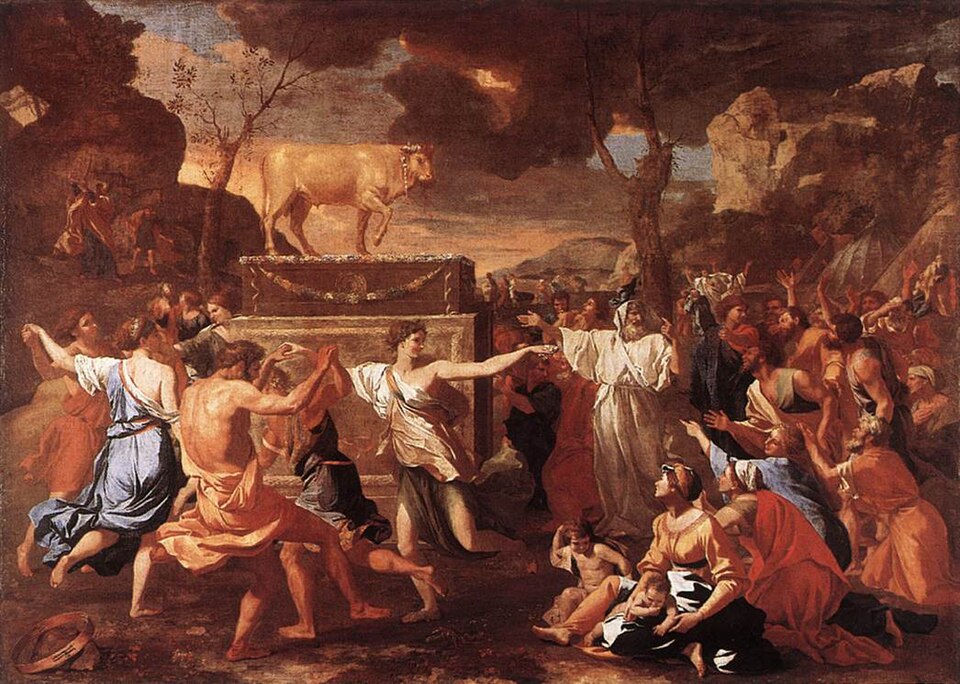 Source: Nicolas Poussin, The Adoration of the Golden Calf, public domain, via Wikimedia Commons. Western biblical illustration.
The calf that supposedly made itself (Exodus 32:21-24; Greek/Brenton 32:21-24)
21: And Moses said to Aaron, What has this people done to thee, that thou hast brought upon them a great sin? 22: And Aaron said to Moses, Be not angry, my lord, for thou knowest the impetuosity of this people. 23: For they say to me, Make us gods, which shall go before us; for as for this man Moses, who brought us out of Egypt, we do not know what is become of him. 24: And I said to them, If any one has golden ornaments, take them off; and they gave them me, and I cast them into the fire, and there came out this calf.
Moses names Aaron’s responsibility before Aaron gives his explanation: he has brought a great sin upon the people (32:21). Aaron answers first with the people’s impetuosity, then repeats their demand, then describes the calf as emerging from the fire (32:22-24). Verse 4 has already told us that he received, formed, and made it. His retelling removes the very actions that reveal his participation.
Pressure is real in verse 1, and Moses’ question acknowledges that something has happened between Aaron and the people (32:21). Yet Aaron’s explanation cannot cancel his agency. There is a recognizable spiritual evasion here: a choice becomes something that simply happened to us. Confession begins when we restore the missing verbs. I consented; I made; I concealed. Naming them is not despair. It is the beginning of asking for mercy without hiding from the truth.
Deuteronomy 9:20 refuses to leave Aaron inside his excuse: God’s anger against him is serious, and Moses prays for him by name. Read beside the priestly instructions of Exodus 28:1 and 29:4-9, that prayer shows why ministry can never be a shelter from repentance. Aaron’s calling remains a gift; the calf he made remains a great sin (32:21). Church office must never be invoked to shield wrongdoing from truthful accountability or to prevent those harmed from seeking protection.
Levi, the sword, and three thousand deaths (Exodus 32:25-29; Greek/Brenton 32:25-29)
25: And when Moses saw that the people was scattered, - for Aaron had scattered them so as to be a rejoicing to their enemies, - 26: then stood Moses at the gate of the camp, and said, Who is on the Lord’s side? let him come to me. Then all the sons of Levi came to him. 27: And he says to them, Thus saith the Lord God of Israel, Put every one his sword on his thigh, and go through and return from gate to gate through the camp, and slay every one his brother, and every one his neighbour, and every one him that is nearest to him. 28: And the sons of Levi did as Moses spoke to them, and there fell of the people in that day to the number of three thousand men. 29: And Moses said to them, Ye have filled your hands this day to the Lord each one on his son or on his brother, so that blessing should be given to you.
Brenton describes the people as scattered and says Aaron has made them a rejoicing to their enemies (32:25). The collapse of faithful worship has also become communal disintegration. Moses calls for allegiance to the Lord, and the sons of Levi gather to him (32:26). The command that follows is attributed to the Lord God of Israel and enacted with swords; about three thousand men die (32:27-28). These are deaths of people, including those bound by close relationships, not a harmless metaphor for self-discipline. The text gives no individual case histories from which to reconstruct every victim’s conduct.
The passage is a grave act of judgment within Israel’s covenant history. Its severity cannot be erased by calling all the dead symbols of passions. Neither can it be transferred into a Christian mandate. No priest, servant, parent, or political leader may invoke verses 27-29 as authorization to kill, beat, threaten, or coerce someone over belief or disobedience. Christ commands love and prayer for enemies and tells His disciple to put the sword back in its place (Matthew 5:44; 26:52). Fidelity to God in the Church is lived through repentance, truthful discipline, protection of the vulnerable, and mercy, never religious violence.
Verse 29 joins Levi’s costly allegiance to blessing. Deuteronomy 33:9 later remembers Levi’s keeping of the covenant above family partiality. That connection concerns fidelity to God’s word; it cannot make harm to relatives a Christian virtue. A Christian may need to refuse a family’s demand to hide abuse or join wrongdoing, but refusal must seek truth and safety, not punishment by private force.
Translation insight: “filled your hands”
Brenton prints “Ye have filled your hands” in verse 29. Exodus 29:9 uses the same English expression in the command to fill the hands of Aaron and his sons. The phrase belongs to consecration, the setting apart of a person for God’s service. Here it links Levi’s allegiance to sacred service after Aaron’s failure. The verbal echo does not make these killings the ordinary rite of priestly consecration or a pattern for Christian ordination.5
The three thousand who die in verse 28 can be read beside the approximately three thousand added through repentance and Baptism at Pentecost (Acts 2:37-41). This is a Christian canonical contrast, not a claim that Acts explicitly cites Exodus 32. It brings the reader from judgment to the life-giving gift of the Spirit. St. Paul’s contrast between the letter that kills and the Spirit who gives life develops the difference between the ministry engraved on stones and the glory of the new covenant (2 Corinthians 3:6-11). It neither calls God’s earlier revelation evil nor tells us to discard obedience. The same reader who must take judgment seriously is summoned into life through Christ.
“Blot me out”: love, the book, and unfinished judgment (Exodus 32:30-35; Greek/Brenton 32:30-35)
30: And it came to pass after the morrow had begun, that Moses said to the people, Ye have sinned a great sin; and now I will go up to God, that I may make atonement for your sin. 31: And Moses returned to the Lord and said, I pray, O Lord, this people has sinned a great sin, and they have made for themselves golden gods. 32: And now if thou wilt forgive their sin, forgive it; and if not, blot me out of thy book, which thou hast written. 33: And the Lord said to Moses, If any one has sinned against me, I will blot them out of my book. 34: And now go, descend, and lead this people into the place of which I spoke to thee: behold, my angel shall go before thy face; and in the day when I shall visit I will bring upon them their sin. 35: And the Lord smote the people for the making of the calf, which Aaron made.
After the deaths, Moses still goes up to seek atonement (32:30). The sword has not settled the people’s need for forgiveness. He tells God what Aaron obscured: they have sinned a great sin and made golden gods (32:31). His prayer asks that the sin be forgiven; then it places his own life beside the people’s: if they cannot be forgiven, let him be blotted out too (32:32). Romans 9:1-3 offers a close apostolic parallel in Paul’s sorrow for his own people. Neither Moses nor Paul seeks a private escape while abandoning those he loves.
God’s answer in verse 33 preserves responsibility: the one who sins against Him is liable to be blotted out. Moses’ love is honored as intercession, but his offer is not accepted as a transfer of guilt that removes everyone else’s accountability. The chapter speaks of God’s written book without giving a complete account of its relation to every later use of the image. Its immediate force is belonging, life, and the danger of exclusion under judgment (32:32-33).
Psalm 69:28 (LXX 68:29 in this Brenton numbering) speaks of removal from the book of the living; Daniel 12:1 joins deliverance to being written in the book. Christ tells His disciples to rejoice that their names are written in heaven (Luke 10:20); Philippians 4:3 names fellow workers in the Book of Life; Revelation 3:5 promises the conqueror that his name will not be blotted out. These passages deepen the hope of belonging to God without turning Exodus 32:32-33 into a calculation by which we determine another person’s eternal destiny.6
Moses’ prayer finds its fulfillment beyond Moses. Christ, the one Mediator, gives Himself as a ransom for all (1 Timothy 2:5-6). Hebrews 7:25-27 joins His continuing intercession to His once-for-all self-offering: the sinless High Priest offers Himself, rather than first needing sacrifice for His own sins. This is why Moses’ loving willingness in verse 32 is a true anticipation yet not the saving sacrifice itself. The fulfillment reveals the depth of God’s own love; it does not picture the Son persuading an unwilling Father to become merciful.
Gems from the Fathers: Love that stays with the guilty
St. Clement of Rome turns directly to Moses’ prayer in First Epistle to the Corinthians 53. He is addressing a Church wounded by division and asks its members to remember a servant who would not seek greatness at his people’s expense. After recounting Moses’ plea, he exclaims: “O marvellous love! O insuperable perfection! The servant speaks freely to his Lord, and asks forgiveness for the people, or begs that he himself might perish along with them.”7 His point is self-giving love that seeks another’s salvation, not an instruction to wish for damnation. The following chapter applies that love to accepting personal loss for the Church’s peace. Exodus 32:32 becomes a rebuke to the desire to win a religious quarrel while losing love for the people involved.
The Lord sends Moses back to lead the people, and His angel will go before them, but He also announces a visitation of their sin (32:34). Verse 35 records His smiting the people for the calf Aaron made. This is commonly called the plague: Brenton itself says “smote” and supplies neither symptoms nor a death total. It must not be merged with the three thousand of verse 28 or explained as a documented result of drinking gold. Forgiveness sought, the nation’s preservation, and the continued seriousness of sin all remain together at the chapter’s end.
Nehemiah 9:18-20 remembers this very calf alongside God’s compassion, continued guidance, and good Spirit. The survival of Israel is mercy, not proof that the idol was tolerable. Exodus 32:34-35 leaves the reader needing the renewed covenant and presence sought in chapters 33-34. We must also resist reversing this particular revelation into a general accusation against sufferers. The chapter identifies the cause of this judgment; it gives us no authority to diagnose another person’s illness as punishment for an unknown sin.
The Church’s Voice in Worship: “Blot me out”: love, the book, and unfinished judgment
The Third Hour of Covenant Thursday of Holy Pascha appoints Exodus 32:30-33:5. Moses’ ascent to seek atonement (32:30), his prayer to be blotted out with the people (32:32), and the unfinished question of God’s presence in chapter 33 are heard on the day the Church commemorates the Lord’s gift of the Holy Eucharist and approaches His Cross.8 Here the earlier servant stands with a guilty people; the true Mediator gives Himself for them (1 Timothy 2:5-6). The appointment extends beyond this study’s chapter, preserving the passage from intercession to the people’s need for renewed communion. Holy Pascha makes the reading a summons to repentance and grateful reception of Christ’s saving gift, not an occasion to place ourselves above the people who fell.
Glossary
- “Tables of testimony”: the stone tablets bearing God’s covenant words (32:15-16), not pieces of furniture.
- “Graving tool”: an engraving or shaping implement; verse 4 assigns Aaron an active role in making the calf.
- “Abraam”: Brenton’s form of Abraham, named with Isaac and Jacob in Moses’ appeal (32:13).
- Intercession: prayer to God on behalf of others, as Moses prays for the people (32:11-13, 31-32).
- Atonement: the restoration sought in the face of sin; here Moses goes before God seeking forgiveness (32:30-32). Christ’s perfect self-offering fulfills what Moses cannot accomplish by offering to share the people’s loss (Hebrews 7:25-27).
- Consecration: being set apart for God’s service; the “filled your hands” wording of 32:29 echoes Exodus 29:9.
- Adoration and veneration: adoration is owed to God alone; veneration is reverent honor, such as that given to a holy image without treating its material as God.
- Typology: recognizing real earlier biblical events as patterns fulfilled more fully in Christ and the Church, while preserving the difference between anticipation and fulfillment.
Spiritual Fruit
Wait without constructing a substitute. Israel’s uncertainty becomes a demand for a god it can make (32:1-4). When an answer is delayed, keep the prayer and obedience already given rather than inventing a permission God has never offered. A practical act may be to postpone an anxious decision long enough to pray, seek sound counsel, and ask whether the decision contradicts a clear duty.
Put the missing verbs back into confession. Aaron’s calf supposedly comes out of the fire by itself (32:24), although verse 4 names his work. Confess the action you chose before explaining the pressure you faced. Where another person was harmed, join confession to restitution, accountability, and whatever protection is needed. Mercy can heal what an excuse only conceals.
Pray for the person you are tempted to discard. Moses calls the people God’s own and returns to seek their forgiveness (32:11, 30-32). Name one person before the Lord without rehearsing a case for hatred. Ask for repentance and healing, including your own. Such prayer is compatible with firm boundaries and protection from harm; it does not require returning to an unsafe relationship.
Receive grace as a call to watchfulness. The feast in 32:5-6 warns that correct religious words can accompany a false allegiance. After prayer or Communion, examine one place where the heart still insists on praise, money, or control. St. Paul’s answer is to flee idolatry and to trust God’s faithful help against temptation (1 Corinthians 10:12-14).
Moses returns to the mountain with a great sin to confess and a people he still loves (32:31-32). Bring that same truthfulness to Christ: name the idol, relinquish the excuse, and ask mercy for more than yourself. The Lord who preserves His people does not need to be taught compassion (32:14). Under His mercy, repentance becomes possible, and prayer can learn to stay with those whom impatience would abandon.
Teaching Notes
Where to linger: the false feast in verses 4-6; the exchange of “thy people” in verses 7 and 11; the preservation in verse 14; Aaron’s missing actions in verse 24; the deaths in verse 28; and Moses’ prayer with God’s answer in verses 32-33. Give the violent passage enough time for honest grief and explicit safeguards. The chapter’s controlling burden is truthful repentance joined to intercession, rather than zeal separated from love.
Discuss: A feast of the Lord before a manufactured god (Exodus 32:1-6; Greek/Brenton 32:1-6)
- Ask: How do verses 4 and 5 show that religious language can hide a changed allegiance?
- Watch for: Treating the calf as an argument against all images, or assuming sacramental participation removes the need for repentance. Keep John of Damascus’ distinction between adoration and reverent honor explicit.
Discuss: “Thy people”: judgment and the opening for prayer (Exodus 32:7-14; Greek/Brenton 32:7-14)
- Ask: What does Moses restore by answering God’s “thy people” with his own “thy people”?
- Watch for: A changeable God, a more merciful Moses, or prayer presented as manipulation. The textual omission of verse 9 is retained, not supplied from another Bible.
Discuss: Tablets shattered, the calf reduced to dust (Exodus 32:15-20; Greek/Brenton 32:15-20)
- Ask: What do the tablets’ divine workmanship and the calf’s destruction reveal about Israel’s exchange?
- Watch for: Turning anger or forced drinking into pastoral techniques. Poussin is Western illustration, not an Orthodox icon or a reconstruction of the event.
Discuss: The calf that supposedly made itself (Exodus 32:21-24; Greek/Brenton 32:21-24)
- Ask: Which actions disappear between the narrator’s verse 4 and Aaron’s verse 24?
- Watch for: Using crowd pressure or religious office to excuse wrongdoing, or treating a guilty leader as beyond mercy.
Discuss: Levi, the sword, and three thousand deaths (Exodus 32:25-29; Greek/Brenton 32:25-29)
- Ask: What does the contrast with Acts 2:37-41 reveal about the life-giving work of the Spirit?
- Watch for: Any authorization of violence, coercion, hatred of a people, or harm to relatives. Do not erase the historical deaths by spiritualizing them, and do not present the Pentecost contrast as an explicit citation in Acts.
Discuss: “Blot me out”: love, the book, and unfinished judgment (Exodus 32:30-35; Greek/Brenton 32:30-35)
- Ask: How does God’s answer preserve personal responsibility while Moses’ prayer expresses solidarity?
- Watch for: Inviting self-destruction, calculating others’ eternal fate, assigning illness to hidden guilt, or confusing Moses’ offered solidarity with Christ’s effective self-offering.
Sources
Embedded Scripture is from Brenton’s English Septuagint (LXX).
Exodus 32, Brenton; Greek Exodus 32. Scripture wording is retained as printed in this study; numbering and the absent verse 9 are explained beside the passage.
Israel’s inward return and Christian watchfulness: Acts 7:39-41; 1 Corinthians 10:1-13 and 10:14; Romans 1:23; Psalm 106:19-23 (LXX 105:19-23); 1 Kings 12:28-30 (Septuagint 3 Kingdoms 12:28-30).
Prayer, accountability, and continued mercy: Deuteronomy 9:16-21; Numbers 23:19; James 1:17; Ezekiel 33:11; Nehemiah 9:18-20.
Levi and the gift of the Spirit: Deuteronomy 33:8-11; Exodus 29:9; Acts 2:37-41; 2 Corinthians 3:6-11; Matthew 5:44; 26:52.
The book and the Mediator: Psalm 69:28 (LXX 68:29, Brenton); Daniel 12:1-2; Luke 10:20; Philippians 4:3; Revelation 3:5; Romans 9:1-3; 1 Timothy 2:5-6; Hebrews 7:25-27.
The Incarnation and sacred images: Deuteronomy 4:15-19; John 1:14-18; Colossians 1:15-17; St. John of Damascus, First Apology against Those Who Decry Holy Images, 5-8, 14-16; St. Clement of Rome, First Epistle to the Corinthians, 53-54. Direct citations follow.
Nicolas Poussin, The Adoration of the Golden Calf, individual Wikimedia Commons file, public domain. The retained painting is later Western illustration.
Coptic Reader, Coptic Orthodox Metropolis of the Southern United States, Holy Pascha service text: Monday, Sixth Hour, Exodus 32:7-15; Covenant Thursday, Third Hour, Exodus 32:30-33:5. Reading appointments are stated as printed; this study retains Brenton’s wording rather than replacing it with the service’s English translation.
Footnotes
-
St. John of Damascus, On Holy Images, First Apology, section 16, paragraph beginning “Of old, God the incorporeal and uncircumscribed was never depicted,” Mary H. Allies translation (London: Thomas Baker, 1898), pp. 15-16: text. The section numbering corresponds to First Apology 16; the bracketed numerals in the Allies text mark printed pages, not sections. ↩ ↩2
-
Coptic Reader, Coptic Orthodox Metropolis of the Southern United States, Holy Pascha, Monday Day, Sixth Hour, first prophecy, printed “Exodus 32:7-15”: service text. This appointment includes the opening of the next Scripture section of this guide, verse 15. Exact menu: Special > Pascha > Monday > Monday Day > 6th Hour. ↩
-
Brenton Exodus 32 and Greek Exodus 32 both pass from verse 8 to verse 10. This note concerns these textual witnesses, not a claim that every Septuagint manuscript has identical contents. ↩
-
Exodus 32:18, Greek text, compared with Brenton. ↩
-
Exodus 32:29 and Exodus 29:9, Brenton’s English Septuagint. ↩
-
Psalm 69:28 (LXX 68:29, Brenton) is the book-of-the-living sentence. Brenton numbers the superscription here as verse 1; the difference involves both psalm and verse numbering. ↩
-
St. Clement of Rome, First Epistle to the Corinthians, 53, “The Love of Moses Towards His People,” John Keith translation, Ante-Nicene Fathers, vol. 9: text. Chapter 54 carries the application to peace in the Church. ↩
-
Coptic Reader, Coptic Orthodox Metropolis of the Southern United States, Covenant Thursday, Third Hour, first prophecy, printed “Exodus 32:30-33:5”: service text. Covenant Thursday and the institution of the Eucharist: SUS Coptic Orthodox Diocese, The Sacrament of the Eucharist. Exact menu: Special > Pascha > Thursday > Thursday Day > 3rd Hour. ↩