


This narration was recorded before the latest revision. The text on this page is current.
Moses has left Pharaoh’s palace and is tending another man’s sheep when God calls him from an unconsumed bush. Israel’s cry has reached the Lord, and the shepherd is sent back to the land from which he fled. Exodus 3 joins holy ground, divine compassion, and the Name of the living God to one purpose: a people brought out of bondage to worship Him.
The fire and the holy ground (Exodus 3:1-6; Greek/Brenton 3:1-6)
A note on numbering. This study follows NKJV chapter and verse numbering and prints Brenton’s English Septuagint with its own verse labels. The numbered passage units here correspond in the two editions, although their wording can differ.
1: And Moses was feeding the flock of Jothor his father-in-law, the priest of Madiam; and he brought the sheep nigh to the wilderness, and came to the mount of Choreb. 2: And an angel of the Lord appeared to him in flaming fire out of the bush, and he sees that the bush burns with fire, - but the bush was not consumed. 3: And Moses said, I will go near and see this great sight, why the bush is not consumed. 4: And when the Lord saw that he drew nigh to see, the Lord called him out of the bush, saying, Moses, Moses; and he said, What is it? 5: And he said, Draw not nigh hither: loose thy sandals from off thy feet, for the place whereon thou standest is holy ground. 6: And he said, I am the God of thy father, the God of Abraam, and the God of Isaac, and the God of Jacob; and Moses turned away his face, for he was afraid to gaze at God.
Moses brings Jothor’s flock to Choreb, the form of Horeb used in this translation. His ordinary work brings him to the place of revelation. The text gives no license to despise those hidden years or to treat his care for the sheep as spiritually empty. The man who will lead Israel is attending to a flock when he notices the fire.
The bush burns but remains unconsumed. Moses approaches to see, and the Lord calls him by name. Wonder becomes a personal summons, then an act of reverence: he must loosen his sandals before he receives instructions about Pharaoh. Joshua will hear the same command at another holy encounter (Joshua 5:15). Holiness reaches the body as well as the mind. Prayer begins with attention to the One before whom we stand, not with our need to speak.
God identifies Himself through Abraam, Isaac, and Jacob. The promises of Genesis still govern Israel’s future. Moses turns his face away in fear, yet the God whom he fears has come to rescue the afflicted. Christ later draws resurrection hope from this very identification: God is the God of the living, and the patriarchs live before Him (Matthew 22:31-32; Luke 20:37-38). Covenant faithfulness reaches beyond the grave.
Gems from the Fathers : The Word and the unconsumed bush
The shift from an angel appearing in verse 2 to the Lord speaking in verse 4 receives a precise Christological reading in St. Justin Martyr. In Dialogue with Trypho 59-60, Justin identifies the divine revealer with the Son, who makes the Father known. In chapter 60 he argues that the titles refer to the same speaker: “this same One alone who is called an Angel, and who is God, appeared to and communed with Moses.”1 Here the title “Angel” expresses His role as messenger; Justin’s argument concerns the divine Son, not a claim that Christ is a created angel.
St. Cyril of Alexandria reads the unconsumed bush as a figure of the Incarnation in Glaphyra, Book Eight, Exodus Part 1. Scripture compares divine power to fire and frail humanity to vegetation. Cyril sees the fire’s presence without destruction as an image of the Word dwelling in the flesh received from the Virgin and giving life to His own body. His reading moves toward salvation: the Word comes to save and makes the mortal flesh He has assumed victorious over death. This is a paraphrase of Cyril’s explanation, not a quotation from his modern English translator.2
The burning bush also prepares the mystery of the Incarnation. Divine fire can dwell with creation without destroying it. Before Communion, the priest confesses the union in the Coptic Liturgy of St. Basil: “He made it one with his divinity without mingling, without confusion and without alteration.” He then declares: “Truly I believe that his divinity parted not from his humanity for a single moment nor a twinkling of an eye.”3 The first sentence refers to the life-giving body the Son took from the Virgin; the second confesses the abiding union of His divinity and humanity. The flesh He truly assumed is His own, life-giving through union with the Word, without being dissolved or changed into divinity. The bush is not the doctrine itself, but it is a luminous sign that creation can be filled by God without being annihilated.
St. Gregory of Nyssa makes the Marian meaning explicit in Life of Moses II.21: the divine light shines into human life through the Virgin’s childbearing, while her virginity remains intact. His interpretation concerns both the real birth and the Virgin’s preservation. It grows from the unconsumed bush without removing Moses’ call from the story.4
The Church’s Voice in Worship: The fire and the holy ground
The Matins prophecies of the first Monday of the Great Fast include Exodus 2:23-3:5; those of Monday in the second week include Exodus 3:6-14.5 The bush, God’s attention to Israel’s affliction (3:7-9), and His promise to be with Moses (3:12) are heard within the Fast. Repentance begins before the living God who sees our bondage and calls us into His service; it is sustained by His presence rather than confidence in our own sufficiency.
The Thursday Theotokia, a hymn praising the Mother of God, begins with the bush Moses saw in the wilderness. Its first part identifies the bush as a symbol of Mary and sings: “The fire of His divinity, did not burn the womb of the Virgin, and after she bore Him, she remained a virgin.”6 The hymn’s attention rests on the Word who took flesh from her. Honoring His Mother leads to worship of the Savior she bore.
The Church also reads Exodus 2:23-3:5 among the prophecies on Monday of the first week of Great Lent. The reading carries Israel’s groaning directly into Moses’ encounter with holy ground. At the beginning of the Fast, the cry for freedom meets a call to reverence: liberation from slavery and the purification of our approach to God belong together.7
The cry that God hears (Exodus 3:7-10; Greek/Brenton 3:7-10)
7: And the Lord said to Moses, I have surely seen the affliction of my people that is in Egypt, and I have heard their cry caused by their task-masters; for I know their affliction. 8: And I have come down to deliver them out of the hand of the Egyptians, and to bring them out of that land, and to bring them into a good and wide land, into a land flowing with milk and honey, into the place of the Chananites, and the Chettites, and Amorites, and Pherezites, and Gergesites, and Evites, and Jebusites. 9: And now, behold, the cry of the children of Israel is come to me, and I have seen the affliction with which the Egyptians afflict them. 10: And now come, I will send thee to Pharao king of Egypt, and thou shalt bring out my people the children of Israel from the land of Egypt.
The Lord speaks of Israel as “my people.” Pharaoh’s possession of their labor has never made him their rightful lord. God has seen the taskmasters’ cruelty and heard the cry it has caused. His knowledge of affliction is personal and active: He comes down to deliver and to bring the people into a good and wide land. Freedom has a destination, a life received from God rather than another form of servitude.
“I have come down” announces divine action in history. The Gospel reveals its fullness in the Son who comes down from heaven (John 3:13; John 6:38). Christ enters human life and frees us from sin and death. That fulfillment strengthens the chapter’s compassion rather than spiritualizing away Israel’s suffering. The taskmasters, the forced labor, and the cries matter to God.
Verse 10 turns compassion into a commission: “I will send thee.” Moses is to become an instrument of the deliverance God has announced. The person who prays for the afflicted may also be sent to help them. A household under strain, an isolated parishioner, or a worker treated unjustly needs more than our explanation of providence. Attention, practical help, and truthful advocacy can become the obedient answer to suffering we have finally allowed ourselves to hear.
Presence before sufficiency (Exodus 3:11-12; Greek/Brenton 3:11-12)
11: And Moses said to God, Who am I, that I should go to Pharao king of Egypt, and that I should bring out the children of Israel from the land of Egypt? 12: And God spoke to Moses, saying, I will be with thee, and this shall be the sign to thee that I shall send thee forth, - when thou bringest out my people out of Egypt, then ye shall serve God in this mountain.
“Who am I?” is answered by “I will be with thee.” God does not deny the distance between a solitary shepherd and Pharaoh’s power. He gives Moses a different ground on which to stand. The same assurance will sustain Gideon (Judges 6:16), and the risen Christ promises His presence to the disciples He sends (Matthew 28:20). The servant’s weakness is real, but it is not the measure of God’s faithfulness.
The sign points forward: after bringing Israel out, Moses and the people will serve God on this mountain. Its promised fulfillment lies beyond the first confrontation with Pharaoh. Moses receives a word to obey before he possesses the whole experience that will confirm it. This is neither reckless self-appointment nor an excuse to disregard counsel; the promise belongs to the mission God actually gives.
The final words reveal what deliverance is for. Israel passes from labor imposed by a tyrant to service offered to God. Worship is not a reward added after freedom, as if life with God were optional. It is the proper use of freedom. A servant who can organize everything except prayer has lost sight of the mountain toward which the mission leads.
The Name and the fathers’ God (Exodus 3:13-15; Greek/Brenton 3:13-15)
13: And Moses said to God, Behold, I shall go forth to the children of Israel, and shall say to them, The God of our fathers has sent me to you; and they will ask me, What is his name? What shall I say to them? 14: And God spoke to Moses, saying, I am THE BEING; and he said, Thus shall ye say to the children of Israel, THE BEING has sent me to you. 15: And God said again to Moses, Thus shalt thou say to the sons of Israel, The Lord God of our fathers, the God of Abraam, and God of Isaac, and God of Jacob, has sent me to you: this is my name for ever, and my memorial to generations of generations.
Moses needs a word he can carry to Israel. Brenton’s “I am THE BEING” preserves the distinct form of the Greek answer. The Septuagint gives “ἐγώ εἰμι ὁ ὤν,” meaning “I am the One who is,” and then sends Moses with the title “ὁ ὤν,” “the One who is.” The answer moves from God’s own declaration to the name by which Moses identifies his sender. The Lord is not dependent on Pharaoh’s permission or on Israel’s strength for His existence or His authority.8
Verse 15 immediately joins this revelation to the God of Abraam, Isaac, and Jacob. The One who is has bound Himself to a people through His promises. His transcendence does not distance Him from their cry. Nor does the gift of His Name give Moses control over Him: it gives Moses truth to speak and a covenant to remember.
Revelation 1:4 and 1:8 take up the title of the One who is, extending it to the One who was and who is to come. John 8:58 belongs beside this testimony: Christ speaks of His existence before Abraham with the declaration “I AM.” These texts direct Christian hearing toward the eternal Lord revealed in Christ; they are not identical sentences in translation.9
The Church’s Voice in Worship: The Name and the fathers’ God
After the opening dialogue of the Coptic Anaphora of St. Basil, the priest addresses God: “O You, THE BEING, Master, Lord, God of Truth,” followed by praise of His eternal existence and reign.10 The anaphora is the Church’s Eucharistic prayer. It brings the language of the divine Name into thanksgiving, and it identifies the One addressed as the Father of our Lord Jesus Christ. The Lord who looks upon the lowly is the Creator whom the congregation worships.
Exodus 3:6-14 is read among the prophecies on Monday of the second week of Great Lent. The day’s Gospel, Luke 18:1-8, teaches persistent prayer through the widow’s appeal for justice. Israel’s cry and the widow’s appeal meet in the confidence that God hears His people. During the Fast, perseverance in prayer grows from His character, not from the strength of our feelings.11
Elders, worship, and resistance (Exodus 3:16-20; Greek/Brenton 3:16-20)
16: Go then and gather the elders of the children of Israel, and thou shalt say to them, The Lord God of our fathers has appeared to me, the God of Abraam, and God of Isaac, and God of Jacob, saying, I have surely looked upon you, and upon all the things which have happened to you in Egypt. 17: And he said, I will bring you up out of the affliction of the Egyptians to the land of the Chananites and the Chettites, and Amorites and Pherezites, and Gergesites, and Evites, and Jebusites, to a land flowing with milk and honey. 18: And they shall hearken to thy voice, and thou and the elders of Israel shall go in to Pharao king of Egypt, and thou shalt say to him, The God of the Hebrews has called us; we will go then a journey of three days into the wilderness, that we may sacrifice to our God. 19: But I know that Pharao king of Egypt will not let you go, save with a mighty hand; 20: and I will stretch out my hand, and smite the Egyptians with all my wonders, which I shall work among them, and after that he will send you forth.
Moses must first gather the elders. Deliverance is announced to a community through its recognized leaders, not pursued as a private adventure. The message begins with God’s visitation: He has looked upon them and upon what has happened to them in Egypt. Their wounds are known before Moses speaks to Pharaoh.
The elders are to accompany Moses in asking for a three-day journey to sacrifice. Their request makes worship the public issue. Pharaoh’s authority over their work cannot become authority over their God. Yet the Lord warns Moses that Pharaoh will resist and that a mighty hand will be required. The wonders that follow are already promised here; they will reveal whose authority finally governs Egypt.
God’s warning protects obedience from a false expectation of instant success. Resistance will not by itself show that Moses has misunderstood his mission. The warning also prevents him from confusing his own force with the power that will deliver Israel. He has words to speak and people to accompany; the Lord has the mighty hand.
Leaving bondage without empty hands (Exodus 3:21-22; Greek/Brenton 3:21-22)
21: And I will give this people favour in the sight of the Egyptians, and whenever ye shall escape, ye shall not depart empty. 22: But every woman shall ask of her neighbour and fellow lodger, articles of gold and silver, and apparel; and ye shall put them upon your sons and upon your daughters, - and spoil ye the Egyptians.
The promise reaches into the households of the enslaved. Women are to ask their neighbors and fellow lodgers for silver, gold, and clothing, and the goods are to go upon their sons and daughters. The children whom Pharaoh’s earlier decree endangered will leave clothed with the goods of Egypt. God’s favor accompanies the departure; the people will not go out empty.
Brenton says “ask,” not “borrow.” That distinction matters when interpreting the closing command to spoil the Egyptians: this passage does not describe a loan agreement or a promise to repay. Genesis 15:14 had foretold a departure with possessions after judgment on the enslaving nation. Wisdom 10:17 (Septuagint), within its account of the Exodus, describes Wisdom as giving the holy people the reward of their labor. Read together, these passages frame the goods as recompense and provision, not a general permission to steal from people of another faith.12
Gems from the Fathers : What wealth is for
St. Irenaeus directly addresses the objection to Israel’s taking Egyptian goods in Against Heresies IV.30.1-3. He points to the Egyptians’ debt, Israel’s long years of forced labor, and the later use of the goods for the tabernacle. His argument links justice to worship: possessions are to serve God and those in need, rather than become another master.13
St. Gregory of Nyssa approaches the difficulty differently in Life of Moses II.112-116. He objects to defending a transaction that he understands as deceptive borrowing and turns to a spiritual interpretation: useful learning from outside the Church can be received and dedicated to God’s service, as Basil dedicated his education to the Church. Gregory’s reading is not an endorsement of fraud, and his assumption about borrowing differs from the wording “ask” displayed here. His application gives a further question to the liberated heart: the knowledge and resources we bring with us should build God’s house, not recreate Egypt within it.14
Iconography Connection
This Sinai icon concentrates on Moses loosening his sandal before the burning bush. The raised foot and the sandal set aside make reverence visible. It is a Byzantine witness preserved in Sinai, not evidence of a specifically Coptic halo convention.
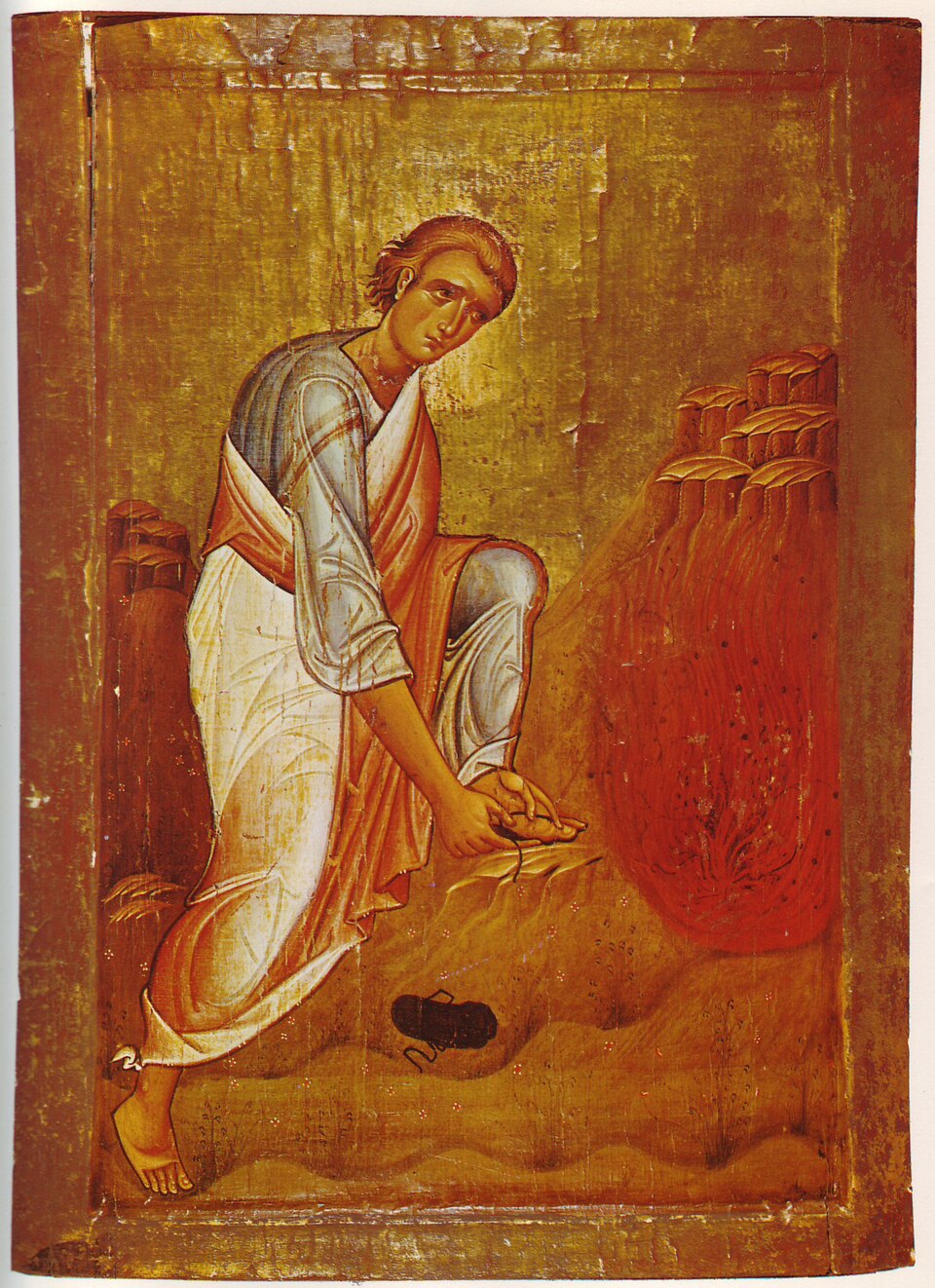 Source: Moses and the Burning Bush, Sinai icon, 12th century, public domain, via Wikimedia Commons.
The letters “ὁ ὤν,” “He Who Is,” are documented in Christ’s cruciform halo in Greek Orthodox iconography. That wider Orthodox convention should not be assumed for every Coptic icon or for this image. The Coptic worship witness above is the explicit address in the Anaphora of St. Basil.15
Spiritual Fruit
Let attention become reverence. Before opening Scripture or entering the church, put away one deliberate distraction. Stand before God without rushing to fill the silence. Moses’ loosened sandals can become a small examination of the habits we insist on carrying into prayer: haste, display, or the need to control the encounter.
Hear a cry instead of explaining it away. The Lord names the taskmasters and the affliction they cause. Give sustained attention this week to someone whose suffering has become easy to overlook. Pray for that person by name and offer a specific help within your responsibility. Compassion becomes truthful when it begins to cost us time.
Receive presence and take the next obedient step. When service feels larger than your strength, pray with the assurance given to Moses: “I will be with thee.” Then do the next clear duty, with counsel where needed, without demanding that every outcome be visible first. Keep prayer within the work, because the people are being led toward worship.
Dedicate what freedom places in your hands. Examine one resource, skill, or possession that could serve God’s house or a neighbor’s need. Put it to that use. The departure from Egypt is incomplete in the heart while wealth still tells us whom to serve.
Teaching Notes
Discuss: The fire and the holy ground (Exodus 3:1-6; Greek/Brenton 3:1-6)
- Ask: How do the command about sandals and God’s covenant name change Moses’ approach to the sight?
- Watch for: Reducing the chapter to Marian symbolism or treating the Son as a created angel because Justin calls Him messenger.
Discuss: The cry that God hears (Exodus 3:7-10; Greek/Brenton 3:7-10)
- Ask: How does God’s hearing of Israel’s cry become a responsibility for Moses?
- Watch for: Explaining oppression away as a useful spiritual experience rather than naming the wrong God comes to remedy.
Discuss: Presence before sufficiency (Exodus 3:11-12; Greek/Brenton 3:11-12)
- Ask: Why does God’s answer direct Moses away from measuring only his own strength?
- Watch for: Treating God’s promise as approval of any self-chosen ministry or confusing humility with worthlessness.
Discuss: The Name and the fathers’ God (Exodus 3:13-15; Greek/Brenton 3:13-15)
- Ask: What does the address “THE BEING” become when the congregation hears it within Eucharistic thanksgiving?
- Watch for: Treating the Name as an impersonal idea or assuming that the wording of Exodus, John, and Revelation is identical.
Discuss: Elders, worship, and resistance (Exodus 3:16-20; Greek/Brenton 3:16-20)
- Ask: What does Moses know in advance about both the elders’ response and Pharaoh’s resistance?
- Watch for: Promising immediate results or treating the servant’s aggression as the mighty hand of God.
Discuss: Leaving bondage without empty hands (Exodus 3:21-22; Greek/Brenton 3:21-22)
- Ask: How do recompense and the building of the tabernacle change the purpose of the goods Israel receives?
- Watch for: Using the passage to excuse theft, religious hostility, or dishonest borrowing; Gregory’s moral difficulty must not be hidden.
Sources
Embedded Scripture is from Brenton’s English Septuagint (LXX).
Exodus 3, with Greek and Brenton text: 🔗 Elpenor, Exodus 3.
St. Justin Martyr, Dialogue with Trypho 59-60; St. Cyril of Alexandria, Glaphyra, Book Eight, Exodus Part 1, pp. 24-26; St. Gregory of Nyssa, Life of Moses II.19-21, 112-116; St. Irenaeus, Against Heresies IV.30.1-3. Direct editions and locators are in the footnotes.
Thursday Theotokia, First Part; Coptic Anaphora of St. Basil, opening prayer after the dialogue; St. Bishoy Coptic Orthodox Church, Katameros of Lent, Weeks 1 and 2. These are hymn, prayer, and reading-book witnesses respectively, not interchangeable kinds of evidence.
Footnotes
-
St. Justin Martyr, Dialogue with Trypho 60, translated by Marcus Dods and George Reith, Ante-Nicene Fathers 1 (1885), 🔗 exact passage. ↩
-
St. Cyril of Alexandria, Glaphyra on the Pentateuch, Book Eight, Exodus Part 1, pp. 24-26, PG 69, cols. 413-416; translated by Nicholas P. Lunn, volume 2, Fathers of the Church 138 (Catholic University of America Press, 2019). Paraphrase of the primary text in a modern English translation, 🔗 edition text. ↩
-
Coptic Liturgy of St. Basil, “The Confession,” priest’s declaration before Communion, English text supplied through St. Mary Coptic Orthodox Church, Seattle; translator not named, 🔗 primary liturgy text. ↩
-
St. Gregory of Nyssa, Life of Moses II.19-21, especially II.21, translated by Abraham J. Malherbe and Everett Ferguson (Paulist Press, 1978). Paraphrase, 🔗 edition. ↩
-
Coptic Reader, Coptic Orthodox Metropolis of the Southern United States, official app: Readings > Matins > Prophecies, printed Exodus 2:23-3:5; Readings > Matins > Prophecies, printed Exodus 3:6-14. The app link does not select a service; follow the menu path. Printed references are retained separately from the Brenton text displayed here. The consulted Reader documents were selected for February 16 and 23, 2026, with the respective first- and second-week Monday occasions confirmed; these dated witnesses do not establish every edition’s calendar practice. ↩
-
Thursday Theotokia, First Part, English text, 🔗 Tasbeha hymn text. ↩
-
St. Bishoy Coptic Orthodox Church, Katameros of Lent: Readings of the First Week, Monday, prophecies, Exodus 2:23-3:5, pp. 2-3, 🔗 reading book. ↩
-
John 8:58; Revelation 1:4, 8. 🔗 John 8:58; 🔗 Revelation 1:4-8. ↩
-
Coptic Anaphora of St. Basil, priest’s opening prayer after “It is meet and right,” 🔗 primary prayer text. ↩
-
St. Bishoy Coptic Orthodox Church, Katameros of Lent: Readings of the Second Week, Monday, prophecies, Exodus 3:6-14, pp. 2-4, 🔗 reading book. The day’s Liturgy Gospel is Luke 18:1-8, 🔗 CopticChurch.net reading page. ↩
-
Genesis 15:14; Wisdom of Solomon 10:15-19 (Septuagint), especially 10:17, 🔗 Wisdom text. “Reward of labor” is a paraphrase of this Exodus account. ↩
-
St. Irenaeus, Against Heresies IV.30.1-3, Ante-Nicene Fathers 1, 🔗 chapter text. ↩
-
St. Gregory of Nyssa, Life of Moses II.112-116, Malherbe and Ferguson translation (1978). Paraphrase, 🔗 edition. ↩
-
Annunciation Greek Orthodox Church, Muskegon, Dome Icons, description of Christ Pantocrator, 🔗 iconography account. ↩