


This narration is from a previous version of the study and may include a combined recording of multiple chapters.
Moses’ last word to the tribes is blessing. The servant who has warned them with such severity now prays for their life, worship, fruitfulness, and safety. His blessing begins with the Lord’s appearing and ends with the people saved by Him. Between those declarations, the tribes receive distinct gifts without becoming distinct peoples before God. The giver of the inheritance is also the shelter beneath it.
Orientation
The blessing is spoken before Moses’ death and can be compared with Jacob’s tribal sayings in Genesis 49. Sinai, Seir, and Paran recall the Lord’s coming and the wilderness; Joseph’s fields and the coastal wealth carry the prayer into settled life. The early modern map and inherited chart below orient the tribes without reconstructing Moses’ period. Simeon is not separately named in this blessing; the chapter does not explain why.
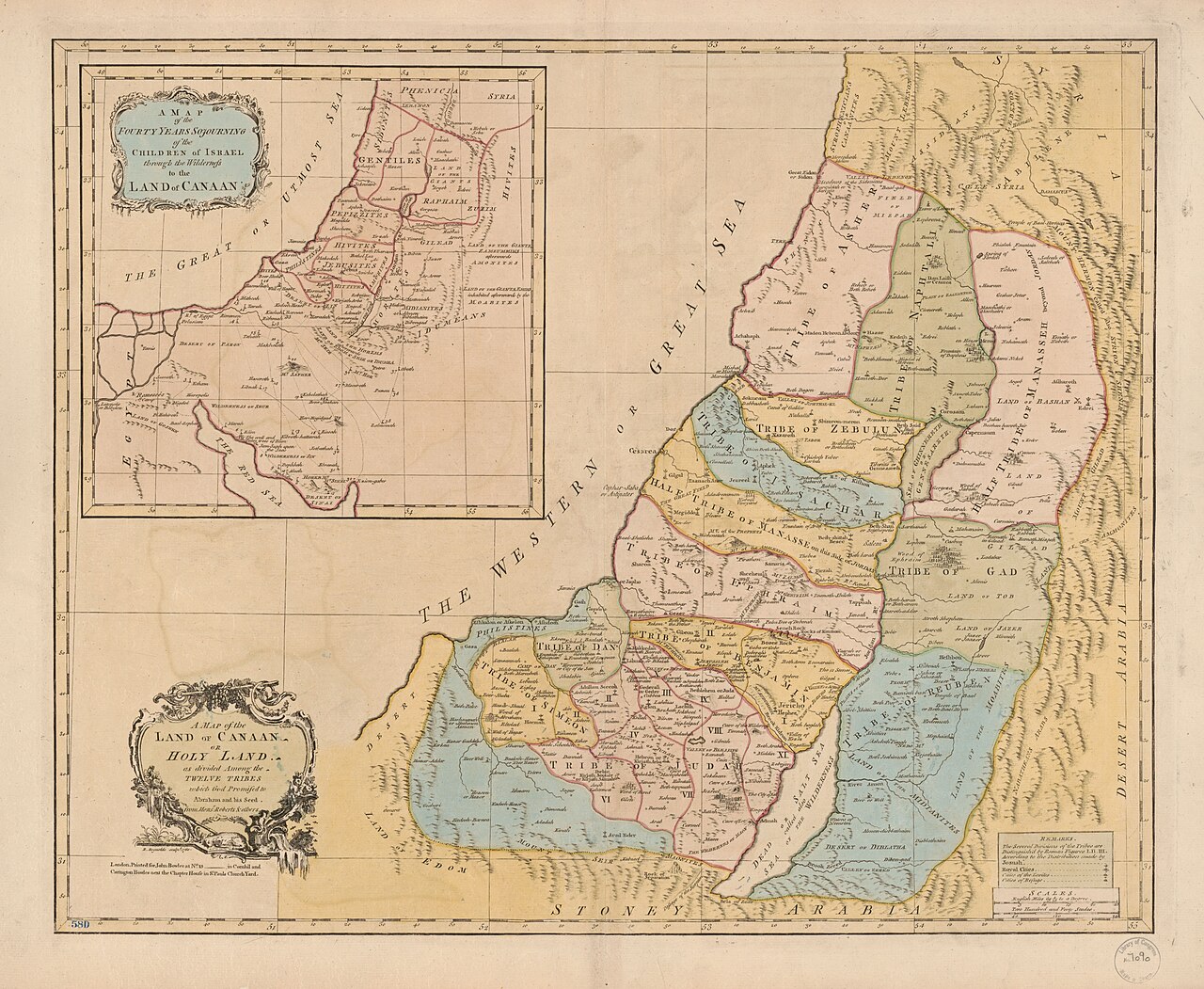 Source: Wikimedia Commons, Library of Congress map of Canaan divided among the twelve tribes, public domain. Early modern biblical map, not a map from Moses’ period.
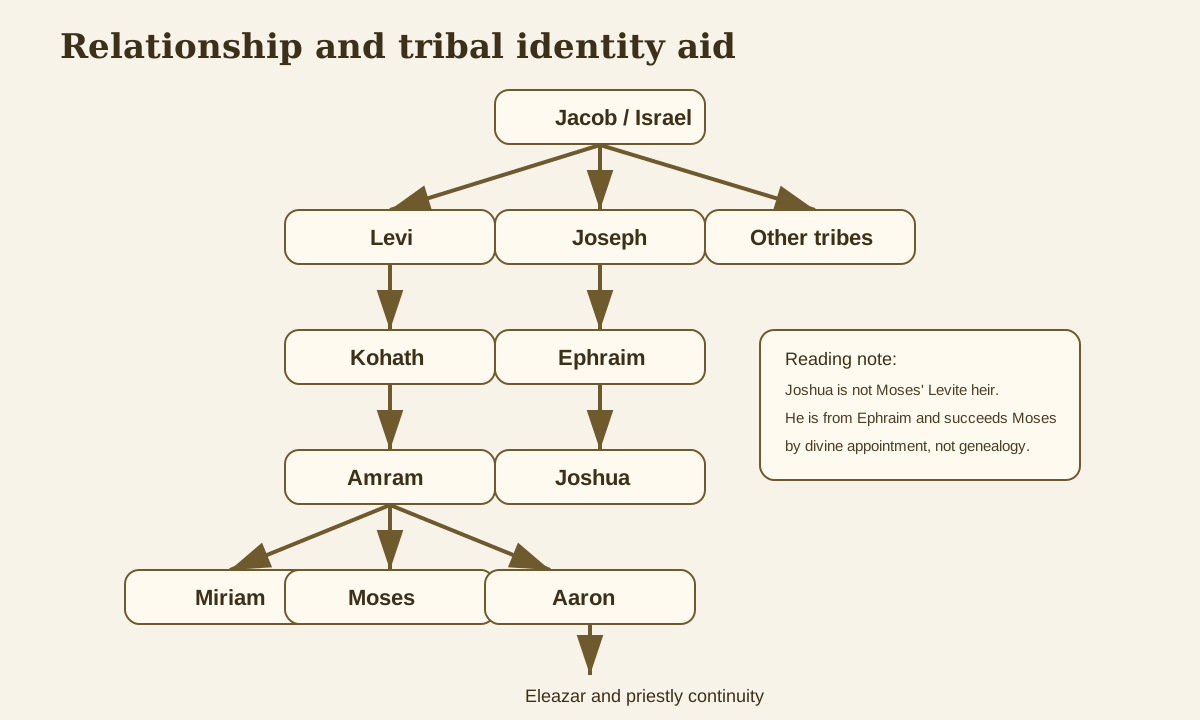 Source: Original project chart, 2026-06-19. Use as a relationship aid, not as an exhaustive genealogy tree. Arrows show descent and tribal affiliation; intervening generations are not all displayed.
The Lord comes, and His people receive the law (Deuteronomy 33:1–7)
Scripture: Brenton Septuagint
1 And this is the blessing with which Moses the man of God blessed the children of Israel before his death. 2 And he said, The Lord is come from Sina, and has appeared from Seir to us, and has hasted out of the mount of Pharan, with the ten thousands of Cades; on his right hand were his angels with him. 3 And he spared his people, and all his sanctified ones are under thy hands; and they are under thee; and he received of his words 4 the law which Moses charged us, an inheritance to the assemblies of Jacob. 5 And he shall be prince with the beloved one, when the princes of the people are gathered together with the tribes of Israel. 6 Let Ruben live, and not die; and let him be many in number. 7 And this is the blessing of Juda; Hear, Lord, the voice of Juda, and do thou visit his people: his hands shall contend for him, and thou shalt be a help from his enemies.
Moses is called the man of God before he blesses. The authority of his words comes from the Lord whose appearing opens the prayer. The people are under God’s hands, and the law is their inheritance. Gift and command remain joined even in benediction.
Language insight: “his angels with him”
Brenton’s verse 2 pictures angels at the Lord’s right hand. The corresponding Hebrew expression is difficult; NKJV renders it ‘a fiery law’. The Greek’s explicit angelic company belongs beside the apostolic teaching that the Law was received through angels in Acts 7:53, Galatians 3:19, and Hebrews 2:2. These are meaningful parallels in the account of Sinai, not proof that each author is quoting this particular clause.1
Reuben’s blessing begins with life, while Judah’s asks the Lord to hear and help. Military strength is placed under prayer. The tribes cannot turn their vocation into confidence independent of God. A person who asks for blessing should also be willing to receive the word under the same protecting hands.
Levi: truth, teaching, and incense (Deuteronomy 33:8–11)
Scripture: Brenton Septuagint
8 And to Levi he said, Give to Levi his manifestations, and his truth to the holy man, whom they tempted in the temptation; they reviled him at the water of strife. 9 Who says to his father and mother, I have not seen thee; and he knew not his brethren, and he refused to know his sons: he kept thine oracles, and observed thy covenant. 10 They shall declare thine ordinances to Jacob, and thy law to Israel: they shall place incense in the time of thy wrath continually upon thine altar. 11 Bless, Lord, his strength, and accept the works of his hands; break the loins of his enemies that have risen up against him, and let not them that hate him rise up.
Levi’s blessing remembers testing at the waters of strife and the costly priority of covenant loyalty. Verse 9’s severe family language places God’s claim above favoritism. It does not license abandonment of dependents or contempt for kin. Ministry must serve truth even when a relative wants an exception.
Language insight: “manifestations”, “truth”, and “the temptation”
The Greek renders the priestly terms Thummim and Urim with dēlous and alētheian, words for manifestations and truth. Brenton’s order follows that wording. The expressions describe the priestly means of discernment associated with the breastplate; they do not promise a private method of divination to the reader. The place Massah is rendered as ‘the temptation’, as in Deuteronomy 6:16, the verse used in Christ’s answer to the tempter in Matthew 4:7.2
Teaching and incense are joined in verse 10. The ministry must speak God’s ordinances and stand before Him in worship. The Coptic Church’s Raising of Incense at Vespers and Matins provides a living Christian resonance: truthful teaching and reverent prayer belong to the same service of the Lord. This is a worship connection, not a claim that the chapter is appointed in those services.
Gems from the Fathers: a heavenly trust borne on earth
St. John Chrysostom, in On the Priesthood, III.4, places Christian ministry under a holy responsibility: ‘the priestly office is indeed discharged on earth, but it ranks among heavenly ordinances’. He immediately attributes the calling to the Holy Spirit, the Paraclete, and speaks of purity and Eucharistic awe.3 His point is a thematic Christian lens on Levi’s teaching and worship, not a claim that the two priesthoods are simply interchangeable.
St. Gregory Nazianzen, Oration 2, section 61, turns to the covenant with Levi in Malachi and calls the ministry ‘how honourable and at the same time how fearful’. His warning concerns truth in the priest’s mouth and worship corrupted by unworthy offerings.4 The honor belongs to the Lord served. Reverence should make a servant more careful with the vulnerable, not more certain of personal importance.
Benjamin sheltered, Joseph made fruitful (Deuteronomy 33:12–17)
Scripture: Brenton Septuagint
12 And to Benjamin he said, The beloved of the Lord shall dwell in confidence, and God overshadows him always, and he rested between his shoulders. 13 And to Joseph he said, His land is of the blessing of the Lord, of the seasons of sky and dew, and of the deeps of wells below, 14 and of the fruits of the changes of the sun in season, and of the produce of the months, 15 from the top of the ancient mountains, and from the top of the everlasting hills, 16 and of the fulness of the land in season: and let the things pleasing to him that dwelt in the bush come on the head of Joseph, and on the crown of him who was glorified above his brethren. 17 His beauty is as the firstling of his bull, his horns are the horns of a unicorn; with them he shall thrust the nations at once, even from the end of the earth: these are the ten thousands of Ephraim, and these are the thousands of Manasse.
Benjamin’s confidence is placed beneath God’s overshadowing. The Lord’s protection is the heart of the blessing, not a declaration that Benjamin will never know trouble. Luke 1:35 and Matthew 17:5 also use divine overshadowing language in the Annunciation and Transfiguration. Those are Christian resonances of God’s presence, not grounds for turning every detail of Benjamin’s saying into a direct prediction.
Joseph’s blessing opens out through dew, wells, seasons, fruit, mountains, and the fullness of the land. The abundance has a remembered source: the favor of Him who dwelt in the bush. The God who called Moses is the One who gives growth. Exodus 3:1–6 keeps that reference anchored in the revealed encounter.
The Church’s Voice in Worship
The Thursday Theotokia, First Part, receives the bush as a figure of the Virgin Mary bearing the incarnate Word. Its first stanza remembers the unconsumed branches; the second sings: ‘This is a symbol of Mary, the undefiled Virgin, which the Word of the Father, came and took flesh from her.’5 This is the Church’s interpretation of the Exodus bush recalled in Joseph’s blessing, not a claim that Deuteronomy 33 is appointed with the hymn. The Word truly becomes man from the Virgin while remaining God. The giver of Joseph’s fruitfulness is the Lord whose coming sanctifies His creation.
Joseph’s sons Ephraim and Manasseh are named within the strength of his blessing. The gifts are distinct and their use carries responsibility. We can rejoice in another person’s fruitfulness without needing to make it evidence of our own inadequacy.
Different callings within one people (Deuteronomy 33:18–23)
Scripture: Brenton Septuagint
18 And to Zabulon he said, Rejoice, Zabulon, in thy going out, and Issachar in his tents. 19 They shall utterly destroy the nations, and ye shall call men there, and there offer the sacrifice of righteousness; for the wealth of the sea shall suckle thee, and so shall the marts of them that dwell by the sea-coast. 20 And to Gad he said, Blessed be he that enlarges Gad: as a lion he rested, having broken the arm and the ruler. 21 And he saw his first-fruits, that there the land of the princes gathered with the chiefs of the people was divided; the Lord wrought righteousness, and his judgment with Israel. 22 And to Dan he said, Dan is a lion’s whelp, and shall leap out of Basan. 23 And to Nephthali he said, Nephthali has the fulness of good things; and let him be filled with blessing from the Lord: he shall inherit the west and the south.
Zebulun’s going out and Issachar’s tents are both included in rejoicing. Coastal wealth, Gad’s strength, Dan’s leap, and Naphtali’s fullness each have their place. The poem allows variety without forcing every tribe into the same description.
The language includes conflict and the overthrow of enemies. Its ancient setting is Israel’s inheritance, not a mandate for Christians to attack those outside the Church. A Christian reception must hold the gifts under the crucified Lord, whose call to faithful service cannot be converted into sanctified aggression.
Different gifts can provoke comparison in a parish or household. Someone speaks publicly, another keeps a difficult work going unseen, and another gives practical help. The blessing trains us to give thanks without insisting that everyone’s vocation be our own. Diversity becomes communion when gifts are received as service rather than rank.
Strength for the days, help from heaven (Deuteronomy 33:24–29)
Scripture: Brenton Septuagint
24 And to Aser he said, Aser is blessed with children; and he shall be acceptable to his brethren: he shall dip his foot in oil. 25 His sandal shall be iron and brass; as thy days, so shall be thy strength. 26 There is not any such as the God of the beloved; he who rides upon the heaven is thy helper, and the magnificent One of the firmament. 27 And the rule of God shall protect thee, and that under the strength of the everlasting arms; and he shall cast forth the enemy from before thy face, saying, Perish. 28 And Israel shall dwell in confidence alone on the land of Jacob, with corn and wine; and the sky shall be misty with dew upon thee. 29 Blessed art thou, O Israel; who is like to thee, O people saved by the Lord? thy helper shall hold his shield over thee, and his sword is thy boast; and thine enemies shall speak falsely to thee, and thou shalt tread upon their neck.
Asher’s blessing joins children, acceptance among brethren, oil, and strength. ‘As thy days, so shall be thy strength’ stands within this tribal prayer for God’s provision. It may console us in daily trust, but it is not a private guarantee that every burden will feel manageable or that someone who is exhausted has failed in faith.
The final praise returns to the incomparable God. He rides upon heaven as Helper, and His rule shelters the people under everlasting arms. The arms give the inheritance its security: Israel lives beneath a strength it did not create. Seeking assistance from others can be one way a weak person receives that care.
Verse 29 calls Israel a people saved by the Lord. Acts 2:47 likewise speaks of those being saved as the Lord adds to the Church. This is a Christian resonance of dependence upon God’s saving action, not an identity of every historical circumstance. The people may rejoice because their boast is in His help.
The closing image of enemies beneath their feet belongs to the poem’s ancient triumph language. In Christ we receive courage to resist sin and serve faithfully, while enemy-love refuses delight in another person’s humiliation. The blessing’s deepest comfort is the Lord Himself, not the possibility of standing above our neighbors.
Glossary
- Man of God: a title of prophetic service under divine authority.
- Overshadow: cover with the protection and presence of God.
- Urim and Thummim: terms associated with priestly discernment; Brenton follows the Greek’s rendering as manifestations and truth.
- Paraclete: the Holy Spirit, the Helper named by Christ.
- Theotokia: a hymn honoring the Mother of God and confessing the Incarnation.
Spiritual Fruit
Bless without comparing. Name a gift in someone whose calling differs from yours, and thank God for it. Tell the person plainly why their service matters. Refuse the small envy that would make a shared blessing feel like your own loss.
Join teaching to prayer. Before advising or teaching, pray for the person who must receive your words. Correct an exaggeration or a harsh claim you have defended in the name of authority. Truthfulness and reverence must inhabit the same mouth.
Receive help under the everlasting arms. Bring today’s burden to God without trying to solve every future day. Ask for a practical form of assistance if you need it. Weakness does not put you outside His keeping.
Moses’ blessing rests upon many tribes, yet ends in one Helper. You do not have to possess another person’s gift to belong beneath His hands. Receive the duty and help given for this day. Let your thanksgiving become a blessing upon the person beside you.
Teaching Notes
Teacher guidance
Use the map and chart on this page with their stated limits. Do not invent a reason for Simeon’s absence. Explain Levi’s terms without offering them as a private oracle. The priesthood citations are Christian thematic witnesses; use their awe to cultivate humble service, not clerical superiority.
The Lord comes, and His people receive the law (Deuteronomy 33:1–7)
- Ask: What does receiving the law as an inheritance change about our idea of blessing?
- Watch for: Pretending the Hebrew clause is simple, or calling every apostolic reference a direct quotation of verse 2.
Levi: truth, teaching, and incense (Deuteronomy 33:8–11)
- Ask: Where must truthfulness and worship meet in a servant’s daily conduct?
- Watch for: Using covenant loyalty to neglect family duties, treating ministry as status, or presenting a worship resonance as a lectionary assignment.
Benjamin sheltered, Joseph made fruitful (Deuteronomy 33:12–17)
- Ask: How does the memory of the bush change the way Joseph’s abundance is received?
- Watch for: Making overshadowing a guarantee against suffering, or attaching an uncited liturgical quotation or direct prophecy to the blessing.
Different callings within one people (Deuteronomy 33:18–23)
- Ask: Which different gift in another person is hardest for me to receive with thanksgiving?
- Watch for: Turning tribal warfare into a modern religious mandate, or measuring every vocation by public visibility.
Strength for the days, help from heaven (Deuteronomy 33:24–29)
- Ask: What does reliance on everlasting arms permit a weary person to receive today?
- Watch for: Using daily strength to shame exhaustion, or hearing salvation as permission to humiliate enemies.
Sources
Embedded Scripture is from Brenton’s English Septuagint (LXX). New Testament comparisons follow NKJV.
St. John Chrysostom, On the Priesthood, III.4, direct text.
St. Gregory Nazianzen, Oration 2, section 61, direct text.
No appointed Coptic lectionary reading from this chapter is known in the references consulted.
Footnotes
-
Deuteronomy 33:2, Swete’s Greek text; Acts 7:53, Galatians 3:19, and Hebrews 2:2. ↩
-
Deuteronomy 33:8, Swete’s Greek text, with Deuteronomy 6:16. ↩
-
St. John Chrysostom, On the Priesthood, III.4, direct text. ↩
-
St. Gregory Nazianzen, Oration 2, section 61, direct text. ↩
-
Thursday Theotokia (Watos), First Part, opening two stanzas, direct hymn text. The stanza is quoted with line breaks collapsed; the printed refrain marker is omitted. ↩