


This narration is from a previous version of the study and may include a combined recording of multiple chapters.
Moses must prepare the people for a future in which they will no longer hear his own voice. He strengthens Joshua, entrusts the law to its guardians, and makes provision for children who have not yet learned it. His departure is real; God’s presence remains. The chapter asks what a faithful servant leaves behind when personal influence can no longer carry the work.
Orientation
Israel remains east of the Jordan in Moab. Joshua will lead the crossing, while priests, elders, families, and strangers share responsibility for hearing and handing on the covenant. The Lord commissions Joshua at the tabernacle of testimony, the sacred tent of meeting. The inherited illustration below is Western biblical art, not an Orthodox icon, and is retained as a picture of public succession.
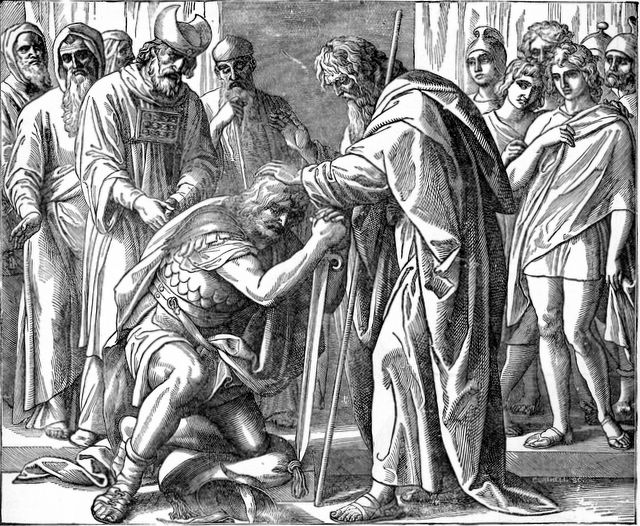 Source: Wikimedia Commons, Moses Appoints Joshua, public domain. Western biblical illustration, not Orthodox iconography.
The Lord goes before the departing servant (Deuteronomy 31:1–8)
Scripture: Brenton Septuagint
1 And Moses finished speaking all these words to all the children of Israel; 2 and said to them, I am this day a hundred and twenty years old; I shall not be able any longer to come in or go out; and the Lord said to me, Thou shalt not go over this Jordan. 3 The Lord thy God who goes before thee, he shall destroy these nations before thee, and thou shalt inherit them: and it shall be Joshua that goes before thy face, as the Lord has spoken. 4 And the Lord thy God shall do to them as he did to Seon and Og the two kings of the Amorites, who were beyond Jordan, and to their land, as he destroyed them. 5 And the Lord has delivered them to you; and ye shall do to them, as I charged you. 6 Be courageous and strong, fear not, neither be cowardly, neither be afraid before them; for it is the Lord your God that advances with you in the midst of you, neither will he by any means forsake thee, nor desert thee. 7 And Moses called Joshua, and said to him before all Israel, Be courageous and strong; for thou shalt go in before this people into the land which the Lord sware to your fathers to give to them, and thou shalt give it to them for an inheritance. 8 And the Lord that goes with thee shall not forsake thee nor abandon thee; fear not, neither be afraid.
Moses names both his age and the Lord’s command that he will not cross the Jordan. He then turns the people’s attention to the One who will go before them. Joshua is appointed within that promise. The succession is neither a denial of loss nor a transfer of confidence from one indispensable personality to another.
The repeated call to courage receives its reason in verses 6 and 8: the Lord will not forsake or abandon His people. Hebrews 13:5 applies the promise of non-abandonment to a life freed from covetousness, so Christian confidence is not a promise of invulnerability or conquest. It is trust in the God who remains with His people when familiar securities are removed.
Gems from the Fathers: Joshua’s name and Christ’s inheritance
In Dialogue with Trypho, chapter 113, St. Justin Martyr reads Joshua’s name and succession as a figure of Jesus Christ. The Greek name Iēsous is the name used for both Joshua and Jesus. Justin says Joshua ‘led the surviving people into the Holy Land’, then distinguishes the temporary inheritance he gave from Christ’s gift after the Resurrection: ‘the eternal possession’.1
This is a typological reading of Joshua’s mission, not a claim that Joshua is divine or that Moses failed as a lawgiver. Hebrews 4:8–11 likewise looks beyond the earlier entry into the land to the rest that remains. Christ fulfills the hope toward which faithful servants lead. A ministry can therefore be handed on without despair: its deepest continuity is in Him.
The law read in the year of release (Deuteronomy 31:9–13)
Scripture: Brenton Septuagint
9 And Moses wrote the words of this law in a book, and gave it to the priests the sons of Levi who bear the ark of the covenant of the Lord, and to the elders of the sons of Israel. 10 And Moses charged them in that day, saying, After seven years, in the time of the year of release, in the feast of tabernacles, 11 when all Israel come together to appear before the Lord your God, in the place which the Lord shall choose, ye shall read this law before all Israel in their ears, 12 having assembled the people, the men, and the women, and the children, and the stranger that is in your cities, that they may hear, and that they may learn to fear the Lord your God; and they shall hearken to do all the words of this law. 13 And their sons who have not known shall hear, and shall learn to fear the Lord thy God all the days that they live upon the land, into which ye go over Jordan to inherit it.
The written law is given to the priests who bear the ark and to the elders. It must be read before all Israel in the place the Lord chooses. Writing guards the word from dependence upon a single speaker’s memory, and public hearing prevents its guardians from treating it as their private expertise.
Men, women, children, and strangers are named. Hearing is ordered toward learning reverence and doing what is heard. The children who have not known must be helped to know. An assembly becomes spiritually impoverished when it assumes that everyone understands the words because everyone has heard the sounds before.
Language insight: “release” and the public word
The Greek form apheseōs in verse 10 belongs to aphesis, ‘release’. It joins this reading to the seventh-year release in Deuteronomy 15. Luke 4:18 uses aphesis for the liberty Christ proclaims in Nazareth from Isaiah. Here the law is heard in a year of release; there the Lord reads Scripture and announces its fulfillment in Himself. The common word gives a real connection, while the passages have distinct historical settings.2
Nehemiah 8:1–18 later joins the public reading and explanation of the law to the Feast of Tabernacles. Understanding, repentance, joy, and shared provision belong together there. A family or parish can receive the same discipline: read a manageable passage, explain what is unfamiliar, and let the youngest or newest hearer ask a question without embarrassment.
The cloud, the commission, and the warning (Deuteronomy 31:14–18)
Scripture: Brenton Septuagint
14 And the Lord said to Moses, Behold, the days of thy death are at hand; call Joshua, and stand ye by the doors of the tabernacle of testimony, and I will give him a charge. And Moses and Joshua went to the tabernacle of testimony, and stood by the doors of the tabernacle of testimony. 15 And the Lord descended in a cloud, and stood by the doors of the tabernacle of testimony; and the pillar of the cloud stood by the doors of the tabernacle of testimony. 16 And the Lord said to Moses, Behold, thou shalt sleep with thy fathers, and this people will arise and go a whoring after the strange gods of the land, into which they are entering: and they will forsake me, and break my covenant, which I made with them. 17 And I will be very angry with them in that day, and I will leave them and turn my face away from them, and they shall be devoured; and many evils and afflictions shall come upon them; and they shall say in that day, Because the Lord my God is not with me, these evils have come upon me. 18 And I will surely turn away my face from them in that day, because of all their evil doings which they have done, because they turned aside after strange gods.
Moses and Joshua stand at the tent’s doors, and the Lord descends in the cloud. The commission takes place in God’s presence before Moses is lost to the people. Joshua receives a task under the Lord’s authority, not merely under a retiring leader’s approval.
The warning follows immediately. The people will break covenant and go after strange gods. Brenton’s old phrase ‘go a whoring’ names covenant infidelity through a marital image. It condemns betrayal; it must never become contempt for a person or an excuse to speak crudely about suffering.
God’s foreknowledge does not turn rebellion into obedience. The warning identifies what the people are doing and where that refusal leads. Religious inheritance, holy leaders, and remarkable experiences cannot replace the people’s own answer. When we grieve a change of leadership, the duty to pray, hear, and repent remains ours.
A song the children will remember (Deuteronomy 31:19–23)
Scripture: Brenton Septuagint
19 And now write the words of this song, and teach it to the children of Israel, and ye shall put it into their mouth, that this song may witness for me among the children of Israel to their face. 20 For I will bring them into the good land, which I sware to their fathers, to give to them a land flowing with milk and honey: and they shall eat and be filled and satisfy themselves; then will they turn aside after other gods, and serve them, and they will provoke me, and break my covenant. 21 And this song shall stand up to witness against them; for they shall not forget it out of their mouth, or out of the mouth of their seed; for I know their wickedness, what they are doing here this day, before I have brought them into the good land, which I sware to their fathers. 22 And Moses wrote this song in that day, and taught it to the children of Israel. 23 And he charged Joshua, and said, Be courageous and strong, for thou shalt bring the sons of Israel into the land, which the Lord sware to them, and he shall be with thee.
The Lord appoints a song as witness and tells Moses to put it into the people’s mouth. Its memory is to survive into their children’s mouths. God addresses a people who may forget the meaning of His gifts while continuing to enjoy their abundance.
The song will tell the truth when their later explanations evade it. Fullness can hide the path by which it came, making another allegiance attractive. A retained word can interrupt that evasion. Deuteronomy 32 will give the song’s actual content: divine care, betrayal, judgment, compassion, and widened praise.
Singing truth is therefore an entrusted memory, not decoration added after instruction. A prayer learned early can return in a difficult hour. Yet familiar words still require attention and interpretation. Choose what your household repeats with care, and help its members understand whom they are addressing and what they are confessing.
The book beside the ark (Deuteronomy 31:24–30)
Scripture: Brenton Septuagint
24 And when Moses finished writing all the words of this law in a book, even to the end, 25 then he charged the Levites who bear the ark of the covenant of the Lord, saying, 26 Take the book of this law, and ye shall put it in the side of the ark of the covenant of the Lord your God; and it shall be there among you for a testimony. 27 For I know thy provocation, and thy stiff neck; for yet during my life with you at this day, ye have been provoking in your conduct toward God: how shall ye not also be so after my death? 28 Gather together to me the heads of your tribes, and your elders, and your judges, and your officers, that I may speak in their ears all these words; and I call both heaven and earth to witness against them. 29 For I know that after my death ye will utterly transgress, and turn aside out of the way which I have commanded you; and evils shall come upon you in the latter days, because ye will do evil before the Lord, to provoke him to anger by the works of your hands. 30 And Moses spoke all the words of this song even to the end, in the ears of the whole assembly.
Moses finishes the book and commands the Levites to place it beside the ark as a testimony. The place of covenant presence is also a place where God’s word judges the people. Nearness to holy things cannot be made into a shelter from what God says.
The prophet knows their stiff neck even during his life. He does not conceal this painful truth in order to leave an impressive legacy. A faithful handover includes warning, not merely celebration. The heavens and earth are called to witness, and Moses speaks the song to the whole assembly.
Our own continuity requires such humility. A servant can leave organized materials, a trusted successor, and clear instruction, while accepting that the next generation’s response belongs to it before God. Honest service seeks people formed by the word rather than people dependent upon the servant. We can love a ministry enough to let someone else bear its responsibility.
Glossary
- Tabernacle of testimony: the sacred tent where the Lord met His people.
- Ark of the covenant: the holy chest associated with covenant presence and witness.
- Typology: earlier persons and events read as patterns fulfilled more fully in Christ.
- Release: the freeing associated with the seventh year; Greek aphesis.
Spiritual Fruit
Leave something another person can receive. If you serve, prepare a clear handover instead of preserving your importance through withheld knowledge. Give the successor the necessary materials and a truthful account of difficulties. Pray for that person without demanding imitation of your every choice.
Make hearing hospitable. Read one short passage with a child or newcomer and explain one unfamiliar word. Do not turn the encounter into a test. The assembly includes those who have not yet known.
Remember the Lord’s promise in a transition. When a familiar support changes, bring the fear to prayer before reacting with control or withdrawal. Hebrews 13:5 joins God’s abiding help to contentment. You can receive the next duty without possessing the entire future.
Moses speaks the song, and Joshua stands ready. The people will move beyond the prophet’s own footsteps, but not beyond the Lord’s presence. Entrust the work you cannot continue to Christ. Let what remains after you be a clearer word, a strengthened person, and room for God to lead.
Teaching Notes
Teacher guidance
Show the Western succession illustration with its existing label. Keep Joshua’s name, his historical task, and Justin’s typological reading distinct. Public reading must include those with little prior knowledge.
The Lord goes before the departing servant (Deuteronomy 31:1–8)
- Ask: What does the promise of God’s presence allow Moses to entrust to Joshua?
- Watch for: Personality worship, identifying Joshua himself as divine, or reading courage as permission for modern religious violence.
The law read in the year of release (Deuteronomy 31:9–13)
- Ask: What would make a familiar reading understandable to a child or newcomer?
- Watch for: Treating public reading as enough without understanding, or making the shared word prove an identical institution in every passage.
The cloud, the commission, and the warning (Deuteronomy 31:14–18)
- Ask: Why is the warning against infidelity placed beside Joshua’s commission?
- Watch for: Fatalism about foreknowledge, or assuming that a holy leader guarantees everyone else’s faithfulness.
A song the children will remember (Deuteronomy 31:19–23)
- Ask: What remembered prayer or Scripture has brought you back to truth when you were tempted to forget?
- Watch for: Treating song as an automatic safeguard regardless of understanding or conduct.
The book beside the ark (Deuteronomy 31:24–30)
- Ask: What would a truthful and generous handover require in a responsibility I hold?
- Watch for: Controlling successors in the name of preserving a legacy, or supposing that possession of Scripture makes obedience unnecessary.
Sources
Embedded Scripture is from Brenton’s English Septuagint (LXX). New Testament comparisons follow NKJV.
St. Justin Martyr, Dialogue with Trypho, chapter 113, direct text.
No appointed Coptic lectionary reading from this chapter is known in the references consulted.
Footnotes
-
St. Justin Martyr, Dialogue with Trypho, chapter 113, direct text. ↩
-
Deuteronomy 31:10, Swete’s Greek text, with Deuteronomy 15:1–2 and Luke 4:18. ↩